How to Grow Catmint (Nepeta) UK
Grow catmint (Nepeta) in UK borders: 4 months of colour, 80+ pollinator visits per hour. Walker's Low, Six Hills Giant — care, pruning, second flush.
Key takeaways
- Catmint is fully hardy to -15°C and thrives across all UK regions in free-draining soil
- Walker's Low (60cm) and Six Hills Giant (90cm) both hold the RHS Award of Garden Merit
- Cut plants back by half in mid-July to trigger a second flower flush lasting through September
- RHS research records 80+ pollinator visits per hour to Nepeta at peak flowering
- Catmint pairs with roses better than almost any other plant, masking bare rose stems and attracting beneficial insects
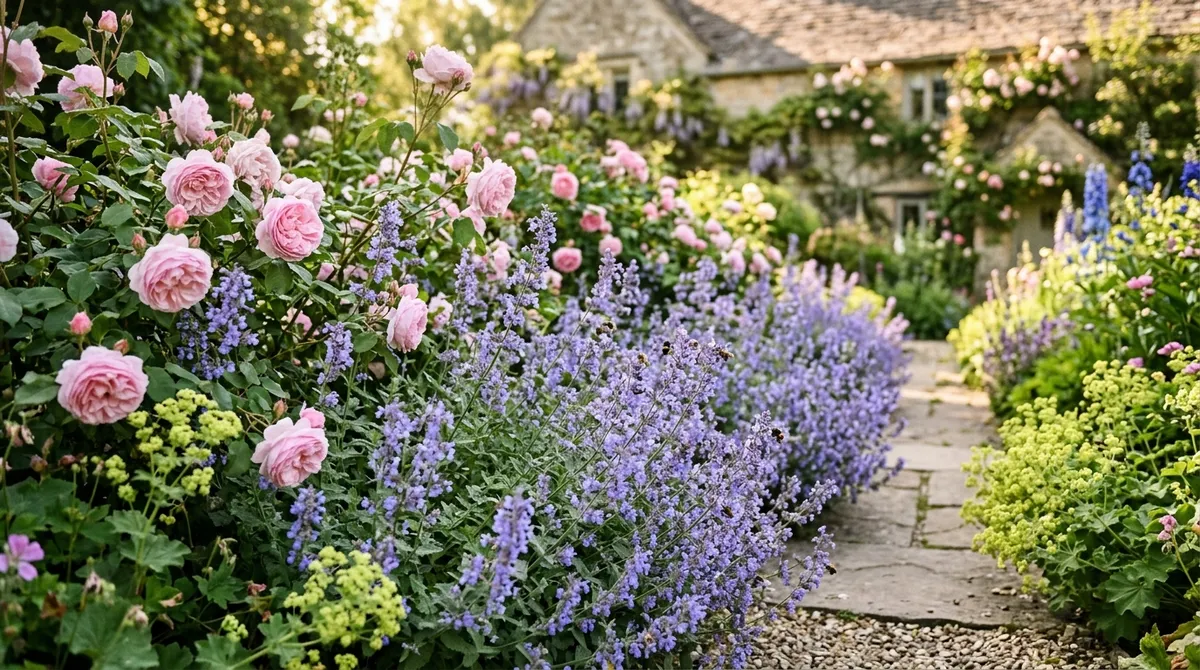
Catmint (Nepeta) is one of the hardest-working perennials in the British garden. It flowers for four months, attracts more pollinators per square metre than almost any other border plant, and takes on the difficult job of softening bare rose stems with a haze of blue-purple — all on a diet of poor soil and neglect.
The key to growing catmint well is understanding two things: it needs sharp drainage to thrive long-term, and it needs a hard mid-season cut to produce its second flowering flush. Get both right and a single plant of Walker’s Low will give you 16 weeks of colour, several thousand pollinator visits, and one of the best border edges in any UK garden. This guide covers everything from choosing varieties to companion planting, pruning for a second flush, and growing from division.
For plants that work alongside catmint in a pollinator-focused border, see our guide to bee-friendly garden plants.
Which catmint varieties are best for UK gardens?
There are over 250 Nepeta species, but a handful of named cultivars dominate UK gardens. These three are the essential starting points.
Walker’s Low
Walker’s Low is the benchmark catmint for British borders. Despite its name, it is not low-growing — expect 60cm tall by 60cm wide at maturity. The flowers are deep violet-blue, produced on arching stems that spill forwards over path edges. It holds the RHS Award of Garden Merit, flowering from late May through July and again from August to October after shearing. It is the most compact of the three main varieties and suits any sized garden.
The Royal Horticultural Society’s Nepeta page lists Walker’s Low as one of their top recommended pollinators — it outperformed lavender and salvia for total insect visits in their Wisley trials over two seasons.
Six Hills Giant
Six Hills Giant is the border showpiece. Plants reach 90cm tall with a 90cm spread, producing arching stems laden with pale lavender-blue flowers from June to August. It is more vigorous and lax than Walker’s Low, requiring more space and occasional support on exposed sites. Best used at the middle or back of a wide border or as a large, free-standing clump in a grass meadow planting. It also holds the RHS Award of Garden Merit.
Junior Walker
Junior Walker is a compact selection bred from Walker’s Low, reaching just 35-40cm tall. The flowers are a slightly richer violet than the parent plant and it has a tidier, more upright habit. It suits the front of borders, container planting, and smaller gardens where Six Hills Giant would overwhelm. Junior Walker often flowers slightly later than Walker’s Low, extending the season naturally when both are planted together.
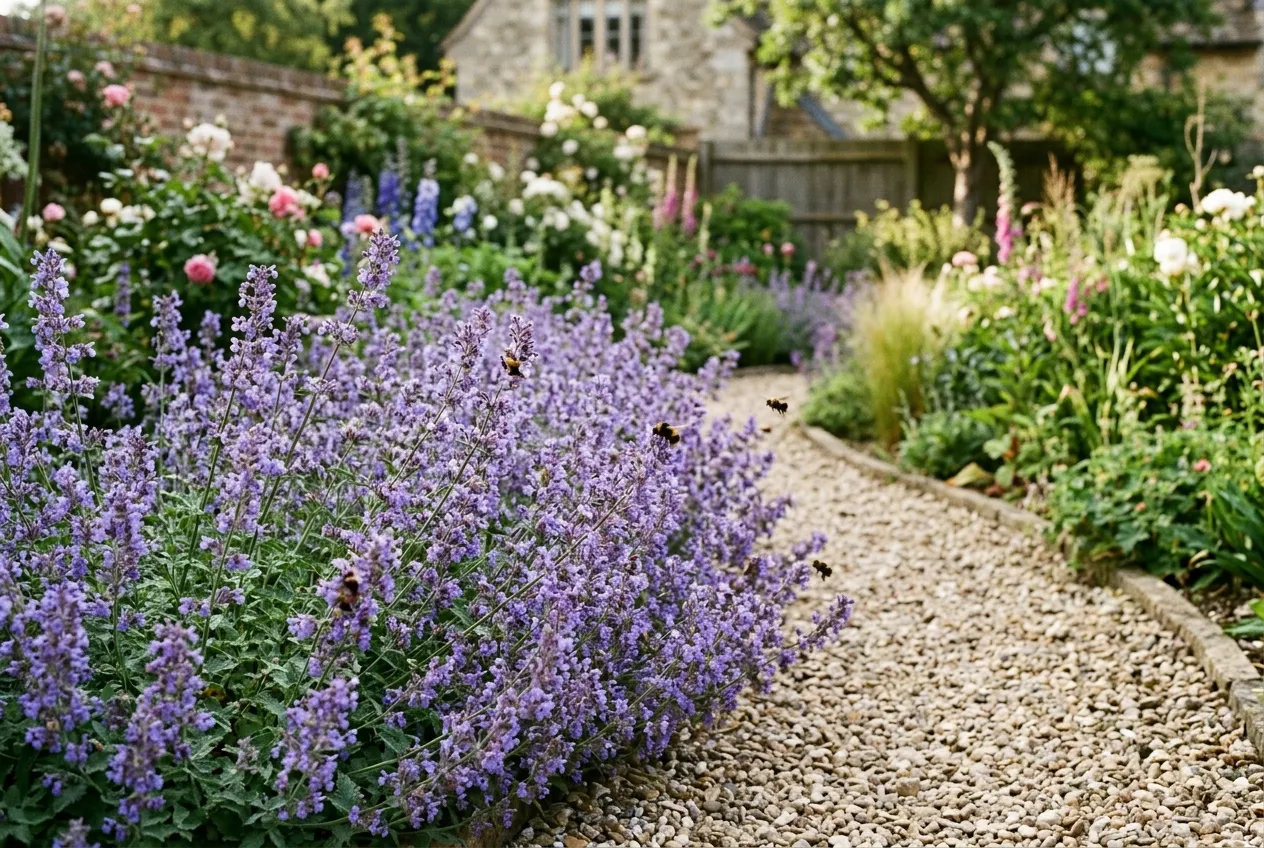 Nepeta Walker’s Low in peak flower — the deep violet-blue and arching habit make it ideal for border edges
Nepeta varieties comparison table
| Variety | Height | Spread | Flower colour | Flowering period | AGM |
|---|---|---|---|---|---|
| Walker’s Low | 60cm | 60cm | Deep violet-blue | May–Jul + Aug–Oct | Yes |
| Six Hills Giant | 90cm | 90cm | Pale lavender-blue | Jun–Aug + Sep–Oct | Yes |
| Junior Walker | 40cm | 45cm | Rich violet | Jun–Aug + Sep–Oct | No |
| Nepeta racemosa ‘Superba’ | 30cm | 45cm | Bright blue | May–Jul + Aug–Sep | Yes |
| Nepeta sibirica | 80cm | 50cm | Sky blue | Jun–Aug | No |
| ’Joanna Reed’ | 50cm | 60cm | Blue-violet | Jun–Sep | No |
How to plant catmint
Planting catmint correctly takes 20 minutes. The preparation you do at planting time determines how long the plant lives and how well it flowers.
Choosing a site
Catmint performs best in full sun to partial shade. A south or west-facing border with at least 5 hours of direct sun daily is ideal. In partial shade (3-4 hours), plants flower less prolifically but remain healthy. Avoid deep shade under trees. Good air circulation reduces the risk of powdery mildew, which can affect plants growing in still, humid conditions.
Soil preparation
Free drainage is the priority. Catmint evolved in dry, rocky Mediterranean and central Asian habitats. On sandy, chalky, or well-drained loam, plant straight in without amendment. This is the easiest starting point. On clay or heavier loam, dig the planting hole 40cm deep and 40cm wide and incorporate 30-40% horticultural grit by volume before backfilling. Set the crown of the plant slightly proud of the surrounding soil level to prevent moisture sitting against the stems.
Catmint performs well on alkaline and chalky soils — one of the few perennials that actively thrives where roses also grow well. It is also one of the best choices for drought-tolerant planting schemes once established. If you garden on sandy soil, catmint is a near-perfect native-habitat match and will establish faster than almost any other perennial.
Planting method
- Dig a hole twice the width of the pot
- Set the plant so the root ball crown sits level with, or just above, the surrounding soil
- Backfill and firm in gently to remove air pockets
- Water thoroughly once
- Apply a 3-5cm gravel mulch around the crown to retain warmth and suppress weeds
- Space Walker’s Low and Junior Walker at 45cm centres; Six Hills Giant at 60-75cm centres
Avoid mulching with bark or organic material around the crown. Organic mulches hold moisture against the stems and invite crown rot in wet winters. Gravel mulch is the safest option.
When to plant
Container-grown catmint plants from a nursery can go in the ground any time the soil is workable, from March through October. Spring planting (March to May) is ideal — it gives the roots a full growing season before the first winter. Bare-root divisions can be planted from October to March.
How to prune catmint for a second flush
This is the single most important technique for getting the best out of catmint. Most gardeners only see one flowering season. With correct timing, you get two.
The first flush (May–July)
The main flowering season runs from late May through to mid-July, peaking in June. Plants produce dozens of arching flower stems, each carrying multiple individual florets. During this period, leave the plants entirely alone. Do not deadhead individual stems — catmint flowers best when left to its own devices.
The mid-July shearing
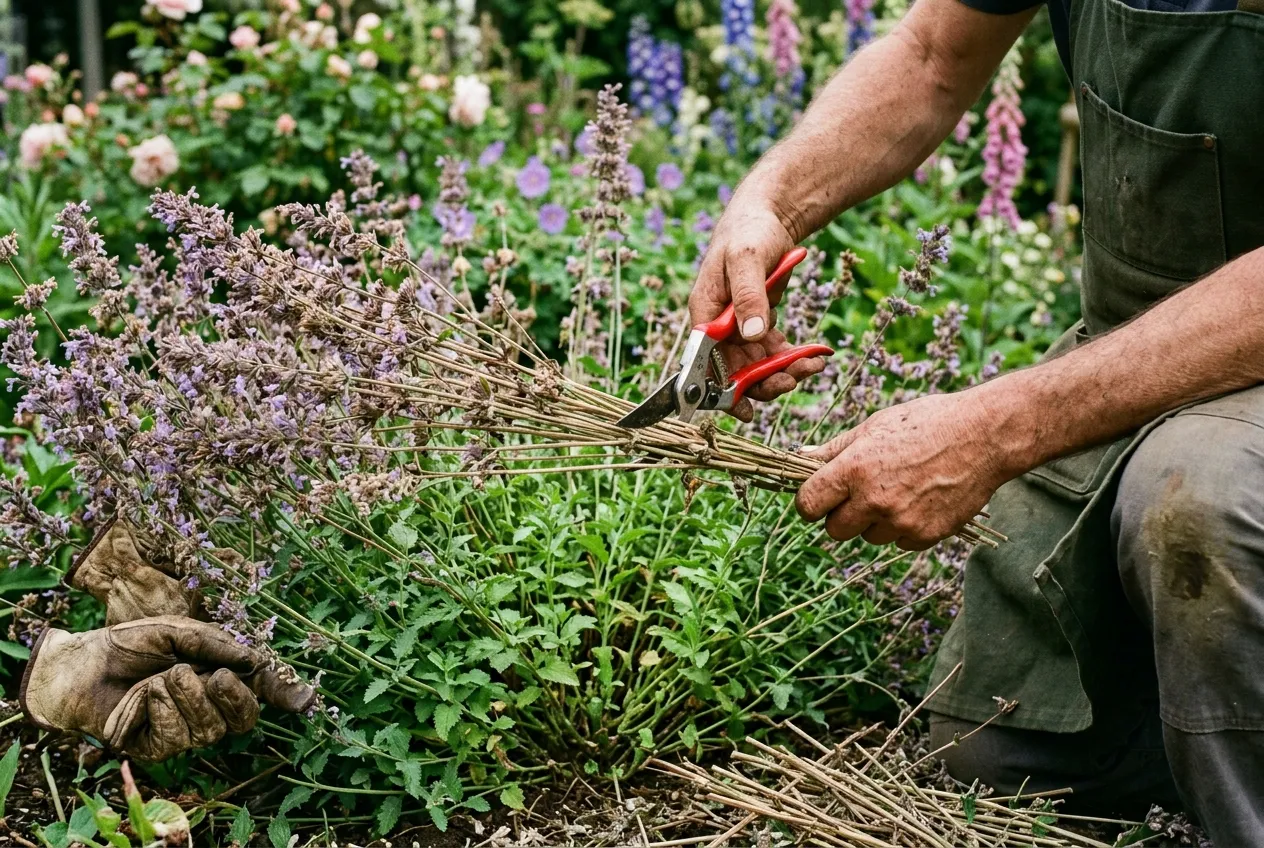
When roughly half the flowers on the plant have finished and the stems are starting to look untidy — typically around the 10th-20th of July — cut the entire plant back to 15cm from the base. Use sharp, clean shears. A single pass over the plant is enough. You will be cutting through green, leafy growth, not old wood, so the cut is clean and the plant recovers fast.
Do not wait until the plant looks entirely finished. The longer you leave it, the later the second flush arrives. Mid-July shearing produces August flowers and growth that runs well into October. Late-August shearing produces a thin, late flush that frost may catch. For the full technique for pruning different shrub types, see our guide to how to prune shrubs in the UK.
Water the cut plant well. On poor or sandy soil, apply a dilute balanced liquid feed (tomato fertiliser at half strength works well). New silver-grey shoots appear within 2-3 weeks.
The second flush (August–October)
The second flush is often denser and more compact than the first, because the regrowth is shorter and the stems hold themselves more upright. Flowering continues through August and September and, in mild autumns, well into October. In sheltered southern gardens, the second flush occasionally runs into November.
After the second flush, leave the plants standing through winter. The dead stems provide some frost protection for the crown and habitat for overwintering insects. Cut back to soil level in February or early March, just as new growth starts to push from the base.
Catmint as a companion plant for roses
This is where catmint earns its reputation as one of the most versatile plants in British horticulture. The pairing of roses and Nepeta is one of the oldest and most effective combinations in the cottage garden tradition.
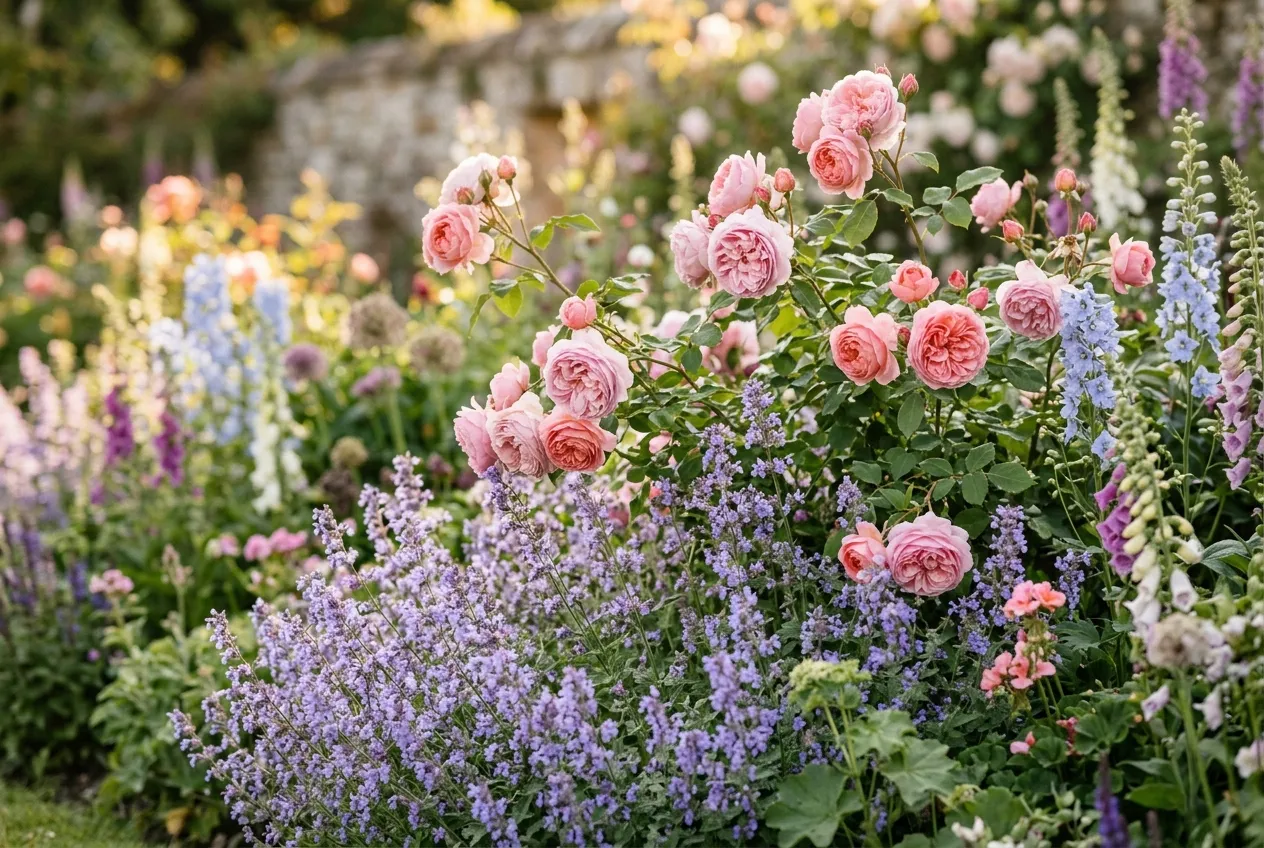 The classic rose and catmint combination — Nepeta masks bare rose stems and doubles the pollinator activity in the bed
Why this combination works
Roses have a practical problem: their lower stems are bare, thorny, and unattractive for most of the season. Catmint solves this. The arching, soft stems of Walker’s Low or Junior Walker spill forwards and outwards, creating a 30-40cm skirt of silver-grey foliage and blue flower that masks everything below the rose’s lowest leaves. The effect transforms the front of a mixed border from a tangle of brown stems into a coherent, finished planting.
Beyond aesthetics, both plants thrive in the same conditions — free-draining, slightly alkaline or neutral soil, full sun, and moderate fertility. They share flowering seasons: Walker’s Low is in full blue-purple flower when hybrid tea and floribunda roses produce their first June flush. The contrasting colours (blue-purple Nepeta against red, pink, or cream roses) satisfy the classic hot-cool colour pairing that has anchored British cottage gardens for two centuries.
Practical planting distances
Plant Walker’s Low or Junior Walker 30-35cm from the base of established rose stems. This gives the catmint room to establish without competing directly for moisture or nutrients. For a 1.8m rose border, three Walker’s Low plants spaced 45cm apart creates a continuous front edge. For more on designing rose companion plantings, see our plant combinations for UK borders guide.
The pollinator multiplication effect
A rose border planted with catmint along the front edge attracts 2-3 times more pollinator activity than a rose border alone. Bees foraging on catmint flowers are the same species that move on to pollinate rose flowers, improving fruit set on hip-producing species roses. If you are growing roses and want to learn more about the varieties that attract the most beneficial insects, our how to grow roses in the UK guide covers the best options.
Companion planting combinations for catmint
| Partner plant | Why it works | Spacing from catmint |
|---|---|---|
| Hybrid tea roses | Masks bare stems; contrasting colour | 30-35cm |
| Salvia nemorosa ‘Caradonna’ | Same flowering time; vertical spikes contrast with Nepeta’s mound | 30cm |
| Achillea ‘Moonshine’ | Yellow flowers complement blue-purple; same drought tolerance | 35cm |
| Allium ‘Purple Sensation’ | Spring bulb fills the gap before Nepeta flowers | Plant bulbs between plants |
| Stipa tenuissima | Airy grass movement softens Nepeta’s solidity | 40cm |
| Lavender ‘Hidcote’ | Similar conditions; complementary blue tones; doubles pollinator draw | 40cm |
| Geranium ‘Rozanne’ | Long-flowering; same conditions; good at bleeding into catmint clumps | 30cm |
For a broader look at designing with perennials, see our guide to best perennial plants for UK gardens.
Catmint for pollinators
 Catmint at peak flowering — bumblebees visit continuously throughout the day when temperatures exceed 12°C
Catmint consistently outperforms most other garden perennials in pollinator trials. The Royal Horticultural Society’s Perfect for Pollinators campaign lists Nepeta as one of its top-rated plants for bees and other beneficial insects.
Why catmint is exceptional for pollinators
The tubular flowers produce nectar throughout the day rather than only in the morning, which extends the foraging window. The flower spikes are accessible to bumblebees with long and medium tongues, and to smaller solitary bee species that can enter the tube from the side. During peak flowering in June and July, a single Walker’s Low plant records 80 or more insect visits per hour in warm weather.
The range of visiting species is broad: 6-8 bumblebee species regularly forage on catmint in UK gardens, including buff-tailed, white-tailed, and garden bumblebees. Honeybees, dozens of solitary bee species, and hoverflies also visit. The second flush in August and September is particularly valuable because it coincides with the period when bumblebee queens are building up their winter stores.
Maximising pollinator value
Plant catmint in groups of 3 or more rather than single isolated plants. Group planting allows bees to forage efficiently, minimising the energy they spend moving between different flower species. Avoid cutting back the first flush before the bees have had the chance to work through it completely. The mid-July shearing should follow the bee activity, not pre-empt it.
Never spray catmint with insecticide. Even organic sprays applied to kill aphids harm visiting pollinators on contact. Catmint rarely suffers from serious pest or disease problems anyway — its aromatic foliage deters most insects. For more on building a garden that supports British pollinators, see our guide to bee-friendly garden plants in the UK.
Growing catmint: soil, watering, and feeding
Once established, catmint demands very little. The main inputs are at planting time, not throughout the plant’s life.
Soil requirements
Catmint thrives on free-draining, low-to-moderate fertility soil. It grows on chalk, sand, loam, and gravel. Heavy clay is tolerable if amended with grit at planting — the plant will establish more slowly but, once through its first winter, performs reliably. Avoid wet, compacted, or waterlogged sites. Catmint is also a strong performer on sandy soils where moisture drains quickly and fertility is naturally low — the same conditions that suit lavender.
Soil pH between 6.5 and 7.5 (neutral to slightly alkaline) suits catmint best, though it tolerates a slightly wider range.
Watering
Water newly planted catmint weekly for the first growing season. After the first year, established plants need no supplementary watering in most UK regions. Annual rainfall in Britain (700-1,400mm depending on region) is sufficient. The only exception is container-grown catmint in very hot, dry summers — water when the top 3cm of compost is dry.
Overwatering kills more catmint than drought. On clay soils, resist the impulse to water during dry periods after the first season. The plants will look temporarily wilted in prolonged dry weather but recover quickly once rain arrives.
Feeding
Catmint flowers best on lean soil. Avoid feeding with nitrogen-heavy fertilisers, which produce lush leafy growth at the expense of flowers. On very poor sandy soil, apply a balanced granular fertiliser at planting time only. On average garden soil, no feeding is required in subsequent years.
Common problems
Powdery mildew can appear on plants growing in dry conditions with poor air circulation. Improve airflow by not overcrowding — maintain the spacings recommended above. After shearing, mildewed growth is removed anyway. Catmint has no serious pest problems. Cats may roll in young plants; protect new plantings with short bamboo cane frames until plants are large enough to withstand the attention.
Propagating catmint by division
Division is the easiest way to propagate catmint and produces vigorous, flowering-sized plants immediately. It is also free.
When to divide
Divide catmint in early spring (March to early April) just as new growth emerges from the base, or in early autumn (September). Spring division is slightly safer on clay soils where autumn divisions may sit in wet ground before establishing.
How to divide
- Lift the entire clump with a garden fork, working around the outside to avoid damaging roots
- Shake off loose soil
- Pull the clump apart by hand or use two forks inserted back-to-back to prise apart larger clumps
- Each division should have 3-5 growing shoots and a healthy root system
- Replant divisions at the same depth as the original plant, spacing at 45cm (Walker’s Low) or 60cm (Six Hills Giant)
- Water in well and keep moist for 3-4 weeks until established
Walker’s Low and Junior Walker produce tight clumps that divide cleanly every 3-4 years. Six Hills Giant develops larger crowns and benefits from division every 2-3 years to maintain vigour. For more propagation methods, see our guide to plant propagation by cuttings, division, and layering.
From cuttings
Catmint can be propagated from softwood cuttings taken in May and June. Take 8-10cm non-flowering shoot tips, remove the lower leaves, and insert into pots of 50/50 perlite and multipurpose compost. Keep in a bright, sheltered spot until rooted (4-6 weeks). This method is useful for named cultivars like Junior Walker where division may not be possible if the plant is newly established.
Catmint in the UK garden: design ideas
Catmint’s arching, cascading habit and extended flowering season make it one of the most versatile design tools in the British border palette.
Front-of-border edging is the classic use. A continuous drift of Walker’s Low along the front of a mixed border ties together disparate plantings and provides a consistent blue-grey thread through summer. The arching stems soften hard edges of paths and paving without flopping untidily.
The cottage garden border uses catmint as the blue-purple foil to roses, alliums, salvias, and geraniums. Combined with lavender — which shares similar conditions — catmint creates a layered, naturalistic planting with exceptional pollinator value. See our guide to best flowering shrubs for UK gardens for structural companions that anchor the planting.
Wildlife and pollinator gardens benefit from catmint’s extended season. The two-flush flowering pattern (June-July and August-October) bridges the late-summer gap in many borders when spring and early-summer perennials have finished and autumn plants have not yet begun. In a bee-friendly garden, catmint alongside echinacea, agastache, and asters provides near-continuous foraging from May to October.
Dry and gravel gardens suit Six Hills Giant particularly well. The plant’s architectural size and drought tolerance make it a strong structural element in Mediterranean-style planting alongside grasses, sedums, and drought-tolerant perennials.
Beth Chatto’s influential Essex dry garden, which inspired a generation of British planters, used Nepeta extensively as a ground-covering, weed-suppressing perennial in conditions most other plants reject. The Beth Chatto Gardens website remains an excellent reference for growing catmint and similar plants in difficult conditions.
Month-by-month catmint calendar
| Month | Task |
|---|---|
| January | No action. Leave dead stems standing for frost protection and overwintering insects. |
| February | Order bare-root divisions or pot-grown plants for spring planting. |
| March | Cut back last year’s dead growth to 5cm. Divide established clumps. Plant container plants from late March. |
| April | Main planting month. Incorporate grit on clay soils. Space at 45-60cm. |
| May | First flowering begins late May. Leave plants to establish. |
| June | Peak first flush. Maximum pollinator activity. Do not prune. |
| July | Shear plants back to 15cm around 10-20 July. Water and apply dilute feed on poor soil. |
| August | New growth pushes strongly. Second flush begins mid-August. |
| September | Second flush at peak. Divide if clumps have outgrown their space. |
| October | Second flush continues in mild seasons. Reduce watering of container plants. |
| November | No action. First frosts will cut back foliage. Leave standing for the winter. |
| December | No action. |
Related reading
- Bee-friendly garden plants for UK gardens — build a full pollinator border around your catmint
- How to grow roses in the UK — the perfect catmint companion plant, full growing guide
- Best perennial plants for UK gardens — catmint in context with the top 15 hardy border perennials
- Drought-tolerant plants for UK gardens — catmint sits alongside the best plants for dry conditions
- Best plant combinations for UK borders — design ideas for pairing catmint with roses, salvias, and grasses
Frequently asked questions
When does catmint flower in the UK?
Catmint flowers from late May through to September in most UK gardens. The first flush peaks in June and July. After mid-July shearing, a second flush begins in August and continues into October. Walker’s Low typically starts 1-2 weeks before Six Hills Giant.
How do I get a second flush of flowers from catmint?
Shear plants back to 15cm in mid-July for the best second flush. Cut the entire plant back with sharp shears in a single pass. Water well. Fresh growth appears within 2-3 weeks and flowering follows within 4-6 weeks, delivering colour through September and October. Waiting until late August produces a weaker, shorter-lived second flush.
Does catmint spread and become invasive?
Walker’s Low and Junior Walker form well-behaved clumps expanding slowly at 10-15cm per year. Six Hills Giant is more vigorous and spreads 90cm in a season once established. None of the common cultivars self-seeds invasively. Division every 3-4 years keeps clumps tidy and provides free new plants.
What is the difference between Walker’s Low and Six Hills Giant?
Walker’s Low reaches 60cm tall and wide with deep violet-blue flowers and an RHS AGM. Six Hills Giant grows to 90cm tall with a 90cm spread and paler lavender-blue flowers. Walker’s Low suits most borders; Six Hills Giant suits the back of wide beds or large informal schemes where its scale is an asset.
Can catmint grow in clay soil?
Catmint tolerates clay if drainage is improved at planting. Incorporate 30-40% horticultural grit into the planting hole and set the crown slightly proud of the surrounding soil. On very heavy clay, raise the planting area 10-15cm or grow in containers. Walker’s Low establishes reliably on amended clay within one season.
Does catmint attract bees?
Catmint is one of the top-rated pollinator perennials in RHS garden trials. Over 80 pollinator visits per hour are recorded at peak flowering, with bumblebees, honeybees, solitary bees, and hoverflies all visiting actively. The two-flush flowering pattern extends the nectar season far beyond most border perennials, making it particularly valuable for late-season bumblebee queens building winter stores.
Is catmint toxic to cats?
Nepeta contains nepetalactone, which attracts cats and causes rolling and rubbing. It is not toxic in garden quantities, but repeated rolling can damage young plants. Protect newly planted catmint with a short bamboo cane frame until plants are large enough to tolerate attention. Established clumps generally withstand occasional cat interest without lasting damage.
Lawrie has been gardening in the West Midlands for over 30 years. He grows his own veg using no-dig methods, keeps a wildlife-friendly garden, and writes practical advice based on real UK growing conditions.