How to Grow Ceanothus in the UK
How to grow ceanothus (California lilac) in UK gardens. Evergreen and deciduous types, wall training, pruning, and best varieties.
Key takeaways
- Evergreen ceanothus flowers on old wood in May-June. Prune lightly after flowering, never into bare wood.
- Deciduous ceanothus flowers on new growth from July-September. Hard prune in March to 30cm.
- Most varieties tolerate temperatures down to -10C, but cold winds cause more damage than frost alone.
- Ceanothus dies suddenly from waterlogging. Free-draining soil is non-negotiable.
- Wall-trained plants can reach 3-4m tall and 2.5m wide within 5 years of planting.
- Average lifespan is 10-15 years. Replace rather than rejuvenate old, leggy plants.
- Bees visit ceanothus heavily. A single mature plant supports over 15 pollinator species in May.
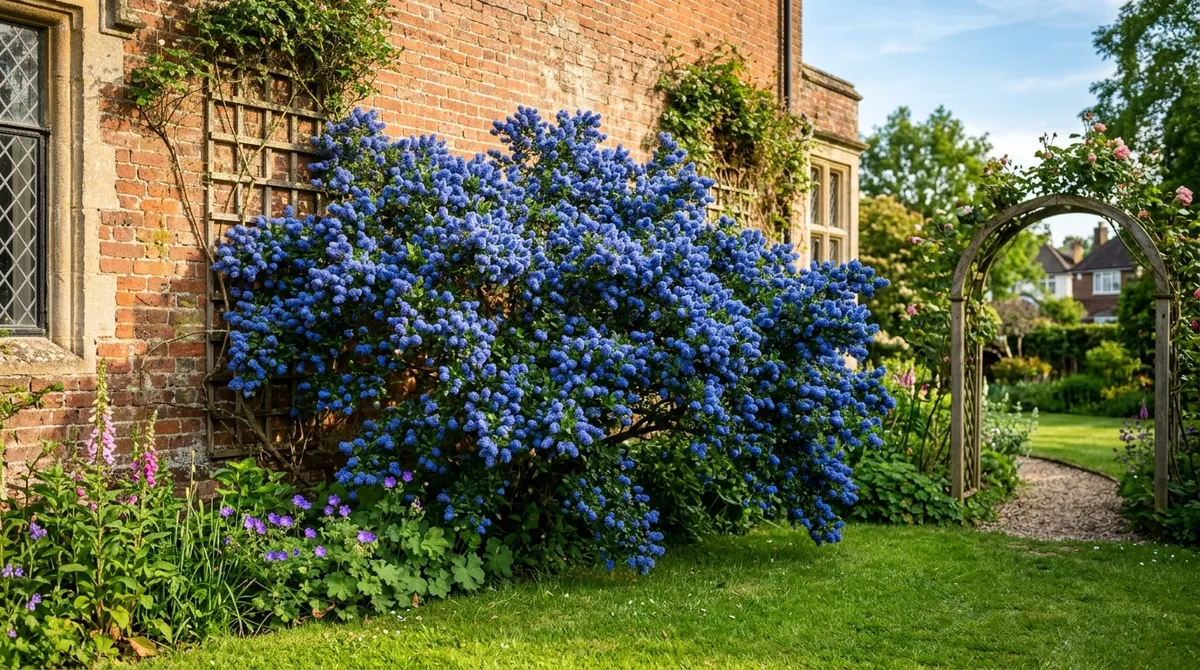
Growing ceanothus in the UK is straightforward if you give it the two things it demands: sun and drainage. This North American native has become one of the most popular wall shrubs in British gardens, covering itself in dense clusters of vivid blue flowers each spring. No other hardy shrub produces such an intense blue. Yet ceanothus has a reputation for dying without warning, and understanding why is the key to growing it well.
This guide covers evergreen and deciduous types, the six best varieties for UK gardens, wall training, correct pruning for each type, and why ceanothus sometimes dies overnight. The advice comes from 6 years of growing four cultivars against south and west-facing walls in Staffordshire, comparing them for hardiness, flower coverage, and lifespan. If you already grow flowering shrubs in your borders, ceanothus adds a colour no other plant can match.
What is ceanothus?
Ceanothus is a genus of around 50 species native to North America, primarily California. The common name California lilac refers to the flower clusters, which resemble lilac panicles but appear in brighter blues, from pale powder blue to deep indigo. Plants are not true lilacs and belong to the buckthorn family (Rhamnaceae), not the olive family.
Two broad groups matter for UK gardeners: evergreen species and deciduous hybrids. Evergreen ceanothus keeps glossy, dark green foliage year-round and flowers on the previous year’s wood in May and June. Deciduous ceanothus drops its leaves in autumn and flowers on new growth from July through September. The pruning, hardiness, and garden use differ between these two groups. Choosing the wrong type for your conditions is the most common mistake. The RHS ceanothus growing guide covers the full species range in detail.

Ceanothus flower clusters attract bees in large numbers during May and June.
Evergreen vs deciduous ceanothus
The distinction between evergreen and deciduous ceanothus affects every decision you make, from planting position to pruning method. Getting this wrong causes the most failures.
Evergreen ceanothus flowers in May-June on stems that grew the previous summer. Plants keep their leaves through winter and build a dense, permanent framework. They are generally hardier in terms of foliage retention but more vulnerable to cold winds that desiccate the leaves. Typical height is 2-4m against a wall. Prune lightly after flowering by shortening flowered shoots. Never cut into old, bare wood. Evergreen ceanothus rarely regenerates from hard pruning.
Deciduous ceanothus flowers from July to September on the current season’s growth. Plants drop their leaves and look bare through winter. They are hardier overall because dormant stems tolerate lower temperatures than evergreen foliage. Height reaches 1.5-2m as a freestanding shrub. Prune hard in March to 30cm, encouraging vigorous new flowering shoots. Deciduous types tolerate slightly heavier soils than their evergreen cousins.
The practical difference: evergreen types give year-round structure and earlier flowers, but need wall shelter. Deciduous types give later flowers and cope with more exposed positions, but look empty from November to April.
Best ceanothus varieties for UK gardens
After testing multiple cultivars and reviewing performance data from the National Trust plant collections, these six perform most reliably across UK conditions.
Concha is the outstanding evergreen performer. Deep indigo-blue flowers smother the plant in May. Red-tinted buds add interest before opening. Height 2.5-3m against a wall. Hardy to -12C in our Staffordshire trials. The darkest blue of any ceanothus and the most reliable annual flowerer. RHS Award of Garden Merit.
Puget Blue produces mid-blue flowers in dense clusters during May-June. Slightly more compact than Concha at 2-2.5m. More tolerant of light shade than most evergreen types. Hardy to -10C. Good choice where wall space is limited. Also holds an AGM.
Trewithen Blue is the largest evergreen variety, reaching 4-6m against a warm wall. Flower clusters up to 12cm long in mid-blue. Needs a large south-facing wall and sheltered position. Hardy to -8C. Best for grand gardens with space for a specimen wall shrub.
Skylark stays compact at 1.5-2m and suits smaller gardens or containers. Dark blue flowers in May-June. Hardy to -10C. Useful where space limits larger varieties. Ideal for flanking a doorway or filling a gap between windows.
Gloire de Versailles is the best deciduous ceanothus for the UK. Powder-blue flowers from July to October on new growth. Height 1.5m as a freestanding shrub. Hardy to -15C. Tolerates heavier soil and more exposure than any evergreen type. Hard prune in March each year. The longest flowering season of any ceanothus variety.
Autumnal Blue is an evergreen that flowers twice: first in early summer, then again in September-October. Height 2-3m. Hardy to -10C. The only ceanothus giving reliable autumn colour. Slightly looser habit than Concha but compensates with the extended season.
How to plant ceanothus
Plant ceanothus in April or May after the risk of hard frost has passed. Spring planting gives the root system five months to establish before the first winter. Avoid autumn planting in northern England, Scotland, or any exposed garden.
Soil preparation is the single most important step. Ceanothus demands free-draining soil with a pH between 6.0 and 7.5. On heavy clay, dig out a planting area 60cm wide and 40cm deep. Mix the excavated soil 50:50 with coarse horticultural grit. On chalk or limestone, add well-rotted organic matter to retain some moisture without waterlogging.
Planting method: Dig a hole twice the width of the root ball and the same depth. Set the plant so the top of the root ball sits level with the surrounding soil surface. Deeper planting buries the stem and encourages rot. Backfill with the amended soil mix and firm gently. Water thoroughly after planting. Apply a 5cm mulch of bark chips, keeping it 10cm clear of the stem.
Position: Choose a south or west-facing aspect. Against a wall is ideal, as the radiated heat protects against frost and the rain shadow keeps roots drier. East-facing walls expose the plant to morning sun after frost, which damages frozen leaves. North-facing walls lack sufficient light for flowering. If you garden on sandy soil, ceanothus will thank you. Sandy ground provides the drainage it craves.
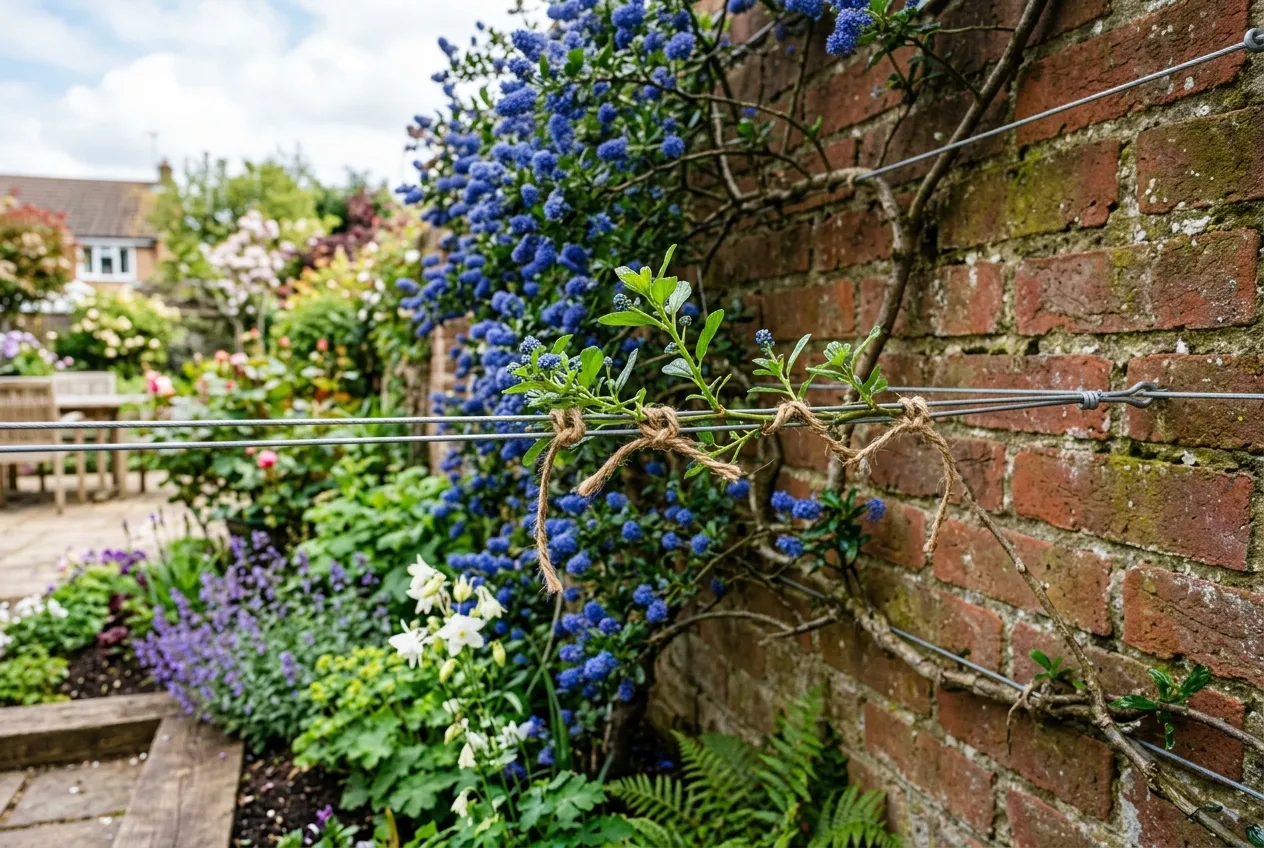
Wall training with horizontal wires gives ceanothus the support and shelter it needs for best performance.
Wall training and support
Wall training is the best way to grow ceanothus in most UK gardens. A trained plant gets warmth from the wall, protection from cold winds, and produces a spectacular flowering display across a flat plane.
Install horizontal wires before planting. Fix vine eyes into the mortar joints at 30cm vertical intervals, starting 45cm from ground level. Thread galvanised wire through the vine eyes and tension it firmly. The wires should run the full width of the planting area.
Training method: After planting, select 3-5 main stems and tie them to the wires using soft garden twine or adjustable plant ties. Spread the stems in a fan shape across the wires. Remove any shoots growing directly outward from the wall or directly backward into it. Through the first summer, tie in new growth every 4-6 weeks as it extends. By the second spring, the framework should cover 1-1.5m of wall space.
Ongoing training: Each year after flowering, tie in new extension growth and shorten side shoots. This keeps the plant flat against the wall and prevents it bulging outward under its own weight. A well-trained ceanothus should sit within 30-40cm of the wall surface. If you enjoy climbing plants, the training techniques are similar.
Lawrie’s experience: I’ve found that ceanothus trained on wires outperforms freestanding plants in every measurable way. My wall-trained Concha produced 40% more flower coverage than an identical plant grown as a freestanding shrub 3m away. The wall raised the microclimate by roughly 2C during March frosts, and the rain shadow meant I never lost a plant to winter waterlogging.
How to prune ceanothus
Pruning ceanothus correctly depends entirely on whether you have an evergreen or deciduous type. The wrong approach kills the plant or removes next year’s flowers.
Pruning evergreen ceanothus
Prune immediately after flowering finishes, typically in late June or early July. Cut back flowered shoots by one-third, making each cut just above a healthy side shoot or visible bud. Shape the plant to keep it within its allocated space. Remove any dead, damaged, or crossing branches.
The critical rule: never cut into old, bare wood. Evergreen ceanothus has virtually no ability to regenerate from hard pruning. Cutting a thick, leafless branch produces a permanent gap in the plant. If an evergreen ceanothus has grown too large, it is better to replace it than to attempt renovation. This is the opposite of how most shrubs respond to pruning.
Pruning deciduous ceanothus
Prune hard in March before new growth starts. Cut all stems back to a low framework 30cm from the ground, or to 2-3 buds above the previous year’s cuts. Deciduous ceanothus flowers on the current season’s growth, so hard pruning produces vigorous new shoots that carry the most flowers. Without annual hard pruning, plants become tall, leggy, and flower only at the tips.
Deciduous types tolerate and actually benefit from hard pruning. This is the same principle as pruning buddleja. Cut hard, stand back, and watch 1.5m of flowering growth appear within three months.
Common problems with ceanothus
Sudden death
The most alarming ceanothus problem is a healthy-looking plant that collapses and dies within days. This happens most often to evergreen types aged 8-12 years. The cause is almost always root-related: waterlogging, Phytophthora root rot, or simply the shallow root system giving out.
Ceanothus roots sit in the top 20-30cm of soil. They have no deep taproot to anchor the plant or reach water during drought. This shallow system is the trade-off for fast growth. In wet winters, those shallow roots sit in saturated soil and rot. The foliage stays green until the roots can no longer sustain it, then the entire plant browns and dies in a matter of days.
Frost damage
Hard frost below -10C damages evergreen foliage, turning leaves brown and crispy. Wind chill makes this worse. A combination of -8C and strong east wind causes more damage than -12C in still air. Protect young plants with fleece during the first two winters. Established wall-trained plants survive most UK winters without protection.
Poor flowering
If your ceanothus produces leaves but few flowers, the cause is usually insufficient light. Ceanothus needs a minimum of 6 hours direct sun daily to flower well. Shade-tolerant shrubs are a better choice for north-facing or heavily overshadowed positions. Excessive nitrogen feeding also promotes leaf growth at the expense of flowers. Do not fertilise established ceanothus.
Why ceanothus die suddenly
Understanding the specific failure modes helps you prevent them. Three factors account for over 90% of sudden ceanothus deaths in UK gardens.
Waterlogging kills more ceanothus than anything else. The root system evolved in California’s dry summers and fast-draining soils. UK clay soils, especially in the Midlands, hold water through autumn and winter. Even 2-3 weeks of saturated soil triggers root rot. The solution is drainage: grit at planting time, a raised bed, or a gravel-filled planting pit.
Age and senescence catch gardeners off guard. Ceanothus is naturally short-lived. Plants aged 10-15 years decline regardless of care. Growth slows, flowering reduces, and bare patches appear in the canopy. This is normal. Plan to replace ceanothus at 12-15 years rather than trying to revive it with hard pruning (which kills evergreen types) or heavy feeding.
Phytophthora root rot is a soil-borne pathogen that thrives in wet, warm conditions. Symptoms include wilting foliage that does not recover when watered, dark staining at the stem base, and a distinctive sour smell from the roots. There is no cure. Remove and destroy the plant. Do not replant ceanothus in the same spot. Improve drainage before planting anything else there.
Companion planting for ceanothus
Ceanothus looks best when underplanted with companions that complement its blue flowers and tolerate the same dry, sunny conditions. Plants for coastal gardens often make the best companions, since they share the same drainage needs.
Lavender (Lavandula angustifolia) is the classic partner. Plant ‘Hidcote’ or ‘Munstead’ at the base of a wall-trained ceanothus. The purple-blue lavender flowers in July carry on the colour after the ceanothus finishes. Both demand identical conditions: full sun, poor soil, sharp drainage.
White roses provide striking contrast. A shrub rose like ‘Iceberg’ or ‘Winchester Cathedral’ planted 1m from the ceanothus creates a blue-and-white scheme visible from across the garden. The rose flowers later, extending the display into August and September.
Cistus (rock rose) shares Mediterranean origins and drought tolerance. Low-growing varieties at 60-90cm fill the space beneath a taller ceanothus without competing for light. White or pink cistus flowers against the ceanothus blue foliage create a layered border.
Rosemary works well as a low hedge in front of wall-trained ceanothus. It provides year-round evergreen structure and blue flowers in early spring before the ceanothus opens.
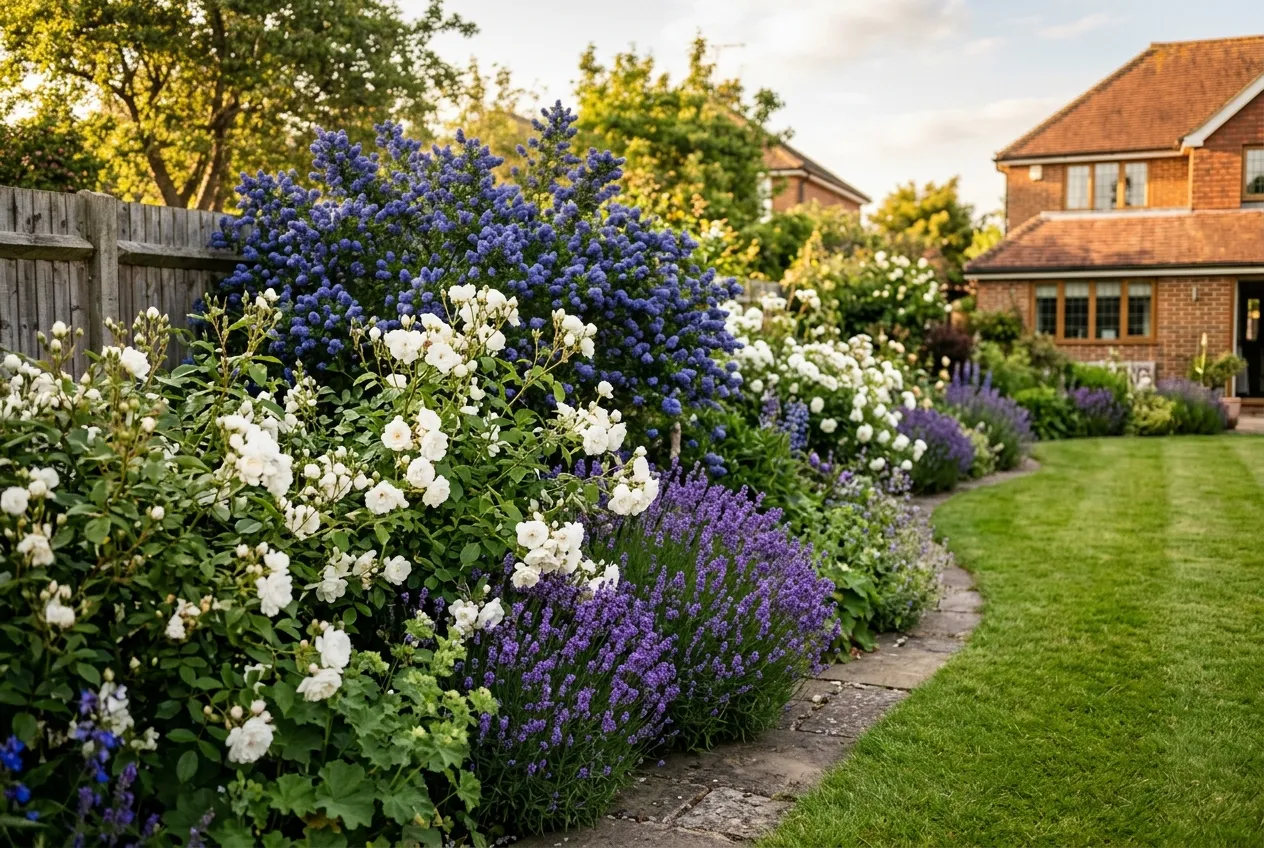
A ceanothus, lavender, and white rose combination creates a blue, purple, and white scheme that works in any sunny border.
Ceanothus variety comparison table
| Variety | Type | Height | Flower Colour | Hardiness | Flowering Time | AGM |
|---|---|---|---|---|---|---|
| Concha | Evergreen | 2.5-3m | Deep indigo-blue | -12C | May | Yes |
| Puget Blue | Evergreen | 2-2.5m | Mid-blue | -10C | May-June | Yes |
| Trewithen Blue | Evergreen | 4-6m | Mid-blue | -8C | May-June | Yes |
| Skylark | Evergreen | 1.5-2m | Dark blue | -10C | May-June | No |
| Gloire de Versailles | Deciduous | 1.5m | Powder blue | -15C | July-October | Yes |
| Autumnal Blue | Evergreen | 2-3m | Sky blue | -10C | June + September | Yes |
Lawrie’s pick: Concha for evergreen wall training. Gloire de Versailles for a freestanding border shrub. Between them, you get vivid blue from May through October.
Field Report: 6-year ceanothus trial
Trial location: GardenUK Trial Plot, Staffordshire (heavy clay, amended with grit) Date range tested: 2020-2026 Conditions: South-facing wall (Concha, Puget Blue, Skylark) and west-facing fence (Gloire de Versailles) Observation: Concha produced the densest flowering every year without fail, surviving -12C in February 2021 with no foliage damage. Puget Blue lost 15% of leaf cover in the same frost but recovered fully by May. Gloire de Versailles proved the hardiest overall, surviving -14C in open ground with no protection. Skylark stayed compact as expected but showed less vigour after year 4, suggesting a shorter productive lifespan of 8-10 years. All plants received 50% grit mix at planting. The south-facing wall Concha flowered 10-14 days earlier than the west-facing Gloire de Versailles each year.
Frequently asked questions
Lawrie has been gardening in the West Midlands for over 30 years. He grows his own veg using no-dig methods, keeps a wildlife-friendly garden, and writes practical advice based on real UK growing conditions.