Aquilegia: The Self-Seeding Shade Perennial
Grow aquilegia in UK gardens with this expert guide. Covers granny's bonnet, hybrid varieties, shade planting, self-seeding control, and sawfly.
Key takeaways
- Native Aquilegia vulgaris self-seeds prolifically in UK gardens, giving you free plants every year with zero effort
- Individual plants live only 3-4 years but replacement seedlings appear automatically each spring
- Aquilegia tolerates deep shade better than most flowering perennials, making it ideal for north-facing borders
- McKana Giants reach 75cm with large bi-colour spurred flowers in every shade from red to yellow
- Aquilegia sawfly caterpillars strip foliage in days — hand-pick on sight or spray with pyrethrum
- Cut back flowering stems after bloom to prevent excessive self-seeding and keep colonies manageable
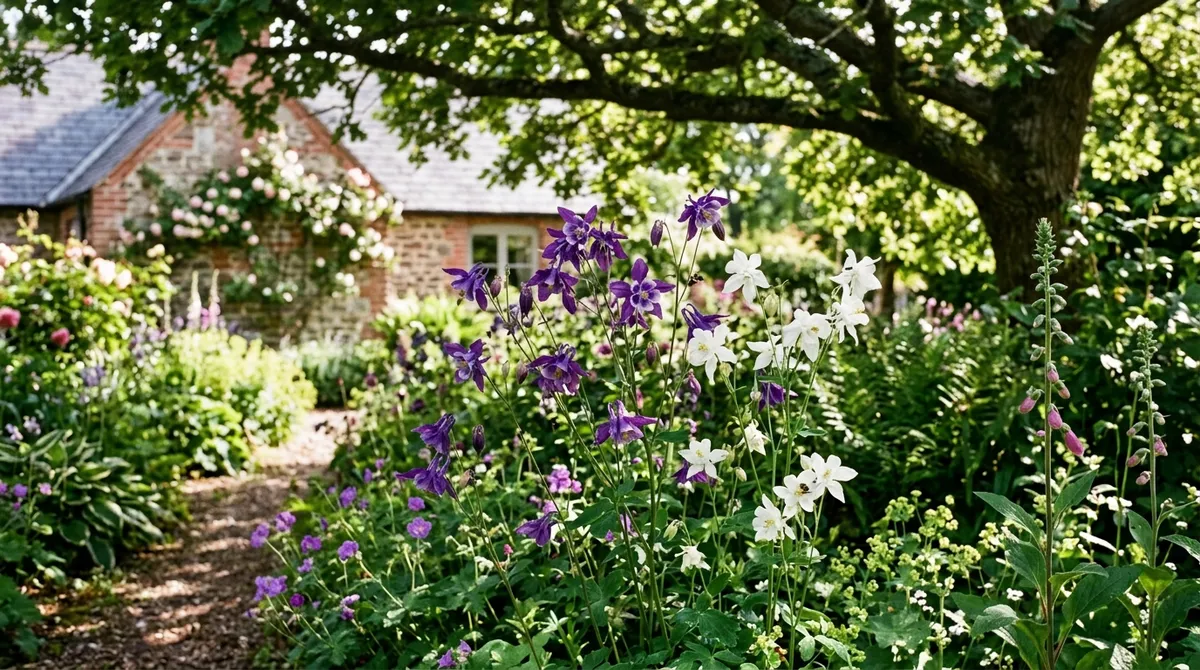
Aquilegia vulgaris — granny’s bonnet — is one of Britain’s native cottage garden perennials, flowering in May and June across woodland edges, hedgerow bottoms, and shady borders the length of the country. The plants are short-lived, lasting just 3-4 years before dying out. But they self-seed so freely that established colonies maintain themselves indefinitely without any gardener input.
This guide covers the native species, the best hybrid groups for UK gardens, and the practical detail of growing aquilegia on clay soil in the West Midlands across six seasons. If you are looking for more plants that thrive in difficult shady spots, see our guide to the best plants for shade in UK gardens.
What does aquilegia look like when it flowers?
Aquilegia produces distinctive spurred flowers on wiry stems above mounds of blue-green lobed foliage. Native A. vulgaris flowers in shades of purple, blue, pink, and white, with short hooked spurs at the back of each bloom. Each flower nods downward on its stem, giving the plant a graceful, informal habit.
Plants reach 60-90cm tall in flower, with a basal clump of foliage around 30cm wide. The leaves are divided into three-lobed leaflets with a distinctive blue-green colour that makes the plant identifiable even before flowering. Foliage emerges early in spring, often by late February in mild winters, making aquilegia useful ground cover beneath deciduous trees and shrubs before they leaf out.
Flowering lasts 4-6 weeks from mid-May in southern England. In the West Midlands, peak bloom falls in the last two weeks of May and first week of June. After flowering, decorative seed pods form on the stems. These split open when ripe, scattering fine black seed around the parent plant.
Which aquilegia varieties are best for UK gardens?
The range of aquilegia varieties available to UK gardeners runs from the native wildflower to highly bred hybrids with flowers four times the size. Each group has a distinct character and purpose in the garden.
Aquilegia vulgaris is the native species. It grows to 60-90cm, tolerates the widest range of conditions, self-seeds most reliably, and looks most natural in cottage garden borders. Colours include purple, blue, pink, mauve, and white. Named selections include ‘Nivea’ (pure white) and ‘Adelaide Addison’ (blue and white bi-colour). This is the species to choose for a naturalistic planting or a cottage garden scheme.
Barlow series are double-flowered forms of A. vulgaris with no spurs. The flowers are pompom-like and upward-facing, quite different from the nodding single flowers of the species. Colours include deep blue (‘Blue Barlow’), black-purple (‘Black Barlow’), pink (‘Nora Barlow’), and white (‘White Barlow’). Heights reach 60-75cm. They self-seed reasonably well, though seedlings often revert to single forms over generations.
McKana Giants are large-flowered American hybrids reaching 75cm with dramatic long-spurred bi-colour flowers. Individual blooms can measure 10cm across. Colours include red and yellow, blue and white, pink and cream. They make the strongest visual impact of any aquilegia group. However, they are less persistent than the native species — lifespan is closer to 2-3 years, and self-sown seedlings are unpredictable in colour.
Aquilegia chrysantha (golden columbine) is a North American species with pure yellow long-spurred flowers. It reaches 90cm and is longer-lived than most aquilegia at 4-5 years. It needs more sun than the native species and does best in a south or west-facing border. See our guide to yellow flowers for UK gardens for more options in this colour.
Aquilegia variety comparison table
| Variety / Group | Height | Flower Type | Colours | Lifespan | Self-Seeds? | Best Position |
|---|---|---|---|---|---|---|
| A. vulgaris (native) | 60-90cm | Single, short spurs | Purple, blue, pink, white | 3-4 years | Freely | Sun to deep shade |
| Barlow series | 60-75cm | Double, spurless | Blue, black, pink, white | 3-4 years | Moderately | Sun to partial shade |
| McKana Giants | 75cm | Single, long spurs | Bi-colour mixes | 2-3 years | Unreliably | Sun to light shade |
| A. chrysantha | 90cm | Single, long spurs | Yellow | 4-5 years | Moderately | Sun to light shade |
| ’Winky’ series | 40-50cm | Double, upward-facing | Mixed bi-colours | 2-3 years | Poorly | Sun to partial shade |
| A. alpina | 30-45cm | Single, large blue | Blue | 3-4 years | Moderately | Sun, well-drained |
Where should I plant aquilegia in the garden?
Aquilegia vulgaris tolerates a wider range of light conditions than almost any other flowering perennial. Full sun, partial shade, and deep shade all produce flowering plants. This makes aquilegia useful in positions where few other perennials perform.
North-facing borders suit aquilegia perfectly. On my north-facing clay border in Staffordshire, granny’s bonnets are the most reliable flowering plant from May onwards. The border receives less than two hours of direct sun daily in summer. Plants grow slightly taller here — reaching 90cm rather than 70cm — but flower production is comparable to sunnier spots. If your north-facing garden needs more planting ideas, see our full guide to north-facing garden design.
Under deciduous trees and shrubs is another strong position. Aquilegia foliage emerges before the canopy fills in, capturing early spring light. By flowering time in May, the canopy is only partially developed. The plants cope with the increasing shade through summer because they have finished their main growth by then.
In gravel or along path edges works well for the smaller species. A. alpina and the ‘Winky’ series suit the front of a border or a gravel garden where they can self-seed into paving cracks. The larger hybrids belong in the middle or back of a border among other perennials.
Soil type is rarely an issue. Heavy clay, chalky alkaline soil, sandy acid ground — aquilegia tolerates all of them. The only fatal condition is prolonged waterlogging, which rots the crown. For more on matching plants to difficult soils, see our guide to plants for clay soil.
How to grow aquilegia from seed in the UK
Growing aquilegia from seed is straightforward, but germination has one important quirk. The seed benefits from a cold period (stratification) to break dormancy. There are two practical approaches for UK gardeners.
Autumn sowing outdoors is the simplest method. Scatter seed on the surface of prepared soil or pots of compost from September to November. Press it in gently but do not cover it — aquilegia seed needs light to germinate. Leave the pots outside through winter. Natural cold and moisture trigger germination in March or April. This mimics how the plant reproduces in the wild.
Spring sowing with artificial chilling works if you miss the autumn window. Place seed in a sealed bag with damp vermiculite in the fridge for 3-4 weeks from January. Then sow on the surface of seed compost in a cold greenhouse or unheated frame from February to March. Germination takes 2-4 weeks at 15-18C after the cold treatment.
Do not sow aquilegia in warm conditions without chilling. Unchilled seed germinates poorly and erratically. This is the most common cause of failure when growing from seed. For more guidance on seed starting techniques, see our guide to sowing seeds indoors.
Seedlings grow slowly at first. Prick out into individual 9cm pots when the first true leaves appear. Plant out in their final positions from September to November, or the following March. First-year plants establish a strong root system. Expect flowers in the second spring after sowing.
How to manage self-seeding aquilegia
Self-seeding is both the greatest strength and the main management challenge with aquilegia. A single plant produces hundreds of seeds, and germination rates in open ground are high.
To encourage self-seeding, leave all flower stems standing until the seed pods split and scatter their contents. This happens 4-6 weeks after flowering finishes. The seed falls close to the parent plant, so seedlings appear in a gradually expanding drift.
To limit self-seeding, cut all flower stems to the base as soon as petals drop. This prevents seed formation entirely. If you want some replacement seedlings but not a takeover, leave 2-3 stems and remove the rest.
Colour management is an issue with mixed plantings. Aquilegia species cross-pollinate freely. If you grow native purple-blue granny’s bonnets next to pink Barlow types and McKana Giants, the offspring will be unpredictable hybrids. Over 3-4 generations, colours often drift towards muddy purple-brown. Remove seedlings that flower in unwanted colours before they set seed. This gradually steers the colony towards the shades you prefer.
Unwanted seedlings are easy to hoe off in early spring when they are small. The distinctive lobed leaves make aquilegia seedlings identifiable from March onwards. Transplant any you want to keep while they are still small — large plants resent root disturbance. For more self-seeding plants that work on this principle, see our guide to self-seeding plants for UK gardens.
How to deal with aquilegia sawfly
Aquilegia sawfly (Pristiphora aquilegiae) is the only serious pest. The small grey-green caterpillars with black heads appear from April onwards, feeding on the underside of leaves. A heavy infestation strips the foliage to skeletons within a few days, leaving only the veins.
Detection is the key to control. Check the undersides of aquilegia leaves weekly from April through June. The caterpillars are well camouflaged and easy to miss until damage is severe. Look for the telltale semi-circular notches in leaf edges — these are the first feeding marks.
Hand-picking is the most effective control for small colonies. Drop caterpillars into soapy water. Check thoroughly — a single leaf can harbour five or six caterpillars pressed flat against the underside.
Pyrethrum spray works as a last resort for heavy infestations. Apply in the evening to minimise harm to pollinators. Repeat after 10 days as a second generation often follows.
Recovery after sawfly damage is good. Aquilegia regrows a fresh flush of leaves within 3-4 weeks of defoliation. If the attack happens after flowering, the plant’s seed production may be reduced but the root survives. Plants weakened by repeated annual defoliation are more likely to die after their third year rather than their fourth.
For broader pest management strategies, see our organic pest control guide.
How to combine aquilegia with other plants
Aquilegia works best in mixed plantings where their informal habit blends with other cottage garden perennials. The wiry flower stems weave through neighbouring plants rather than standing in isolation.
Spring combinations pair aquilegia with bluebells, forget-me-nots, and the fresh foliage of hostas. The timing is perfect — all peak together in May. Under-plant with late-flowering perennials like Japanese anemones that take over the display from July onwards as the aquilegia foliage fades.
Shade border schemes use aquilegia alongside ferns, brunnera, epimedium, and hellebores. This gives a succession from February (hellebores) through March (epimedium) to May (aquilegia), with ferns providing structure all season.
Cottage garden borders in sun combine aquilegia with lupins, hardy geraniums, and early roses. The blue-purple tones of native granny’s bonnets contrast well with the warm pinks and apricots of shrub roses.
Avoid planting aquilegia too close to vigorous ground-cover plants that smother seedlings. Self-seeding depends on bare soil being available nearby. A 10-15cm gap around the base of each plant gives seedlings space to establish.
When should I cut back aquilegia after flowering?
Timing the cut-back depends on whether you want self-seeding or not. Both approaches have merits.
For self-seeding, wait until seed pods have split open and released their contents. This happens 4-6 weeks after the last flowers fade, typically by late July in the Midlands. Cut all stems to the base once pods are empty. The plant redirects energy to the root crown and produces a fresh mound of foliage that persists through autumn.
To prevent self-seeding, cut stems to the base as soon as the last flowers finish, before seed pods develop. On most plants, this means cutting in late June or early July. This gives the plant more energy for root growth and can extend its lifespan slightly.
In both cases, leave the basal foliage intact. The leaves continue photosynthesising and feeding the root crown through summer and autumn. Only remove foliage if it is heavily damaged by sawfly or has turned brown. Fresh replacement leaves appear quickly in most cases.
Old flower stems left standing through winter serve no purpose for aquilegia. Unlike some perennials, they do not provide winter structure or wildlife habitat. Cut them whenever is convenient after seed has dispersed.
Can I grow aquilegia in pots and containers?
Aquilegia grows perfectly well in containers, though the shorter varieties suit pot culture better than the tall native species. Choose pots at least 30cm in diameter with good drainage.
Use a loam-based compost such as John Innes No. 2. Aquilegia dislikes waterlogging, and loam-based mixes drain more reliably than peat-free multipurpose composts in containers. Water when the top 2cm of compost feels dry — roughly every other day in summer, less in winter.
The ‘Winky’ series at 40-50cm is purpose-bred for containers. Barlow types at 60-75cm also work well in large pots. McKana Giants tend to flop in containers because the tall stems have no neighbouring plants for support.
Container-grown aquilegia benefit from a liquid feed every two weeks from April to July. Use a balanced feed rather than a high-nitrogen formula. After flowering, reduce feeding and allow the plant to rest.
Expect container-grown plants to last 2-3 years before declining. Self-seeding in containers is less reliable than in open ground — seedlings struggle to establish in the limited space. Replace plants when they lose vigour rather than waiting for self-sown replacements.
Frequently asked questions
Do aquilegia come back every year in the UK?
Individual aquilegia plants live 3-4 years, then die. However, they self-seed so freely that new plants replace old ones each spring without any intervention. An established colony appears to be perennial even though individual plants are short-lived. Leave some seed heads on the plant after flowering to ensure replacement seedlings.
Can aquilegia grow in full shade?
Yes, aquilegia is one of the best flowering perennials for full shade. Native Aquilegia vulgaris evolved in woodland clearings and hedgerow bottoms across Britain. In deep shade, plants grow slightly taller and leggier but flower reliably. They outperform most alternatives in north-facing borders where direct sun is limited to an hour or less per day.
How do I stop aquilegia spreading too much?
Cut all flowering stems to the base immediately after petals drop. This prevents seed formation and stops unwanted self-seeding. If you want some replacement seedlings, leave 2-3 stems to set seed and remove the rest. Hoe off unwanted seedlings in early spring when they form their first recognisable lobed leaves.
What is eating the leaves on my aquilegia?
Aquilegia sawfly caterpillars are the most common cause of stripped foliage. These grey-green caterpillars with black heads appear from April onwards and can reduce leaves to skeletons within days. Check the undersides of leaves regularly. Hand-pick caterpillars on sight or spray with pyrethrum as a last resort. Healthy plants regrow foliage after an attack.
When should I plant aquilegia in the UK?
Plant pot-grown aquilegia from March to May or September to October. Sow seed directly where you want plants from May to July, pressing it into the surface — aquilegia seed needs light and a period of cold to germinate well. Autumn-sown seed outdoors germinates the following spring after natural winter chilling.
Do aquilegia cross-pollinate and change colour?
Yes, aquilegia species cross-pollinate freely and seedlings show mixed colours. If you grow several varieties near each other, offspring will be unpredictable hybrids. Colours often revert towards the native purple-blue over generations. To maintain a specific colour, remove unwanted seedlings before they flower and set seed themselves.
What soil do aquilegia need?
Aquilegia grow in almost any soil, from heavy clay to chalky alkaline ground. They prefer moist but well-drained conditions and tolerate poor soil better than most perennials. On heavy clay in the West Midlands, they perform well without any soil amendment. The only soil they dislike is waterlogged ground where the crown rots over winter.
Lawrie has been gardening in the West Midlands for over 30 years. He grows his own veg using no-dig methods, keeps a wildlife-friendly garden, and writes practical advice based on real UK growing conditions.