How to Grow Cornus (Dogwood) in the UK
Grow cornus dogwood in any UK garden for vivid winter stems and summer flowers. Expert guide covering 5 species, pruning by type, and planting tips.
Key takeaways
- Coppice stem-colour dogwoods hard to 15cm in March for the brightest winter stems each year
- Cornus alba 'Sibirica' produces the most vivid red stems of any UK-hardy shrub, November to March
- Cornus kousa and C. florida are ornamental trees that should never be coppiced
- All cornus tolerate heavy clay, damp ground, and partial shade across every UK region
- Mix red (Sibirica), yellow (Flaviramea), and orange (Midwinter Fire) for a 5-month winter display
- Hardwood cuttings taken in November root with 80-90% success in open ground
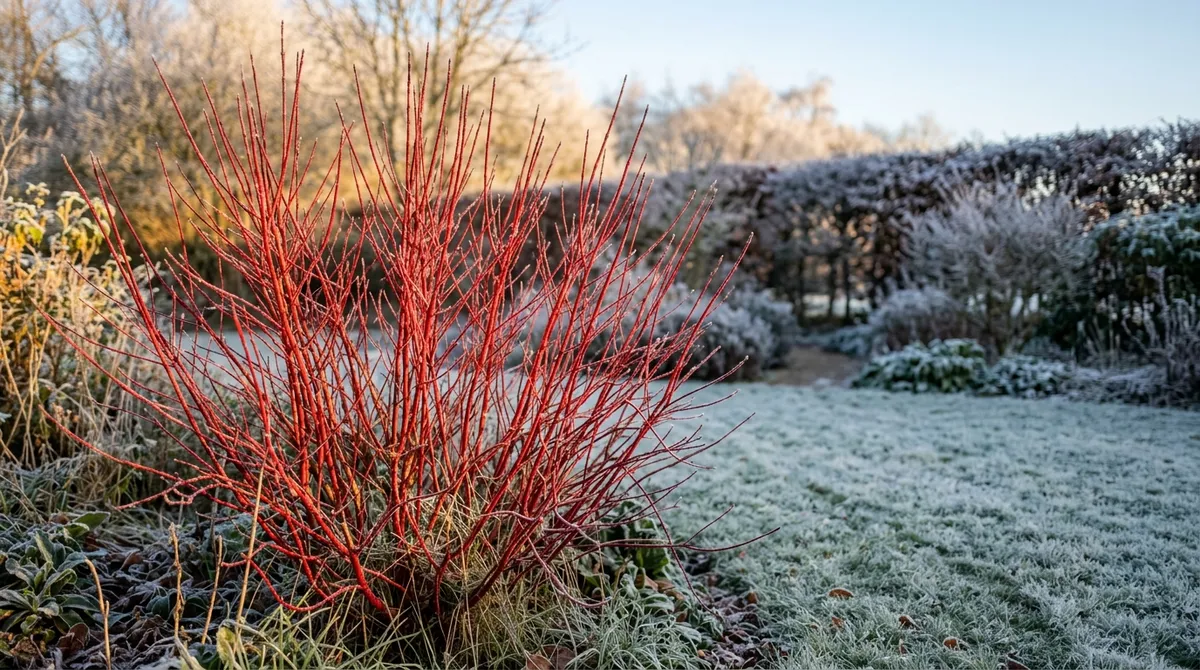
Cornus dogwood is one of the most versatile shrubs for UK gardens, delivering vivid stem colour from November through to March when almost nothing else in the border is performing. Plant a group of Cornus alba ‘Sibirica’ and by mid-winter you have stems the colour of lacquered red enamel, glowing in low sunlight against bare hedgerows and frosted lawns. No other hardy shrub gives you five full months of colour with so little effort.
The genus covers more than just winter stems. It includes flowering trees with spectacular June bracts, autumn foliage that rivals any Japanese maple, and the edible-fruited Cornus mas that provides the earliest blossom of any tree in the British Isles. This guide covers the five main species grown in UK gardens, with specific advice on soil, planting, pruning by type, and propagation. For more shrub options for winter interest, see our guide to best winter flowering shrubs.
Which cornus species grow best in the UK?
Five cornus species account for almost all dogwoods grown in British gardens. Each serves a different purpose, and the pruning regime differs between them. Getting this distinction wrong is the single biggest mistake people make with dogwood. Stem-colour types need hard annual coppicing. Flowering types must never be coppiced.
| Species | Type | Height (coppiced/mature) | Main feature | Pruning | Soil pH tolerance |
|---|---|---|---|---|---|
| C. alba | Multi-stem shrub | 1.5-2.5m coppiced | Red, yellow, or variegated winter stems | Coppice to 15cm, March | pH 5-8 |
| C. sanguinea | Multi-stem shrub | 1.5-2m coppiced | Orange and flame winter stems | Coppice to 15cm, March | pH 5-8 |
| C. sericea (stolonifera) | Multi-stem shrub | 1.5-2m coppiced | Yellow-green winter stems | Coppice to 15cm, March | pH 5-8 |
| C. kousa | Small tree | 4-7m mature | White or pink flower bracts, June | Minimal shaping only | pH 5.5-7.0 |
| C. mas | Small tree/large shrub | 4-6m mature | Yellow flowers February, edible fruit | Minimal, remove dead wood | pH 5-8 |
C. alba and C. sanguinea are native to the UK and northern Europe, so they cope with the worst British weather. C. kousa originates from Japan and Korea but has proved reliably hardy in all regions except the most exposed Scottish Highland sites. All five species are rated H5 or above on the RHS hardiness scale.
What soil and position does cornus need?
Cornus grows in almost any UK soil, including heavy waterlogged clay. This makes it one of the most useful shrubs for difficult sites where other ornamentals struggle. I have grown C. alba ‘Sibirica’ in solid Staffordshire clay that sits wet all winter, and it performs as well there as in lighter ground.
Stem-colour varieties (C. alba, C. sanguinea, C. sericea) are naturally found along riverbanks and in damp woodland edges. They tolerate permanently moist soil that would rot the roots of most garden shrubs. They also grow perfectly well in drier conditions, though stem growth is typically shorter on thin, dry soils.
For the best stem colour, plant in full sun or light partial shade. Stems develop their most vivid pigment when exposed to direct sunlight for at least 4 hours per day. Plantings in deep shade produce longer, thinner stems with noticeably weaker colour. A south or west-facing border gives the strongest effect because low winter sun catches the stems at the best angle.
Flowering dogwoods (C. kousa, C. florida) prefer a slightly acidic to neutral soil with reasonable drainage. They perform poorly on shallow chalk. If your soil is heavy clay, see our clay soil improvement guide for practical steps before planting a C. kousa. C. mas is the most lime-tolerant of the tree forms and grows happily on chalk.
Best cornus varieties for vivid winter stems
The main reason British gardeners grow cornus is for winter stem colour. These are the proven performers in UK conditions.
Cornus alba ‘Sibirica’ (red stems)
The benchmark red-stemmed dogwood and my first recommendation for anyone wanting winter colour. Stems turn a brilliant, almost luminous crimson from November. In low winter sunlight the effect is extraordinary, particularly against a dark evergreen hedge. Reaches 2-2.5m in a single season after coppicing. Holds the RHS Award of Garden Merit.
Cornus alba ‘Westonbirt’ (dark red stems)
Slightly deeper, darker red than Sibirica. More of a blood-red than a bright crimson. Less commonly stocked in garden centres but worth seeking out. Some growers find the colour less vivid at a distance because it lacks Sibirica’s luminous quality.
Cornus sanguinea ‘Midwinter Fire’ (orange-flame stems)
Each stem transitions from warm yellow at the base through orange to flame-red at the tips. This gradient effect is unique among dogwoods and makes it one of the most photographed winter plants in UK gardens. Slightly less vigorous than C. alba varieties, reaching 1.5-2m. Also sold as ‘Winter Beauty’.
Cornus sericea ‘Flaviramea’ (yellow-green stems)
Bright greenish-yellow stems that contrast dramatically when planted alongside red varieties. Fully hardy throughout the UK. Produces suckering growth and can spread wider than C. alba, so allow 1.5m between plants. Ideal for waterside planting where the reflection doubles the colour.
Cornus alba ‘Kesselringii’ (near-black stems)
Dark purple-black stems through winter. Less showy at a distance than brighter colours but dramatic up close, particularly against a backdrop of snow or white-barked birches. Grows to 2m when coppiced.
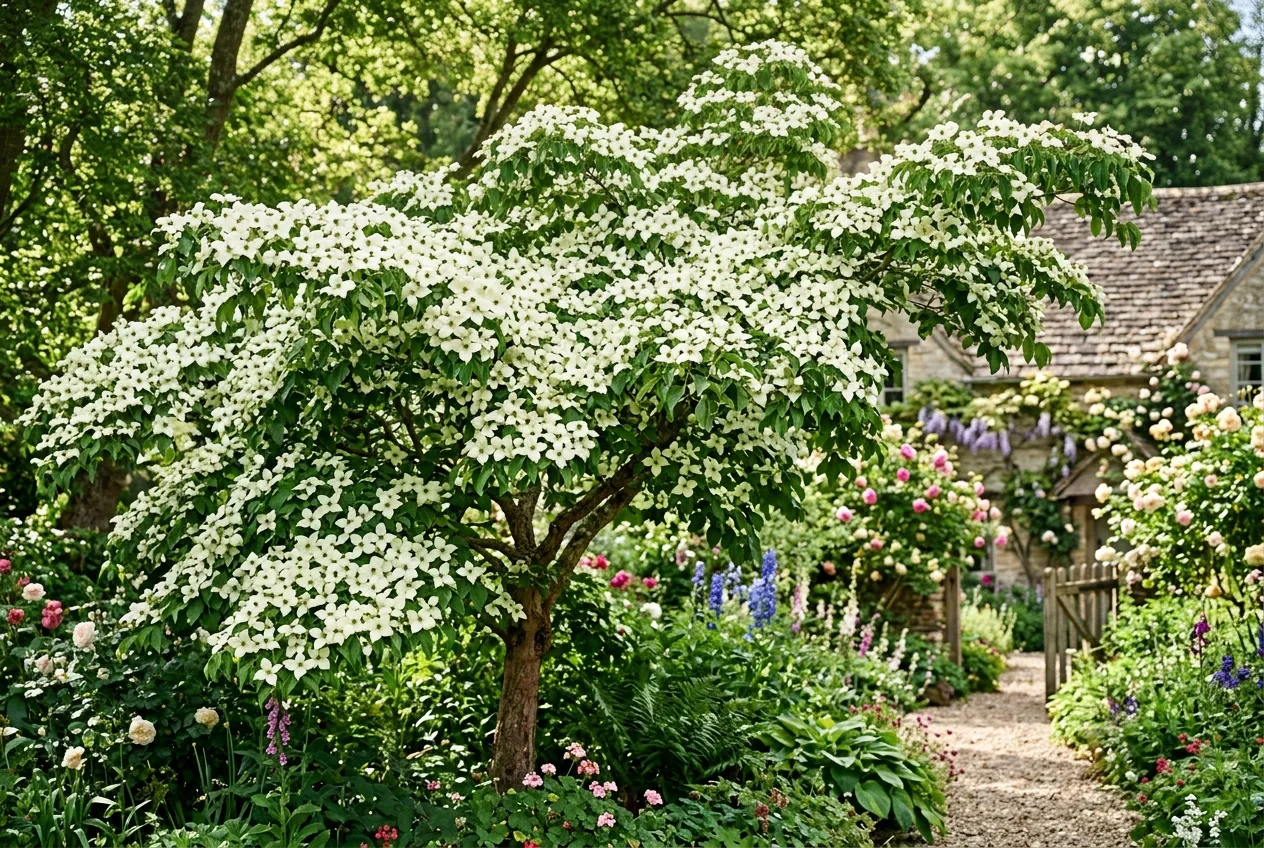
Cornus kousa in full flower. The white ‘petals’ are actually bracts surrounding a small central flower cluster. This species should never be coppiced.
How to plant cornus dogwood
Plant bare-root cornus between November and March, or container-grown plants any time of year. Bare-root stock is cheaper, establishes faster, and is the standard method used by landscape professionals for large plantings. Our guide to planting bare-root trees covers the general technique.
For a strong winter display, plant stem-colour varieties in groups of three to five at 60-90cm spacing. A single plant looks thin and isolated. A group of five coppiced plants produces 30-50 coloured stems and creates a genuine focal point from across the garden.
Planting steps
- Dig a hole twice the width of the root ball and the same depth
- Fork over the base to break up compaction, particularly in clay
- Set the plant at the same depth it was growing previously (look for the soil mark on the stem)
- Backfill with the excavated soil only. Do not add compost or fertiliser to the planting hole
- Water in thoroughly with a full watering can, even if the ground is already damp
- Mulch with a 5-8cm layer of bark or garden compost, keeping mulch clear of the stems
Do not stake stem-colour cornus. They are multi-stemmed shrubs, not standard trees, and staking restricts the natural root-strengthening movement.
How to coppice cornus for the brightest winter stems
Coppice stem-colour dogwoods hard to 15cm in late March for the brightest winter display. This is the single most important task in growing cornus for winter interest. Without it, the colour fades year on year as older wood turns dull brown.
The principle is straightforward. Winter stem colour is strongest on first-year wood. By cutting the entire plant down to short stumps each spring, you force a flush of vigorous new stems that colour fully by the following November.
Coppicing method
Use sharp bypass loppers or a pruning saw for thicker stems. Cut every stem to 10-15cm above ground level. Make clean cuts. Do not leave ragged tears that invite disease. Remove all cut material from the base of the plant.
After coppicing, apply a handful of general-purpose fertiliser (fish, blood, and bone or Growmore) around the base and water it in. Follow with a 5-8cm mulch of garden compost or well-rotted manure. This feeds the plant through its vigorous regrowth phase. Coppiced plants push 1.5-2.5m of new growth in a single season, so that energy has to come from somewhere.
For gardeners who want winter stems but find the hard-pruned look too bare in summer, a compromise approach works. Coppice half the stems each year, alternating sides. You get coloured stems on one-year wood and leafy growth on the older side.
The critical mistake most people make is not coppicing hard enough. Cutting stems to 30-40cm produces a top-heavy plant with weak colour at the tips. The brightest colour is always on the lowest section of new growth, so the more stem you leave, the higher that vivid zone sits. Cut hard to the base every year without hesitation.
For more on pruning shrubs across all types, see our step-by-step guide. The spring pruning guide covers the full March checklist.
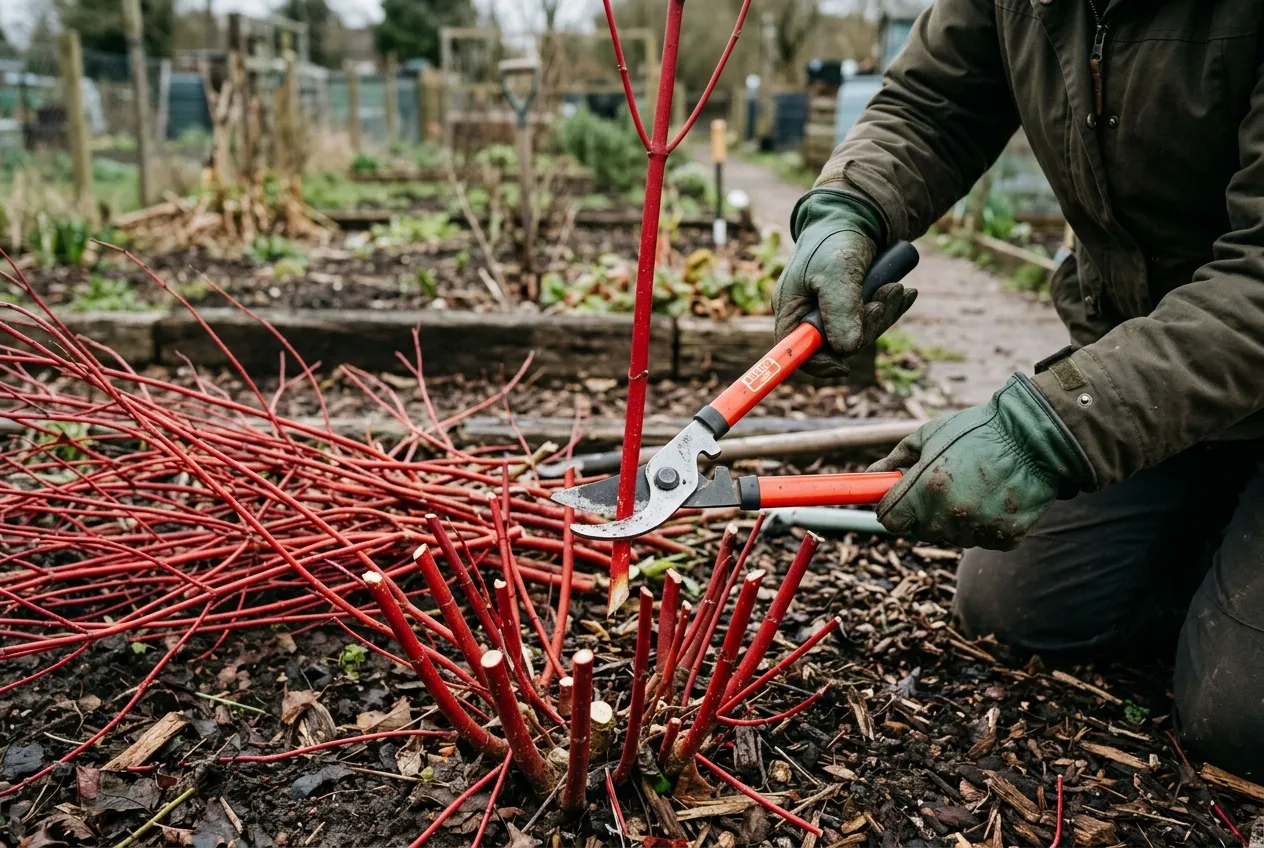
Coppice all stems to 10-15cm in March. The stumps look bare but will produce 1.5-2.5m of fresh coloured growth by November.
How to grow Cornus kousa as a garden tree
Cornus kousa is a different plant altogether from the stem-colour dogwoods. It is a small, spreading tree that earns its place through four seasons of interest: white or pink flower bracts in June, attractive layered form in summer, vivid red-purple autumn foliage, and strawberry-like fruits in September.
It reaches 4-7m over 15-20 years, forming a broad, slightly flat-topped canopy. Growth is moderate at 20-30cm per year once established. This is a tree for patient gardeners, but the payoff is one of the most beautiful small garden trees available in Britain.
Best C. kousa varieties
Cornus kousa var. chinensis is the most widely grown form. Larger and more floriferous than the straight species. White bracts fade to pink with age. Holds the RHS Award of Garden Merit.
Cornus kousa ‘Miss Satomi’ produces soft pink bracts that deepen through June. One of the finest pink-flowering small trees for UK gardens. Autumn colour is outstanding in crimson and purple.
Cornus kousa ‘Milky Way’ flowers more profusely than any other variety, covering the canopy so thickly the branches almost disappear beneath white bracts.
C. kousa prefers acid to neutral soil (pH 5.5-7.0) with good drainage. It dislikes thin chalk and waterlogged clay. If your garden sits on alkaline soil, grow C. mas instead, or choose the stem-colour species which tolerate any pH. For more small tree options, our guide to best trees for small gardens covers the full range.
Pruning flowering dogwoods
Never coppice flowering dogwoods. These are small trees that flower on established wood. Coppicing destroys the flowering framework and may kill the plant.
Flowering dogwoods need only light formative pruning in late winter. Remove dead, damaged, or crossing branches. Shape the canopy if needed but avoid removing more than 20% of growth in a single year. The tiered branch structure is the plant’s defining feature, so aim to enhance it rather than fight it.
Winter stem colour guide: planning a mixed display
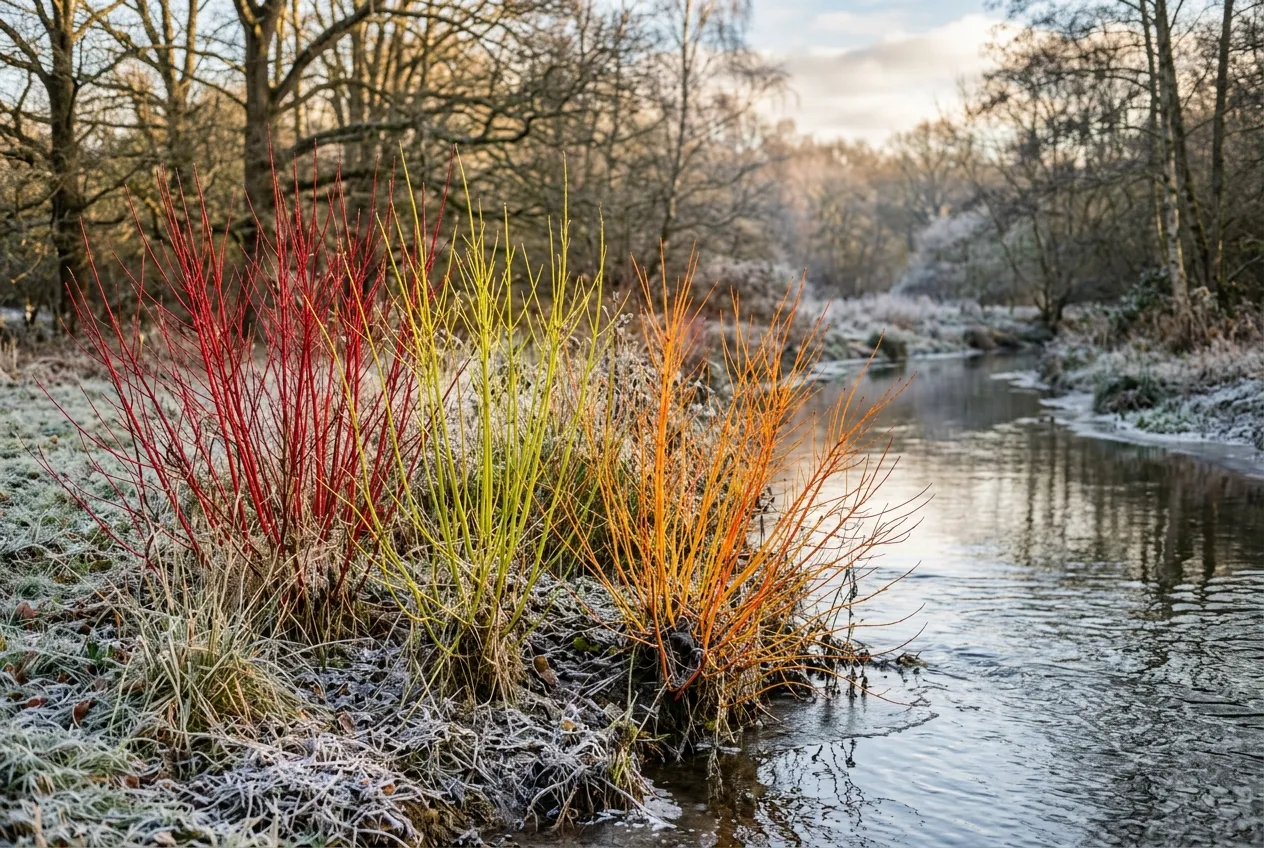
Red, yellow, and orange cornus stems planted together by water. The colour intensity peaks in January and February, and the reflection doubles the impact.
Combining different stem colours creates a display that lasts from November to March. This is one of the most effective winter planting schemes in British gardens. The classic combination is red (C. alba ‘Sibirica’), yellow (C. sericea ‘Flaviramea’), and orange (C. sanguinea ‘Midwinter Fire’).
Design approach
Plant each variety in a group of three or five. Stagger the groups so colours blend at the edges rather than sitting in rigid blocks. Place the tallest grower (C. alba ‘Sibirica’, 2-2.5m) at the back, orange ‘Midwinter Fire’ in the middle, and the yellow-green ‘Flaviramea’ at the front.
A dark backdrop intensifies the colour. Yew hedging is the classic choice, but a fence stained dark green or a bank of evergreen holly works just as well. Underplant with snowdrops, winter aconites, and early crocuses for ground-level interest while the stems glow above.
Where to use cornus in the garden
Waterside planting is the classic use. Mass planting along a pond edge or stream bank looks natural and provides winter structure when marginal plants have died back.
Mixed winter borders combine cornus with other winter-interest plants. See our guide to best winter flowering plants for companion planting ideas.
Boundary hedging using C. alba planted at 45cm spacing creates an informal screen that can be coppiced annually for colour or allowed to grow taller.
Difficult sites where other plants fail suit cornus perfectly. Wet hollows, heavy clay, north-facing borders, and exposed sites all support healthy growth. For more options in shady spots, see our guide to best shrubs for shade.
Cornus problems and pests in the UK
Cornus is largely trouble-free in UK gardens. The stem-colour species suffer from virtually no serious pests or diseases in this country.
Cornus anthracnose (Discula destructiva) affects C. florida and occasionally C. kousa. Symptoms include brown leaf spots, shoot dieback, and canker on branches. More common in the United States than the UK, but it does occur in southern England during cool, wet springs. Remove and burn affected branches. C. kousa has much better resistance than C. florida, which is one reason C. kousa is preferred for UK planting.
Leaf scorch causes leaf margins to turn brown during hot, dry summers, particularly on C. kousa in exposed positions. This is moisture stress, not disease. Mulch heavily and water deeply during dry spells. Established plants on clay rarely suffer.
Suckering from C. sericea ‘Flaviramea’ can spread into adjacent borders. Remove suckers at source each spring when coppicing, or plant with a root barrier.
How to propagate cornus from hardwood cuttings
Hardwood cuttings are the easiest and most reliable way to propagate stem-colour cornus. Take them in November or December when the plant is dormant and the stems have fully coloured. No specialist equipment is needed.
Step-by-step method
- Select straight, healthy stems of pencil thickness (8-12mm diameter)
- Cut 20-25cm lengths, making a straight cut at the base just below a bud and an angled cut at the top to mark polarity
- Dig a narrow slit trench in a sheltered, well-drained spot
- Add a 2cm layer of sharp sand to the base of the trench for drainage
- Insert cuttings two-thirds deep at 10-15cm spacing
- Firm the soil and water in
- Leave for 12 months without disturbing
By the following autumn, 80-90% will have rooted and produced new shoots. Transplant to their final positions the following November. This method produces free plants genetically identical to the parent.
For C. kousa, propagation by cuttings is more difficult. Semi-ripe cuttings taken in July have around 40-50% success rate. Layering in spring is more reliable for the tree species.
Month-by-month cornus care calendar
| Month | Task |
|---|---|
| January | Enjoy winter stem colour. Plan any changes to the display |
| February | Order bare-root plants for March delivery. C. mas flowers this month |
| March | Coppice stem-colour varieties to 15cm. Feed and mulch after cutting |
| April | New growth appears from coppiced stumps. Water if dry |
| May | Growth accelerates. C. kousa flower buds forming |
| June | C. kousa in full flower. Water newly planted trees in dry spells |
| July | Take semi-ripe cuttings of C. kousa if needed |
| August | Maintain watering for first-year plantings during dry weather |
| September | C. kousa fruits ripen. Autumn colour begins developing |
| October | Peak autumn foliage on C. kousa and C. florida |
| November | Plant bare-root cornus. Take hardwood cuttings of stem varieties |
| December | Full winter stem display. Mulch young plants for frost protection |
Frequently asked questions
For further reading, our guides to flowering shrubs and trees for autumn colour cover complementary plants that work alongside cornus in mixed borders.
Lawrie has been gardening in the West Midlands for over 30 years. He grows his own veg using no-dig methods, keeps a wildlife-friendly garden, and writes practical advice based on real UK growing conditions.