How to Grow Crocus in the UK
How to grow crocus in UK gardens. Spring and autumn varieties, planting depths, naturalising in lawns, and best corms for pollinators.
Key takeaways
- Plant crocus corms 8-10cm deep and 8cm apart from September to November for spring flowers
- Crocus are the first major food source for bumblebees and solitary bees in late winter
- Dutch large-flowered crocus give the boldest colour; species crocus naturalise more freely in lawns
- Do not mow naturalised crocus in grass until at least 6 weeks after flowering finishes
- Autumn-flowering crocus (C. speciosus, C. sativus) extend the season into October and November
- Squirrels dig up freshly planted corms — cover with chicken wire for the first season to protect them
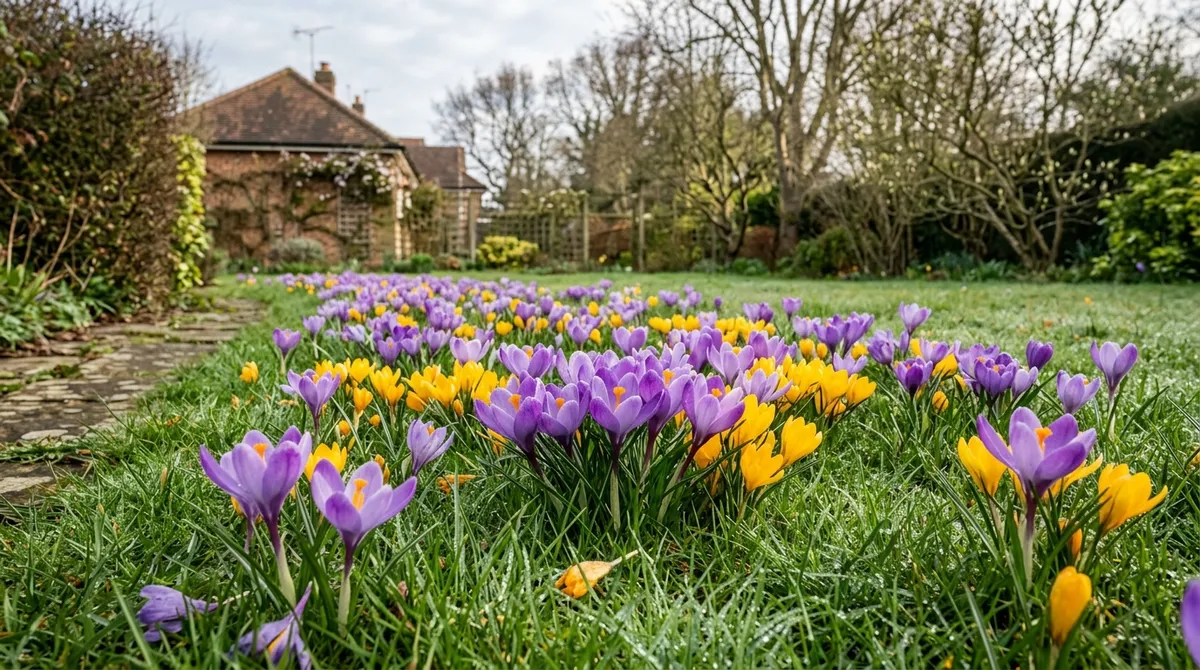
Growing crocus in the UK is one of the simplest ways to bring early colour to a garden after winter. These small corms produce flowers from as early as February, often pushing through frost or the last traces of snow. They are short-lived individually — each bloom lasts a week or so — but planted in generous drifts, they deliver a display that builds and improves each year as the corms multiply.
Crocus also serve a purpose beyond decoration. They are the first significant source of pollen and nectar for bumblebees and solitary bees emerging from hibernation. A patch of open crocus flowers on a mild February afternoon will be alive with bees. This guide covers spring and autumn types, the best varieties, planting, naturalising in lawns, and how to keep squirrels from ruining the display. For broader advice on timing, see our guide to when to plant spring bulbs in the UK.
Why do crocus matter for pollinators?
Crocus are the first major nectar and pollen source for UK bees after winter, bridging a critical gap between January and April when almost nothing else flowers. Bumblebee queens emerge from hibernation on mild days in February and March. They need immediate food to build energy for nest founding. Without early flowers, queens starve.
A patch of 50-100 crocus in a sunny spot provides enough forage for multiple bumblebee visits per day. The open, cup-shaped flowers are accessible to short-tongued bees and hoverflies alike. Purple and yellow varieties are the most visited — bees see ultraviolet patterns on the petals that guide them to the nectar.
Planting crocus alongside snowdrops and winter aconites creates a continuous early food supply from January through to April, when dandelions and fruit blossom take over. See our guide to bee-friendly garden plants for more species that support pollinators through the year. The Bumblebee Conservation Trust lists crocus among the top five plants for early-season bee support.
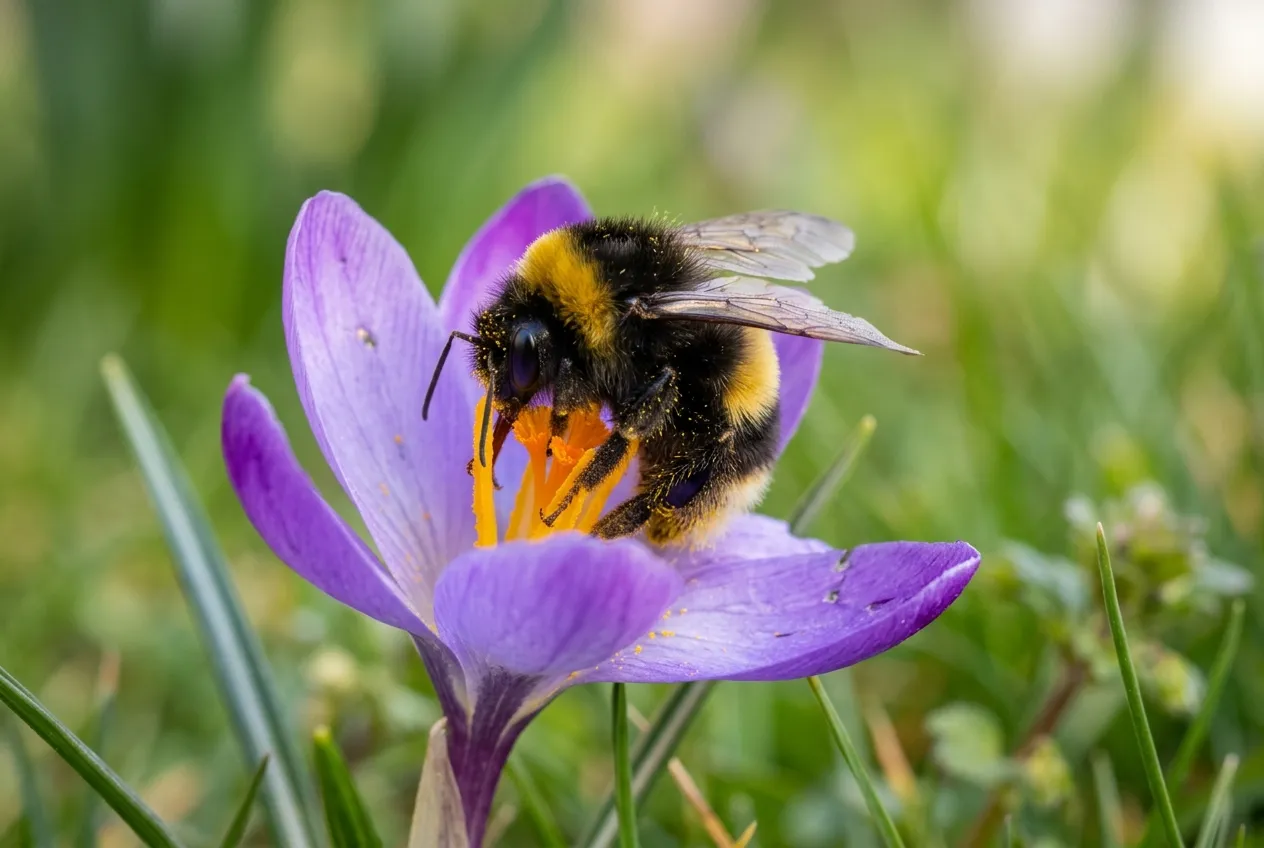
Crocus flowers are the first major food source for bumblebees emerging from winter hibernation
What types of crocus can I grow?
There are three broad groups of crocus worth knowing about for UK gardens. Each has a different character and a different role.
Dutch large-flowered crocus
These are the big, bold hybrids sold in every garden centre from August onward. They grow 10-12cm tall with flowers 5-6cm across in strong purples, yellows, whites, and stripes. They are bred from Crocus vernus and produce the most dramatic display. The trade-off: they naturalise less freely than species types, and squirrels target them heavily.
Species (botanical) crocus
Smaller and more delicate than Dutch hybrids, species crocus grow 5-8cm tall. What they lack in size, they make up for in persistence and grace. Crocus tommasinianus is the star of this group — it seeds itself freely, forming expanding drifts of lilac flowers that squirrels ignore. These are the best choice for naturalising in grass.
Autumn-flowering crocus
A separate group that flowers from October to November, after the leaves have appeared and died back in spring. Crocus speciosus and Crocus sativus (the saffron crocus) are the most commonly grown. They provide unexpected colour at a time when most people assume the bulb season is over.
Which crocus varieties should I grow?
| Variety | Type | Colour | Height | Flowering | Naturalising | Squirrel Resistance |
|---|---|---|---|---|---|---|
| ’Remembrance’ | Dutch | Deep purple | 12cm | Feb-March | Moderate | Low |
| ’Jeanne d’Arc’ | Dutch | Pure white | 12cm | Feb-March | Moderate | Low |
| ’Pickwick’ | Dutch | Pale lilac, dark stripes | 12cm | Feb-March | Moderate | Low |
| ’Cream Beauty’ | Chrysanthus | Creamy yellow | 8cm | Feb | Good | Medium |
| C. tommasinianus | Species | Pale lilac to purple | 8cm | Feb | Excellent | High |
| C. speciosus | Autumn | Violet-blue | 12cm | Oct-Nov | Good | High |
| C. sativus | Autumn | Purple, red stigmas | 10cm | Oct-Nov | Moderate | High |
‘Remembrance’ is the best Dutch crocus for garden impact. The deep purple flowers glow against spring grass and pair well with yellow daffodils. ‘Jeanne d’Arc’ is the finest white — clean, large, and reliable.
Crocus tommasinianus is the essential naturalising crocus. Its narrow buds look insignificant at first, but they open into wide lilac stars in sunshine. It self-seeds aggressively in the right conditions, forming carpets of colour within five years. Crucially, squirrels show almost no interest in the corms. The RHS crocus growing guide recommends it as one of the finest species for UK gardens.
‘Cream Beauty’ is a chrysanthus hybrid that flowers slightly earlier than Dutch types, often in the first week of February. The soft yellow flowers have a faint honey scent and attract early bees.
How do I plant crocus?
Plant crocus corms from September to November. October is the ideal month — the soil is still warm enough for root growth but cool enough to prevent premature shooting.
Planting depth and spacing
Bury each corm 8-10cm deep with the pointed end facing upward. Space corms 8cm apart. In heavy clay, add a handful of horticultural grit beneath each corm to prevent waterlogging. In containers, you can plant closer — almost touching — for a denser display.
Choosing a position
Crocus need full sun or light shade. The flowers only open fully in direct sunlight, closing on cloudy days and at night. A south-facing border, the base of a sunny wall, or an open lawn all work well. Avoid deep shade and waterlogged ground.
Step-by-step planting
- Choose your spot and clear any weeds or debris from the surface.
- Dig individual holes with a dibber or narrow trowel, 8-10cm deep.
- Drop a corm into each hole, pointed end up. If you cannot tell which end is up, plant sideways — the shoot will find its way.
- Backfill with soil (and grit in heavy ground) and firm gently.
- Water in if the soil is dry. Mark the area so you do not accidentally dig it later.
For a natural effect, scatter corms by hand and plant each one where it falls. Avoid straight lines or grid patterns. Groups of 15-25 corms with gaps between groups look most convincing.
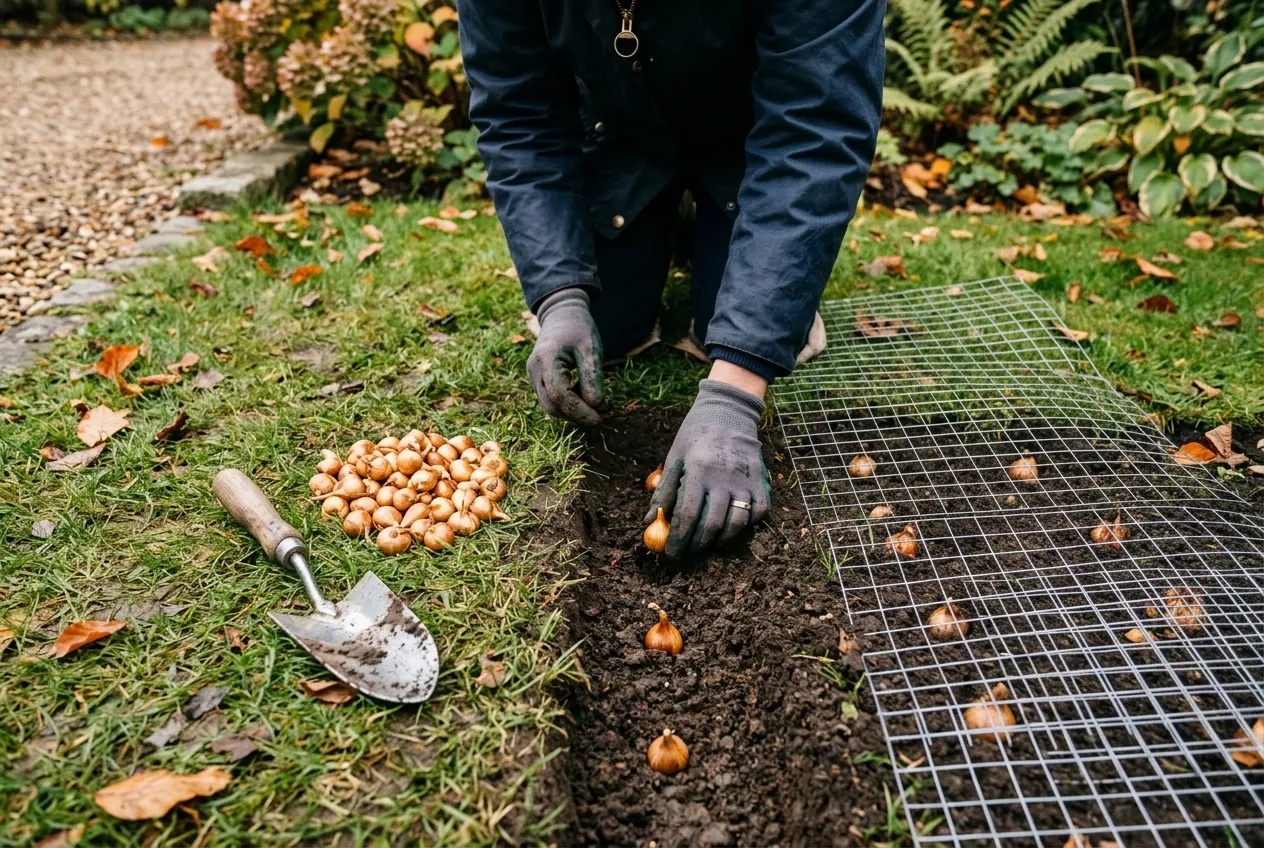
Plant crocus corms 8-10cm deep and 8cm apart from September to November for a reliable spring display
How do I naturalise crocus in a lawn?
Naturalising crocus in grass creates a stunning February display. The key is choosing the right varieties and accepting that you cannot mow for six weeks after flowering.
Planting in grass
Use a bulb planter or a narrow trowel to cut holes through the turf. Plant each corm at 8-10cm deep, replace the turf plug, and firm down. For larger areas, peel back a section of turf with a spade, fork over the soil, scatter corms, and replace the turf.
Crocus tommasinianus is the best species for lawns. It spreads by self-seeding and forms expanding carpets over three to five years. ‘Pickwick’ and ‘Remembrance’ also work well but multiply more slowly. Mix species and Dutch types for a longer display — species types flower a week or two earlier.
When to mow
Do not mow over crocus until the foliage has died back naturally, at least six weeks after flowering. In most UK gardens, this means the first mow over crocus areas is in late April or early May. Set the blade high for the first cut. If you want a tidy lawn year-round, plant crocus only in areas you can leave unmown — around the base of trees, along edges, or in a dedicated wildflower strip.
For a layered spring display in grass, combine crocus with snowdrops (January-February) and daffodils (March-April). The three together give nearly four months of colour before the grass needs cutting.
Can I grow crocus in containers?
Crocus make excellent container plants, especially the Dutch large-flowered types that give bold colour at close range. Use pots at least 15cm deep with drainage holes.
Fill with a mix of multipurpose compost and horticultural grit (roughly 3:1) for sharp drainage. Plant corms 5-8cm deep, almost touching, for a dense display. A 20cm pot holds 15-20 corms comfortably. Water once after planting and leave the pot outdoors through winter — crocus need cold to flower well.
Layered (lasagne) planting works brilliantly. Place tulip bulbs at the bottom (15cm deep), daffodil bulbs in the middle (10cm), and crocus corms near the top (5-8cm). You get three waves of flowers from a single pot, February through to May. See our guide to bulb lasagne planting for detailed layering instructions.
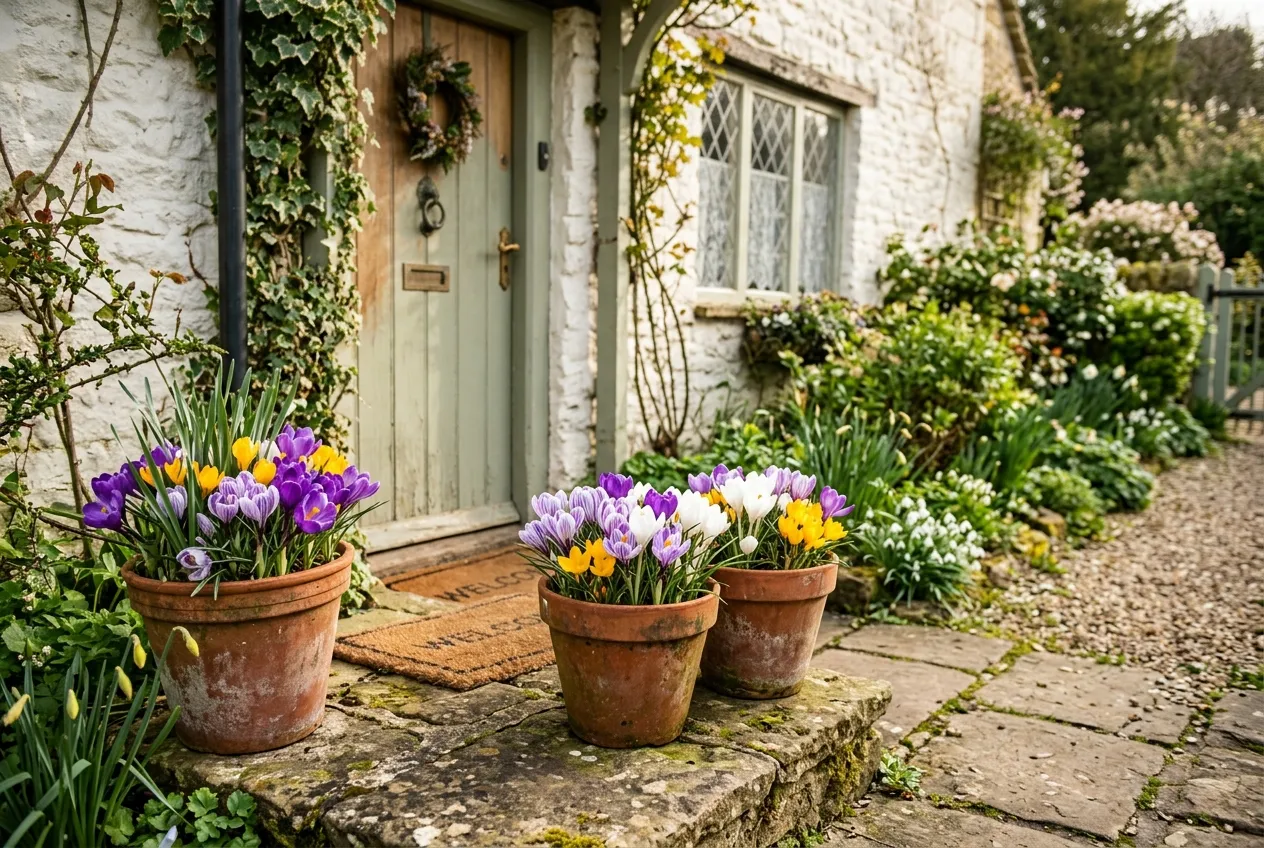
Crocus in containers bring bold spring colour to patios, doorsteps, and balconies
How do I grow autumn-flowering crocus?
Autumn crocus are an underused group that flower from October to November, filling a gap between summer perennials and winter bulbs. They produce flowers without leaves — the foliage appears the following spring.
Crocus speciosus
The easiest autumn crocus for UK gardens. Violet-blue flowers with darker veins appear in October, 10-12cm tall. It naturalises freely in well-drained soil and light shade. Plant corms in August at 8-10cm deep. Within three years, a handful of corms becomes a spreading colony.
Crocus sativus (saffron crocus)
The saffron crocus has been grown in England since the 14th century — the town of Saffron Walden in Essex is named after the crop. Each purple flower produces three red stigmas, which are the saffron threads used in cooking. You need around 150 flowers for one gram of saffron, so it is a hobby rather than a commercial enterprise.
Plant corms in July or August in a warm, sunny, well-drained position. A south-facing raised bed is ideal. The corms are hardy to -15 degrees C but need a baking summer to flower reliably. In wet, cool summers, flowering can be poor.
How do I protect crocus from squirrels and mice?
Squirrels are the main enemy of crocus corms in UK gardens. They dig up freshly planted corms in autumn and eat them. Mice and voles also take corms, particularly in rural areas.
Prevention
- Chicken wire: Lay chicken wire flat over the planted area and peg it down. Remove it as shoots appear in January. This is the single most effective deterrent.
- Deep planting: Corms planted at 10cm rather than 5cm are harder for squirrels to find by scent.
- Species crocus: C. tommasinianus and autumn-flowering types are far less attractive to squirrels than Dutch hybrids. After eight years of testing in our Staffordshire garden, we have never lost a single tommasinianus corm to squirrels.
- Interplant with daffodils: Daffodil bulbs are toxic. Squirrels learn to avoid areas where daffodils grow, which protects neighbouring crocus corms.
After 8 years of growing crocus across borders, lawns, and containers in Staffordshire, one lesson stands out: plant Crocus tommasinianus if squirrels are a problem in your area. Dutch hybrids disappear within a season in our garden. Tommasinianus not only survives but spreads. It now covers more ground than everything else combined, and the lilac carpet it produces each February draws more bumblebees than any other plant in the garden at that time of year. For best results, plant at least 50 corms in a single area — a handful looks thin.
Year-on-year care for crocus
Crocus are among the lowest-maintenance plants in any garden. Once established, they need almost nothing.
- Do not remove foliage until it has died back naturally (mid-May). The leaves feed the corm for next year.
- Feed lightly with a general-purpose fertiliser after flowering if corms are in borders or containers. Corms in grass take what they need from the soil.
- Divide congested clumps every 4-5 years by lifting in summer (once foliage has died back) and replanting immediately at the correct depth and spacing.
- Replace container compost every two years. Crocus in pots exhaust the growing medium faster than those in open ground.
For a complete guide to the best early-season plants, see our spring flowers guide.
Frequently asked questions
When should I plant crocus bulbs?
Plant crocus corms from September to November, ideally by mid-October. Earlier planting gives corms longer to develop roots before winter. You can plant as late as December in mild areas, but late-planted corms often produce shorter stems and fewer flowers in the first spring. Autumn-flowering crocus are the exception — plant these in August or early September for flowers the same autumn.
How deep do I plant crocus?
Plant crocus corms 8-10cm deep with the pointed end facing upward. In heavy clay, plant at the shallower end and add grit beneath the corm for drainage. In light sandy soil, plant at the deeper end. Shallow planting is the main cause of corms being dug up by squirrels or heaved out by frost.
Do crocus come back every year?
Yes, crocus are fully perennial and return reliably each year in UK gardens. They also multiply by producing offsets around the parent corm. A single corm becomes a clump of five or six within three years. Species crocus like C. tommasinianus also self-seed freely, creating expanding drifts over time.
How do I stop squirrels digging up crocus?
Cover freshly planted areas with chicken wire pegged flat to the ground. Remove it as shoots appear in late January. Planting 10cm deep rather than shallowly also helps. Species crocus, particularly C. tommasinianus, are far less attractive to squirrels than Dutch hybrids. Interplanting with daffodils deters digging because daffodil bulbs are toxic and squirrels learn to avoid the area.
Can I grow crocus in pots?
Yes, crocus grow well in containers at least 15cm deep with good drainage. Plant corms 5-8cm deep and almost touching for a dense display. Use gritty, free-draining compost. Water after planting and leave outdoors through winter. Species crocus and Dutch hybrids both perform well in pots, though Dutch types give bolder colour.
When can I mow grass with crocus in it?
Wait at least 6 weeks after the last crocus flowers fade before mowing. The leaves must stay intact to photosynthesise and feed the corm for next year. This usually means the first mow is in late April or early May. Set the mower blade high for the first cut. In most UK gardens, crocus foliage dies back naturally by mid-May.
Can I grow saffron crocus in the UK?
Yes, Crocus sativus grows well in southern and central England. Plant corms in July or August in a warm, sunny, well-drained spot. Each flower produces three red stigmas — the saffron threads. You need around 150 flowers to produce one gram of saffron. The corms are hardy to -15 degrees C but need hot, dry summers to flower reliably, so raised beds or south-facing borders are ideal.
Related articles
Lawrie has been gardening in the West Midlands for over 30 years. He grows his own veg using no-dig methods, keeps a wildlife-friendly garden, and writes practical advice based on real UK growing conditions.