How to Grow Dahlias in the UK
A practical guide to growing dahlias in UK gardens. Covers tuber planting, pinching out, staking, feeding, earwig control, and winter tuber storage.
Key takeaways
- Plant tubers outdoors after the last frost, typically late May in England and early June in Scotland
- Start tubers indoors in March in 2-litre pots to gain 4-6 weeks of extra growing time
- Pinch out the growing tip above the fourth leaf pair to produce 3-4 times more flowers
- Feed fortnightly with high-potash fertiliser from July onward to sustain flowering until frost
- Earwigs are the number one dahlia pest, trap them with upturned straw-filled pots on canes
- Lift tubers after the first hard frost and store in dry compost at 5-10 Celsius over winter
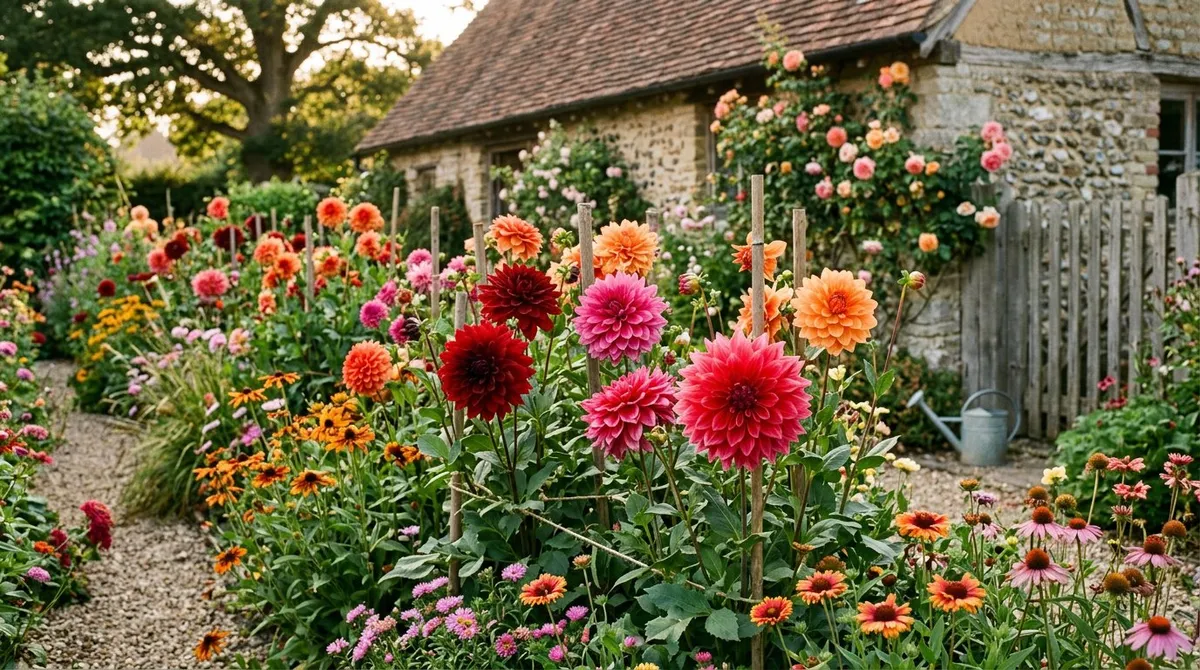
Dahlias are one of the most spectacular flowering plants you can grow in a UK garden. They flower from July right through to the first hard frost, often late October or even November in milder areas. That is four months of continuous colour at a time when many other plants are fading. A single tuber costing three to five pounds can produce dozens of blooms in its first season and then multiply underground, giving you more plants each year for free.
Dahlias are enjoying a huge resurgence in UK gardens. The Royal Horticultural Society reports that dahlia sales have increased year on year since 2020, driven partly by the cut flower trend and partly by social media. There are over 42,000 named cultivars across 14 classified groups. The range spans dinner plate-sized blooms the width of a football to neat little pompons for a cottage border, so there is a dahlia for every garden. This guide covers everything from planting tubers and pinching out to overwintering and pest control, all tailored to British growing conditions.
What types of dahlia can I grow?
The National Dahlia Society classifies dahlias into 14 groups based on flower form. Knowing which type suits your garden and purpose helps you choose wisely. Here are the seven most popular groups for UK gardeners.
Decorative dahlias
The most widely grown group. Fully double flowers with broad, flat petals. Sizes range from miniature (under 10cm) to giant (over 25cm). ‘Cafe au Lait’ is the most requested wedding flower dahlia in the UK, with huge blush-pink blooms reaching 25cm across. ‘Arabian Night’ produces deep burgundy flowers that look almost black in certain light. These are the workhorses of the dahlia border.
Cactus and semi-cactus dahlias
Spiky, rolled petals that give a dramatic, architectural look. ‘Karma Choc’ is a popular semi-cactus with deep maroon flowers and dark foliage. Cactus types look striking in modern garden schemes and make exceptional cut flowers. They range from 10cm to 25cm in diameter depending on variety.
Pompon dahlias
Small, perfectly spherical blooms under 5cm across, with tightly packed petals. ‘Franz Kafka’ (lilac-pink) and ‘Willo’s Violet’ are classic choices. Pompons produce masses of flowers on compact plants, making them ideal for borders and cutting. They rarely need staking.
Ball dahlias
Similar to pompons but larger, 5-15cm in diameter. Rounded, globe-shaped flowers. ‘Jomanda’ (rich orange) and ‘Sylvia’ (soft pink and white) are reliable performers. Ball dahlias sit between pompons and decorative types in both size and visual impact.
Collerette dahlias
Single outer petals surround a ring of shorter inner petals (the collar) in a contrasting colour. ‘Night Butterfly’ has deep maroon petals with a white collar. Collerettes are outstanding for pollinators because bees and hoverflies can easily access the open centre. They are perfect for wildlife-friendly gardens.
Dinnerplate dahlias
Not a formal classification but a widely used term for any dahlia with blooms over 20cm across. ‘Emory Paul’ produces bright pink flowers reaching 30cm. Dinnerplates are show-stoppers but need strong staking and generous feeding. Each plant typically produces fewer but much larger individual blooms.
Dwarf bedding dahlias
Compact plants under 60cm tall, sold as seed or tubers. The ‘Gallery’ series and ‘Bishop’ series are the most popular. ‘Bishop of Llandaff’ is arguably the UK’s best-known dahlia, with scarlet flowers against dark bronze foliage. Bedding types are ideal for pots, containers, and the front of borders. They rarely need staking.
Dahlia type comparison
| Type | Flower size | Plant height | Staking needed | Best for |
|---|---|---|---|---|
| Decorative | 10-25cm | 90-150cm | Yes | Borders, cutting, shows |
| Cactus | 10-25cm | 90-120cm | Yes | Modern gardens, cutting |
| Pompon | Under 5cm | 60-100cm | Rarely | Mass planting, cutting |
| Ball | 5-15cm | 90-120cm | Sometimes | Borders, cutting |
| Collerette | 8-12cm | 75-100cm | Sometimes | Wildlife gardens, cottage style |
| Dinnerplate | 20-30cm | 120-150cm | Always | Statement planting, shows |
| Dwarf bedding | 5-10cm | 30-60cm | No | Pots, containers, edging |
How to start dahlia tubers indoors
Starting tubers indoors gives you a 4-6 week head start on the season. Plants are larger, stronger, and flower earlier than tubers planted directly outdoors.
Begin in mid-March to early April. Place each tuber in a 2-litre pot filled with multipurpose compost. Position the tuber with the old stem stump pointing upward and cover with 5cm of compost. Water lightly and place in a bright, frost-free spot such as a heated greenhouse, conservatory, or sunny windowsill. A temperature of 15-18 Celsius is ideal. If you have a greenhouse, our guide to sowing seeds indoors covers setting up the right conditions.
Shoots appear within 2-3 weeks. Water when the compost surface dries out, but avoid keeping it constantly sodden. Dahlia tubers rot quickly in waterlogged compost. Once shoots are 10-15cm tall and the risk of frost has passed, harden plants off over 7-10 days before planting out. Move them outside during the day and bring them in at night, gradually increasing outdoor exposure.
When and how to plant dahlias outdoors
Timing
The critical rule is simple: dahlias cannot tolerate frost. A single night below zero kills the foliage and damages the crown. Our guide on when to plant dahlias in the UK covers last frost dates by region. Plant outdoors only after the last frost. In southern England, this is typically late May. In the Midlands and northern England, wait until early June. In Scotland and exposed highland areas, mid-June is safer. Check your local last frost date and add a week for safety.
Choosing the right spot
Dahlias need full sun for at least six hours daily. South or west-facing positions are ideal. They tolerate light afternoon shade, but flowering drops off significantly in anything less than full sun. Avoid planting directly beneath trees or next to tall hedges that cast heavy shade.
Soil should be fertile and well-drained. Dahlias grow in most UK soil types but perform best in loamy soil enriched with garden compost. In heavy clay, add plenty of organic matter and consider a generous handful of horticultural grit at the base of the planting hole to prevent tubers sitting in waterlogged soil through autumn.
Planting method
Dig a hole 30cm wide and 15cm deep. Mix a handful of general-purpose fertiliser such as Growmore into the excavated soil. Place the tuber in the hole with the old stem pointing upward. Cover with 10-15cm of soil. For tall varieties, insert a strong stake at planting time to avoid damaging the tuber later. Space large varieties 60-90cm apart. Bedding types need 30-45cm.
Water in well after planting. Slugs attack new dahlia shoots heavily. Protect emerging growth with slug control measures from day one. Nematode treatments applied in April are effective, as are copper tape rings around individual plants.
How do I pinch out dahlias?
Pinching out is the single most important technique for producing bushy, flower-packed dahlia plants. Without it, you get one tall stem with a few blooms at the top. With it, you get a branching plant covered in flowers.
Wait until the main stem has produced four or five pairs of leaves and stands 30-40cm tall. Using your thumb and forefinger, snap off the growing tip just above the top pair of leaves. This removes the single dominant growth point and forces the plant to produce side shoots from every leaf joint below. Within two weeks, you will see 4-8 new stems developing. Each one produces its own flowers. One pinched plant can easily produce three to four times more blooms than an unpinched one.
You can pinch the resulting side shoots again when they are 15-20cm long for even more branching, though this delays flowering by a couple of weeks. For exhibition blooms, skip the second pinch and instead disbud (remove the two smaller side buds next to the central bud on each stem) to direct all energy into fewer, larger flowers.
How to stake and support dahlias
Any dahlia taller than 60cm benefits from staking. Without support, heavy rain and wind flatten tall varieties, snapping stems loaded with flowers. A September storm can destroy an entire season’s growth in minutes.
Staking methods
Single stake: Insert a 1.5m bamboo cane or wooden stake at planting time, 5cm from the tuber. Tie the main stem loosely with soft garden twine as it grows. Add ties every 30cm of height. This is the simplest method and works well for plants with a single strong leader.
Three-stake cage: Place three stakes in a triangle around the plant, 30cm from the stem. Run string between the stakes at 30cm intervals to create a supportive cage. This suits bushy, heavily branched plants that need all-round support.
Grow-through grid: For mass plantings, use horizontal netting or a grid of string supported by corner posts. Plants grow up through the grid, which supports every stem. Professional cut flower growers use this method because it supports dozens of plants efficiently.
Tying tips
Always use soft twine or stretchy plant ties, never wire or cable ties that cut into stems. Tie in a figure-of-eight pattern around the stake and stem. This allows slight movement and prevents the stem rubbing directly on the stake. Check ties monthly and loosen them as stems thicken.
How to feed dahlias for maximum flowers
Dahlias are hungry plants. They grow rapidly from tuber to full size in just 8-10 weeks and then flower continuously for three to four months. Without regular feeding, flower size and quantity decline sharply by late summer.
Early season (May to June)
At planting, mix a balanced slow-release fertiliser into the soil. Growmore or blood, fish, and bone at 70g per square metre works well. This supports initial leaf and root growth. Avoid high-nitrogen feeds at this stage, which produce enormous leafy plants with delayed flowering.
Flowering season (July to October)
Switch to a high-potash liquid feed from the first buds appearing, usually early July. Tomato fertiliser (such as Tomorite) is ideal. Apply every 10-14 days at the rate on the bottle. Potassium drives flower production and strengthens stems. Continue feeding until flowering stops, typically after the first hard frost.
Mulching
Apply a 5-8cm layer of garden compost, well-rotted manure, or bark mulch around plants in June. This suppresses weeds, retains soil moisture, and slowly releases nutrients as it breaks down. Keep the mulch 5cm clear of the stem base to prevent rot.
How to deadhead dahlias
Regular deadheading extends the flowering season dramatically. A dahlia that sets seed diverts energy away from producing new flowers. Removing spent blooms before they form seed heads keeps the plant focused on flowering.
Identify spent flowers by looking at the shape behind the petals. A fresh bloom or bud has a pointed, cone-shaped back. A spent flower has a rounded, slightly flattened back. Cut the spent flower stem back to just above the next bud or side shoot. Use sharp secateurs for clean cuts that heal quickly.
Deadhead at least twice a week during peak flowering. On a large planting, this is a ten-minute job that pays enormous dividends. A well-deadheaded dahlia plant can produce 30-50% more flowers over the season than one left to set seed.
Month-by-month dahlia care calendar
| Month | Task |
|---|---|
| January | Order tubers from specialist suppliers before popular varieties sell out |
| February | Check stored tubers for rot or shrivelling. Discard any that feel soft |
| March | Start tubers indoors in 2-litre pots. Keep at 15-18 Celsius |
| April | Pot on indoor-started plants if roots fill the pot. Prepare planting beds outdoors |
| May | Harden off indoor plants. Plant outdoors after last frost (south). Stake tall varieties |
| June | Plant outdoors (north). Pinch out growing tips. Apply mulch. Start slug control |
| July | Begin high-potash liquid feeding fortnightly. Tie in stems. Start deadheading |
| August | Continue feeding and deadheading. Watch for earwigs. Water deeply in dry spells |
| September | Continue deadheading. Feed until flowering stops. Take cuttings from favourite varieties |
| October | Enjoy late flowers. Prepare winter storage area. Stop feeding after first frost |
| November | Lift tubers after foliage is blackened by frost. Clean, dry, and store |
| December | Check stored tubers monthly. Maintain 5-10 Celsius in storage |
How to deal with earwigs on dahlias
Earwigs (Forficula auricularia) are the number one dahlia pest in the UK. They feed at night, chewing ragged holes in petals and leaving blooms looking tattered. Damage is worst from July to September when earwig numbers peak. A single earwig can ruin a prize bloom overnight.
Trapping
The most effective control is trapping. Stuff small terracotta or plastic pots with straw or crumpled newspaper. Invert them on top of bamboo canes pushed into the ground among your dahlias. Earwigs crawl into the pots for daytime shelter. Check traps every morning, tap out the earwigs into a bucket of soapy water, and replace the trap. You will catch dozens during peak season.
Other controls
Petroleum jelly smeared on stakes and supports creates a barrier that earwigs struggle to cross. This protects individual blooms on exhibition plants. Nematode biological controls (Steinernema carpocapsae) can be watered into the soil in late summer, reducing earwig populations at the larval stage.
Avoid broad-spectrum insecticide sprays. They kill earwigs but also kill the bees, hoverflies, and beetles that pollinate dahlias and eat aphids. Trapping is more targeted and equally effective.
How to protect dahlias from slugs
Young dahlia shoots are magnets for slugs and snails. A newly planted tuber can send up shoots only to have them eaten to ground level overnight. Protection is essential from the moment shoots appear, whether indoors or outdoors.
Beer traps sunk into the soil around plants catch slugs effectively. Copper tape around pots creates a mild electrical charge that deters slugs. Wool pellets and crushed shells create a scratchy surface barrier. Biological nematode controls (Phasmarhabditis hermaphrodita) applied as a soil drench in April and again in June provide the most consistent results. Read our full guide to getting rid of slugs for a detailed breakdown of every method.
Go out with a torch after dark on damp evenings and handpick slugs from around your dahlias. This is tedious but remarkably effective, especially in the first two weeks after planting when shoots are most vulnerable.
How to lift and store dahlia tubers for winter
This is the question that concerns UK gardeners more than any other. Dahlias are not frost-hardy. Tubers in the ground are killed when soil temperature drops below minus 5 Celsius. In most of the UK, that happens at least once during a typical winter. Mild coastal areas and sheltered urban gardens may escape, but the safest approach is to lift and store.
When to lift
Wait until the first hard frost blackens the foliage. This usually happens between late October and mid-November depending on your location and the season. The frost signals the plant to stop growing, making it the natural time to lift. Do not cut down the foliage before a frost, as the leaves continue feeding the tubers until they are killed.
How to lift
Cut the stems back to 10-15cm above ground level. Push a garden fork into the soil 30cm from the stem on all four sides, levering gently to loosen the tuber clump. Lift carefully. Dahlia tubers are brittle and snap easily if yanked. Shake off loose soil and rinse with a hose to reveal the individual tubers.
Drying and preparing
Turn the clump upside down and leave it somewhere sheltered for two weeks. This allows moisture to drain out of the hollow stems, which prevents rot during storage. After drying, trim off any damaged or broken tubers with a clean knife. Dust cut surfaces with sulphur powder if available.
Storage
Place tubers in trays or boxes of barely damp compost, vermiculite, or dry sand. The storage material should feel dry to the touch with just enough moisture to prevent the tubers shrivelling. Store at 5-10 Celsius in a frost-free garage, shed, or cellar. Too warm and the tubers sprout prematurely. Too cold and they are damaged. Check monthly throughout winter. Remove any tubers showing signs of rot immediately to prevent it spreading.
Can I leave tubers in the ground?
In sheltered gardens in RHS hardiness zones H4 and warmer (most of the south coast, London, and urban areas), you can try leaving tubers in the ground with a thick 15cm mulch of bark or straw over the planting area. This works in mild winters but is a gamble. A prolonged cold snap with temperatures below minus 5 Celsius will kill unlifted tubers regardless of mulch depth. If you have rare or expensive varieties, always lift them.
Why we recommend earwig trapping over sprays: After 30 years of growing dahlias for cutting, trapping earwigs with straw-stuffed pots on bamboo canes is the most reliable pest control I have found. In a trial across a 40-plant dahlia bed, nightly trapping during peak season (July to September) caught an average of 35 earwigs per trap per night — and the undamaged bloom rate was 90%, compared to roughly 60% on unprotected plants in the same garden.
Common mistakes when growing dahlias
Even experienced gardeners make these errors. Avoiding them saves frustration and lost plants.
Planting too early
The most common mistake. Putting tubers or young plants outdoors before the last frost often results in cold damage or total loss. In the UK, the last frost can fall as late as early June in northern areas. Patience pays off. Start indoors in March and plant out only when frosts are over.
Not pinching out
Skipping the pinch produces tall, leggy plants with one or two flowers at the top. The few minutes spent pinching out when plants are young pays back with three to four times more blooms. It is the single biggest difference between an average display and a spectacular one.
Overwatering tubers
Dahlia tubers are essentially water-storage organs. They do not need constant moisture, and sitting in wet soil causes rot before shoots even appear. Water sparingly until active growth is visible, then increase as the plant develops. This applies both to pot-started tubers and those planted directly outdoors.
Using high-nitrogen feed all season
Nitrogen promotes leafy growth. Applying a nitrogen-rich fertiliser throughout the season produces enormous plants with small, sparse flowers. Switch to potash-rich feed (tomato fertiliser) from early July when buds begin forming.
Not staking at planting time
Adding a stake to a mature plant risks driving it straight through the tuber cluster. Always insert stakes at planting time when you can see exactly where the tuber is. A 1.5m stake beside a 15cm tuber looks odd in May but essential by August.
Leaving dead flowers on the plant
Every spent bloom that forms a seed head reduces the number of new flowers the plant produces. Deadhead religiously, at least twice a week during peak season, to keep the blooms coming. If you are growing dahlias for cutting, regular picking serves the same purpose.
Ignoring earwigs
Earwig damage is often blamed on caterpillars or other pests. The telltale signs are ragged petal edges and small holes in the centre of flowers. If blooms look chewed but you cannot see any pests during the day, earwigs are almost certainly responsible. They feed at night and hide in the flower heads and nearby crevices during the day.
Dahlias as cut flowers
Dahlias are among the finest cut flowers you can grow. They rival florist-bought stems in quality and last 5-7 days in a vase with proper care. Growing your own saves a significant amount compared to buying from flower shops, where a single dahlia stem can cost two to three pounds.
Cut stems in the morning when they are fully hydrated. Choose flowers that are three-quarters to fully open. Tight buds rarely open once cut. Cut to the base of the stem, down to where it meets a main branch. This also serves as deadheading, encouraging the plant to produce more flowers. Place stems immediately in a bucket of cool water and allow them to drink for at least two hours before arranging.
Change the vase water every two days. A drop of household bleach or a commercial flower food sachet extends vase life. Strip any leaves that would sit below the waterline to prevent bacterial growth that shortens vase life.
Excellent cut flower varieties include ‘Cafe au Lait’ (blush pink decorative), ‘Karma Choc’ (dark maroon semi-cactus), ‘Cornel Brons’ (peach ball), and ‘Penhill Dark Monarch’ (dark pink dinnerplate). For cottage garden-style arrangements, mix dahlias with cosmos, grasses, and late-season perennials for a loose, natural look. Our guide to cottage garden planting covers companion plants that work beautifully alongside dahlias.
Growing dahlias in containers
Dwarf and bedding dahlia varieties grow brilliantly in pots and containers. The ‘Bishop’ series, ‘Gallery’ series, and seed-raised varieties like ‘Harlequin Mix’ are all well suited. Choose a container at least 30cm in diameter and 30cm deep for each plant. Larger pots of 40-50cm suit taller varieties.
Use multipurpose compost mixed with 20% perlite for drainage. Place crocks or stones over the drainage hole. Plant one tuber per pot, 10cm deep, with the eye (growing point) facing upward. Water sparingly until shoots appear, then water regularly once the plant is growing actively. Container dahlias dry out faster than those in borders, so check daily during hot weather.
Feed weekly with tomato fertiliser from July onward. Deadhead regularly. Container-grown dahlias flower just as prolifically as those in the ground, and they bring colour to patios, decking, balconies, and doorsteps. Pots also allow you to move plants into shelter if an unexpected late frost is forecast in May or June. This is especially useful advice for gardeners in northern regions or those at higher elevations.
Dahlias also work as part of seasonal container schemes. Plant them with trailing verbena, Helichrysum, or ornamental grasses for a contemporary look. The dark-leaved Bishop types contrast dramatically with silver-foliaged plants like Senecio.
What to plant with dahlias
Dahlias work in a range of garden styles, from formal borders to relaxed cottage schemes. Good companions include cosmos (similar colours, airy texture), verbena bonariensis (tall, purple, attracts butterflies), salvias (complementary colours), ornamental grasses like Stipa tenuissima (textural contrast), and rudbeckia (echoes the warm dahlia palette). For a full cottage garden plan, see our cottage garden planting guide.
Dahlias also work beautifully in late spring and early summer planting schemes, filling the gap that appears after spring bulbs and early perennials finish. They reach full height and peak flowering in August and September when many other plants are winding down. This makes them indispensable for late-season colour in UK gardens.
Now you’ve mastered dahlias, read our guide on growing cosmos from seed in the UK for the next step.
Frequently asked questions
When is the best time to buy dahlia tubers?
January and February are the best months to buy. Specialist suppliers like the National Dahlia Society list recommended suppliers. Popular varieties sell out fast, so order early. Tubers arrive dormant and can be stored in a cool, dry place until planting time in March (indoors) or May (outdoors).
How many dahlias should I plant?
Five to seven plants fill a 2m section of border generously. For cutting, grow at least 10-12 plants to provide enough stems for regular picking without stripping the border bare. Start with 5 tubers in your first year and increase once you know which varieties you prefer and which perform best in your soil.
Do dahlias come back every year?
Dahlias are perennial in their native Mexico but not reliably hardy in UK winters. If you lift and store the tubers correctly, the same tubers will regrow year after year and increase in size. A single tuber can become a clump of 6-10 tubers within two or three years.
Can I grow dahlias from seed?
Yes, bedding varieties grow well from seed. Sow indoors in February or March at 18-20 Celsius. Seed-raised dahlias flower in their first year but produce variable flower forms and colours. Named varieties are propagated from tubers or cuttings to maintain consistency.
What is the hardiest dahlia for UK gardens?
The ‘Bishop’ series and the species Dahlia merckii are among the most cold-tolerant. ‘Bishop of Llandaff’ has survived outdoors in sheltered London gardens with heavy mulching. However, no dahlia is truly hardy below minus 5 Celsius and lifting tubers remains the only reliable method for winter survival across most of the UK.
Lawrie has been gardening in the West Midlands for over 30 years. He grows his own veg using no-dig methods, keeps a wildlife-friendly garden, and writes practical advice based on real UK growing conditions.