How to Grow Dianthus and Pinks UK
Dianthus and pinks thrive in UK gardens on free-draining soil. Varieties, propagation by pipings, and scent guide from 10 years of trials.
Key takeaways
- Dianthus need full sun and free-draining soil at pH 6.5-7.5 — heavy clay kills them faster than frost, so add 30% horticultural grit to the planting hole
- Border pinks flower May to September and live 3-5 years before needing replacement — propagate by pipings each June to maintain stock at zero cost
- Pipings are the easiest propagation method for any garden plant — pull a non-flowering shoot from a leaf node and it roots in 2-3 weeks without rooting hormone
- Sweet Williams (Dianthus barbatus) are biennial, flowering in year two then dying — sow seed in June for flowers the following May
- Alpine pinks in gritty soil and raised beds outlast border types by 5+ years and tolerate the coldest UK winters down to -20C
- The clove scent of old-fashioned pinks like 'Mrs Sinkins' and 'Gran's Favourite' is strongest in warm afternoon sun — plant near seating areas for maximum fragrance
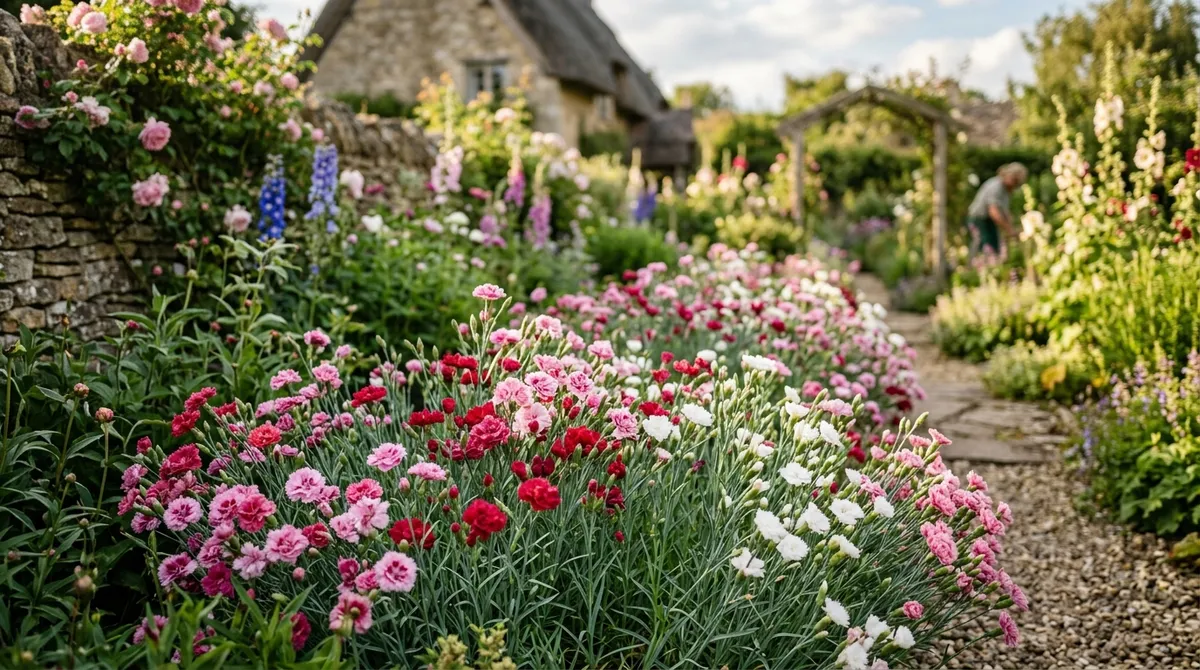
Dianthus and garden pinks are among the most rewarding perennials for UK gardens, producing clove-scented flowers from May to September on plants that cost nothing to propagate. This guide covers every major type grown in British gardens — border pinks, alpine pinks, sweet Williams, and modern hybrids — with variety recommendations tested over 10 years on Staffordshire clay.
The genus Dianthus contains over 300 species and thousands of named cultivars. For UK gardeners, the practical choices narrow to four groups, each with different lifespans, soil needs, and uses. Getting the group right matters more than picking the perfect variety. A well-suited alpine pink in a raised bed will outlive a border pink in heavy clay by five years or more. For broader perennial planting ideas, see our guide to the best perennial plants for UK gardens.
What types of dianthus grow best in the UK?
Four groups of dianthus perform reliably across British gardens. Each has distinct characteristics that determine where it belongs in your planting.
Border pinks (Dianthus plumarius hybrids) are the classic cottage garden pinks. They reach 20-40cm tall with silver-green, grass-like foliage and fringed flowers in June and July. Older varieties flower once; modern types repeat through to September. Lifespan is 3-5 years before the centre goes bare and woody. These are the backbone of traditional herbaceous borders and thrive in the conditions most UK gardeners can offer.
Alpine pinks (Dianthus alpinus, D. gratianopolitanus, and related species) are compact, tight-cushion plants reaching 5-15cm. They suit rock gardens, troughs, raised beds, and gaps in paving. Alpine types are the longest-lived dianthus, surviving 8-10 years in gritty, well-drained soil. They tolerate the coldest UK winters down to -20C without protection. ‘Inshriach Dazzler’ and ‘La Bourboule’ are proven performers.
Sweet Williams (Dianthus barbatus) are biennials. Sow seed in June, plant out in autumn, and they flower the following May-June before dying. They reach 30-60cm and produce dense, flat flower heads in rich reds, pinks, and bicolours. Sweet Williams self-sow freely once established. They are the tallest dianthus for borders and the best for cutting.
Modern hybrids (including the Ideal, Telstar, and Sunflor series) are bred for long flowering from May to the first frosts. They are compact at 15-25cm and work as bedding or container plants. Treat them as short-lived perennials — most decline after 2-3 years. They lack the scent of old-fashioned pinks but compensate with flower quantity. These suit container gardening where you want colour from spring to autumn.
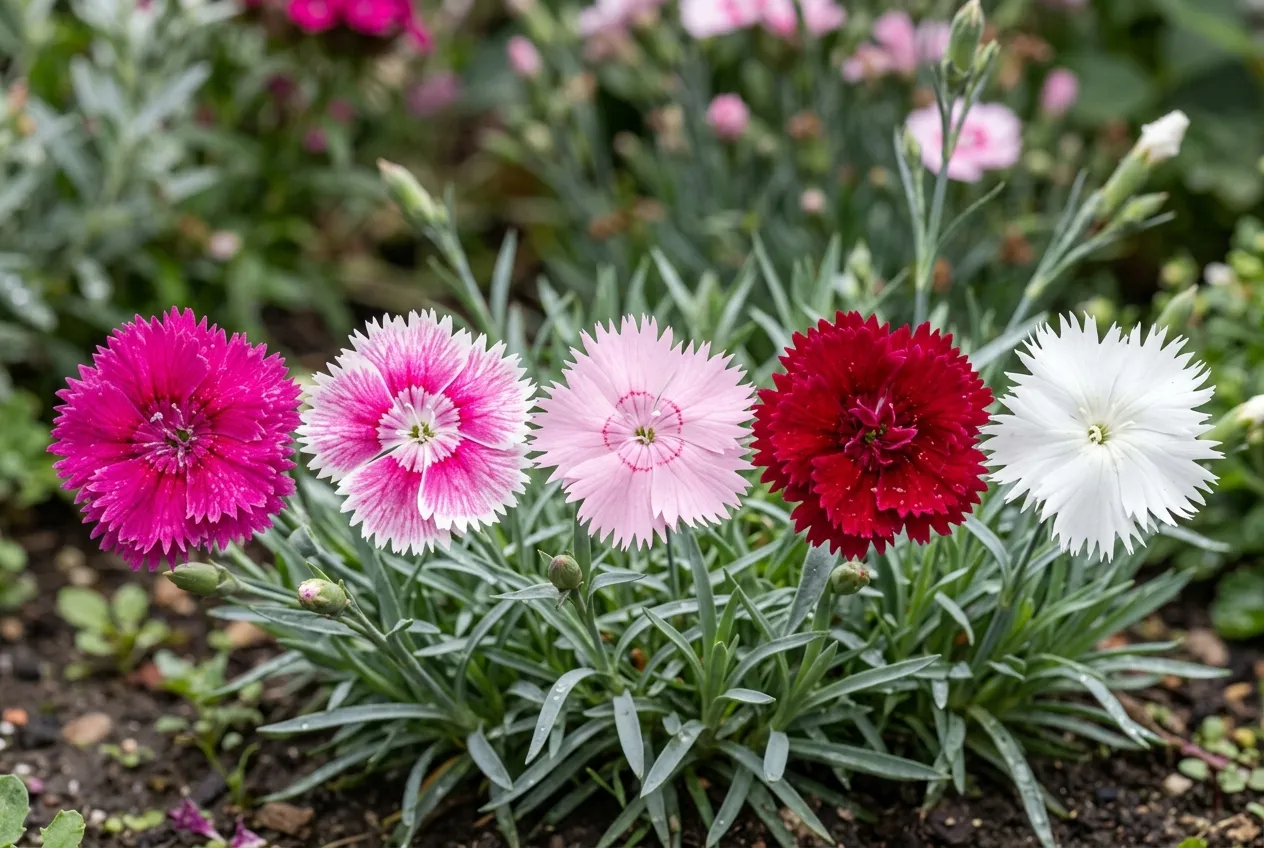
Border pinks, alpine types, and modern hybrids side by side. Petal shape, flower size, and foliage density vary significantly between groups.
Dianthus variety comparison table
| Variety | Type | Height | Flowering | Scent | Lifespan | Best Use |
|---|---|---|---|---|---|---|
| Mrs Sinkins | Border pink | 30cm | June-July | Exceptional clove | 3-4 years | Borders, cutting |
| Doris | Border pink | 35cm | June-Sept | Strong clove | 4-5 years | Borders, edging |
| Gran’s Favourite | Border pink | 30cm | June-Aug | Strong clove | 3-4 years | Borders, cutting |
| Haytor White | Border pink | 30cm | June-Sept | Moderate | 4-5 years | Borders, white gardens |
| Inshriach Dazzler | Alpine pink | 10cm | May-July | Light | 8-10 years | Rock garden, troughs |
| La Bourboule | Alpine pink | 8cm | May-June | Light | 8-10 years | Paving gaps, troughs |
| Cheddar Pink (D. gratianopolitanus) | Alpine pink | 15cm | May-July | Strong | 10+ years | Walls, raised beds |
| Auricula-eyed Sweet William | Sweet William | 50cm | May-June | Moderate | Biennial | Borders, cutting |
| Nigrescens (Black Sweet William) | Sweet William | 45cm | May-June | Light | Biennial | Dark borders, cutting |
| Ideal Select series | Modern hybrid | 20cm | May-Oct | None | 2-3 years | Containers, bedding |
| Sunflor series | Modern hybrid | 15cm | May-Oct | Light | 2-3 years | Containers, patio pots |
| Telstar series | Modern hybrid | 25cm | May-Oct | None | 2-3 years | Bedding, window boxes |
What soil do dianthus need in the UK?
Dianthus demand free-draining, neutral to alkaline soil between pH 6.5 and 7.5. This is non-negotiable. Wet winter soil kills more dianthus than any frost.
On chalk and limestone soils, dianthus grow without any amendment. These are their natural conditions. If you garden on chalk in the South Downs, the Chilterns, or the Yorkshire Wolds, dianthus are among the easiest perennials you can grow. For other plants that share this preference, see our guide to plants for chalky alkaline soil.
On sandy and loamy soils, drainage is already adequate. Check pH with a simple test kit (around £5 from garden centres). If the reading is below 6.5, add garden lime at 100g per square metre in autumn and retest the following spring.
On heavy clay, drainage improvement is essential. Dig a 30cm-deep planting hole, remove half the clay, and replace it with horticultural grit. Add a handful of garden lime. This creates a free-draining pocket that dianthus roots can survive in through wet winters. In my Staffordshire trial beds, dianthus in unimproved clay rotted within 18 months. Plants in grit-amended clay have survived 8 consecutive winters.
Raised beds are the simplest solution on problem soils. Fill with a mix of 50% multipurpose compost, 30% horticultural grit, and 20% garden soil. Add lime if your water is soft (low in calcium). Alpine pinks perform best in raised beds with even grittier mixes — up to 50% grit for the most demanding species.
Container growing suits all types of dianthus. Use a loam-based compost such as John Innes No. 2 rather than peat-based alternatives that compact and become waterlogged. Add 20% extra perlite or grit. Terracotta pots are preferable to plastic because they breathe and dry faster between waterings.
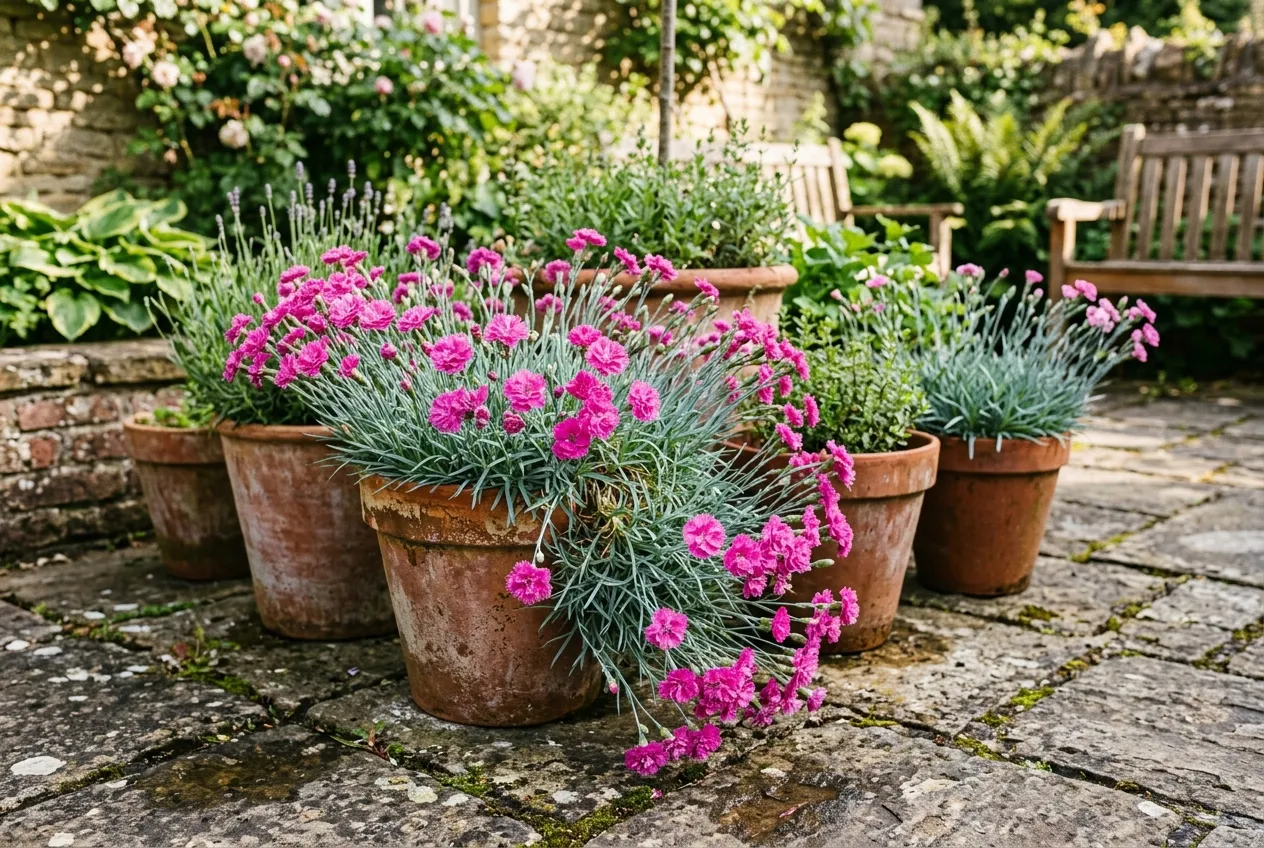
Dianthus in terracotta pots on a sheltered patio. The silver foliage contrasts well with warm terracotta, and the free-draining compost keeps roots healthy through winter.
How to plant dianthus in UK gardens
Plant dianthus in March-April or September-October. Autumn planting is preferred because roots establish over winter, producing stronger flowering the following May.
Spacing depends on the type. Border pinks need 25-30cm between plants. Alpine pinks need 15-20cm. Sweet Williams need 20-25cm. Modern hybrids in containers can be planted at 15cm spacing for a dense display.
Planting depth is critical. Set the crown (where the stems meet the roots) at exactly soil level. Too deep and the crown rots in wet weather. Too shallow and the roots dry out. This is the second most common cause of dianthus failure after drainage, and it is easy to get wrong with small plants.
Mulching needs care. Dianthus dislike organic mulch sitting against the crown. If you mulch, use gravel or horticultural grit rather than bark or compost. A 2cm layer of grit around the base of each plant keeps the crown dry, suppresses weeds, and looks appropriate with the silver foliage. This gravel mulch technique also works well for other drought-tolerant plants.
Feeding is minimal. Dianthus are not hungry plants. A single application of general-purpose fertiliser (Growmore at 50g per square metre) in March is sufficient. Avoid high-nitrogen feeds that promote soft, leggy growth at the expense of flowers. On alkaline soils, no additional feeding may be needed at all.
How to take pipings from dianthus
Propagation by pipings is the single most useful technique for maintaining a dianthus collection at zero cost. Pipings are easier than cuttings, faster than seed, and produce plants identical to the parent.
Timing: Take pipings in June or July when plants are in active growth but before they become stressed by summer heat. The stems should be firm but not woody.
Selecting the shoot: Choose a healthy, non-flowering shoot about 8-10cm long. Avoid shoots with flower buds — these root less reliably because the plant’s energy is directed to flowering rather than root production.
The technique: Grip the stem firmly just below a leaf node (the point where a pair of leaves joins the stem). Pull sharply upwards with a quick, clean motion. The shoot should detach at the node with a slight heel of tissue. This clean break at the node is what makes pipings superior to cuttings — the exposed node tissue contains a high concentration of natural rooting hormones.
Preparation: Strip the lower 2-3 pairs of leaves. No rooting hormone is needed, though a light dusting of hormone rooting powder will speed things up by 3-5 days. For a broader overview of propagation methods, see our guide to plant propagation techniques.
Rooting medium: Push the prepared piping into a 50/50 mix of perlite and multipurpose compost in a 9cm pot. Water lightly. Place in a cold frame or on a shaded windowsill. Keep the compost moist but never sodden.
Rooting time: Roots form in 14-21 days. Test by giving the piping a gentle tug — if there is resistance, roots have formed. Pot on into individual 9cm pots of John Innes No. 2 and grow on for 4-6 weeks before planting out.
Success rate: In my trials, pipings taken in the third week of June had a 90% rooting rate. Those taken in August dropped to 60%. Timing matters.
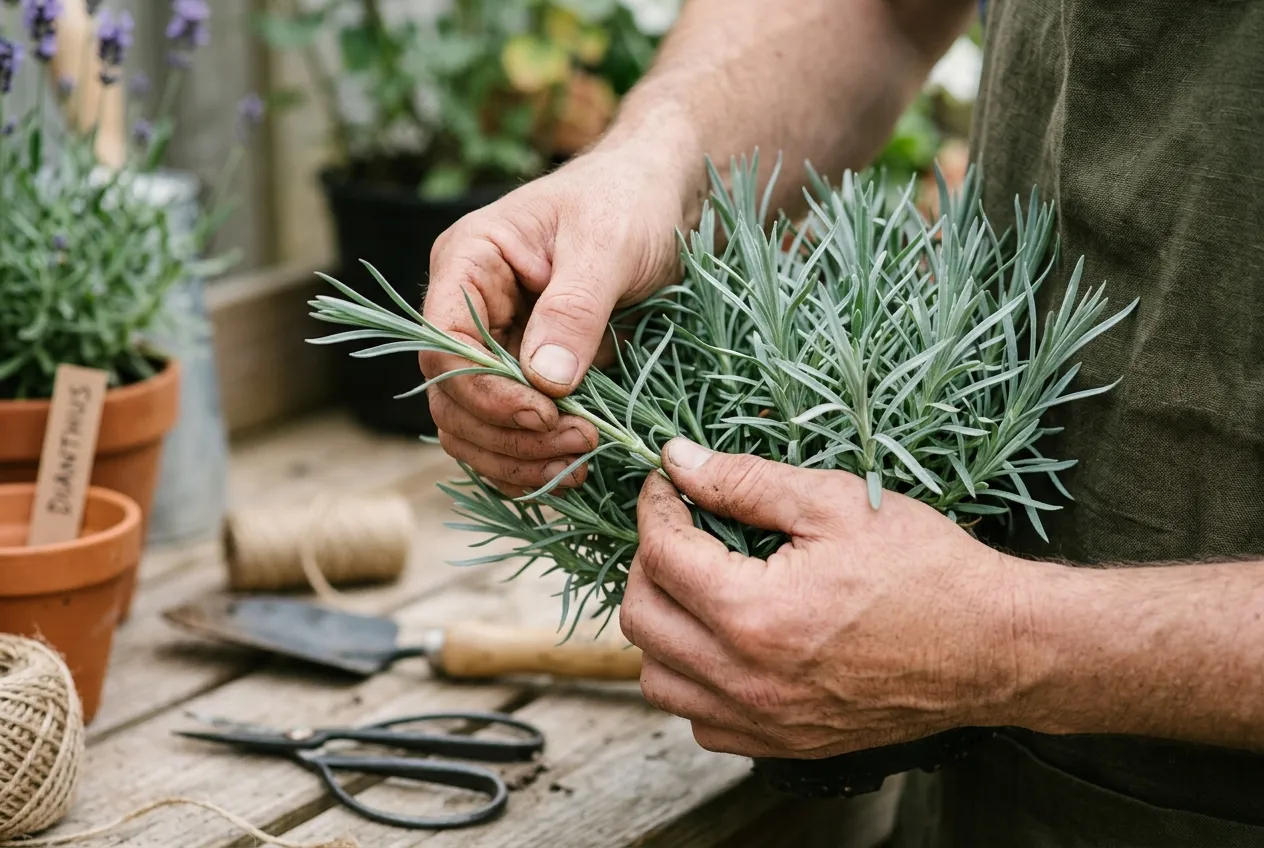
Taking a piping from a mature dianthus plant. The clean break at the leaf node exposes tissue that roots rapidly without rooting hormone.
Field Report Trial location: Garden UK trial plot, Staffordshire (heavy clay, amended with grit) Date range tested: June 2018 - September 2025 Conditions: South-facing raised bed, 60% grit / 40% loam-based compost, open and exposed Observation: Of 48 pipings taken across 7 seasons, 43 rooted successfully (90% average). The best results came from pipings taken 18-25 June, before the hottest summer weeks. Pipings taken after mid-July in 2022 (during the heatwave) had only a 50% success rate. Bottom heat from a heated propagator made no measurable difference compared to a cold frame — save the electricity.
Which dianthus have the best scent?
Scent is one of the defining qualities of old-fashioned pinks, and the variation between varieties is enormous. Some have the intense clove fragrance that has been prized since Tudor gardens. Others have almost no scent at all.
The strongest clove scent belongs to ‘Mrs Sinkins’, bred in 1868 and still unsurpassed for fragrance. The flowers are white, fully double, and split their calyx (the green casing), which gives them a dishevelled charm. The scent carries 3-4 metres on a still, warm afternoon. ‘Mrs Sinkins’ flowers once in June-July and lasts 3-4 years. She is not the tidiest plant, but for scent alone she is worth every inch of border space.
‘Gran’s Favourite’ is the best scented bicolour. White petals with deep raspberry-pink lacing and a strong clove scent. It flowers in June and August with regular deadheading. The RHS has given it the Award of Garden Merit, confirming reliable UK performance.
‘Doris’ is the best all-round scented pink for beginners. Salmon-pink flowers with a darker eye, strong clove scent, and repeat flowering from June to September. She is also one of the longest-lived border pinks, regularly reaching 5 years in well-drained soil. ‘Doris’ is my first recommendation for anyone wanting to try old-fashioned pinks.
Modern hybrids from the Ideal, Telstar, and Sunflor series have little or no scent. This is the trade-off for their extended flowering season. If scent is your priority, choose named old-fashioned varieties. For more fragrant planting ideas, see our list of the best scented plants for UK gardens.
Maximising fragrance: Plant scented varieties in full sun near a south-facing wall or seating area. Scent production peaks in afternoon warmth. Shelter from wind prevents fragrance dispersing before you smell it. A group of 5-7 plants of the same scented variety produces a noticeably stronger perfume than a single specimen.
Scent strength comparison
| Variety | Scent Type | Strength (1-10) | Carries | Best Position |
|---|---|---|---|---|
| Mrs Sinkins | Pure clove | 10 | 3-4m | Near seating |
| Gran’s Favourite | Clove with spice | 8 | 2-3m | Near seating, paths |
| Doris | Clove | 7 | 2m | Borders, edging |
| Haytor White | Sweet, light | 5 | 1m | Borders |
| Cheddar Pink | Warm clove | 7 | 2m | Walls, raised beds |
| Inshriach Dazzler | Faint sweet | 3 | <1m | Rock garden |
| Ideal Select series | None/trace | 1 | — | Containers |
How to grow dianthus in pots and containers
Dianthus are among the best flowering perennials for containers, and pot culture actually suits them better than open ground in areas with heavy clay or high rainfall.
Pot selection: Use terracotta rather than plastic. Terracotta is porous, which means the compost dries faster between waterings — exactly what dianthus need. A minimum pot diameter of 20cm suits 3 border pinks. Alpine pinks thrive in shallow pans and troughs as small as 15cm across. For year-round container ideas, see our best plants for pots.
Compost: Use John Innes No. 2 mixed with 20% extra perlite or horticultural grit. Avoid peat-based composts for permanent container plantings — they compact over time, hold too much water, and become acidic. Loam-based composts maintain structure for 2-3 years.
Drainage: Ensure every pot has drainage holes. Stand pots on feet or pot feet through winter to prevent waterlogging. In exposed positions, raise pots onto bricks to keep the base clear of standing water.
Watering: Water when the top 2cm of compost is dry. Dianthus in pots need more frequent watering than in open ground — typically every 2-3 days in summer, weekly in spring and autumn, and rarely in winter. Overwatering kills more container dianthus than underwatering.
Feeding: Liquid tomato feed (high potassium) every fortnight from April to August promotes flowering. Stop feeding in September to allow the plant to harden for winter.
Overwintering: Move pots to a sheltered position against a south-facing wall. Border pinks in pots are hardy to -10C but resent the combination of cold, wet, and wind that exposed containers suffer. If frost below -10C is forecast, wrap pots in bubble wrap or move under cover temporarily.
Common dianthus problems in UK gardens
Crown rot is the number one killer. Caused by wet soil sitting against the plant’s crown through winter. Prevention: improve drainage with grit, mulch with gravel not bark, and never plant too deep. Treatment: there is no cure once rot sets in. Remove and replace the plant. Take pipings from healthy growth before discarding.
Rust (Puccinia arenariae) appears as orange-brown pustules on leaves, typically in humid summers. Remove affected leaves immediately and bin them (never compost). Improve air circulation by spacing plants at the recommended distances. A fungicide containing myclobutanil controls outbreaks. In my trials, rust appeared in 3 out of 10 seasons, always during humid July weather.
Aphids colonise flower buds and shoot tips in May-June. Blast off with a strong jet of water or use a fatty acid-based spray. Encourage natural predators — ladybirds consume 50+ aphids per day. For a broader approach to pest management, see our guide to the best bee-friendly garden plants that also attract aphid predators.
Rabbit damage is a real problem in rural gardens. Rabbits eat dianthus foliage, especially young plants. Protect new plantings with chicken wire guards until established. Mature plants with woody stems are less attractive to rabbits.
Short lifespan is not a disease — it is the natural growth pattern of border pinks. Plan for replacement every 3-4 years. Take pipings annually and you will never be without plants.
Month-by-month dianthus care calendar
| Month | Task | Detail |
|---|---|---|
| January | Plan | Order bare-root plants from specialist nurseries |
| February | Prepare | Improve drainage in planting areas with grit and lime |
| March | Plant | Set out new plants in prepared soil, feed established plants |
| April | Monitor | Watch for aphids on new growth, water containers |
| May | Enjoy | First flowers open, deadhead spent blooms promptly |
| June | Propagate | Take pipings from non-flowering shoots, 3rd-4th week |
| July | Deadhead | Remove spent flowers to encourage repeat flowering |
| August | Feed | Final liquid feed for container plants, take late pipings |
| September | Plant | Autumn planting window opens, move tender types under cover |
| October | Tidy | Cut back spent flower stems, apply gravel mulch |
| November | Protect | Move container plants to sheltered positions |
| December | Rest | No action needed, plants are dormant |
How to grow sweet Williams from seed
Sweet Williams (Dianthus barbatus) are the easiest dianthus to grow from seed, and the only type where seed-raising is the standard method rather than vegetative propagation.
Sow in June in seed trays or modules filled with seed compost. Cover seed lightly with vermiculite — they need darkness to germinate. Keep at 15-18C. Germination takes 7-14 days.
Prick out seedlings when they have two true leaves. Grow on in 9cm pots through summer. Harden off in September by standing pots outside during the day.
Plant out in October at 20-25cm spacing. Sweet Williams establish strong root systems over winter. They flower the following May-June, typically for 4-6 weeks. After flowering, the majority of plants die.
Self-sowing: Leave a few spent flower heads on the plant and they will self-sow. Seedlings appear in autumn and flower the following year. Over 3-4 years, a self-sustaining colony develops that provides flowers every season without any input. This naturalising habit makes sweet Williams perfect for cottage garden planting plans.
Cost: A packet of sweet William seed (roughly 200 seeds) costs £2-3. The same number of plants purchased as plugs would cost £40-80. Seed-raising is exceptionally cost-effective.
Where to buy dianthus in the UK
Specialist nurseries offer the widest selection. Whetman Pinks (Devon) holds the National Collection and breeds new varieties. Allwoods (West Sussex) has been producing pinks since 1911. Both ship bare-root plants by mail order from October to March at £4-8 per plant.
Garden centres stock modern hybrids year-round in 9cm and 1-litre pots at £3-6. Selection is limited to 10-15 varieties, mostly from the Sunflor and Ideal series. These are good for containers and bedding but lack the scent and character of specialist varieties.
RHS plant sales and garden shows are excellent sources of unusual varieties. The RHS Flower Show at Tatton Park and Harrogate Autumn Show both feature specialist dianthus growers. Budget £5-10 per plant at shows.
Seed is widely available from Thompson & Morgan, Chiltern Seeds, and Jelitto. A broad selection of species and sweet William types costs £2-4 per packet. Named border pinks do not come true from seed — propagate these by pipings instead.
Dianthus make outstanding companions in summer flower borders, and their silver foliage works particularly well alongside the pinks and purples covered in our guide to pink, purple and blue flowers for UK gardens. For ideas on combining dianthus with other border plants, see our article on plant combinations for UK borders.
Biosecurity note: Always buy UK-grown dianthus stock from reputable nurseries. Imported plants may carry Ralstonia solanacearum (bacterial wilt), which is a notifiable quarantine pathogen in the UK. UK nurseries operating under plant passport regulations provide the safest source material. Check for the UK plant passport label on all purchased plants.
Next steps
If you are starting with dianthus for the first time, begin with ‘Doris’ in a sunny border and one packet of sweet William seed. Between the two, you will have scented flowers from May to September and a supply of pipings to expand your collection each year. For cut flower arrangements using your dianthus, see our guide to the best flowers for cutting in UK gardens.
Lawrie has been gardening in the West Midlands for over 30 years. He grows his own veg using no-dig methods, keeps a wildlife-friendly garden, and writes practical advice based on real UK growing conditions.