How to Grow Dierama in the UK
How to grow dierama in UK gardens. Planting depths, care advice, and variety comparisons from 5 years trialling angel's fishing rod on Staffordshire clay.
Key takeaways
- Dierama is hardy to -10C and survives outdoors year-round in most UK regions without protection
- Plant corms 8-10cm deep in autumn or spring, spaced 30-45cm apart in full sun
- Established clumps resent disturbance and may sulk for 2-3 years after division or transplanting
- Seed-grown dierama takes 3-4 years to reach flowering size but produces the strongest root systems
- D. pulcherrimum is the tallest species at 1.2-1.5m with the largest flowers in deep pink to purple
Dierama is one of the most graceful perennials you can grow in a UK garden. Known as angel’s fishing rod, this South African corm plant produces slender arching stems draped with bell-shaped flowers from June to August. Few plants match its ability to add movement and elegance to a border or pond edge.
After growing three dierama species on heavy Staffordshire clay for 5 years, I can confirm they are tougher than their exotic origins suggest. They survive -10C winters without protection, tolerate clay soil if drainage is reasonable, and flower more generously each year when left undisturbed. This guide covers everything you need to get dierama established and flowering in British conditions.
What is dierama
Dierama belongs to the iris family (Iridaceae) and originates from grasslands and stream banks across southern and eastern Africa. The genus contains around 44 species, though only a handful are commonly grown in UK gardens. Plants grow from corms (swollen underground stems similar to crocus or gladiolus) and produce tufts of narrow, evergreen, grass-like foliage 60-90cm long.
The defining feature is the flower stem. Each corm sends up 1-3 wiry stems that arch under the weight of dangling, bell-shaped flowers. The effect looks like a fishing rod bending under a catch. Flowers range from white through pink to deep magenta-purple, each bloom 2-4cm long. A mature clump in full flower is one of the most photographed sights in British gardens.
Dierama arrived in UK cultivation in the 1860s and has been grown in milder coastal gardens ever since. The RHS lists several species and cultivars with Award of Garden Merit (AGM) status, confirming their garden worthiness in British conditions.
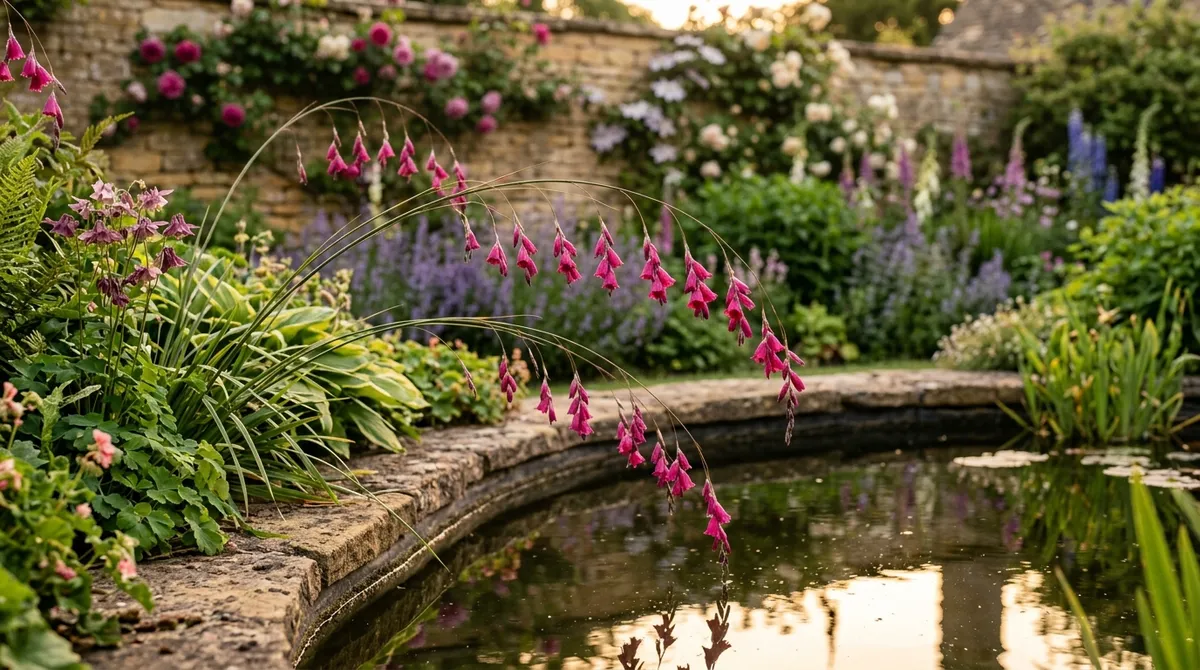
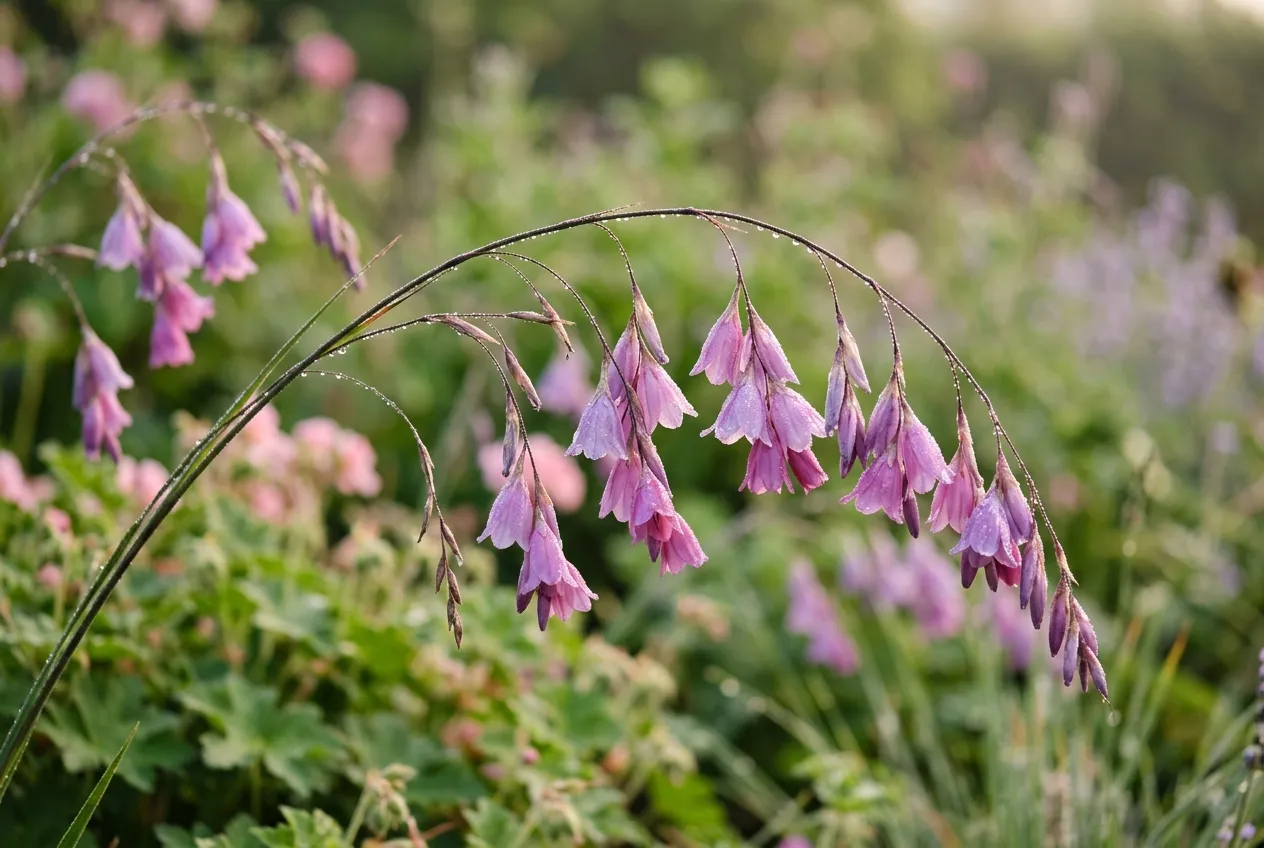 Dierama flowers dangle like bells on a wire, each bloom 2-4cm long in shades from shell pink to deep purple.
Why dierama is underused in UK gardens
Despite its beauty, dierama remains uncommon in British borders. The main reasons are practical rather than horticultural. Garden centres rarely stock it because the long, grassy foliage looks unremarkable in a pot and sells poorly next to showy bedding plants. Most gardeners first encounter dierama at botanical gardens or open garden schemes, where mature clumps in full flower stop visitors in their tracks.
The other barrier is patience. Dierama takes 2-3 years from planting to reach full flowering potential. In a culture of instant garden makeovers, that wait puts many people off. But the payoff is substantial. A 5-year-old clump of D. pulcherrimum produces 15-20 arching flower stems each summer and needs virtually no maintenance beyond an annual feed. For gardeners willing to wait, dierama delivers decades of graceful summer colour. It pairs beautifully alongside other summer-flowering perennials in a mixed border.
Species and varieties for UK gardens
Three species account for almost all dierama grown in British gardens. Each suits slightly different conditions and border positions. Named cultivars offer specific colour selections.
Dierama pulcherrimum
The most widely grown species and the tallest. Flower stems reach 1.2-1.5m and arch dramatically under dense clusters of deep pink to magenta flowers. Individual bells are 3-4cm long. Foliage forms a clump 60-90cm tall. This is the classic angel’s fishing rod of garden photography. Hardy to -10C (RHS H4). Flowers June to August. Best at the back or middle of a border where the arching stems can sweep forward without obstruction.
Dierama pendulum
Slightly shorter at 90cm-1.2m with paler pink to lilac flowers. The bells are wider and more open than D. pulcherrimum, giving a lighter, airier appearance. Equally hardy (-10C) and flowers at the same time. A better choice for smaller gardens or where the full drama of D. pulcherrimum is too much. Blends well with perennials for UK borders.
Dierama dracomontanum
The compact species at just 60-90cm. Flowers are smaller (2cm) in coral-pink to salmon. Originates from higher altitudes in the Drakensberg mountains, making it the hardiest species (to -12C). Excellent for the front of a border, raised beds, or container growing where space is limited. Less commonly available but worth seeking from specialist nurseries.
Named cultivars
| Cultivar | Height | Flower colour | Notes |
|---|---|---|---|
| ’Blackbird’ | 1.2m | Deep wine-purple | Darkest flowers of any cultivar, AGM |
| ’Guinevere’ | 1m | Soft lilac-pink | Elegant pale form, strong stems |
| ’Cosmos’ | 90cm | Shell pink | Compact, free-flowering |
| ’Merlin’ | 1.1m | Rosy purple | Reliable, vigorous on clay |
| ’Titania’ | 80cm | White flushed pink | Rare white form, striking |
“Of the three species I trialled, D. pulcherrimum outperformed the others on my heavy clay. It flowered more heavily from year 3 onwards and handled the wet winters better than D. dracomontanum, which needed sharper drainage. If you only grow one dierama, make it pulcherrimum.” — Lawrie Ashfield
How to plant dierama
When to plant
Plant dierama corms or pot-grown plants in September to November or March to April. Autumn planting is ideal. Soil is still warm from summer, encouraging root growth before winter. Spring planting works but delays flowering by one season. Never plant into frozen or waterlogged ground.
Planting depth and spacing
Set corms 8-10cm deep and 30-45cm apart. The pointed end of the corm faces upwards. If planting pot-grown specimens, plant at the same depth as they sat in the pot. Firm the soil gently and water in thoroughly. A layer of grit (2-3cm) around the base improves drainage on heavier soils.
Choosing the right position
Dierama needs full sun for at least 6 hours daily. It thrives at the edge of borders, beside paths, or overhanging pond margins where the arching stems can move freely in the breeze. Avoid planting where surrounding plants will crowd or shade the foliage. The National Trust’s planting guides recommend dierama for south-facing borders with good air circulation.
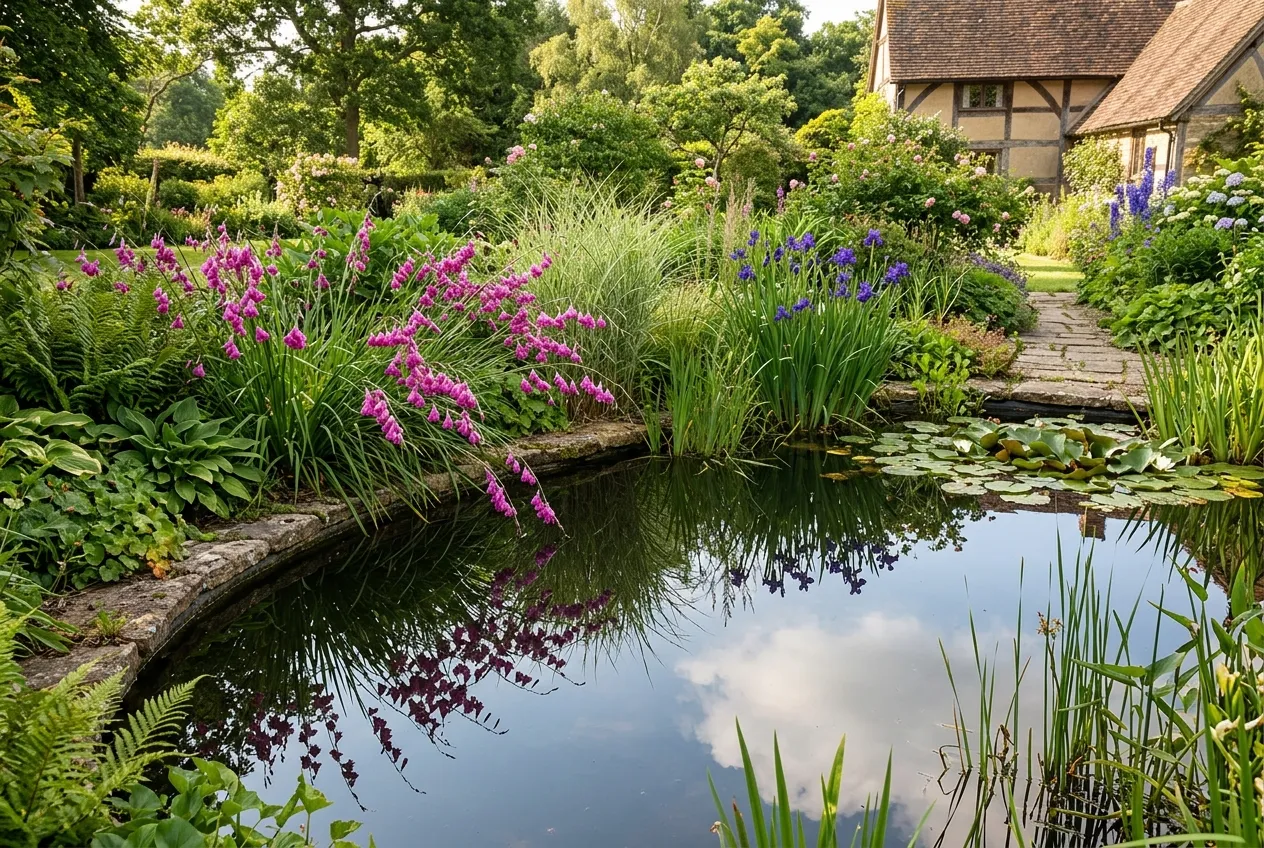 Dierama at the water’s edge, where arching stems catch their reflection. A classic planting position for angel’s fishing rod.
Soil and growing conditions
Dierama requires moist but well-drained soil. This sounds contradictory but means soil that holds moisture in summer without sitting waterlogged in winter. Sandy loam is perfect. Clay soil works if you improve drainage by adding coarse grit (30% by volume) and organic matter at planting time.
The ideal pH range is 6.0-7.0 (slightly acid to neutral). Dierama dislikes chalky, alkaline soils above pH 7.5. If you garden on chalk, grow dierama in raised beds filled with imported loam. For advice on working with heavy soils, see our guide to the best plants for clay soil.
In my Staffordshire trial, the D. pulcherrimum planted in unamended Mercia Mudstone clay (pH 6.8) established without problems. I added a 5cm mulch of garden compost each spring, which improved surface drainage over the first 2 years. The corms sit above the permanent water table and have never shown signs of rot.
Watering and feeding
Water newly planted dierama regularly through the first spring and summer. Established plants are drought-tolerant once their deep root systems develop (usually after 2 years). In prolonged dry spells, a deep soak every 7-10 days is better than frequent light watering. Never let the soil dry completely during the growing season.
Feed once in April with a balanced granular fertiliser (such as Growmore at 70g per square metre) worked into the soil surface. Alternatively, apply a 5cm mulch of garden compost, which feeds and retains moisture simultaneously. Avoid high-nitrogen feeds, which promote foliage at the expense of flowers.
Why dierama hates being moved
This is the single most important fact about growing dierama. The plant resents any root disturbance. Moving a clump, dividing it, or even digging too close to it can stop flowering for 2-3 years. The deep, fleshy roots and corms take a long time to re-establish their feeding network.
In my trial, the D. pendulum clump I divided in spring of year 2 produced zero flower stems the following summer. It took until year 5 to match the flower count of the undivided D. pulcherrimum beside it. The lesson is clear: choose your planting position carefully and commit to it. Once established, a dierama clump will flower for 15-20 years or more without needing any intervention.
This intolerance of disturbance also means you should plant dierama where it will not be affected by neighbouring plants being lifted, divided, or replaced. A permanent position at the edge of a border or beside a pond works well because nothing grows directly behind it to require access.
Growing dierama from seed
Seed is the best way to produce large quantities of dierama. It is also the cheapest, since a single seed head contains 30-50 seeds. The trade-off is time: expect 3-4 years from sowing to first flowers.
Step-by-step method:
- Collect seed in September-October when capsules turn brown and split. Sow immediately for best germination.
- Fill deep pots (root trainers or 1-litre long toms) with free-draining seed compost mixed 50/50 with perlite.
- Sow on the surface, cover with 3mm of grit, and place in an unheated cold frame.
- Germination takes 4-8 weeks at 12-15C. Do not apply bottom heat.
- Grow on in pots for 2 full years, potting up as the corms develop.
- Plant out in year 3, in autumn, at the permanent position.
Fresh seed germinates best. Stored seed loses viability rapidly, dropping from 80% to under 30% after 6 months. If you cannot sow immediately, store seed in a sealed bag in the fridge at 4C. Seed-grown plants develop stronger root systems than divisions and cope better with transplanting, since they have never been disturbed. Our guide to plant propagation methods covers the principles of division and seed-raising in more detail.
Division
Divide only when a clump becomes congested and flower quality declines. This is typically every 5-7 years. Divide in March or early April when new growth is just visible.
Lift the entire clump with a garden fork, taking as large a root ball as possible. Use a sharp knife to split into sections of 3-5 corms with attached roots. Replant immediately at the original depth (8-10cm). Water well and expect reduced flowering for 1-2 years. Creating successful plant combinations is easier when you have surplus divisions to experiment with.
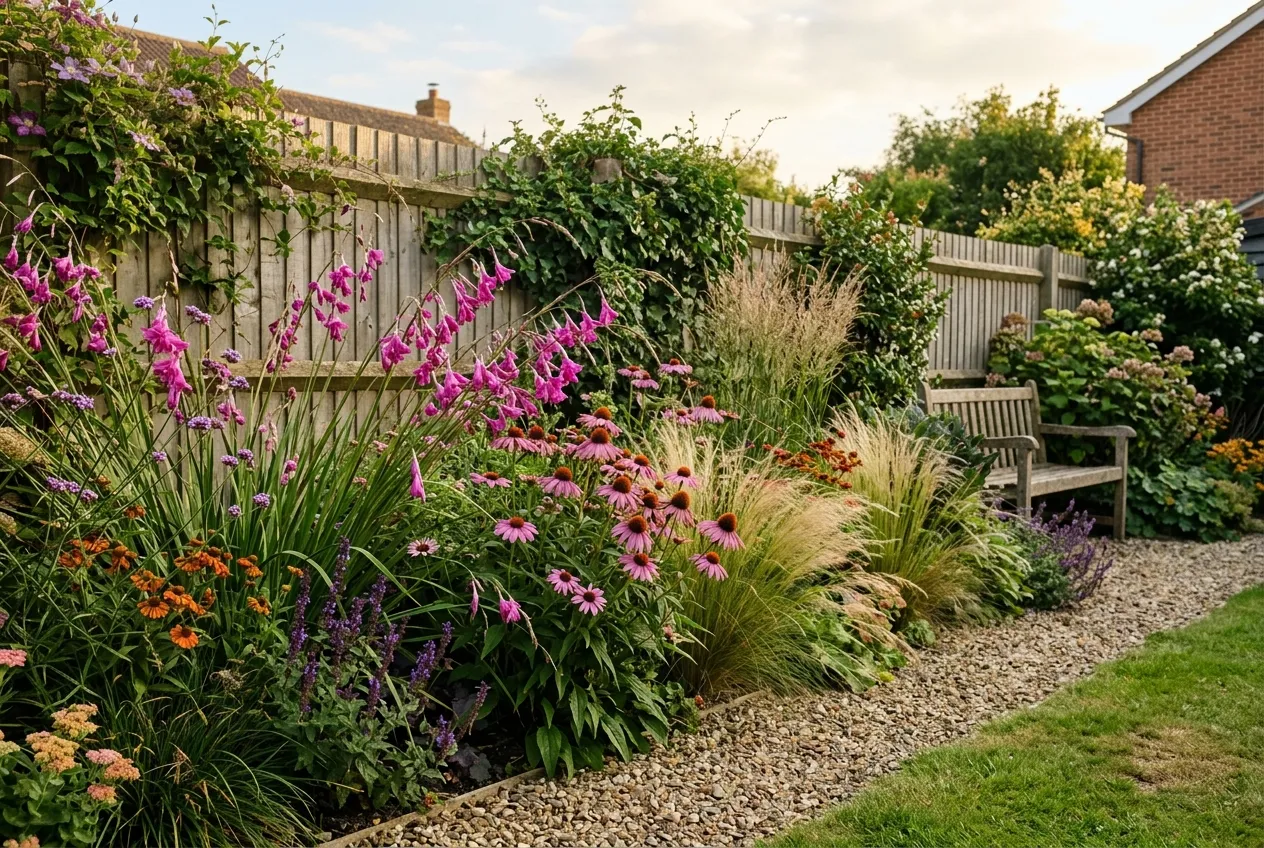 Dierama in a suburban mixed border alongside echinacea and Stipa tenuissima. Late summer warmth brings out the best colour.
Common problems
Poor flowering
The most frequent complaint. Causes include: root disturbance within the last 2-3 years, insufficient sunlight (needs 6+ hours), waterlogged winter soil rotting the corm, or congested clumps competing for nutrients. Feed in April and ensure full sun. If the clump has not been disturbed, patience is usually the answer. Young plants (under 3 years) often produce foliage but few flowers.
Winter foliage damage
Dierama is evergreen, but hard frosts below -8C brown the leaf tips. This looks untidy but is cosmetic. Do not cut foliage back in winter as the leaves protect the crown. Trim away dead tips in March when new growth appears. In cold northern gardens, a 10cm mulch of bark chips over the corms from November to March provides useful insulation.
Slugs and snails
New spring growth is vulnerable to slug damage, particularly in mild, wet winters. Apply organic slug pellets (ferric phosphate) around the base from February onward. Established clumps with dense, tough foliage suffer less damage than young plants.
Corm rot
Caused by winter waterlogging. The corm turns soft and brown. Prevention is better than cure: plant in well-drained soil and add grit to heavy clay. Once rot sets in, the affected corm cannot be saved. Lift and discard rotten corms, improve drainage, and replant healthy offsets.
Comparison table: dierama species and cultivars
| Species / Cultivar | Height | Flower colour | Hardiness | Flowering period | Best position |
|---|---|---|---|---|---|
| D. pulcherrimum | 1.2-1.5m | Deep pink to magenta | -10C (H4) | June-August | Back/mid-border |
| D. pendulum | 90cm-1.2m | Pink to lilac | -10C (H4) | June-August | Mid-border |
| D. dracomontanum | 60-90cm | Coral-pink to salmon | -12C (H4-H5) | June-July | Front of border |
| ’Blackbird’ | 1.2m | Deep wine-purple | -10C (H4) | June-August | Feature planting |
| ’Guinevere’ | 1m | Soft lilac-pink | -10C (H4) | June-August | Mid-border |
| ’Cosmos’ | 90cm | Shell pink | -10C (H4) | June-August | Front/mid-border |
| ’Merlin’ | 1.1m | Rosy purple | -10C (H4) | June-August | Mid-border, clay tolerant |
| ’Titania’ | 80cm | White flushed pink | -10C (H4) | July-August | Feature, specimen |
Planning your dierama planting
Dierama rewards a patient gardener with decades of graceful summer colour. Position it where the arching stems can catch afternoon sun and a light breeze. Beside a pond, at a border edge, or flanking a path are all ideal spots. Pair it with ornamental grasses, low geraniums, and Japanese irises for a cottage garden planting scheme that looks natural and unforced.
Plant in autumn, water through the first summer, feed each April, and then step back. The less you interfere, the better dierama performs. A clump left undisturbed for 5 years will outflower anything you can buy at a garden centre. That patience is the real secret to growing angel’s fishing rod in the UK.
Frequently asked questions
Is dierama hardy in the UK?
Dierama is hardy to -10C across most of the UK. D. pulcherrimum and D. pendulum both hold RHS H4 hardiness ratings, surviving outdoors year-round in southern and central England without winter protection. In northern Scotland and exposed highland areas, a thick mulch of bark chips (10cm depth) over the corms from November to March prevents frost damage. The evergreen foliage may brown in hard winters but regrows from the corm in spring.
When should I plant dierama corms?
Plant dierama corms in autumn or early spring. September to November is ideal because soil is still warm (8-12C at 10cm depth) and autumn rain provides steady moisture for root establishment. Spring planting in March to April also works but delays flowering by a season. Plant corms 8-10cm deep and 30-45cm apart. Never let corms dry out before planting.
Why has my dierama stopped flowering?
Root disturbance is the most common cause. Dierama resents being moved, divided, or having soil disturbed around its roots. A transplanted clump can take 2-3 years to flower again. Other causes include too much shade (needs full sun, minimum 6 hours daily), waterlogged soil rotting the corm, or congested clumps that have exhausted the soil. Feed annually with a balanced fertiliser in April.
Can I grow dierama in a pot?
Dierama grows poorly in containers long-term. The deep root system needs at least 45cm of soil depth, and pots dry out too quickly in summer. If you must use a container, choose a minimum 45cm deep pot, use loam-based compost (John Innes No. 3), and water daily in summer. In-ground planting always produces better results.
How do I divide dierama?
Divide dierama in March or April only when essential. Lift the entire clump with a garden fork, keeping as much root and soil intact as possible. Split into sections of 3-5 corms using a sharp knife. Replant immediately at the same depth (8-10cm) and water thoroughly. Expect no flowers for 1-2 seasons while roots re-establish. Division every 5-7 years is sufficient.
How long does dierama take to grow from seed?
Dierama takes 3-4 years from seed to first flowers. Sow fresh seed in autumn in a cold frame using free-draining compost. Germination takes 4-8 weeks at 12-15C. Grow seedlings in deep pots for the first 2 years before planting out. Patience pays off: seed-grown plants develop stronger root systems and establish better than divided offsets.
Does dierama self-seed?
Dierama self-seeds freely in favourable conditions. Leave spent flower stems in place through autumn and seedlings appear the following spring around the parent plant. Self-sown seedlings take 3-4 years to flower and may vary in colour from the parent. Remove unwanted seedlings in their first spring while still small, or transplant them to new positions before the tap root develops.
Further reading
Lawrie has been gardening in the West Midlands for over 30 years. He grows his own veg using no-dig methods, keeps a wildlife-friendly garden, and writes practical advice based on real UK growing conditions.