How to Grow Flowering Cherry UK
How to grow a flowering cherry in the UK. Covers Kanzan, Amanogawa, weeping cherry, and 9 varieties with planting, pruning, and disease advice.
Key takeaways
- Flowering cherries range from 4m compact trees to 12m spreading specimens, so there is one for every UK garden size
- Prune only in June to August to prevent fatal silver leaf disease entering through winter wounds
- Amanogawa is the best columnar cherry for narrow spaces at just 2m wide and 7m tall
- Prunus Autumnalis flowers from November to March, providing blossom when nothing else blooms
- All flowering cherries thrive in well-drained soil and full sun across the entire UK
- Most varieties live 40-60 years and need minimal maintenance beyond summer pruning
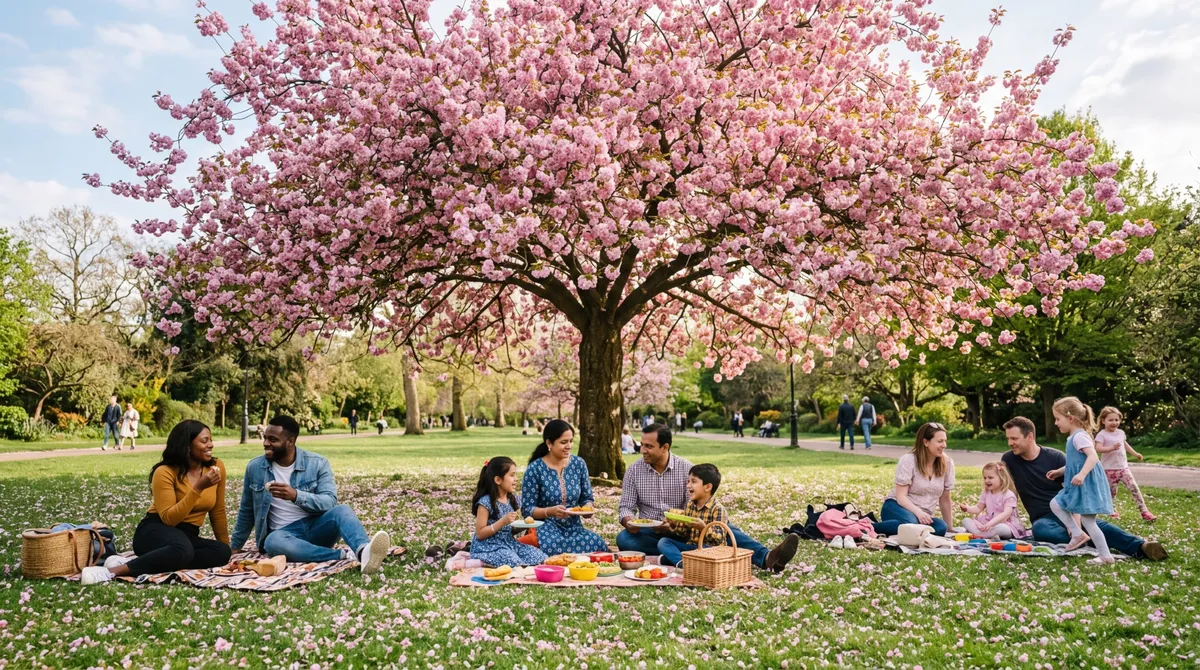
Flowering cherry trees produce the most spectacular spring blossom of any tree grown in British gardens. A mature Prunus Kanzan in full bloom carries thousands of double pink flowers along every branch, visible from 200 metres away. These are the trees that stop traffic in suburban streets each April and draw crowds to parks across the country.
The genus Prunus includes over 400 species, but UK gardeners choose from roughly a dozen reliable varieties. They range from the columnar Amanogawa at just 2m wide to the spreading Tai-haku at 10m across. There are weeping forms, upright forms, white flowers, pink flowers, and even a variety that blooms through winter. This guide covers the best varieties for UK gardens, how to choose the right size, planting, aftercare, pruning, and dealing with common problems.
What type of flowering cherry suits your garden?
Flowering cherries fall into four growth habits. Understanding these is the fastest way to narrow your choice.
Spreading types form the classic rounded or vase-shaped crown. Kanzan, Tai-haku, and Shirotae all grow this way. They reach 8-12m tall and 8-10m wide at maturity. These need space. A Kanzan planted 3m from a house will cause problems within 15 years. Plant spreading types at least 6m from buildings and boundaries.
Columnar types grow upright with a narrow crown. Amanogawa is the classic example, reaching 7m tall but only 2m wide. This habit makes columnar cherries ideal for small gardens, front gardens, driveways, and narrow borders where a spreading tree would overwhelm the space.
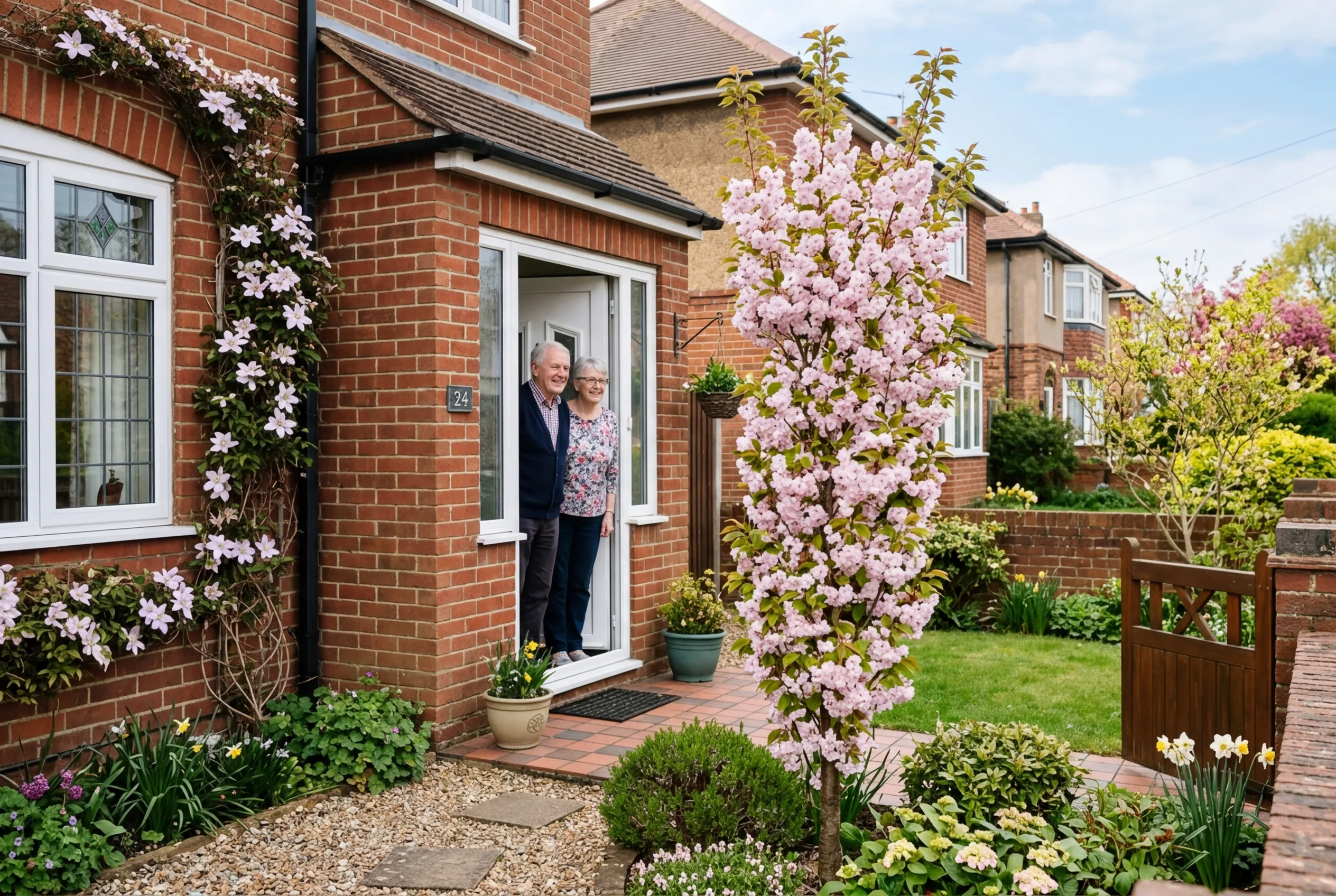 Prunus Amanogawa: the perfect flowering cherry for a small front garden. Just 2m wide at maturity.
Weeping types have pendulous branches that cascade towards the ground. Kiku-shidare-zakura (Cheal’s weeping cherry) is the most common, reaching just 3-4m tall. Weeping cherries make stunning focal points in lawns and borders. They need a clear area beneath them of at least 3m diameter.
Compact types stay naturally small without pruning. Okame reaches 4-5m and Prunus incisa Kojo-no-mai grows to just 2.5m. These suit containers, small borders, and gardens where space is tight. Kojo-no-mai is one of the few flowering cherries that works in a large pot on a patio.
Best flowering cherry varieties for UK gardens
Prunus Kanzan
The most widely planted flowering cherry in the UK. Double pink flowers smother every branch in late April to May. The blossom is so dense that the branches are invisible beneath it. Young leaves emerge bronze-copper, maturing to green. Ultimate height 8-10m, spread 8m. Hardy throughout the UK. RHS Award of Garden Merit holder. The only downside is its vigour; this tree needs space.
Prunus Tai-haku (great white cherry)
The largest single white flowers of any cherry, reaching 6cm across. Blooms in mid-April. Young leaves emerge copper-red, creating a striking contrast against the white petals. This variety was thought extinct in Japan until a specimen was found growing in a Sussex garden in 1923. Ultimate height 8-12m, spread 8-10m. RHS AGM. Magnificent as a specimen tree in a large lawn.
Prunus Amanogawa
The columnar flowering cherry. Grows bolt upright to 7m with a spread of just 2m. Semi-double pale pink flowers in late April to early May. Fragrant. Young leaves are bronze-green. The narrow habit makes it the go-to choice for front gardens and tight spaces. It also works as a street tree and is widely planted by councils for this reason. Plant in groups of three for a dramatic avenue effect even in modest gardens.
Prunus Kiku-shidare-zakura (Cheal’s weeping cherry)
The best weeping flowering cherry for gardens. Deep pink double flowers on pendulous branches in April. Ultimate height just 3-4m, spread 3-4m. The cascading branches can reach the ground on mature trees. Often grafted onto a 1.8m stem to create a clear trunk. Makes a beautiful focal point beside a pond, at the end of a path, or in the centre of a lawn.
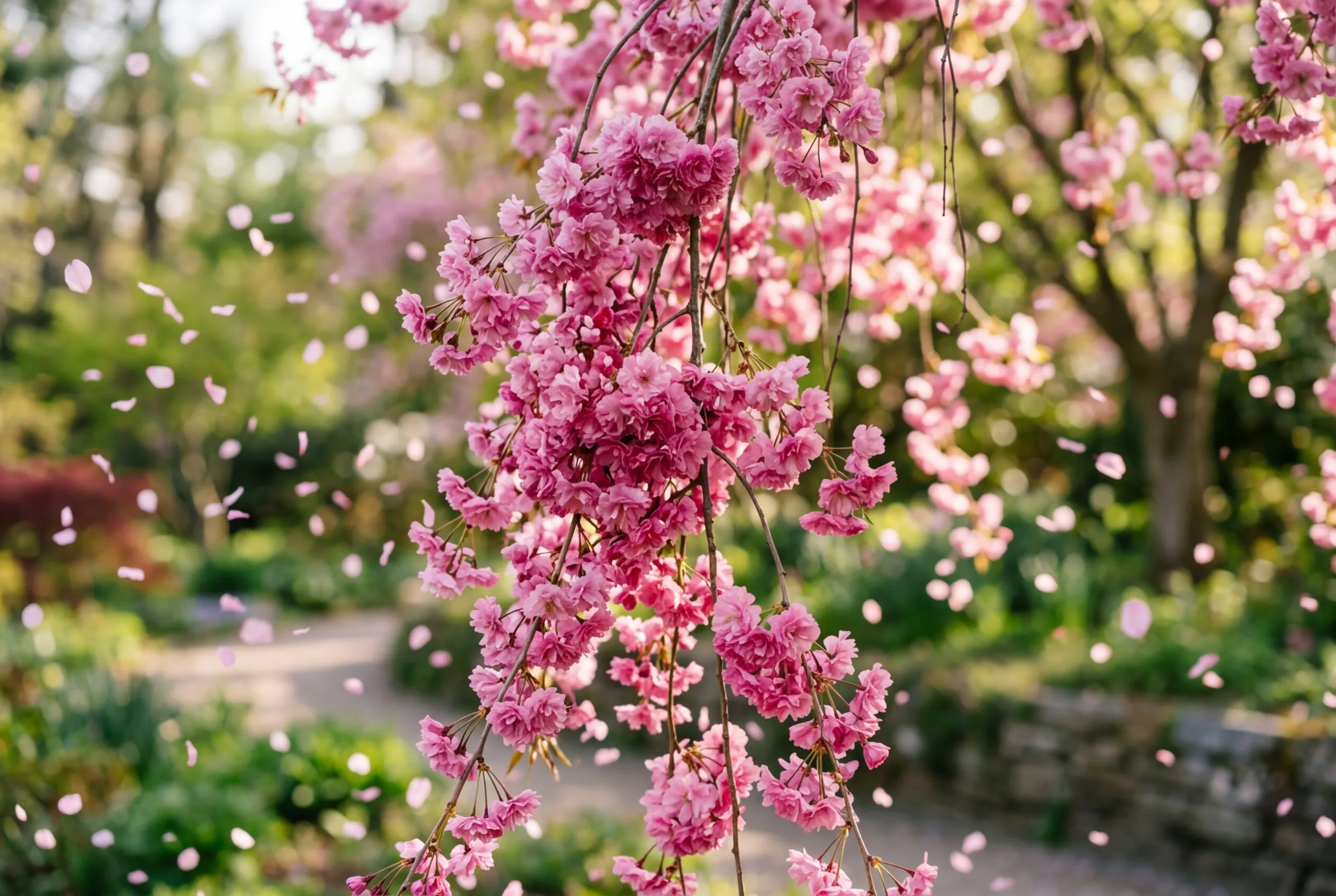 Prunus Kiku-shidare-zakura: cascading deep pink blossom on a weeping cherry.
Prunus Okame
One of the earliest flowering cherries, blooming in March. Single carmine-pink flowers on bare branches before the leaves emerge. Compact habit at 4-5m tall and 4m wide. Outstanding autumn colour in shades of orange and red. RHS AGM. Okame is a hybrid between Prunus incisa and Prunus campanulata, bred by the great cherry expert Captain Collingwood Ingram in Kent. An excellent choice for autumn colour as well as spring blossom.
Prunus x subhirtella Autumnalis
The winter-flowering cherry. Produces semi-double white or pale pink flowers intermittently from November to March during mild spells. No other flowering cherry blooms in winter. The flowers are smaller than spring-flowering types but appear when nothing else is in bloom, making them invaluable. Ultimate height 8m, spread 8m. Cut branches for indoor arrangements from December onwards. Also provides modest autumn colour. If you want year-round interest from a single tree, Autumnalis is the one.
Prunus Shirotae (Mount Fuji)
Large semi-double white flowers on spreading, slightly pendulous branches in April. The habit is wide and flat-topped, reaching 6m tall and 10m wide. Fragrant. The branches spread almost horizontally, giving the tree a distinctive layered silhouette. RHS AGM. One of the most elegant flowering cherries when mature.
Prunus Sargentii (Sargent’s cherry)
Single pink flowers in April followed by the best autumn colour of any flowering cherry. The leaves turn vivid orange-red in September, often the first tree in the garden to colour up. Ultimate height 10-12m, spread 10m. A large tree that needs space but repays it with two seasons of interest. Widely planted in parks and avenues. The autumn colour alone makes this worth growing, earning it a place among the best trees for autumn colour.
Prunus incisa Kojo-no-mai
A compact, slow-growing variety reaching just 2-2.5m. Pale pink buds open to white flowers in March. The branches grow in an attractive zigzag pattern. Outstanding autumn colour in orange and red. Works well in containers and small borders. This is the smallest flowering cherry available and suits the tiniest gardens. RHS AGM.
Flowering cherry variety comparison table
| Variety | Type | Height | Spread | Flower colour | Flowering time | RHS AGM |
|---|---|---|---|---|---|---|
| Kanzan | Spreading | 8-10m | 8m | Double pink | Late Apr-May | Yes |
| Tai-haku | Spreading | 8-12m | 8-10m | Single white | Mid-April | Yes |
| Amanogawa | Columnar | 7m | 2m | Semi-double pale pink | Late Apr-May | No |
| Kiku-shidare-zakura | Weeping | 3-4m | 3-4m | Double deep pink | April | No |
| Okame | Compact | 4-5m | 4m | Single carmine-pink | March | Yes |
| Autumnalis | Spreading | 8m | 8m | Semi-double white/pink | Nov-March | Yes |
| Shirotae | Spreading | 6m | 10m | Semi-double white | April | Yes |
| Sargentii | Spreading | 10-12m | 10m | Single pink | April | No |
| Kojo-no-mai | Compact | 2-2.5m | 1.5m | Single white | March | Yes |
How to plant a flowering cherry tree
When to plant
Plant bare-root flowering cherries from November to March while dormant. November and December are best because autumn soil warmth encourages root establishment before the ground cools. Container-grown trees can go in at any time of year, but autumn planting gives the strongest first-year growth. For detailed bare-root technique, see our guide to planting bare-root trees.
Choosing the right spot
Flowering cherries need full sun for the best blossom display. A tree in partial shade produces fewer flowers and a more open, leggy canopy. Well-drained soil is essential. Cherries evolved on the freely draining volcanic soils of Japan and do not tolerate waterlogged roots. If your soil is heavy clay (common across the Midlands and much of England), improve drainage by working sharp grit and compost into the planting area.
Avoid frost pockets. Late frosts in April can damage open blossom, turning pink flowers brown overnight. A sheltered position against a south or west-facing wall suits smaller varieties. Leave enough room for the ultimate spread. A Kanzan planted 2m from a fence is a problem waiting to happen.
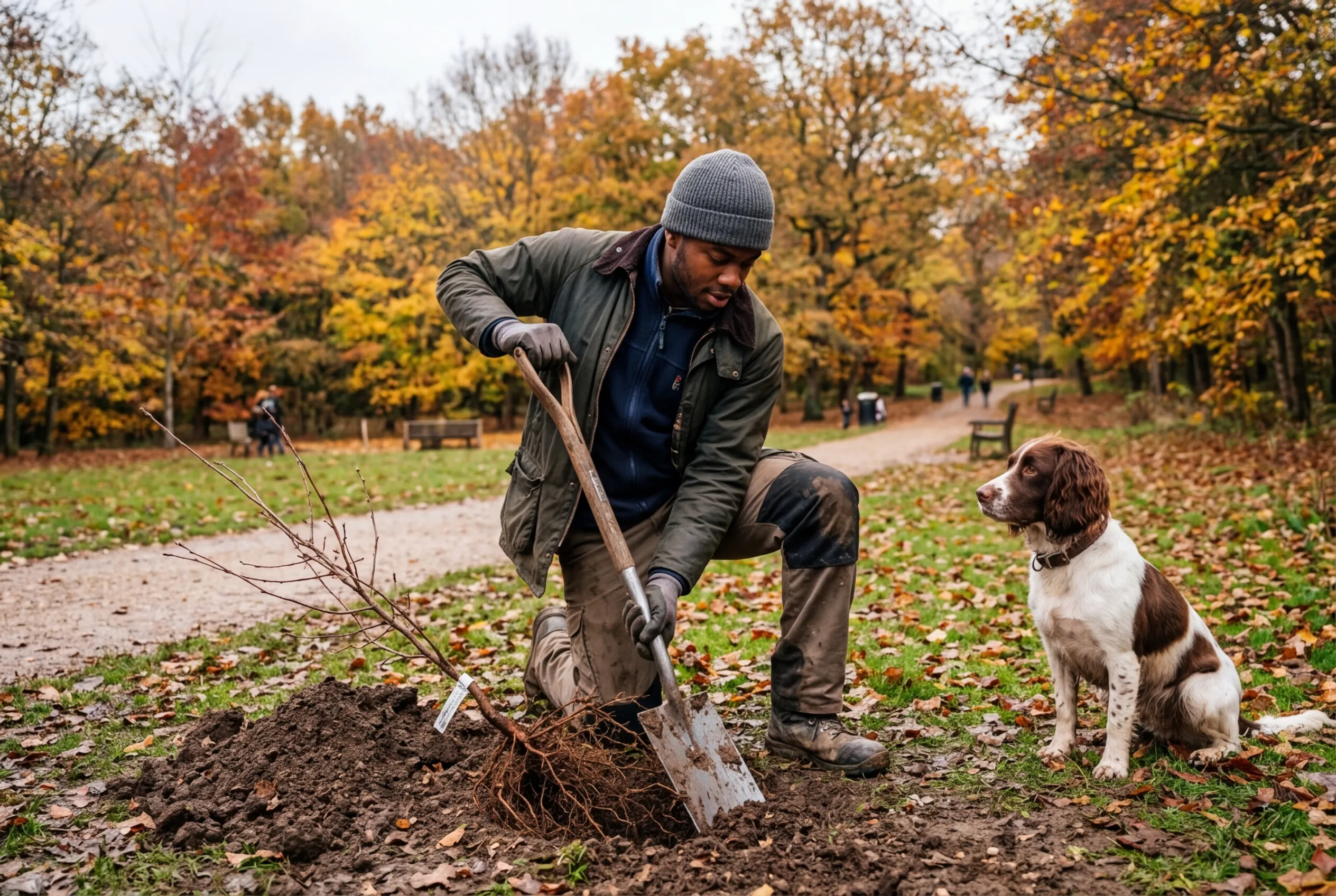 Planting a bare-root cherry tree in autumn. November is the ideal planting month.
Planting steps
- Dig a hole twice the width of the root ball and the same depth
- Fork over the base of the hole to break up compacted subsoil
- For heavy clay, add a 10cm layer of coarse grit to the base for drainage
- Drive a stout stake into the hole before placing the tree
- Position the tree so the graft union (the bulge near the base of the trunk) sits 5-10cm above soil level
- Backfill with the excavated soil mixed with garden compost
- Firm the soil gently with your heel to remove air pockets
- Water thoroughly with at least 10 litres
- Tie the trunk to the stake using a rubber tree tie with a spacer
- Mulch with 8-10cm of bark chips or composted woodchip, keeping mulch 10cm clear of the trunk
Lawrie’s tip: On heavy Midlands clay, I dig the hole 50% deeper than needed and backfill the bottom third with a mix of coarse gravel and compost. This creates a drainage sump beneath the roots. Every flowering cherry I have planted this way has established faster than those planted at standard depth.
Aftercare and feeding
Flowering cherries are low-maintenance trees once established. The first two years are the critical period.
Watering: Water newly planted trees weekly from April to September in the first two years. Give 10-20 litres per session, delivered slowly at the base. Established trees (3+ years) rarely need watering except in prolonged drought. Container-grown trees need watering throughout their lives.
Feeding: Apply a general-purpose fertiliser (such as Growmore or fish, blood, and bone) in March at 70g per square metre around the root zone. Do not feed after July as late growth is soft and frost-vulnerable. Mature trees on decent soil need no feeding at all.
Mulching: Top up the bark mulch ring each autumn to 8-10cm depth. Mulch suppresses weeds, retains moisture, and feeds the soil as it decomposes. Keep mulch clear of the trunk to prevent bark rot.
Staking: Check tree ties twice a year (March and October). Loosen ties as the trunk thickens. Most flowering cherries can have the stake removed after 2-3 years once the roots are anchored. Weeping cherries grafted onto a standard stem may need permanent staking.
How to prune a flowering cherry tree
Pruning is where many gardeners make a fatal mistake. The golden rule for all Prunus species is: prune only in summer, between June and August.
Why summer pruning is essential
Flowering cherries are highly susceptible to silver leaf disease (Chondrostereum purpureum). This fungus enters through wounds and pruning cuts during the damp months from September to May. Infected branches develop a metallic silver sheen on the leaves, then die back progressively. There is no chemical cure. Prevention means pruning only when the tree is in active growth, wounds callus over rapidly, and fungal spores are at their lowest levels. This same rule applies to all stone fruit, including fruit tree pruning.
What to prune
Flowering cherries need very little pruning compared to fruit trees. Annual maintenance involves:
- Remove dead, diseased, or damaged branches first
- Cut out crossing branches that rub against each other (rubbing creates wound sites for disease)
- Remove suckers from the base or rootstock below the graft union
- Thin congested growth in the centre to improve air circulation
- Shape only when young (first 3-4 years) to establish a balanced framework
Do not attempt to reduce the size of a mature flowering cherry by hard cutting. They respond poorly to heavy pruning and often produce ugly, whippy regrowth or die back. If a tree has outgrown its space, replacement with a smaller variety is better than butchering the canopy. This is why choosing the right variety at planting time matters so much.
Pruning cuts
Use clean, sharp tools. Make cuts just above an outward-facing bud or back to a branch collar. Never leave stumps. Seal large cuts (over 5cm diameter) with a wound paint containing trichoderma, which actively fights silver leaf fungus.
Common problems
Silver leaf disease
The most serious disease of flowering cherries in the UK. Leaves develop a silver metallic sheen. Cut through an affected branch and the wood shows a brown stain in cross-section. Branches die back progressively. Remove infected branches back to clean white wood, at least 15cm below the last visible stain. Burn the prunings. Prune only in summer. There is no chemical treatment. The RHS has detailed guidance on silver leaf.
Bacterial canker
Causes sunken, oozing lesions on branches and trunk, usually appearing in autumn. Leaves develop small brown holes (known as shothole). Affected branches die back. Remove cankered branches in summer, cutting well below the infection. Copper-based sprays applied in autumn (September, October, November) can reduce new infections. Bacterial canker is more common on trees stressed by poor drainage or drought.
Cherry blackfly
Dense colonies of black aphids cluster on shoot tips in May and June, curling young leaves. Pinch out infested shoot tips by hand as soon as you spot them. Encourage natural predators: ladybirds, lacewings, and blue tits eat thousands of aphids. Chemical sprays are rarely necessary on ornamental cherries because the tree’s health is not seriously affected.
Blossom wilt
Flowers and young shoots wilt and turn brown, appearing as if scorched. Caused by Monilinia fungus. Most common in wet springs. Remove affected shoots promptly. Improve air circulation through the canopy by thinning congested branches. The problem is usually cosmetic rather than life-threatening.
Honey fungus
Established flowering cherries can be attacked by honey fungus (Armillaria), particularly in gardens with old tree stumps nearby. White fungal mycelium appears beneath the bark at the base. Bootlace-like rhizomorphs spread through soil. There is no chemical treatment. Remove stumps from the garden where possible. Plant on well-drained soil.
Autumn colour bonus
Several flowering cherries provide excellent autumn foliage colour, giving two seasons of interest from a single tree. Sargent’s cherry is the undisputed champion, with leaves turning vivid orange-red in September. Prunus incisa varieties (including Kojo-no-mai) produce reliable orange and bronze tones. Okame colours well in most years with orange-red leaves.
Even varieties not noted for autumn colour, such as Kanzan and Tai-haku, produce reasonable yellow and amber tones in a good year. Autumn colour is strongest on trees growing in full sun on well-drained, slightly acidic soil. Trees on alkaline chalk still colour, but less intensely. For a garden designed around autumn display, consider pairing flowering cherries with other trees grown for autumn colour. If you grow fruit cherries too, our guide to growing cherry trees covers varieties, rootstocks, and harvest tips.
Flowering cherries and wildlife
Flowering cherries are valuable for wildlife despite being non-native. The early blossom of Okame and Kojo-no-mai (March) provides nectar for queen bumblebees, solitary bees, and early hoverflies when few other food sources are available. The Bumblebee Conservation Trust ranks flowering cherries among the top early nectar sources.
Single-flowered varieties (Tai-haku, Okame, Sargentii) offer more accessible nectar than double-flowered forms (Kanzan, Kiku-shidare-zakura) where the extra petals obstruct pollinators. If wildlife value is important, choose single-flowered varieties.
Small cherry fruit ripens in late summer and is eaten by blackbirds, thrushes, starlings, and wood pigeons. The canopy provides nesting sites for garden birds. Flowering cherries also support moth caterpillars, including the winter moth and mottled umber, which in turn feed nestlings.
For a garden designed around wildlife, pair flowering cherries with native trees and crab apples, which provide autumn fruit for fieldfares and redwings.
Growing flowering cherries in containers
Compact varieties grow well in large containers for several years. Choose Kojo-no-mai, Okame, or a young Amanogawa. Use a container at least 45cm in diameter and depth. Fill with John Innes No. 3 compost mixed with 20% perlite for drainage.
Water regularly from April to September. Feed fortnightly with a liquid general-purpose fertiliser during the growing season. Repot every 3-4 years into fresh compost and a slightly larger container. Protect roots from freezing in hard winters by wrapping the pot in bubble wrap or moving to a sheltered spot.
Container-grown flowering cherries will not reach the same size as garden-planted trees. Kojo-no-mai stays at 1.5-2m in a pot. This makes containers a practical option for patios, balconies, and paved front gardens where planting in the ground is impossible.
Flowering cherry tree planting calendar
| Month | Task |
|---|---|
| November-December | Best planting time for bare-root trees. Mulch after planting. |
| January-February | Check stakes and ties. Firm in trees lifted by frost heave. |
| March | Apply general-purpose fertiliser. Enjoy early blossom (Okame, Kojo-no-mai). |
| April | Peak blossom month for most varieties. Protect from late frost if possible. |
| May | Watch for cherry blackfly on shoot tips. Water newly planted trees weekly. |
| June | Begin summer pruning if needed. This is the safest month to prune. |
| July-August | Continue summer pruning. Complete all cuts by end of August. |
| September | Enjoy autumn colour (Sargentii, Okame). Clear fallen leaves if diseased. |
| October | Prepare planting sites for new trees. Order bare-root trees from nurseries. |
The Woodland Trust recommends November as the optimal month for planting all deciduous trees in the UK, and flowering cherries are no exception. Bare-root trees cost 30-50% less than container-grown equivalents and establish equally well when planted during dormancy.
Lawrie has been gardening in the West Midlands for over 30 years. He grows his own veg using no-dig methods, keeps a wildlife-friendly garden, and writes practical advice based on real UK growing conditions.