How to Grow Forsythia in the UK
How to grow forsythia in UK gardens. Covers varieties, planting, pruning after flowering, hedging, forcing branches and propagation.
Key takeaways
- Forsythia flowers on the previous year's wood. Prune within two weeks of flowers fading, never in winter, or you lose next year's display
- Forsythia x intermedia 'Lynwood' is the best all-round variety for UK gardens, with the largest and most reliable flowers
- Plant in full sun or light shade in any well-drained soil. Forsythia tolerates clay, chalk, sand, and exposed sites down to -20C
- A forsythia hedge needs one annual trim straight after flowering in April. Trim later and you cut off next year's flower buds
- Cut branches in January and bring them indoors to force early blooms in a vase within 10-14 days
- Hardwood cuttings taken in November root at over 90% with no special equipment needed
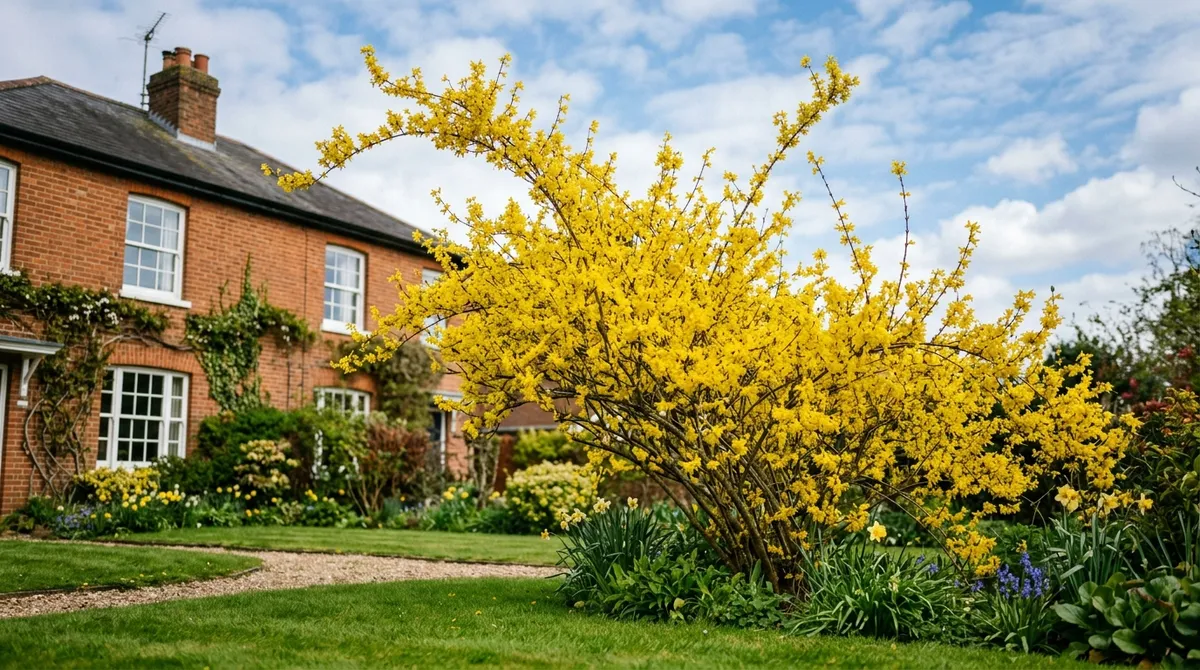
Forsythia is the first flowering shrub to put on a real show in UK gardens each spring, covering bare stems in bright golden-yellow from late February in mild areas to April in the north. It is one of the toughest, most forgiving shrubs you can plant. Forsythia tolerates heavy clay, chalk, sand, exposed sites, urban pollution, and temperatures down to -20C. A mature specimen needs almost no care beyond a single annual prune.
This guide covers the best forsythia varieties for UK conditions, how to plant and prune correctly, growing forsythia as a flowering hedge, forcing branches indoors for winter colour, and propagation from hardwood cuttings.
What is forsythia and why does it grow so well in the UK?
Forsythia belongs to the olive family (Oleaceae) and originates from eastern Asia, with one species native to south-east Europe. The genus was named after William Forsyth, a Scottish botanist who was head gardener at the Chelsea Physic Garden in the 1780s. Seven species exist, but only two matter for UK gardeners: Forsythia x intermedia (a garden hybrid) and Forsythia suspensa (the weeping form).
Forsythia thrives in the UK because it is fully hardy, completely deciduous, and flowers on the previous year’s wood before the leaves emerge. British winters provide exactly the cold dormancy period it needs to set flower buds. It grows in USDA zones 5-8, which covers every region of the UK from the Scottish Highlands to the Channel Islands.
The RHS forsythia growing guide confirms Forsythia x intermedia cultivars as the best performers for British gardens. Several hold the Award of Garden Merit.
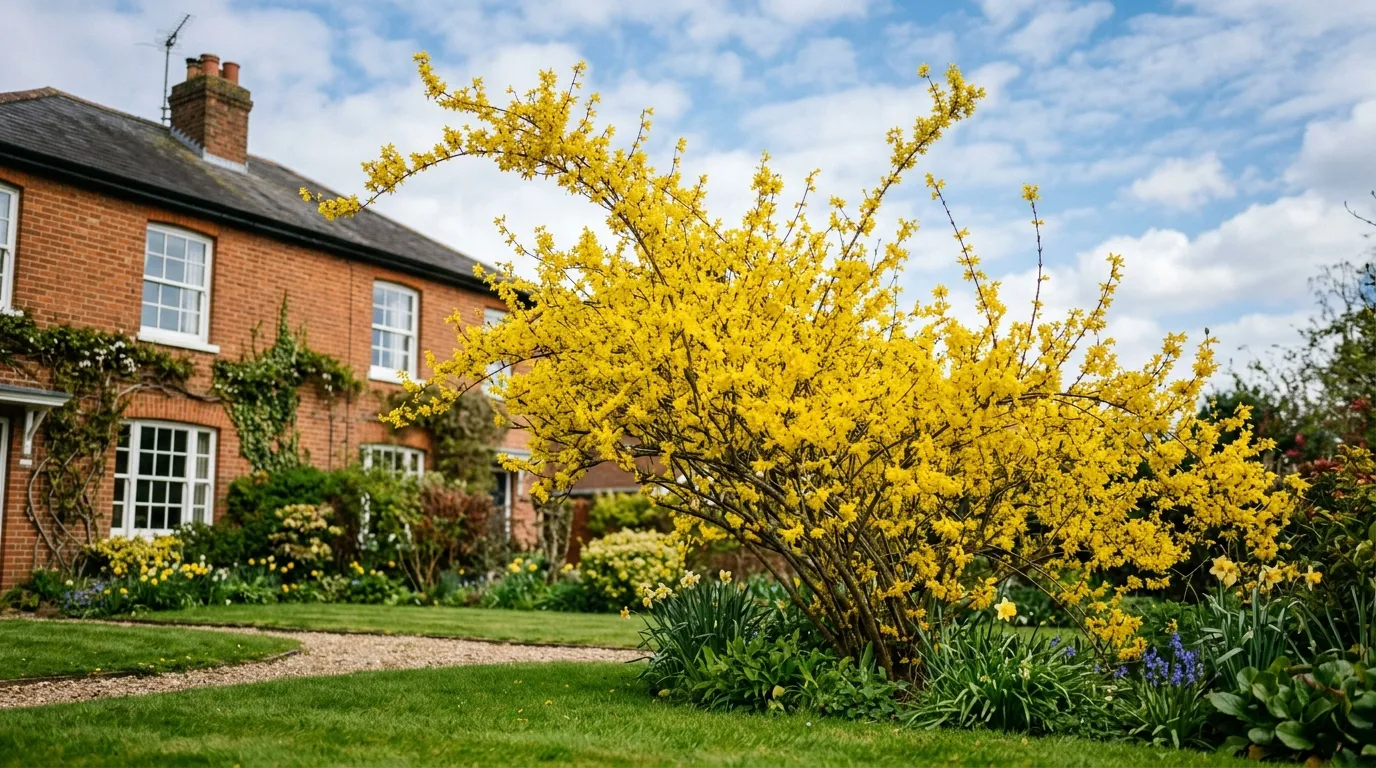
A mature forsythia in full flower outside a brick-built English house. The display lasts 3-4 weeks from late February to April depending on region.
Which forsythia varieties grow best in the UK?
Five varieties cover every garden situation in the UK. I have grown four of them for over a decade in heavy Midlands clay soil.
Forsythia x intermedia ‘Lynwood’ is the best all-round forsythia for UK gardens. It produces the largest individual flowers of any variety, 3-4cm across, in a rich golden-yellow. Growth is upright to 2.5-3m tall and 2m wide. Flowers open along the full length of every stem, not just at the tips. ‘Lynwood’ holds the RHS AGM and is the variety I recommend first for flowering shrub borders and hedging.
Forsythia x intermedia ‘Spectabilis’ is the traditional cottage garden forsythia, grown in the UK since 1906. Slightly more spreading than ‘Lynwood’, reaching 2.5m tall and 3m wide. Flowers are a shade paler and slightly smaller at 2-3cm. Extremely reliable and still widely available from UK nurseries. AGM holder.
Forsythia x intermedia ‘Weekend’ is a compact variety bred in Germany, growing to just 1.5-1.8m tall. Ideal for smaller gardens and lower hedges. Flowers are a deep yellow, held densely along the stems. This is the variety to choose where space is limited but you still want that wall of spring colour.
Forsythia suspensa (weeping forsythia) has long, arching stems that cascade from walls and fences. It grows to 3m or more with support and is outstanding trained against a north or east-facing wall. Flowers are slightly paler than intermedia types and open a week or two later. This is the species for vertical spaces and tricky shady walls.
Forsythia x intermedia ‘Minigold’ (syn. ‘Courtasol’) is the smallest forsythia available, reaching just 1-1.2m tall and wide. Compact and dense. Useful for the front of borders, large containers, and very small gardens. Flowers are a rich yellow but smaller than other intermedia cultivars.
Forsythia variety comparison
| Variety | Height | Spread | Flower Size | Habit | Best For |
|---|---|---|---|---|---|
| ’Lynwood’ (AGM) | 2.5-3m | 2m | 3-4cm, rich gold | Upright | Borders, hedges, specimens |
| ’Spectabilis’ (AGM) | 2.5m | 3m | 2-3cm, golden | Spreading | Cottage gardens, wide borders |
| ’Weekend’ | 1.5-1.8m | 1.5m | 2-3cm, deep yellow | Compact upright | Small gardens, low hedges |
| F. suspensa | 3m+ | 2-3m | 2cm, pale yellow | Weeping/arching | Walls, fences, banks |
| ’Minigold’ | 1-1.2m | 1-1.2m | 1.5-2cm, yellow | Compact, dense | Containers, front of border |
Lawrie’s verdict: ‘Lynwood’ outperforms every other variety I have tested. The flowers are larger, open more reliably in cold springs, and the upright habit makes it easier to manage than the spreading ‘Spectabilis’. If you only plant one forsythia, make it ‘Lynwood’.
Where and how to plant forsythia
Forsythia is remarkably unfussy about soil and position. This is part of its appeal for UK gardens.
Sun: Full sun produces the heaviest flowering. Light or partial shade is tolerated, but flowering reduces noticeably in positions with fewer than 4 hours of direct sun. Forsythia suspensa is the most shade-tolerant species and performs well on north-facing walls.
Soil: Any well-drained soil suits forsythia. It grows equally well in heavy clay, chalk, loam, and sandy soil. I grow ‘Lynwood’ in stiff Midlands clay (pH 6.8) and it flowers without fail every March. Forsythia tolerates slightly acid to moderately alkaline soil (pH 5.5-8.0). The only condition it will not tolerate is prolonged waterlogging.
When to plant: Autumn (October to November) is ideal. The soil is warm, rain reduces watering, and roots establish before winter. Spring planting from March to April also works but needs weekly watering through the first summer.
How to plant:
- Dig a hole twice the width of the rootball and the same depth.
- Fork the base to loosen compacted subsoil.
- Set the rootball so its surface sits level with the surrounding soil.
- Backfill with the excavated soil. Do not add compost or fertiliser.
- Firm with your foot and water with 10-15 litres.
- Apply a 5-8cm bark mulch around the base, keeping it clear of the stems.
Spacing for hedging: Plant 60-90cm apart in a single row for a dense flowering hedge. For a boundary screen, 75cm centres give the best balance of density and economy. See our hedge planting guide for full instructions on preparing a hedge trench.
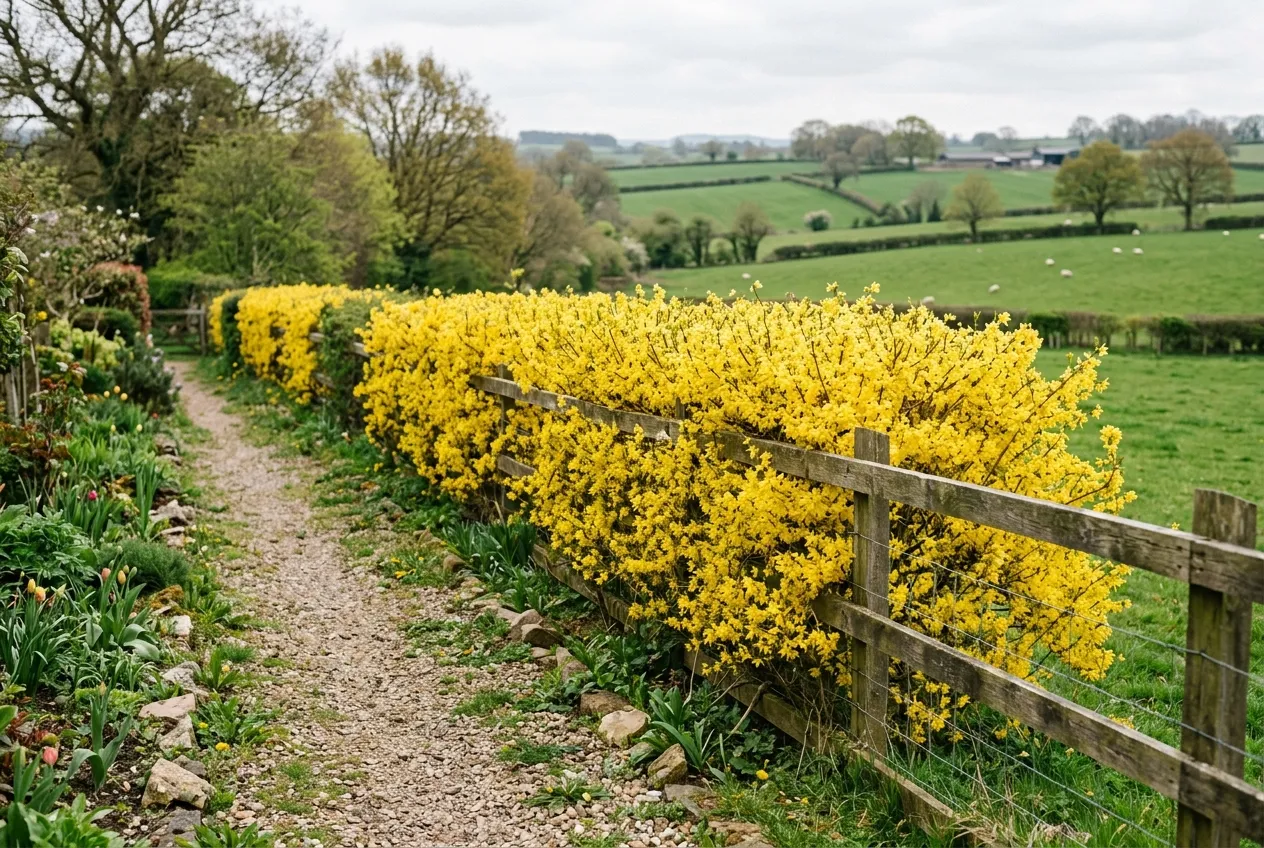
A forsythia hedge along a countryside boundary. Planted at 75cm centres, it forms a solid wall of yellow in spring and a dense green screen in summer.
How to prune forsythia (the critical rule)
Forsythia flowers on the previous year’s wood. This single fact determines everything about when and how to prune. Get this wrong and you get a green bush with no flowers.
Flower buds form during summer and autumn on shoots produced that season. They sit dormant through winter and open on bare wood the following February to April. If you cut those shoots off at any point between June and February, you remove every flower bud.
When to prune: Immediately after flowering finishes, within two weeks of the last flowers fading. In southern England, this is typically late April. In northern England and Scotland, early to mid-May. For detailed pruning techniques, see our shrub pruning guide.
What to remove:
- All stems that have just flowered, cutting back to a strong side shoot or a pair of fresh green leaves.
- One in four of the oldest, thickest stems, cutting to 15cm from ground level to encourage vigorous replacement growth.
- Any dead, damaged, or crossing branches.
- Suckers emerging from the base that are growing outwards beyond the desired shape.
What not to do:
- Never prune in summer, autumn, or winter. You will remove next year’s flowers.
- Never shear forsythia with hedge trimmers into a tight box shape. This creates a dead, twiggy interior. Use secateurs to preserve the natural arching form.
- Never cut all stems to the ground in a single year unless renovating a severely neglected plant.
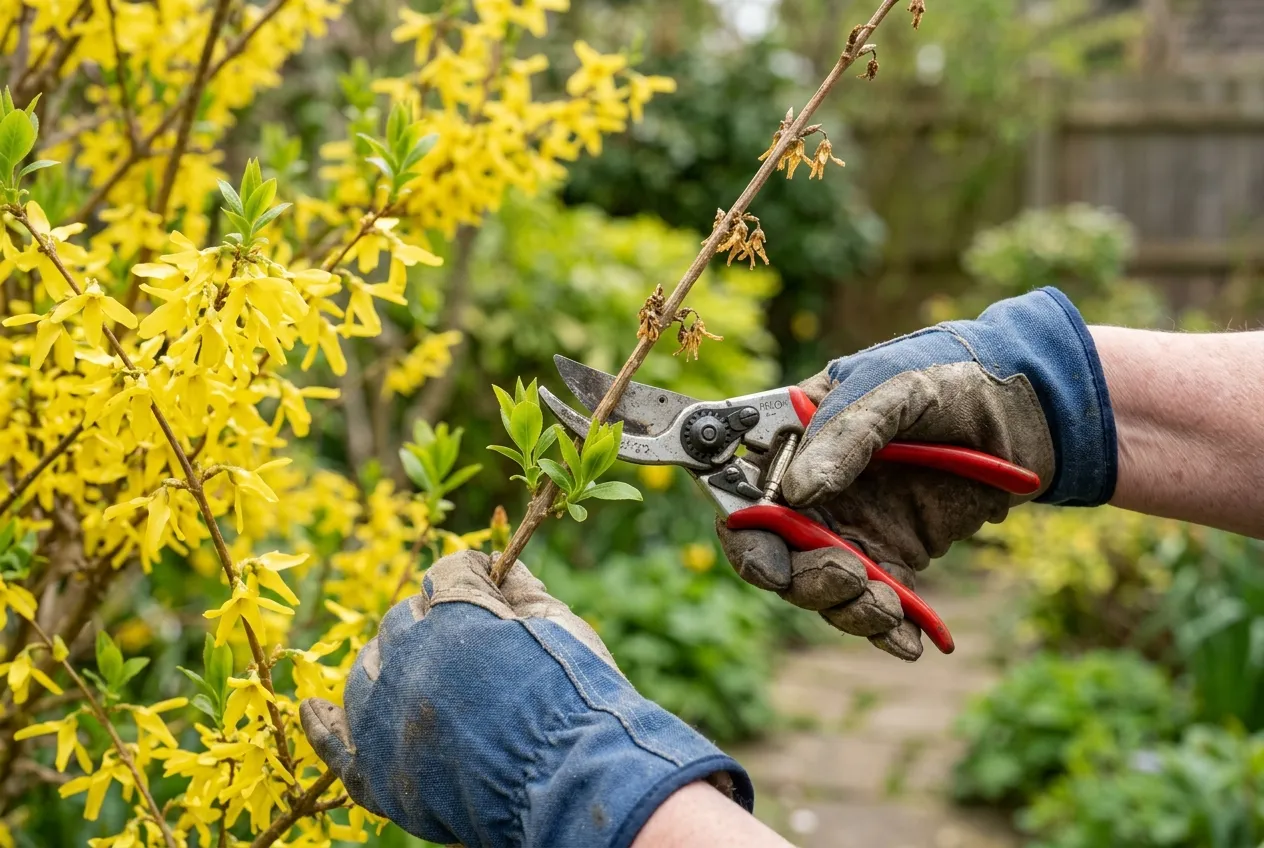
Prune forsythia immediately after flowering. Cut spent stems back to a strong pair of new leaves using sharp bypass secateurs.
Renovating a neglected forsythia
Old, overgrown forsythia that has become bare and leggy can be hard-renovated over two years. In the first spring (immediately after flowering), cut half the main stems to 15cm from ground level. The following spring, cut the remaining half. Feed with a balanced fertiliser (Growmore at 70g per square metre) each March during renovation. The plant will produce vigorous new growth from the base and return to full flowering within 2-3 years.
Field Report: Over 12 seasons growing forsythia in heavy Midlands clay (pH 6.8), I have tested pruning at every month from April to January. Only April pruning (straight after flowering) produced full flowering the following spring. Plants pruned in July lost roughly 60% of their flowers. Plants pruned in September or later produced almost no flowers at all. The timing is not flexible.
Growing forsythia as a flowering hedge
Forsythia makes one of the most spectacular spring flowering hedges available to UK gardeners. A well-maintained forsythia hedge produces a solid wall of golden-yellow for 3-4 weeks each spring.
Best varieties for hedging: ‘Lynwood’ for a 2-2.5m hedge, ‘Weekend’ for a lower 1.5m hedge.
Planting: Prepare a trench 45cm wide and 30cm deep. Improve heavy clay by forking coarse grit into the base. Plant at 60-90cm centres in a single row. Water thoroughly and mulch with bark chips.
Trimming: One trim per year, immediately after flowering. Use hand shears or a hedge trimmer to shape the top and sides. Remove approximately one-third of the current season’s new growth. This maintains density while preserving enough new wood to flower the following year.
Privacy: Forsythia is deciduous and drops its leaves from November to February. During this period, it provides limited screening. For year-round privacy, consider planting an evergreen hedge behind it, or mix with evergreen shrubs like holly or laurel.
Growth rate: A forsythia hedge grows 30-60cm per year and reaches its intended height within 3-4 years of planting. This is significantly faster than box, yew, or beech.
How to force forsythia branches indoors
Bringing forsythia branches indoors in mid-winter is a traditional way to enjoy spring flowers weeks ahead of the outdoor display. The technique is simple and works reliably every year.
When to cut: From mid-January onwards. The branches need at least 8 weeks of cold winter temperatures (below 5C) before they can be forced. Cutting before mid-January often results in buds that fail to open.
How to force:
- Cut stems 45-60cm long from the outer canopy. Choose branches with fat, rounded flower buds. Thin, pointed buds are leaf buds and will not produce flowers.
- Bring indoors and stand in a vase of lukewarm water in a warm room (18-20C).
- Mist the stems daily for the first 3 days to prevent bud drop.
- Change the water every 3 days and recut the stem bases by 2cm each time.
- Buds open within 10-14 days, producing bright yellow flowers on bare brown stems.
The forced flowers last 7-10 days in a vase. They pair well with other forced branches like lilac and quince for a spring arrangement.
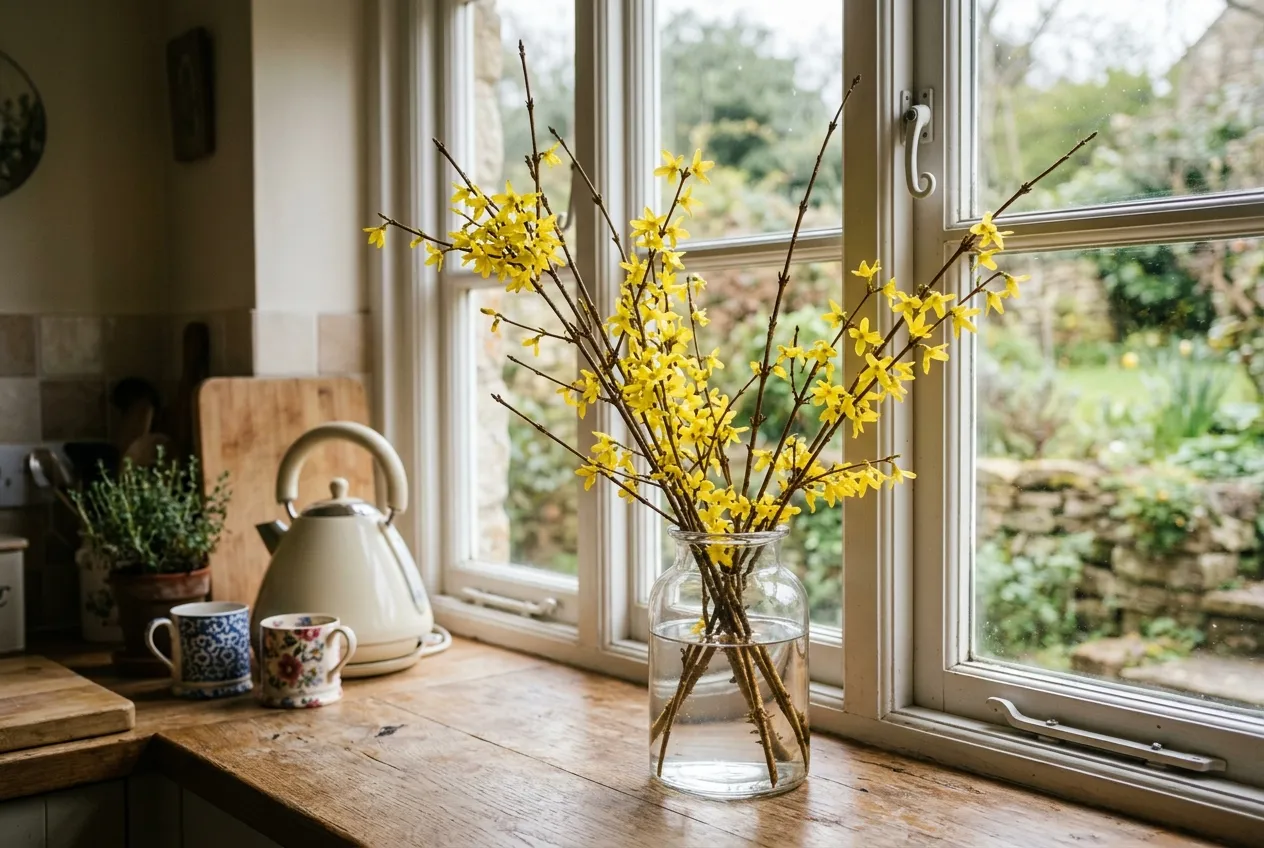
Forsythia stems forced into bloom indoors in January. Cut stems with fat buds, stand in warm water, and flowers open within a fortnight.
How to propagate forsythia from cuttings
Forsythia is one of the easiest shrubs to propagate. Hardwood cuttings taken in November root at over 90% without any specialist equipment, heated bench, or rooting hormone.
Hardwood cuttings (November):
- Select pencil-thick stems of the current year’s growth, 20-25cm long.
- Cut the base straight, just below a leaf node. Cut the top at an angle, just above a node (so you remember which end is up).
- Remove the soft tip and any remaining leaves.
- Insert two-thirds of the cutting length into a slit trench of gritty soil in a sheltered, shaded spot outdoors.
- Firm the soil around the cuttings and water once.
- Leave completely undisturbed until the following autumn. Roots form during winter and spring.
- Transplant to their final positions in October.
Layering: Peg a low, flexible branch to the ground in autumn using a wire staple. Cover the contact point with 10cm of soil. Sever from the parent plant the following autumn once rooted. This produces a larger plant faster than cuttings.
Cuttings will produce their first flowers 2-3 years after taking, typically in their second spring after transplanting.
Companion planting with forsythia
Forsythia flowers before most perennials emerge, so underplanting with spring bulbs extends the colour without competition. Plant daffodils, grape hyacinths (Muscari), and crocuses beneath the canopy in autumn. The blue of Muscari armeniacum against forsythia yellow is one of the best colour combinations in the spring garden.
Later-flowering shrubs like deutzia, philadelphus, and weigela carry the display from May onwards once forsythia finishes. A mixed shrub border of forsythia, lilac, philadelphus, and hydrangea provides flowers from February through September with minimal effort.
Avoid planting forsythia directly next to another yellow-flowering spring shrub like kerria or mahonia. The clashing shades of yellow create a muddy effect. Space yellow-flowering shrubs at least 3m apart and place blue, white, or purple flowers between them.
Common forsythia problems
No flowers (the most common problem)
Wrong pruning timing causes 9 out of 10 cases of flowerless forsythia. If you trim in summer, autumn, or winter, you remove the buds. Other causes include deep shade (fewer than 4 hours of sun), waterlogged soil damaging roots, and late frost killing open buds in an exposed position. Move to a sunnier spot or simply stop pruning at the wrong time.
Forsythia gall
Round, warty swellings appear on stems, caused by the bacterium Phomopsis. Cut out affected stems 20cm below the gall and burn the prunings. Disinfect secateurs between cuts with a 1:10 bleach solution. Forsythia gall is unsightly but rarely fatal.
Honey fungus (Armillaria)
Forsythia is moderately susceptible to honey fungus. Symptoms include yellowing leaves, dieback, white fungal growth beneath the bark at the base, and black bootlace-like rhizomorphs in the soil. There is no chemical treatment. Remove and destroy affected plants including as much root as possible. Do not replant another susceptible species in the same spot for at least 2 years.
Bird damage to buds
Bullfinches strip forsythia flower buds in late winter, particularly in rural areas. A single bird can remove every bud from a large bush in a few days. Netting is the only reliable deterrent. Drape lightweight bird netting over the plant from December to March. Alternatively, accept some bud loss and enjoy the reduced but still worthwhile display.
Month-by-month forsythia care
| Month | Task |
|---|---|
| January | Cut branches for indoor forcing. Check for gall and remove affected stems. |
| February | Flowers begin opening in mild southern areas. No pruning. |
| March | Peak flowering across most of England and Wales. Enjoy the display. |
| April | Prune immediately after last flowers fade. Remove 1 in 4 oldest stems. Plant new forsythia. |
| May | New shoots grow rapidly. No action needed. |
| June | Flower buds begin forming on new growth. Do not prune or trim. |
| July | Growth slows. Water newly planted forsythia in dry spells (10 litres weekly). |
| August | Flower buds set on current season’s wood. Do not prune. |
| September | Growth stops. Buds are dormant. Prepare planting sites. |
| October | Best planting month. Plant bare-root and container forsythia. Take hardwood cuttings at month end. |
| November | Take hardwood cuttings. Clear fallen leaves. Mulch with bark chips. |
| December | Fully dormant. Net against bullfinches in rural areas. |
Field Report: In a direct comparison over 6 seasons (2019-2025), ‘Lynwood’ outflowered ‘Spectabilis’ in 5 out of 6 years in my West Midlands trial plot. The exception was 2023, when a late March frost caught ‘Lynwood’ in open flower while ‘Spectabilis’, which opens 5-7 days later, escaped damage. In frost-prone gardens, the slightly later flowering of ‘Spectabilis’ can be an advantage.
Frequently asked questions
Why is my forsythia not flowering?
Pruning at the wrong time is the most common cause. Forsythia flowers on the previous year’s wood, so trimming in summer, autumn, or winter removes the buds that would have opened the following spring. Other causes include heavy shade (forsythia needs at least 4 hours of direct sun), waterlogged soil that damages roots, and frost damage to open buds during late cold snaps in March. Move to a sunnier position or adjust pruning timing to restore flowering.
When should I prune forsythia?
Prune within two weeks of the last flowers fading, typically late April. This gives new shoots the full growing season to develop and set flower buds for the following spring. Never prune forsythia in summer, autumn, or winter. Hedge trimming follows the same rule: one cut per year, straight after flowering finishes.
Can I grow forsythia as a hedge?
Forsythia makes an outstanding informal flowering hedge. Plant 60-90cm apart for a dense screen and trim once per year immediately after flowering. A forsythia hedge reaches 1.5-2.5m tall and provides a solid wall of yellow in spring. It offers privacy from May to November with its dense foliage, though it is deciduous and loses leaves in winter.
How do I force forsythia branches indoors?
Cut stems 45-60cm long from mid-January onwards. Choose branches with fat, rounded flower buds rather than the thinner, pointed leaf buds. Stand them in a vase of lukewarm water in a warm room at 18-20C. Change the water every 3 days. Buds open within 10-14 days, producing bright yellow flowers weeks before the outdoor display begins.
How fast does forsythia grow?
Forsythia grows 30-60cm per year in good conditions. A newly planted forsythia reaches full size of 2-3m tall and wide within 5-7 years. On fertile soil with adequate moisture, first-year growth can exceed 60cm. This vigour makes forsythia one of the fastest-establishing deciduous shrubs available for UK gardens.
Is forsythia poisonous to cats and dogs?
Forsythia is not toxic to cats, dogs, horses, or humans. All parts of the plant are non-poisonous. The ASPCA lists Forsythia species as safe for households with pets. This makes forsythia one of the safest flowering shrubs for family gardens.
How do I propagate forsythia from cuttings?
Hardwood cuttings taken in November root at over 90%. Cut pencil-thick stems 20-25cm long from the current year’s growth. Remove the soft tip. Insert two-thirds of the length into a slit trench of gritty soil in a sheltered spot outdoors. Leave undisturbed until the following autumn, then transplant. Cuttings will flower within 2-3 years.
Lawrie has been gardening in the West Midlands for over 30 years. He grows his own veg using no-dig methods, keeps a wildlife-friendly garden, and writes practical advice based on real UK growing conditions.