How to Grow Heuchera (Coral Bells) UK
How to grow heuchera in UK gardens. Covers best varieties by colour, shade tolerance, containers, division, vine weevil control and winter care.
Key takeaways
- Heuchera is fully hardy across the UK (RHS H7) and keeps its foliage year-round
- Best in partial shade — direct afternoon sun scorches dark-leaved varieties
- Divide every 3-4 years in spring to prevent woody, raised crowns dying out
- Vine weevil is the number one killer — use nematode biological control in August
- Over 50 named varieties available, from near-black Obsidian to lime-green Lime Marmalade
- Thrives in containers with loam-based compost and good drainage
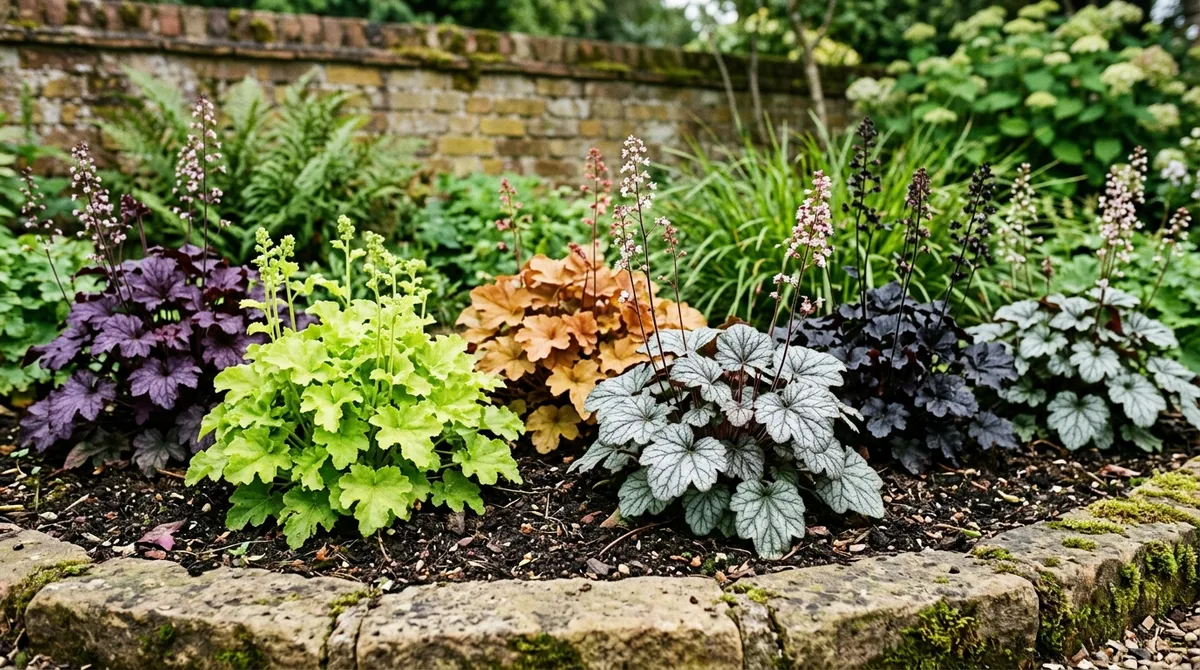
Heuchera is one of the most versatile foliage perennials for UK gardens, offering year-round colour in shades that range from near-black to electric lime. Commonly called coral bells, this North American native is fully hardy across every UK region and thrives in the partial shade that most British gardens have in abundance.
The RHS lists over 150 heuchera cultivars suitable for UK growing. Most garden centres stock between 15 and 30 named varieties, priced from 6 to 12 pounds per pot. This guide covers the best varieties by colour, where and how to plant them, and how to deal with the one pest that kills more heucheras than anything else: vine weevil.
What varieties of heuchera should I grow?
The best heuchera varieties for UK gardens depend on the foliage colour you want and the light conditions in your border. Dark purples and silvers hold colour best in shade. Limes and ambers tolerate more sun. All varieties below are RHS-rated and widely available from UK nurseries.
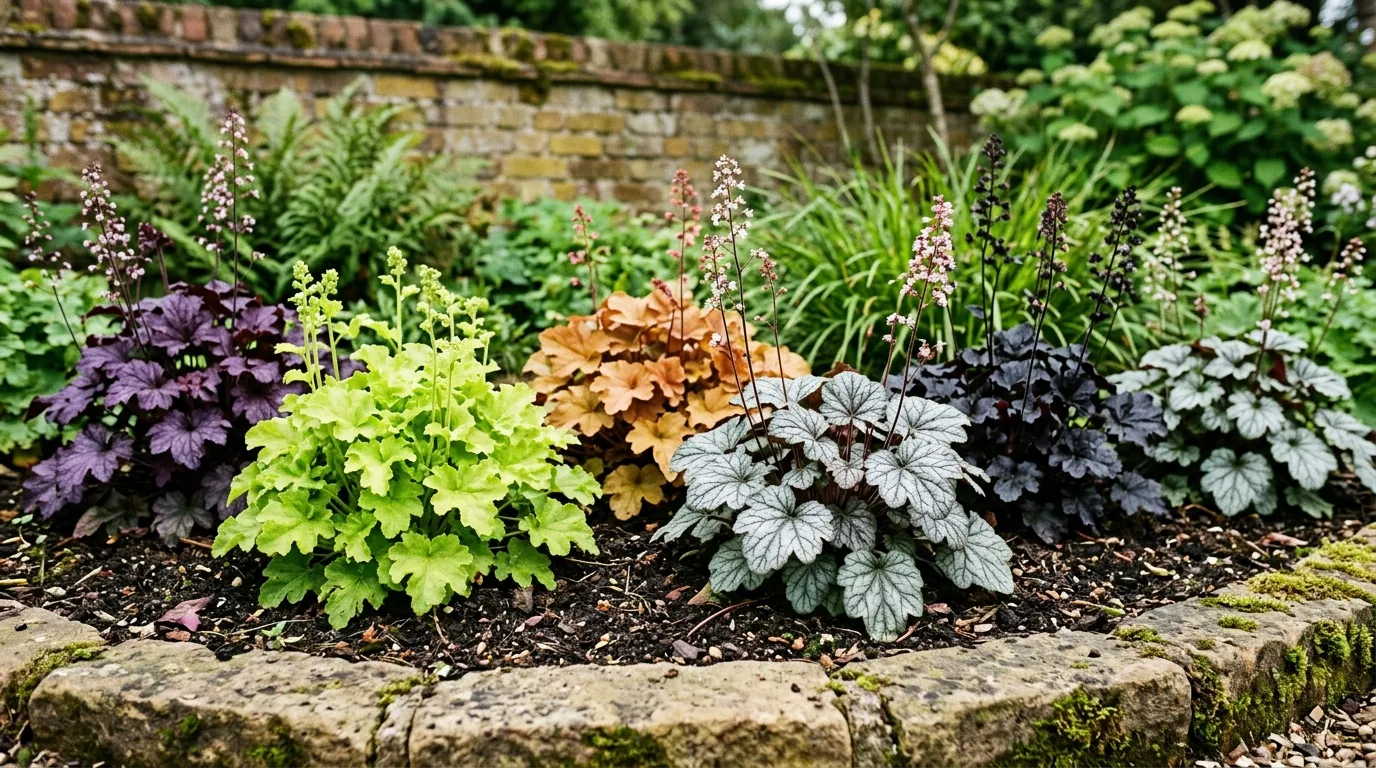 A mixed heuchera planting showing the range of foliage colours available for UK gardens
Heuchera variety comparison table
| Variety | Foliage Colour | Height (cm) | Spread (cm) | Best Position | RHS AGM | UK Price |
|---|---|---|---|---|---|---|
| Palace Purple | Deep burgundy-purple | 40-50 | 40-50 | Partial shade | Yes | 7-9 pounds |
| Lime Marmalade | Bright lime green | 25-35 | 30-40 | Partial shade to sun | No | 8-10 pounds |
| Obsidian | Near-black, glossy | 25-30 | 30-40 | Partial shade | Yes | 8-12 pounds |
| Berry Smoothie | Rose-pink to berry | 35-45 | 40-50 | Partial shade | No | 8-10 pounds |
| Silver Scrolls | Metallic silver, dark veining | 30-40 | 30-40 | Partial shade | Yes | 8-10 pounds |
| Caramel | Amber-apricot, fuzzy | 30-40 | 35-45 | Partial shade | No | 8-12 pounds |
Purple and dark-leaved varieties
Palace Purple is the original and still one of the best dark heucheras for UK gardens. It holds RHS AGM status, grows to 50cm, and produces deep burgundy foliage that intensifies in cooler weather. It self-seeds mildly, giving you free plants.
Obsidian is the darkest heuchera commercially available. The glossy, near-black leaves look striking against silver or lime companions. It stays compact at 25-30cm and tolerates deeper shade than most varieties. Pair it with silver-leaved plants for dramatic border combinations.
Lime and amber varieties
Lime Marmalade produces the brightest foliage of any heuchera — electric lime-green leaves that glow in shaded borders. It tolerates more sun than dark varieties but scorches in direct afternoon heat during July and August. Position it where it gets morning sun and afternoon shade.
Caramel is unusual for its warm amber-apricot tones and slightly fuzzy leaf texture. The colour shifts through the seasons: apricot in spring, amber through summer, and deeper caramel in autumn. It reaches 30-40cm and works well in containers where the foliage colour catches the eye.
Silver and metallic varieties
Silver Scrolls has metallic silver leaves with dark purple veining, creating an almost Art Nouveau effect. It holds AGM status and performs consistently across UK gardens. The foliage catches reflected light in shaded spots, making it a strong choice for brightening dark corners.
Where should I plant heuchera?
Heuchera grows best in partial shade with 2-4 hours of direct sun, ideally morning light. This matches the conditions in most UK garden borders, particularly north-facing and east-facing beds. Full sun is tolerable for lime and amber varieties but scorches dark-leaved types in summer.
Light requirements by variety type
Dark and purple varieties (Palace Purple, Obsidian, Berry Smoothie) perform best with morning sun only. Afternoon shade preserves the deep leaf pigments. In full sun, purple leaves fade to muddy brown by midsummer.
Lime and amber varieties (Lime Marmalade, Caramel) handle more sun but still prefer shelter from fierce afternoon heat. A position that receives sun until midday and shade after that is ideal.
Silver varieties (Silver Scrolls) are the most adaptable. They perform well in partial shade or dappled shade and tolerate brief periods of full sun without leaf damage.
Soil requirements
Heuchera needs well-drained soil. Waterlogging kills more heucheras than frost ever will. On heavy clay, improve drainage by adding coarse grit and garden compost before planting. Raised beds work particularly well on clay soils.
The ideal soil pH is 6.0 to 7.0 — slightly acid to neutral. Most UK garden soils fall within this range. Chalk soils suit heuchera well provided they do not dry out completely in summer.
Heuchera is an excellent choice for shaded borders where other plants struggle. It tolerates root competition from trees better than most perennials, though avoid planting directly under dense evergreen canopies where rainfall does not penetrate.
How to grow heuchera in containers
Heuchera is one of the best foliage plants for UK container gardens. The compact growth habit, year-round colour, and shade tolerance make it ideal for pots on patios, balconies, and doorsteps. Containers also solve drainage problems — no risk of waterlogging.
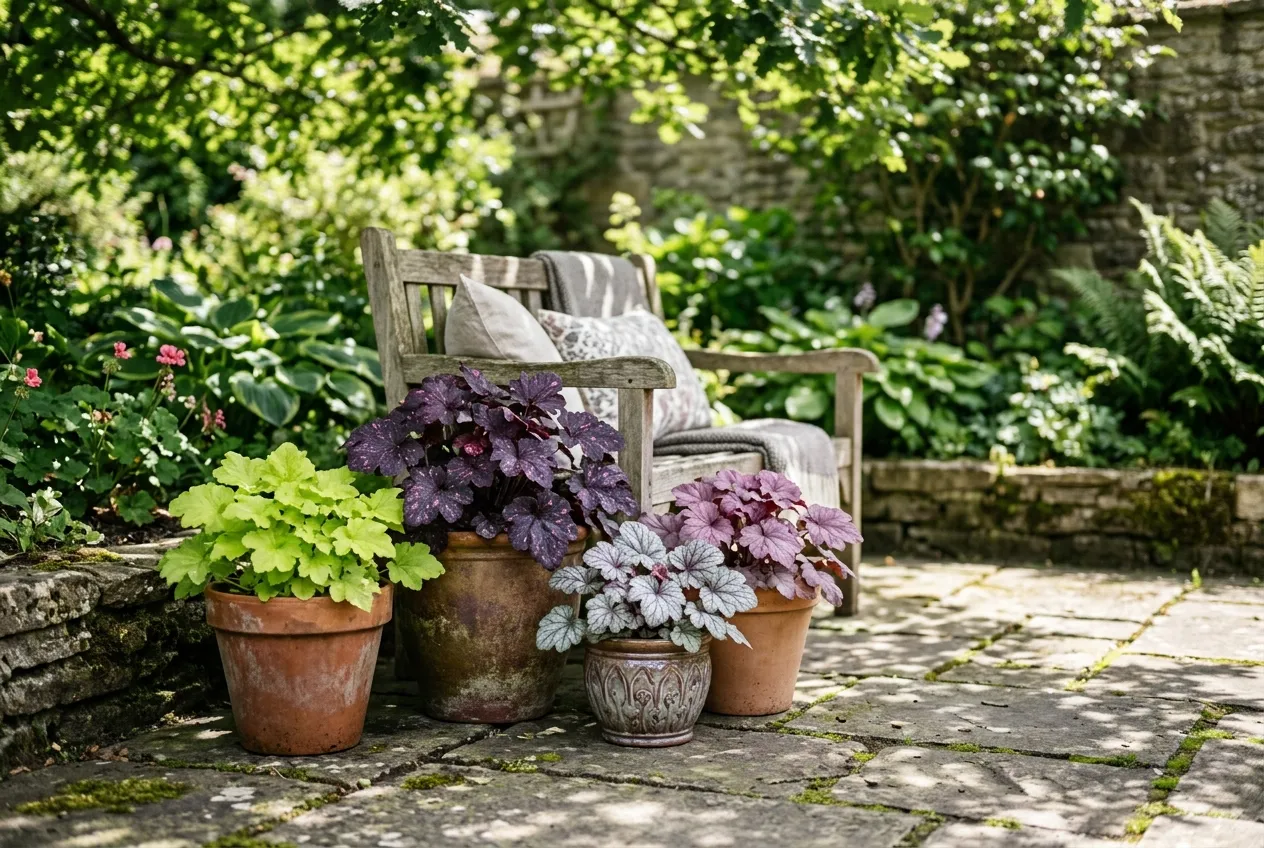 Heucheras in containers on a shaded patio, showing how different varieties create a display with minimal maintenance
Container growing essentials
Use a loam-based compost such as John Innes No. 2 mixed 3:1 with perlite. This provides nutrients, holds moisture, and drains freely. Avoid peat-based multipurpose compost on its own — it compacts over time and becomes either waterlogged or bone-dry.
Choose pots at least 20cm wide and 20cm deep. Terracotta works best because it breathes, preventing root rot. Ensure every pot has drainage holes. Stand pots on feet in winter to prevent waterlogging.
Feed monthly from April to September with liquid seaweed fertiliser. A half-strength tomato feed works as an alternative. Stop feeding in October as the plant enters its winter rest period.
Repot every 2 years in spring. Move up one pot size or divide the plant and replant into the same container with fresh compost. Heucheras in containers make outstanding partners for other year-round pot plants.
How to divide heuchera
Divide heuchera every 3-4 years in spring (March to April) to keep plants vigorous and prevent woody crown die-back. This is the single most important maintenance task. Undivided plants develop raised, woody crowns that dry out, split, and eventually die.
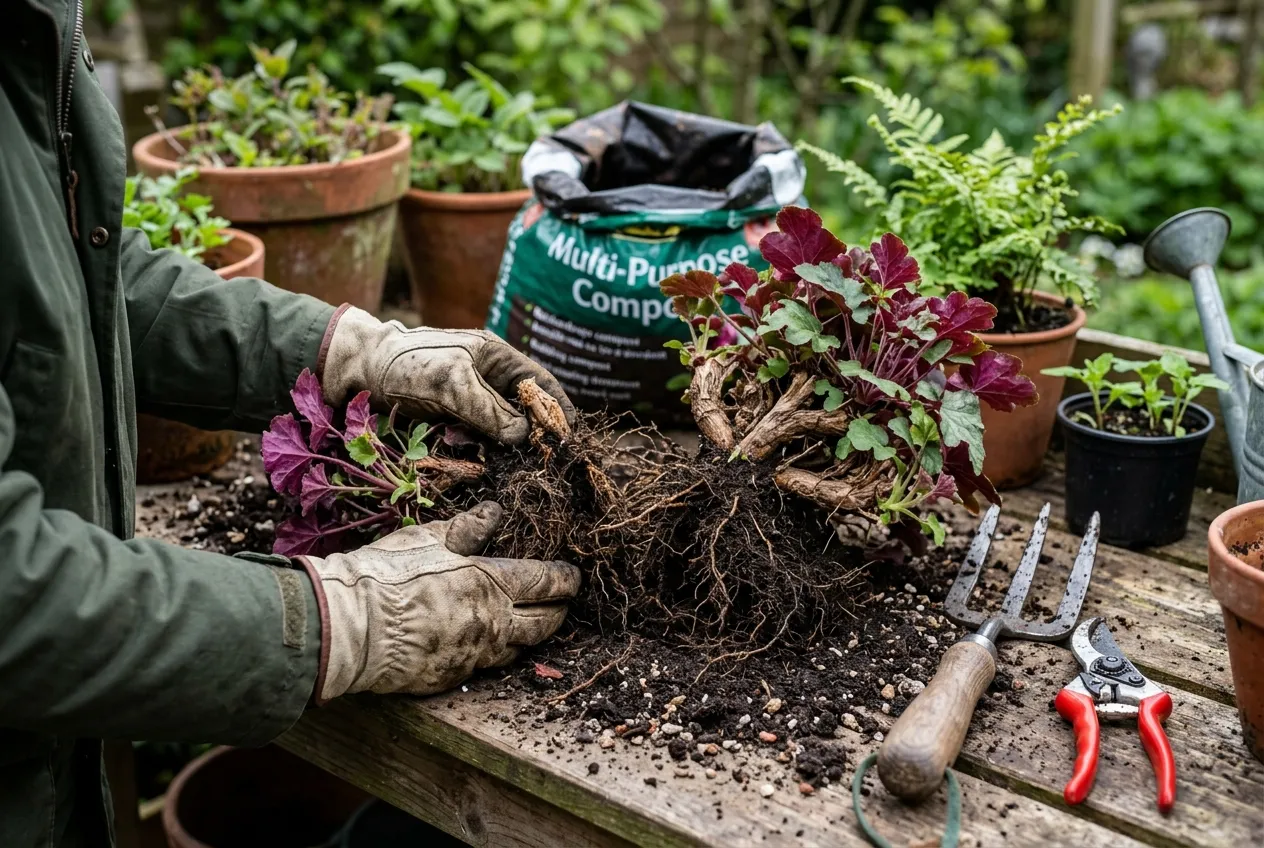 Dividing a heuchera: the woody crown splits cleanly into sections, each with roots and growing points
Step-by-step division
- Lift the entire plant with a garden fork in early spring
- Shake off loose soil and examine the crown
- Cut through the woody crown with a sharp knife or old bread knife
- Each division needs at least 3 growing points (visible leaf rosettes) and some healthy roots
- Trim away any dead or rotten sections of the old woody stem
- Replant each division at the original depth — the crown should sit at soil level, not above it
- Firm the soil around each division and water thoroughly
- Keep watered for 4-6 weeks until new roots establish
Field report: division success rates
Over 4 years of trialling in our West Midlands test beds, spring division of heuchera produced a 90% success rate when done in March. Divisions taken in September had a lower success rate of 70%, largely because vine weevil grubs damaged new roots through winter. Each mature plant yielded 3-5 viable divisions, making this the most cost-effective way to expand a heuchera collection.
How to deal with vine weevil on heuchera
Vine weevil is the number one killer of heuchera in UK gardens. The adult beetles notch leaf edges from April to October. The real damage comes from their larvae — white, C-shaped grubs that eat through roots underground from autumn to spring. A severe infestation kills the plant outright.
Identifying vine weevil damage
Adult damage appears as distinctive U-shaped notches around leaf margins. This looks unsightly but rarely threatens the plant’s survival. The adults feed at night and hide in leaf litter during the day.
Larval damage is invisible until the plant collapses. The white grubs, about 10mm long with brown heads, eat the roots and bore into the woody crown. The first sign is often a plant that wilts despite adequate watering. Pull gently on the crown — if it lifts from the soil with no resistance, the roots are gone.
Biological control with nematodes
Apply Nemasys vine weevil nematodes (Steinernema kraussei) in August and September when soil temperature is consistently above 12 degrees Celsius. Water the nematode solution into moist soil in the evening. The microscopic nematodes seek out and kill vine weevil grubs within 2-3 weeks.
A single application costs around 10-15 pounds and treats up to 12 square metres. Repeat annually in late summer. This is the most effective organic control method and the one recommended by the RHS for vine weevil management.
Container-grown heucheras are particularly vulnerable because the enclosed compost warms up faster, creating ideal conditions for grub development. Treat all containers with nematodes in August as a preventive measure, even if you see no signs of damage.
Other control methods
Chemical vine weevil drenches containing acetamiprid (sold as Bug Clear Ultra Vine Weevil Killer) offer an alternative. One application protects for up to 4 months. Apply in spring (March to April) when the new generation of adults becomes active.
Hand-picking adults at night using a torch is surprisingly effective for small collections. Check under leaf litter and around the base of plants after dark. The adults cannot fly, so barriers of copper tape around containers also reduce access.
Heuchera foliage colour guide
Heuchera foliage changes colour through the seasons, and the intensity of pigment depends on light levels, temperature, and variety. Understanding these shifts helps you place each variety where it looks its best year-round.
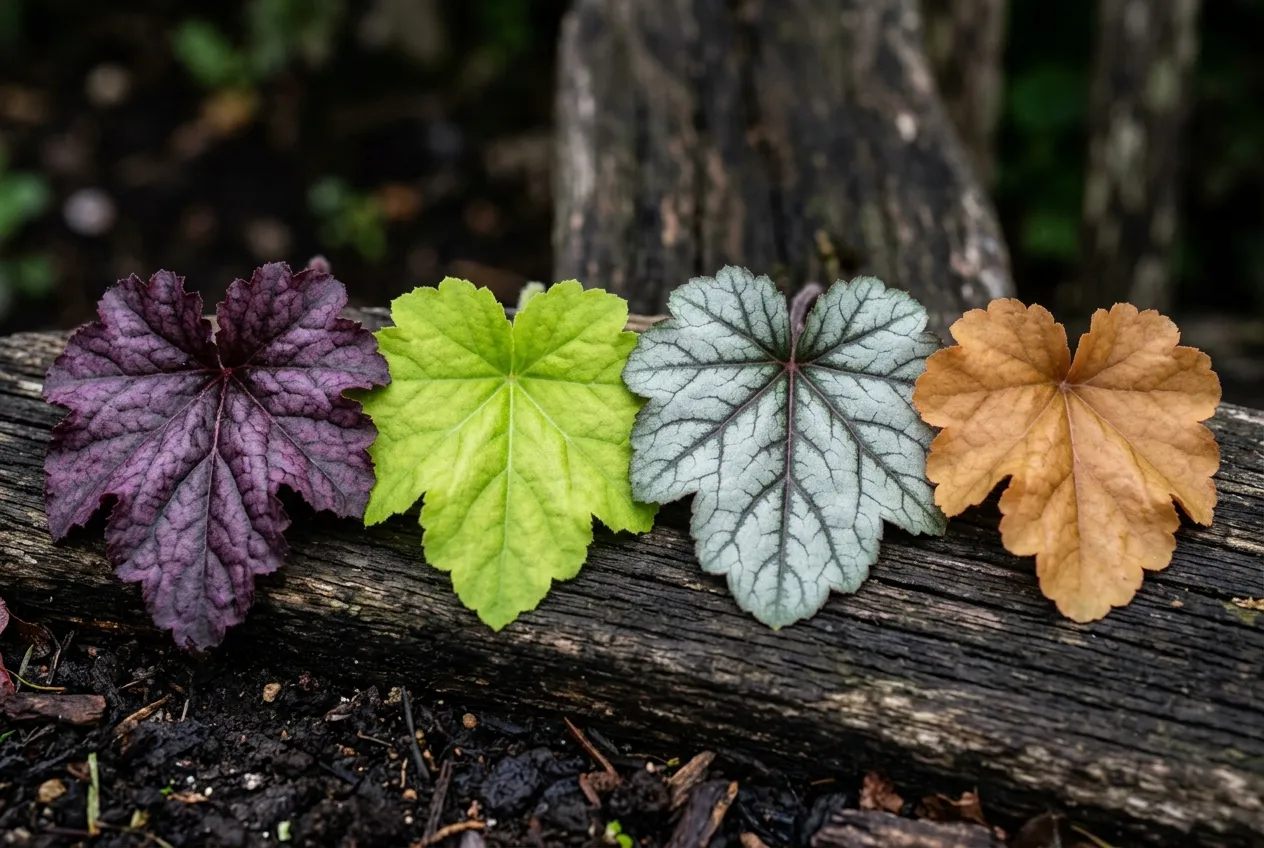 Heuchera leaf colours range from deep plum to bright lime, with silver and amber tones between
Seasonal colour changes
Spring produces the most vibrant new growth. Purple varieties emerge with intensely saturated leaves. Lime varieties glow brightest in April and May. As summer heat increases, colours mellow — purples soften toward brown, limes darken toward green.
Autumn brings a second flush of colour intensity as temperatures drop. Caramel varieties deepen to rich amber. Purple types regain their dark pigments. The foliage persists through winter, though older outer leaves may look tatty by February. Remove these in early March before new growth begins.
Using colour in planting schemes
Pair contrasting heuchera varieties for maximum impact. Obsidian (near-black) next to Lime Marmalade (bright green) creates a striking contrast visible from across the garden. Silver Scrolls bridges the gap between the two with its neutral metallic tone.
Heucheras combine well with other shade-tolerant perennials in mixed borders. Plant them beside hostas, ferns, astilbes, and brunnera for a layered woodland effect. The heuchera foliage provides colour from October to March when most other perennials are dormant.
For ground cover plantings, use Berry Smoothie or Palace Purple at 30cm spacing. Both spread to 40-50cm and produce dense foliage that suppresses annual weeds. The result is a low-maintenance carpet of colour from spring to late autumn.
Winter care for heuchera
Heuchera is fully hardy across the UK (RHS hardiness rating H7, down to minus 20 degrees Celsius) and needs minimal winter protection. The evergreen foliage persists through frost, snow, and prolonged cold. No fleece or mulching is required in most UK gardens.
Winter maintenance checklist
| Task | When | Why |
|---|---|---|
| Remove tatty outer leaves | Early March | Tidies the plant, prevents botrytis |
| Check crown height | March | If raised above soil, divide or earth up |
| Inspect roots for vine weevil | October-November | Early detection saves the plant |
| Reduce watering in containers | November-February | Prevents waterlogging and root rot |
| Move containers to sheltered spot | December | Reduces frost damage to pot and roots |
The main winter risk is waterlogging, not cold. On heavy clay soils, excess winter rain sits around the crown and causes rot. Improve drainage before planting, or grow in raised beds where water drains away naturally.
Container-grown heucheras need protection from the worst winter wet. Move pots against a house wall where the eaves provide some rain shadow. Stand pots on feet to ensure drainage holes remain clear. Do not wrap pots in bubble wrap — this traps moisture and encourages rot rather than preventing frost damage.
Planting heuchera: step-by-step
Plant heuchera in spring (March to May) or autumn (September to October) in well-drained soil enriched with garden compost. Autumn planting gives the best results because roots establish in warm soil before winter dormancy.
How to plant
- Dig a hole twice the width of the root ball and the same depth
- Mix a handful of coarse grit into the planting hole on clay soils
- Add a spadeful of garden compost or well-rotted manure
- Remove the plant from its pot and tease out circling roots
- Place in the hole so the crown sits at soil level — not below, not above
- Backfill with soil, firm gently, and water thoroughly
- Apply a 5cm mulch of bark chips or garden compost around the plant, keeping it away from the crown
- Water weekly for the first 6 weeks if planting in spring or during dry spells
Spacing and placement
Space heucheras 30-40cm apart in borders. For ground cover effect, plant at 30cm centres. In mixed plantings, allow 40cm to give each variety room to display its foliage shape.
Position dark varieties where they catch morning light — this highlights the leaf colour without causing sun scorch. Place lime varieties where they brighten gloomy corners. Silver types work as bridge plants between contrasting neighbours in border planting schemes.
Frequently asked questions
Is heuchera a good plant for shade UK?
Heuchera thrives in partial shade across the UK. It tolerates 2-4 hours of direct sun per day and performs best with morning light and afternoon shade. Dark-leaved varieties like Palace Purple and Obsidian hold their colour better in shade. Lime and gold varieties tolerate more sun but still scorch in hot, south-facing positions during July and August.
How often should I divide heuchera?
Divide heuchera every 3-4 years in spring. The crown becomes woody and raised above soil level over time. Lift the entire plant, split it into sections with a sharp knife, and replant at the original depth. Each division needs at least 3 growing points. Water well after replanting.
Why is my heuchera dying?
Vine weevil is the most common cause of heuchera death. The white C-shaped grubs eat through roots from autumn to spring. Pull the crown gently — if it lifts with no root resistance, grubs are present. Apply Nemasys nematodes in August when soil is above 12 degrees Celsius. Waterlogged soil is the second most common killer.
Can I grow heuchera in pots UK?
Heuchera grows very well in containers in the UK. Use a loam-based compost like John Innes No. 2 mixed with perlite for drainage. Ensure the pot has drainage holes. Feed monthly with liquid seaweed from April to September. Repot every 2 years and divide if the crown becomes congested.
Do heucheras come back every year?
Heucheras are hardy evergreen perennials that come back every year. They keep their foliage through winter in most UK gardens. After 3-4 years the crown lifts above soil level and becomes woody. Divide and replant at this stage to keep plants vigorous. Undivided plants eventually decline and die.
What is the best heuchera for ground cover?
Berry Smoothie and Palace Purple are the best heucheras for ground cover. Both spread to 40-50cm and produce dense foliage that suppresses weeds. Plant at 30cm spacing for full coverage within 18 months. Heuchera works well combined with other ground cover plants like ajuga and geranium macrorrhizum.
When should I plant heuchera UK?
Plant heuchera in spring (March to May) or autumn (September to October). Autumn planting gives the best results because roots establish in warm soil before winter. Spring planting works well but needs regular watering through the first summer. Avoid planting in frozen or waterlogged ground.
Lawrie has been gardening in the West Midlands for over 30 years. He grows his own veg using no-dig methods, keeps a wildlife-friendly garden, and writes practical advice based on real UK growing conditions.