How to Grow Honeysuckle UK
Grow honeysuckle in UK gardens: native Lonicera periclymenum, evergreen japonica, and winter fragrantissima. Planting, training, and pruning.
Key takeaways
- Lonicera periclymenum (native woodbine) climbs to 7m and is moth-pollinated — scent peaks after dusk for hawk-moths
- L. japonica 'Halliana' is evergreen and flowers June to October, reaching 10m; it can become invasive outside beds
- Winter honeysuckle (L. fragrantissima) is a shrub, not a climber, flowering November to March with intense lemon scent
- Plant 45cm from the base of a wall or fence in moist, well-drained soil with roots in shade and growth in sun
- Prune climbing honeysuckle in late summer after flowering; prune L. fragrantissima after flowering in early spring
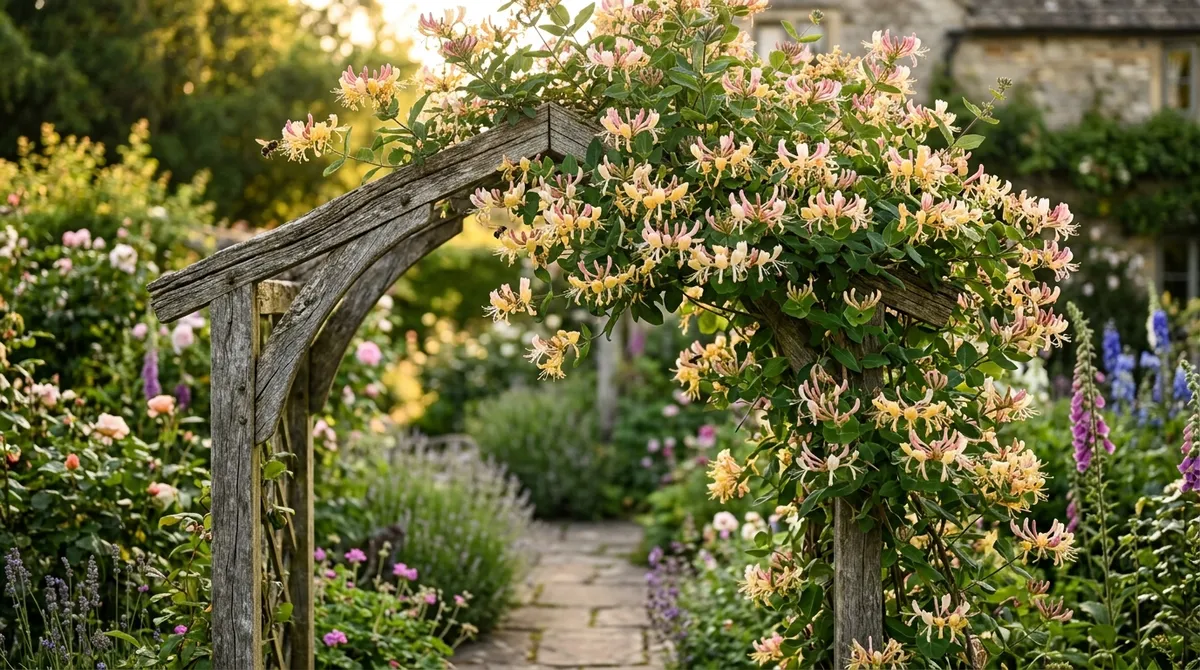
Honeysuckle is one of the most evocative plants in any British garden. The scent of Lonicera periclymenum on a warm July evening, drifting across a garden after dark, is the smell of an English summer. It is a plant with genuine wildlife credentials — moth-pollinated, berry-producing, and dense enough to shelter nesting warblers — and it is genuinely easy to grow once you understand its two requirements: keep the roots cool and give the top growth sun.
This guide covers the main honeysuckle types for UK gardens, how to plant and train them on arches, fences, and pergolas, pruning by species, and how to get the best scent and wildlife value. For other climbers that work well alongside honeysuckle, see our guide to the best climbing plants for UK gardens.
Which honeysuckle should I grow?
The name “honeysuckle” covers a large genus — Lonicera — with both climbing species and shrubby species. The climbing and shrubby types behave very differently, and mixing them up leads to confusion about pruning and siting.
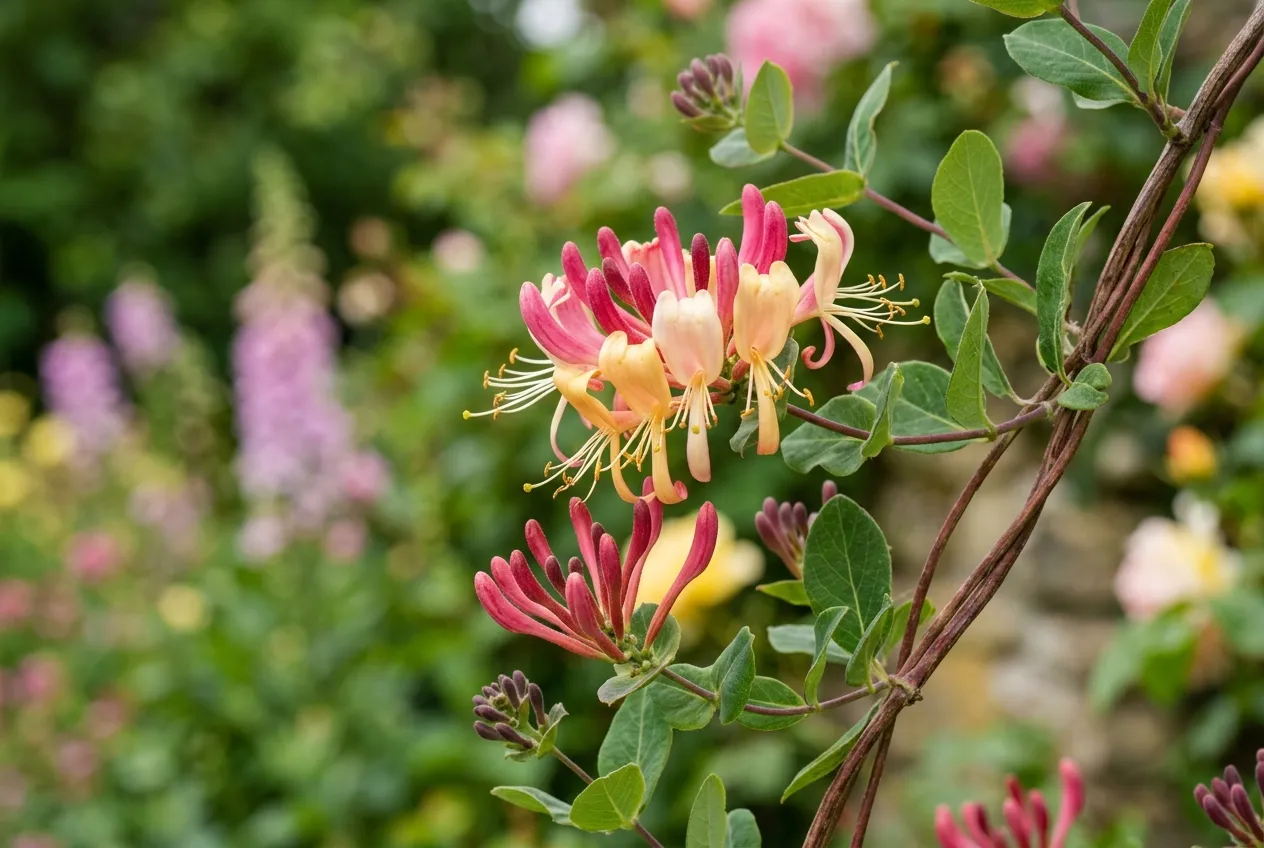 The main UK honeysuckle species. Left to right: L. periclymenum ‘Belgica’, L. japonica ‘Halliana’, L. × tellmanniana, L. fragrantissima.
Native woodbine — Lonicera periclymenum
The UK native species, known as woodbine, is the most valuable honeysuckle for wildlife and arguably the most rewarding to grow. It is a vigorous twining climber reaching 6–7 metres on a sturdy support. Flowers appear from June to September — creamy white flushed purple-pink on the outside, yellow within — in dense terminal clusters. The scent is strong and sweet, intensifying markedly after dusk. This is the plant that attracts hawk-moths.
Named cultivars of L. periclymenum improve on the straight species:
- ‘Belgica’ (Early Dutch): Compact, flowers May to June with a second flush in late summer. Reddish-purple outside, cream within. Strong scent.
- ‘Serotina’ (Late Dutch): Later flowering, July to October. Deeper purple-red outside. Extends the season significantly.
- ‘Graham Thomas’: Pure cream flowers from July to October. Very fragrant, long-flowering, RHS Award of Garden Merit. Good for white garden schemes.
- ‘Scentsation’: Selected for exceptionally strong scent. Creamy white flowers June to October. Heavy-cropping red berries.
The RHS Plant Finder lists over 15 named cultivars of L. periclymenum suited to UK gardens, but ‘Belgica’, ‘Serotina’, and ‘Graham Thomas’ remain the most widely grown and most reliable.
Japanese honeysuckle — Lonicera japonica
An evergreen or semi-evergreen climber, more vigorous than the native species, reaching 8–10 metres. Flowers are creamy white, turning yellow with age, and appear from June to October — a longer season than L. periclymenum. Fragrant but with a slightly different, less complex scent than the native woodbine. ‘Halliana’ is the most commonly grown cultivar and the most fragrant.
L. japonica is fully hardy across the UK and survives to approximately -25°C. Its vigour is a consideration: it covers a large structure efficiently but can overwhelm smaller supports or scramble into trees if not managed. In the wild it is classified as invasive in some countries — in UK gardens it is easily controlled by annual pruning, but do not plant it where it can reach hedgerows.
Scarlet trumpet honeysuckle — Lonicera × brownii and L. × tellmanniana
Both are deciduous hybrids grown primarily for the visual impact of their flowers rather than scent. L. × brownii ‘Dropmore Scarlet’ produces orange-red tubular flowers from June to September and attracts bumblebees strongly — the flowers are accessible to short-tongued bees unlike the deep tubes of L. periclymenum. L. × tellmanniana has striking golden-yellow flowers in May to July but no meaningful fragrance. Both are fully hardy and reach 3–5 metres.
Winter honeysuckle — Lonicera fragrantissima
A shrub, not a climber. It forms a spreading deciduous or semi-evergreen bush reaching 2 metres high by 2.5 metres wide. The flowers are small, creamy white, and produced on bare stems from November to March — and the scent is extraordinary. In the depths of winter, a single L. fragrantissima in flower produces an intense lemon fragrance that carries clearly on still air. This is one of the best winter-flowering plants available for a UK garden.
Sited near a path, an entrance, or a seating area used in mild winter weather, it earns its space entirely. It does not suit a boundary fence or wall where a climber is needed — plant it as a specimen shrub in a border.
The Woodland Trust identifies Lonicera periclymenum as one of the 30 most valuable native plants for UK garden wildlife, noting its importance for hawk-moths, nesting birds, and late-season berry production.
Honeysuckle varieties comparison table
| Species / cultivar | Type | Scent | Flowers | Aspect | Height | Wildlife |
|---|---|---|---|---|---|---|
| L. periclymenum (woodbine) | Deciduous climber | Very strong (evening) | Jun–Sep | S, W, E | 6–7m | Hawks-moths, bees, birds |
| L. p. ‘Belgica’ | Deciduous climber | Strong | May–Jun + late Aug | S, W, E | 4–5m | As above |
| L. p. ‘Serotina’ | Deciduous climber | Strong | Jul–Oct | S, W, E | 5–6m | As above |
| L. p. ‘Graham Thomas’ | Deciduous climber | Strong | Jul–Oct | S, W, E | 5–6m | As above |
| L. japonica ‘Halliana’ | Evergreen climber | Moderate | Jun–Oct | S, W, E | 8–10m | Bees, hoverflies |
| L. × brownii ‘Dropmore Scarlet’ | Deciduous climber | None | Jun–Sep | S, W | 3–4m | Bumblebees |
| L. × tellmanniana | Deciduous climber | None | May–Jul | S, W, E | 4–5m | Bees |
| L. fragrantissima | Deciduous shrub | Very strong (lemon) | Nov–Mar | Any | 2m × 2.5m | Queen bumblebees |
Where to plant honeysuckle
Honeysuckle has a well-known preference: roots in cool, moist conditions, top growth in sun. In woodland — its natural habitat — it grows through hedges and up into the canopy, with roots in the permanently shaded, moisture-retentive woodland floor. In a garden, recreate this by choosing a position where the root zone is shaded by the base of a wall, paving, or a low shrub, even as the climbing stems reach up into sun.
Ideal aspects are south, west, or east-facing. A south-west-facing wall or fence is close to perfect: enough sun for good flowering, some protection from the drying east wind.
North-facing walls are possible for the native woodbine, which is more shade-tolerant than most climbers, though flowering is reduced. L. japonica handles partial shade well. L. × tellmanniana actually prefers semi-shade and is one of the few honeysuckles that thrives on an east-facing wall.
Keep climbing honeysuckle away from positions in the open garden where roots bake in summer sun — this combination produces mildew, weak growth, and poor flowering more reliably than almost any other management error.
For ideas on structures to train honeysuckle over, our pergola ideas guide covers timber, metal, and modular options suited to UK gardens.
How to plant honeysuckle
Plant container-grown honeysuckle from autumn to spring. October and November are ideal — the soil is still warm, roots establish over winter, and the plant begins active growth early the following spring. Spring planting (March to April) works well if you water attentively through the first summer.
Planting step by step
- Prepare the planting hole 45cm wide and 45cm deep. Position it at least 40cm from the base of the wall or fence, where soil tends to be very dry due to the rain shadow effect.
- Incorporate a generous amount of well-rotted garden compost or leaf mould into the excavated soil. Honeysuckle benefits from moisture-retentive soil.
- Soak the rootball thoroughly before removing the pot — 20–30 minutes in a bucket of water.
- Angle the rootball toward the wall at 45°. This encourages the stems toward the support.
- Set the plant at the same depth it was growing in the container.
- Backfill with the improved soil, firm gently, and water thoroughly.
- Apply a deep (7–10cm) mulch of bark chippings, composted wood chip, or garden compost. Keep mulch clear of the stems. This is the single most important step for keeping roots cool and moist.
- Tie in the main stems to the support loosely with soft garden twine or plant ties.
In very dry summers, water established honeysuckle deeply once a week rather than frequent shallow watering. Deep watering encourages deep rooting, which improves drought tolerance in subsequent years.
How to train honeysuckle on arches, fences, and pergolas
Honeysuckle twines naturally — it wraps anticlockwise around supports without needing to be tied every few centimetres. However, it does need a framework to grip, and spreading the stems manually when young makes a huge difference to coverage and density.
Training on a trellis or fence wires
Fix trellis 5cm from the wall using spacer blocks, or strain horizontal wires at 30cm intervals using vine eyes — this air gap prevents moisture trapping and allows you to guide stems behind the support. As the plant grows, weave new shoots horizontally into the framework rather than letting them all run vertically. Horizontal training produces more side shoots, and more side shoots mean more flowers.
Training over an arch
Arches are one of the best structures for climbing honeysuckle, particularly over a garden path where the scent is encountered at head height. Train one or two main stems up each upright of the arch and tie them in loosely. As the plant matures, guide stems over the top of the arch and allow them to cascade on both sides. A well-established honeysuckle on a timber arch looks spectacular from year three onwards and requires only annual light pruning to keep in shape.
For best effect on an arch, combine L. p. ‘Belgica’ (early flowering) with ‘Serotina’ (late flowering) to extend the season from May through to October. Both grow at similar rates and their stems weave together naturally.
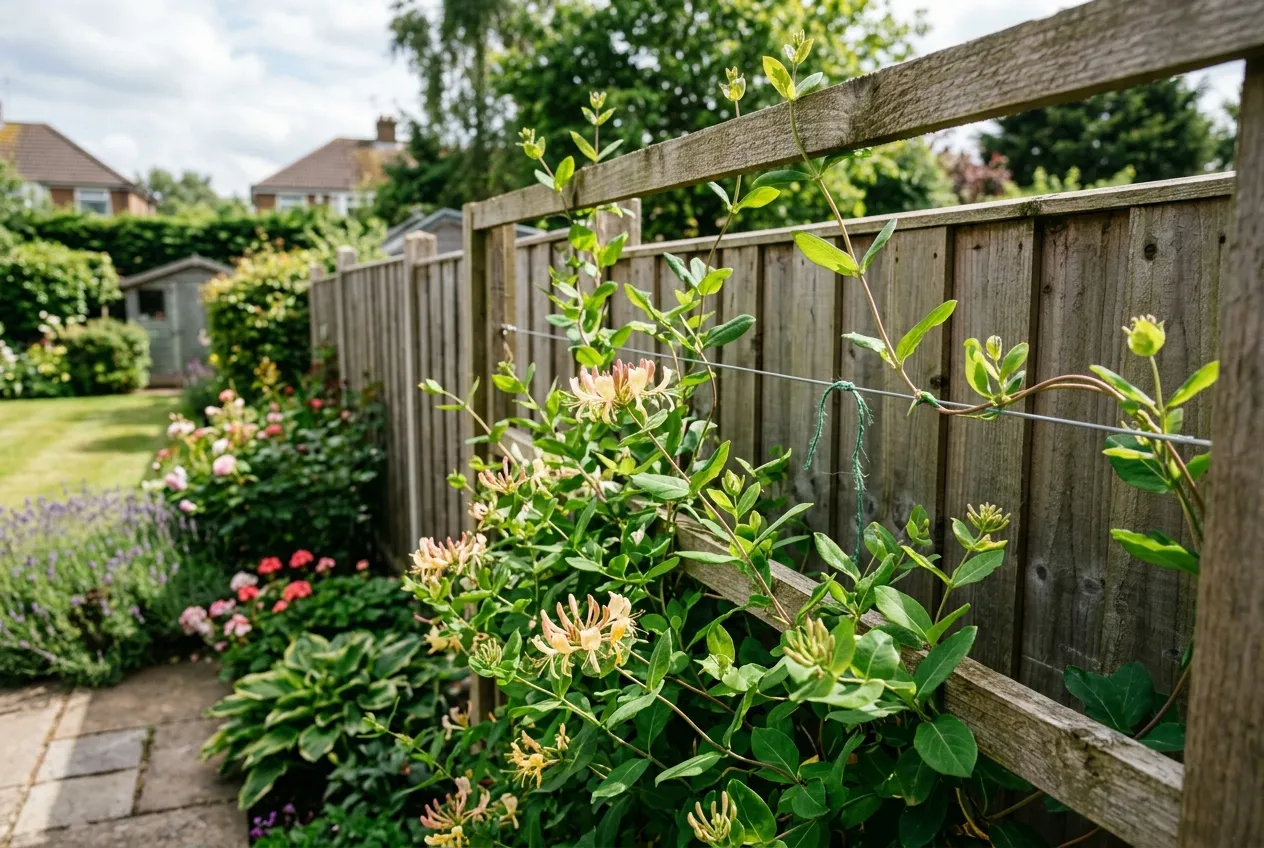 Training honeysuckle over an arch gives scent at head height. Use horizontal stems tied in to the uprights for maximum flower coverage.
Training on a pergola
On a larger pergola structure, allow two or three main framework stems to grow up each post and then spread out along the horizontal beams. The beams provide natural support and the honeysuckle will clothe them with little intervention once the main framework is established. Pair with a fast-growing climber like clematis or a climbing rose on adjacent posts to maximise seasonal interest.
Self-supporting — through a hedge or shrub
The native L. periclymenum is perfectly happy scrambling through an established shrub or informal hedge, as it would in the wild. This requires no training and produces a naturally informal look with good wildlife value — birds can nest in the combined structure. Suitable host plants include hawthorn, blackthorn, hazel, and large shrub roses.
Honeysuckle pruning — by species
Pruning honeysuckle is straightforward once you understand whether the plant flowers on new growth from old wood (the climbing species) or on the previous season’s stems (winter honeysuckle). Getting this wrong means cutting off this season’s flowers.
Pruning climbing honeysuckle (L. periclymenum, L. japonica, hybrids)
Climbing honeysuckle flowers on new side shoots produced from an established framework of older stems. The pruning aim is to maintain the framework, remove crowded or dead growth, and stimulate production of new flowering shoots.
Timing: August to September, after flowering. For L. japonica which flowers into October, prune in November.
Method:
- Remove any dead, damaged, or diseased stems completely.
- Cut back flowered side shoots to two or three buds from the main framework stems.
- Remove one third of the oldest, most congested stems by cutting to ground level or to a healthy young stem lower down. This prevents the plant becoming a dense, tangled mass that produces flowers only at the top.
- Tie in new growth to fill gaps in the framework.
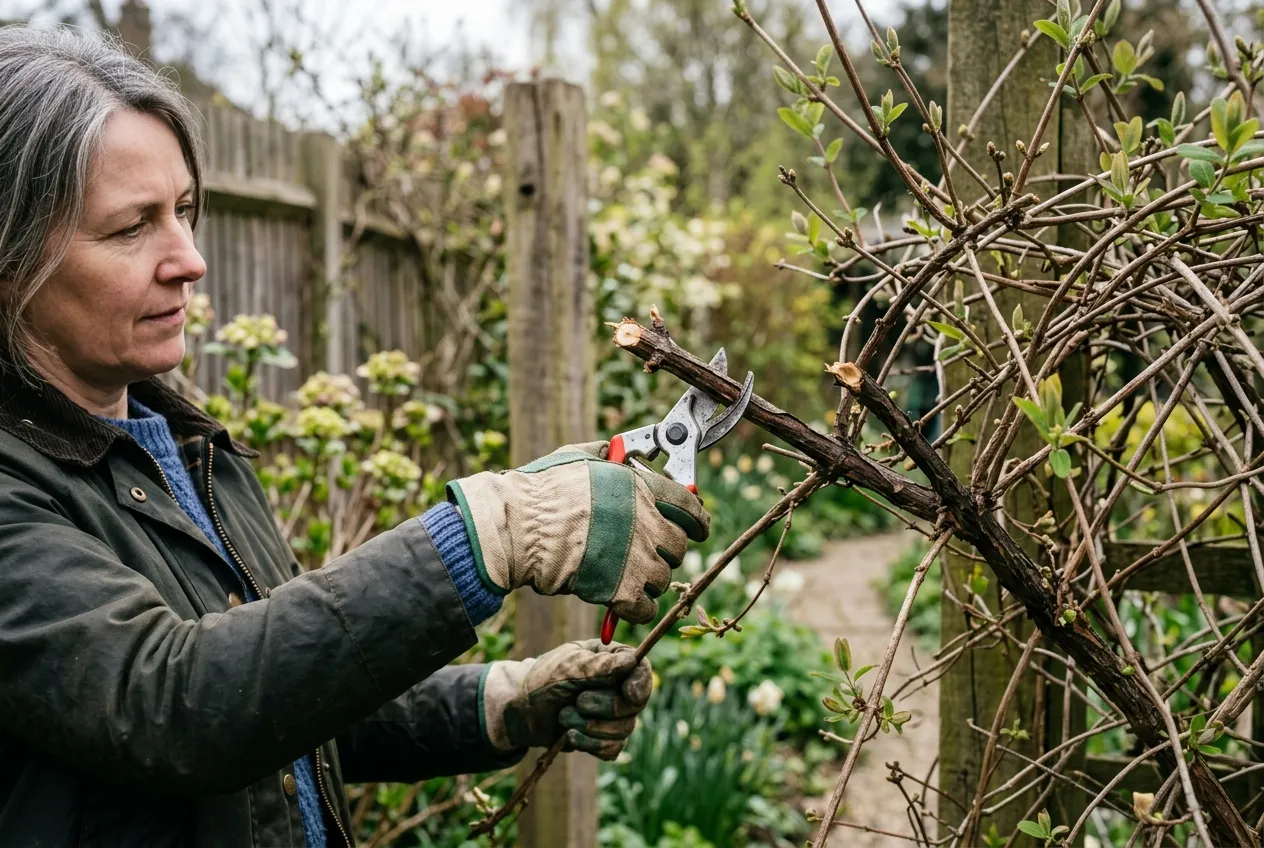
Renovating a neglected honeysuckle: if the plant has become a tangled, woody mass with flowers only at the top, cut it back hard in late winter (February to March) to about 60cm from the ground. It will regenerate vigorously. Feed with a balanced fertiliser in spring and mulch around the base.
Pruning winter honeysuckle (L. fragrantissima)
Prune immediately after flowering in February to March. Remove flowered stems, cutting back to strong young growth or to a healthy bud. Lightly shape the plant to maintain its overall form. Do not prune in autumn — the stems you see in late summer carry the flower buds for winter. For broader context on shrub pruning timing and technique, our guide to how to prune shrubs covers the general principles.
Pruning schedule by species
| Species | When to prune | What to remove | Hard renovation |
|---|---|---|---|
| L. periclymenum | Aug–Sep after flowering | Flowered shoots to 2–3 buds; 1/3 oldest stems | Feb–Mar, cut to 60cm |
| L. p. ‘Serotina’ | Oct–Nov | As above | Feb–Mar, cut to 60cm |
| L. japonica ‘Halliana’ | Oct–Nov after flowering | Flowered side shoots; thin congested growth | Mar, cut to 60cm |
| L. × brownii | Aug–Sep after flowering | Flowered shoots; thin if needed | Mar, cut to 60cm |
| L. × tellmanniana | Jul–Aug after flowering | Flowered shoots to 2–3 buds | Mar, cut to 60cm |
| L. fragrantissima | Feb–Mar after flowering | Flowered stems; shape lightly | Mar, cut by half |
Honeysuckle scent — when is it strongest?
The scent of Lonicera periclymenum is one of the defining characteristics of the British summer garden — but the timing matters. The plant is moth-pollinated, not bee-pollinated, which means its scent strategy is the reverse of most garden flowers. Scent production ramps up sharply after dusk, peaks through the night, and is at its weakest in the middle of a sunny afternoon.
 Honeysuckle flowers at their most fragrant after dusk — the scent intensifies to attract hawk-moths. Plant near a seating area used in the evening for maximum impact.
For maximum scent experience, plant honeysuckle near:
- An evening seating area, patio, or terrace
- A bedroom window that opens in summer
- A garden path used in the evening
- Near the front door on the approach to the house
Positioning honeysuckle specifically for evening scent is one of the most impactful decisions in planting a scented garden. No other hardy climber delivers this combination of intensity and timing.
The elephant hawk-moth (Deilephila elpenor) is the primary pollinator of L. periclymenum in the UK. Its long proboscis — 30mm — reaches the nectar deep in the 3–4cm flower tubes. In warm summer evenings, watching hawk-moths hover at honeysuckle is one of the most spectacular wildlife experiences available in a UK garden.
Honeysuckle wildlife value
The native Lonicera periclymenum is genuinely outstanding for UK wildlife. The dense twining stems create favoured nesting habitat for several small birds. The flowers supply nectar to hawk-moths through the night and to bumblebees during the day. The red berries in late summer and autumn are eaten by thrushes, garden warblers, blackcaps, and bullfinches.
- Moth species: Elephant hawk-moth, hummingbird hawk-moth, white-lined sphinx moth. The flowers’ long tubes mean only long-tongued moths can access the nectar — this is a co-evolved relationship between the plant and its pollinators.
- Bee species: Lonicera periclymenum attracts bumblebees during the day. The buff-tailed bumblebee and garden bumblebee are regular visitors. Short-tongued species occasionally “rob” nectar by biting a hole at the base of the tube.
- Birds: Blackcap and garden warbler are known to nest preferentially in dense honeysuckle. The berries (ripe August to October) are consumed quickly by thrushes, redwings in winter, and resident seed-eaters.
- Insects: The RHS notes that L. periclymenum supports over 20 insect species, including the white admiral butterfly caterpillar, which feeds on the leaves.
For companion planting with honeysuckle to extend wildlife value through the season, our guides to bee-friendly garden plants and the best plants for butterflies include complementary climbers and border plants.
Common honeysuckle problems
Honeysuckle aphids
Honeysuckle aphids (Hyadaphis foeniculi) cause distinctive yellow leaf curling at shoot tips from late spring onwards. They live inside the curled leaves, protected from contact sprays. The most practical response is to pinch out and remove affected shoot tips in late spring. Established plants with a healthy wildlife population (including blue tits, which actively search out aphid colonies on honeysuckle) rarely suffer severe damage.
Powdery mildew
The most common honeysuckle problem, particularly on plants in dry conditions with poor air circulation. Grey-white powdery coating on leaves, usually from July onwards. Prevention is better than cure: keep the root zone cool and moist with deep mulch, ensure good air movement around the plant, and avoid overhead watering. If mildew is severe every year, consider replacing with L. japonica, which shows better mildew resistance, or try ‘Scentsation’ which has been selected partly for disease resistance.
No flowers
Most commonly caused by one of three factors. First, too much shade — flowering is sharply reduced below about 4 hours of direct sun. Second, pruning at the wrong time — if the plant was pruned hard in spring, this season’s flowering shoots have been removed. Third, over-feeding with nitrogen from lawn fertiliser run-off or heavy manure applications; switch to a high-potash feed (tomato feed) from May to encourage flowers over foliage.
Leggy, bare-stemmed at the base
Normal in older plants, but manageable. Honeysuckle naturally produces new growth from shoot tips and the base of the plant becomes woody and bare over time. Prevent this by always removing one third of the oldest stems annually, and by tying some stems low down to cover the base. A companion low-growing climber or wall shrub at the base can disguise bare stems on an established plant.
Frequently asked questions
When does honeysuckle flower in the UK?
Lonicera periclymenum flowers June to September, peaking in July to August. ‘Belgica’ starts in May; ‘Serotina’ extends to October. L. japonica flowers June to October. L. fragrantissima flowers November to March.
How fast does honeysuckle grow?
Established climbing honeysuckle grows 1.5–2 metres per year. L. japonica ‘Halliana’ can cover a 3m fence panel in two seasons. First-year growth is slower — 30–60cm — as roots establish. From year two, growth accelerates. In ideal conditions (cool moist root zone, warm sunny aspect), L. periclymenum will cover a 3m arch completely within four to five years.
Does honeysuckle need full sun?
Honeysuckle flowers best with stems and foliage in sun but needs its root zone kept cool and moist. Plant it so roots are shaded — behind low paving, a wall, or a ground-level shrub — with the climbing growth in a south, west, or east-facing aspect. L. × tellmanniana is the exception: it actually prefers semi-shade and is one of the few climbers suited to east-facing walls.
How do I prune honeysuckle?
Prune climbing honeysuckle in August to September after flowering. Cut flowered side shoots to two or three buds, remove one third of the oldest stems to ground level, and tie in new growth. For neglected plants, cut back hard to 60cm in late winter and feed in spring. Prune winter honeysuckle (L. fragrantissima) in February to March after flowering — do not prune in autumn.
Is honeysuckle good for wildlife?
Honeysuckle is among the best UK native plants for wildlife. Flowers attract hawk-moths at night and bumblebees by day. Red berries feed thrushes, warblers, and bullfinches in autumn. Dense stems shelter nesting blackcaps and garden warblers. L. periclymenum supports over 20 insect species including white admiral butterfly larvae.
What is the most fragrant honeysuckle?
L. periclymenum ‘Graham Thomas’ and ‘Scentsation’ are the most fragrant hardy climbing honeysuckles. Both deliver the classic sweet evening scent, strongest from July to August after dusk. Winter honeysuckle (L. fragrantissima) has a very different, intensely lemony scent from November to March — extraordinary for the season.
Why is my honeysuckle not flowering?
The most common causes are too much shade, over-feeding with nitrogen (which promotes leafy growth over flowers), or pruning at the wrong time. Honeysuckle flowers on new side shoots from established stems — pruning hard in spring removes the base for this season’s flowers. Switch to a high-potash feed (tomato fertiliser) from May. If in too much shade, flowering reduces sharply and the plant becomes prone to mildew.
Related reading
Lawrie has been gardening in the West Midlands for over 30 years. He grows his own veg using no-dig methods, keeps a wildlife-friendly garden, and writes practical advice based on real UK growing conditions.