How to Grow Hyacinths in the UK
Grow hyacinths UK: plant bulbs 15cm deep in autumn for May flowers, or force indoors on hyacinth glasses for Christmas blooms from just 10 weeks.
Key takeaways
- Plant hyacinth bulbs 15cm deep from September to November for outdoor spring flowers
- For Christmas flowering, start indoor forcing in early October — bulbs need 10-12 weeks at 4-9°C
- Hyacinth glasses allow you to watch root development; tip the glass to drain weekly to prevent rot
- Prepared bulbs are pre-chilled by suppliers and flower 6-8 weeks earlier than standard bulbs indoors
- After flowering, plant forced bulbs outdoors where they will recover and flower again in 1-2 years
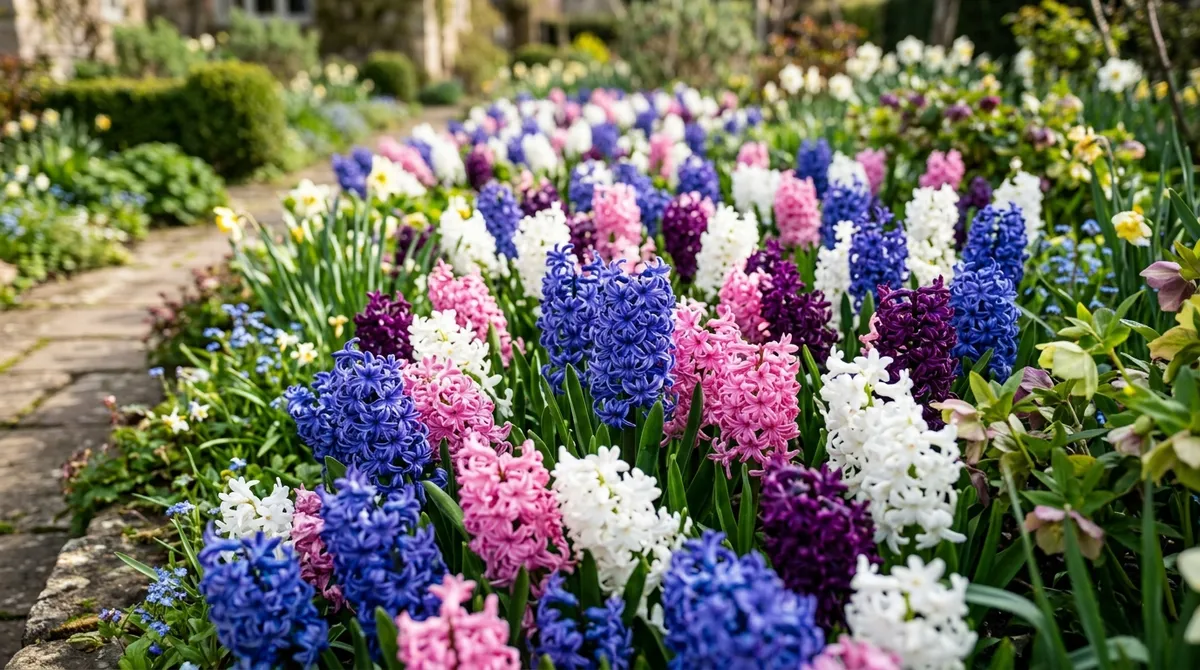
Hyacinths are among the most intensely fragrant spring bulbs available to UK gardeners, filling a room or garden border with their distinctive sweet scent from a single flower spike. Whether you are growing them outdoors in a border for May colour, forcing them on hyacinth glasses for a Christmas display, or massing them in spring containers, hyacinths are rewarding and straightforward to grow once you understand their chilling requirements.
This guide covers outdoor planting, indoor forcing on glasses and in pots, the best UK varieties by colour and fragrance strength, planting depth and spacing, and aftercare once the flowers are spent. For context on how hyacinths fit into a wider spring planting scheme, see our guide to when to plant spring bulbs in the UK.
What are hyacinths and where do they come from?
Hyacinths (Hyacinthus orientalis) are hardy spring-flowering bulbs native to the eastern Mediterranean and south-west Asia. They were introduced to British gardens in the 16th century and became enormously fashionable in the Netherlands during the 18th century, when Dutch growers developed the dense, multi-floret flower spikes that modern cultivars are descended from.
All commonly grown garden hyacinths belong to a single species — Hyacinthus orientalis — though thousands of cultivars exist. Commercial UK suppliers typically stock around 60 named varieties at any one time, in colours ranging from deep violet and navy blue through to soft pink, white, salmon, coral, pale yellow, and near-red.
The characteristic flower spike consists of a central stem densely packed with individual bell-shaped florets, each with reflexed petals. A well-grown spike can carry 20-40 individual florets. The fragrance comes from phenylacetaldehyde and benzyl acetate — the same aromatic compounds found in jasmine and lily of the valley.
Hyacinths are mildly toxic. All parts of the plant contain oxalic acid crystals and alkaloids. Wear gloves when handling bulbs as the outer skin can cause skin irritation in sensitive individuals. The Royal Horticultural Society’s hyacinth growing guide confirms this and recommends gloves for handling. Keep bulbs away from pets and children.
UK hyacinth varieties: colour, fragrance, and suitability
Choosing the right variety makes a significant difference to both flowering performance and fragrance intensity. The table below covers the most widely available named cultivars in the UK, based on supplier listings and RHS Award of Garden Merit holders.
Hyacinth variety comparison
| Variety | Colour | Fragrance strength | Best use | Height | AGM |
|---|---|---|---|---|---|
| Delft Blue | Soft lilac-blue | Intense | Outdoors + forcing | 25cm | Yes |
| Blue Jacket | Navy blue | Intense | Outdoors + forcing | 25cm | Yes |
| Anna Marie | Shell pink | Strong | Forcing + pots | 20cm | Yes |
| Pink Pearl | Deep rose-pink | Strong | Outdoors + borders | 25cm | Yes |
| Carnegie | White | Moderate | Forcing + indoors | 25cm | Yes |
| White Pearl | White | Moderate | Outdoors + borders | 28cm | No |
| Jan Bos | Deep carmine-red | Moderate | Forcing + pots | 22cm | Yes |
| Woodstock | Dark burgundy | Moderate | Outdoors + borders | 25cm | No |
| City of Haarlem | Pale primrose-yellow | Mild | Indoors + pots | 28cm | Yes |
| Gypsy Queen | Apricot-salmon | Mild | Outdoors + borders | 28cm | Yes |
| Miss Saigon | Deep violet | Strong | Outdoors + forcing | 25cm | No |
| Hollyhock | Double deep red | Mild | Containers + borders | 20cm | No |
Key recommendation: For indoor forcing where fragrance can build up in a closed room, choose ‘City of Haarlem’ or ‘Carnegie’. For outdoor use where you want maximum scent in the garden, ‘Delft Blue’ and ‘Blue Jacket’ are the strongest-performing UK varieties. For Christmas forcing specifically, buy bulbs labelled “prepared” — these are pre-chilled and flower 6-8 weeks earlier than untreated bulbs.
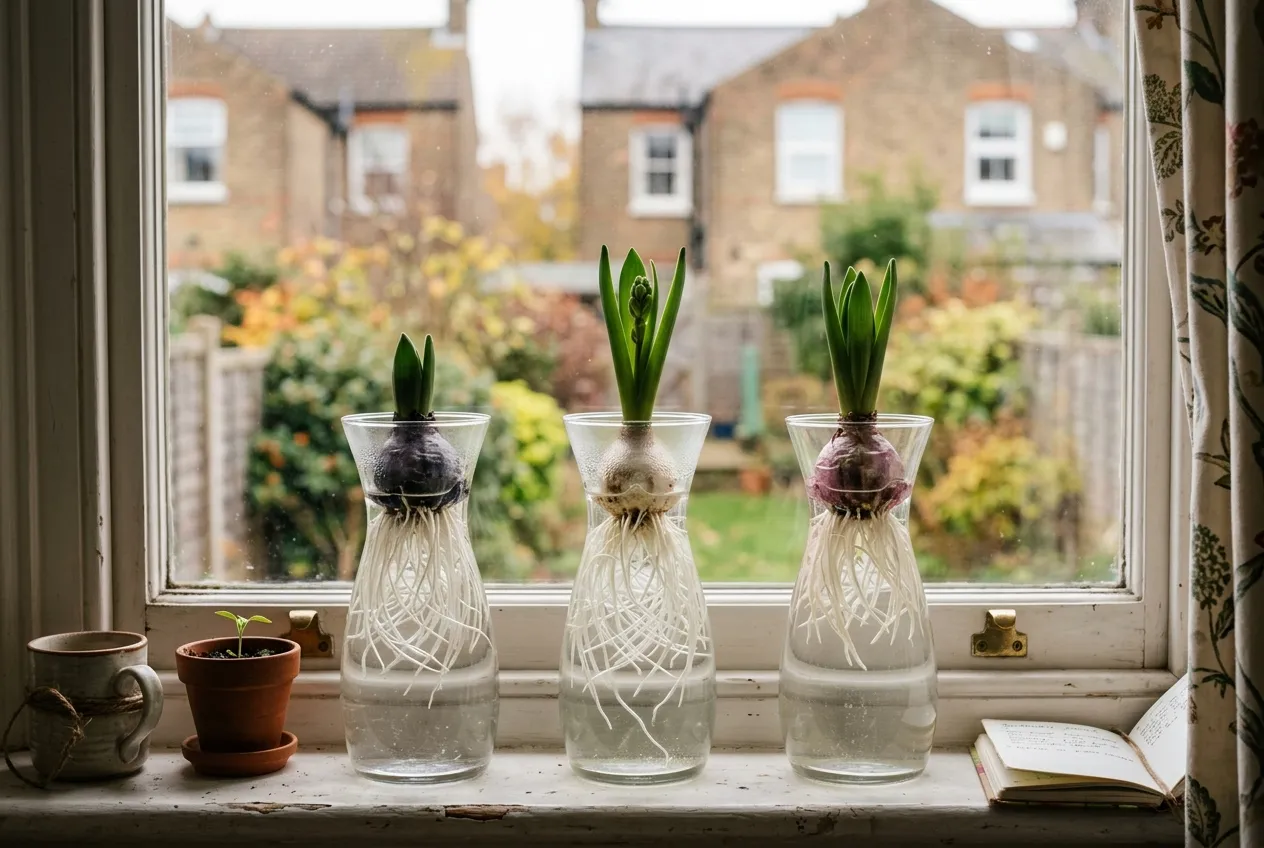 A hyacinth glass allows you to watch the roots develop — one of the most rewarding aspects of winter forcing.
How to force hyacinths indoors
Indoor forcing is the art of tricking hyacinth bulbs into flowering ahead of their natural outdoor schedule. Done correctly, you can have hyacinths in flower for Christmas, New Year, or any winter date you choose. Forcing works because hyacinths (like all hardy spring bulbs) need a cold period — called vernalisation — before they can flower. By controlling the temperature and timing, you control the flowering date.
Prepared versus standard bulbs
Prepared bulbs have already been given a partial cold treatment by the supplier. They are intended specifically for Christmas forcing. Because part of the chilling is already done, they need only 8-10 weeks of cold from you before they are ready to bring into warmth. Standard bulbs need the full 10-12 weeks.
Always buy prepared bulbs if you want Christmas flowers. They are clearly labelled by suppliers including Thompson & Morgan. Standard bulbs cost slightly less and are suitable for January and February forcing.
Indoor forcing timeline
| Week | Action | Temperature |
|---|---|---|
| Week 1 (early October) | Plant bulbs in glasses or pots, move to cold dark place | 4-9°C |
| Weeks 2-4 | Roots develop on glasses; check water level weekly | 4-9°C |
| Weeks 5-8 | Shoots emerge. Keep cool and dark. | 4-9°C |
| Week 9-10 | Shoots reach 4-5cm. Bring into a cool bright room | 10-13°C (transition) |
| Week 11-12 | Move to full warmth and light as buds form | 15-18°C |
| Week 13-14 (mid-late December) | Flowers open. Deadhead after 2-3 weeks of display | 15-18°C |
The most common mistake is rushing the cold period. Bulbs moved into warmth with shoots less than 4cm tall produce weak, blind (non-flowering) spikes. Always wait until shoots reach 5cm before transitioning.
Forcing in hyacinth glasses
Hyacinth glasses are purpose-made vessels with a narrow waist that holds the bulb above water. They are one of the oldest forms of indoor bulb forcing — records of their use in Britain go back to the 1700s.
How to set up a hyacinth glass:
- Fill the glass with clean, cold water to just below the upper cup.
- Place one bulb in the upper cup. The base should sit 5-10mm above the water surface — close enough that roots reach down, but not touching (contact rots the base plate).
- Move to a cool, dark place at 4-9°C. A garage, unheated spare room, or outdoor cold frame works well.
- Check weekly. Top up water as needed, keeping the level just below the bulb base.
- If algae form, tip out the water, rinse the glass, and refill with fresh cold water.
- After 8-10 weeks, roots will fill the lower glass and a pale shoot will be 3-5cm tall.
- Move to a cool, bright windowsill for 7-10 days, then to normal room temperature.
The development of roots through glass is genuinely fascinating. Roots grow in spirals, twisting around each other as they reach for the water. Children find this especially engaging. Hyacinth glasses are an excellent indoor gardening project. See our guide to best indoor plants for UK homes for more ideas for winter windowsills.
Forcing in pots
For a larger display — or to force several bulbs together — pots give better volume than individual glasses.
Use a pot at least 15cm deep with drainage holes. Fill with free-draining compost: two parts multipurpose to one part horticultural grit works well. Plant bulbs close together (2-3cm between bulbs) with their noses just at or slightly above the soil surface. A 15cm pot holds 3-4 bulbs comfortably.
Water once, then place in a cool dark location at 4-9°C for 10-12 weeks. Do not water again until shoots reach 3-4cm. Overwatering in the cold period causes basal rot and is responsible for most forcing failures.
For a succession of winter flowers, start a new pot every 3-4 weeks from early October through to December. By January you will have pots at different stages coming into flower week by week.
How to grow hyacinths outdoors in UK gardens
Outdoor hyacinths need far less intervention than forced bulbs. They are fully hardy throughout the UK, tolerating temperatures down to -15°C, and will return each spring for several years if planted well.
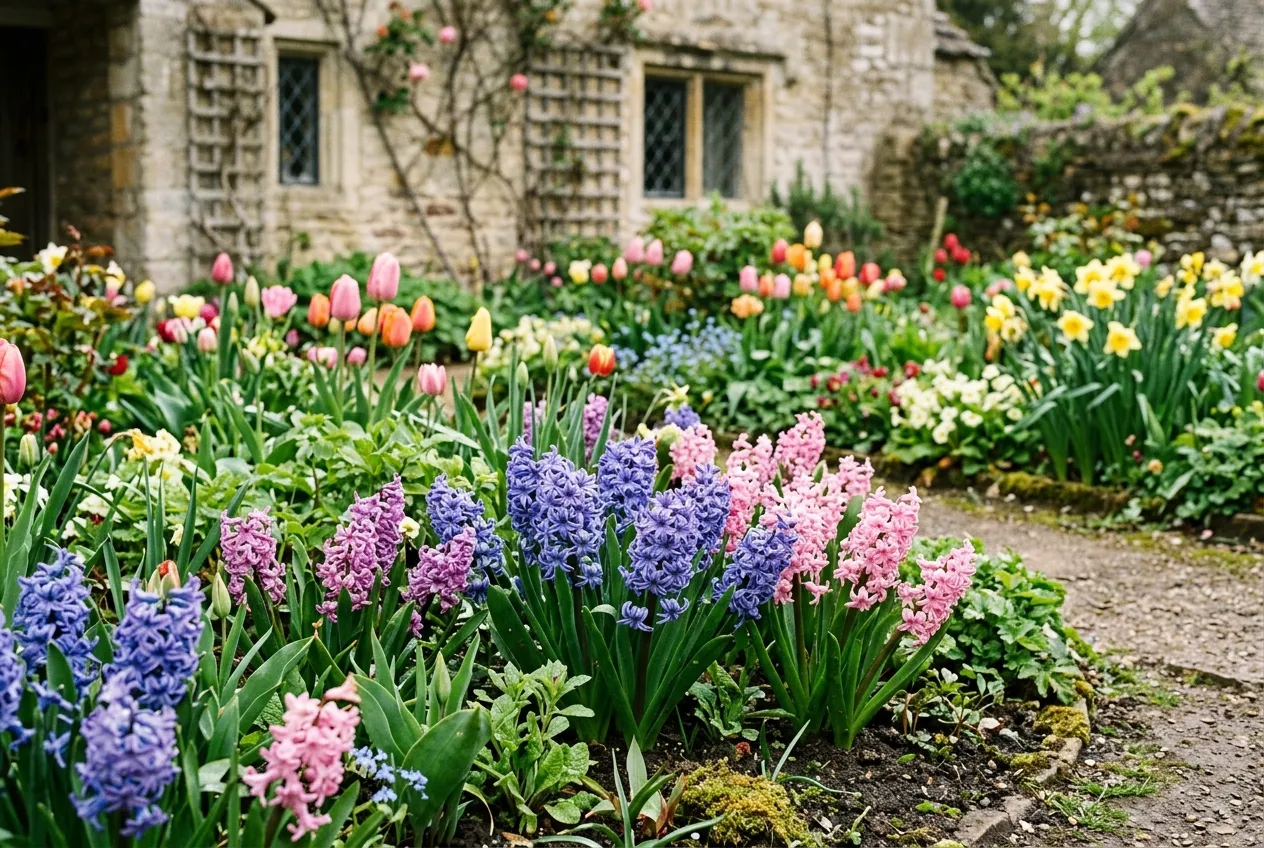 Massed outdoor hyacinths flower from late March to May depending on variety and location.
When to plant outdoor hyacinths
Plant from September to November. September and October are ideal for most of the UK, as bulbs have time to produce strong roots before cold weather arrives. In Scotland and northern England, September planting is preferable. In mild southern areas, October into early November works well.
Hyacinths are often planted alongside tulips and daffodils in the same autumn session. Unlike tulips, hyacinths do not need to wait for cold soil — they can go in as soon as other autumn bulbs do.
Choosing the right site
Hyacinths need:
- Full sun to light shade. They flower well in dappled shade under deciduous trees (which are leafless when hyacinths bloom in spring). Avoid deep shade from evergreens or north-facing walls.
- Free-draining soil. Bulbs rot in waterlogged ground. On heavy clay, incorporate horticultural grit at one bucket per square metre before planting, or grow in raised beds.
- Shelter from strong wind. Hyacinth spikes are top-heavy when fully in flower and snap in wind. A sheltered border, low wall, or hedge line behind the planting offers useful protection.
pH of 6.0-7.5 suits hyacinths well. They are less fussy about soil chemistry than tulips and perform adequately even on chalky ground.
Planting depth and spacing
Plant at 15cm deep, measured from the base of the bulb. This is deeper than some older guides recommend (8-10cm) but it produces more stable stems and better protection from late frosts. The nose of the bulb should sit roughly 5cm below the soil surface.
Space bulbs 10-15cm apart for a natural look. For a dense carpet effect in formal beds, reduce spacing to 8cm. Always plant in groups of at least 5 bulbs of the same variety — single or paired hyacinth bulbs look isolated and do not display well.
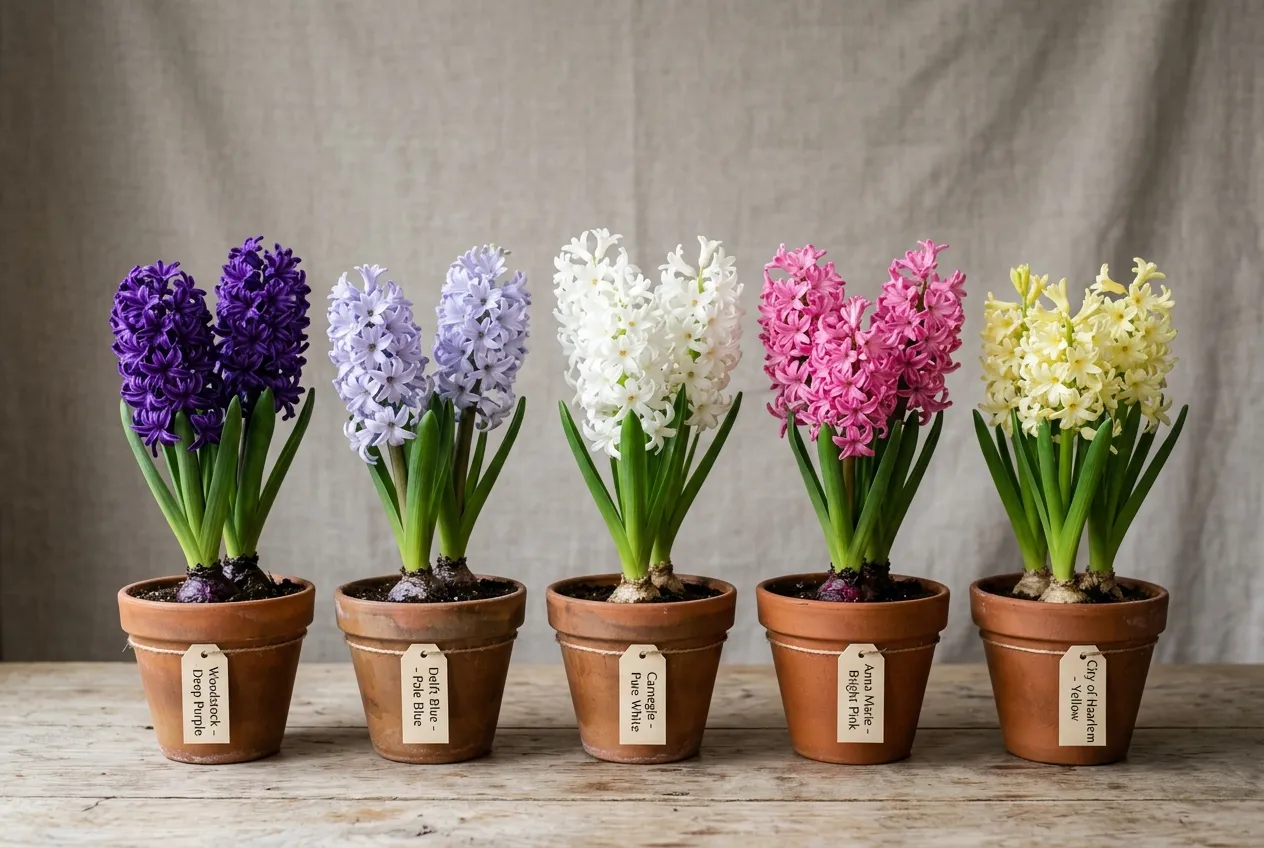 Plant hyacinth bulbs 15cm deep in autumn. Wear gloves — the outer skin causes irritation in some people.
Planting in containers
Hyacinths are outstanding container plants. Their compact size (20-30cm) suits pots, window boxes, and formal planters that larger daffodils or alliums would overpower.
Use pots at least 20cm deep. Fill with a free-draining mix: two parts compost to one part grit. Plant at the same 15cm depth as for borders. A 25cm pot holds 5-7 bulbs planted close together for maximum impact.
Leave pots outdoors through winter — hyacinths need the cold to flower well. Move into a prominent position as buds develop in spring. For ideas on combining hyacinths with other spring bulbs in the same container, our guide to bulb lasagne planting for year-round colour covers layering techniques in detail.
For broader container planting inspiration, see our container gardening ideas for UK gardens.
Hyacinth aftercare: what to do after flowering
Deadheading
Remove the spent flower spike by snapping or cutting it off at its base, leaving all the foliage in place. The leaves photosynthesise and feed energy back into the bulb for the following year’s flower. This is the same principle as for all spring bulbs — see our complete guide to spring bulb care after flowering.
Do not tie, fold, or braid the foliage. This reduces photosynthesis. Leave it to die back naturally over 6-8 weeks until it yellows and pulls away easily.
Feeding
After flowering, water in a balanced liquid fertiliser (a general-purpose feed at half strength works well) once a fortnight until the foliage yellows. This tops up the nutrients the bulb depleted producing its flower and builds reserves for next year.
Lifting and storing
Unlike tulips, hyacinths can usually be left in the ground permanently. In free-draining soil, bulbs persist for 5-7 years, though the flower spikes become shorter and more open over time as the bulb divides.
If you want to lift and store bulbs (useful in heavy clay or to make space for summer planting), wait until foliage is completely yellow and then dig carefully. Clean off soil, allow to dry for 2-3 days in a warm, airy spot, and store in paper bags or net sacks at 15-20°C until autumn. Avoid airtight bags which cause storage rot.
Do outdoor hyacinth bulbs need replacing?
The first-year flower spike from a new bulb is always the most impressive — densely packed with 20-40 florets on a thick stem. After 3-4 years, spikes typically become sparser and shorter as the bulb naturally offsets. There is no harm in leaving them in place, but if you want to maintain a full-impact display, replace bulbs every 3-4 years. Retired bulbs can be relocated to a wilder part of the garden where their smaller spikes still add colour and fragrance.
Growing hyacinths alongside other spring bulbs
Hyacinths flower from late March to early May depending on variety, which slots them neatly between snowdrops and crocuses (February-March) and the main tulip season (April-May). This makes them useful connectors in a timed spring display.
Good companions for hyacinths include:
- Daffodils — plant at the same depth layer in a lasagne pot. Daffodils provide height and colour before hyacinths flower.
- Grape hyacinths (Muscari) — a natural partner, their vivid blue spikes complement pink or white hyacinths. Read our guides to tulips and alliums for compatible later-season companions.
- Early perennials — euphorbia, bergenia, and pulmonaria all flower alongside hyacinths in March and April, providing foliage backdrop that offsets the upright spikes.
- Forget-me-nots — a classic partner. The soft blue haze of Myosotis fills gaps between hyacinth spikes and complements any hyacinth colour.
For a broader picture of what to plant for an extended spring display, our early spring flowers for UK gardens guide covers the full season from January to April.
If you are interested in plants specifically for fragrance, our best scented plants for UK gardens guide pairs hyacinths with other top performers.
Common problems with hyacinths
”Loose” flower spikes
A common issue with forced hyacinths: the spike opens with widely spaced florets instead of a dense, tight cluster. This is almost always caused by insufficient chilling — fewer than 10 weeks at below 9°C. Standard (non-prepared) bulbs moved into warmth too quickly produce loose spikes. Solution: extend chilling to a full 12 weeks next season.
Basal rot
Bulbs that become soft and brown at their base plate, with roots failing to develop. Caused by:
- Water touching the base plate on hyacinth glasses (keep a 5-10mm gap)
- Overwatering during the cold period in pots
- Planting in waterlogged outdoor soil
There is no recovery from basal rot. Discard the bulb and improve drainage before replanting.
Flopping stems
Outdoor hyacinths with stems that lean or fall over are often suffering from:
- Insufficient chilling — stems are shorter and weaker without adequate cold
- Too much warmth too fast during forcing — moving from cold dark to warm room in one step (always use a 7-10 day cool, bright transition period)
- Wind damage — site in a sheltered spot
Proprietary hyacinth supports (small wire rings) help if flopping is an aesthetic problem in a formal display.
Skin irritation from bulbs
The outer tunic of hyacinth bulbs contains raphide crystals (calcium oxalate). These can cause contact dermatitis and itching in sensitive individuals. Always wear gloves when planting. If irritation occurs, wash with soap and water. This does not affect the plants’ safety as garden ornamentals once established.
Related reading
- When to plant spring bulbs in the UK — full autumn planting schedule by bulb type
- Spring bulb care after flowering — deadheading, feeding, and storing your spring display
- How to grow daffodils in the UK — complementary spring bulb for borders and containers
- Early spring flowers for UK gardens — what to grow from January to April
- Best scented plants for UK gardens — fragrance-led planting for every season
Frequently asked questions
When should I plant hyacinth bulbs outdoors in the UK?
Plant hyacinth bulbs outdoors from September to November. September and October are ideal, as bulbs need time to establish roots before the ground freezes. In mild areas of southern England you can plant into November. Earlier planting gives bulbs more time to settle in and generally produces sturdier spring stems. Choose a sunny, well-drained spot and plant at 15cm depth.
How do I force hyacinths for Christmas?
Buy prepared hyacinth bulbs and start chilling in early October for Christmas flowers. Place bulbs in an unheated shed, garage, or cold frame at 4-9°C for 10-12 weeks. Bring into a warm room (15-18°C) once shoots reach 5cm. Flowers appear 2-3 weeks later. Starting too late is the most common mistake — always begin in the first week of October.
What is a hyacinth glass and how does it work?
A hyacinth glass is a hourglass-shaped vessel that holds a single bulb above water. The bulb sits in the upper cup with its base just touching the water surface. Roots grow downward into the water while the shoot emerges from the top. The glass allows you to watch root development, which is one of the most rewarding parts of indoor forcing. Keep water topped up to just below the bulb base to prevent rot.
Can I plant forced hyacinths outside after flowering?
Yes, forced hyacinths can be planted outdoors after flowering. Cut off the spent flower spike but leave all the foliage to die back naturally. Plant the bulbs outdoors at 15cm depth. They will not flower the following year as they need to recover, but most will produce flowers again by the second or third year. They will never be as vigorous as a fresh bulb.
How deep should hyacinth bulbs be planted outdoors?
Plant hyacinth bulbs 15cm deep, with the nose of the bulb just at or slightly below the soil surface when covered. This depth protects bulbs from frost and promotes strong stem development. In containers, the same depth applies. Shallower planting at 8-10cm is sometimes seen, but it results in weaker stems that flop in spring rain.
Why do my hyacinths smell so strong the first year then weaker after that?
First-year bulbs are at peak size and energy. The flower spike is packed with florets and fragrance is strongest when the bell cluster is fully dense. After the first season, bulbs divert energy into producing offsets and the main bulb shrinks slightly. Subsequent flowers have fewer florets and lighter fragrance. Replacing hyacinth bulbs every 3-4 years keeps fragrance at peak levels in borders.
Which hyacinth varieties are most fragrant?
‘Delft Blue’ and ‘Blue Jacket’ consistently top fragrance trials in UK conditions. Both produce dense, heavily scented blue-purple flower spikes in April. Among pinks, ‘Anna Marie’ and ‘Pink Pearl’ are strongly fragrant. ‘City of Haarlem’ (pale yellow) and ‘Carnegie’ (white) are milder and better suited to indoor use where intense scent can become overwhelming in a closed room.
Lawrie has been gardening in the West Midlands for over 30 years. He grows his own veg using no-dig methods, keeps a wildlife-friendly garden, and writes practical advice based on real UK growing conditions.