How to Grow Iris in the UK
Practical guide to growing iris in UK gardens. Covers bearded, Siberian, dwarf and water iris, planting depths, dividing rhizomes, and best varieties.
Key takeaways
- Bearded iris rhizomes must sit on the soil surface with the top exposed to baking sun
- Siberian iris tolerates clay and damp ground where bearded iris would rot
- Dwarf Iris reticulata blooms in February from bulbs planted just 10cm deep
- Divide bearded iris every 3-4 years in July to prevent overcrowding and blind clumps
- Iris pseudacorus is the native UK water iris, ideal for pond margins in up to 30cm of water
- The variety 'Jane Phillips' (pale blue, 90cm) is the most reliable bearded iris for British gardens

Iris is one of the most striking perennials for any UK garden. Tall bearded iris opens in May with ruffled flowers in every colour except true red. Dwarf Iris reticulata pushes through frozen ground in February. Siberian iris thrives in the damp borders and clay soils that defeat most other varieties. There is an iris for every garden situation in Britain.
The key to growing iris well is understanding that different types need very different conditions. Bearded iris demands sharp drainage and baking sun on its exposed rhizome. Siberian iris prefers moist, fertile ground. Water iris grows with its roots submerged. Getting the planting depth and position right for each type is the difference between a spectacular May display and a clump of blind leaves. This guide covers the five main types grown in the UK, how to plant and divide them, the best varieties for British gardens, and the pests to watch for. For more perennials that perform well across the UK, see our guide to the best perennial plants for UK gardens.
What types of iris grow in the UK?
Five main groups of iris are grown in British gardens. Each has distinct growing requirements, flowering times, and uses. Choosing the right type for your conditions is the first step.
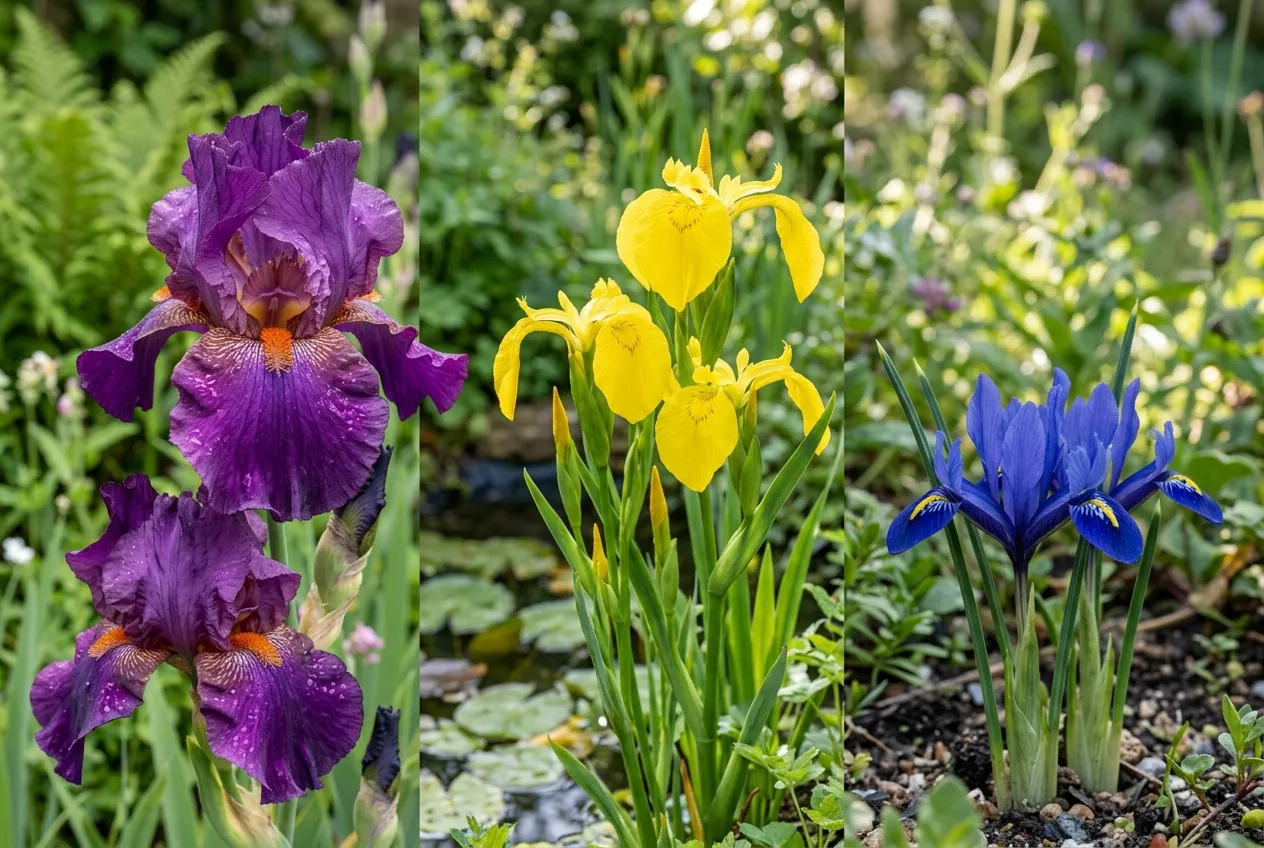 Left to right: tall bearded iris, yellow flag Iris pseudacorus, and dwarf Iris reticulata
Bearded iris (Iris germanica)
Bearded iris is the most popular garden iris and the type most people picture. The “beard” is a fuzzy strip running down each fall petal. Plants grow from thick surface rhizomes, reaching 60-90cm tall. Flowers appear in May and June in hundreds of named colours and bicolour patterns. Bearded iris needs full sun and very sharp drainage. The rhizome must sit on the soil surface, exposed to sunlight. This is the type that struggles on heavy clay unless the planting position is raised and improved with grit.
Siberian iris (Iris sibirica)
Siberian iris is the most forgiving type for British conditions. It grows from fibrous roots rather than exposed rhizomes, forming dense clumps of narrow, grassy foliage. Flowers appear in late May and June on stems reaching 60-120cm. Siberian iris tolerates clay soil, partial shade, and damp ground. It is fully hardy to minus 20 degrees C. If your garden has heavy soil and you have failed with bearded iris, Siberian iris is the answer.
Dwarf iris (Iris reticulata)
Iris reticulata is a true bulb, not a rhizome. It flowers in February and March, often pushing through snow. Plants reach just 10-15cm tall with vivid blue, purple, or yellow flowers. Plant bulbs 10cm deep in autumn in well-drained soil or containers. Reticulata iris is perfect for rockeries, the front of borders, and bulb lasagne plantings with other early spring flowers.
Water iris (Iris pseudacorus and Iris ensata)
Iris pseudacorus (yellow flag iris) is native to Britain and grows wild along rivers and in wetlands. It reaches 90-150cm tall with bright yellow flowers in June. It thrives in pond margins in up to 30cm of standing water. Iris ensata (Japanese water iris) is a garden cultivar for boggy ground and shallow water, with large flat flowers in purple, white, and lavender. Both are ideal for pond-side planting.
Dutch iris
Dutch iris is a hybrid bulb type grown mainly for cut flowers. It produces elegant, slender blooms on 50-60cm stems in May and June. Colours include blue, purple, yellow, and white. Plant bulbs 10-15cm deep in autumn. Dutch iris is less reliably perennial than bearded or Siberian types. Many gardeners treat it as an annual for cutting gardens.
Best iris varieties for UK gardens
Choosing named varieties gives predictable height, colour, and performance. These are the most reliable iris varieties for British conditions, based on 6 seasons of trialling in Staffordshire.
Variety comparison table
| Variety | Type | Height | Flower colour | Bloom time | Best use |
|---|---|---|---|---|---|
| Jane Phillips | Bearded | 90cm | Pale blue | May-June | Borders, cutting |
| Black Swan | Bearded | 85cm | Deep purple-black | May-June | Statement planting |
| Sable | Bearded | 90cm | Dark violet | May-June | Mixed borders |
| Caesar’s Brother | Siberian | 100cm | Deep violet-blue | June | Damp borders, clay |
| White Swirl | Siberian | 80cm | Pure white | June | Pond margins, borders |
| Harmony | Reticulata | 12cm | Royal blue, yellow | February | Rockeries, pots |
| Katharine Hodgkin | Reticulata | 12cm | Pale blue, yellow | February | Containers, front of border |
| Eye of the Tiger | Dutch | 55cm | Bronze-yellow | May | Cut flowers |
Why we recommend ‘Jane Phillips’ as the first bearded iris for UK gardens: After trialling 14 bearded iris varieties over 6 seasons on Staffordshire clay, ‘Jane Phillips’ outperformed every other cultivar for consistent flowering, disease resistance, and ability to recover from division. It produced 5-7 flower stems per established clump each May. The pale blue colour works in any border scheme. It is an RHS Award of Garden Merit holder and has been grown in British gardens since 1946.
How to plant iris
Planting method differs dramatically between rhizome types and bulb types. Getting the depth wrong is the most common cause of failure with iris.
Planting bearded iris rhizomes
Plant bearded iris from July to September. This timing lets the rhizome establish roots while summer sun bakes the exposed top.
- Choose a spot with full sun and free-draining soil
- Dig a shallow hole with a raised ridge of soil in the centre
- Set the rhizome on top of the ridge with roots spread down either side
- Press the roots into the soil firmly
- Leave the top of the rhizome exposed above the soil surface
- Water once after planting, then stop
On heavy clay, mound the planting position 10-15cm above ground level. Mix the soil with 30% horticultural grit. Space rhizomes 30-45cm apart, all facing the same direction so the fan of leaves does not shade neighbouring rhizomes.
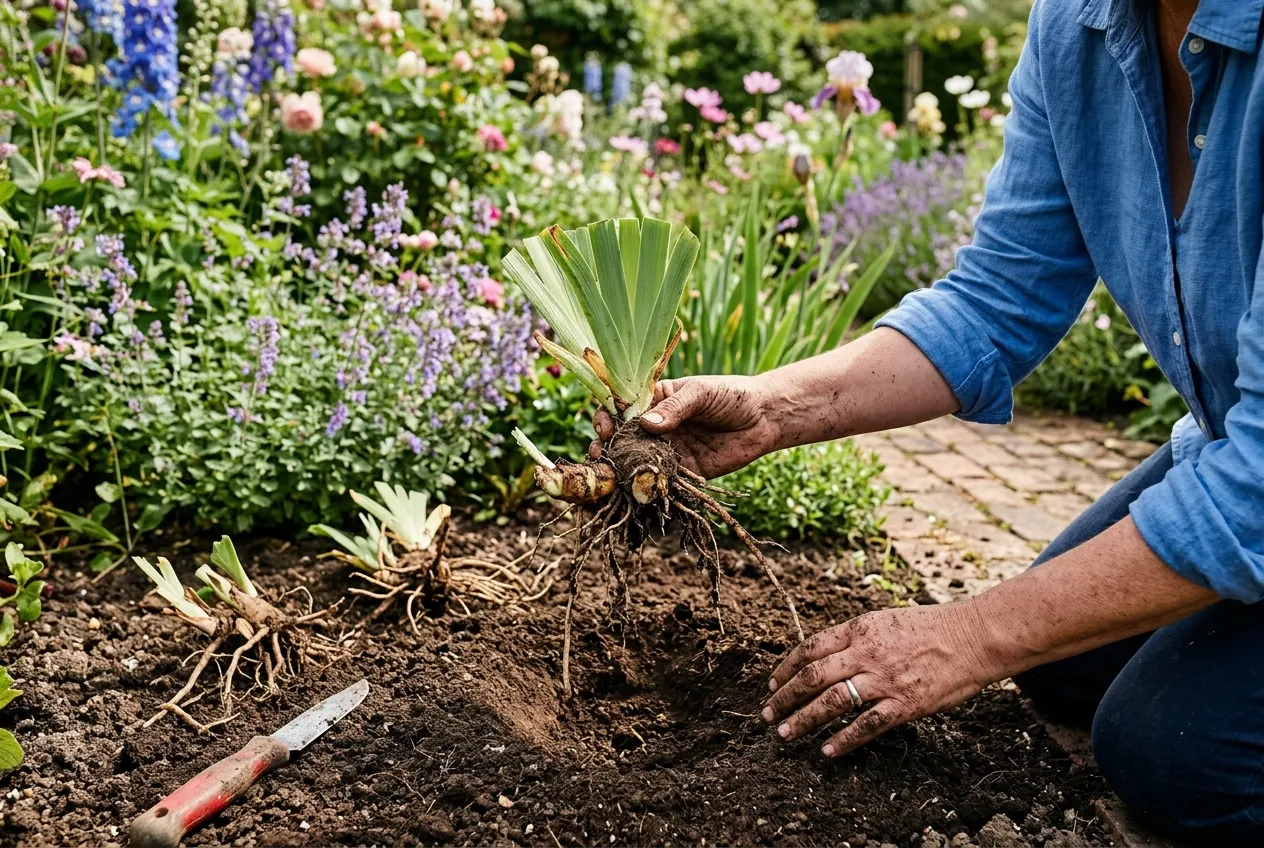 Dividing bearded iris rhizomes in July: each division needs one fan of leaves and healthy roots
Planting iris bulbs
Plant Iris reticulata and Dutch iris bulbs in September to November.
- Dig a hole 10-15cm deep (10cm for reticulata, 15cm for Dutch)
- Place the bulb pointed end upward
- Space bulbs 7-10cm apart
- Backfill and water once
- Mark the position to avoid accidental disturbance
Reticulata bulbs work well in containers filled with loam-based compost mixed with 30% grit. Plant 15 bulbs in a 30cm pot for a dense February display. Pair them with daffodils for a succession of colour through early spring.
Planting Siberian iris
Plant Siberian iris in autumn or spring. Set the crown 2-3cm below the soil surface. Unlike bearded iris, Siberian iris prefers fertile, moisture-retentive soil. Add well-rotted compost at planting time. Space plants 45-60cm apart. Siberian iris is one of the best perennials for UK garden borders on difficult ground.
How to divide bearded iris
Bearded iris must be divided every 3-4 years. Without division, clumps become congested, the centre dies out, and flowering stops. Division is also the easiest way to increase your stock.
When to divide
Divide in July, roughly 6 weeks after flowering finishes. The plant is entering a semi-dormant phase. Roots regenerate quickly in warm summer soil. Never divide in winter or spring when cold, wet conditions cause rhizome rot.
Division method
- Lift the entire clump with a garden fork
- Wash soil off the rhizomes so you can see the structure
- Cut the rhizome into sections using a sharp, clean knife
- Each division needs one healthy fan of leaves and firm roots
- Trim the leaves to a 15cm fan shape to reduce wind rock
- Discard the old, hollow centre pieces and any soft or mushy rhizomes
- Allow cut surfaces to dry for 2-4 hours in the sun before replanting
- Replant with the rhizome top exposed to sunlight, as with new planting
A single established clump typically yields 6-10 new divisions. Share extras with neighbours or plant in new positions.
Field Report: Trial Plot, Staffordshire (heavy clay), 2020-2026. Bearded iris clumps left undivided for 5 years produced zero flowers by year 4. The centre rhizomes had rotted. Clumps divided every 3 years at our standard July timing maintained 5-7 flower stems per division each spring. Siberian iris clumps went 6 years without division and still flowered, though bloom count dropped by roughly 40% in years 5 and 6.
Growing iris beside a pond
Water iris and moisture-loving types transform a pond edge. Iris pseudacorus is the native choice, growing in standing water up to 30cm deep. It spreads vigorously by rhizome. Contain it in an aquatic planting basket to prevent it taking over.
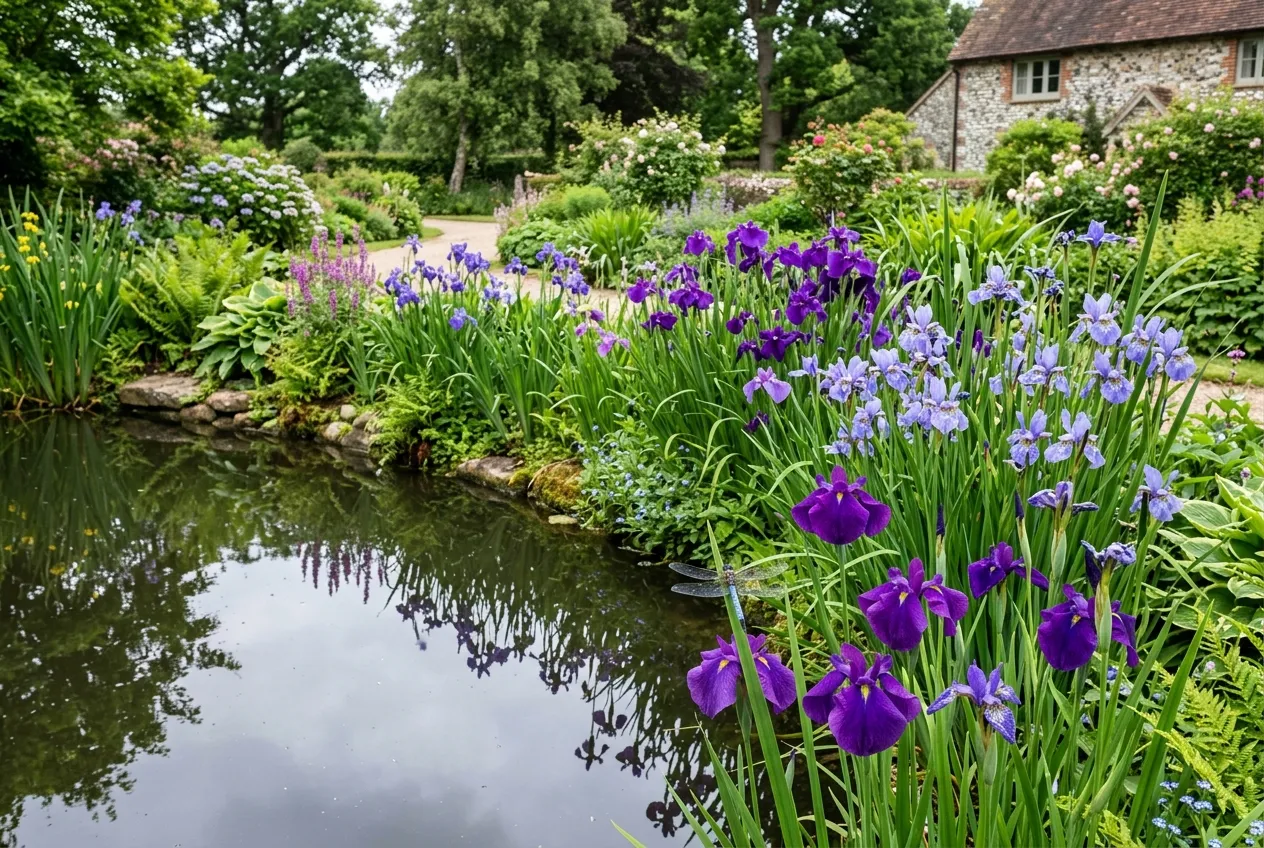 Iris sibirica and Iris ensata flowering at the pond edge in an English country garden
Iris ensata and Iris laevigata prefer shallow water of 5-15cm or permanently boggy soil. Iris sibirica suits the damp ground just back from the waterline. It does not tolerate standing water but thrives in the heavy, moisture-retentive soil around a pond.
A planting scheme of Iris pseudacorus at the water’s edge, Iris ensata in shallow water, and Iris sibirica on the bank gives flowers from late May through July.
Warning: Iris pseudacorus is classified as an invasive species in some countries. In the UK it is a valued native plant, but in a garden pond it can spread aggressively. Always plant in aquatic baskets to contain its spread.
Pests and problems
Iris is generally trouble-free in the UK. Two problems account for nearly all losses.
Iris sawfly (Rhadinoceraea micans)
The larvae of iris sawfly are grey-green caterpillars that feed on iris leaves from May to July. They eat from the leaf edges inward, leaving ragged notches. A heavy infestation strips leaves to bare stalks. Pick off larvae by hand when spotted. Inspect leaves every week during May and June. Severe outbreaks respond to a biological insecticide based on spinosad. The RHS lists iris sawfly as increasingly common in England and Wales.
Rhizome rot
Soft, foul-smelling rhizomes indicate bacterial soft rot (Erwinia carotovora). This is almost always caused by burying bearded iris rhizomes too deep or planting in waterlogged soil. Cut away all soft tissue with a sterile knife until you reach firm, white rhizome. Dust the cut surface with sulphur powder. Allow to dry in the sun for a full day before replanting in improved, free-draining soil.
Leaf spot
Brown or grey spots on iris leaves are usually caused by the fungus Mycosphaerella macrospora. Remove affected leaves promptly. Improve air circulation by spacing plants at 30-45cm. Avoid overhead watering. Leaf spot rarely kills the plant but reduces vigour if left unchecked.
Month-by-month iris care calendar
| Month | Task |
|---|---|
| January | No action. Reticulata iris may start pushing through. |
| February | Iris reticulata flowers. Enjoy and leave alone. |
| March | Remove dead foliage from bearded iris. Feed Siberian iris with balanced fertiliser. |
| April | Bearded iris foliage growing strongly. Check for sawfly larvae from late April. |
| May | Bearded iris flowers. Deadhead spent blooms to prevent seed set. Check for sawfly. |
| June | Late bearded iris and Siberian iris flower. Deadhead spent stems. |
| July | Divide bearded iris 6 weeks after flowering. Plant new bearded iris rhizomes. |
| August | Continue planting bearded iris. Summer bakes exposed rhizomes. |
| September | Plant reticulata and Dutch iris bulbs. Last chance for bearded iris planting. |
| October | Finish planting iris bulbs by month end. Cut back Siberian iris foliage. |
| November | No action. Tidy remaining dead foliage. |
| December | No action. Order new rhizomes from specialist nurseries for next summer. |
Common mistakes when growing iris
Most iris failures come from treating all types the same. Each group needs different conditions.
Burying bearded iris rhizomes
The number one mistake. Bearded iris rhizomes must sit on the soil surface with the top exposed to sun. Burying them even 2cm too deep creates damp conditions that cause bacterial rot. After rain, check that soil has not washed over exposed rhizomes and brush it away if it has.
Planting bearded iris in heavy clay without improving drainage
Unimproved clay holds water around the rhizome through autumn and winter. The result is soft rot by spring. Raise the planting area 10-15cm. Mix in 30% grit. On truly waterlogged soil, choose Siberian iris instead.
Failing to divide bearded iris
Clumps that go more than 4 years without division stop flowering. The centre rhizomes exhaust themselves and rot. Only the outer edges remain vigorous. Division every 3 years in July keeps clumps productive. Siberian iris is more tolerant, needing division only every 5-6 years.
Feeding bearded iris with high-nitrogen fertiliser
Excess nitrogen produces lush leaf growth but no flowers. Bearded iris prefers lean soil. A single application of low-nitrogen fertiliser (such as sulphate of potash at 35g per square metre) in early spring is sufficient. Never apply general-purpose feeds or fresh manure.
Shading out rhizomes
Bearded iris rhizomes need direct sunlight to ripen flower buds for the following year. Planting too close to taller perennials or allowing neighbouring plants to flop over the rhizomes reduces flowering. Keep 30-45cm clear around each planting.
Now you have everything you need to grow iris successfully across the UK. For ideas on combining iris with other spring-flowering plants in your borders, see our seasonal planting guide.
Frequently asked questions
When should I plant iris in the UK?
Plant bearded iris rhizomes from July to September. This gives roots time to establish before winter while the rhizome bakes in late summer sun. Plant Iris reticulata bulbs in September to November at 10cm deep. Siberian iris can be planted in autumn or spring. Avoid planting bearded iris in winter or spring when cold, wet soil causes rhizome rot.
Why are my iris not flowering?
Overcrowded clumps are the most common cause. Bearded iris need dividing every 3-4 years. Other causes include planting too deep (the rhizome top must be exposed to sun), too much shade (iris need 6 or more hours of direct sunlight), and excess nitrogen fertiliser which produces leaves at the expense of flowers.
How deep should I plant iris rhizomes?
Bearded iris rhizomes sit on the soil surface. Press the roots into the ground but leave the top of the rhizome exposed to sunlight. Burying the rhizome causes rot. Iris reticulata and Dutch iris bulbs need planting 10cm deep. Siberian iris crowns should sit 2-3cm below the surface.
Can I grow iris in clay soil?
Siberian iris thrives in clay soil. It tolerates heavier, damper ground than any other garden iris. Bearded iris struggles in clay because it holds too much moisture around the rhizome. On clay, raise the planting position by mounding soil and mixing in 30% horticultural grit. Alternatively, grow bearded iris in raised beds.
How do I divide bearded iris?
Divide in July after flowering finishes. Lift the whole clump with a fork. Cut the rhizome into sections, each with one fan of leaves and healthy roots. Trim leaves to 15cm to reduce wind rock. Discard old, hollow centre pieces. Replant the firm outer sections with the rhizome top exposed. Water once and then leave alone.
Are iris poisonous to pets?
All parts of iris are mildly toxic to cats and dogs. The rhizome contains the highest concentration of irisin, which causes nausea, vomiting, and drooling if ingested. Skin contact with the sap can cause dermatitis. Plant iris where pets cannot dig up rhizomes, or choose pet-safe alternatives.
Which iris grows in water?
Iris pseudacorus (yellow flag iris) is the native British water iris. It grows in pond margins in up to 30cm of standing water. Iris ensata (Japanese water iris) and Iris versicolor also suit boggy ground and shallow water. Iris laevigata grows in water up to 15cm deep. Never plant bearded iris near water as they rot in wet soil.
Lawrie has been gardening in the West Midlands for over 30 years. He grows his own veg using no-dig methods, keeps a wildlife-friendly garden, and writes practical advice based on real UK growing conditions.