Japanese Anemones: The Best Late Show
Japanese anemones flower from August to October in UK shade and sun. Covers six top varieties, planting, division, spread control, and autumn borders.
Key takeaways
- Japanese anemones flower from August to October, filling the gap between summer perennials and winter
- They thrive in partial shade and tolerate north-facing borders, unlike most autumn flowers
- Six top varieties suit UK gardens: Honorine Jobert (white), September Charm (pink), Pamina (deep pink semi-double), Whirlwind (white semi-double), Queen Charlotte (silvery pink), and Wild Swan (white with blue reverse)
- Plant in spring or autumn into moist, humus-rich soil enriched with garden compost
- Control spread by severing underground runners with a spade each spring
- Fully hardy to minus 20 Celsius (RHS H7) with no winter protection needed
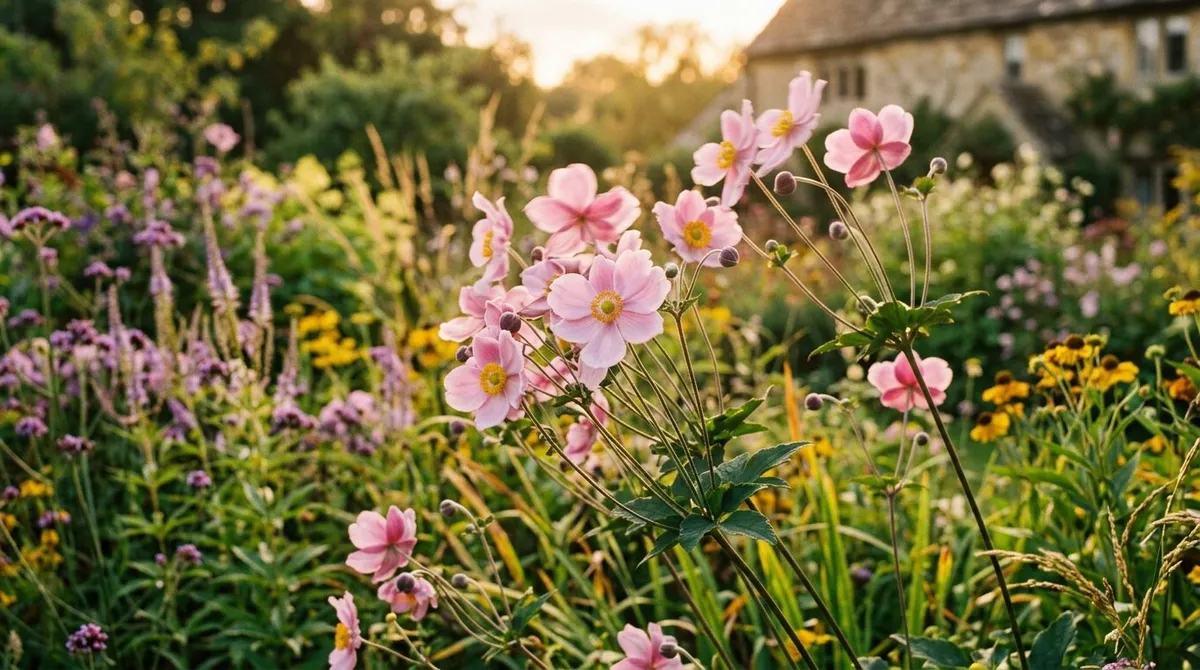
Japanese anemones are the quiet stars of the autumn garden. While dahlias and asters demand attention, these graceful perennials produce elegant flowers on tall, wiry stems from August right through to late October. That is 8-12 weeks of colour at a time when most borders are winding down for winter.
What makes Japanese anemones stand apart from other autumn flowers is their tolerance of shade. Most autumn-flowering plants need full sun. Japanese anemones thrive in partial shade, dappled light, and even north-facing borders. The Royal Horticultural Society rates them among the finest perennials for difficult positions. They are fully hardy (RHS H7, down to minus 20 Celsius), ignore poor soil once established, and spread to fill gaps without any help. If you have a shady corner that looks bare from August onward, Japanese anemones will solve the problem.
What are Japanese anemones?
Japanese anemones belong to the buttercup family (Ranunculaceae), despite looking nothing like a buttercup. The garden hybrids sold in UK nurseries are classified as Anemone x hybrida, a cross between A. hupehensis (from China, not Japan) and A. vitifolia (from the Himalayas). The common name is misleading. These plants arrived in Japan from China centuries ago and were later brought to Europe by plant hunter Robert Fortune in 1844.
The plants form clumps of dark green, vine-shaped leaves at ground level. From late July, tall branching stems rise 60-120cm above the foliage, carrying saucer-shaped flowers 5-8cm across. Each bloom has 5-6 petals (technically tepals) surrounding a prominent ring of golden stamens. The flowers sway in the slightest breeze, giving the whole border movement and life. After flowering, attractive woolly seed heads form and persist into winter.
Japanese anemones are herbaceous perennials. They die back completely in November and emerge again in late March or April. Once established, they are among the most long-lived garden perennials. A single plant can persist for 20 years or more, gradually spreading outward via underground runners to form a substantial colony.
Which varieties should I grow?
Six varieties consistently perform well in UK gardens. I have grown all of them in heavy Staffordshire clay over the past 7 seasons and can report on their individual strengths.
Honorine Jobert
The finest white Japanese anemone and an RHS Award of Garden Merit holder since 1993. Single white flowers with golden centres appear from August to October on stems reaching 120cm. This is the variety you see in the great British gardens: Sissinghurst, Great Dixter, and Hidcote all plant it extensively. Vigorous, spreading freely in moist soil. The best choice for lighting up a shady border.
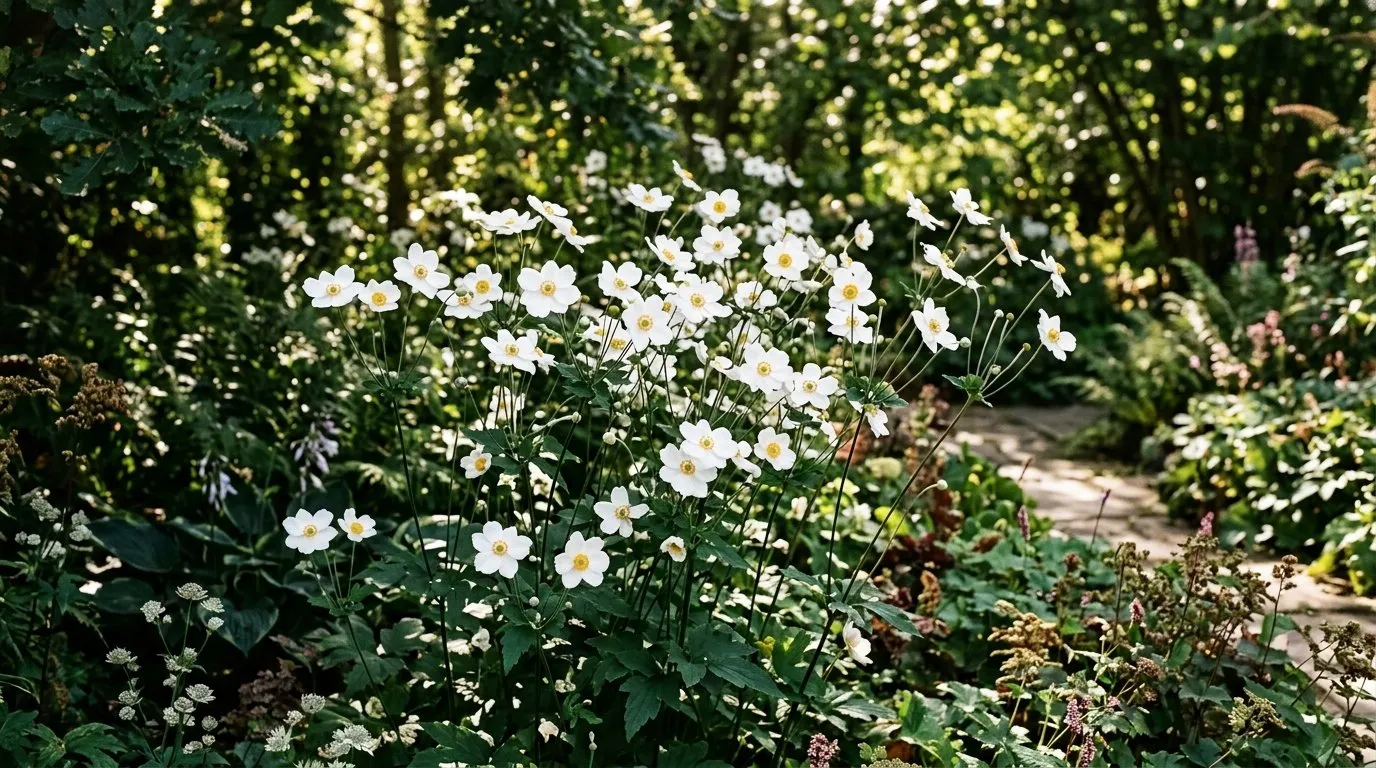 Honorine Jobert: the classic white Japanese anemone, flowering from August to October in dappled shade.
September Charm
Single soft pink flowers on 75cm stems. Despite the name, it starts flowering in mid-August in most of England and continues into October. More compact than Honorine Jobert, making it better for smaller borders. The flowers fade gracefully from mid-pink to pale blush as they age. One of the most widely sold varieties in UK garden centres. AGM holder.
Pamina
Semi-double deep rose-pink flowers on sturdy 70cm stems. The darkest-coloured commonly available variety. Each bloom has 15-20 petals arranged in two or three rows. More compact and less vigorous than other varieties, spreading more slowly. Ideal for front-of-border positions where taller types would flop. Flowers from September to October.
Whirlwind
Semi-double white flowers with a slight greenish tinge. Reaches 100cm tall. The multiple petal layers give each bloom a fuller appearance than single-flowered types. Good in windy sites as the shorter stems resist being blown about. AGM holder. Slightly later to flower than Honorine Jobert, starting in early September.
Queen Charlotte
Large silvery-pink semi-double flowers up to 8cm across on 80cm stems. Introduced in 1898, it remains one of the most elegant varieties. The petals have a slight cupping that catches light beautifully. Flowering from early September to late October. Less vigorous than Honorine Jobert, which makes it easier to manage in smaller gardens.
Wild Swan
A newer variety bred by Elizabeth MacGregor in Scotland. White flowers with a striking blue-purple reverse to the petals, visible when the blooms nod in a breeze. Unusually compact at 45-60cm tall. The real advantage of Wild Swan is its flowering season: June to October, a full four months longer than other Japanese anemone varieties. AGM holder since 2011. Less vigorous and spreading than the hybrida types.
| Variety | Flower colour | Height (cm) | Flowering months | Spread rate | AGM |
|---|---|---|---|---|---|
| Honorine Jobert | White | 100-120 | Aug-Oct | Fast | Yes |
| September Charm | Soft pink | 60-75 | Aug-Oct | Moderate | Yes |
| Pamina | Deep rose-pink | 60-70 | Sep-Oct | Slow | No |
| Whirlwind | White (semi-double) | 90-100 | Sep-Oct | Moderate | Yes |
| Queen Charlotte | Silvery pink | 75-80 | Sep-Oct | Slow | No |
| Wild Swan | White, blue reverse | 45-60 | Jun-Oct | Slow | Yes |
Why we recommend Honorine Jobert: After growing 6 varieties side by side for 7 years, Honorine Jobert outperforms them all for vigour, flower count, and reliability. In the 2024 season, a single 4-year-old clump produced over 60 flowering stems. It flowers for the longest period of the hybrida types (10 weeks), tolerates the deepest shade, and never needs staking. The only drawback is its vigorous spread, which some gardeners may find too assertive.
Where to plant Japanese anemones
Getting the position right matters more than soil type or feeding. Japanese anemones are adaptable plants, but they flower best and spread at a manageable rate when planted in the right spot.
Light requirements
Partial shade is the ideal position. Japanese anemones evolved on the edges of woodland in China, growing in dappled light beneath deciduous trees. In UK gardens, they perform best with 3-4 hours of direct sunlight or bright filtered light throughout the day.
They also grow well in full sun, provided the soil stays moist. In hot, south-facing borders with dry soil, the leaves scorch and flowers fade quickly. Full sun on clay soil works well because clay retains moisture. Full sun on sandy soil is the worst combination.
North-facing borders suit Japanese anemones perfectly. They receive enough reflected and ambient light to flower well without the stress of direct afternoon sun. This is their greatest strength. Very few autumn-flowering perennials tolerate north-facing positions.
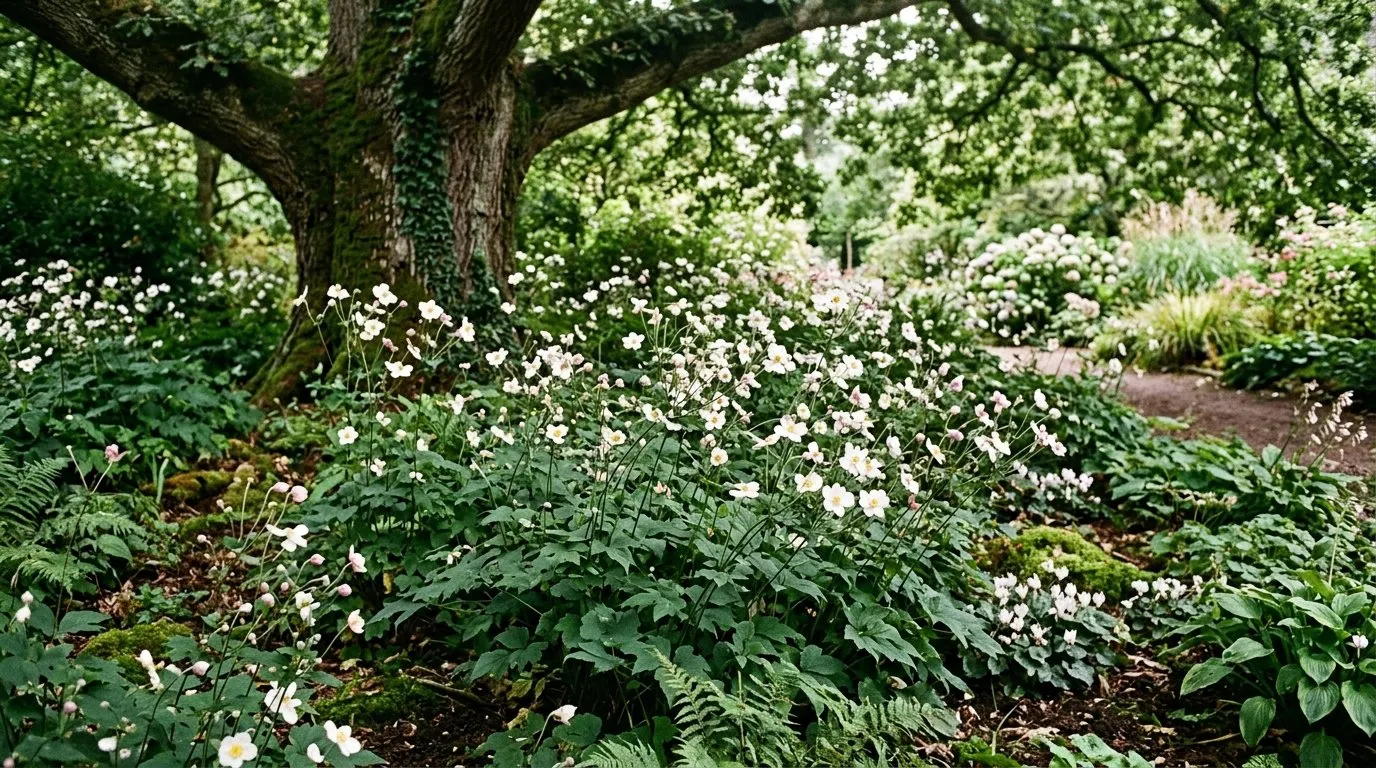 Japanese anemones naturalised in partial shade under a mature tree. They spread via underground runners to fill bare ground.
Soil
Japanese anemones grow in most UK soil types. They prefer moist, humus-rich soil that does not dry out in summer. Heavy clay is fine. They are one of the best perennials for clay gardens because they need the moisture that clay naturally holds.
Improve light, sandy, or chalky soils by digging in generous quantities of garden compost or well-rotted farmyard manure before planting. This increases moisture retention. Apply a 5cm mulch of organic matter around plants each spring.
Very dry soil slows their spread dramatically. In my Staffordshire garden, plants in the irrigated border spread 40cm per year. Identical plants in a dry, rain-shadowed spot spread just 10cm per year. The dry border plants also flowered two weeks later.
Planting position in the border
Plant Japanese anemones in the middle to back of a border. Varieties like Honorine Jobert (120cm) and Whirlwind (100cm) need plants in front to hide their somewhat bare lower stems. Compact types like Wild Swan (50cm) and Pamina (70cm) work at the front or middle.
Allow 45-60cm between plants. They fill the gaps within two seasons. Space them further apart if you want to slow the spread. Plant closer if you want quick ground cover.
How to plant Japanese anemones
The best time to plant is March to April or September to October. Spring planting gives the roots a full growing season to establish before winter. Autumn planting works well in milder areas but newly planted anemones can suffer in a harsh first winter if the roots have not anchored.
Step-by-step planting
- Dig a hole twice the width of the pot and the same depth
- Mix a handful of garden compost into the removed soil
- Remove the plant from its pot and tease out any circling roots
- Place the plant in the hole with the crown at soil level, not buried
- Backfill with the improved soil and firm gently
- Water thoroughly, giving at least 5 litres per plant
- Apply a 5cm mulch of garden compost, keeping it clear of the stems
Do not expect flowers in the first year. Japanese anemones almost always spend their first season building root systems. Most plants flower from the second year onward, with peak performance from year three. This slow start puts off some gardeners, but the wait is worth it. Once established, they flower reliably for decades.
Month-by-month care calendar
Japanese anemones need very little attention. This is one of their greatest virtues. The following calendar covers every task required across the year.
| Month | Task |
|---|---|
| March | Cut down old stems to 5cm if not done in November. Apply balanced fertiliser (Growmore at 70g per sq m). Sever spreading runners with a spade to control spread. |
| April | Mulch with 5cm of garden compost. New shoots emerge. Divide overcrowded clumps if needed. |
| May | Water newly planted specimens during dry spells. Established plants need no watering. |
| June | Wild Swan begins flowering. Tall varieties start producing flower stems. No staking needed in sheltered sites. |
| July | Flower buds form on most varieties. Apply a liquid feed (tomato fertiliser) if plants look pale. |
| August | Main flowering begins. Honorine Jobert, September Charm, and Wild Swan in full bloom. Deadhead spent flowers to prolong display. |
| September | Peak flowering month. Pamina, Whirlwind, and Queen Charlotte join the display. Take root cuttings for propagation. |
| October | Flowering continues until the first hard frost. Leave seed heads for winter interest. |
| November | Foliage yellows and dies back. Cut stems to 5cm or leave until March. Apply leaf-mould mulch in exposed gardens. |
| December-February | Plants dormant. No action required. Roots survive to minus 20 Celsius without protection. |
How to control the spread
Japanese anemones spread by underground runners (technically rhizomes). In ideal conditions of moist, rich soil and partial shade, a single plant can colonise 30-50cm of new ground each year. After five years, one plant may occupy a square metre.
This vigour is an advantage when you want ground cover. It becomes a problem when they invade neighbouring plants. Three methods control spread effectively.
Root barrier
Sink a 30cm deep barrier of rigid plastic, slate, or old roofing tiles vertically into the soil around the planting area. The runners grow horizontally at 5-15cm depth and cannot cross a solid barrier. This is the most effective long-term solution.
Annual edge-slicing
In March, push a sharp spade vertically into the soil around the perimeter of the clump, severing all outward-running roots. Pull out any runners that have escaped. This takes five minutes per clump annually and works well in most gardens.
Dry soil positioning
Plant in drier soil where spread is naturally slower. In my trials, plants in dry shade under a mature oak spread at roughly a quarter of the rate of plants in moist, open ground. The trade-off is slightly fewer flowers.
The important point is that Japanese anemones are not invasive in the ecological sense. They do not self-seed aggressively or suppress native flora. They simply form expanding clumps. Removing unwanted spread is straightforward: fork out the runners in spring.
Companion planting for autumn borders
Japanese anemones look best when planted with other late-season performers. The goal is to create a border that peaks from August to November, filling the gap after summer perennials fade.
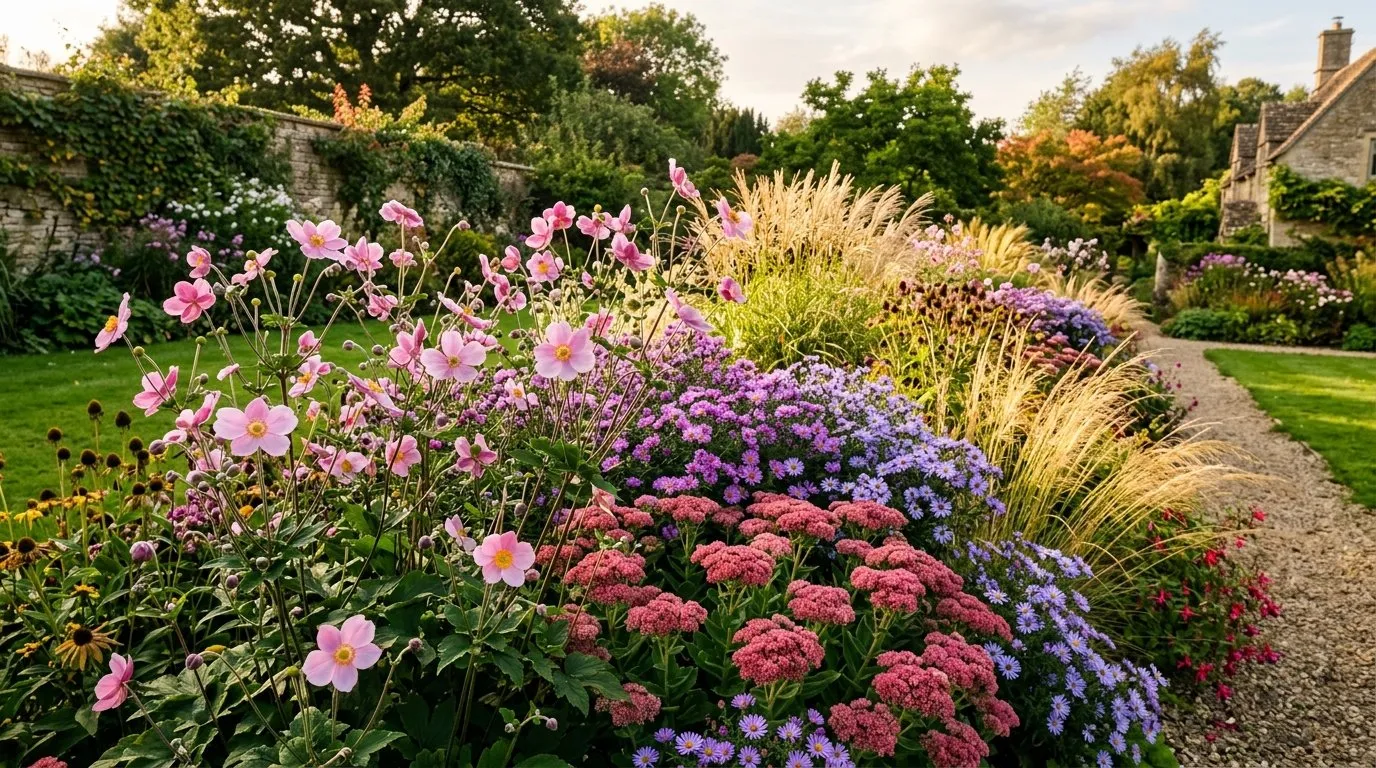 A mixed autumn border combining pink Japanese anemones with sedum, asters, and Miscanthus grasses for 12 weeks of colour.
Best companions
Aster x frikartii ‘Monch’ is the single best companion. Its lavender-blue daisies flower from July to October, overlapping perfectly with Japanese anemones and providing a cool colour contrast against the pink and white flowers.
Persicaria amplexicaulis produces deep red or pink poker-like spikes from July to November. The vertical flower shape contrasts with the flat, open anemone blooms. ‘Firetail’ (red) and ‘Rosea’ (pink) are the best varieties.
Miscanthus sinensis adds height, movement, and texture. The feathery plumes appear in September and October, catching the low autumn sun. ‘Morning Light’ (150cm) and ‘Kleine Fontane’ (120cm) pair well.
Sedum spectabile provides a flat-topped landing pad of pink or mauve flowers from August to October. The fleshy grey-green foliage contrasts strongly with the dark, vine-shaped anemone leaves. ‘Autumn Joy’ is the classic choice.
For spring interest before the anemones emerge, underplant with snowdrops, hellebores, and Brunnera macrophylla. These flower from January to April, providing 4 months of colour before the anemone foliage appears in late March. Cottage garden planting plans often rely on this layered approach.
Border scheme: a 3-metre autumn combination
This planting plan fills a 3-metre section of border with continuous colour from August to November.
| Position | Plant | Height | Colour | Flowering |
|---|---|---|---|---|
| Back | Miscanthus sinensis ‘Morning Light’ | 150cm | Silver plumes | Sep-Nov |
| Back | Anemone ‘Honorine Jobert’ | 120cm | White | Aug-Oct |
| Middle | Aster x frikartii ‘Monch’ | 70cm | Lavender-blue | Jul-Oct |
| Middle | Anemone ‘September Charm’ | 75cm | Soft pink | Aug-Oct |
| Front | Sedum ‘Autumn Joy’ | 50cm | Dusky pink | Aug-Oct |
| Front | Geranium ‘Rozanne’ | 40cm | Violet-blue | Jun-Oct |
This combination works in partial shade or full sun on any soil type. The Chelsea chop in late May delays the asters and geranium to synchronise their peak with the anemones.
Propagation
Japanese anemones propagate easily from division and root cuttings. Seed is possible but unreliable because the hybrids do not come true from seed.
Division
Divide established clumps in March or April just as new growth appears. Lift the entire clump with a fork. Pull or cut it into sections, each with 3-4 growing points and a healthy root system. Replant immediately at the original depth. Water well for the first month.
Division works best on clumps that are 3 years old or more. Younger plants resent disturbance. Expect reduced flowering in the division year, with full recovery by the second season.
Root cuttings
The most efficient method. Take root cuttings in September or October when the roots are full of stored energy.
- Lift part of the clump or excavate soil at the edge to expose thick roots
- Cut pencil-thick roots into 5cm sections
- Place each cutting vertically (right way up) in a pot of gritty compost, with the top of the cutting just below the surface
- Water lightly and place in a cold frame or unheated greenhouse
- Shoots appear in March or April
- Pot on individually and plant out the following autumn
Root cuttings have a success rate of 80-90% in my experience. Each parent plant can provide 10-15 cuttings without any noticeable damage.
Common problems and solutions
Japanese anemones are remarkably trouble-free. They suffer from fewer pests and diseases than almost any other perennial. However, three issues arise occasionally.
Powdery mildew
White powdery coating on leaves in late summer. Caused by dry air and poor air circulation. Rarely severe enough to affect flowering. Prevention: ensure good spacing (45cm minimum) and avoid overhead watering. Treatment: remove badly affected leaves. Fungicide sprays are unnecessary for this purely cosmetic problem.
Vine weevil
Adult vine weevils eat notches from leaf edges. The larvae (white C-shaped grubs) feed on roots underground. Container-grown plants are most at risk. Apply biological nematode treatment (Steinernema kraussei) in September when soil temperature is above 5 Celsius. In open ground, vine weevil damage is rarely significant.
Slug damage on new growth
Slugs target the emerging shoots in March and April. Apply organic slug pellets (ferric phosphate) around plants as new growth appears. Beer traps and copper tape are less effective for ground-level plants. Once the foliage toughens in May, slug damage stops.
Failure to establish
The most common complaint. Newly planted Japanese anemones sulk for 1-2 seasons before performing. This is normal. Do not move them, feed them excessively, or assume they have died. Keep the soil moist in the first summer and wait. The old saying applies: “First year they sleep, second year they creep, third year they leap.”
Winter interest from seed heads
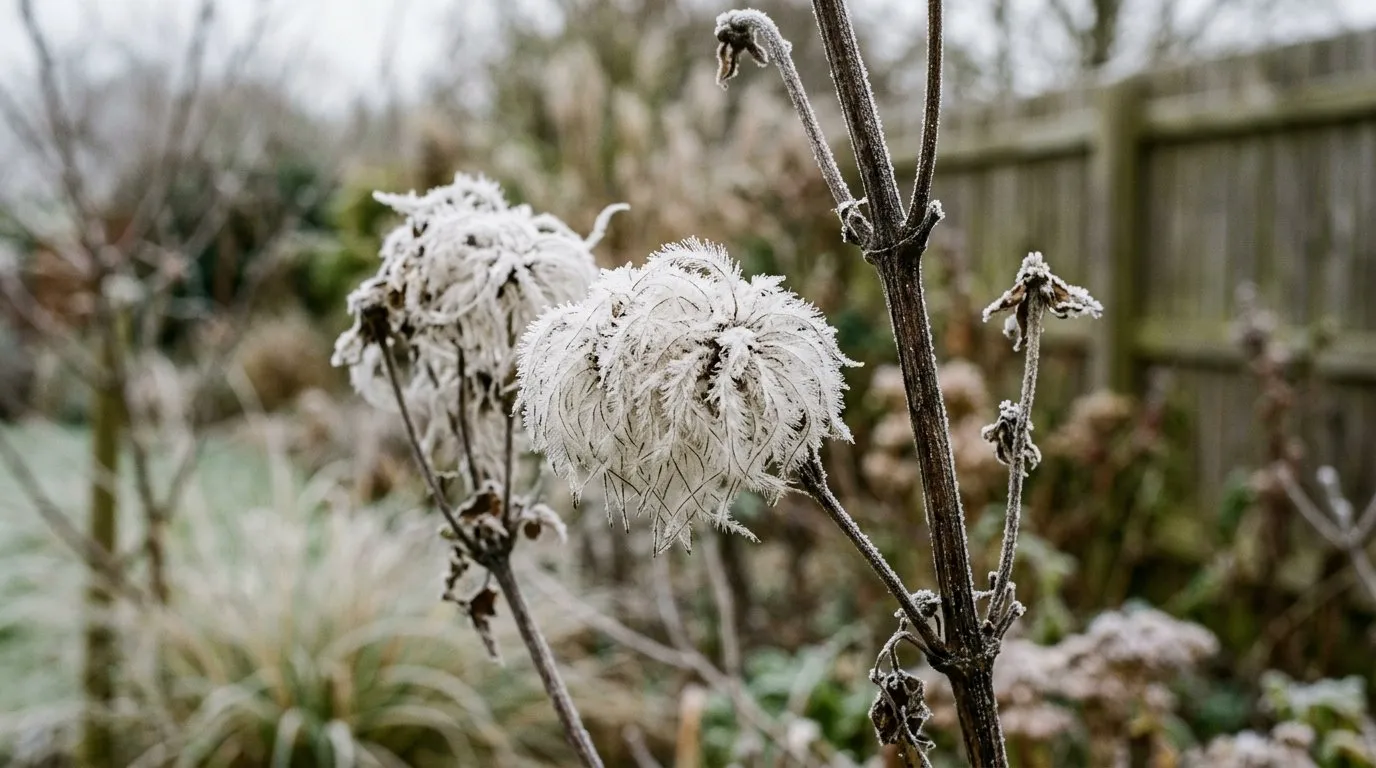 Japanese anemone seed heads hold their structure through winter, catching frost and low light.
After the flowers fade, woolly seed heads form on the stems. These silvery puffs look attractive through November and December, catching frost and low winter sunlight. Many gardeners leave them standing for winter interest, cutting back in March instead.
The seed heads also provide food for finches and other small birds. Goldfinches in particular feed on the seeds through late autumn and early winter.
Whether to cut back in November or March is a matter of garden style and local conditions. In wet western areas of the UK, the dead stems hold moisture against the crown and can encourage rotting. In drier eastern regions, leaving them standing does no harm. I cut mine back in late November in the West Midlands after losing two plants to crown rot when I left the stems through a particularly wet winter.
Five mistakes to avoid
Planting in deep, dry shade. Japanese anemones tolerate shade but not bone-dry shade under dense evergreen trees. They need some soil moisture and at least dappled light. The best plants for shade guide covers alternatives for the darkest corners.
Moving established plants unnecessarily. They hate root disturbance. A plant that has flowered beautifully for three years may sulk for two seasons after being moved. Only move them if absolutely necessary, and always in March.
Expecting flowers in the first year. Almost all Japanese anemone varieties spend their first season building roots. Buying the largest pot size does not solve this. Accept the wait and plant other quick-flowering perennials nearby to fill the gap. Dahlias and echinacea both flower in their first season.
Overfeeding with nitrogen. High-nitrogen feeds produce lush leaf growth at the expense of flowers. Use a balanced fertiliser (equal N-P-K) in spring or a high-potash feed from July. Tomato fertiliser works well.
Ignoring the spread. A charming patch of anemones can colonise half a border in five years if left unchecked. Decide on the boundaries at planting time and edge-slice every March. It takes five minutes and saves hours of future work.
Frequently asked questions
Do Japanese anemones grow in shade?
Yes, partial shade is their ideal position. They evolved as woodland-edge plants and flower well with just 3-4 hours of direct sun. North-facing borders suit them perfectly. Full shade reduces flower count but the foliage stays attractive as ground cover.
Are Japanese anemones invasive?
They spread freely but are not invasive. Underground runners extend the clump by 30-50cm per year in moist soil. Control spread by slicing around the clump with a spade each March. In drier soil, spread is much slower. They do not self-seed aggressively.
When do Japanese anemones flower in the UK?
Most varieties flower from mid-August to late October. Wild Swan is an exception, flowering from June to October. Flowering lasts 8-12 weeks in a typical British autumn. Peak display is usually mid-September to early October across all varieties.
Can I move Japanese anemones?
Move them in March before new growth starts. Lift the entire clump with a fork, keeping as many roots as possible. Replant at the same depth and water well. Expect reduced flowering for one to two seasons after transplanting.
Why are my Japanese anemones not flowering?
New plants often skip their first year of flowering. This is normal establishment behaviour, not a problem. Too much shade, drought, and recent transplanting also reduce blooms. Feed with balanced fertiliser in April. Most plants flower reliably from year two.
Do Japanese anemones come back every year?
Yes, they are fully hardy herbaceous perennials. Top growth dies back in November and fresh shoots emerge in April. Once established, they return every year with no winter protection. Plants improve with age, producing more flowers for 10 years or more.
What goes well with Japanese anemones?
Asters, sedums, ornamental grasses, and persicaria are the best companions. Aster x frikartii ‘Monch’ provides blue contrast. Miscanthus grasses add height. For spring interest, underplant with snowdrops, hellebores, and Brunnera macrophylla.
Now you know how to grow Japanese anemones, read our guide on the best shrubs for shade for more ways to fill those difficult shaded spots.
Lawrie has been gardening in the West Midlands for over 30 years. He grows his own veg using no-dig methods, keeps a wildlife-friendly garden, and writes practical advice based on real UK growing conditions.