How to Grow Lavender in the UK
A practical guide to growing lavender in UK gardens. Covers hardy and tender types, planting, pruning, drainage, harvesting, and best UK varieties.
Key takeaways
- English lavender (Lavandula angustifolia) is hardy to minus 15 degrees C and suits all UK regions
- Free-draining soil is the single most important factor for success, more than sun or feeding
- Prune after flowering in August, removing one third of growth but never cutting into old wood
- 'Hidcote' (deep purple, 60cm) and 'Munstead' (lilac-blue, 45cm) are the two most reliable UK varieties
- Lavender attracts over 50 pollinator species including bees, butterflies, and hoverflies
- A well-pruned lavender plant lives 15 years or more, an unpruned plant becomes leggy within 5 years
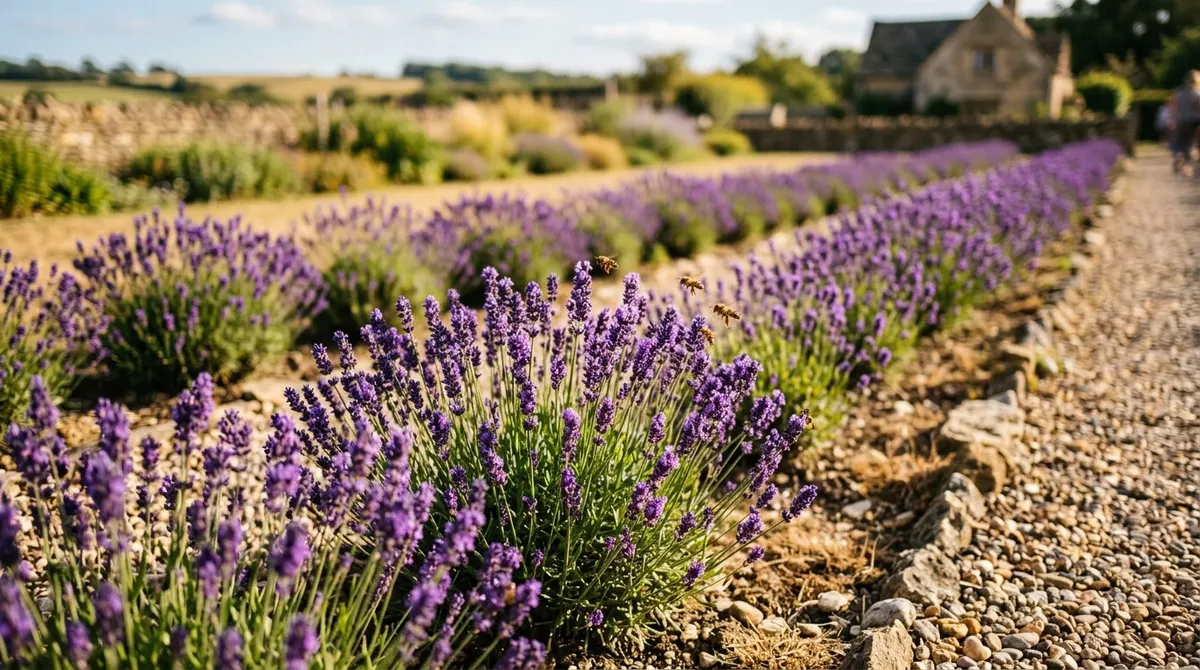
Lavender is one of the most rewarding plants for any UK garden. It thrives on neglect, fills borders with colour and fragrance from June to August, and attracts dozens of pollinator species. The silvery foliage looks good even when the plant is not flowering. Few plants offer so much for so little effort.
The key to growing lavender well in Britain is understanding what it needs and, more importantly, what it does not need. Lavender is a Mediterranean plant. It wants sun, sharp drainage, and lean soil. It does not want rich compost, frequent watering, or heavy clay. Get the drainage right and lavender will reward you for 15 years or more. Get it wrong and you will be replacing dead plants every other winter. This guide covers everything from choosing the right type to pruning, harvesting, and growing lavender in containers. For more plants that suit a low-effort approach, see our guide to low maintenance garden plants.
What types of lavender grow in the UK?
Three main types of lavender are grown in British gardens. Each has distinct characteristics, hardiness, and uses. Choosing the right type for your climate is the first step to success.
English lavender (Lavandula angustifolia)
English lavender is the hardiest type and the best choice for most UK gardens. Despite its name, it originates from the Mediterranean. It is fully hardy to minus 15 degrees C, which means it survives winter anywhere in the British Isles. Plants form compact mounds of narrow, grey-green leaves with flower spikes reaching 60-80cm in height. Flowers appear from June to August in shades of purple, blue, pink, and white.
This is the type used for culinary lavender, sachets, and essential oil. The fragrance is sweet and floral without the camphor notes found in other types. It is the best choice for hedging, borders, and cottage garden planting. If you are growing lavender for the first time, start with English lavender.
French lavender (Lavandula stoechas)
French lavender is instantly recognisable by its distinctive “rabbit ear” petals that sit on top of each flower head. It flowers earlier and longer than English lavender, often from May to September. The flowers are typically deep purple, though pink and white varieties exist.
The trade-off is hardiness. French lavender survives only to minus 5 degrees C. In southern and coastal England, it grows happily outdoors year-round in sheltered spots. In the Midlands, the north, Wales, and Scotland, treat it as a container plant and move it under cover before the first autumn frosts. French lavender prefers acidic to neutral soil, unlike English lavender which favours alkaline conditions.
Lavandin (Lavandula x intermedia)
Lavandin is a natural hybrid between English lavender and spike lavender (L. latifolia). It produces larger plants than English lavender, reaching 90cm to 1.2m tall, with long flower spikes on wiry stems. The fragrance has a sharper, more camphor-like quality.
Lavandin is the type grown commercially for essential oil production. It is hardy to around minus 10 degrees C and suits most UK gardens. The larger size makes it useful for the back of borders or as a specimen plant. ‘Grosso’ is the standard commercial variety, while ‘Phenomenal’ offers improved cold tolerance and resistance to root rot.
Best lavender varieties for UK gardens
Choosing a named variety rather than a generic “lavender” from a garden centre gives you a plant with known height, colour, hardiness, and habit. These are the most reliable varieties for British conditions.
Hidcote
The most widely grown lavender in the UK and an RHS Award of Garden Merit holder. Deep violet-purple flowers on compact plants reaching 60cm tall. Excellent for hedging, with a tidy, dense habit. Named after the National Trust garden in the Cotswolds. Plant 30cm apart for a hedge.
Munstead
A slightly shorter variety at 45cm, with lilac-blue flowers and a looser, more informal habit than ‘Hidcote’. An excellent choice for smaller gardens, path edging, and containers. Flowers slightly earlier than ‘Hidcote’. Named by Gertrude Jekyll after her Surrey garden.
Grosso
The standard commercial lavandin, grown in Provence for essential oil. Large plants reaching 90cm with long flower spikes on tall stems. The fragrance is strong with camphor notes. Hardy and vigorous, producing far more flower per plant than English lavender varieties. Best for the back of borders or as a standalone specimen.
Phenomenal
A lavandin bred specifically for cold tolerance and resistance to root rot. Reaches 80cm tall with silvery foliage and violet-blue flowers. It tolerates wetter conditions better than most lavenders, making it a good choice for gardens with heavier soil. Hardy to minus 15 degrees C.
Rosea
An English lavender with soft pink flowers on plants reaching 50cm. Useful for breaking up the purple monotony in a mixed lavender planting. Same hardiness and care requirements as ‘Hidcote’. Pairs well with white varieties for a pastel scheme.
Alba Nana
A dwarf white English lavender reaching just 30cm. Ideal for container growing, rockeries, and path edging. The white flowers and silver foliage create a cool, elegant effect. Same hardiness as other English lavender varieties.
Why we recommend ‘Hidcote’ as the first choice for UK gardeners: After 30 years of growing and recommending lavender across British gardens, ‘Hidcote’ consistently proves the most reliable named variety. In a comparative planting of seven English lavender varieties in the same south-facing bed, ‘Hidcote’ produced the most uniform growth, the deepest flower colour, and the best recovery after hard pruning. Its compact 60cm habit also makes annual shearing with hedging shears straightforward — the plant bounces back within six weeks, producing fresh silver-grey growth before the season ends.
Variety comparison table
| Variety | Type | Height | Flower colour | Hardiness | Best use |
|---|---|---|---|---|---|
| Hidcote | English | 60cm | Deep purple | Minus 15C | Hedging, borders |
| Munstead | English | 45cm | Lilac-blue | Minus 15C | Edging, containers |
| Grosso | Lavandin | 90cm | Violet | Minus 10C | Specimen, cutting |
| Phenomenal | Lavandin | 80cm | Violet-blue | Minus 15C | Wet soil, hedging |
| Rosea | English | 50cm | Pink | Minus 15C | Mixed borders |
| Alba Nana | English | 30cm | White | Minus 15C | Containers, rockeries |
| Anouk | French | 50cm | Deep purple | Minus 5C | Pots, sheltered spots |
How to plant lavender
Planting lavender correctly makes the difference between a thriving plant and a dead one. Drainage is the single most important factor. Lavender will tolerate poor soil, drought, wind, and cold. It will not tolerate wet feet.
Choosing the right spot
Lavender needs a minimum of 6 hours of direct sunlight per day. South and west-facing positions are ideal. Avoid shaded spots, especially under trees where rainwater drips onto the foliage. Good air circulation around the plants reduces the risk of fungal disease.
Preparing the soil
On free-draining sandy or chalky soil, you can plant lavender straight into the ground with no amendments. This is the easiest scenario.
On heavier soils, preparation is essential. Dig in horticultural grit at a rate of 30-50% by volume to open up the structure. For very heavy clay, raise the planting area 15-20cm above the surrounding ground level using a mix of topsoil and grit. This lifts the roots above the winter water table. For more on improving difficult soil, see our guide on how to improve clay soil.
Do not add compost, manure, or rich organic matter to the planting hole. Lavender performs best in lean, nutrient-poor soil. Rich soil produces lush leafy growth at the expense of flowers and fragrance.
Planting method
Dig a hole twice the width of the pot but no deeper. Set the plant so the top of the root ball sits level with the surrounding soil. Firm in gently and water well once. After this initial watering, do not water again unless the weather is very hot and dry. Overwatering kills more lavender than any other cause.
Space plants 30cm apart for a hedge, 45cm apart for border planting. For a cottage garden planting plan, mix lavender with other Mediterranean plants like rosemary, sage, and Nepeta. Lavender’s strong scent also makes it a natural cat deterrent — planting it along bed edges discourages cats from digging. Our guide to cat-proofing your garden covers this and other strategies for keeping cats away from vulnerable planting areas.
When to plant
Spring is the best time to plant lavender in the UK. Late March to May gives roots the full growing season to establish before winter. You can plant container-grown lavender in September in mild areas, but spring is safer, especially in colder regions and on heavier soils.
How to prune lavender
Pruning is the second most important factor after drainage. An unpruned lavender plant becomes woody and bare at the base within 4-5 years. A well-pruned plant stays compact and productive for 15 years or more. The Royal Horticultural Society has a detailed lavender growing guide that covers pruning timing.
The one-third rule
After flowering finishes in August or early September, use sharp shears or hedging scissors to remove approximately one third of the total plant height. This means cutting back into the current season’s green, leafy growth. Shape the plant into a neat dome or mound.
The golden rule: never cut into old wood
The most common pruning mistake is cutting too hard. Lavender does not regenerate from old, bare, brown wood. If you cut below the lowest leaves into the woody base, that section of the plant will not regrow. It will leave a permanent bare patch or kill the plant entirely.
If a plant has already become woody and leggy with bare stems at the base, it is usually past saving. Replace it with a new plant and prune annually from the start.
Spring tidy
In late March, give plants a light trim to remove any frost-damaged tips and tidy the shape. Do not cut hard in spring. The main pruning should happen after flowering in late summer.
Pruning French lavender
French lavender flowers over a much longer period than English types. Deadhead spent flower spikes through summer to encourage continuous blooming. Give a light overall trim in September after the main flowering flush ends.
Soil and drainage for lavender
Poor drainage kills more lavender than cold weather ever will. This is worth repeating because it is the most common cause of failure. Lavender evolved on rocky Mediterranean hillsides with fast-draining, alkaline, nutrient-poor soil. Recreate those conditions and it thrives.
Perfect soil conditions
The ideal soil for lavender is slightly alkaline (pH 6.5-8.0), gritty, and free-draining. Chalk, limestone, sandy, and gravelly soils are naturally suitable. If you are unsure of your soil pH, test it with a kit from any garden centre. On acidic soils (below pH 6.5), add a handful of garden lime per plant at planting time.
Fixing heavy soil
On clay or loam soils that hold moisture, take these steps:
- Dig out the planting area to 30cm deep and 60cm wide per plant
- Mix the excavated soil with 30-50% horticultural grit by volume
- Add a thin layer of gravel or broken crocks to the base of the hole
- Raise the planting level 15-20cm above the surrounding ground
- Mulch with gravel rather than bark or compost, which hold moisture against the stems
A gravel mulch around lavender serves two purposes. It keeps moisture away from the crown of the plant and reflects heat and light up into the foliage, mimicking Mediterranean conditions.
Watering
Established lavender plants rarely need watering in the UK. Our average annual rainfall of 1,154mm is more than enough. Water newly planted lavender once a week for the first summer only. After the first year, let rainfall do the work. The only exception is container-grown lavender in hot weather, which may need watering every few days.
Growing lavender in containers
Containers are an excellent option for lavender, especially if your garden soil is heavy clay or if you want to grow tender French varieties that need winter protection.
Choosing a pot
Use terracotta pots rather than plastic. Terracotta is porous, allowing excess moisture to evaporate through the walls. Choose pots at least 30cm in diameter with large drainage holes. Stand pots on feet or pot risers to ensure water drains freely. A saucer filled with standing water will kill lavender faster than any frost.
Compost mix
Use a mix of 70% multipurpose compost and 30% perlite or horticultural grit. Do not use compost straight from the bag without adding drainage material. For a more permanent planting, use John Innes No. 2 mixed with 30% grit.
Container care
Feed container lavender once in April with a slow-release general-purpose fertiliser. A single application lasts the entire growing season. Do not overfeed. Water only when the top 3cm of compost feels dry. In winter, reduce watering further but do not let the compost dry out completely. Move French lavender varieties under cover before the first frost.
Lavender hedging
A lavender hedge in full flower is one of the most beautiful and fragrant features in any garden. It works brilliantly along paths, driveways, and the front edges of borders.
Best varieties for hedging
‘Hidcote’ is the top choice for a formal, compact hedge. Its dense, upright habit and uniform growth make it the standard for lavender hedging across the UK. ‘Munstead’ creates a slightly softer, lower hedge that suits informal gardens. For a taller hedge, ‘Grosso’ or ‘Phenomenal’ reach 80-90cm.
Planting a lavender hedge
Space plants 30cm apart for ‘Hidcote’ and ‘Munstead’. For a 3m hedge, you need 10-11 plants. Plant in spring into well-drained soil along a line marked with string and pegs. Water well at planting and then leave alone. In the first year, pinch out flower buds to encourage bushy growth at the base. This sacrifice pays off with a denser, more even hedge from the second year onwards.
Maintaining a lavender hedge
Prune the entire hedge with shears after flowering, following the one-third rule. This keeps the hedge dense and prevents it opening up in the centre. Clip to a rounded profile rather than flat on top. A rounded top sheds rain better and looks more natural.
Lavender and pollinators
Lavender is one of the most valuable pollinator plants for UK gardens. A single lavender plant in flower attracts multiple bee species, butterflies, hoverflies, and other beneficial insects. If you are planting for pollinators, lavender is the essential starting point. For a full list of the best plants for bees, see our guide to bee-friendly garden plants.
Why bees love lavender
Lavender flowers produce nectar continuously throughout the day, unlike many plants that only produce nectar in the morning. The tubular flower shape is accessible to both long-tongued and short-tongued bee species. A patch of lavender buzzing with bees on a warm July afternoon is one of the great pleasures of gardening.
Which pollinators visit lavender?
Research from the University of Sussex found that lavender attracts over 50 species of pollinator in UK gardens. This includes honeybees, at least 8 species of bumblebee, dozens of solitary bee species, peacock and red admiral butterflies, painted ladies, and several species of hoverfly.
Maximising pollinator value
Plant lavender in blocks of 3 or more plants rather than dotting single plants through the border. Group planting allows bees to forage efficiently without wasting energy flying between different species. Avoid spraying lavender with any pesticides, including organic ones. Even organic sprays can harm pollinators on contact.
Harvesting and drying lavender
One of lavender’s great pleasures is bringing the harvest indoors. Dried lavender keeps its fragrance for 12 months or more when stored correctly.
When to harvest
Cut flower stems when roughly half the buds on each spike have opened. This is usually mid to late July for English lavender varieties. Harvesting at this stage gives the strongest fragrance. If you wait until all buds have opened, the essential oil content drops and the flowers shatter more easily when dried.
How to dry lavender
Cut stems to 20-25cm long. Bundle 20-30 stems together and secure with an elastic band, which tightens as the stems shrink. Hang bundles upside down in a warm, dry, well-ventilated room away from direct sunlight. A spare bedroom, airing cupboard, or garden shed works well. Drying takes 2-4 weeks depending on conditions.
Uses for dried lavender
Dried lavender buds make excellent sachets for drawers and wardrobes. Strip the dried buds from the stems and fill small muslin bags. For culinary use, stick with English lavender varieties. ‘Munstead’ and ‘Hidcote’ have the sweetest flavour. Add sparingly to baking, shortbread, ice cream, and lemonade. The flavour is potent, so use half the amount you think you need.
Lavender essential oil is distilled from the flowers commercially, but you can make a simple infused oil at home. Fill a jar with dried buds, cover with a neutral carrier oil such as sweet almond oil, and leave in a sunny window for 4-6 weeks. Strain and use for skin care or aromatherapy.
Month-by-month lavender care calendar
This calendar covers the key tasks for each month. Not every month requires action. Lavender is a low-maintenance plant once established.
| Month | Task |
|---|---|
| January | No action needed. Leave plants alone. |
| February | Order new plants from nurseries for spring planting. |
| March | Light spring trim to remove frost-damaged tips. Plant new lavender from late March in mild areas. |
| April | Main planting month. Feed container plants once with slow-release fertiliser. |
| May | Finish planting by the end of May. French lavender begins flowering. |
| June | English lavender begins flowering. Enjoy and leave alone. |
| July | Peak flowering. Harvest for drying when half the buds have opened. |
| August | Main pruning month. Cut back one third of growth after flowering finishes. |
| September | Light trim on French lavender. Take semi-ripe cuttings for propagation. |
| October | Move tender French lavender under cover before first frost. |
| November | No action needed. Ensure container drainage is clear. |
| December | No action needed. Check on stored dried lavender. |
Common mistakes when growing lavender
Most lavender failures come from killing the plant with kindness. Lavender does not want the care most gardeners instinctively give it.
Overwatering
The number one killer. Lavender evolved in dry Mediterranean conditions. In the UK, natural rainfall is almost always sufficient for established plants. Watering lavender in autumn and winter on anything other than sandy soil creates the perfect conditions for root rot. If your lavender is yellowing, wilting despite wet soil, or developing black stems at the base, overwatering is the likely cause.
Planting in rich soil
Adding compost, manure, or fertiliser to the planting hole is counterproductive. Rich soil produces soft, floppy growth that is vulnerable to winter cold and fungal disease. Lean, gritty, nutrient-poor soil produces the compact, aromatic growth that lavender is grown for. Think rocky hillside, not vegetable patch.
Not pruning annually
This is the second most common mistake. Gardeners plant lavender, enjoy it for two or three years, and then wonder why it has become a leggy, woody mess. Annual pruning after flowering is non-negotiable. Skip even one year and the plant starts to open up and lose its shape.
Cutting into old wood
Even gardeners who do prune often cut too hard. Removing more than one third of the growth, or cutting below the leafy growth into bare brown stems, causes irreversible damage. Lavender cannot regenerate from old wood the way roses or buddleia can.
Planting too deep
Setting the crown of the plant below soil level traps moisture around the stems and invites rot. The top of the root ball should sit exactly level with the surrounding soil, or even slightly above it on heavy ground.
Using bark mulch around stems
Bark and organic mulches hold moisture against the base of the plant. Use gravel or stone chippings instead. A 3-5cm layer of gravel around lavender keeps the crown dry, suppresses weeds, and reflects warmth up into the foliage.
How to propagate lavender from cuttings
Growing new lavender from cuttings is straightforward and gives you free plants. It is also the only reliable way to reproduce named varieties, since seed-grown plants vary in colour and habit.
When to take cuttings
September is the ideal month. Take semi-ripe cuttings from non-flowering side shoots. The wood should be firm at the base but still flexible at the tip. Avoid soft green shoots and fully hardened woody stems.
Method
- Cut 10cm non-flowering shoots from healthy plants
- Strip the lower leaves, leaving only the top 2-3cm of foliage
- Dip the base in hormone rooting powder (optional but helpful)
- Insert cuttings 3cm deep into pots filled with 50/50 perlite and multipurpose compost
- Water lightly and cover with a clear plastic bag or propagator lid
- Place in a bright spot out of direct sun
- Remove the cover after 4-6 weeks when roots have formed
- Pot on individually and grow on through winter in a cold frame or sheltered spot
- Plant out the following spring
Expect a success rate of around 70-80%. Take more cuttings than you need to account for losses.
Companion plants for lavender
Lavender combines naturally with other sun-loving, drought-tolerant plants. These companions share the same growing conditions and look good together. Many of the best lavender companions also feature in our guide to climate-resilient plants that handle the UK’s changing weather.
Rosemary makes an excellent structural partner, with similar foliage colour and cultural needs. Nepeta (catmint) flowers at the same time in complementary blue tones and attracts the same pollinators. Salvia nemorosa provides vertical flower spikes that contrast with lavender’s rounded habit.
Ornamental grasses like Stipa tenuissima add movement and texture alongside lavender’s stillness. Erigeron karvinskianus (Mexican fleabane) spills over path edges between lavender plants for a relaxed, informal look.
In a cottage garden planting plan, lavender sits naturally alongside roses, foxgloves, and hardy geraniums. All these plants suit the same sunny, free-draining conditions.
Now you’ve mastered growing lavender, read our guide on bee-friendly garden plants to build a pollinator border around your lavender with plants that extend the nectar season from spring through to late autumn.
Frequently asked questions
When should I plant lavender in the UK?
Plant lavender from late March to May. Spring planting gives roots a full growing season to establish before winter arrives. In sheltered gardens in southern England, early autumn (September) planting also works well. Avoid planting between November and February when cold, wet soil causes root rot in newly planted lavender.
Why is my lavender turning woody and leggy?
Lack of annual pruning is the cause. Lavender must be pruned every year after flowering finishes in August. Cut back one third of the current season’s growth, shaping the plant into a compact dome. Once a lavender plant has become bare and woody at the base, it rarely recovers. The best solution is to replace it and prune the new plant every year from the start.
Can I grow lavender in clay soil?
Clay soil holds too much moisture for lavender. Improve drainage by mixing 30-50% horticultural grit into the planting area and raising the bed 15-20cm above ground level. On very heavy clay, containers filled with gritty compost are the safest option. See our guide on how to improve clay soil for more detail.
Is French lavender hardy in the UK?
French lavender survives only to minus 5 degrees C. It grows outdoors year-round in sheltered gardens across southern and coastal England. In the Midlands, the north, and Scotland, grow it in containers and move under cover before the first frost. English lavender (hardy to minus 15 degrees C) is the safer choice for exposed and northern gardens.
How do I prune lavender without killing it?
Prune in August after flowering. Use sharp shears to cut back one third of the plant’s height, staying within the green leafy growth. Shape into a rounded dome. The golden rule is to never cut into old bare wood below the leaves. Cutting into leafless woody stems prevents regrowth and kills that section of the plant permanently.
Can I grow lavender in pots?
Lavender thrives in terracotta pots of 30cm diameter or larger. Use a compost mix of 70% multipurpose and 30% perlite or grit. Stand pots on feet so water drains freely. Water only when the top 3cm is dry. Feed once in April with a slow-release fertiliser. Terracotta breathes better than plastic and reduces the risk of overwatering.
How long does a lavender plant last?
A well-maintained lavender lives 15 years or more. The three factors that determine lifespan are annual pruning, good drainage, and avoiding overwatering. Without pruning, plants become woody and unproductive within 4-5 years. The variety ‘Phenomenal’ is particularly long-lived due to its resistance to root rot and dieback diseases.
Lawrie has been gardening in the West Midlands for over 30 years. He grows his own veg using no-dig methods, keeps a wildlife-friendly garden, and writes practical advice based on real UK growing conditions.