How to Grow Muscari (Grape Hyacinth) UK
How to grow muscari grape hyacinth in UK gardens. Planting depth, best varieties, naturalising in lawns, and container tips from a hands-on grower.
Key takeaways
- Plant muscari bulbs 8cm deep and 5cm apart from September to November for spring flowers
- Muscari armeniacum is the most reliable species, flowering March to April in cobalt blue
- They spread vigorously by offsets and self-seeding — plant where spreading is welcome
- White (Album), pale blue (Valerie Finnis), and two-tone (latifolium) varieties add contrast
- Muscari naturalise well in lawns, borders, rockeries, and under deciduous trees
- Leave foliage to die back naturally after flowering — do not cut or tie leaves
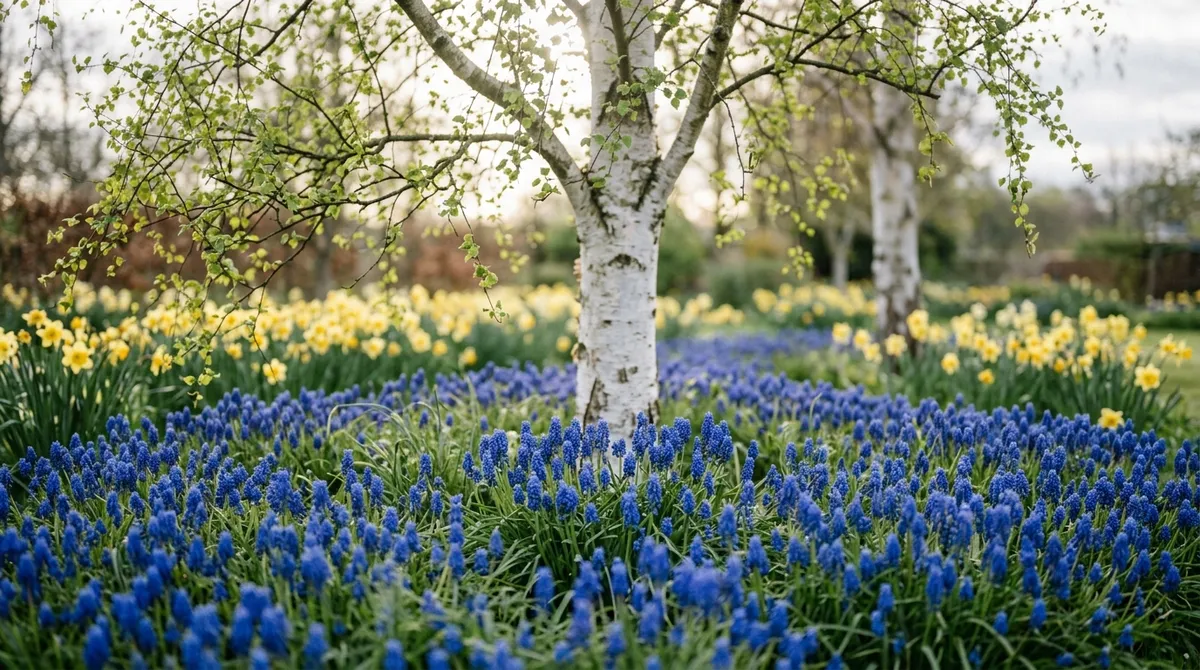
Muscari grape hyacinth are among the most reliable spring bulbs for UK gardens, producing dense spikes of blue, white, or pink flowers from March through to May. They grow in almost any soil, tolerate shade, and multiply freely without any attention. A single bag of 50 bulbs planted in autumn becomes a carpet of colour within three years.
What makes muscari particularly useful is their timing. They bridge the gap between early spring bulbs like crocus and the main tulip season, providing colour and pollinator food during a lean period. They also thrive in the awkward spots where little else grows well — under deciduous trees, along shaded walls, and in thin soil over tree roots.
What types of muscari can I grow in the UK?
Muscari is a genus of around 40 species in the asparagus family, with six species and their cultivars commonly grown in UK gardens. The plants grow from small, round bulbs and produce narrow, grass-like leaves from autumn onward. Flower spikes appear from March, carrying dense clusters of tiny, urn-shaped florets that resemble miniature bunches of grapes — hence the common name.
All muscari are fully hardy across the UK, surviving temperatures down to -20 degrees C without protection. They grow 10-25cm tall depending on species and prefer well-drained soil in sun or partial shade. The RHS muscari growing guide rates them as among the easiest bulbs for beginners.
Most species flower for 3-4 weeks. The flowers are mildly fragrant — a sweet, musky scent that is strongest on warm afternoons. Bees visit muscari readily, though the small florets are best suited to short-tongued species like mining bees and hoverflies.
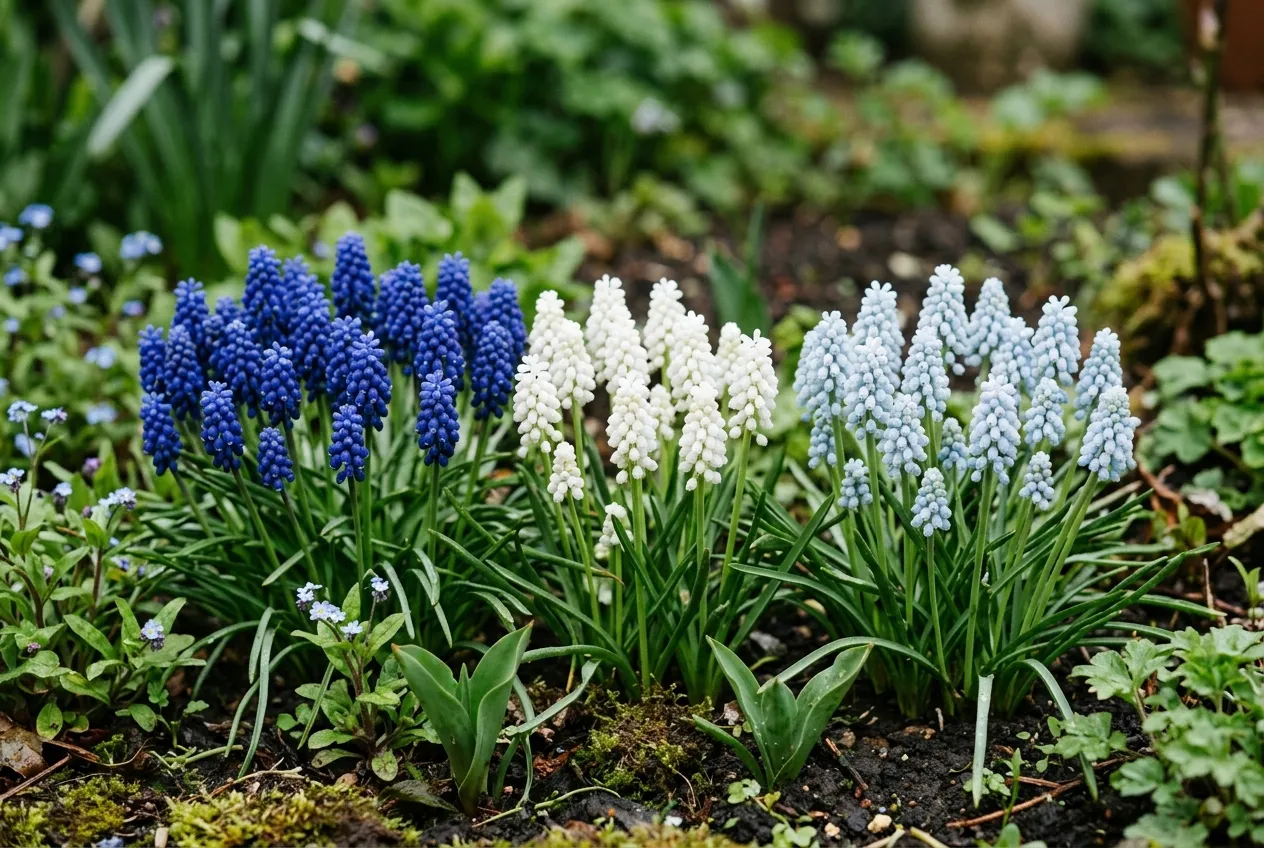
Muscari varieties range from deep cobalt blue to pure white and soft pale blue
Which muscari varieties should I grow?
| Variety | Colour | Height | Flowering | Spread Rate | Best Use |
|---|---|---|---|---|---|
| M. armeniacum | Cobalt blue | 15-20cm | March-April | Fast (vigorous self-seeder) | Naturalising, borders, mass planting |
| M. armeniacum ‘Valerie Finnis’ | Pale powder blue | 15cm | March-April | Moderate | Borders, containers, formal areas |
| M. botryoides ‘Album’ | Pure white | 15cm | April | Slow to moderate | Containers, white gardens, edging |
| M. latifolium | Two-tone (dark base, pale top) | 20cm | April-May | Slow | Borders, rockeries, specimen planting |
| ’Pink Sunrise’ | Soft pink | 12-15cm | March-April | Slow | Containers, front of border |
| M. aucheri ‘Ocean Magic’ | Bright blue, white tips | 12cm | March-April | Moderate | Containers, rockeries |
Muscari armeniacum is the workhorse variety and the one sold in bulk bags at every garden centre from August onward. It produces dense, 15-20cm spikes of cobalt blue and is almost indestructible. The trade-off is vigour — it self-seeds aggressively and spreads by offsets, colonising paths, gravel, and neighbouring beds if left unchecked.
‘Valerie Finnis’ is the best choice for controlled planting. The pale powder-blue flowers are elegant and the plant spreads at roughly half the rate of standard armeniacum. It holds an RHS Award of Garden Merit.
Muscari latifolium is the most distinctive species. Each spike carries dark indigo florets at the base and pale violet-blue at the top, giving a bicolour effect. It flowers slightly later than armeniacum (April-May) and spreads slowly, making it better behaved in mixed borders.
‘Album’ is the finest white muscari. The pure white spikes stand out against dark foliage and pair beautifully with blue varieties. It is less vigorous than armeniacum, which makes it easier to manage.
‘Pink Sunrise’ is a recent introduction with soft pink flowers on compact 12-15cm stems. It is less vigorous than blue types and best suited to containers or prominent positions where the subtle colour can be appreciated at close range.
How do I plant muscari?
Plant muscari bulbs from September to November. October is the optimum month — the soil retains warmth from summer, encouraging rapid root growth before winter.
Planting depth and spacing
Bury each bulb 8cm deep with the pointed end facing upward. Space bulbs 5cm apart for a dense display, or 8cm apart for a more natural effect. In heavy clay, place a small handful of horticultural grit beneath each bulb to improve drainage. Muscari tolerate most soils but bulbs rot in waterlogged ground.
Choosing a position
Muscari grow in full sun, partial shade, or even quite deep shade under trees. They flower best in sun but tolerate north-facing borders and woodland conditions. The ideal spots are under deciduous trees (where they receive winter sun before the canopy fills), along the front of borders, in rockeries, and along paths.
Avoid planting muscari in highly formal areas where spreading would be a problem. Once established, armeniacum in particular is difficult to remove — every tiny offset left in the soil regrows.
Step-by-step planting
- Clear weeds from the planting area. Fork over compacted ground to 15cm deep.
- For mass planting, scatter bulbs across the area by hand and plant each one where it lands. This creates a natural, random pattern.
- Use a narrow trowel or dibber to make individual holes 8cm deep.
- Drop a bulb into each hole, pointed end up. If unsure which end is up, plant it on its side — the shoot will find its way.
- Backfill with soil and firm gently. Water in if the soil is dry.
- Mark the area so you do not dig through the bulbs by accident.
For container planting, use pots at least 12cm deep and plant bulbs 5-6cm deep, almost touching.
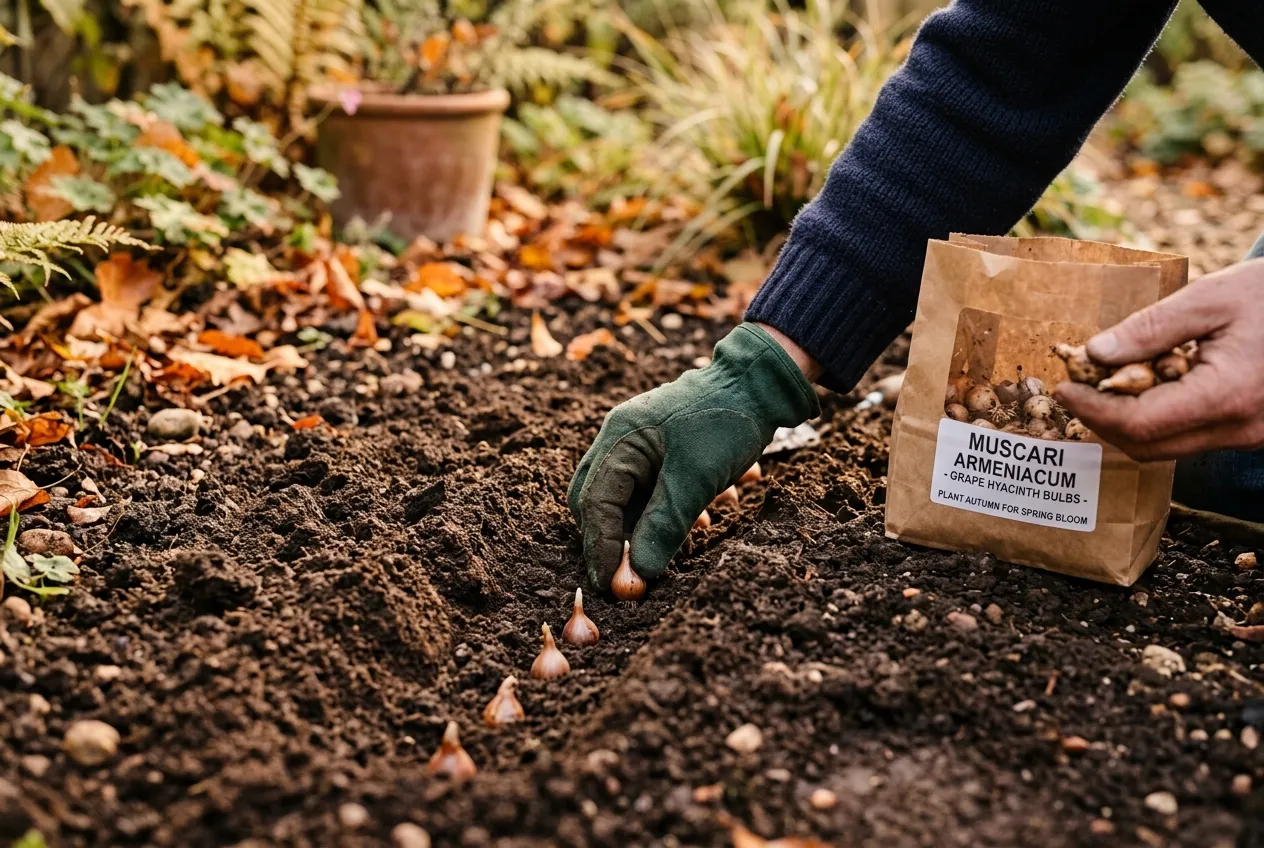
Plant muscari bulbs 8cm deep and 5cm apart from September to November
How do I naturalise muscari in a lawn?
Muscari armeniacum naturalises freely in grass, forming expanding drifts of blue that appear each March without any intervention. The key is choosing the right area and accepting that you cannot mow for 6-8 weeks after flowering finishes.
Planting in grass
Use a bulb planter or narrow trowel to cut plugs through the turf. Plant each bulb at 8cm deep, replace the turf plug, and press down firmly. For larger areas, peel back a section of turf with a flat spade, fork over the soil underneath, scatter bulbs, and relay the turf.
Plant in groups of 20-30 bulbs with natural gaps between groups. Straight lines and grid patterns look artificial. Concentrate planting under trees, around the base of hedges, and along lawn edges where later mowing is less critical.
Mowing around naturalised muscari
Do not mow over muscari until the foliage has died back naturally — at least 6 weeks after the last flowers fade. In most UK gardens, this means the first cut over muscari areas is in mid to late May. The long, floppy leaves must stay intact to photosynthesise and feed the bulb for the following year.
If a fully unmown lawn for six weeks is unacceptable, plant muscari only in areas you can leave: around tree trunks, along boundaries, or in a dedicated wild strip. This approach works well combined with crocus and daffodils for a three-month sequence of colour before mowing resumes.
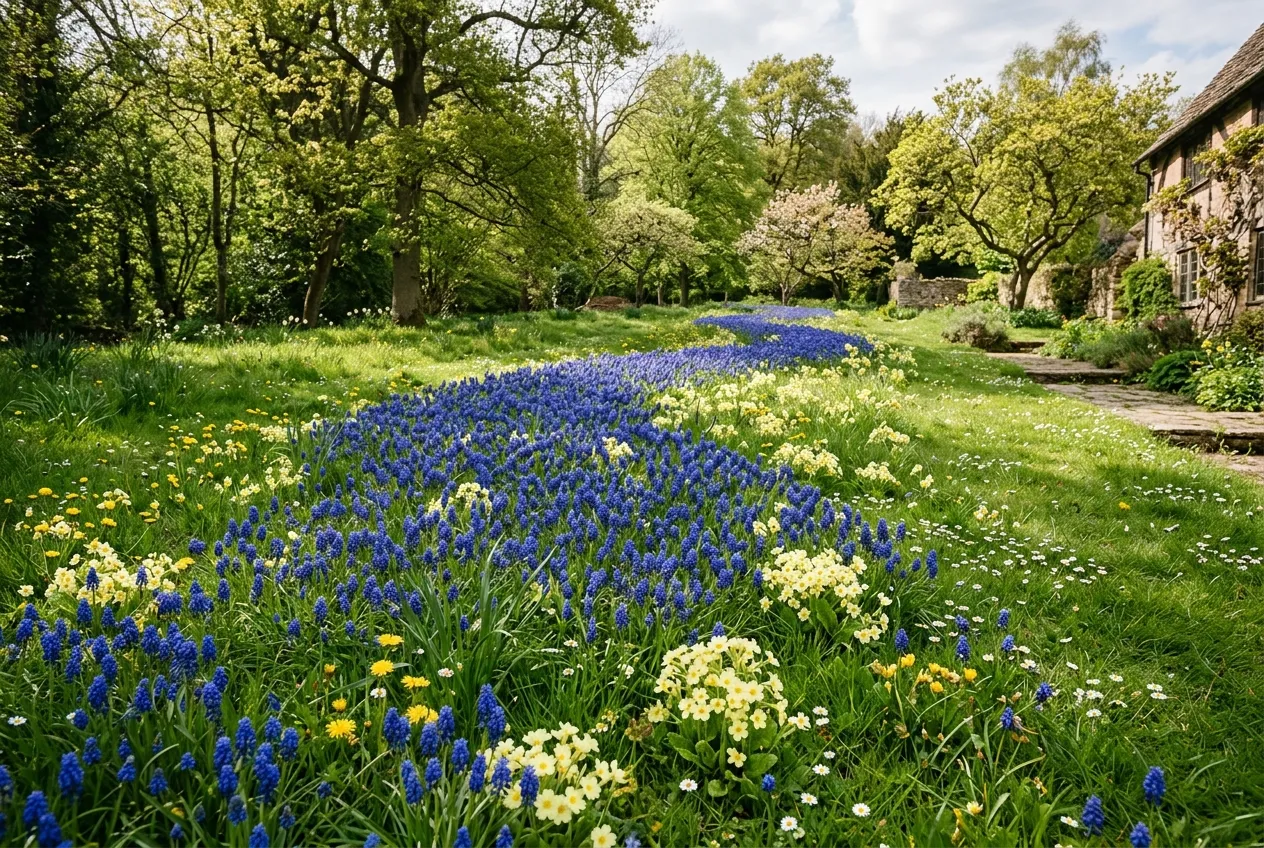
Muscari naturalise freely in lawns, creating expanding drifts of blue each spring
Can I grow muscari in containers?
Muscari are excellent container plants. Their compact size, dense flower spikes, and tolerance of close planting make them ideal for pots, troughs, and window boxes.
Use containers at least 12cm deep with drainage holes. Fill with a mix of multipurpose compost and horticultural grit at roughly 3:1 for sharp drainage. Plant bulbs 5-6cm deep and almost touching — a 20cm pot holds 20-25 muscari bulbs comfortably.
Water once after planting and leave the pot outdoors through winter. Muscari need cold exposure to flower well. In spring, water if the compost dries out, but avoid keeping it sodden.
Layered (lasagne) planting is particularly effective with muscari. Place tulip bulbs at the bottom (15cm), daffodil bulbs in the middle (10cm), and muscari at the top (5cm). You get three waves of flowers from a single pot. See our bulb lasagne guide for detailed layering instructions.
After flowering, either plant the bulbs out into the garden or refresh the compost and replant in the same pot for next year. Container-grown muscari exhaust their compost faster than those in open ground.
How do muscari spread — and how do I control them?
Muscari armeniacum is one of the most prolific self-spreading bulbs in UK gardens, multiplying by both offsets and self-seeding. A single bulb produces 3-5 offsets per year. Each flower spike also sets seed, and seedlings appear the following year. Within 3-4 years, a planting of 20 bulbs can become a colony of several hundred.
This vigour is a benefit when you want ground cover under trees or in wild areas. It becomes a nuisance in formal borders, gravel paths, and rock gardens, where muscari invade aggressively.
Managing spread
- Deadhead after flowering to prevent self-seeding. This is the single most effective control measure. Snap off flower heads as soon as the blue fades, before seed capsules form.
- Edge with a physical barrier. A buried strip of plastic lawn edging, 15cm deep, stops bulb offsets from migrating sideways into adjacent areas.
- Lift and thin clumps every 3-4 years. Dig out congested clumps after foliage dies back in June, separate the bulbs, and replant only as many as you want. Give extras to neighbours or compost them.
- Choose slower varieties. Muscari latifolium, Album, and Valerie Finnis spread at roughly half the rate of standard armeniacum.
After 6 years of growing muscari in Staffordshire clay, the spreading habit is both the greatest strength and the biggest management challenge. Armeniacum seeded into paving joints, gravel, and a neighbouring alpine trough within 3 years. The bulbs are incredibly persistent — every tiny offset left behind when lifting regrows. For naturalising under trees and along boundaries, this vigour is perfect. For anything formal, stick to Valerie Finnis or latifolium.
Year-on-year care for muscari
Muscari require almost no maintenance once established. They are among the most self-sufficient bulbs in any garden.
- Leave foliage intact until it yellows and dies back naturally in June. The long, floppy leaves are untidy but essential for feeding the bulb. Never cut, tie, or braid the leaves.
- Feed lightly after flowering with a balanced granular fertiliser if growing in borders or containers. Muscari in lawns take what they need from the soil.
- Water containers if the compost dries out in spring. Open-ground muscari rarely need watering in the UK.
- Divide congested clumps every 3-4 years by lifting in June, separating bulbs, and replanting immediately at 8cm deep.
- Watch for smut disease — a fungal infection that turns flower heads into black, dusty masses. Dig out and destroy affected bulbs. It is uncommon but can spread through a colony.
For more seasonal tasks, see our spring gardening jobs checklist and the guide to spring bulb care after flowering.
Best planting partners for muscari
Muscari combine well with other spring bulbs and early perennials. Their compact height (15-20cm) makes them ideal for the front of borders or as ground-level filler between taller plants.
- Daffodils and tulips: The classic spring combination. Muscari flower at the same time as mid-season daffodils and early tulips, creating a blue carpet beneath taller blooms.
- Forget-me-nots: Both produce blue flowers in April. Together they create a sea of blue that works beautifully in cottage-style planting. See our cottage garden planting plan for more ideas.
- Wallflowers: The warm oranges and reds of wallflowers contrast sharply with muscari blue.
- Primroses and polyanthus: Yellow primroses and blue muscari is a classic spring pairing, especially under deciduous trees.
- Alliums: Late muscari varieties overlap with early alliums, creating a continuous display of bulb flowers from March through June.
For the widest possible range of spring colour, see our guide to best spring flowers for UK gardens.
Frequently asked questions
When should I plant muscari bulbs?
Plant muscari bulbs from September to November for spring flowers. October is the ideal month, giving bulbs time to root before winter cold slows growth. Late planting (December) still works but produces shorter flower spikes in the first year. Muscari tolerate being planted later than most spring bulbs because their root system establishes quickly even in cool soil.
How deep do I plant muscari?
Plant muscari bulbs 8cm deep with the pointed end facing upward. Space them 5cm apart for a dense display. In heavy clay, add a layer of horticultural grit beneath the bulbs to prevent waterlogging. In containers, plant at 5-6cm deep and almost touching for maximum impact.
Do muscari spread too much?
Muscari armeniacum is a vigorous spreader and can colonise large areas within 3-4 years. Each bulb produces offsets underground and the plants self-seed freely. This is ideal for naturalising under trees or in wild areas, but can become invasive in formal borders. For slower spreading, choose Muscari botryoides Album or Valerie Finnis.
Can I grow muscari in pots?
Yes, muscari grow well in containers at least 12cm deep with drainage holes. Plant bulbs 5-6cm deep and almost touching for a dense cluster. Use a mix of multipurpose compost and grit at 3:1 ratio. Water once after planting and leave outdoors through winter. They combine well with tulips and daffodils in layered bulb lasagne pots.
Why are my muscari leaves long and floppy?
Muscari produce long, grass-like leaves in autumn that persist through winter. This is normal, not a sign of a problem. The leaves photosynthesise through mild winter days, feeding the bulb for spring flowering. Do not cut them. The leaves look untidy by March but the flower spikes emerge through them and draw the eye away.
Do muscari come back every year?
Yes, muscari are fully perennial and return reliably in UK gardens for decades. They multiply each year, producing offsets around the parent bulb. A single bulb becomes a clump of 6-8 within three years. Left undisturbed, established clumps become denser and more floriferous with age.
What is the best muscari variety for UK gardens?
Muscari armeniacum is the best all-round variety for UK gardens. It is the hardiest, most reliable, and most widely available species. For white flowers, choose Muscari botryoides Album. For a two-tone effect, Muscari latifolium produces bicolour spikes of dark and pale blue. For container displays, the compact Pink Sunrise is striking.
Related articles
Lawrie has been gardening in the West Midlands for over 30 years. He grows his own veg using no-dig methods, keeps a wildlife-friendly garden, and writes practical advice based on real UK growing conditions.