How to Grow Passionflower UK
How to grow passionflower in the UK. Covers hardy Passiflora caerulea, planting, pruning, overwintering, containers, and passion fruit.
Key takeaways
- Passiflora caerulea is the only reliably hardy passionflower for outdoor UK growing, surviving -10°C
- Plant against a south or west-facing wall in well-drained soil for the best flowering
- Flowers appear from July to October on the current season's growth, attracting bees and other pollinators
- Prune in late spring by removing dead growth and shortening side shoots to 15cm from the main framework
- Grow edible passion fruit (P. edulis) only in a heated greenhouse kept above 10°C year-round
- Propagate from semi-ripe cuttings in July or August, rooting in 4-6 weeks with bottom heat
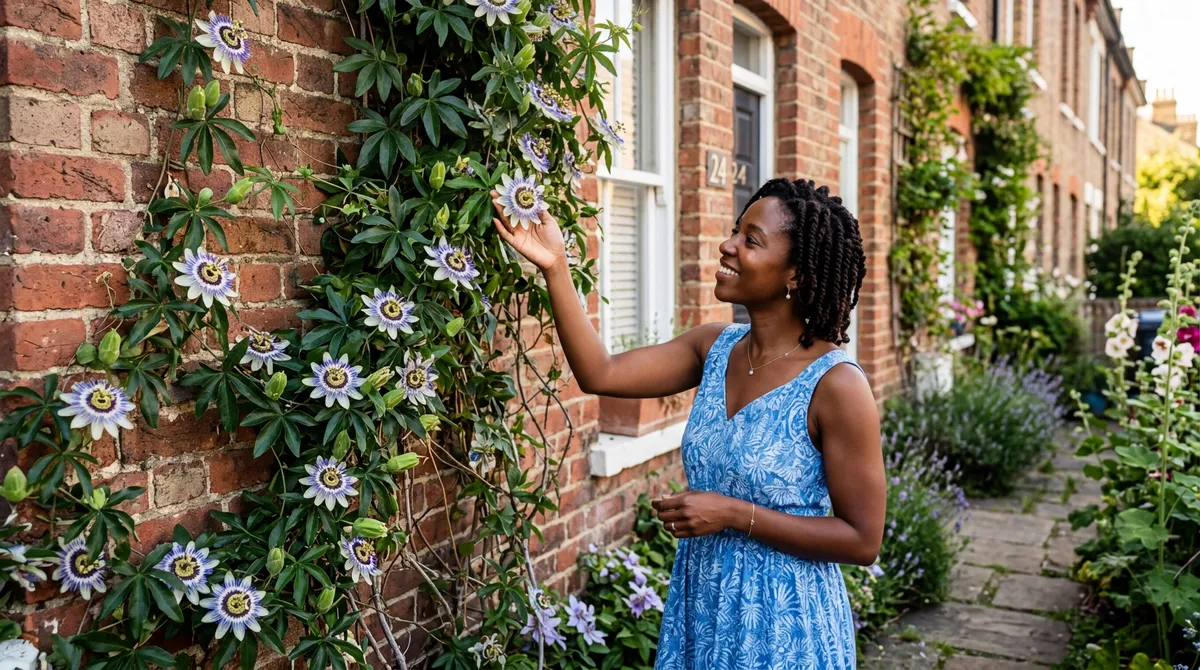
Passionflower is one of the most striking climbers you can grow in a UK garden. The flowers of Passiflora caerulea look like they belong in the tropics, yet this species survives British winters down to -10°C against a warm wall. Once established, it grows vigorously, produces flowers from July right through to October, and attracts bees like few other plants.
This guide covers which passionflower species suit UK conditions, how to plant and train them, pruning for maximum flowers, overwintering, and whether you can actually grow edible passion fruit in Britain. If you are looking for more vertical cover, see our guide to fast growing climbers for fences and walls.
Which passionflower can I grow in the UK?
Not all passionflower species survive outdoors in the UK. The choice depends on whether you have a sheltered wall, a heated greenhouse, or a conservatory.
Passiflora caerulea (blue passionflower)
This is the only passionflower that grows reliably outdoors across most of the UK. A vigorous, semi-evergreen climber that reaches 8-10 metres in five years using twining tendrils. The flowers are 7-10cm across with white petals and a striking corona of blue, white, and purple filaments. Flowering runs from July to October on new growth. After hot summers, egg-shaped orange fruit appear in autumn, though they are not particularly palatable.
P. caerulea holds the RHS Award of Garden Merit and tolerates temperatures down to approximately -10°C once established. In a hard winter, top growth may die back to the ground, but the roots survive and send up fresh shoots in spring. The RHS growing guide for Passiflora recommends a south or west-facing wall for the best results.
The variety ‘Constance Eliott’ has pure white flowers without any blue colouring. It is just as hardy as the straight species and suits gardens where the blue does not fit the colour scheme.
Passiflora incarnata (maypop)
A herbaceous species from the southern United States. The top growth dies back completely each winter and regrows from the roots in spring. Hardy to around -10°C but needs a long, warm summer to flower well. In southern England against a hot wall, it produces lavender-purple flowers from August onwards. Less reliable in the Midlands and further north.
Tender passionflower species
Passiflora edulis (the edible passion fruit), P. quadrangularis (giant granadilla), and P. ligularis (sweet granadilla) are all tropical and cannot survive outdoors in the UK. Grow them in a heated greenhouse with a minimum winter temperature of 10°C. P. edulis is the most rewarding for fruit production under glass.
| Species | Hardy | Height | Flowers | Fruit | UK suitability |
|---|---|---|---|---|---|
| P. caerulea | -10°C | 8-10m | Blue-white, Jul-Oct | Orange, bland | Outdoor wall or fence |
| P. caerulea ‘Constance Eliott’ | -10°C | 8-10m | Pure white, Jul-Oct | Orange, bland | Outdoor wall or fence |
| P. incarnata | -10°C | 3-5m | Lavender, Aug-Oct | Yellow-green, edible | South England, warm wall |
| P. edulis | 10°C min | 5-8m | White-purple, summer | Purple/yellow, edible | Heated greenhouse only |
| P. quadrangularis | 15°C min | 10m+ | Red-white, summer | Large, edible | Heated greenhouse only |
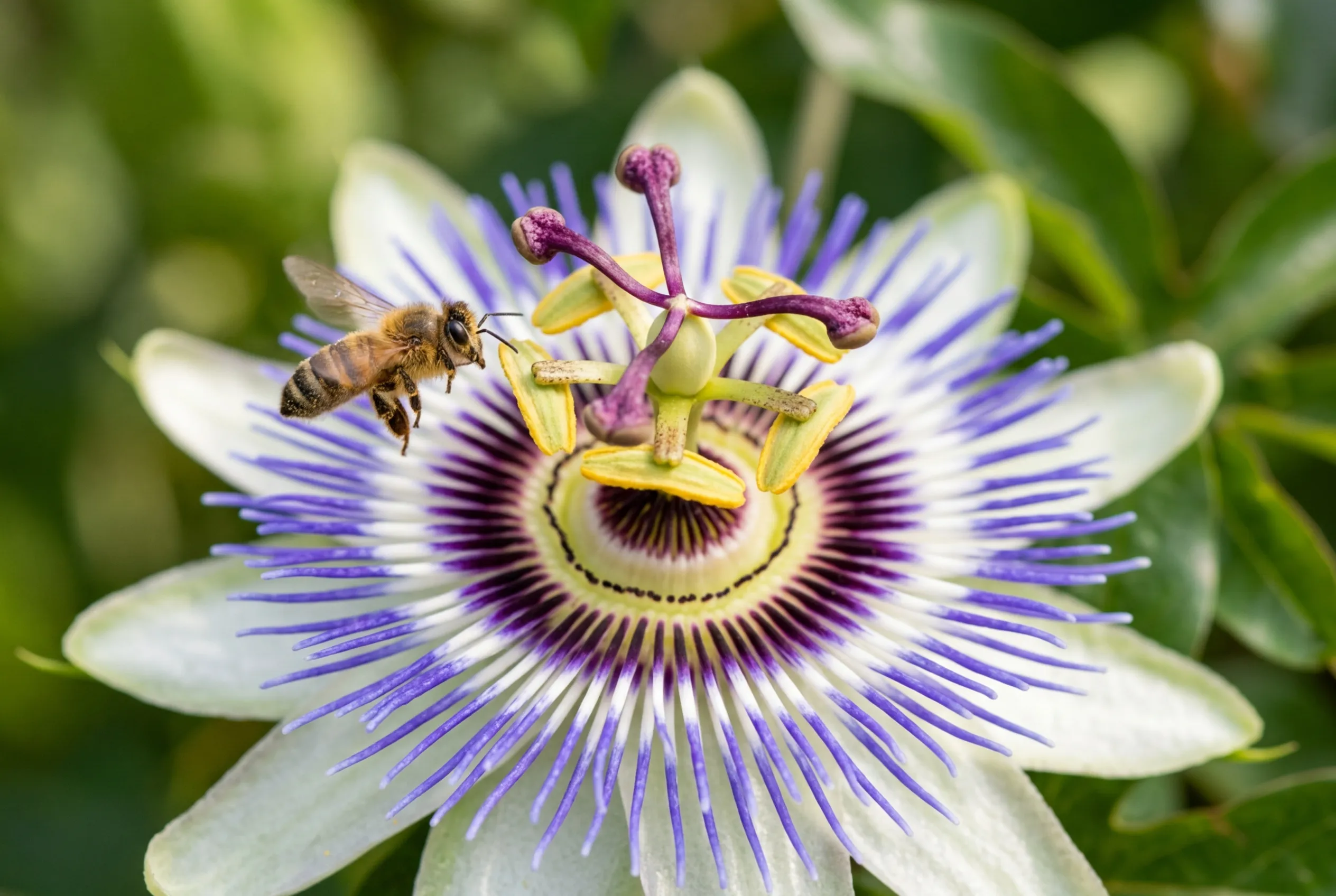
The intricate corona filaments of Passiflora caerulea. Each flower lasts only one to two days, but the plant produces new blooms from July to October.
Where and when to plant passionflower
Plant passionflower between April and June when the soil has warmed and the risk of hard frost has passed. Autumn planting is possible in mild areas, but spring planting gives the roots a full growing season to establish before their first winter.
Choosing the right position
A south or west-facing wall is the best position for passionflower in the UK. The reflected warmth from brickwork pushes temperatures several degrees above the open garden, which makes the difference between a thriving plant and a struggling one. East-facing walls work in mild areas but flowering is reduced. North-facing walls are unsuitable.
The soil must drain freely. Passionflower hates waterlogged roots, which rot over winter. If your soil is heavy clay, dig in generous quantities of horticultural grit and composted bark to improve drainage. Raised beds against a wall solve persistent drainage problems.
Step by step planting
- Fix a trellis or horizontal wires to the wall before planting. Space wires 30-40cm apart using vine eyes and galvanised wire.
- Dig a planting hole 45cm wide and 45cm deep, at least 30cm from the wall base.
- Mix the excavated soil with a bucketful of grit and well-rotted compost.
- Soak the rootball in water for 20 minutes before planting.
- Set the plant at the same depth it was growing in its pot.
- Backfill with the improved soil, firm gently, and water thoroughly.
- Tie in the main shoots to the support with soft garden twine.
- Apply a 5cm mulch of bark chippings, keeping it clear of the stem base.
For more on training and supporting climbing plants, see our guide to the best climbing plants for UK gardens.
Training and supporting passionflower
Passionflower climbs using tendrils that wrap around anything thin enough to grip. Wire supports, trellis, and netting all work well. Thick posts and smooth walls do not, because the tendrils cannot get a hold.
Fan the main stems out across the support in the first two years. Tie in new growth every few weeks during the summer growing season. Aim for an even framework of permanent stems spaced 30-40cm apart, with side shoots growing from these. This framework produces the maximum number of flowering shoots each year.
On a pergola, passionflower works beautifully. Train the main stem up one post and allow it to spread across the top beams. The tendrils grip the wooden cross-members, and flowers hang down where you can see them at eye level.
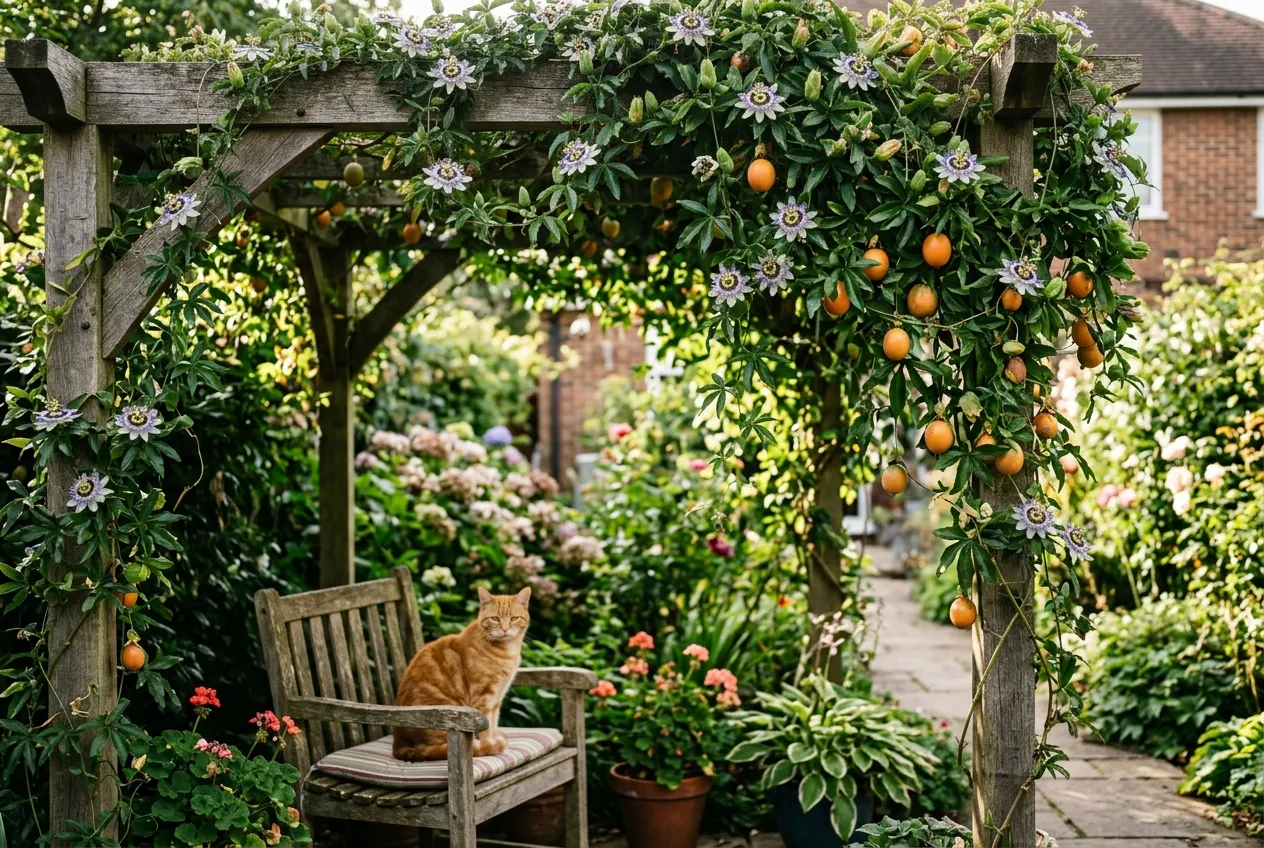
Passionflower trained over a pergola with orange fruit developing after a warm summer. Fruit forms on P. caerulea but is bland compared to the tropical P. edulis.
How to prune passionflower
Prune in late spring, typically late April or May, once new growth is clearly visible. This is important: do not prune in autumn or winter. The old stems insulate the crown and main framework from frost. Removing them in autumn exposes the plant to cold damage.
Pruning method
- Start by cutting out all dead and frost-damaged wood. On an established plant after a cold winter, this may be substantial.
- Identify the main framework of permanent stems tied to the support.
- Shorten all side shoots growing from this framework to approximately 15cm (about three or four buds).
- Remove any shoots growing directly away from the wall or tangling through each other.
- Tie in any loose growth.
Passionflower blooms on the current season’s new growth. Hard pruning of side shoots in spring stimulates vigorous new shoots that carry flowers from July onwards. If you leave the plant unpruned, it becomes a tangled mass with flowers only at the tips, out of sight.
If the plant has become completely overgrown, you can renovate by cutting the entire plant back to 30-60cm from the ground in late spring. It regenerates quickly from the base and is usually flowering again by the following summer.
Overwintering passionflower
In mild coastal and urban areas, established P. caerulea needs no winter protection. In colder inland areas, the Midlands, and further north, a few precautions help:
- Mulch the base with 10-15cm of bark chippings or straw in November. This insulates the roots and crown.
- Do not cut back dead-looking stems until spring. They provide insulation to the living wood beneath.
- If growing against a wall, the residual warmth from the building acts as a buffer on cold nights.
- Young plants in their first and second winters are most vulnerable. Consider wrapping the base with horticultural fleece if temperatures drop below -5°C.
After a severe winter, the entire top growth may appear dead. Leave it until late May before making a judgement. In most cases, new shoots emerge from the roots or base of the old stems. Passionflower has a deep, resilient root system.
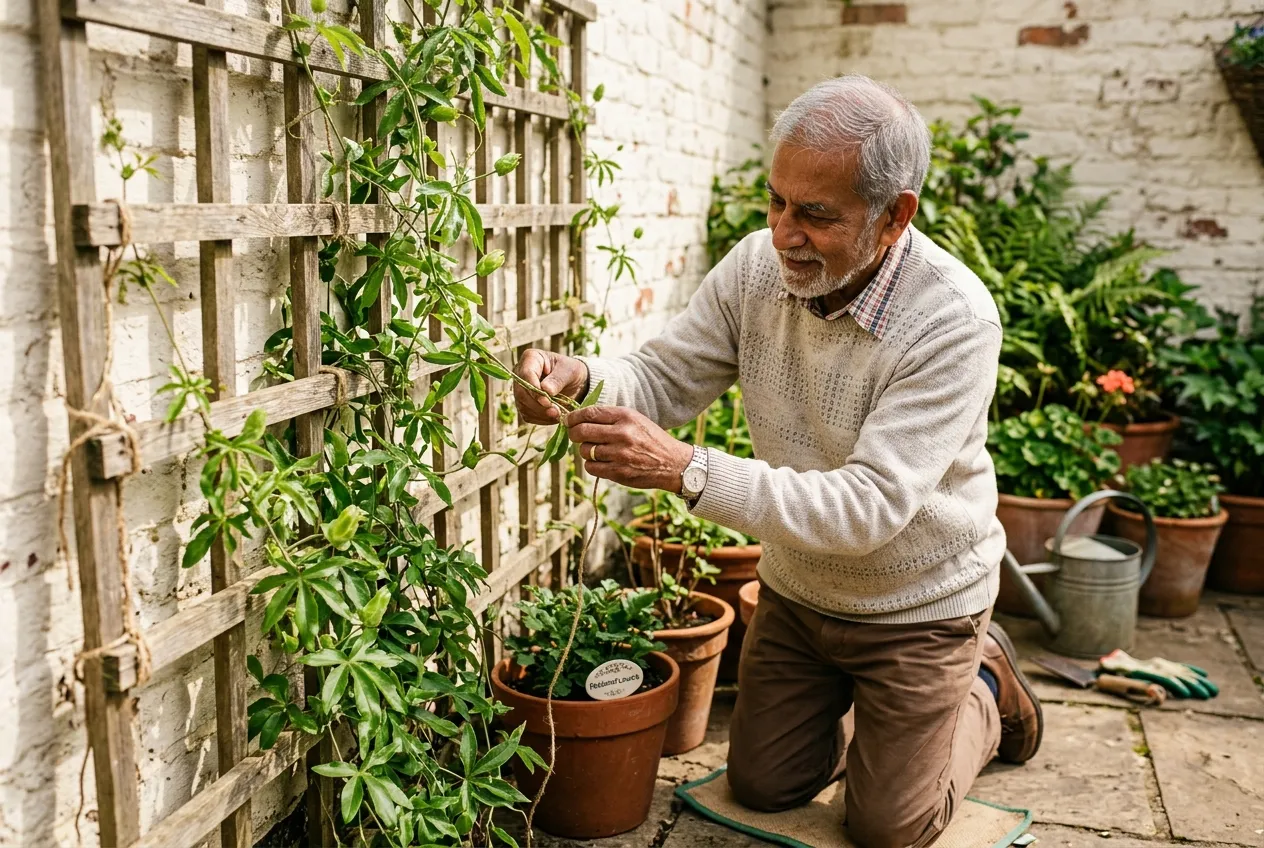
Training a young passionflower against a trellis in spring. Tie in new shoots regularly to build an even framework that maximises flowering.
Growing passionflower in containers
Container growing suits gardeners in cold areas or those without a suitable wall. A potted passionflower can be moved to a frost-free greenhouse or conservatory for winter.
Use a pot at least 40cm in diameter with good drainage holes. Fill with John Innes No. 3 compost mixed with 20% perlite. Insert a sturdy trellis or obelisk into the pot at planting time. Position in full sun against a warm wall.
Water regularly from April to September. Passionflower in pots dries out faster than plants in the ground, so check daily during hot spells. Feed fortnightly with liquid tomato fertiliser from May to September. The high-potash formula promotes flowering rather than excessive leaf growth.
Repot every two to three years in spring, moving up one pot size. If the plant has reached its maximum pot size, top-dress instead: remove the top 5cm of old compost and replace with fresh.
Can I grow edible passion fruit in the UK?
The short answer: only in a heated greenhouse. Passiflora edulis, the species that produces the passion fruit sold in supermarkets, is a tropical plant. It needs a minimum winter temperature of 10°C and will not survive outdoors anywhere in the UK.
In a heated greenhouse with good light, P. edulis fruits well. Train it along wires beneath the ridge. Pollinate flowers by hand using a soft paintbrush, transferring pollen between flowers. Fruit ripens from green to purple (or yellow, depending on the variety) over 60-80 days. A single mature plant can produce 20-30 fruit per season in a British greenhouse.
P. caerulea produces orange, egg-shaped fruit outdoors after a warm British summer. The fruit is technically edible but contains very little pulp. The seeds are surrounded by a thin, watery juice that is bland compared to P. edulis. They make reasonable jam with enough added sugar but are not worth growing for fruit alone.
Propagating passionflower from cuttings
Semi-ripe cuttings taken in July or August root readily. This is the cheapest way to produce new plants and ideal for sharing with other gardeners. For a broader guide to propagation methods, see our article on plant propagation from cuttings, division, and layering.
Taking cuttings
- Select a healthy, non-flowering shoot from the current season’s growth. It should be firm at the base but still slightly soft at the tip.
- Cut a 10-15cm section just below a leaf node with a clean, sharp blade.
- Remove the lower leaves and any tendrils.
- Dip the cut end in hormone rooting powder (optional but improves success rate).
- Insert into a pot filled with equal parts perlite and peat-free compost.
- Cover with a polythene bag or place in a heated propagator with bottom heat of 18-20°C.
- Roots form in four to six weeks. Tug gently to check for resistance.
- Pot on individually into 9cm pots and grow on in a frost-free greenhouse for the first winter.
Layering is an even simpler alternative. Peg a low-growing stem to the ground in spring, cover the contact point with soil, and leave it. Roots form within a few months. Sever from the parent plant the following spring.
Passionflower month by month care
| Month | Task |
|---|---|
| January | Leave the plant alone. Old stems protect the crown from frost. |
| February | Check mulch depth around the base. Top up to 10cm if needed. |
| March | Watch for first signs of new growth from buds. Do not prune yet. |
| April | Begin pruning once new shoots are 5-10cm long. Remove dead wood first. |
| May | Shorten side shoots to 15cm. Tie in new growth. Start feeding with tomato fertiliser. |
| June | Active growth period. Tie in shoots weekly. Water regularly in dry spells. |
| July | First flowers appear. Take semi-ripe cuttings for propagation. |
| August | Peak flowering. Continue feeding fortnightly. Second batch of cuttings if needed. |
| September | Flowers continue into early autumn. Fruit may start to form after a warm summer. |
| October | Reduce watering. Stop feeding. Fruit ripens to orange if present. |
| November | Mulch the base with 10-15cm of bark chippings or straw before the first hard frost. |
| December | No action needed. The plant is dormant but the old framework provides winter structure. |
Passionflower and wildlife
Passionflower is valuable for pollinators. The large, open flowers with their prominent nectar ring attract bumblebees, honeybees, and hoverflies throughout the summer months. The Wildlife Trusts list passionflower among plants that support UK pollinator populations.
The dense foliage provides shelter for nesting birds and overwintering insects. In mild winters where the leaves persist, the vine acts as a wildlife corridor along walls and fences. If wildlife is a priority in your garden, pairing passionflower with other pollinator-friendly climbers like clematis and jasmine creates a succession of nectar sources from spring right through to autumn.
Blue tits and other small birds sometimes nest among the dense growth against warm walls. Avoid pruning between March and August if you suspect nesting activity.
Common problems
No flowers
Usually caused by too much nitrogen fertiliser. Switch to a high-potash tomato feed. Insufficient sunlight is the second most common cause. Passionflower needs at least six hours of direct sun daily. Pruning at the wrong time removes the new growth that carries flowers.
Die-back after winter
Normal in cold areas. Do not dig the plant up. Wait until late May. In most cases, new growth emerges from the roots or base of old stems. Mulch heavily the following autumn to prevent recurrence.
Yellowing leaves
Usually a sign of waterlogged soil. Improve drainage by adding grit around the root zone. On chalky soils, iron deficiency causes yellowing between the leaf veins. Apply a chelated iron feed.
Aphids and red spider mite
Aphids cluster on new shoot tips in spring. Wash off with a strong jet of water or use a biological control. Red spider mite attacks in hot, dry summers, especially against south-facing walls. Mist the foliage regularly to raise humidity and introduce the predatory mite Phytoseiulus persimilis.
Passionflower rewards a little patience with one of the most spectacular flowering displays available in a British garden. Against a warm wall, a single established plant provides exotic colour from midsummer to mid-autumn. Combine it with wisteria for a succession of dramatic flowers from spring through to October.
Frequently asked questions
Is passionflower hardy in the UK?
Passiflora caerulea is hardy to -10°C in a sheltered position. It is the only species that survives outdoors reliably across most of the UK. In cold regions and inland frost pockets, plant against a south-facing wall and mulch the base with 10cm of bark chippings each November. Young plants are more vulnerable than established ones. After a severe winter, top growth may die back but the plant usually regrows from the roots in spring.
When does passionflower flower in the UK?
Passionflower blooms from July to October in the UK. Flowers form on the current season’s new growth, so a warm spring followed by a hot summer produces the most blooms. Each individual flower lasts only one to two days, but the plant produces a succession of new flowers throughout the season. South-facing walls generate the best display because of the extra warmth.
Can I grow passion fruit in the UK?
Edible passion fruit needs a heated greenhouse in the UK. Passiflora edulis requires a minimum winter temperature of 10°C and cannot survive outdoors anywhere in Britain. Grow it in a large pot or border inside a greenhouse with full sun. P. caerulea produces orange fruit outdoors after hot UK summers, but they are bland and contain minimal pulp.
How do I prune passionflower?
Prune in late spring once new growth appears. Remove all dead and frost-damaged stems first. Then shorten side shoots to about 15cm from the main framework of permanent stems. This encourages fresh flowering shoots because passionflower blooms on new wood. Do not prune in autumn or winter as this removes frost protection from the main framework.
Why is my passionflower not flowering?
The most common cause is too much nitrogen fertiliser. Excess nitrogen promotes leaf growth at the expense of flowers. Switch to a high-potash tomato feed from May onwards. Insufficient sunlight is the second cause. Passionflower needs a minimum of six hours of direct sun daily to flower well. Hard pruning at the wrong time, removing all the new growth, also prevents flowering.
Can I grow passionflower in a pot?
Yes, use a pot at least 40cm in diameter with drainage holes. Fill with loam-based compost mixed with 20% perlite for drainage. Insert a trellis or obelisk for support. Water regularly from April to September and feed fortnightly with liquid tomato fertiliser. Move the pot to a sheltered position against a house wall in winter. Repot every two to three years in spring.
How do I propagate passionflower?
Take semi-ripe cuttings in July or August. Cut a 10-15cm shoot just below a leaf node, remove the lower leaves and any tendrils, and insert into a mix of equal parts perlite and peat-free compost. Cover with a polythene bag and provide bottom heat of 20°C. Roots form in four to six weeks. Pot on individually and overwinter in a frost-free greenhouse for the first year.
Lawrie has been gardening in the West Midlands for over 30 years. He grows his own veg using no-dig methods, keeps a wildlife-friendly garden, and writes practical advice based on real UK growing conditions.