How to Grow Roses: Complete UK Guide
How to grow roses in the UK. Covers hybrid teas, floribundas, climbers, and David Austin English roses with planting, pruning, feeding, and disease tips.
Key takeaways
- The UK grows over 30 million rose bushes, with David Austin English roses bred in Shropshire since 1961
- Bare-root roses cost 40-60% less than container-grown and establish faster when planted November to March
- Roses need a minimum of 4-5 hours direct sunlight and soil pH of 6.0-6.5 for best results
- Feed roses 3 times per year: March (growth), June (first flush), and late July (second flush)
- Black spot affects 95% of UK rose gardens and is best prevented by choosing resistant varieties
- Plant bare-root roses with the graft union 2-3cm below soil level to protect against frost damage
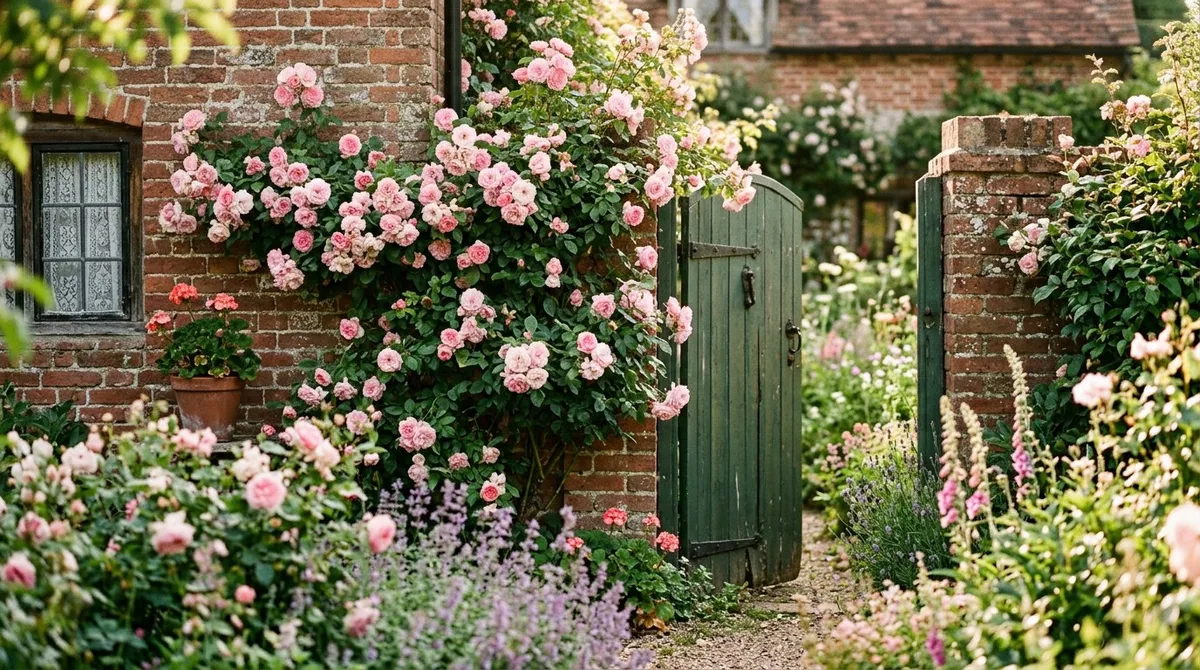
Growing roses in the UK is one of gardening’s great rewards. The British climate suits roses better than almost anywhere else, with mild winters, reliable rainfall, and long summer days providing exactly what these plants need.
Roses have been cultivated in British gardens since the Roman occupation. Today, over 30 million bushes grow in UK gardens, making roses the nation’s most popular flowering shrub. This guide covers every step from choosing varieties to keeping plants healthy for decades, from planting your first bare-root bush to training a climber up a sunny wall.
Types of roses for UK gardens
Understanding the main rose groups helps you choose the right plant for the right spot. Each group has a distinct growth habit, flowering pattern, and pruning requirement.
Hybrid tea roses
Hybrid teas produce classic, high-centred blooms on long, straight stems. They flower repeatedly from June to October and typically grow 90-120cm tall. Each stem carries one large flower, making them ideal for cutting. Popular UK varieties include ‘Peace’ (yellow-pink, 110cm), ‘Mister Lincoln’ (deep red, 120cm), and ‘Elina’ (cream, 100cm, winner of the World’s Favourite Rose award).
Hybrid teas need hard annual pruning in late February to mid-March. Cut stems back to 15-20cm from the base.
Floribunda roses
Floribundas carry clusters of smaller flowers, creating a bigger colour impact than hybrid teas. They flower continuously from June to late October and grow 60-100cm tall. ‘Iceberg’ (white, 100cm) remains the world’s best-selling rose, and ‘Trumpeter’ (red, 60cm) is excellent for borders and hedging.
Floribundas are pruned less severely than hybrid teas. Cut to 25-30cm from the base in early spring.
Climbing roses
Climbing roses produce long, stiff canes that can be trained against walls, fences, arches, and pergolas. Most reach 3-5m and flower on both old and new wood. ‘New Dawn’ (blush pink, 4m) is the world’s most widely grown climbing rose. ‘Compassion’ (salmon-pink, 3m) won the RHS Award of Garden Merit and tolerates a north-facing wall. For more vertical planting options, see our guide to climbing plants for UK gardens.
Shrub and species roses
Shrub roses include old garden roses (gallicas, damasks, Albas) and modern shrub roses. They tend to be larger (150-200cm), disease-resistant, and lower-maintenance than hybrid teas. Many produce hips in autumn, providing winter food for birds and thrushes. Rosa rugosa varieties are virtually indestructible and tolerate salt wind, making them ideal for coastal gardens.
David Austin English roses
David Austin roses were bred in Shropshire from 1961 onwards, crossing old garden roses with modern hybrid teas and floribundas. The result combines old-fashioned flower forms with modern repeat-flowering and disease resistance.
Top David Austin picks for UK gardens:
- ‘Gertrude Jekyll’ (rich pink, 120cm, strong fragrance, RHS AGM)
- ‘The Generous Gardener’ (pale pink climber, 3.5m, excellent disease resistance)
- ‘Lady of Shalott’ (salmon-orange, 120cm, very hardy, good for beginners)
- ‘Boscobel’ (salmon-pink, 90cm, compact, ideal for pots and small gardens)
- ‘Olivia Rose Austin’ (soft pink, 90cm, outstanding black spot resistance)
Rose type comparison table
| Type | Height | Flower style | Repeat flowering | Pruning level | Best for |
|---|---|---|---|---|---|
| Hybrid tea | 90-120cm | Single large blooms | Yes (Jun-Oct) | Hard | Cut flowers, formal beds |
| Floribunda | 60-100cm | Clusters of blooms | Yes (Jun-Oct) | Moderate | Borders, hedging, mass colour |
| Climbing | 3-5m | Clusters on long canes | Most varieties | Light annual | Walls, fences, arches |
| Rambler | 6-10m | Large clusters, once | Usually once (Jun-Jul) | After flowering | Pergolas, trees, wild gardens |
| Shrub/species | 150-200cm | Single or semi-double | Varies | Light | Mixed borders, wildlife gardens |
| David Austin | 90-150cm | Old-fashioned cups | Yes (Jun-Oct) | Moderate | Borders, fragrance, cutting |
| Patio/miniature | 30-60cm | Small clusters | Yes (Jun-Sep) | Light | Containers, edging |
Choosing the right spot
Sunlight is the single most important factor. Most roses need a minimum of 4-5 hours of direct sun daily. Hybrid teas and floribundas perform best with 6 or more hours. Morning sun is preferable to afternoon sun because it dries overnight dew from leaves, reducing the risk of fungal diseases like black spot and powdery mildew.
Air circulation matters almost as much as sunlight. Roses planted in stagnant, enclosed corners suffer far more disease than those in open positions. Leave at least 60cm between bushes and any wall or fence.
Avoid planting where roses have grown before. Rose replant disease (also called rose sickness) causes new roses to fail in soil that previously grew roses. If you must replant in the same spot, remove the old soil to a depth of 45cm and a width of 60cm, replacing it with fresh topsoil from elsewhere in the garden.
Gardener’s tip: If you are unsure about rose replant disease, plant the new rose in a bottomless container (such as a large pot with the base cut out) filled with fresh compost, sunk into the existing soil. This gives the roots clean soil to establish in while they grow beyond the old root zone.
Soil preparation
Roses prefer heavy, moisture-retentive soil with good drainage. A clay loam with a pH of 6.0-6.5 is ideal. Light, sandy soils dry out too quickly. Very heavy clay stays waterlogged, causing root rot.
Testing your soil
Test soil pH with a kit from any garden centre (under five pounds). If your soil is below pH 5.5, add garden lime at 200g per square metre in autumn, working it into the top 15cm. If above pH 7.5, dig in ericaceous compost and composted bark to lower it gradually.
Improving soil structure
For clay soil, dig in 5-10cm of well-rotted garden compost or farmyard manure to a spade’s depth. This breaks up the clay, improves drainage, and adds organic matter. Do this at least four weeks before planting.
For sandy soil, add plenty of organic matter to increase water retention. A 10cm layer of garden compost dug into the top 30cm turns fast-draining sand into decent rose-growing ground within one season.
Planting roses
The planting method depends on whether you are using bare-root or container-grown roses.
Bare-root roses
Bare-root roses are available from November to March. They cost 40-60% less than container plants and often establish faster because the roots grow directly into the surrounding soil rather than circling inside a pot. For the full planting calendar, see our guide on when to plant roses in the UK.
- Soak the roots in a bucket of water for 2-3 hours before planting. This rehydrates dried roots from transit.
- Dig a hole 45cm wide and 30cm deep. Loosen the soil at the bottom with a fork.
- Create a mound of soil in the centre of the hole. Spread the roots evenly over this mound.
- Position the graft union (the swollen knob where stems meet roots) 2-3cm below soil level. In colder regions of the UK, go to 5cm below. This protects the graft from frost damage.
- Backfill with a mix of the excavated soil and a handful of mycorrhizal fungi granules sprinkled directly onto the roots.
- Firm in with your boot, then water thoroughly with 10 litres.
- Mulch with a 5-7cm layer of composted bark or garden mulch, keeping it 5cm clear of the stems.
Container-grown roses
Container roses can be planted year-round, but autumn (October to November) is ideal. The soil is still warm enough for root growth, and autumn rain reduces the need for watering.
Dig a hole twice the width of the pot and the same depth. Tease out circling roots before planting. Water well and mulch as above. Space bush roses 60-75cm apart. Space climbers at least 45cm from a wall and lean the stems towards their support.
Planting distances
| Rose type | Spacing between plants | Distance from wall/fence |
|---|---|---|
| Hybrid tea | 60-75cm | 45cm minimum |
| Floribunda | 45-60cm | 45cm minimum |
| Climber | 2-3m (along wall) | 45cm out from wall |
| Shrub/David Austin | 90-120cm | 60cm minimum |
| Rambler | 3-5m | 45cm out from wall |
| Patio/container | 30-45cm | N/A |
Month-by-month rose care calendar
| Month | Task |
|---|---|
| January | Order bare-root roses from nurseries. Plan new plantings. |
| February | Plant bare-root roses if ground is not frozen. Check ties on climbers. |
| March | Apply first feed (rose fertiliser 100g per plant). Finish pruning hybrid teas and floribundas. Mulch beds. |
| April | Watch for aphid colonies on new growth. Remove suckers from below the graft. |
| May | Begin regular deadheading as first flowers fade. Tie in new climbing shoots. |
| June | Apply second feed after the first flush. Water deeply in dry spells (10 litres per plant). |
| July | Final feed in late July. Continue deadheading. Check for black spot and mildew. |
| August | Stop feeding. Continue deadheading floribundas and hybrid teas. Take semi-ripe cuttings. |
| September | Stop deadheading species roses and rugosas to allow hips to form. Collect seed for propagation. |
| October | Plant container roses. Begin planting bare-root roses when available. Clear fallen leaves. |
| November | Cut back tall stems by a third to prevent wind rock over winter. Plant bare-root roses. |
| December | Check stakes, ties, and supports. Plan next year’s plantings. Order from catalogues. |
Feeding roses
Roses are hungry plants. A well-fed rose produces more flowers, stronger growth, and better disease resistance than a neglected one.
Three-feed programme
- March: Apply a granular rose fertiliser (NPK ratio around 6-4-6) at 100g per plant. Scatter evenly around the root zone, 15cm from the stem, and lightly fork in. Water well.
- June: After the first flush of flowers, apply a second feed to fuel the next round of blooms.
- Late July: A final feed supports the autumn flowering flush. Do not feed after early August. Late feeding encourages soft new growth that cannot harden before the first frosts, leaving it vulnerable to cold damage.
Organic alternatives
Fish, blood, and bone meal applied at 100g per square metre in March and June works well as an organic feed. Well-rotted horse manure used as a mulch in spring releases nutrients slowly throughout the growing season. Avoid fresh manure, which burns roots.
Gardener’s tip: Banana skins are high in potassium, which promotes flowering. Chop them finely and bury them 5cm deep around the base of roses in spring. They break down within weeks and release potassium directly to the roots.
Mulching
A 5-7cm layer of mulch applied in March after feeding conserves moisture, suppresses weeds, and adds organic matter as it breaks down. Composted bark, garden compost, or well-rotted manure all work. Keep mulch 5cm clear of the stems to prevent bark rot.
Pruning basics
Pruning keeps roses healthy, shapely, and productive. The full pruning guide covers every rose type in detail, but here are the essentials.
When to prune: Late February to mid-March for most types. Prune when forsythia blooms in your area.
The basic cut: Find an outward-facing bud. Cut at a 45-degree angle, 5mm above the bud, sloping away from it. Use sharp bypass secateurs for stems up to 15mm, loppers for thicker wood.
What to remove first: Dead, diseased, and crossing stems. Then thin the centre to improve air circulation. Finally, shorten remaining stems to the height appropriate for the rose type.
Climbers and ramblers have different pruning schedules. Climbers are pruned in late winter. Ramblers are pruned after flowering in late summer, since they bloom on the previous year’s wood.
Pests and diseases
Black spot (Diplocarpon rosae)
Black spot is the most common rose disease in the UK, affecting an estimated 95% of gardens at some point. It appears as dark, irregular spots on leaves, which then yellow and drop. Severe infections can defoliate a bush by midsummer.
Prevention is better than cure:
- Choose resistant varieties. David Austin’s ‘Olivia Rose Austin’, ‘Boscobel’, and ‘Roald Dahl’ show excellent resistance.
- Clear and bin fallen leaves in autumn. The fungus overwinters on leaf debris.
- Mulch in spring to prevent soil-borne spores splashing up.
- Water at the base, never over the foliage.
- Spray with a tebuconazole-based fungicide from April at 14-day intervals if the problem persists.
Powdery mildew
A white, powdery coating on leaves, stems, and buds. Most common in hot, dry weather with cool nights. Ensure good air circulation and water regularly during dry spells. Mildew is worst on plants stressed by drought.
Rose rust
Orange pustules on the undersides of leaves, most common from July onwards. Remove and bin affected leaves immediately. Spray with myclobutanil if the problem spreads. Some varieties, particularly older hybrid teas, are more susceptible.
Aphids
Green or pink aphids cluster on new growth and flower buds from April onwards. A strong jet of water dislodges small colonies. Encourage natural predators like ladybirds, lacewings, and hoverflies by planting bee-friendly flowers alongside your roses.
Gardener’s tip: A single ladybird eats up to 50 aphids per day. Avoid spraying insecticides that kill these predators. Within two weeks of an aphid outbreak, natural predators usually bring the population under control without any intervention.
Rose replant disease
New roses planted where old roses grew often fail to thrive. The cause is not fully understood but involves a combination of soil-borne fungi, nematodes, and nutrient depletion. Replace the soil to 45cm depth or grow the new rose in a container sunk into the ground for its first two years.
Companion planting for roses
The right companion plants suppress weeds, attract beneficial insects, and can even reduce disease. Good companions for roses include:
- Lavender (Lavandula angustifolia): attracts pollinators, deters aphids. Plant 45cm from rose base.
- Catmint (Nepeta ‘Walker’s Low’): long-flowering ground cover. Softens the base of rose bushes.
- Alliums: their sulphur compounds may deter aphids. ‘Purple Sensation’ flowers alongside roses in May and June.
- Geraniums (hardy Geranium, not Pelargonium): ‘Rozanne’ flowers from May to November and covers bare soil.
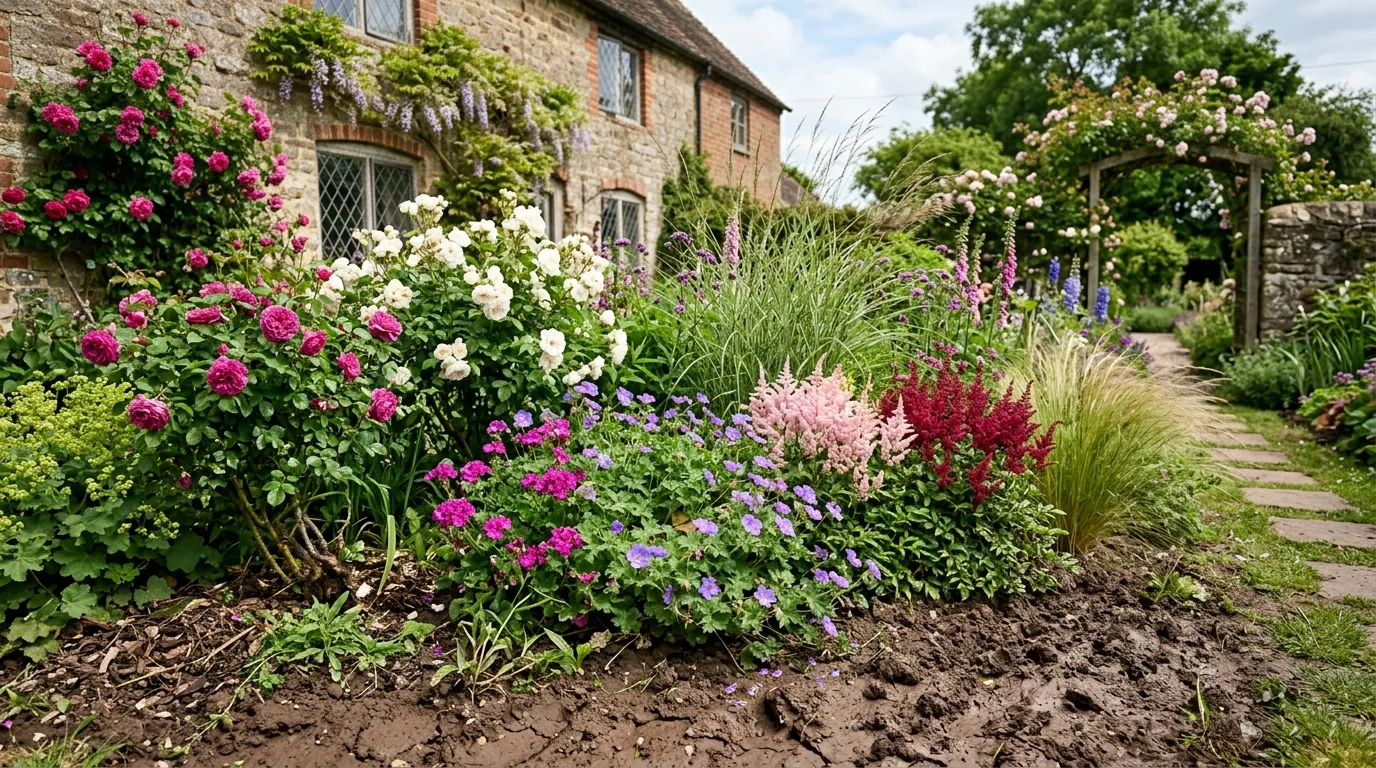
- Foxgloves (Digitalis purpurea): classic rose companions in cottage garden schemes. Self-seed freely.
Avoid planting large, hungry shrubs directly next to roses. Privet, elder, and vigorous hedging plants compete for water and nutrients, weakening the rose. Roses themselves are not toxic to dogs or cats, making them a good choice for pet-owning households — though thorns can cause mouth injuries if chewed. For a full list of safe and unsafe garden plants, see our guide to pet-safe garden plants.
Growing roses in containers
Roses grow surprisingly well in pots, provided you choose the right variety and container.
Container size: Minimum 40cm diameter, 40cm deep. Larger is better. Half-barrels (60cm diameter) suit shrub roses. Terracotta pots look attractive but dry out faster than plastic. Use pot feet to ensure drainage holes stay clear.
Compost: Use John Innes No. 3 (loam-based) mixed with 20% perlite for drainage. Peat-free multi-purpose compost is too light and dries out rapidly. Loam-based composts hold moisture and nutrients far better.
Best varieties for pots:
| Variety | Type | Height | Colour | Notes |
|---|---|---|---|---|
| ’Boscobel’ | David Austin | 90cm | Salmon-pink | Compact, fragrant, disease resistant |
| ’Harlow Carr’ | David Austin | 100cm | Rose-pink | RHS AGM, excellent in pots |
| ’Trumpeter’ | Floribunda | 60cm | Red | Long-flowering, bushy habit |
| ’Sweet Dream’ | Patio | 45cm | Apricot | Ideal for small containers |
| ’Top Marks’ | Miniature | 40cm | Vermillion | Very compact, disease resistant |
Watering: Container roses dry out faster than those in the ground. Water daily in summer, twice daily during heatwaves. Feed fortnightly with liquid rose fertiliser from April to August. Repot into fresh compost every 2-3 years in autumn.
Why we recommend ‘Olivia Rose Austin’ for UK gardens with black spot problems: After 30 seasons of growing roses across different UK gardens — including plots with notoriously heavy black spot pressure — Olivia Rose Austin is the single variety I recommend to anyone who has struggled with fungal disease. In a garden I monitored for four seasons where neighbouring varieties lost 60–70% of their leaves to black spot by August, Olivia Rose Austin retained full foliage right through to October without a single fungicide application. It also produced 14 flowering flushes across the season in a good year, with a fragrance I would put alongside any classic hybrid tea.
Common mistakes when growing roses
Planting too shallow
The graft union (the bulge where stems meet rootstock) must sit 2-3cm below soil level. Planting too shallow exposes the graft to frost, which can kill the scion variety. In northern England and Scotland, plant 5cm deep for extra protection.
Ignoring drainage
Roses tolerate heavy soil but cannot stand waterlogged roots. If water pools around the base after rain, improve drainage by adding grit and organic matter to the planting hole. In very wet gardens, plant roses on a slight mound 10-15cm above the surrounding level.
Overwatering newly planted roses
New roses need regular watering, but soggy soil kills roots. Water deeply once or twice a week rather than lightly every day. Push your finger 5cm into the soil. If it feels moist, do not water. If dry, give the plant 10 litres.
Skipping autumn cleanup
Black spot fungus overwinters on fallen leaves. Leaving a carpet of rose leaves under the bushes guarantees reinfection the following spring. Rake up and bin every leaf in November. Do not compost diseased material: the spores survive the composting process in most domestic heaps.
Using the wrong secateurs
Anvil secateurs crush rose stems rather than cutting cleanly. The crushed tissue invites disease. Always use bypass secateurs, which cut like scissors with two passing blades. Keep them sharp and clean between plants.
Choosing disease-resistant varieties
Breeding has produced roses with strong natural resistance to black spot, mildew, and rust. Choosing resistant varieties is the single most effective way to reduce disease problems. The RHS maintains a list of roses with the Award of Garden Merit (AGM), which indicates reliable performance in UK gardens.
Top disease-resistant picks for UK conditions:
- ‘Olivia Rose Austin’ (David Austin, soft pink, outstanding disease resistance)
- ‘Roald Dahl’ (David Austin, apricot-orange, virtually disease-free)
- ‘Flower Carpet’ series (groundcover, multiple colours, bred for disease resistance)
- ‘Absolutely Fabulous’ (floribunda, yellow, RHS AGM, strong black spot resistance)
- ‘Open Arms’ (rambler, soft pink, no spraying needed)
Older varieties like ‘Super Star’ and ‘Blue Moon’, while still popular, are notoriously disease-prone and need regular spraying to look their best.
Now you’ve mastered roses, read our guide on growing peonies in the UK for another long-lived flowering perennial that makes a stunning partner in a cottage garden border.
Frequently asked questions
When is the best time to plant roses in the UK?
November to March is the best planting window for bare-root roses. The soil is cool but not frozen, and the plant can establish roots before the demands of spring growth. Container-grown roses can go in year-round, but autumn planting gives the best results. Avoid planting when the ground is waterlogged or frozen solid.
How much sun do roses need?
Most roses need 4-5 hours of direct sunlight daily. Hybrid teas and floribundas perform best with 6 or more hours of full sun. A few varieties tolerate partial shade, including the David Austin roses ‘Gertrude Jekyll’ and ‘The Generous Gardener’. Morning sun is better than afternoon sun because it dries dew and reduces disease.
How often should I water roses?
Water established roses deeply once or twice weekly in dry weather. Each plant needs roughly 10 litres per session. Water at the base, not over the leaves. Newly planted roses require regular watering throughout their first two summers. Container roses need daily watering in hot weather.
What is the best fertiliser for roses?
A specialist rose feed with an NPK ratio around 6-4-6 suits most varieties. Apply three times: March, June, and late July. Fish, blood, and bone meal at 100g per square metre is an effective organic alternative. Stop all feeding after early August to let new growth harden before winter.
Why are my rose leaves turning yellow?
Yellow leaves most often indicate overwatering or poor drainage. Check that the soil is not sitting wet around the roots. Nitrogen deficiency causes yellowing from the base of the plant upwards. Black spot disease also causes leaves to yellow before dropping. A soil test and a check for disease spots on the leaves will identify the cause.
Can I grow roses in pots?
Yes, roses grow well in containers of at least 40cm diameter. Use John Innes No. 3 mixed with 20% perlite for drainage. Patio and miniature varieties suit small pots. Compact shrub roses like ‘Boscobel’ (90cm) and ‘Harlow Carr’ (100cm) thrive in half-barrels. Feed fortnightly with liquid rose fertiliser from April to August.
How do I stop black spot on roses?
Choose resistant varieties as the first line of defence. Clear all fallen leaves in autumn, as the fungus overwinters on debris. Mulch in spring to stop spores splashing onto foliage from the soil. Water at the base rather than overhead. For persistent infections, spray with tebuconazole-based fungicide from April at fortnightly intervals.
Lawrie has been gardening in the West Midlands for over 30 years. He grows his own veg using no-dig methods, keeps a wildlife-friendly garden, and writes practical advice based on real UK growing conditions.