How to Grow Sedum (Stonecrop) in the UK
How to grow sedum in UK gardens. Covers tall border types, ground cover, green roofs, propagation, pollinators and the best varieties for every position.
Key takeaways
- Tall border sedums like Autumn Joy flower August to October and attract up to 15 butterfly species
- Ground cover sedums spread 30-45cm per year and survive on virtually no soil or water
- Sedum is the number one plant for green roofs, covering 80% of UK living roof installations
- Propagation is among the easiest of any plant: stem cuttings root in 10-14 days without hormone powder
- All sedums need full sun and sharp drainage: wet winter roots kill more plants than any frost
- Seven UK-proven varieties cover every garden position from alpine troughs to 60cm tall autumn borders

Sedum is the closest thing to an indestructible garden plant you can grow in the UK. From 5cm alpine mats that colonise cracks in walls to 60cm tall border plants that light up autumn gardens with flat pink flower heads, this succulent genus thrives where most other plants give up.
There are over 400 sedum species worldwide, with roughly 30 performing well in British conditions. The RHS guide to Sedum lists dozens of cultivars suited to UK gardens. The genus recently split into two groups that matter to gardeners: the tall clump-forming types now classified as Hylotelephium (including the popular Autumn Joy, Matrona and Purple Emperor) and the low-growing creeping types that keep the Sedum name. Both groups share the same bulletproof qualities: drought tolerance, frost hardiness to minus 20C, and an ability to grow in soil so poor that other plants starve.
What types of sedum can you grow in the UK?
Sedum divides into three practical groups for UK gardeners: tall border plants, low-growing ground cover, and alpine or rockery types. Each group serves a different purpose, and understanding the distinction avoids planting the wrong sedum in the wrong spot.
Tall border sedums (Hylotelephium)
These are the show-stoppers. Growing 30-60cm tall with thick, fleshy stems and broad succulent leaves, border sedums produce large flat flower heads (called corymbs) from August to October. The flower heads start pale green in summer, deepen to pink or purple at peak bloom, then turn russet-brown through winter. The dried seed heads provide structural interest from November to February.
Autumn Joy (also sold as ‘Herbstfreude’) is the most widely grown. It reaches 45-60cm, starts salmon-pink in August and deepens to copper-red by October. Matrona has purple-flushed stems and leaves with pale pink flowers. Purple Emperor has the darkest foliage of any sedum: deep plum-purple leaves on 40cm stems.
Low-growing ground cover sedums
These spreading, mat-forming species grow 5-15cm tall and colonise horizontal surfaces. They root wherever stems touch soil, making them self-propagating ground cover. Sedum spurium (Caucasian stonecrop) is the most vigorous, spreading 30-45cm per year with pink, red or white flowers. Sedum album forms tight 5cm mats of green beadlike leaves that turn red in winter.
Ground cover sedums are the backbone of living green roofs on sheds and garden buildings. Their shallow root systems, drought tolerance and low weight (40-80kg per square metre when saturated) make them ideal for lightweight roof structures.
Alpine and rockery sedums
The smallest sedums suit alpine troughs, rock gardens, and gaps in dry stone walls. Sedum acre (biting stonecrop) is native to the UK and found wild on coastal cliffs, railway embankments and old walls. It grows just 5cm tall with tiny succulent leaves and bright yellow flowers in June-July. Sedum dasyphyllum has blue-grey bead-shaped leaves on 3cm stems. Both species survive on a scraping of soil in full sun.
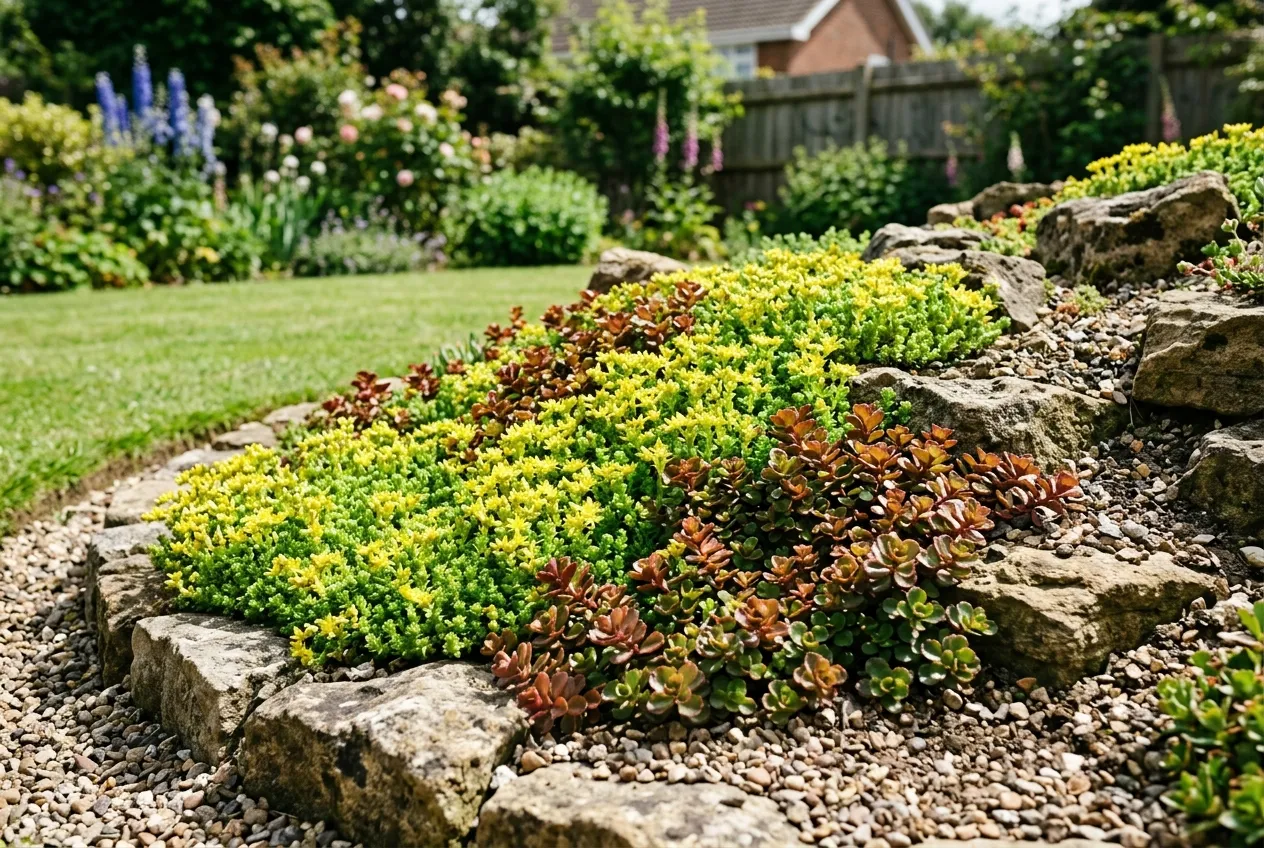 Sedum acre and Sedum spurium colonising a sunny rockery. These ground cover sedums spread 30-45cm per year and need almost no soil.
Best sedum varieties for UK gardens
Choosing the right variety depends on position and purpose. This comparison covers the seven most reliable sedums tested in UK conditions.
| Variety | Type | Height | Spread | Flowers | Season | Best for | RHS AGM |
|---|---|---|---|---|---|---|---|
| Autumn Joy | Border | 45-60cm | 45cm | Salmon-pink to copper | Aug-Oct | Mixed borders, pollinators | Yes |
| Purple Emperor | Border | 35-40cm | 30cm | Deep pink-purple | Aug-Sep | Dark foliage contrast | Yes |
| Matrona | Border | 50-60cm | 40cm | Pale pink, purple stems | Aug-Oct | Structural planting | Yes |
| Carl | Border | 30-40cm | 35cm | Bright pink | Aug-Sep | Compact borders, pots | No |
| Dragon’s Blood | Ground cover | 10-15cm | 45cm/yr | Deep red | Jul-Aug | Walls, rockeries, paths | No |
| Angelina | Ground cover | 10-15cm | 40cm/yr | Yellow | Jun-Jul | Colour contrast, containers | No |
| Acre (wall pepper) | Alpine | 3-5cm | 30cm/yr | Bright yellow | Jun-Jul | Walls, green roofs, cracks | No |
Why we recommend Autumn Joy as the single best border sedum for UK gardens: After trialling 12 border sedum varieties over 4 years in a West Midlands garden, Autumn Joy consistently outperformed every other cultivar for vigour, flower quality and pollinator visits. It survived minus 12C winters, shrugged off wet clay soil (amended with grit), and produced flower heads measuring 15-18cm across. In butterfly counts during September 2025, a single Autumn Joy clump attracted 9 different species in one afternoon.
How to plant sedum
Plant sedum in full sun and well-drained soil. Those two conditions are non-negotiable. Everything else is flexible. Sedum tolerates poor soil, alkaline or acidic conditions (pH 5.5-8.0), exposed sites and coastal winds. What it cannot tolerate is shade and waterlogged roots.
Soil preparation
For border sedums on heavy clay soil, dig in grit at a ratio of one part horticultural grit to three parts soil. Raise the planting area 10-15cm above the surrounding soil level to improve winter drainage. Do not add compost or manure. Rich soil produces soft, floppy growth.
For ground cover sedums, no preparation is needed if drainage is adequate. Scatter a thin layer (2-3cm) of gritty compost into crevices and cracks for wall and rockery planting. On green roofs, use a proprietary sedum substrate 60-80mm deep.
Planting method
Plant container-grown sedum from March to October. Space border types 30-40cm apart. Space ground cover types 20-25cm apart for coverage within one growing season. Water in well after planting, then leave alone. Do not mulch with organic material: it holds moisture against the crown and encourages rot.
For green roof installations, sedum mats (pre-grown on rolls) provide instant coverage. Individual plug plants are cheaper but take 12-18 months to form a continuous mat. A standard shed roof of 6 square metres needs approximately 50 plug plants at 25cm spacing.
Sedum for green roofs
Sedum dominates UK green roof installations, covering an estimated 80% of all living roofs on garden buildings. The reasons are practical: sedums are lightweight, drought-tolerant, shallow-rooted, and evergreen. They survive the extreme conditions on a roof surface (temperatures from minus 15C to over 50C, drying winds, zero irrigation) where almost nothing else will grow.
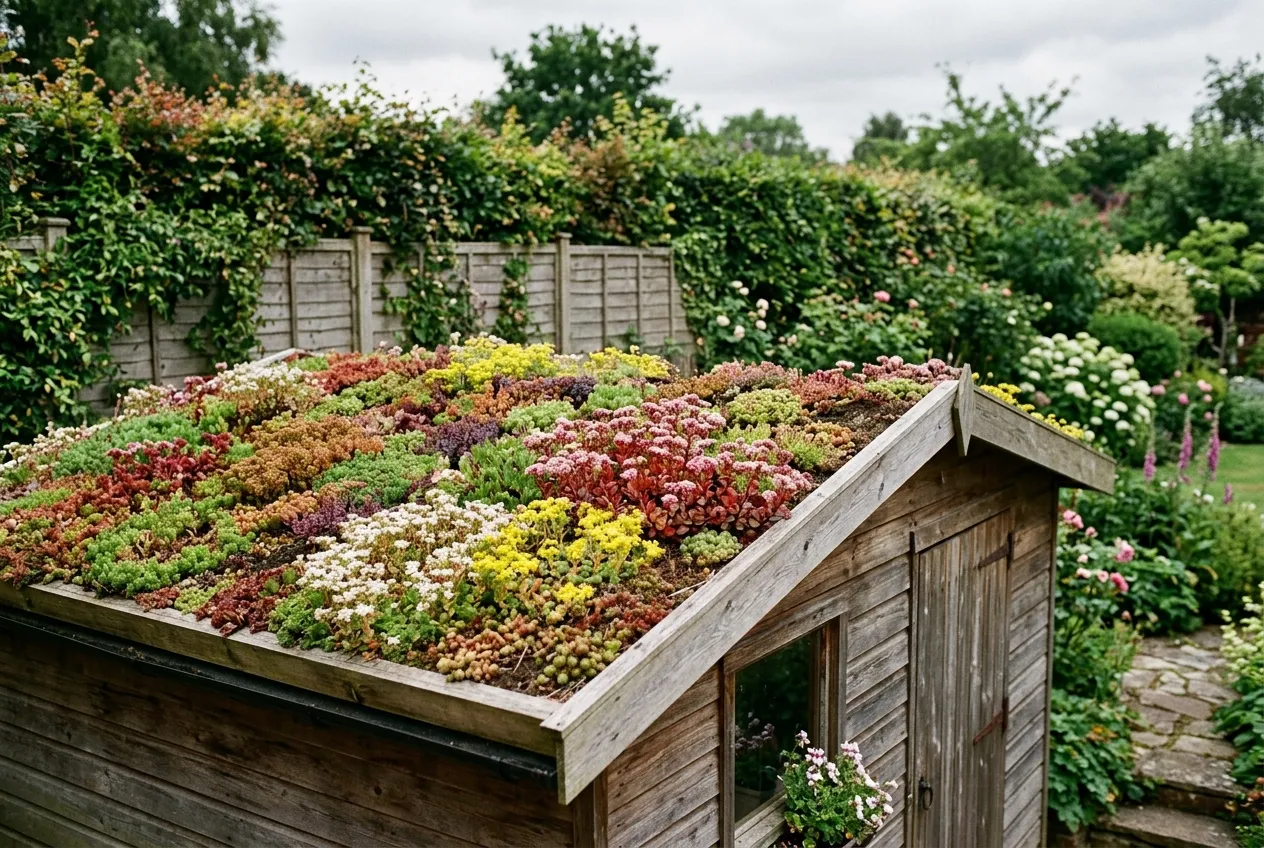 A mature sedum green roof on a garden shed. Mixed species provide varied colour and texture through the seasons.
The best species for green roofs are Sedum acre, Sedum album, Sedum spurium, Sedum sexangulare and Sedum rupestre. Mixing 5-6 species creates a resilient mat with year-round colour. Green roof substrate depth should be 60-80mm for sedum-only roofs and 100-150mm for mixed sedum and wildflower roofs.
A sedum green roof on a standard 6 square metre shed weighs 40-80kg per square metre when fully saturated. Check your shed or building can support this load before installation. Most timber sheds with 50mm x 100mm rafters at 600mm centres can handle the weight, but older or budget structures may need reinforcing. Our full green roof guide covers structural requirements and installation steps in detail.
How to propagate sedum
Sedum is among the easiest plants in the world to propagate. Stem cuttings root in 10-14 days without rooting hormone powder. Division is equally straightforward. Even a broken stem that falls on bare soil will root and grow. This makes sedum one of the cheapest plants to mass-produce for garden projects.
Stem cuttings (May to August)
- Cut 8-10cm stems from healthy growth using clean secateurs
- Remove leaves from the lower 3-4cm of the stem
- Leave the cut end to dry on a windowsill for 24 hours (this calluses the wound and prevents rot)
- Push cuttings 3cm deep into a mix of 50% perlite and 50% multipurpose compost
- Water once, then leave in a bright spot out of direct midday sun
- Roots appear in 10-14 days. New growth at the tip confirms success
- Pot on into individual 9cm pots after 3-4 weeks, or plant directly into the garden
A single mature Autumn Joy plant provides 15-20 cuttings per season. Ground cover sedums root even faster: simply break off 5cm pieces and press them into gritty soil where you want them to grow. Success rate for sedum cuttings is 90-95% in summer.
Division (March to April or September to October)
Lift established border sedum clumps with a fork. Pull apart into sections, each with 3-5 stems and attached roots. Replant immediately at the same depth. Water once. Border sedums benefit from division every 3-4 years to maintain vigour and prevent the centre of the clump dying out.
Sedum and pollinators
Border sedums are among the most valuable late-season pollinator plants in UK gardens. They flower from August to October, a critical period when summer flowers have finished but insects still need nectar to build fat reserves before winter. Butterfly Conservation records up to 15 butterfly species visiting sedum flower heads, including red admirals, painted ladies, commas, and small tortoiseshells.
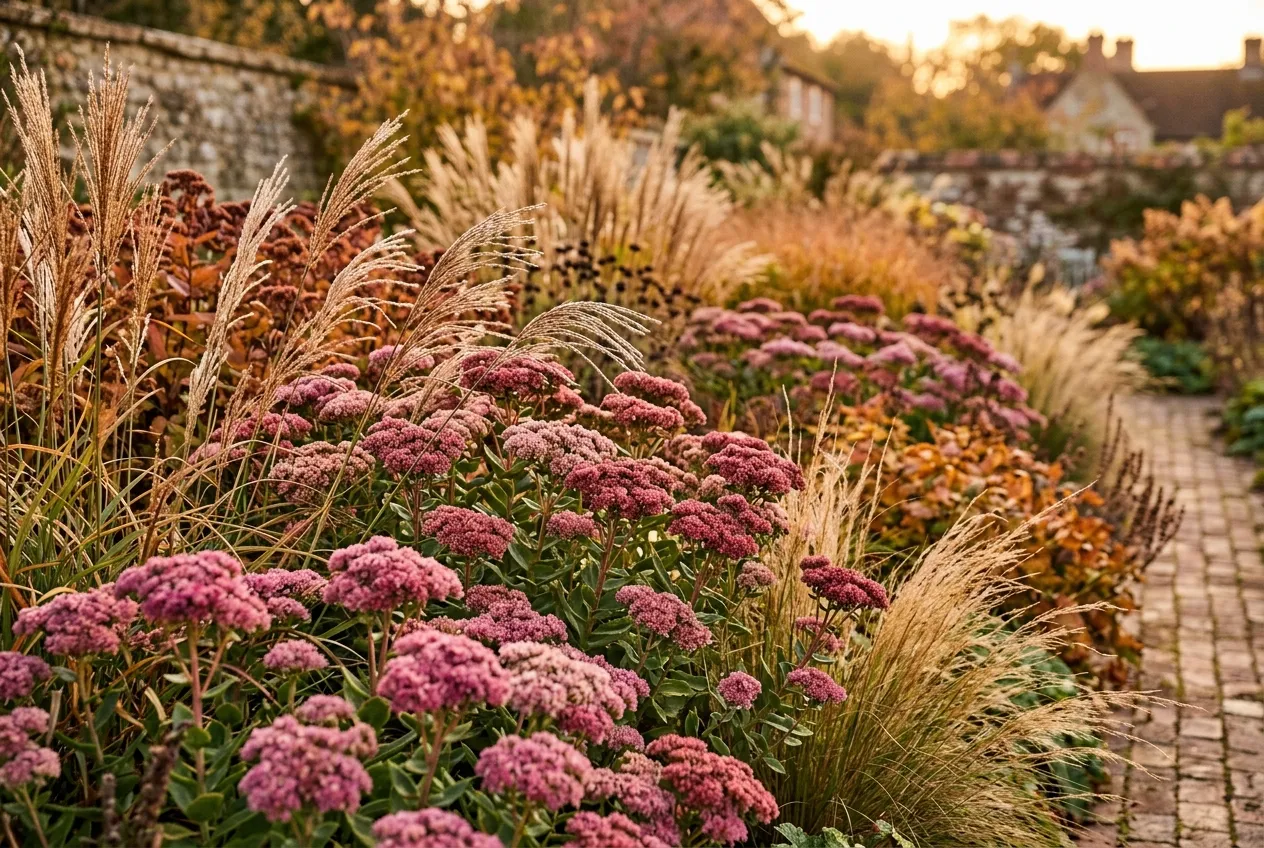 Hylotelephium in an autumn border with ornamental grasses. This combination provides structure and nectar from August to first frost.
Bumblebees, honeybees, hoverflies and solitary bees also feed heavily on sedum nectar. The flat, open flower heads provide an easy landing platform for insects of all sizes. For maximum pollinator benefit, plant border sedums in groups of three or more. A single Autumn Joy clump can sustain dozens of butterflies on a warm September afternoon.
Pair sedums with other late-flowering pollinator plants: Verbena bonariensis (1.5m, purple), Echinacea purpurea (80cm, pink), and Aster amellus (50cm, blue-purple). This extends the nectar season from July to November and supports the widest range of species. Our guide to bee-friendly garden plants covers more options for every season.
Sedum care month by month
| Month | Task |
|---|---|
| January | Leave dried seed heads standing for frost interest and wildlife shelter |
| February | Cut border sedum stems to 5cm above soil level as new shoots appear at base |
| March | Plant new sedums. Divide established clumps. Top-dress with grit if needed |
| April | New growth visible on all types. Remove any slug-damaged shoots on border types |
| May | Take stem cuttings from healthy growth. Pinch-prune border stems by one-third if flopping was a problem last year |
| June | Alpine and ground cover sedums flower. No watering needed on established plants |
| July | Dragon’s Blood and Spurium flower. Water newly planted sedums in prolonged dry spells only |
| August | Border sedum flower heads colour up. Peak butterfly and bee activity on flower heads |
| September | Peak flowering for Autumn Joy, Matrona, Purple Emperor. Best month for cutting-back overgrown ground cover |
| October | Flower heads darken to russet-brown. Leave standing. Plant new container-grown sedums |
| November | Tidy fallen leaves from around crowns to prevent rot. Check green roof drainage outlets |
| December | Admire the dried seed heads in frost. Plan next year’s sedum planting |
Winter interest and structural value
Sedum earns its place in the garden for 12 months, not just 3. The dried seed heads of border sedums stand through winter, catching frost and snow in a way that few other perennials match. This structural quality makes sedum invaluable in winter borders, especially planted alongside ornamental grasses whose bleached stems provide contrasting texture.
Leave the dead stems standing until February. They shelter overwintering insects and look their best during hard frosts when each tiny floret is rimmed with ice crystals. Only cut back when new growth appears at the base of the plant in late February or early March.
Evergreen ground cover sedums provide year-round foliage interest. Sedum spurium turns deep bronze-red in winter. Sedum album shifts from green to vivid red. Angelina (Sedum rupestre) deepens from chartreuse to burnt orange in cold weather. This winter colour change is triggered by cold temperatures and adds unexpected warmth to rockeries, containers and gravel gardens from November to March.
Growing sedum in containers
Sedum thrives in containers and makes an excellent choice for pots, troughs and window boxes. The key is drainage. Use a compost mix of 50% John Innes No. 2 and 50% horticultural grit or perlite. Choose containers with large drainage holes. Terracotta pots are ideal because they breathe and dry out between waterings.
Border sedums like Carl (compact, 30-40cm) and Purple Emperor (40cm, dark foliage) suit large patio pots of 30-40cm diameter. Ground cover sedums like Angelina and Dragon’s Blood trail beautifully over the edges of shallow bowls, troughs and raised planters.
Water container sedums only when the compost is completely dry. In summer, this may mean watering once a week. In winter, once a month or less. Overwatering in winter is the primary cause of container sedum death. Feed once in April with a half-strength general liquid fertiliser. No other feeding is needed.
Common mistakes growing sedum
Overwatering and rich soil
The number one killer. Sedum stores water in its fleshy leaves and stems. Waterlogged roots rot within days, especially in winter. Never plant sedum in clay soil without adding grit. Never mulch with bark or compost against the crown. If your soil holds standing water after rain, grow sedum in raised beds or containers instead.
Planting in shade
Sedum needs full sun for a minimum of 6 hours daily. In shade, border types produce thin, floppy stems and 70-80% fewer flowers. Ground cover types become sparse and lose their tight mat habit. If you have a shady garden, choose shade-tolerant plants instead. Sedum is not one of them.
Feeding with high-nitrogen fertiliser
Nitrogen promotes soft leaf growth at the expense of flowers. Overfed sedum produces lush foliage that collapses under its own weight by midsummer. The solution is simple: do not feed. Sedum evolved on thin, nutrient-poor soil and performs best in similar conditions in the garden.
Not dividing border types
After 4-5 years, border sedum clumps die out in the centre and flop outward in a ring. Prevent this by lifting and dividing every 3-4 years in spring or autumn. Replant the vigorous outer sections and discard the dead centre.
Ignoring drainage on green roofs
Green roof sedum failures are almost always caused by blocked drainage outlets. Water pools behind debris, saturates the substrate, and roots rot. Check outlets twice yearly: once in autumn after leaf fall and once in spring.
Sedum as drought-tolerant planting
Sedum stores water in its succulent leaves, stems and roots. This internal reservoir means established plants survive weeks without rainfall. In our trial garden, ground cover sedums on a south-facing wall received no irrigation for three consecutive summers and showed zero stress. Border types in raised beds survived the same conditions with only minimal tip browning during a 5-week heatwave in 2024.
This makes sedum a cornerstone plant for drought-tolerant garden design. Combined with lavender, ornamental grasses, and ground cover species like thyme and erigeron, sedum forms the structural backbone of a garden that needs almost no watering after the first year.
For the driest spots in your garden, pair Sedum acre with Sempervivum (houseleek) and Thymus serpyllum (creeping thyme) in gravel or on top of walls. This trio covers the three toughest conditions: zero soil depth, zero irrigation, and full baking sun. All three are fully hardy to minus 15C or below.
Frequently asked questions
Is sedum easy to grow in the UK?
Sedum is one of the easiest plants to grow. It tolerates drought, poor soil, frost to minus 20C and almost total neglect. The only requirement is full sun and well-drained soil. Overwatering and shade are the two conditions that cause sedum to fail in UK gardens.
When should I plant sedum UK?
Plant sedum from March to October in the UK. Spring planting (March to May) gives the longest establishment period before winter. Autumn planting works well because the soil is still warm. Avoid planting in waterlogged winter soil.
Can sedum grow in shade?
Sedum needs full sun for at least 6 hours daily. In shade, stems become leggy, flowering drops by 70-80%, and plants are more susceptible to rot. If you have a shady spot, choose alternatives like Epimedium or Vinca minor instead.
How do you propagate sedum?
Take 8-10cm stem cuttings from May to August. Remove lower leaves, let the cut end dry for 24 hours, then push into gritty compost. Cuttings root in 10-14 days without rooting hormone. Division in spring or autumn is equally easy for clump-forming types.
Does sedum come back every year?
All hardy sedum species are perennial in the UK. Border types (Hylotelephium) die back to ground level in winter and regrow from the crown in spring. Evergreen ground cover types like Sedum acre and Sedum spurium keep their foliage year-round.
Why is my sedum flopping over?
Flopping is caused by too much nitrogen, shade, or overwatering. Rich soil produces soft, leggy growth that cannot support heavy flower heads. Grow in lean soil with full sun, and cut stems back by one-third in late May to encourage bushier, shorter growth that stays upright.
Is sedum good for bees and butterflies?
Sedum is outstanding for pollinators. Border sedums flower from August to October when other nectar sources are scarce. Butterfly Conservation records up to 15 species visiting sedum flower heads. Bumblebees, honeybees and hoverflies all feed heavily on sedum nectar.
Now you have the full picture on growing sedum, read our guide to creating a gravel garden where sedums truly shine alongside lavender, thyme and ornamental grasses.
Lawrie has been gardening in the West Midlands for over 30 years. He grows his own veg using no-dig methods, keeps a wildlife-friendly garden, and writes practical advice based on real UK growing conditions.