How to Grow Stipa Feather Grass UK
How to grow Stipa feather grass in UK gardens. Covers S. gigantea, S. tenuissima, and S. arundinacea with planting, pruning, and self-seeding tips.
Key takeaways
- Stipa gigantea reaches 2m with golden oat-like flowers from June — one of the most dramatic grasses for UK borders
- Stipa tenuissima self-seeds aggressively in mild areas and is classed as potentially invasive by the RHS
- All Stipa species demand well-drained soil — they will rot in heavy wet clay without grit amendment
- S. gigantea is semi-evergreen and needs no hard cut back — just remove spent flower stems in March
- Divide S. tenuissima every 3-4 years in April to prevent bare, dead centres forming
- Stipa grasses pair brilliantly with lavender, Verbena bonariensis, and Echinacea in gravel and prairie planting
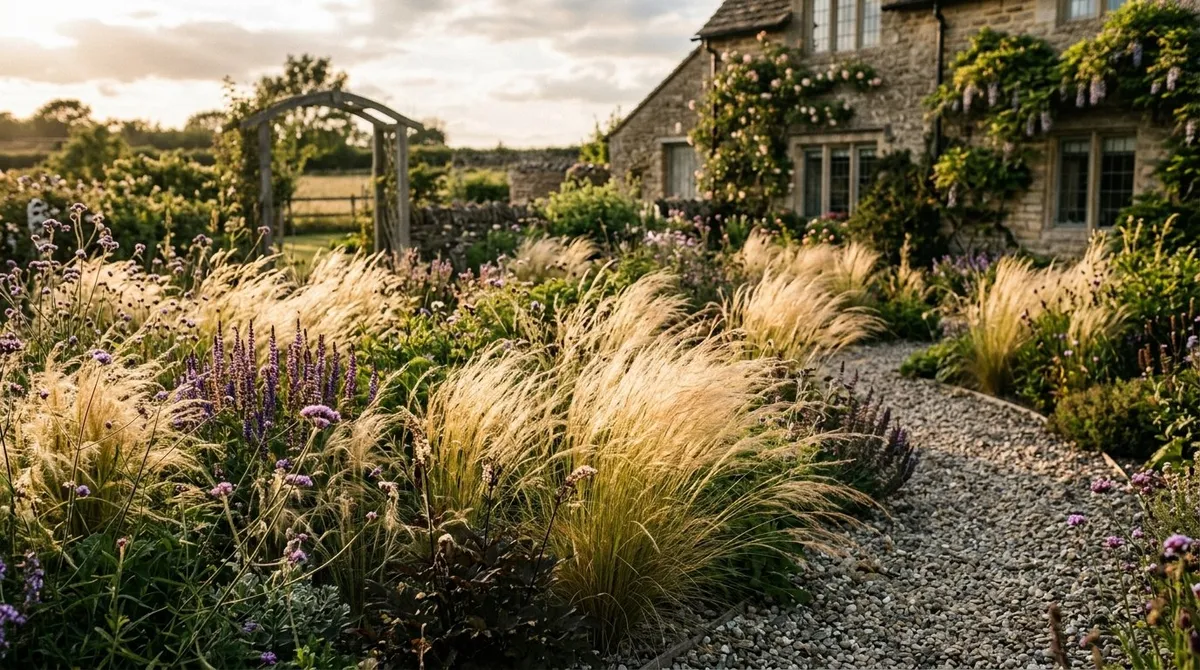
Stipa feather grass is one of the most graceful ornamental grasses for UK gardens, bringing movement, texture, and year-round interest to borders and gravel plantings. The three main species cover every height, from the towering 2m golden oats of S. gigantea to the low, swaying tufts of S. tenuissima at 60cm. All demand one thing above all else: well-drained soil in full sun.
This guide covers the three Stipa species grown in UK gardens, how to plant and maintain them, and what to pair them with for the best effect. For a wider overview of all grass types, see our ornamental grasses guide.
Stipa gigantea sends up 2m flower stems with golden oat-like heads from a low, evergreen base.
Which Stipa species grow best in the UK?
Three Stipa species thrive in British gardens, each suited to a different role. The RHS has given AGM awards to all three, confirming their reliability across UK climates. Choosing the right one depends on your space, soil, and tolerance for self-seeding.
Stipa gigantea (Golden Oats) is the showstopper. A low mound of semi-evergreen foliage sends up 1.8-2m flower stems from June onwards. The oat-like heads open purple-green and ripen to shimmering gold, lasting well into winter. It is fully hardy to -15C and needs no hard cut back. One mature plant fills a 1m-wide space and lasts 10+ years without dividing.
Stipa tenuissima (Mexican Feather Grass) forms a dense 50-60cm tuft of hair-fine leaves. Every breath of wind sets it rippling. Pale green flowers appear in June and age to straw-gold by August. It is a short-lived perennial (3-5 years) but self-seeds so freely that replacement plants appear without intervention. In mild, well-drained areas, it can become a nuisance.
Stipa arundinacea (Pheasant’s Tail Grass) reaches 80cm-1m with arching, bronze-tinted foliage that intensifies through autumn and winter. Now reclassified as Anemanthele lessoniana, it keeps its old name in most UK nurseries. It tolerates more shade than the other two species and is evergreen in sheltered spots.
| Species | Height | Habit | Hardiness | Self-seeding |
|---|---|---|---|---|
| S. gigantea | 1.8-2m (flowers) | Semi-evergreen clump | -15C | Low |
| S. tenuissima | 50-60cm | Deciduous tuft | -10C | Very high |
| S. arundinacea | 80cm-1m | Evergreen arching | -8C | Moderate |
How to plant Stipa feather grass
Plant Stipa in spring (April-May) for the best establishment before winter. Autumn planting works for S. gigantea but risks root rot for S. tenuissima on cold, wet soils. All species need full sun and free-draining ground.
Dig a hole twice the width of the pot and the same depth. On heavy soil, mix the excavated soil 50:50 with horticultural grit. Set the plant so the crown sits at soil level — burying it causes rot. Backfill, firm gently, and water well. Mulch with gravel rather than organic mulch, which holds moisture against the crown.
Spacing depends on species. Plant S. gigantea 80cm-1m apart as individual specimens. S. tenuissima looks best in groups of 3-5, spaced 30cm apart. S. arundinacea needs 60cm between plants.
Container growing suits all three species. Use a gritty, loam-based compost (John Innes No. 2 mixed with 30% perlite). Ensure drainage holes are clear. S. tenuissima is the best container choice — its fine foliage spills over pot edges and it stays compact.
What soil does Stipa need?
Well-drained soil is non-negotiable for every Stipa species. Waterlogged roots over winter kill more Stipa plants than cold temperatures ever will. Sandy and chalky soils are ideal without amendment. Clay soils need serious drainage work before planting.
On heavy clay, dig out a 40cm-wide, 30cm-deep hole and backfill with a 50:50 mix of garden soil and sharp horticultural grit. This creates a free-draining pocket around the roots. Raised beds with gritty compost are an even more reliable solution on clay. Our guide to plants for sandy soil covers more species that thrive in the same dry, lean conditions Stipa demands.
Stipa grasses actually perform better in poor, unfertilised soil. Rich, fertile ground produces lush, floppy growth that collapses in rain and loses the upright, airy habit that makes these grasses attractive. Never feed Stipa with nitrogen-rich fertiliser.
Stipa tenuissima self-seeds freely in gravel gardens — beautiful but potentially problematic in mild areas.
Is Stipa tenuissima really invasive?
S. tenuissima is not officially listed as invasive by DEFRA, but the RHS warns it can be problematic in mild, well-drained areas. Each mature plant sheds thousands of seeds annually. In gravel gardens, cracks in paving, and dry stone walls, seedlings pop up everywhere from late spring onwards.
In the West Midlands, the self-seeding is moderate on heavy clay — most seedlings fail on cold, wet soil. But in southern England, especially on chalk, sand, or coastal ground, it can colonise large areas quickly. The plant is already banned in several US and Australian states for this reason.
To control spread, deadhead flower stems before seeds ripen in late July. Alternatively, pull seedlings in spring when they are small and easy to identify. Many gardeners embrace the self-seeding in gravel gardens, where it creates a naturalistic, meadow-like effect. But in formal borders or near wild habitats, it needs active management.
If you want the feathery texture without the self-seeding risk, consider S. gigantea instead. It seeds far less freely and stays put as a well-behaved clump for a decade or more.
How to cut back and maintain Stipa grass
Each Stipa species has different maintenance needs — getting this wrong can kill the plant. S. tenuissima and S. gigantea are often confused, leading to botched cutting that destroys perfectly healthy grasses.
S. tenuissima: Cut hard to 10cm above ground in late February, before new growth emerges. Use shears or secateurs. After 3-4 years, the centre of the clump dies out. At that point, lift and divide or replace with self-sown seedlings.
S. gigantea: Never cut the evergreen base hard. In March, remove old flower stems at the base and comb through the foliage with gloved hands to pull out dead blades. The basal leaves stay green through winter and provide structure when other grasses are dormant. A hard cut to ground level kills the crown.
S. arundinacea: Trim to 30cm in April, removing the oldest, brownest outer leaves while keeping the fresher inner foliage. It responds well to tidying rather than shearing flat. The bronze winter colour is one of its best features, so leave it standing through the cold months.
Our Chelsea chop guide covers timing for cutting back perennials generally, but Stipa grasses should not be Chelsea-chopped. Their flowering stems form from the base, not from branching.
How to divide Stipa grasses
Divide S. tenuissima every 3-4 years in April to keep plants vigorous. Lift the entire clump with a fork. Pull or cut it into sections, each with roots and green foliage. Discard dead, brown central portions. Replant divisions at the same depth, water well, and mulch with gravel.
S. gigantea resents disturbance and rarely needs dividing. Mature plants perform best when left alone for 10+ years. If you must move one, do it in April and take a large rootball. Expect it to sulk for a full season before flowering again.
S. arundinacea divides easily in spring. Lift, split into 3-4 sections, and replant. It establishes faster than S. gigantea after division and should flower again within the same season.
Division is the most reliable way to propagate S. tenuissima if you want a specific cultivar. Self-sown seedlings may not be true to the parent, especially for named varieties.
Best companion plants for Stipa grasses
Stipa grasses pair best with drought-tolerant perennials that share their need for sun and sharp drainage. The wispy, airy texture of Stipa foliage contrasts brilliantly with bold, structural flowers and fleshy leaves.
| Stipa Species | Best Companions | Planting Style |
|---|---|---|
| S. gigantea | Verbena bonariensis, Crocosmia, Echinops ritro | Prairie border, see-through screen |
| S. tenuissima | Lavender, Eryngium, Sedum, Salvia nemorosa | Gravel garden, Mediterranean |
| S. arundinacea | Heuchera, Astilbe, Japanese anemone | Woodland edge, partial shade |
In border planting combinations, S. tenuissima softens gaps between roses and hardy geraniums. In gravel gardens, it partners with Echinacea, Achillea, and self-seeding Verbascum for a naturalistic effect.
For cottage garden schemes, plant S. gigantea as a tall see-through layer with lower perennials in front. Its open flower stems allow the planting behind to show through, creating depth without blocking the view.
Among the best perennials for UK gardens, Stipa grasses stand out for requiring almost zero ongoing care once established in the right spot.
Stipa arundinacea turns bronze and copper through autumn, earning its common name — pheasant’s tail grass.
Where to use Stipa in the garden
Gravel gardens, prairie borders, and Mediterranean-style planting are the three best settings for Stipa feather grass. Each species fills a specific role depending on your garden’s size and style.
Gravel gardens: S. tenuissima is the signature plant of the modern gravel garden. Plant in drifts of 5-7 between stepping stones, alongside Verbena bonariensis and Allium sphaerocephalon. The self-seeding habit works in your favour here, filling gaps naturally. Beth Chatto’s famous gravel garden in Essex popularised this style, and it suits dry, sunny UK gardens perfectly.
Prairie borders: S. gigantea makes the ultimate see-through screen. Place it mid-border where the tall flower stems catch low evening light while allowing views through to plants behind. Combine with Rudbeckia, Sanguisorba, and late-flowering Helenium for a naturalistic prairie effect.
Containers and courtyards: S. tenuissima in terracotta pots flanking a doorway gives Mediterranean charm. Pair with trailing Rosemary and upright Lavender. The fine foliage spills over pot edges and sways in every breeze. Use gritty compost and never let pots sit in saucers of water.
Common problems with Stipa grasses
Root rot from waterlogging kills more Stipa plants than any pest or disease. Good drainage prevents 90% of failures. Beyond drainage issues, these grasses are remarkably trouble-free.
Crown rot: Shows as yellowing, collapsing foliage from the base. Caused by waterlogged soil or organic mulch piled against the crown. Prevent by planting in well-drained soil and using gravel mulch only.
Dead centres: S. tenuissima develops hollow, brown centres after 3-4 years. This is natural ageing, not disease. Divide in spring or replace with self-sown seedlings.
Flopping: Lush, overfed plants or those in too much shade will flop sideways. Grow in poor soil and full sun. Never apply high-nitrogen feed.
Rust: Occasionally affects S. arundinacea, showing as orange pustules on leaves. Remove affected foliage and improve air circulation. It rarely causes lasting damage.
Stipa grasses have no significant pest problems in UK gardens. They are ignored by slugs, deer, and rabbits — making them ideal for exposed rural gardens where browsing is a constant problem.
Frequently asked questions
Is Stipa tenuissima invasive in the UK?
S. tenuissima self-seeds prolifically in mild, well-drained areas. It is not listed as invasive by DEFRA, but the RHS flags it as potentially problematic in southern and coastal England. Deadhead before seeds ripen in late July to control spread. On heavy clay in the Midlands and North, self-seeding is much less aggressive.
When should I cut back Stipa grass?
Cut S. tenuissima hard to 10cm in late February. S. gigantea is semi-evergreen and should never be cut hard — remove old flower stems in March and comb out dead foliage by hand. S. arundinacea benefits from a trim to 30cm in April. Cutting at the wrong time or cutting S. gigantea hard can kill the plant outright.
Can Stipa grow in clay soil?
Stipa needs well-drained soil and struggles on heavy wet clay. Amend the planting hole with a 50:50 mix of garden soil and sharp horticultural grit. S. gigantea tolerates heavier soils better than S. tenuissima. Raised beds with gritty compost give the most reliable results on clay.
How tall does Stipa gigantea grow?
S. gigantea produces flower stems 1.8-2m tall from a 60-70cm evergreen base. The oat-like flower heads appear in June and persist until late autumn, turning from purple-green to shimmering gold. It is one of the tallest clump-forming grasses for UK gardens.
How do I divide Stipa grasses?
Divide S. tenuissima every 3-4 years in April when new growth appears. Lift the clump, split into sections, discard dead centres, and replant at the same depth. S. gigantea dislikes disturbance and should be left alone for 10+ years. Division is the best propagation method for named cultivars.
What plants go well with Stipa grasses?
Lavender, Verbena bonariensis, Echinacea, Salvia nemorosa, and Eryngium all share Stipa’s need for sun and drainage. In gravel gardens, pair S. tenuissima with Sedum and Achillea. For prairie borders, combine S. gigantea with Crocosmia, Rudbeckia, and Sanguisorba for late-season drama.
Does Stipa tenuissima come back every year?
S. tenuissima is a short-lived perennial lasting 3-5 years in most UK gardens. Individual plants develop dead centres and decline naturally. However, it self-seeds so freely that replacement plants appear without intervention. In well-drained, sunny spots, you will always have plants once the first generation establishes.
Lawrie has been gardening in the West Midlands for over 30 years. He grows his own veg using no-dig methods, keeps a wildlife-friendly garden, and writes practical advice based on real UK growing conditions.