How to Grow Thalictrum (Meadow Rue) UK
Grow thalictrum in UK gardens with this expert guide covering varieties, partial shade planting, moist soil care, staking, division, and companion plants.
Key takeaways
- Thalictrum delavayi reaches 1.2-1.8m tall with airy sprays of lilac-purple flowers from June to August
- Partial shade with moist, humus-rich soil produces the strongest growth -- full sun only works in reliably damp ground
- Stake tall species by mid-May using pea sticks or hazel supports for a natural look
- 'Hewitt's Double' is the best garden cultivar with fully double flowers, longer blooming, and RHS AGM
- Divide clumps every 3-4 years in March or October to maintain vigour and increase stock
- Slugs target young spring shoots so start ferric phosphate pellets in February before growth emerges
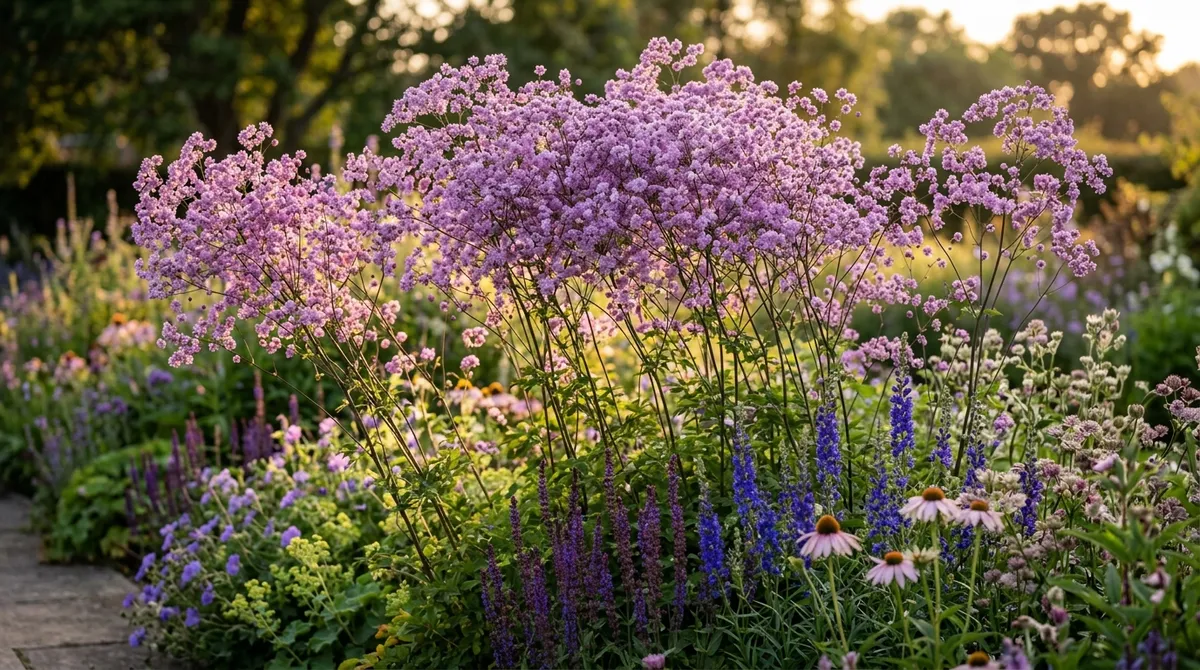
Thalictrum is one of those perennials that transforms a border from solid to atmospheric. The flowers are small individually, tiny fluffy puffs of stamens on thread-thin stems, but massed together they create a haze of purple, lilac, or yellow that seems to float above everything else in the bed. No other tall perennial does quite this.
The common name meadow rue hints at the wild origins: Thalictrum flavum (common meadow rue) grows native in damp UK meadows and ditchsides. But the garden species, particularly T. delavayi from western China, are the ones that earn their place in borders. This guide covers the five best thalictrum species for UK gardens, their planting needs, staking, propagation by division and seed, and the companion plants that work alongside them.
Which thalictrum species and varieties should I grow?
Five species account for nearly all thalictrum planted in UK gardens. Each fills a slightly different role in the border.
| Species / Variety | Height | Flowers | Flowering | Best for |
|---|---|---|---|---|
| T. delavayi | 1.2-1.8m | Lilac-purple, pendant | July-August | Back of border, dappled shade |
| T. delavayi ‘Hewitt’s Double’ | 1.2-1.5m | Double lilac pompoms | July-September | Longest season, RHS AGM |
| T. aquilegiifolium | 60-90cm | Fluffy purple-pink heads | May-June | Mid-border, earliest to flower |
| T. flavum subsp. glaucum | 1.2-1.5m | Pale yellow clusters | June-July | Blue-grey foliage contrast |
| T. rochebrunianum | 1.5-2m | Lavender-lilac, dark stems | July-August | Tallest species, dramatic stems |
T. delavayi is the backbone species. Native to the meadows and open woodland of Yunnan province, it was introduced to British gardens in 1890. The flowers are pendant, each one a cluster of lilac-purple sepals surrounding a boss of cream-yellow stamens. On a still day the effect is a shimmering curtain of colour at 1.5m.
‘Hewitt’s Double’ is the single most planted thalictrum cultivar in the UK, and for good reason. Discovered by Ellen Hewitt at Bettws-y-Coed in North Wales in the 1960s, it has fully double flowers with no stamens, just tight clusters of lilac petals. The double flowers last significantly longer than the singles (4-6 weeks versus 2-3 weeks), and the plant holds an RHS Award of Garden Merit. It is sterile, so it never self-seeds. Propagate by division only.
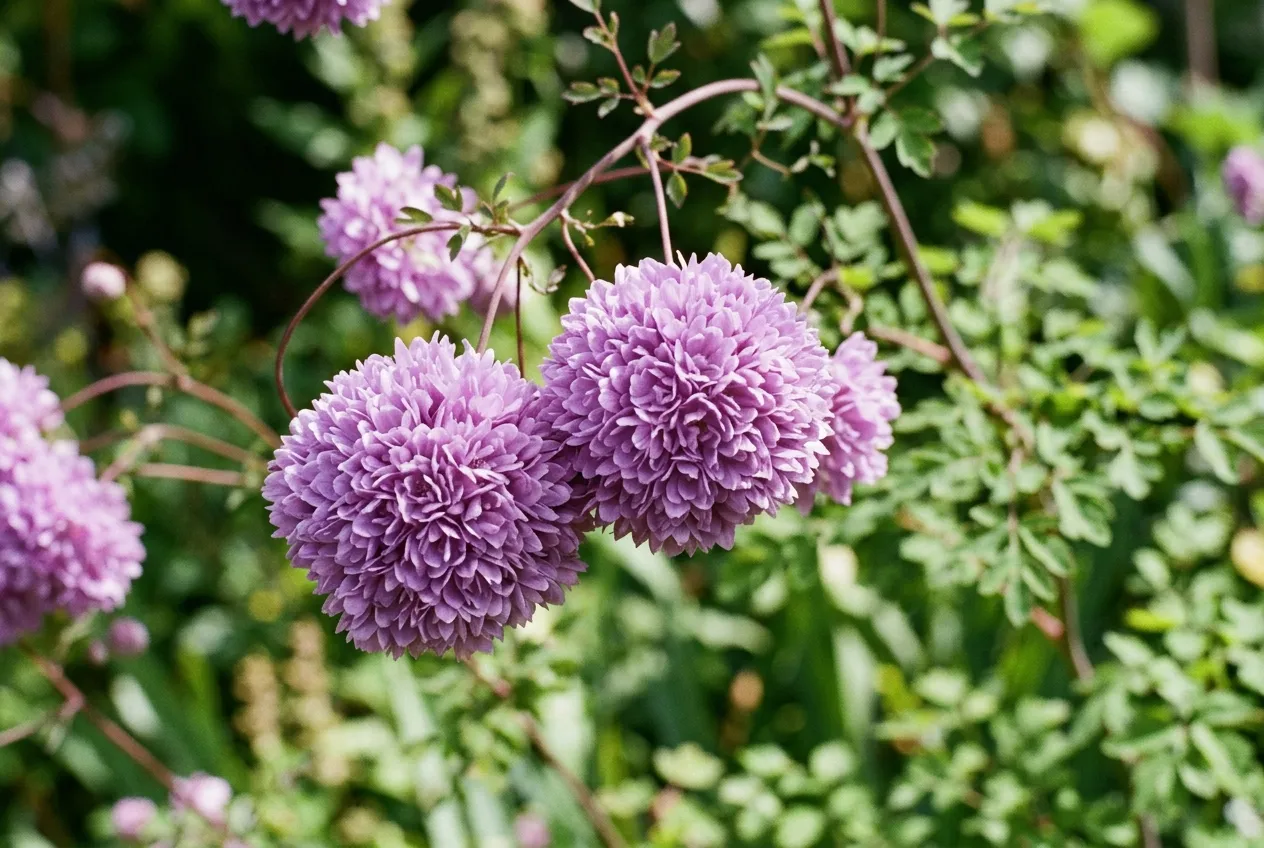
T. delavayi ‘Hewitt’s Double’ produces fully double flowers without stamens, blooming from July to September
T. aquilegiifolium earns its name from foliage that closely resembles aquilegia (columbine). It is the most compact garden species at 60-90cm and the earliest to flower. The fluffy flower heads are held upright rather than pendant. ‘Thundercloud’ is a deep purple form; ‘Album’ is white. This species is self-supporting in most situations.
T. flavum subsp. glaucum brings blue-grey foliage that is ornamental long before the pale yellow flowers open in June. The foliage alone makes it worth growing among the best perennials for UK gardens. It is the most sun-tolerant species, handling open positions better than T. delavayi.
T. rochebrunianum (lavender mist) is the tallest at 1.5-2m, with dark purple-brown stems that provide strong vertical lines even before flowering. The flowers are small and lavender-lilac. It needs staking in all but the most sheltered positions but is spectacular when well-grown.
Where to plant thalictrum in the UK
Getting the position right is the single biggest factor in growing thalictrum well. The plants are tolerant of a range of conditions but have clear preferences.
Partial shade is ideal. Three to four hours of direct sun, with dappled shade for the rest of the day, produces the strongest plants with the least stress. This mirrors the plant’s natural habitat at open woodland edges and shaded meadows. A border on the east or west side of a building, or beneath the canopy of light-foliaged trees, works perfectly. For more shade planting ideas, read the guide to the best plants for shade in UK gardens.
Moist, humus-rich soil is essential. Thalictrum evolved in damp habitats and performs poorly in dry ground. Before planting, dig in two bucketfuls of well-rotted garden compost or leaf mould per planting position. Mulch 5-7cm deep in March each year to retain soil moisture through summer. In heavy clay (which most of the West Midlands sits on), the moisture retention is natural. The challenge is drainage in winter rather than dryness in summer. Our guide to improving clay soil covers the techniques that work.
Full sun works only if the soil stays damp. In a sunny border with free-draining soil, thalictrum leaves will scorch and turn brown by July. If you must plant in sun, choose T. flavum subsp. glaucum (the most sun-tolerant species) and mulch heavily to conserve moisture.
Shelter from strong wind. The tall species (T. delavayi, T. rochebrunianum) have thin, wiry stems that whip about in wind. They do not snap as easily as delphiniums because the stems are flexible rather than brittle. But persistent wind produces a tangled mess and reduces the airy visual effect that is the whole point of growing them.
Soil pH is not critical. Thalictrum grows well across the pH range from 5.5 to 7.5. It thrives on clay, loam, and chalk soils. It struggles only on very dry sandy soils that cannot hold moisture.
How and when to plant thalictrum
Container-grown plants can go in from March to October, but spring planting (March to May) gives the best results. Plants establish root systems during the cool, moist spring months and are ready to flower by midsummer.
Planting method:
- Soak the pot in a bucket of water for 30 minutes before planting
- Dig a hole twice the width of the rootball and the same depth
- Mix the excavated soil with a generous handful of garden compost
- Set the plant at the same depth as in its pot with the crown level with the soil surface
- Backfill, firm gently, and water thoroughly
- Mulch around the plant with 5cm of compost, keeping it clear of the stems
Space plants 45-60cm apart. They spread slowly by rhizomatous roots but are not invasive. A group of three or five creates the best visual impact. Thalictrum’s strength is in massed planting rather than single specimens.
Bare-root plants and divisions are best planted in March as growth starts, or October after cutting back. Autumn planting in heavy clay carries more risk of root rot over winter. If your soil is heavy, spring planting is safer.
How to stake thalictrum without it looking awkward
Tall thalictrum species need support, but the method matters. Single bamboo canes look wrong against the delicate, branching stems. The aim is invisible support.
Pea sticks or branched hazel are the best option. Push them in around the clump in April when growth reaches 20-30cm. The stems grow up and through the twiggy supports, hiding them completely by flowering time. Use sticks that are two-thirds of the expected plant height. For T. delavayi, that means sticks of 80-100cm.
Proprietary grow-through supports (wire grids on legs) work well for T. aquilegiifolium and smaller cultivars. Place them over the crown in March before growth starts.
T. aquilegiifolium rarely needs staking in sheltered borders. Its stems are shorter and sturdier than the other species. In exposed gardens, give it a single ring of twine around three short canes at 50cm height.
Field report, staking trial, Staffordshire clay border: Over three seasons I compared pea sticks, single canes, and no support on T. delavayi in a west-facing border. Pea-sticked plants had zero stem damage. Cane-supported plants had 15-20% of stems bending between tie points. Unsupported plants needed cutting back after every strong wind event from June onwards. The pea sticks were completely hidden by late May.
How to propagate thalictrum by division
Division is the primary propagation method and the only way to maintain named cultivars such as ‘Hewitt’s Double’ (which is sterile and produces no seed).
When to divide: March (as red-purple buds appear at soil level) or October (after cutting back). Spring division gives a higher success rate in heavy soils.
Method:
- Lift the entire clump with a garden fork, working around the root mass
- Shake off loose soil so you can see the root structure
- Split into sections using a sharp spade or two back-to-back forks. Each section needs 3-5 growth buds and a healthy portion of roots
- Replant sections immediately at the original depth
- Water well and mulch
Divide every 3-4 years to maintain vigour. Thalictrum clumps become congested in the centre after this time, producing fewer flowers from a larger area. Division rejuvenates the plant and gives you extra stock for elsewhere in the garden. For the full technique, read the guide on plant propagation by division, cuttings, and layering.
Can I grow thalictrum from seed?
Yes, but patience is required. Thalictrum seed germinates slowly and erratically. It often needs a cold period (stratification) to break dormancy.
Autumn sowing (recommended):
- Collect seed from ripe heads in September. The seed is small and wind-dispersed, so bag the heads before they shatter
- Sow immediately into modules of moist seed compost
- Cover lightly with vermiculite (1-2mm)
- Leave pots outdoors in a shaded cold frame over winter. The natural cold does the stratification
- Germination occurs from March to May the following spring
- Pot on seedlings when they have two true leaves
Spring sowing: If sowing in spring, place seed in a sealed bag with damp sand in the fridge for 6-8 weeks before sowing. This mimics winter cold and improves germination from 10-15% to 40-50%.
Key facts: Seed-raised plants take 2-3 years to reach flowering size. Named cultivars (especially ‘Hewitt’s Double’) will not come true from seed, so divide these instead. Species seed (T. delavayi, T. aquilegiifolium) produces variable but generally true-to-type offspring.
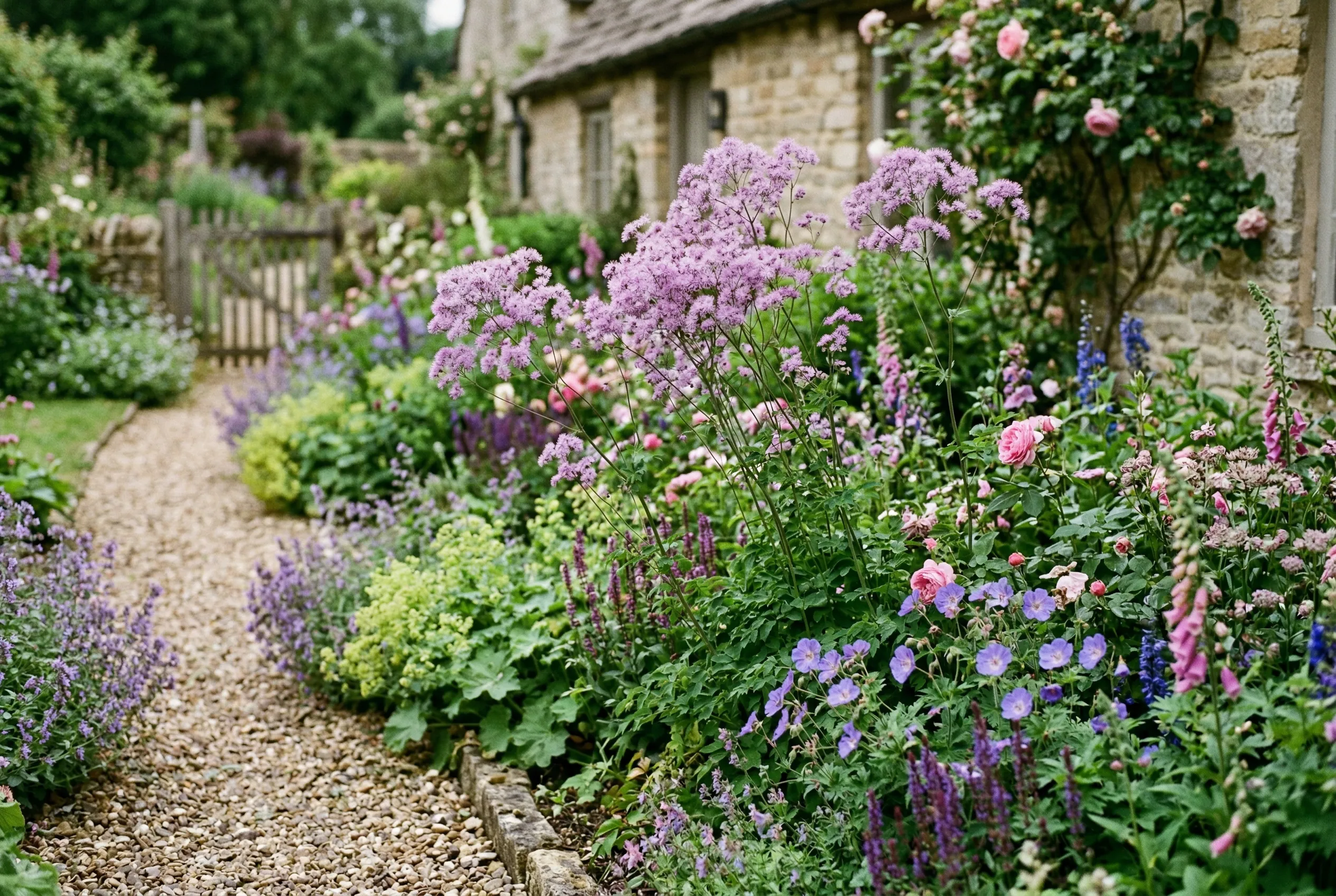
Thalictrum rising above companion plants in a cottage garden border. The airy stems create depth without blocking the view behind
Protecting thalictrum from slugs and mildew
Slugs are the main pest threat, targeting the soft emerging shoots in March and April. Established thalictrum foliage is less palatable, but spring growth is vulnerable.
Prevention strategy:
- Apply ferric phosphate slug pellets around crowns from late February, before shoots emerge
- Renew pellets every 7-10 days through March and April
- In mild wet winters, slugs remain active. Start controls earlier if you spot damage
- Biological nematode control (Phasmarhabditis hermaphroditis) works from March when soil is above 5C
Once stems are 30cm tall and hardening off (typically mid-May), slug pressure drops sharply. The same timing applies to foxgloves, delphiniums, and other spring-emerging perennials. Protect them all at the same time. For a full organic approach, see the guide to getting rid of slugs naturally.
Powdery mildew can affect foliage in hot, dry summers. Ensure adequate watering at the base, maintain mulch, and space plants for airflow. T. aquilegiifolium is the most mildew-resistant species.
Cutting back and autumn care
Cut all stems to ground level after flowering finishes. This is typically September for T. delavayi, earlier for T. aquilegiifolium. Unlike delphiniums, thalictrum does not produce a second flush, so there is no benefit in early cutting.
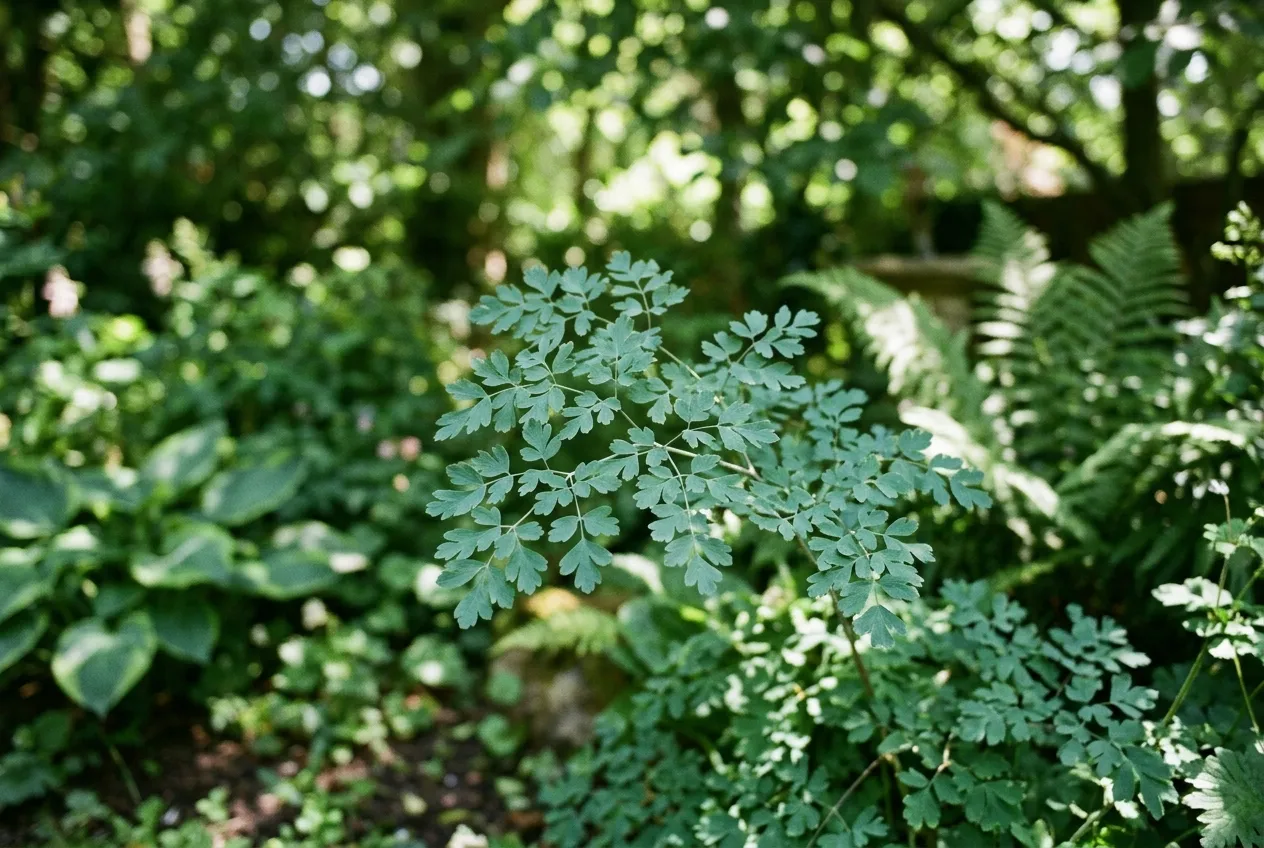
The blue-green divided foliage resembles maidenhair fern or aquilegia. Ornamental from April until the autumn cut-back
Autumn tasks:
- Cut stems to 5cm above soil level once flowering ends and foliage yellows
- Clear debris from around the crown to reduce slug habitat over winter
- Apply a 5cm mulch of garden compost or leaf mould over the crown
- Mark the position with a label. Thalictrum disappears completely in winter and is easy to damage when digging nearby
No winter protection is needed. All five species listed here are fully hardy to USDA zone 5 (-20C). In the UK, winter cold is never a limiting factor. Wet heavy soil in winter causes more losses than cold. If drainage is poor, consider raising the planting slightly or adding grit around the crown.
Best companion plants for thalictrum
Thalictrum’s airy, transparent quality makes it one of the best plants for weaving through a mixed border. It combines well with bold-leaved plants that provide contrast.
| Companion plant | Why it works |
|---|---|
| Hardy geraniums | Low mounding habit contrasts with thalictrum’s height; same shade and moisture needs |
| Astrantia | Similar woodland-edge habitat; complementary flower forms |
| Hostas | Bold foliage offsets the delicate thalictrum leaves; both thrive in moist shade |
| Japanese anemones | Take over the display as thalictrum finishes in late summer |
| Ferns | Textural match for foliage; reinforce the woodland character |
| Astilbe | Shares moist soil needs; feathery plumes at a lower height |
| Foxgloves | Vertical spires at different heights create depth in cottage borders |
The most effective plant combinations for UK borders pair thalictrum with a ground-level carpet (hardy geraniums, Alchemilla mollis), a mid-height block (astrantia, persicaria), and let thalictrum’s flowers float at the back. This three-tier approach maximises the airy effect.
In a cottage garden, thalictrum sits naturally alongside foxgloves, delphiniums, and roses. In a more naturalistic planting, combine it with ornamental grasses such as Molinia caerulea and Deschampsia cespitosa for a meadow-style scheme.
Month-by-month thalictrum calendar
| Month | Task |
|---|---|
| February | Apply slug pellets around crowns before growth appears |
| March | Divide established clumps. Mulch with compost. Watch for emerging shoots |
| April | Insert pea-stick supports when growth reaches 20-30cm |
| May | Tie in tall stems if needed. Water in dry spells |
| June | T. aquilegiifolium flowers. Water deeply during dry periods |
| July | T. delavayi and T. rochebrunianum begin flowering |
| August | Peak flowering for T. delavayi. Collect seed from T. aquilegiifolium |
| September | Collect seed from T. delavayi. Sow immediately for spring germination |
| October | Cut back after foliage yellows. Divide if needed. Mulch crowns |
| November-January | Dormant. Mark positions to avoid accidental disturbance |
Frequently asked questions
When does thalictrum flower in the UK?
Thalictrum flowers from June to August depending on species. T. aquilegiifolium is earliest at May to June. T. delavayi flowers July to August, with ‘Hewitt’s Double’ extending into September. T. rochebrunianum overlaps with T. delavayi from July through August. Each plant flowers for 4-6 weeks in good conditions.
Does thalictrum grow in shade?
Yes, thalictrum thrives in partial shade with 3-4 hours of direct sun. It tolerates dappled woodland shade better than most tall perennials. Full shade reduces flowering but plants survive. Full sun works only if soil stays consistently moist. East-facing and west-facing borders are ideal positions in most UK gardens.
How tall does thalictrum grow?
Height ranges from 60cm to 2m depending on species. T. aquilegiifolium is the shortest at 60-90cm. T. delavayi reaches 1.2-1.8m. T. rochebrunianum is the tallest at 1.5-2m with distinctive dark stems. Rich, moist soil and partial shade consistently produce plants at the upper end of their height range.
Is thalictrum easy to grow?
Thalictrum is straightforward once its two key needs are met: partial shade and moist soil. Plants establish quickly from container-grown stock and need minimal attention beyond spring mulching, staking tall varieties, and dividing every 3-4 years. Slugs threaten young growth in spring but established plants are trouble-free.
Can I grow thalictrum from seed?
Yes, but germination is slow at 3-6 months. Sow fresh seed in autumn and leave outdoors for natural cold stratification over winter. Seedlings appear the following spring. Named cultivars such as ‘Hewitt’s Double’ are sterile and must be propagated by division. Seed-raised plants take 2-3 years to reach flowering size.
How do I stop thalictrum falling over?
Use pea sticks or branched hazel pushed in around clumps when growth reaches 20-30cm. The flexible stems weave through the supports naturally, hiding them by June. Avoid single bamboo canes as they look awkward against the delicate stems. T. aquilegiifolium at 60-90cm rarely needs staking. Sheltered positions reduce wind damage for all species.
When should I divide thalictrum?
Divide in March as new buds appear, or in October after cutting back. Spring division is safest in heavy clay. Each section needs 3-5 growth buds and a healthy root portion. Replant at the original depth and water thoroughly. Divide every 3-4 years to maintain vigour. Congested clumps produce fewer flowers from a larger area.
Thalictrum earns its place in any UK border that gets afternoon shade and stays moist through summer. The fluffy flowers on wiry stems create an effect no other perennial manages, a shimmering haze of colour floating above the planting. Start with ‘Hewitt’s Double’ for the longest season, add T. aquilegiifolium for early colour, and plant in groups of three or five for the strongest visual impact.
For more ideas on building a border around shade-tolerant perennials, the Royal Horticultural Society’s thalictrum guide has additional cultivar recommendations and regional advice.
Lawrie has been gardening in the West Midlands for over 30 years. He grows his own veg using no-dig methods, keeps a wildlife-friendly garden, and writes practical advice based on real UK growing conditions.