How to Grow Tulips in the UK
A practical guide to growing tulips in UK gardens. Covers planting times, bulb depth, varieties, containers, naturalising, and tulip fire disease.
Key takeaways
- Plant tulip bulbs 15-20cm deep from mid-October to late November for spring flowers
- Bulbs need 12-14 weeks of cold below 9 degrees Celsius to trigger flowering
- Species tulips naturalise for 10+ years; most hybrid tulips decline after 2-3 seasons
- Tulip fire (Botrytis tulipae) is the main UK disease, destroying leaves and flowers in wet springs
- Grow tulips in containers at least 30cm deep using 2 parts compost to 1 part grit
- Lift hybrid tulip bulbs in June once foliage dies back, and store at 20 degrees Celsius until autumn
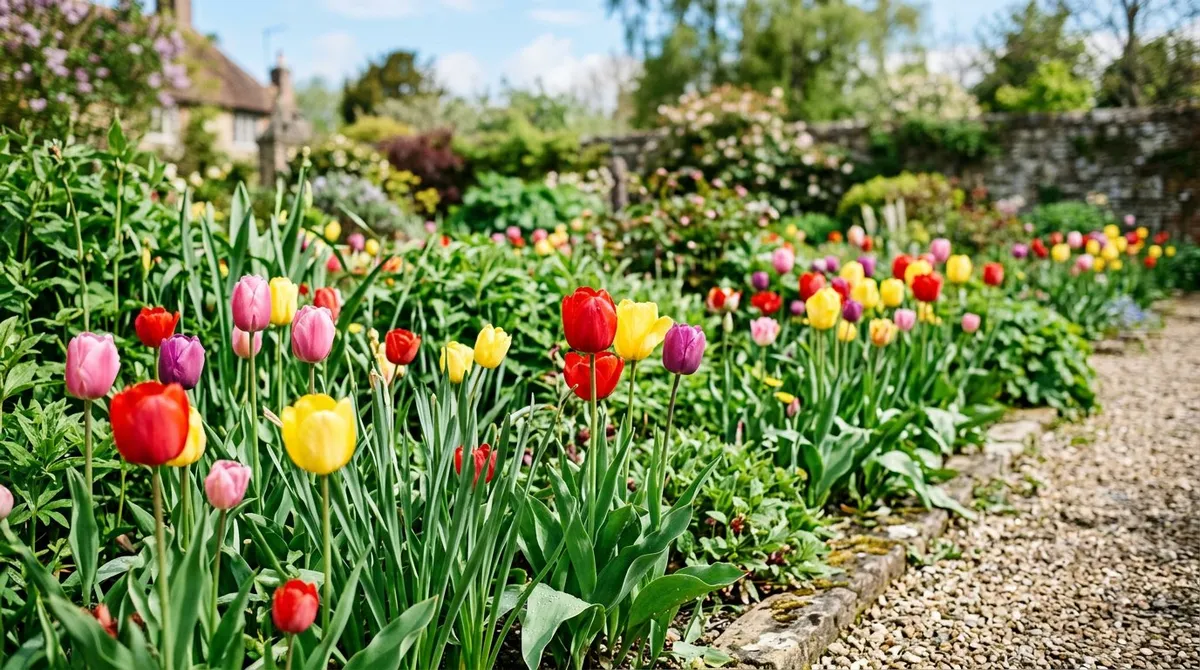
Tulips are the defining flower of the British spring garden. From the first dwarf species blooming in March to towering Darwin hybrids in May, they provide six to eight weeks of colour at a time when most gardens are still waking up. Around 150 million tulip bulbs are sold in the UK each year, making them the country’s most popular spring-flowering bulb after daffodils.
Growing tulips well in the UK comes down to timing, depth, and drainage. Get those three things right and you will have strong flowers year after year. This guide covers choosing varieties, planting technique, container growing, naturalising, disease prevention, and when to lift and store bulbs. Tulips work in borders, pots, and cottage garden displays, and they are straightforward once you understand their needs. For companion planting ideas, see our cottage garden planting plan.
Choosing the right tulip type
The Royal International Horticultural Society classifies tulips into 15 divisions based on flower shape, size, and parentage. You do not need to know all 15, but understanding the main groups helps you pick varieties that suit your garden and your goals.
Single early tulips (Division 1) flower from late March in mild areas. They grow 25-40cm tall with classic cup-shaped blooms. ‘Apricot Beauty’ and ‘Purple Prince’ are two of the most reliable UK performers.
Double early tulips (Division 2) have peony-like flowers packed with petals. They stand 25-35cm tall and flower in April. ‘Monsella’ (yellow and red streaks) and ‘Foxtrot’ (pink) are popular choices.
Triumph tulips (Division 3) are the largest group, flowering in mid to late April. They grow 35-50cm tall and are the backbone of most spring bedding schemes. ‘Negrita’ (purple) and ‘Jan Reus’ (deep red) are excellent varieties.
Darwin hybrid tulips (Division 4) produce the largest flowers on stems up to 70cm tall. They are the best hybrid type for perennialising, often returning for 4-5 years if planted deeply. ‘Apeldoorn’ (red), ‘Golden Apeldoorn’ (yellow), and ‘Pink Impression’ are proven in UK gardens.
Lily-flowered tulips (Division 6) have pointed, reflexed petals that give an elegant, vase-like shape. ‘Ballerina’ (orange, scented), ‘White Triumphator’, and ‘Merlot’ flower in late April and May at 45-60cm.
Parrot tulips (Division 10) have fringed, ruffled petals in vivid colours. ‘Black Parrot’ and ‘Estella Rijnveld’ are dramatic but their heavy heads can snap in wind. Plant them in sheltered spots or use them as cut flowers.
Species tulips (Divisions 13-15) are the wild ancestors and close relatives of garden tulips. They are smaller, typically 10-25cm tall, but they naturalise far better than any hybrid. Tulipa sylvestris, T. sprengeri, T. clusiana ‘Lady Jane’, and T. tarda all return year after year in UK gardens without lifting.
Tulip type comparison
| Division | Type | Height | Flowering time | Perennial? | Best for |
|---|---|---|---|---|---|
| 1 | Single early | 25-40cm | Late March - April | Poor | Pots, early colour |
| 2 | Double early | 25-35cm | April | Poor | Sheltered beds, cutting |
| 3 | Triumph | 35-50cm | Mid-late April | Moderate | Bedding, borders |
| 4 | Darwin hybrid | 50-70cm | April - May | Good (4-5 years) | Borders, naturalising |
| 6 | Lily-flowered | 45-60cm | Late April - May | Moderate | Borders, cutting |
| 10 | Parrot | 40-55cm | Late April - May | Poor | Sheltered spots, cutting |
| 13-15 | Species | 10-25cm | March - April | Excellent (10+ years) | Rock gardens, grass |
Gardener’s tip: If you want tulips that return every year, focus on Darwin hybrids and species types. Treat other divisions as seasonal bedding and plan to buy fresh bulbs each autumn.
When to plant tulips in the UK
Plant tulip bulbs from mid-October to late November. This is deliberately later than daffodils, crocuses, and most other spring bulbs, which go in from September. The later planting date is not laziness. It is the single most effective way to prevent tulip fire (Botrytis tulipae), the most damaging tulip disease in Britain. Our dedicated guide on when to plant tulip bulbs in the UK covers regional timing in more detail.
Tulip fire spores survive in warm soil. By waiting until soil temperatures drop below 9 degrees Celsius, you deny the fungus the warmth it needs to infect emerging shoots. In most of England, soil hits this threshold in late October. In Scotland and northern England, it may happen by mid-October. In mild southern and coastal areas, early November is sometimes better.
November planting is perfectly fine. In trials by the Royal Horticultural Society, tulips planted in November produced flowers of equal quality to those planted in October. You can even plant tulips in December if the ground is not frozen, though this may delay flowering by a week or two.
Choosing a planting site
Tulips need full sun for at least 6 hours per day. They tolerate light shade from deciduous trees (which are still bare when tulips flower) but avoid heavy shade from buildings or evergreens.
Drainage is critical. Tulip bulbs rot in waterlogged soil. If your soil is heavy clay, either improve drainage by digging in sharp grit at 1 bucket per square metre, or grow tulips in raised beds and containers instead. Sandy and loamy soils suit tulips well with no amendments needed.
Avoid sites where tulips grew in the previous 3 years. Tulip fire spores persist in the soil for up to 3 seasons, so rotating your planting position is an important disease control measure.
How to plant tulip bulbs
Soil preparation
Prepare the planting area by forking over the soil to one spade’s depth (roughly 25cm). Remove any weeds and large stones. On heavy or average soils, work in horticultural grit at a rate of one bucket per square metre to improve drainage around the bulbs. Adding garden compost as a mulch after planting improves soil structure over time but avoid placing raw compost directly against the bulbs.
Do not add fertiliser at planting time. Tulip bulbs contain all the energy they need for the first season’s flowers. Feeding at planting can encourage soft, disease-prone growth.
Planting depth and spacing
Plant tulip bulbs 15-20cm deep, measured from the base of the bulb to the soil surface. This is roughly three times the height of the bulb. Deep planting is essential for three reasons:
- It protects bulbs from frost heave during winter cold snaps.
- It reduces the risk of tulip fire infection.
- It encourages bulbs to perennialise rather than splitting into smaller, non-flowering offsets.
Space bulbs 10-12cm apart for a natural look in borders. For dense bedding displays, reduce spacing to 8cm apart. Plant in groups of at least 7-9 bulbs of the same variety for the strongest visual impact. Single scattered bulbs look lost.
Planting method
- Dig a flat-bottomed hole or trench to the correct depth (15-20cm).
- Place bulbs pointed end up on the soil. If you cannot tell which end is up, plant sideways. The shoot will find its own way.
- Space bulbs evenly across the base of the hole.
- Backfill with the excavated soil, firming gently with the back of a rake.
- Water lightly if the soil is dry. Do not water again unless there is a prolonged dry spell.
- Mark the planting area with short canes or labels so you do not accidentally dig into the bulbs.
Gardener’s tip: For a natural cottage garden effect, gently toss bulbs onto the prepared bed and plant each one where it lands. This avoids the rigid grid patterns that look artificial.
Growing tulips in containers
Container growing is one of the best ways to enjoy tulips in the UK. You control the soil mix, drainage is guaranteed, and you can move pots into prime position when flowers open.
Choosing pots
Use containers at least 30cm deep to allow proper planting depth. Terracotta, stone, and thick plastic all work well. Ensure every pot has drainage holes. Terracotta dries out faster than plastic, which actually suits tulips since they dislike sitting wet.
A pot 30cm wide and 30cm deep holds 7-9 tulip bulbs comfortably. A half-barrel or large trough can hold 20-30 bulbs for a dramatic display.
Compost mix
Mix 2 parts multipurpose compost to 1 part horticultural grit or perlite. This gives the free-draining growing medium tulips need. Do not use neat multipurpose compost as it holds too much moisture and can rot the bulbs over winter.
Planting technique (lasagne method)
The lasagne planting method layers different bulb types at different depths in the same pot for a succession of flowers from February to May. Plant the largest, latest-flowering bulbs at the bottom and the smallest, earliest-flowering bulbs near the top.
Bottom layer (20cm deep): Darwin hybrid or lily-flowered tulips (flower May). Middle layer (15cm deep): Triumph tulips or daffodils (flower April). Top layer (8cm deep): Crocuses or grape hyacinths (flower February - March).
Space bulbs so they do not sit directly above the layer below. Water once after planting, then leave the pot outdoors through winter. Tulips need the cold. Only water again if the compost dries out completely.
Aftercare for potted tulips
Move pots into a sunny position as shoots emerge in early spring. Water when the top 3cm of compost feels dry. Feed once with a half-strength liquid tomato fertiliser when flower buds appear. After flowering, deadhead the spent blooms but leave the foliage to die back naturally. This feeds the bulb for next year. Most hybrid tulips in pots are best treated as one-season displays and composted after flowering.
Naturalising tulips in grass and borders
Species tulips are the only group that reliably naturalises in UK conditions. Hybrid tulips rarely persist beyond 3 years in grass because they cannot compete with vigorous turf for moisture and nutrients.
Best species for naturalising
- Tulipa sylvestris - the only tulip native to Britain (naturalised since the 1600s). Yellow, nodding flowers on 30cm stems. Spreads by underground stolons. Thrives in light shade under deciduous trees.
- Tulipa sprengeri - the last tulip to flower, often into June. Red flowers on 40cm stems. Self-seeds freely. The easiest species tulip to establish from seed.
- Tulipa clusiana ‘Lady Jane’ - white and pink striped flowers. Dainty and elegant at 25cm. Best in well-drained soil in full sun.
- Tulipa tarda - clusters of star-shaped yellow and white flowers at just 10cm tall. Perfect for rock gardens and gravel paths. Completely hardy across the UK.
How to naturalise
Plant species tulip bulbs in autumn at 10-15cm deep in groups of 15-20 bulbs. In grass, use a bulb planter to cut neat plugs of turf. In borders, plant among perennials that will grow up and disguise the tulip foliage as it fades.
The critical rule: do not cut the grass or remove foliage for at least 6 weeks after flowering. The leaves photosynthesise and feed the bulb for next year’s flowers. In a lawn, this means leaving an unmown patch until mid-June. Many gardeners find this acceptable when the naturalised area is under a tree or along a boundary where slightly longer grass looks appropriate.
Month-by-month tulip care calendar
| Month | Task |
|---|---|
| January | Check stored bulbs for signs of mould or rot. Discard any soft ones. |
| February | Top-dress autumn-planted beds with a thin layer of garden compost. |
| March | Watch for emerging shoots. Protect species tulips from heavy slug damage with organic pellets. |
| April | Enjoy the main flowering period. Stake tall parrot and lily-flowered types if wind is forecast. |
| May | Deadhead spent flowers immediately. Leave stems and foliage in place. Do not tie or fold leaves. |
| June | Foliage yellows and dies back. Lift hybrid bulbs once leaves are completely brown. |
| July | Clean lifted bulbs, remove old skins, and dry in a warm, well-ventilated spot for 2-3 days. |
| August | Store dried bulbs in paper bags or open trays at around 20 degrees Celsius. Inspect monthly. |
| September | Order new bulbs from suppliers. Plan colour schemes and planting positions. |
| October | Begin planting from mid-October when soil temperature drops below 9 degrees Celsius. |
| November | Complete all tulip planting. This is the ideal month for most UK regions. |
| December | Water containers if compost dries out during mild spells. No other action needed. |
Lifting and storing tulip bulbs
Most hybrid tulips perform best when lifted annually in June, dried, and replanted in autumn. Left in the ground year after year, they gradually split into smaller bulbs that produce leaves but no flowers. This decline is faster in heavy, wet soils.
When to lift
Wait until the foliage has turned completely yellow or brown, usually by mid to late June. Do not cut the leaves while they are still green. Lifting too early robs the bulb of energy it needs for next year’s flower.
How to lift and store
- Fork bulbs out carefully. Push the fork in 15cm away from the stems to avoid spearing the bulbs.
- Shake off loose soil. Do not wash bulbs as excess moisture encourages storage rot.
- Remove dead foliage and any loose outer skins.
- Discard any bulbs that are soft, mouldy, or show dark spots (possible tulip fire).
- Dry bulbs on a wire rack or open tray in a warm, airy place for 2-3 days.
- Store in paper bags, net bags, or open trays at 20 degrees Celsius. Do not use sealed plastic bags as trapped moisture causes rot.
- Check stored bulbs monthly. Remove any that develop mould.
Warning: Do not store tulip bulbs near ripening fruit. Apples and other fruit release ethylene gas, which damages the developing flower bud inside the bulb.
Species tulips do not need lifting. Leave them in the ground permanently.
Tulip fire and other diseases
Tulip fire (Botrytis tulipae)
Tulip fire is the most serious disease affecting tulips in the UK. It is caused by the fungus Botrytis tulipae and thrives in cool, wet springs, which Britain provides in abundance. Infected plants show brown, scorched-looking patches on leaves, twisted and stunted growth, and grey mould on flowers in severe cases. The disease spreads rapidly in crowded plantings during damp weather.
Prevention is far more effective than treatment. There are no fungicide sprays available to home gardeners for tulip fire. Follow these steps:
- Plant late (November) when soil is cold.
- Rotate planting sites on a 3-year cycle.
- Space bulbs 10-12cm apart to allow air circulation.
- Remove and destroy any infected plants immediately. Do not compost them.
- Avoid overhead watering on tulip foliage.
- Buy from reputable suppliers who inspect for disease.
Tulip breaking virus
This virus causes streaks and colour breaks in tulip petals. Historically prized (it caused the 17th-century Dutch “Tulipomania”), it actually weakens plants and is spread by aphids. Modern cultivars are bred to be virus-free. Remove any tulips showing unexpected colour streaking and control aphid populations.
Bulb rot
Caused by several soil fungi, bulb rot turns bulbs soft and mushy during storage or in waterlogged ground. Prevention comes from good drainage, deep planting, and proper drying before storage. Discard affected bulbs immediately to prevent spread.
Common mistakes when growing tulips
Planting too shallow
The most frequent mistake. Bulbs planted at only 5-10cm deep are vulnerable to frost damage, tulip fire, and rarely perennialise. Always plant at 15-20cm. When in doubt, go deeper rather than shallower.
Planting too early
Eager gardeners plant tulips in September alongside their daffodils. In warm September soil, tulip fire spores infect emerging shoots before cold weather arrives. Wait until mid-October at the earliest.
Removing foliage too soon
Cutting back or tying tulip leaves after flowering is tempting but damaging. The foliage needs 6 weeks of photosynthesis after flowering to feed the bulb for next year. Remove only the spent flower heads.
Overcrowding in containers
Packing too many bulbs into a small pot leads to competition for moisture and nutrients. The result is smaller flowers and shorter stems. Allow 2-3cm between bulbs in containers, even when planting densely.
Ignoring drainage
Tulips evolved in the dry summers and cold winters of Central Asia. UK winter rainfall rots bulbs sitting in heavy, waterlogged clay. If your soil does not drain freely within an hour of heavy rain, add grit or switch to containers.
Soil preparation for different conditions
Different UK soil types need different approaches. Understanding your soil helps prevent bulb rot and encourages stronger growth.
Clay soil: The biggest challenge for tulips. Work in sharp grit at 1 bucket per square metre before planting. Create a 5cm grit layer at the base of each planting hole for bulbs to sit on. This prevents water sitting around the bulb base through winter. Alternatively, grow in raised beds filled with a free-draining mix. If you are starting a new bed, our guide to improving clay soil covers long-term strategies.
Sandy soil: Ideal for tulips. The natural drainage prevents rot, and sandy soils warm up faster in spring. The only downside is low fertility. Apply a top-dressing of garden compost each autumn to gradually improve organic matter.
Chalky soil: Tulips tolerate alkaline conditions well (pH 6.0-7.0 is ideal, but up to 7.5 is fine). Chalk soils drain freely, which suits tulips. Thin chalky soils over rock may need supplementary watering in dry springs.
Loam: The perfect tulip soil. Well-drained, fertile, and moisture-retentive. Plant directly with no amendments needed.
Companion planting with tulips
Tulips look best planted alongside other spring flowers and emerging perennials. Good companions disguise the tulip foliage as it yellows and keep the border looking full after tulips finish.
Forget-me-nots (Myosotis) create a blue carpet beneath tulips. Sow seeds in the same bed in March or April the year before. They self-seed freely.
Wallflowers (Erysimum) provide fragrance and warm colours alongside mid-season tulips. Plant bare-root wallflowers in October at the same time as tulip bulbs.
Late-emerging perennials such as hostas, hardy geraniums, and Japanese anemones push up new foliage just as tulip leaves are fading. This natural relay keeps borders looking good through the transition from spring to summer. Alliums planted at the same time as tulips flower immediately after them in May and June, extending the bulb display with their striking spherical heads.
Ornamental grasses like Hakonechloa and Stipa tenuissima provide texture and movement among tulip stems. Their fine foliage also hides yellowing tulip leaves. For more planting combination ideas, explore our small garden design ideas guide.
Tulips for cutting
Tulips are outstanding cut flowers. They last 7-10 days in a vase and continue to grow and move after cutting, creating a living arrangement.
Best varieties for cutting: Triumph, lily-flowered, and parrot tulips all have long, strong stems. ‘Queen of Night’ (deep purple-black), ‘Ballerina’ (orange, scented), and ‘White Triumphator’ are florist favourites.
When to cut: Harvest when the bud is fully coloured but not yet open. Cut in the early morning when stems are turgid with water.
How to cut: Use a sharp, clean knife rather than scissors. Cut the stem at ground level. Place immediately in cool, clean water. Add no flower food as tulips respond better to plain water with a few drops of bleach (5 drops per litre) to keep bacteria down.
Vase life: Tulips prefer cool rooms (15-18 degrees Celsius). They bend towards light, so rotate the vase daily for upright stems. Top up water daily as tulips drink heavily.
If you are interested in starting a small cutting garden, our guide to sowing seeds indoors covers how to get annual cut flowers started early.
Why we recommend ‘Ballerina’ for UK cutting gardens: After 30 years of trialling tulips in British borders and cutting patches, ‘Ballerina’ consistently produces the longest vase life and strongest scent of any lily-flowered tulip. Stems average 55cm, last 10-12 days in a cool room, and the warm orange colour pairs with almost every companion plant in the spring border.
Now you’ve mastered tulips, read our guide on how to grow alliums in the UK to extend your bulb display seamlessly from May through to June with striking spherical flowerheads.
Frequently asked questions
When should I plant tulip bulbs in the UK?
Plant tulip bulbs from mid-October to late November. Planting later than other spring bulbs reduces the risk of tulip fire disease (Botrytis tulipae). The soil needs to have cooled below 9 degrees Celsius before planting. November planting is perfectly fine and often produces healthier plants than early October planting.
How deep should I plant tulip bulbs?
Plant tulip bulbs 15-20cm deep, measured from the base. This is roughly three times the height of the bulb. Deep planting protects bulbs from frost, reduces the chance of tulip fire, and helps them come back in future years. Shallow planting at less than 10cm leads to smaller flowers and poor returns.
Can I leave tulip bulbs in the ground all year?
Species tulips can stay in the ground permanently. They naturalise well and return each spring for a decade or more. Most hybrid tulips (Darwins, parrots, lily-flowered) decline after 2-3 years if left in. For best results with hybrids, lift bulbs after foliage dies back in June and replant in autumn.
Why did my tulips not flower this year?
The most common cause is planting too shallow. Bulbs planted at less than 10cm deep often produce leaves but no flowers. Other causes include too much shade, waterlogged soil, and bulbs that were not chilled for the required 12-14 weeks. Overcrowding also reduces flowering over time.
How do I grow tulips in pots?
Use pots at least 30cm deep with drainage holes. Fill with 2 parts multipurpose compost to 1 part horticultural grit. Plant bulbs 15cm deep, spaced 2-3cm apart. You can layer bulbs at different depths for a longer display. Water once after planting and then only when the compost dries out. Move pots to a sunny spot in spring.
What is tulip fire and how do I prevent it?
Tulip fire is a fungal disease caused by Botrytis tulipae. It causes brown spots on leaves, twisted stems, and grey mould on flowers. Prevent it by planting late (November), avoiding sites where tulips grew in the previous 3 years, spacing bulbs 10cm apart, and destroying any infected foliage immediately.
Which tulip varieties come back every year in the UK?
Species tulips are the most reliable perennial performers. Tulipa sylvestris, T. sprengeri, T. clusiana, and T. tarda all naturalise well in UK conditions. Among hybrids, Darwin hybrids like ‘Apeldoorn’ and ‘Oxford’ return better than most. Emperor and Fosteriana types also persist for 4-5 years with deep planting.
Lawrie has been gardening in the West Midlands for over 30 years. He grows his own veg using no-dig methods, keeps a wildlife-friendly garden, and writes practical advice based on real UK growing conditions.