How to Grow Verbascum in the UK
Grow verbascum (mullein) in UK gardens. Covers species, sowing from seed, poor soil planting, self-seeding, mullein moth caterpillars, and best varieties.
Key takeaways
- Verbascum thrives in poor, dry, well-drained soil and full sun. Rich soil produces floppy growth and short-lived plants
- Most garden verbascums are biennial (flower year two) or short-lived perennials lasting 2-4 years
- Mullein moth caterpillars are the main pest, stripping leaves in days. Hand-pick before they cause serious damage
- Sow seed on the surface in spring — verbascum needs light to germinate. Do not cover with compost
- V. bombyciferum has the most dramatic silver-felted leaves. V. chaixii 'Album' is the best long-lived perennial form
- Self-seeds freely on bare soil and gravel. Let one or two seed heads stand for natural replacement plants
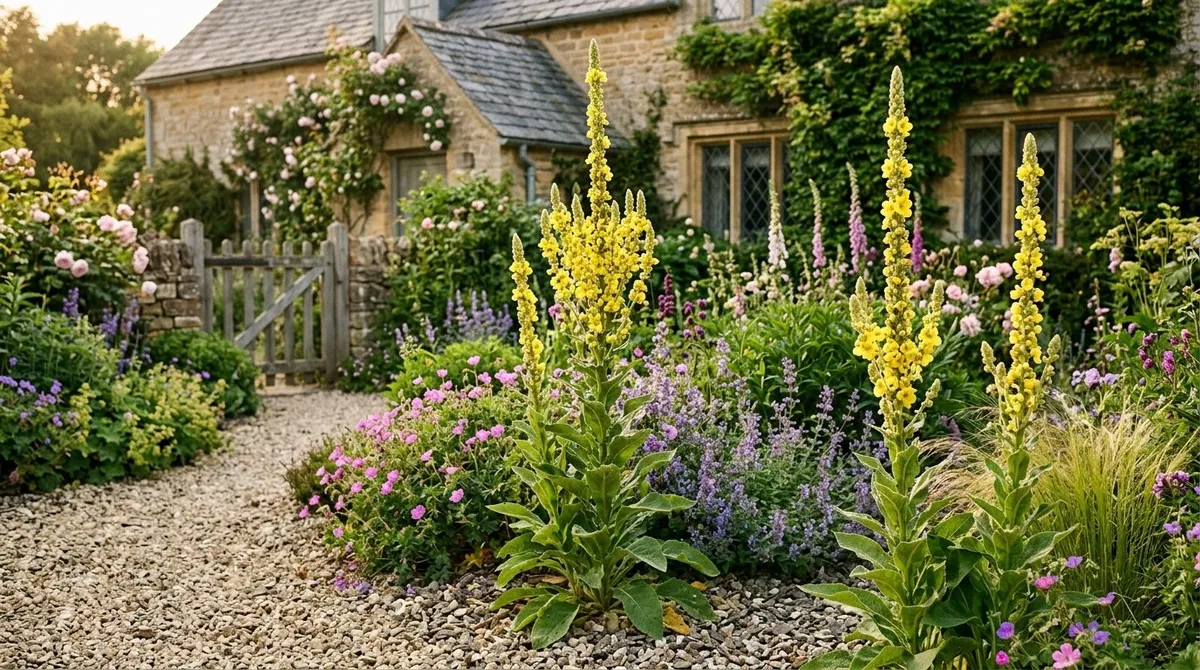
Verbascum is one of the most architectural plants you can grow in a British garden. The tall, candelabra-like flower spikes rise from rosettes of large, often silvery leaves, producing a vertical accent that few other plants can match. Most verbascums thrive in conditions that would kill softer perennials: poor soil, full sun, drought, and neglect.
The genus contains over 360 species, commonly known as mullein. The native great mullein (Verbascum thapsus) grows wild on roadsides, waste ground, and chalk downs across the UK. Garden forms range from compact 60cm hybrids to towering 2.5m specimens. All are easy to grow, and most self-seed freely, ensuring a constant supply of replacement plants.
The dramatic silver-felted rosette of V. bombyciferum in its first year. This biennial produces its towering flower spike the following summer.
What type of plant is verbascum?
Verbascum species fall into three categories: biennial, short-lived perennial, and true perennial. Understanding which type you have determines how you manage the plant.
Biennials produce a rosette of leaves in their first year, then send up a tall flower spike in their second summer, set seed, and die. The native V. thapsus, the dramatic V. bombyciferum, and the giant V. olympicum are all biennial. They persist in the garden through self-seeding rather than returning from the same rootstock.
Short-lived perennials flower for two to four years before declining. V. chaixii, V. phoeniceum, and most named garden hybrids like ‘Clementine’ and ‘Sugar Plum’ fall into this group. They provide reliable colour for several seasons but need replacing eventually.
True perennials are rare in the genus. V. chaixii ‘Album’ is the closest to a genuinely long-lived garden plant, persisting for four to six years in well-drained soil. Even this benefits from allowing self-sown seedlings to develop as insurance.
| Type | Examples | Lifespan | Self-seeds? |
|---|---|---|---|
| Biennial | V. thapsus, V. bombyciferum, V. olympicum | 2 years | Prolifically |
| Short-lived perennial | V. chaixii, V. phoeniceum, hybrids | 2-4 years | Moderately |
| True perennial | V. chaixii ‘Album’ | 4-6 years | Yes, reliably |
Where to plant verbascum
Soil requirements
Verbascum demands poor, dry, well-drained soil. This is the single most important growing requirement. In rich, fertile soil with added compost, verbascums grow lush foliage, produce weak stems that flop over, and die quickly. In poor soil, they stay compact, produce rigid stems, and live longer.
The ideal spot is a south-facing bank, gravel garden, or dry border with thin topsoil over free-draining subsoil. Chalky and alkaline soils are perfect. Sandy and stony soils suit them well. Even rubble-filled ground produces good results.
On heavy clay, which dominates much of the Midlands where I garden, verbascum needs help. Dig a 30cm deep planting pocket and backfill with a 50-50 mix of the original clay and horticultural grit. Top with a 5cm gravel mulch to keep the crown dry. This method has kept V. chaixii ‘Album’ alive in my Staffordshire garden for five consecutive years on otherwise waterlogged clay.
Light requirements
Full sun is essential. Verbascum evolved on open hillsides, roadsides, and Mediterranean scrubland. In shade, plants become leggy, flower poorly, and are more susceptible to rot. A minimum of six hours of direct sunlight per day is needed. South-facing and west-facing positions give the best results.
Companion planting
Verbascum’s vertical form works brilliantly with low, mounding plants that cover its base. Effective companions include:
- Lavender and nepeta for silver-purple contrast at the base
- Sedum and sempervivum in gravel garden settings
- Geranium sanguineum as low ground cover around the rosettes
- Stipa tenuissima (Mexican feather grass) for textural contrast
- Eryngium and echinops for a full dry-garden scheme
All these plants share the same preference for poor soil and full sun, so they thrive together without competition. The combination creates the kind of naturalistic planting seen in cottage garden plans.
Best verbascum species and varieties
Verbascum bombyciferum — giant silver mullein
The most dramatic verbascum for foliage effect. The entire plant, leaves and stems, is covered in dense, silvery-white felt. First-year rosettes reach 60cm across and look like they have been dusted with flour. In the second year, the flower spike shoots to 1.5-2m, carrying sulphur-yellow flowers.
‘Polarsommer’ (also sold as ‘Arctic Summer’) is the best-named selection, with denser felting and more uniform flower spikes than the species. Biennial. Self-seeds generously.
Verbascum chaixii — nettle-leaved mullein
The best verbascum for longevity in UK gardens. A short-lived to true perennial flowering for three to six years. Slender spikes to 90cm carry small flowers with contrasting purple stamens. The white form V. chaixii ‘Album’ is the finest, producing elegant white flowers with mauve centres that complement virtually any border scheme.
‘Album’ is the variety I recommend above all others for perennial borders. It is the most reliably perennial, the most refined in flower, and the least likely to become a weed.
Verbascum olympicum — Olympic mullein
A towering biennial reaching 2-2.5m with branching candelabra-style flower spikes. The largest verbascum commonly grown in UK gardens. The silver-grey rosettes are impressive in their own right, reaching 90cm across. In the second year, the multi-branched flower spike produces hundreds of yellow flowers over several weeks.
Plant at the back of deep borders or use as a focal point in gravel gardens. Self-seeds freely. Seedlings appear in autumn and overwinter as small rosettes.
Verbascum phoeniceum — purple mullein
The most colourful verbascum, producing flowers in shades of purple, pink, and white. Unlike most mulleins, V. phoeniceum has smooth, dark green leaves without the characteristic woolly felt. Flower spikes reach 60-90cm. Short-lived perennial, lasting two to three years.
‘Flush of White’ (pure white), ‘Violetta’ (deep purple), and ‘Cherry Helen’ (rose-pink) are the best-named selections. This species is ideal for the front to middle of borders where its more compact habit and unusual colours add interest.
V. chaixii ‘Album’ flowering in its third year in a Staffordshire border. The white flowers with mauve-purple centres are refined and long-lasting.
Verbascum nigrum — dark mullein
A native UK species with dark green leaves and yellow flowers with purple-bearded stamens. More compact than other mulleins at 60-90cm. Found wild on road verges, banks, and chalk grassland across southern and central England. Short-lived perennial.
This species is valuable for wildlife gardeners because it supports the native mullein moth and other pollinators. It establishes well on poor, disturbed soil and chalk grassland conditions.
Garden hybrids
Modern hybrids bred from crosses between species offer a wider colour range and more compact habits. The best include:
| Variety | Colour | Height | Notes |
|---|---|---|---|
| ’Clementine’ | Burnt orange | 90cm | Unusual colour for the genus |
| ’Sugar Plum’ | Plum-purple | 120cm | Dark stems add drama |
| ’Gainsborough’ | Soft yellow | 120cm | RHS AGM, elegant |
| ’Cotswold Beauty’ | Biscuit-amber | 120cm | Subtle, sophisticated |
| ’Petra’ | Deep rose-pink | 60cm | Compact, good for pots |
Hybrids are generally short-lived perennials lasting two to four years. They self-seed less reliably than species, so take basal cuttings in spring to maintain named varieties.
Growing verbascum from seed
Verbascum seed needs light to germinate. This is the single most important fact. Do not cover the seeds with compost. Sow on the surface and press gently into the compost so the seed makes contact with moisture but remains exposed to light.
Step-by-step seed sowing
- March-April: Fill 9cm pots with seed compost mixed 50-50 with perlite
- Sow on the surface. Scatter 10-15 seeds per pot. Press down lightly. Do not cover
- Water from below by standing pots in a tray of water for 30 minutes. This avoids washing seeds off the surface
- Germination: 14-28 days at 15-20C. Keep in a bright position but out of direct sun until seedlings emerge
- Prick out when the first true leaves appear, into individual 9cm pots of gritty compost
- Grow on through summer, watering sparingly. Plant out in September or the following March
Direct sowing outdoors works for biennial species. Scatter seed onto prepared bare soil in late spring or early autumn. Rake lightly but do not bury. The easiest flowers to grow from seed include several verbascum species, particularly V. thapsus and V. bombyciferum.
Propagation from basal cuttings
Named hybrids do not come true from seed. To maintain a specific variety, take basal cuttings in spring.
Cut a young shoot 8-10cm long from the base of the plant in March or April, with a small piece of root attached. Insert into a 50-50 mix of compost and perlite. Keep moist but not wet. Roots form in four to six weeks. Pot on and plant out in autumn.
Self-seeding behaviour
Verbascum self-seeds prolifically on bare soil, gravel, and disturbed ground. Each flower spike produces thousands of tiny seeds, barely 1mm across, that scatter from the dried capsules in autumn. Seeds remain viable in the soil for years, germinating whenever conditions suit.
In my Staffordshire garden, a single V. bombyciferum planted in 2019 produced self-sown seedlings across a 5m radius within two seasons. Seedlings appeared in gravel paths, between paving slabs, at the base of walls, and in the driest, most unlikely spots. This is typical behaviour. Verbascum seedlings seek out poor, open ground and avoid dense, mulched borders.
To manage self-seeding, remove all but one or two flower spikes before seeds ripen. Leave the retained spikes to produce replacement plants. Hoe out unwanted seedlings at 3cm tall in spring. At that size, they pull out easily. Leave them longer and the deep taproot makes removal harder. Transplant wanted seedlings when they are 5cm tall, before the taproot develops fully.
For more on managing plants that reseed themselves, see our guide to growing cosmos from seed, another prolific self-seeder.
Mullein moth caterpillars
The mullein moth (Cucullia verbasci) is the most significant pest of verbascum in UK gardens. The caterpillars are distinctive: pale grey-green bodies marked with bold yellow and black spots, reaching 5cm long when fully grown. They are one of the most striking-looking caterpillars in Britain.
The moth lays eggs on the underside of verbascum leaves in May. Caterpillars hatch within a week and begin feeding immediately. A group of ten caterpillars can strip a large plant of all its leaves within three to four days. The damage looks alarming but established plants usually survive, sending up new leaves from the crown.
How to manage mullein moth caterpillars
Hand-picking is the most effective method. Check the underside of lower leaves daily from late May through July. Remove caterpillars by hand and relocate them to wild verbascum or a patch you do not mind being defoliated. I check my verbascums every morning for ten minutes during the peak caterpillar season. This keeps damage to cosmetic levels.
Do not use chemical sprays. The mullein moth is a native UK species and an important part of the ecosystem. The caterpillars feed only on verbascum and a few related plants (figwort, buddleia). Accepting some leaf damage is part of growing these plants. The caterpillars pupate in the soil in late summer and emerge as cryptic brown moths the following May.
| Pest/Problem | Symptoms | Solution |
|---|---|---|
| Mullein moth caterpillar | Leaves stripped, grey-green spotted caterpillars | Hand-pick daily May-July |
| Powdery mildew | White coating on leaves in late summer | Improve airflow. Remove affected leaves |
| Crown rot | Plant collapses from base, soft stem | Improve drainage. Do not overwater |
| Aphids | Clusters on flower buds in June | Jet of water or organic soap spray |
| Short lifespan | Plant dies after flowering (biennial types) | Allow self-seeding for replacement |
Verbascum in garden design
Gravel gardens
Verbascum is one of the defining plants of the gravel garden style. Its rosettes sit naturally among stone, and the flower spikes provide height without needing staking. Plant with lavender, alliums, eryngium, and ornamental grasses for a low-maintenance, drought-tolerant scheme.
Cottage gardens
The tall flower spikes of V. olympicum and V. bombyciferum create dramatic accents at the back of cottage garden borders. Underplant with hardy geraniums, aquilegia, and foxgloves. All these plants share the ability to self-seed, creating the spontaneous, abundant look that defines the cottage garden style.
Prairie and naturalistic planting
Verbascum works well in prairie-style plantings alongside echinacea, rudbeckia, and stipa grasses. The Chelsea chop technique does not suit verbascum, but surrounding perennials benefit from it. See our guide to the Chelsea chop for detail on which companion plants respond well to late-May cutting.
Wildlife gardens
Native V. thapsus and V. nigrum support mullein moth caterpillars, attract bees to their pollen-rich flowers, and provide seed for goldfinches in autumn. The tall, dried stems offer overwintering habitat for beneficial insects. Leave dead flower spikes standing until March.
V. olympicum reaching over 2m in a gravel garden setting. The branching candelabra flower spike produces hundreds of yellow blooms over several weeks.
Month-by-month verbascum care
| Month | Task |
|---|---|
| March | Sow seed indoors. Take basal cuttings from hybrids. Remove old dead rosettes |
| April | Plant out pot-grown plants. Thin self-sown seedlings to 30cm apart |
| May | Watch for mullein moth eggs on leaf undersides. Hand-pick caterpillars daily |
| June | Main flowering period begins. No feeding needed |
| July | Flowering continues. Continue caterpillar checks. Cut spent spikes if controlling seed |
| August | Late flowers fade. Leave 1-2 seed heads for self-seeding. Remove the rest |
| September | Self-sown seedlings visible as small rosettes. Transplant to final positions |
| October | Biennial rosettes establish for next year. No watering needed |
| November-February | Leave dead spikes for winter wildlife. No maintenance needed |
The RHS verbascum growing guide provides additional detail on species selection and cultivation in different UK regions.
Frequently asked questions
Is verbascum a perennial or biennial?
Most verbascum species are biennial or short-lived perennials. Biennials like V. bombyciferum and V. olympicum produce a leaf rosette in year one, flower in year two, then die. Short-lived perennials like V. chaixii and V. phoeniceum live 2-4 years. All self-seed freely, ensuring continuity.
What soil does verbascum need?
Verbascum needs poor, dry, well-drained soil in full sun. It thrives in chalky, sandy, and gravelly ground where other plants struggle. Rich, fertile soil causes lush growth that flops and shortens the plant’s life. Never add compost or manure to the planting hole.
How do I grow verbascum from seed?
Sow seed on the surface of moist compost in spring. Do not cover the seeds because verbascum needs light to germinate. Press gently into the surface. Keep at 15-20C. Germination takes 14-28 days. Prick out into individual pots when the first true leaves appear. Plant out in autumn or the following spring.
What eats verbascum leaves?
Mullein moth caterpillars are the main pest. They are pale grey-green with yellow and black spots, reaching 5cm long. They can strip a plant’s leaves completely in a few days. Hand-pick caterpillars daily when spotted. Check the underside of lower leaves first, where eggs are laid in May.
Does verbascum self-seed?
Yes, verbascum self-seeds prolifically on bare soil, gravel, and disturbed ground. Each flower spike produces thousands of tiny seeds. Leave one or two spent flower spikes standing to ensure replacement seedlings. Hoe out unwanted seedlings at 3cm tall in spring.
Can verbascum grow in clay soil?
Verbascum can grow in clay if drainage is improved. Add generous amounts of horticultural grit, 50-50 with the existing soil, in the planting area. Raised beds and gravel-topped borders also work. On unamended heavy clay, verbascum roots rot in winter. Good drainage is more important than soil type.
Which is the best verbascum for UK gardens?
V. chaixii ‘Album’ is the best long-lived perennial verbascum for UK borders. It produces white flowers with purple centres on 90cm stems for 3-4 years. For dramatic foliage, V. bombyciferum ‘Polarsommer’ has the finest silver-felted leaves. For the tallest spikes, V. olympicum reaches 2m or more.
Lawrie has been gardening in the West Midlands for over 30 years. He grows his own veg using no-dig methods, keeps a wildlife-friendly garden, and writes practical advice based on real UK growing conditions.