How to Grow Viburnum in the UK
Learn how to grow viburnum in the UK with species for every season. Covers planting, pruning, soil needs and 8 top varieties from expert growers.
Key takeaways
- Viburnum bodnantense 'Dawn' flowers from November to March, providing scent when almost nothing else blooms
- Viburnum tinus is fully evergreen and flowers through winter, making it the best viburnum for hedging
- Most viburnum species tolerate clay soil, chalk, and partial shade without complaint
- Prune deciduous viburnums after flowering by removing one in five of the oldest stems at ground level
- Viburnum opulus (guelder rose) is a UK native that produces red berries eaten by thrushes and waxwings
- Viburnum davidii needs male and female plants within 5m of each other to produce its metallic blue berries
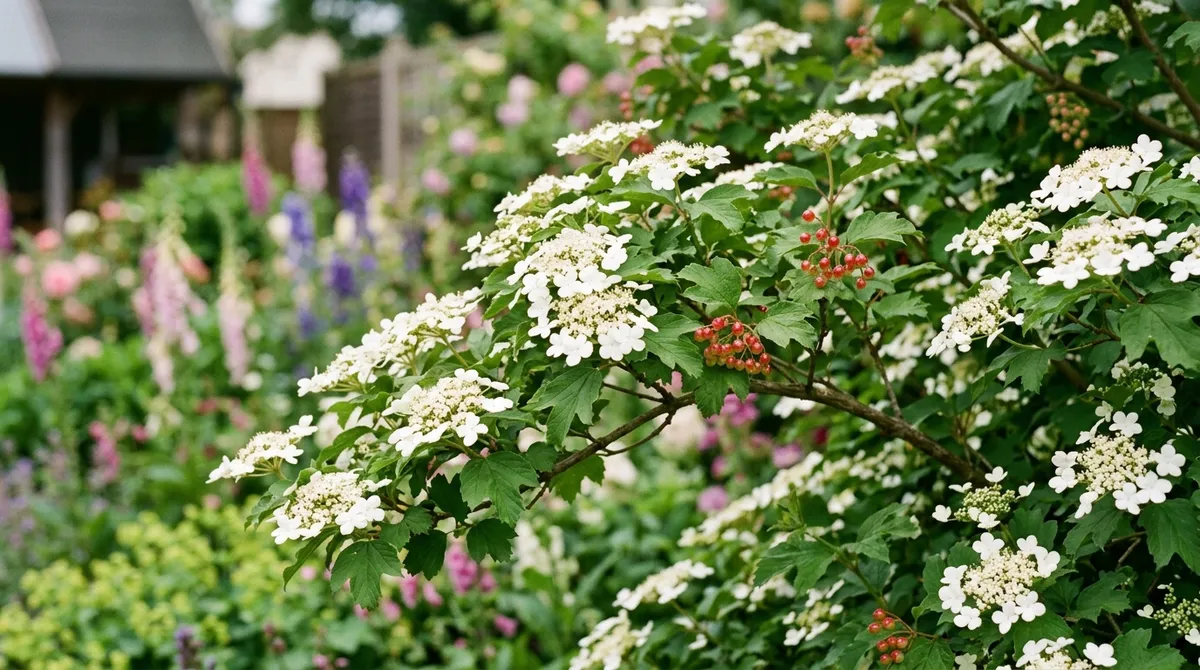
Viburnum is one of the most versatile shrub genera for UK gardens, offering flowers in every season, berries for birds, and evergreen screening where you need it most. From the intensely fragrant winter flowers of V. bodnantense ‘Dawn’ to the translucent red berries of the native guelder rose, there is a viburnum for every soil type, aspect, and garden size in Britain.
I have grown eight viburnum species in heavy Staffordshire clay for nine years, through three notably harsh winters. Every one survived. That kind of cast-iron reliability is rare in ornamental shrubs. This guide covers the best species for UK conditions, with specific advice on planting, pruning, and the one mistake that stops V. davidii producing its famous blue berries.
Which viburnum species grow best in the UK?
The genus Viburnum contains over 150 species worldwide, but roughly 30 perform well across the UK. The eight below are the most reliable for British gardens, covering every season and situation from exposed hedgerows to shaded town plots. Each has earned the RHS Award of Garden Merit (AGM) or proved itself over decades of UK cultivation.
Viburnum bodnantense ‘Dawn’
This is the outstanding winter-flowering shrub for British gardens. Clusters of intensely fragrant pink flowers appear on bare stems from late November and continue through to early March. On a still winter morning, the scent carries 10m or more. Plants grow 2.5-3m tall and 2m wide, with an upright, vase-shaped habit. The foliage turns bronze in autumn before dropping. ‘Dawn’ thrives in full sun or light shade on any reasonable soil, including heavy clay and chalk. It received the RHS AGM and is one of the best winter flowering shrubs available.
Viburnum tinus (laurustinus)
The premier evergreen viburnum for UK gardens. Dense, dark green foliage stays on the plant year-round, making it a first-rate hedging and screening shrub. Flat clusters of pink buds open to white flowers from November through to April. Dark blue-black berries follow in summer. Plants reach 2-3m tall and wide if left unpruned. V. tinus tolerates deep shade, heavy clay, coastal exposure, and urban pollution. ‘Eve Price’ is the best compact variety at 2m, with darker pink buds. ‘Gwenllian’ flowers more heavily and berries more reliably than the straight species.
Viburnum opulus (guelder rose)
Britain’s native viburnum, found in hedgerows and damp woodland margins throughout England and Wales. Flat lacecap heads of white flowers appear in May and June, followed by heavy clusters of translucent red berries from September that attract birds through winter. Mistle thrushes and waxwings favour guelder rose berries above almost all others. The maple-shaped leaves turn vivid crimson in autumn. Plants grow 3-4m tall and wide. V. opulus tolerates wet soil better than any other viburnum, making it the species for damp ground and clay soil gardens. The variety ‘Compactum’ stays at 1.5m and berries heavily.
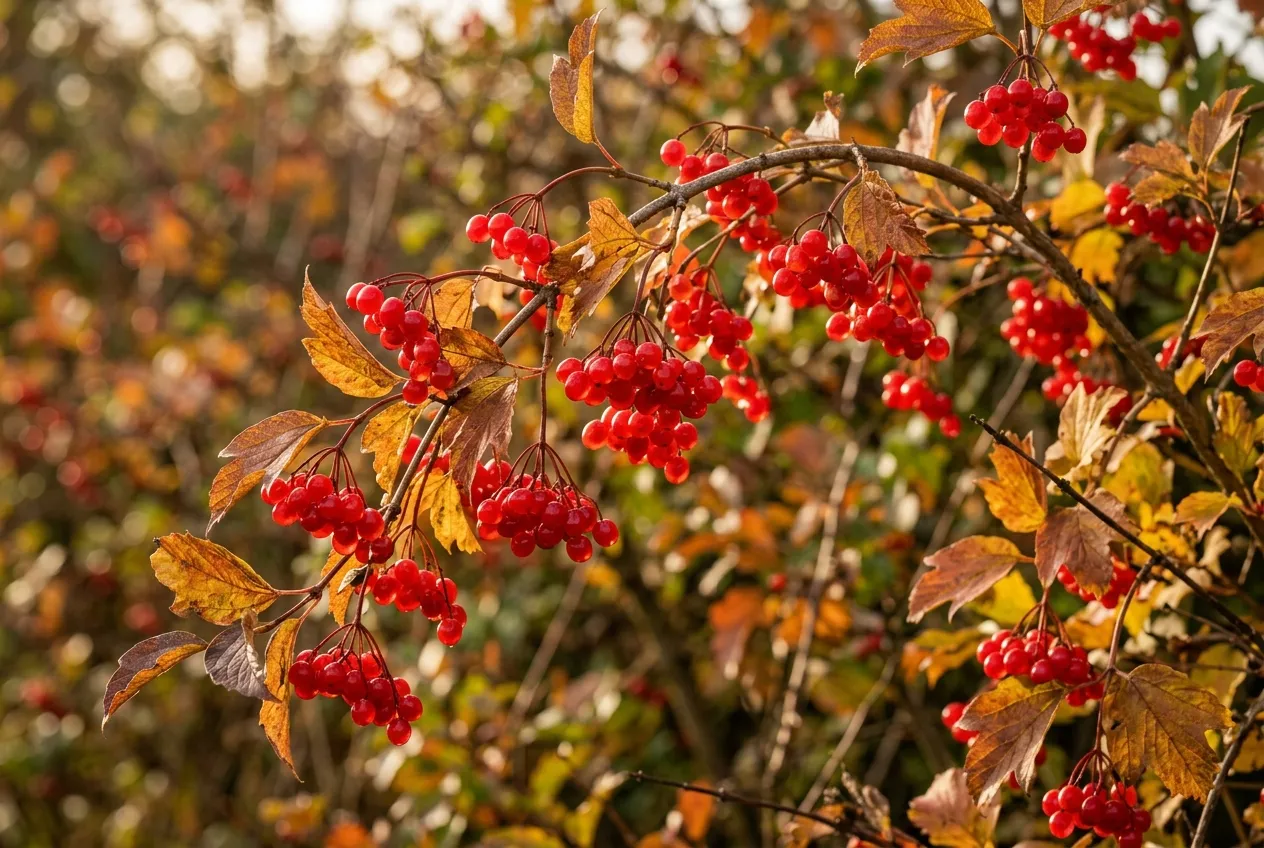
Viburnum opulus berries hang in translucent red clusters from September. Mistle thrushes and fieldfares strip them by January.
Viburnum davidii
A low, dome-forming evergreen reaching just 1-1.5m tall and wide. The large, dark green leaves have three prominent veins running their length, giving them a distinctive corrugated appearance. Female plants produce clusters of striking metallic turquoise-blue berries in autumn, but only when a male pollinator grows within 5m. Plant one male to every two or three females. V. davidii is outstanding as ground cover in shade, under trees, or at the front of a shrub border. It tolerates most soils but dislikes very dry, chalky ground. Fully hardy throughout the UK.
Viburnum plicatum ‘Mariesii’
The Japanese snowball viburnum has a unique tiered, horizontal branching habit that looks architectural even in winter. White lacecap flowers line the upper surface of each branch in May and June, creating the effect of a layered wedding cake. Red berries follow, turning black by autumn. Plants grow 2-3m tall and up to 4m wide, so give it space. V. plicatum needs full sun or very light shade and reasonably well-drained soil. Heavy shade ruins the tiered habit. This is a specimen shrub for an open lawn or the back of a wide border.
Viburnum carlesii
Valued above all for its extraordinary fragrance. Dense, rounded clusters of pink buds open to waxy white flowers in April and May, releasing a sweet, spicy scent that rivals daphne. Plants grow 1.5-2m tall and wide with a rounded habit. The autumn foliage turns wine-red. V. carlesii prefers moist, humus-rich soil in sun or part shade. It is slower-growing than V. bodnantense but utterly reliable once established. ‘Aurora’ has deeper pink buds and is the variety most commonly sold.
Viburnum burkwoodii
A semi-evergreen hybrid combining the fragrance of V. carlesii with better vigour and a longer flowering season. Rounded clusters of scented white flowers appear from February to May. The glossy dark green leaves are semi-evergreen, dropping in harsh winters but holding on through mild ones. Plants reach 2-2.5m tall and wide. V. burkwoodii tolerates most soils and positions, including light shade. It works well as a boundary shrub or informal screen and is one of the toughest viburnums for exposed gardens.
Viburnum lantana (wayfaring tree)
A UK native found on chalk downland and limestone soils. Cream-white flower clusters appear in May, followed by berries that ripen from red through to black, often showing all colours at once on the same cluster. The oval, felted grey-green leaves resist drought and wind. Plants grow 3-5m tall. V. lantana thrives on thin, alkaline soil where many other shrubs struggle. It makes an outstanding informal hedgerow plant for chalk and limestone areas.
Viburnum species comparison table
| Species | Type | Height | Flowers | Berries | Best soil | Shade tolerance |
|---|---|---|---|---|---|---|
| V. bodnantense ‘Dawn’ | Deciduous | 2.5-3m | Nov-Mar (pink) | None | Any, incl. clay | Light shade |
| V. tinus | Evergreen | 2-3m | Nov-Apr (white) | Blue-black | Any, incl. clay | Deep shade |
| V. opulus | Deciduous | 3-4m | May-Jun (white) | Red | Damp, clay | Partial shade |
| V. davidii | Evergreen | 1-1.5m | Jun (white) | Turquoise-blue | Moist, not chalky | Full shade |
| V. plicatum ‘Mariesii’ | Deciduous | 2-3m | May-Jun (white) | Red to black | Well-drained | Full sun best |
| V. carlesii | Deciduous | 1.5-2m | Apr-May (white) | Red to black | Moist, humus-rich | Partial shade |
| V. burkwoodii | Semi-evergreen | 2-2.5m | Feb-May (white) | Red to black | Any | Light shade |
| V. lantana | Deciduous | 3-5m | May (cream) | Red/black | Chalk, alkaline | Light shade |
How to plant viburnum in the UK
Autumn (October to November) is the best planting time for all viburnums. The soil retains warmth from summer, and autumn rain keeps roots moist while they establish. Spring planting works but requires weekly watering through the first summer.
Dig a hole twice the width of the rootball and the same depth. Set the plant so the rootball surface sits level with the surrounding soil. Backfill with the excavated earth, firm with your heel, and water with 10 litres. Apply a 5-8cm mulch of bark chips or garden compost around the base, leaving a 5cm gap around the stems.
On heavy clay, dig the hole 10cm shallower than the rootball and mound soil slightly around the base. This prevents waterlogging around the crown. V. opulus is the exception: it naturally grows in damp ground and can be planted at normal depth even on wet clay.
For V. davidii, plant one male and at least two females within 5m of each other. Males are sold labelled, but if unlabelled, buy three or more plants to ensure a mix. Without a male pollinator, females produce no berries.
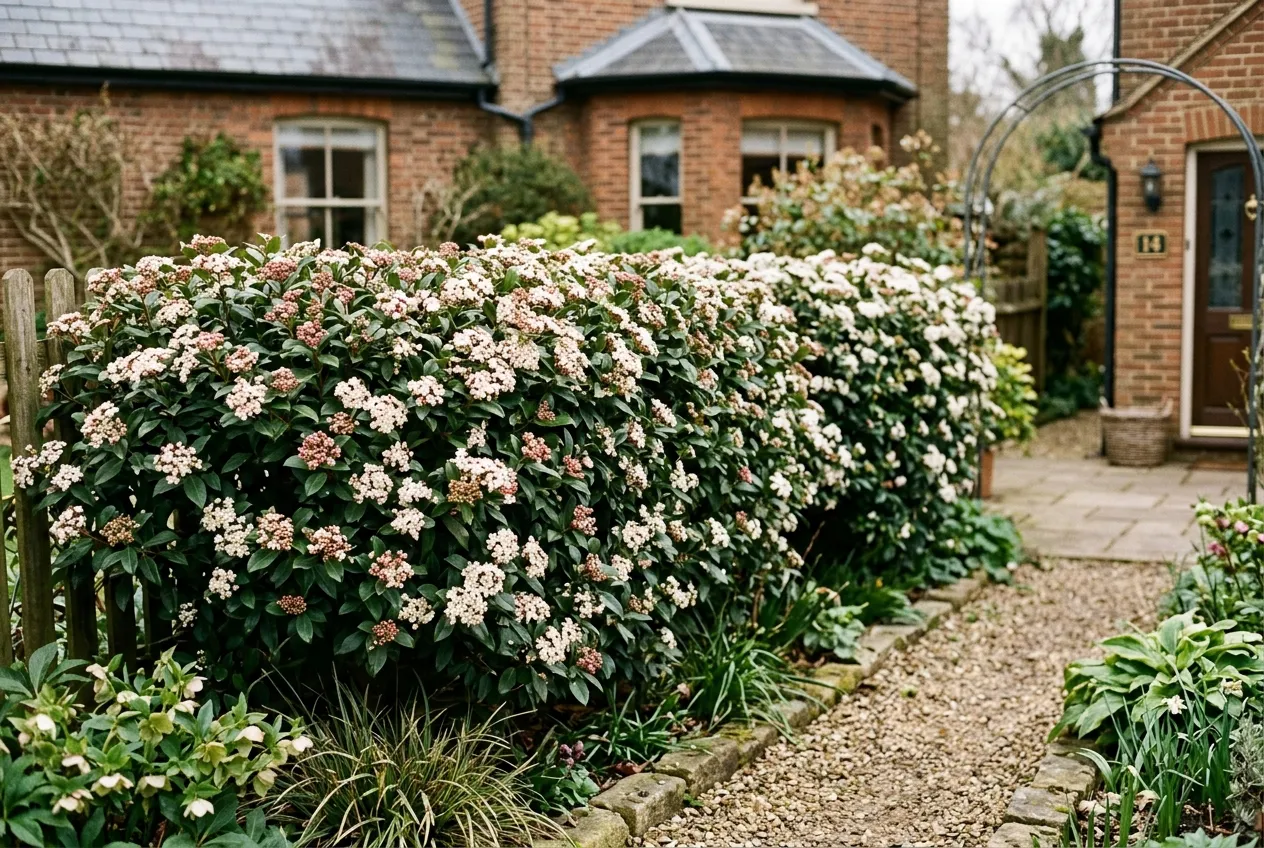
Viburnum tinus makes a dense evergreen hedge that flowers through winter. Clip once in late spring after the main flush.
What soil does viburnum need?
Most viburnums are remarkably tolerant of soil type. Clay, loam, chalk, and sandy ground all support healthy growth. The table below shows specific preferences by species.
| Species | Clay | Chalk | Sand | Acid soil | Wet ground |
|---|---|---|---|---|---|
| V. bodnantense | Yes | Yes | Yes | Yes | No |
| V. tinus | Yes | Yes | Moderate | Yes | No |
| V. opulus | Yes | Moderate | No | Yes | Yes |
| V. davidii | Yes | No | No | Yes | No |
| V. plicatum | Moderate | Yes | Yes | Yes | No |
| V. carlesii | Yes | Yes | No | Neutral-alkaline best | No |
| V. burkwoodii | Yes | Yes | Yes | Yes | No |
| V. lantana | No | Yes (ideal) | Yes | No | No |
If your garden has heavy clay, V. opulus, V. bodnantense, and V. tinus are the safest choices. On thin chalk, V. lantana and V. burkwoodii perform best. V. davidii dislikes alkaline soil and dry conditions, so avoid it on chalk or free-draining sand.
Improve any soil at planting time by mixing well-rotted garden compost into the backfill. This helps moisture retention on sand and improves drainage on clay. No other amendment is needed for established viburnums. They are not fussy feeders.
When and how to prune viburnum
Pruning viburnum correctly depends on whether the species is deciduous or evergreen, and when it flowers. Get the timing wrong and you remove next season’s blooms.
Deciduous winter-flowering viburnums (V. bodnantense, V. farreri): Prune in March or April, immediately after flowering ends. Remove one in five of the oldest stems at ground level to encourage fresh basal growth. Do not cut the whole plant back hard; viburnums do not regenerate well from bare stumps.
Deciduous summer-flowering viburnums (V. opulus, V. plicatum, V. carlesii): Prune immediately after flowering in July. Remove one in five of the oldest branches at the base. V. plicatum should be left largely unpruned to preserve its tiered habit. Only remove dead, crossing, or damaged branches.
Evergreen viburnums (V. tinus, V. davidii): Prune lightly in late April or May after the main flowering flush. Shorten wayward shoots to maintain shape. V. tinus grown as a hedge can be clipped more firmly. Never cut into old, bare wood on evergreen viburnums, as regrowth from old stems is poor. For detailed pruning techniques for all shrub types, see our pruning shrubs guide.
Lawrie’s note on renovation pruning: I inherited a 3m V. tinus that had been neglected for a decade. Rather than cutting the whole thing back (which risks killing it), I removed one-third of the oldest stems at the base each March for three consecutive years. By year three, it was a completely refreshed plant full of new flowering wood. This staged approach works for every viburnum species.
Viburnum seasonal interest calendar
One of the great strengths of this genus is that you can have at least one viburnum in flower or berry every month of the year. Plant three or four species and you never have a gap.
| Month | In flower | In berry |
|---|---|---|
| January | V. bodnantense, V. tinus | V. tinus (blue-black) |
| February | V. bodnantense, V. tinus, V. burkwoodii | V. tinus |
| March | V. bodnantense, V. tinus, V. burkwoodii | V. tinus |
| April | V. tinus, V. burkwoodii, V. carlesii | V. tinus |
| May | V. opulus, V. plicatum, V. carlesii, V. lantana | V. tinus |
| June | V. opulus, V. plicatum, V. davidii | None |
| July | V. davidii (late) | None |
| August | None | V. opulus (ripening), V. lantana (ripening) |
| September | None | V. opulus (red), V. lantana (red/black), V. davidii (blue) |
| October | V. bodnantense (starts) | V. opulus, V. davidii |
| November | V. bodnantense, V. tinus (starts) | V. opulus, V. davidii |
| December | V. bodnantense, V. tinus | V. opulus (stripped by birds) |
For year-round viburnum interest, the minimum combination is V. bodnantense ‘Dawn’ (winter flowers), V. opulus ‘Compactum’ (summer flowers and autumn berries), and V. tinus ‘Eve Price’ (evergreen structure and winter/spring flowers). These three together cover every month and all grow happily in the same clay border.
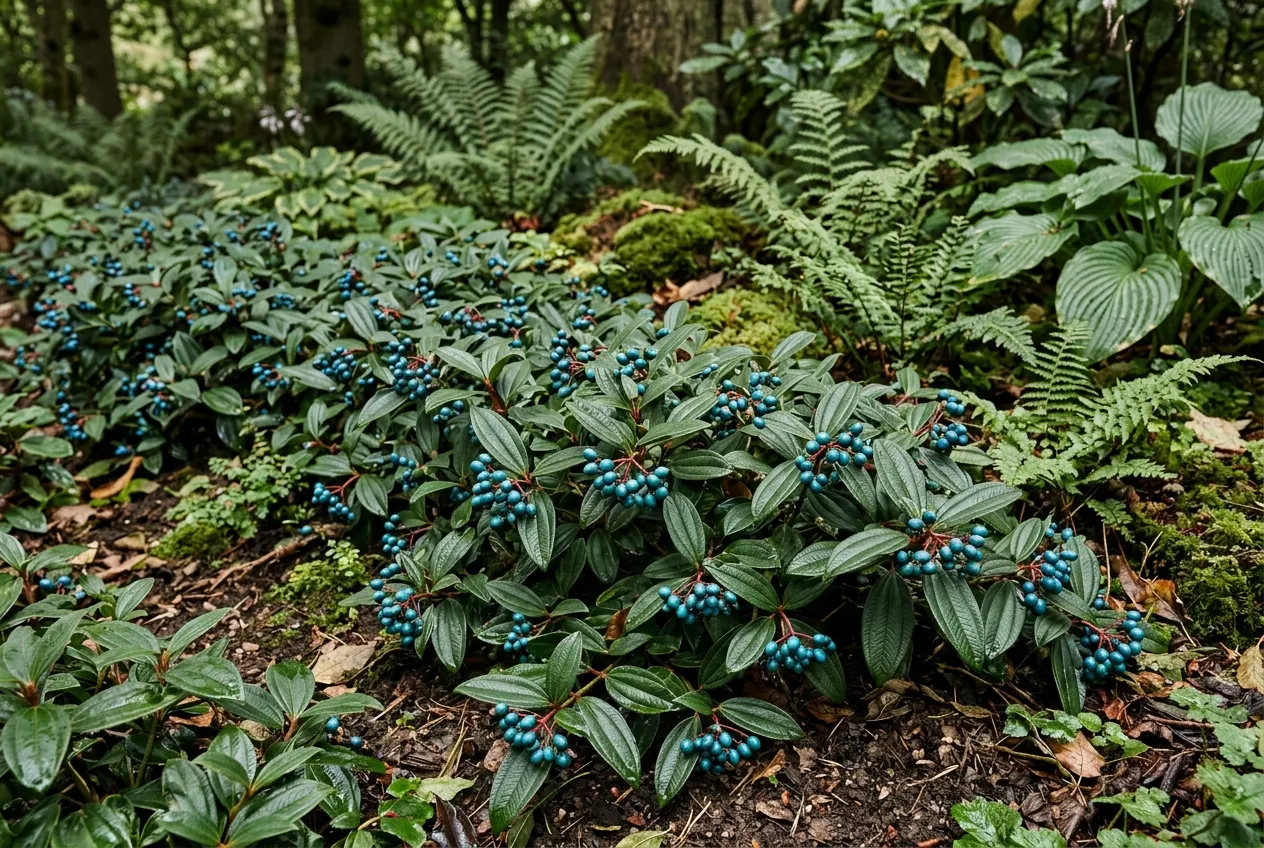
Viburnum davidii produces its metallic blue berries only when male and female plants grow within 5m. Plant three to guarantee a mix.
How to propagate viburnum
Viburnums propagate readily from softwood cuttings taken in June or semi-ripe cuttings in August. Both methods are straightforward.
Softwood cuttings (June): Take 10cm shoot tips from the current year’s growth. Strip the lower leaves, dip the cut end in hormone rooting powder, and insert into pots of 50:50 perlite and multipurpose compost. Cover with a clear plastic bag and place in a warm, bright spot out of direct sun. Roots form in 4-6 weeks. Pot on individually once rooted and grow on for a full year before planting out.
Semi-ripe cuttings (August): Take 15cm lengths from this year’s growth where the base has begun to firm up. Prepare and root as for softwood cuttings. These root more slowly (6-8 weeks) but produce sturdier plants.
Layering (autumn): Peg a low branch to the ground in October, cover the pegged section with soil, and leave for 12 months. Sever from the parent plant the following autumn and transplant. This is the simplest method for V. plicatum and V. davidii, whose low branches layer naturally. For more propagation methods, see our guide to plant propagation.
Common viburnum problems in UK gardens
Viburnum beetle
The viburnum beetle (Pyrrhalta viburni) is the most serious pest. Larvae strip leaves to skeletons in April and May. Adults emerge in July and chew irregular holes. V. opulus and V. lantana are the worst affected; V. tinus and V. davidii are rarely attacked. Check the underside of leaves in April for clusters of small, yellowish-brown larvae. Pick off by hand or spray with an organic pyrethrin-based insecticide. The RHS viburnum beetle page provides identification photographs and a full control guide.
Leaf spot
Brown or black spots on leaves, sometimes with a yellow halo, usually caused by fungal infections during wet summers. Remove and destroy affected leaves. Improve air circulation by thinning crowded branches. Healthy, well-established plants tolerate leaf spot without lasting damage. Avoid overhead watering, as wet foliage encourages the fungus.
No berries on V. davidii
This almost always means you have plants of only one sex. V. davidii requires cross-pollination between male and female plants. Buy from a nursery that labels plants by sex, or plant three or more to ensure at least one male is present. Poor berry set in a given year can also result from cold, wet weather during the June flowering period, which reduces pollinator activity.
Dieback on V. tinus
Phytophthora root rot causes brown, wilting shoots and eventual death of branches. It occurs on waterlogged soil, especially in heavy clay where drainage is poor. Improve drainage before planting. Remove and destroy affected branches, cutting back to healthy wood. In severe cases, the plant may need replacing on a better-drained site.
Viburnum for wildlife in UK gardens
Viburnums are among the best shrubs for supporting British wildlife. The winter flowers of V. bodnantense and V. tinus provide vital early nectar for queen bumblebees emerging from hibernation. The summer flowers of V. opulus feed hoverflies, solitary bees, and small beetles. The berries of V. opulus are eaten by at least 15 species of British bird, with mistle thrushes famously defending a berry-laden guelder rose from all comers. The Wildlife Trusts recognise guelder rose as one of the most valuable native shrubs for UK biodiversity.
For a wildlife-focused viburnum planting, combine V. opulus (berries and lacecap flowers), V. tinus (winter nectar and nesting cover), and V. lantana (multi-stage berries). All three provide dense cover for nesting birds and shelter for overwintering insects. Pair them with bee-friendly plants for a border that supports pollinators from February to October.
Dense evergreen shrubs like V. tinus and V. davidii provide excellent winter shelter, giving birds cover from wind and rain when deciduous plants have dropped their leaves.
Using viburnum in garden design
Viburnum fits into almost every garden style and situation. The genus offers plants for hedging, specimen planting, ground cover, woodland edges, and mixed borders.
Formal hedging: V. tinus clips into a dense, tidy hedge 1.5-3m tall. It keeps foliage right to ground level, unlike laurel which tends to go bare at the base. Clip once in late spring after flowering. Plant 60cm apart for a hedge that fills within 3 years. V. tinus makes an outstanding hedge plant for north-facing boundaries where other evergreens struggle.
Specimen planting: V. plicatum ‘Mariesii’ is one of the finest specimen shrubs for a lawn. Its horizontal branches spread wide, carrying white lacecap flowers along their upper surface in May. Give it a central position where the tiered habit is visible from all sides.
Shaded borders: V. davidii and V. tinus tolerate deep shade. Use V. davidii at the front of shaded borders beneath trees, and V. tinus as a background evergreen. Both maintain a handsome appearance year-round without direct sun.
Mixed borders: V. bodnantense ‘Dawn’ and V. carlesii work well in mixed borders alongside flowering shrubs like philadelphus, weigela, and deutzia. The viburnums provide winter and early spring interest while the other shrubs carry the display through summer.
Native hedgerows: V. opulus and V. lantana are traditional hedgerow components. Combine with hawthorn, blackthorn, and field maple for a native hedge that supports maximum wildlife. Both viburnum species establish quickly from bare-root plants set 45cm apart between November and March.
Now you know how to grow viburnum in the UK, explore our guide to the best perennial plants for UK gardens for companion planting that extends your border’s season through summer and autumn.
Frequently asked questions
What is the best viburnum for a small UK garden?
Viburnum davidii is the best choice for small gardens at just 1-1.5m. It forms a neat evergreen dome and produces metallic blue berries in autumn when planted with a male pollinator nearby. V. tinus ‘Eve Price’ stays compact at 2m and flowers from November to April, making it another strong option for limited spaces. Both tolerate shade and clay soil, which suits the majority of small urban gardens in the UK.
When should I prune viburnum?
Prune immediately after flowering for the species in question. Winter-flowering types like V. bodnantense get pruned in March or April. Summer-flowering types like V. opulus and V. plicatum get pruned in July. Evergreen species like V. tinus only need light shaping in late April or May. The key rule for all viburnums: remove one in five of the oldest stems at the base rather than cutting the whole plant back, as viburnums recover poorly from hard pruning.
Can viburnum grow in shade?
Most viburnum species tolerate partial shade, and several thrive in deep shade. V. davidii and V. tinus flower and berry reliably in positions that receive less than two hours of direct sunlight. V. bodnantense and V. opulus flower best with morning sun but manage in dappled shade. V. plicatum ‘Mariesii’ is the one species that genuinely needs full sun to develop its characteristic tiered form.
Is viburnum poisonous to dogs or cats?
Viburnum berries are mildly toxic and cause stomach upset if eaten in quantity. The intensely bitter taste means dogs and cats rarely eat enough to cause serious harm. Symptoms include vomiting and diarrhoea. Contact your vet if a pet consumes a significant amount. The leaves and stems are not considered toxic. See our guide to plants toxic to dogs for a full list of species to watch.
How fast does viburnum grow?
Most viburnums grow 30-45cm per year once their roots establish in the second season. V. tinus is the fastest at 40-50cm per year, reaching hedging height within 3-4 years from a 60cm plant. V. davidii is the slowest at 15-20cm annually. All viburnums grow little in their first year after planting, so do not expect immediate results. Regular watering through the first summer accelerates establishment.
Why are there no berries on my viburnum?
The most common reason is having only one plant of a dioecious species. V. davidii needs both male and female plants within 5m to set its blue berries. V. opulus needs cross-pollination from another V. opulus plant (or a different variety). Even self-fertile species like V. tinus berry more heavily with a second plant nearby. Cold, wet weather during flowering also reduces berry production by limiting pollinator visits.
Does viburnum make a good hedge?
Viburnum tinus is one of the best evergreen hedging plants for UK conditions. It maintains dense foliage from ground level to the top, tolerates shade, clay, chalk, and coastal exposure, and produces flowers through winter. Clip once in late spring. Plant at 60cm spacing for a solid screen within three years. It outperforms laurel in shade and on heavy clay, and unlike privet it provides winter flowers and berries for birds.
Lawrie has been gardening in the West Midlands for over 30 years. He grows his own veg using no-dig methods, keeps a wildlife-friendly garden, and writes practical advice based on real UK growing conditions.