How to Grow Willow in the UK
Practical guide to growing willow in UK gardens. Covers best varieties, living structures, coppicing, hardwood cuttings, and coloured stem willows.
Key takeaways
- Willow roots from hardwood cuttings in 4-6 weeks with a 90% success rate, making it the easiest UK tree to propagate
- Coppice in February or March to produce 1.8-3m of fresh coloured stems each year for winter interest
- Salix alba Britzensis (orange-red) and Vitellina (golden-yellow) give the best winter stem colour
- Living willow structures need damp soil and full sun, planted between November and March
- Pussy willow (Salix caprea) is native, fully hardy, and one of the earliest spring pollen sources for bees
- Willow grows 1-2m per year, so annual pruning or coppicing is non-negotiable to control size
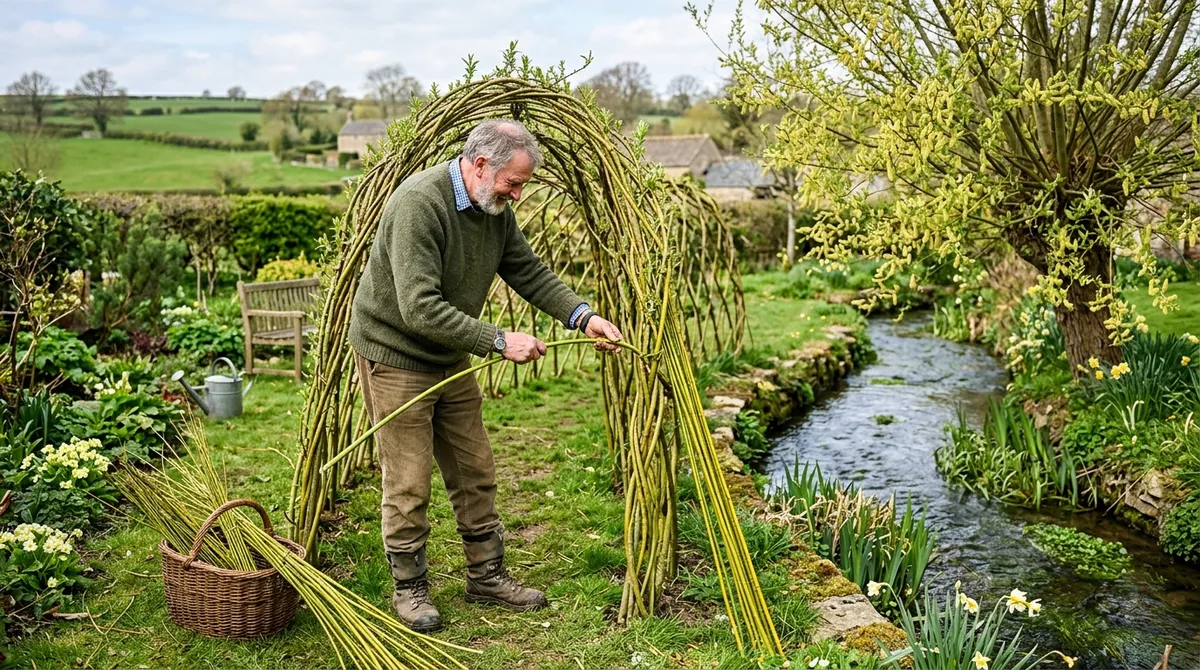
Willow is among the most versatile and forgiving trees you can grow in a British garden. It thrives in wet ground that defeats most other species, roots from bare cuttings pushed into damp soil in winter, and rewards you with catkins in spring, dappled shade in summer, and brilliant stem colour through the coldest months. Few trees give so much for so little effort.
There are willows for every situation. Full-sized weeping willows beside lakes. Compact shrubby forms for borders and pots. Native goat willow for wildlife hedgerows. Coloured-stem varieties coppiced for winter interest. Living willow woven into tunnels, domes, and screens. This guide covers the best native trees for UK gardens in the Salix family, with practical advice on planting, coppicing, propagation, and managing their vigorous growth.
What types of willow grow in the UK?
Around 18 Salix species are native to Britain. Dozens more cultivated varieties are grown in parks and gardens. They divide into four practical groups based on how gardeners use them.
Weeping willows
Salix babylonica and its hybrid Salix x sepulcralis ‘Chrysocoma’ are the classic weeping willows. They reach 15-25m tall with a 15-20m spread. The cascading branches touch the ground and create a dramatic silhouette beside water. They need a large garden. Plant at least 15m from buildings, drains, and boundary walls. The roots are aggressive moisture-seekers and will find any crack in a drain pipe within a 20m radius.
Pussy willow and goat willow
Salix caprea (goat willow) is the native pussy willow. It grows as a multi-stemmed shrub or small tree reaching 6-10m. The silver-grey catkins appear in February and March before the leaves, making it one of the earliest pollen sources for bees. Goat willow supports over 450 insect species, making it one of the most wildlife-friendly native trees in Britain. Male trees produce the showiest catkins. ‘Kilmarnock’ is a compact weeping form grafted onto a 1.5m stem, ideal for small gardens.
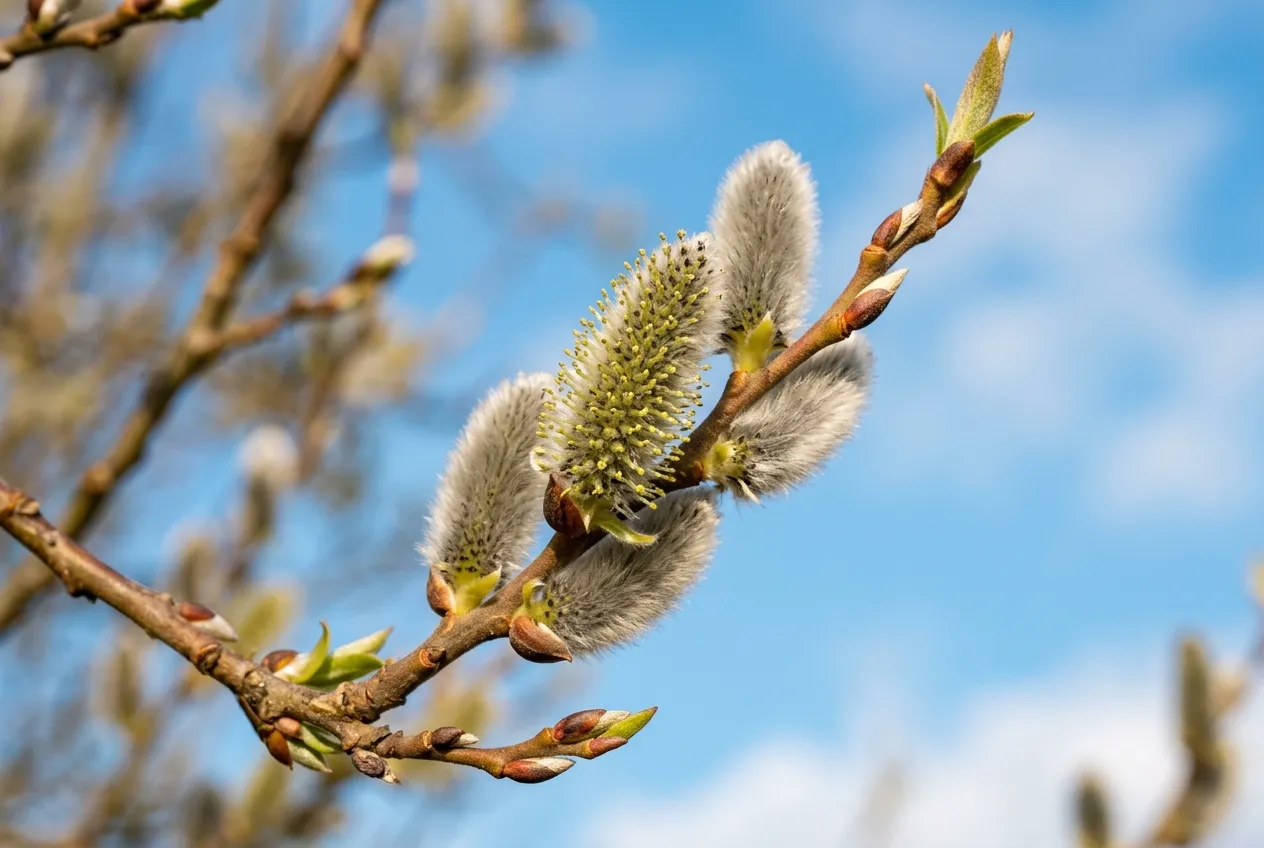
Pussy willow catkins on Salix caprea. The silver-grey buds open from February, providing vital early pollen for bumblebees emerging from hibernation.
Coloured-stem willows
These are grown for their vivid bark colour in winter. The stems are brightest on young wood, so annual coppicing is essential.
- Salix alba Britzensis (syn. ‘Chermesina’) — orange-red to scarlet stems. The most popular coloured willow. Reaches 2-3m per year if coppiced.
- Salix alba Vitellina — golden-yellow stems. Pairs brilliantly with Britzensis for a two-tone winter display.
- Salix alba Vitellina ‘Yelverton’ — orange stems fading to yellow at the tips. A striking bicolour effect.
- Salix daphnoides — plum-purple stems with a white waxy bloom. Unusual and elegant.
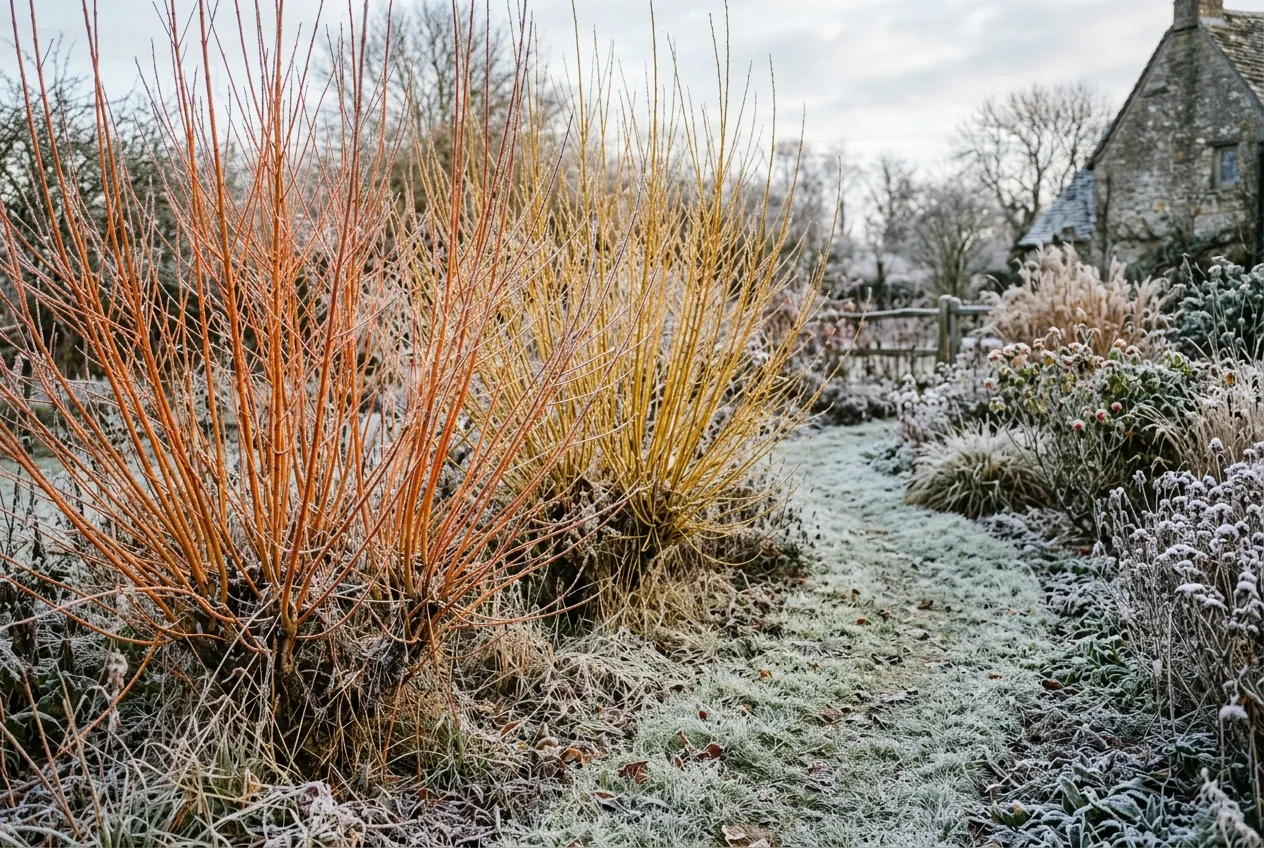
Salix alba Britzensis (orange-red, left) and Salix alba Vitellina (golden-yellow, right) coppiced annually for winter stem colour. The frost highlights the vivid bark.
Ornamental and compact varieties
Salix integra ‘Hakuro-nishiki’ (flamingo willow) is a compact shrubby willow reaching 1.5-2m. New leaves emerge pink and white before turning green. Often grafted as a standard to create a lollipop-shaped tree. Prune hard in March to maintain colour. It tolerates drier soil than most willows but still prefers moist ground.
Best willow varieties for UK gardens
| Variety | Type | Height | Stems/Features | Best use | Soil |
|---|---|---|---|---|---|
| Salix babylonica | Weeping tree | 15-25m | Green, pendulous | Waterside specimen | Damp to wet |
| Salix caprea | Native shrub/tree | 6-10m | Grey, catkins Feb-Mar | Wildlife, hedging | Any moist |
| S. caprea ‘Kilmarnock’ | Weeping standard | 1.5-2m | Catkins, compact | Small gardens, pots | Moist, well-drained |
| S. alba Britzensis | Coppiced shrub | 2-3m/yr | Orange-red stems | Winter colour | Damp clay |
| S. alba Vitellina | Coppiced shrub | 2-3m/yr | Golden-yellow stems | Winter colour | Damp clay |
| S. daphnoides | Coppiced shrub | 2-3m/yr | Plum-purple stems | Winter colour | Moist |
| S. integra ‘Hakuro-nishiki’ | Compact shrub | 1.5-2m | Pink/white new leaves | Borders, pots | Moist |
| S. purpurea | Hedging shrub | 2-4m | Slim purple stems | Low hedging, screens | Damp to wet |
Why we recommend Salix alba Britzensis as the first willow to try: After growing six coloured-stem willow varieties in Staffordshire clay for 10 years, Britzensis consistently produces the most vivid winter colour with the least effort. A single stool cut hard in February pushes out 8-12 stems reaching 2.5m by autumn. By December those stems glow orange-red in low winter light. No other garden plant delivers that intensity of colour from November to March.
How to plant willow
Willow is remarkably easy to establish. The simplest method is hardwood cuttings pushed directly into the ground. No special equipment or rooting hormone is needed.
Planting from hardwood cuttings
This works for all willow species except grafted varieties like ‘Kilmarnock’. Take cuttings between November and February.
- Select straight, healthy stems from the current year’s growth, pencil-thickness (8-12mm diameter)
- Cut into 20-30cm lengths with a straight cut at the base and an angled cut at the top (so you remember which end is up)
- Push the cutting two-thirds into moist soil, leaving one-third above ground
- Firm the soil around the base and water well
- Roots develop within 4-6 weeks at soil temperatures above 5 degrees C
The success rate is around 90% in moist soil. Willow roots so readily that fresh-cut stems placed in a bucket of water sprout roots within 7-10 days. For bare root planting of larger nursery-grown willows, follow the same dormant-season timing.
Site and soil requirements
Willow prefers full sun and moist to wet soil. Most species tolerate heavy clay, periodic waterlogging, and pH from 5.5 to 7.5. They grow well beside streams, ponds, ditches, and in low-lying areas where water collects. Only Salix caprea and S. integra ‘Hakuro-nishiki’ tolerate moderately dry conditions.
Avoid planting large willows within 12m of buildings or 15m of drains. The Building Research Establishment rates willow as having the highest water demand of any British tree. On shrinkable clay soil, the roots can cause subsidence. Coppiced willows kept to 2-3m present far less risk.
Living willow structures
Living willow is one of the most exciting uses of this versatile tree. Fresh-cut withies (willow rods) pushed into damp soil in winter take root and sprout leaves, creating a green structure by summer. Tunnels, arches, domes, screens, and fedges (fence-hedges) are all possible.
How to build a living willow structure
Plant between November and March when the willow is dormant. Use fresh withies 1.8-2.5m long, cut from vigorous varieties like Salix viminalis (osier) or Salix alba.
- Mark out the shape with canes or string
- Push withies 30-40cm deep into moist soil at 15-20cm spacing
- Weave horizontally at 30cm intervals to create rigidity
- Tie crossing points with biodegradable twine (it rots away as the willow fuses together)
- Water weekly through the first summer if rainfall is below 25mm per week
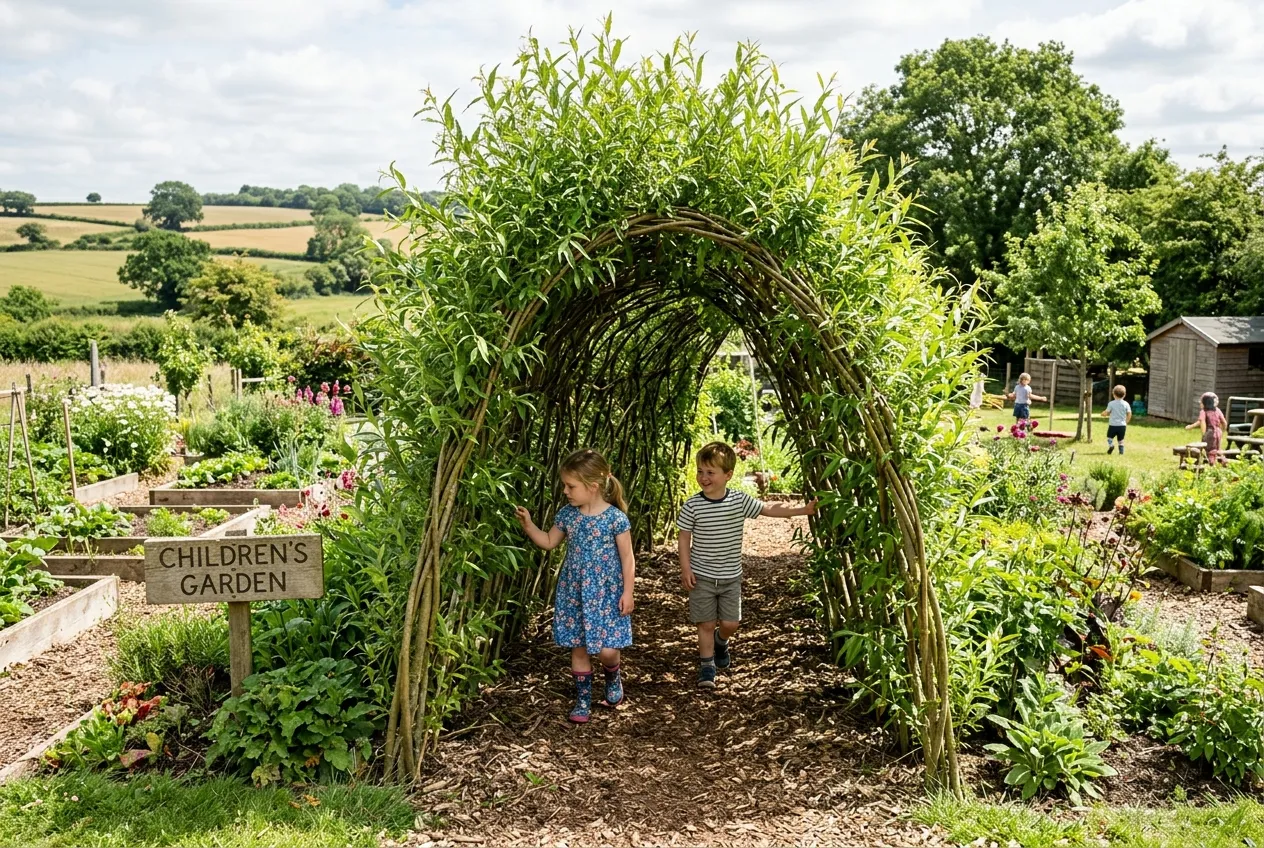
A living willow tunnel in its second year. The withies rooted in winter and leafed out by May, creating a shaded walkway by midsummer.
Living willow structures need trimming 2-3 times per year through summer to keep their shape. Without trimming, they quickly revert to a thicket. The dense growth provides nesting cover for birds, making living willow a practical addition to any wildlife garden.
Best varieties for living structures
- Salix viminalis (common osier) — long, straight, flexible rods. The standard weaving willow.
- Salix purpurea — thinner, more flexible stems. Good for fine detail work.
- Salix alba — strong, tall rods for larger structures like tunnels and screens.
Coppicing and pollarding willow
Coppicing is the key management technique for most garden willows. It controls size, produces coloured stems, and keeps the tree productive for decades.
How to coppice willow
Cut all stems back to 15-30cm above ground level in late February or early March, before leaf bud break. Use loppers for stems up to 3cm diameter and a pruning saw for thicker wood. The stool (stump) produces 8-15 new shoots within weeks. By autumn, these reach 1.8-3m depending on soil moisture and variety.
Annual coppicing produces the brightest stem colour. Two-year coppicing produces longer, thicker rods for weaving and structures but duller colour. A three-year cycle gives the strongest poles for fencing and garden stakes.
Pollarding
Pollarding is the same principle but cuts at 1.5-2m above ground level instead of at the base. This keeps the regrowth out of reach of livestock and deer. Pollard willows are a characteristic feature of British floodplain landscapes. In a garden context, pollarding creates an attractive framework of knobbly branches at eye level, with fresh coloured stems sprouting from the top each year. For guidance on pruning techniques, see our pruning guide.
Field report: 10-year coppicing trial
Trial location: Streamside plot, Staffordshire (heavy clay) Period: 2016-2026 Species tested: S. alba Britzensis, S. alba Vitellina, S. daphnoides, S. purpurea, S. viminalis, S. caprea Key findings:
- Britzensis produced the most vivid winter colour on a 1-year coppice cycle (cut February)
- Vitellina stems were brightest when cut in late February rather than early March
- Daphnoides purple bloom was strongest in the first winter after cutting; faded by the second
- Viminalis produced the longest rods (up to 3.2m) on a 2-year cycle in damp clay
- All six species survived the -12 degrees C cold snap of December 2022 without damage
Managing vigorous growth
Willow’s greatest strength is also its biggest challenge. A tree that grows 2m per year demands regular attention.
Root management near buildings
If planting within 20m of a building, install a root barrier of heavy-duty polypropylene sheeting to a depth of 1.2m. Alternatively, grow willow in a large container (minimum 60-litre) sunk into the ground. This restricts the root spread while still allowing the tree to access ground moisture. Willows planted for coppicing have smaller root systems than free-growing trees, reducing subsidence risk on clay soils.
Controlling spread
Willow drops twigs and small branches that can root where they land on damp ground. Check around established willows each spring and remove any unwanted self-rooted stems. Some species, particularly crack willow (Salix fragilis), spread aggressively along watercourses through broken twigs that root downstream. This is natural regeneration in the wild but a nuisance in gardens.
Annual maintenance calendar
| Month | Task |
|---|---|
| January | Take hardwood cuttings for propagation |
| February | Coppice or pollard before bud break |
| March | Plant new willows (cuttings or container-grown) |
| April-May | Train and tie living willow structures |
| June-August | Trim living structures 2-3 times |
| September | Final trim of living structures |
| October | Order fresh withies for winter planting |
| November-December | Plant new structures; enjoy winter stems |
Willow for wildlife
Willow is among the most wildlife-friendly trees in the British Isles. Goat willow alone supports over 450 insect species.
Early pollen source
Willow catkins are one of the first significant pollen sources each spring. Goat willow and grey willow flower from February, weeks before most other trees. Bumblebee queens emerging from hibernation depend on this early food. Planting even a single goat willow adds a vital wildlife resource to your garden.
Caterpillar food plant
Willow is the food plant for caterpillars of the purple emperor, puss moth, eyed hawk-moth, sallow kitten, and over 100 other moth and butterfly species. The dense foliage also provides nesting cover for warblers, long-tailed tits, and wrens. Dead willow wood left in situ supports beetles, fungi, and woodpeckers.
Biosecurity note
Always source willow from UK-grown nursery stock. Imported willow can carry watermark disease (Erwinia salicis), a bacterial infection that causes dark staining in the wood and eventual dieback. The RHS lists watermark disease as a notifiable plant health concern. UK-grown stock from reputable nurseries poses minimal risk.
Willow and hedging
Willow makes a fast-growing, wildlife-rich hedge for damp sites. Salix viminalis and Salix purpurea are the best hedging species. Plant hardwood cuttings at 20-30cm spacing in a double staggered row during winter. The hedge reaches 2m within two growing seasons. Cut twice per year (June and October) to maintain a dense 1.5-2m screen.
Willow hedges work particularly well on boundaries beside streams, ditches, and damp field edges where traditional hedging plants struggle in waterlogged soil. The dense root system also helps stabilise stream banks and prevent erosion. For a mixed native boundary, combine willow with silver birch and alder on damp ground.
Growing willow in containers
Compact varieties like Salix integra ‘Hakuro-nishiki’ and Salix caprea ‘Kilmarnock’ grow well in large pots. Use a minimum 40-litre container with drainage holes. Fill with 80% multipurpose compost and 20% loam for moisture retention. Water daily in summer. Willow in containers dries out faster than any other tree because of its high water demand. Feed monthly from April to August with a balanced liquid fertiliser. Repot every 2-3 years, root-pruning by one-third to prevent the tree becoming pot-bound.
Frequently asked questions
When should I plant willow in the UK?
Plant willow between November and March during dormancy. Hardwood cuttings pushed into moist soil in January or February root within 4-6 weeks with a 90% success rate. Container-grown willows from nurseries can go in at any time of year, but winter planting gives the strongest establishment. Avoid frozen or waterlogged ground.
How fast does willow grow?
Willow grows 1-2m per year in typical UK conditions. Coppiced specimens on rich, damp soil produce 2-3m of new growth in a single season. Weeping willow (Salix babylonica) reaches 15-25m at maturity over 20-30 years. Even compact varieties like ‘Hakuro-nishiki’ add 1.5m of growth annually without pruning. Annual coppicing or pruning is essential to control size.
Can I grow willow in a small garden?
Yes, but variety choice and annual pruning are critical. Salix integra ‘Hakuro-nishiki’ stays at 1.5-2m when pruned hard each March. Salix caprea ‘Kilmarnock’ is a weeping form on a 1.5m stem that never grows taller. Compact garden trees like these work in borders and containers. Avoid full-sized weeping willows, which need 15m clearance in every direction.
How do I take willow cuttings?
Take hardwood cuttings between November and February. Select pencil-thick stems (8-12mm) from the current year’s growth. Cut 20-30cm lengths with a straight bottom cut and angled top cut. Push two-thirds into moist soil. Roots develop in 4-6 weeks at soil temperatures above 5 degrees C. No rooting hormone is needed. A fresh-cut stem in a jar of water sprouts visible roots within 7-10 days.
Will willow damage my drains or foundations?
Willow roots aggressively seek moisture and can enter cracked drains or joints. The Building Research Establishment classifies willow as a high water-demand species. Plant full-sized willows at least 12m from buildings and 15m from underground drains or septic tanks. On shrinkable clay soil, increase these distances by 50%. Coppiced willows kept to 2-3m height have proportionally smaller root systems and pose less risk.
What is coppicing and why do it?
Coppicing means cutting all willow stems to 15-30cm above ground in late February. The stool regrows 8-15 new shoots each spring. Annual coppicing produces the brightest winter stem colour, supplies weaving material, and keeps the tree at a manageable size. It also extends the tree’s lifespan indefinitely. Coppiced willows in Britain have been producing fresh growth for over 5,000 years.
Which willow is best for wildlife?
Goat willow (Salix caprea) supports the most wildlife. It hosts over 450 insect species, including caterpillars of the purple emperor butterfly and puss moth. The catkins provide vital early pollen for bumblebees from February. Even a single goat willow in a garden hedge adds significant wildlife value. Grey willow (Salix cinerea) and crack willow (Salix fragilis) are also outstanding wildlife trees.
Lawrie has been gardening in the West Midlands for over 30 years. He grows his own veg using no-dig methods, keeps a wildlife-friendly garden, and writes practical advice based on real UK growing conditions.