How to Grow Wisteria in the UK
How to grow wisteria in UK gardens with training and pruning advice. Covers Chinese and Japanese types, the two-prune system, and wall support.
Key takeaways
- Buy grafted wisteria from a reputable nursery — seed-grown plants may take 15-20 years to flower
- Chinese wisteria twines anticlockwise, Japanese wisteria twines clockwise
- Prune twice a year: summer (July-August) and winter (January-February)
- A mature wisteria can weigh several hundred kilograms and needs very strong support
- Wisteria is fully hardy across the UK but late frosts can damage flower buds in northern gardens
- Most wisteria takes 3-7 years to flower for the first time after planting
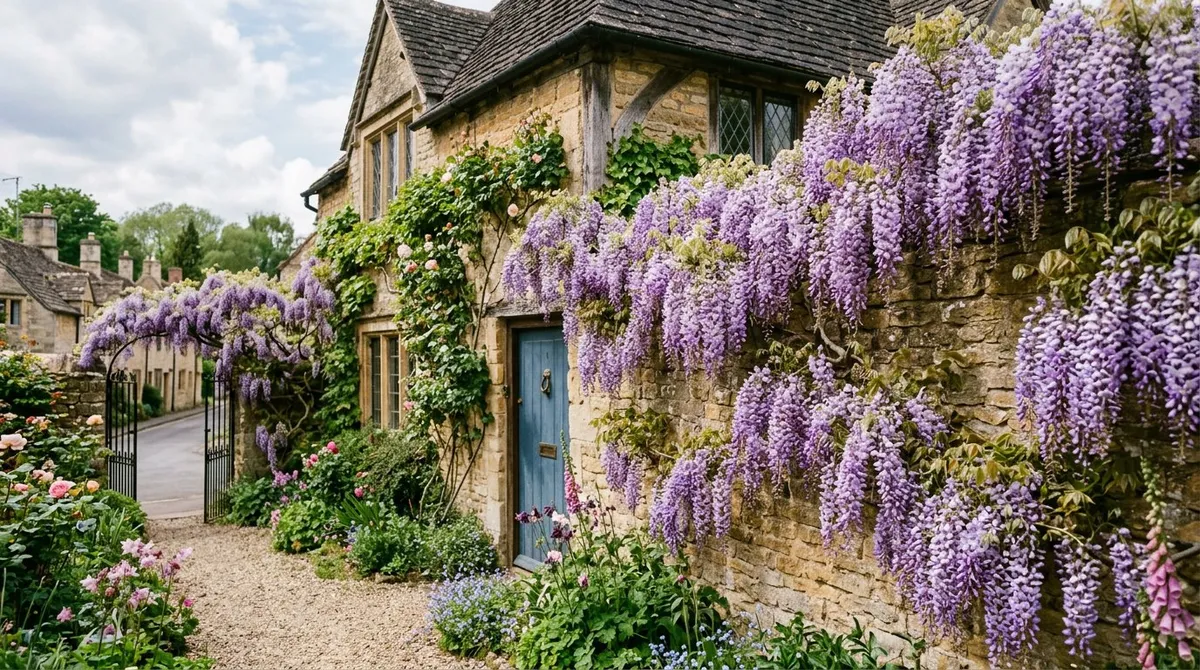
Wisteria in full flower is one of the most spectacular sights in British gardening. Those long, cascading racemes of blue-purple, pink, or white flowers dripping from a wall or pergola are unforgettable. A mature wisteria in late May stops traffic. It is the plant that makes passers-by lean on your gate and stare.
Growing wisteria well comes down to three things: buying the right plant (grafted, not seed-grown), providing strong support, and mastering the simple two-prune system. Get these right and your wisteria will flower reliably for generations. This guide covers everything from choosing and planting to the pruning regime that brings the flowers. Wisteria is one of the finest options on our list of best climbing plants for UK gardens.
Which type of wisteria should I grow?
Two main species are grown in UK gardens, plus several excellent cultivars of each.
Chinese wisteria (Wisteria sinensis)
Chinese wisteria is the most widely planted type in Britain. It twines anticlockwise (looking from below) and produces 20-30cm racemes of violet-blue flowers in May before the leaves fully unfurl. This gives the most dramatic display, as the flowers hang against bare stems. The scent is sweet and carries well. ‘Prolific’ is the most popular cultivar, flowering even on young plants. ‘Alba’ has white racemes.
Japanese wisteria (Wisteria floribunda)
Japanese wisteria twines clockwise and flowers slightly later, as the leaves are emerging. The racemes are significantly longer — 30-60cm on standard cultivars and up to 90cm on the legendary ‘Multijuga’ (also sold as ‘Macrobotrys’). The flowers open gradually from the base of the raceme downward, extending the display period. ‘Rosea’ has pink flowers, ‘Alba’ has white. Japanese types are slightly less vigorous than Chinese, making them better for smaller gardens.
How to tell them apart
If your existing wisteria is unlabelled, look at the direction of twining. Stand below and look up. Chinese wisteria spirals anticlockwise. Japanese spirals clockwise. Chinese flowers before leaves; Japanese flowers with leaves. These two clues identify any wisteria.
How do I plant wisteria?
Buy a named, grafted plant from a reputable nursery. The graft union is visible as a bulge near the base of the stem. Grafted wisteria from known flowering stock typically flowers within 3-7 years. Seed-grown plants are a gamble — some take 15-20 years, and some never flower at all.
Planting step by step
- Dig a hole 60cm wide and 40cm deep, at least 45cm from the wall base.
- Mix excavated soil with a bucketful of well-rotted compost.
- Plant at the same depth as in the pot. Do not bury the graft union.
- Lean the main stem toward the support and tie it in at 30cm intervals.
- Water thoroughly and apply a 5cm mulch, keeping it away from the stem.
Choosing the right spot
Wisteria needs full sun — at least 6 hours of direct sunlight daily — to flower well. A south or south-west facing wall is ideal. The wall radiates stored warmth, protecting early flower buds from late frost. Wisteria grows in any reasonable garden soil but performs best in fertile, well-drained ground. Avoid very chalky or very wet soils.
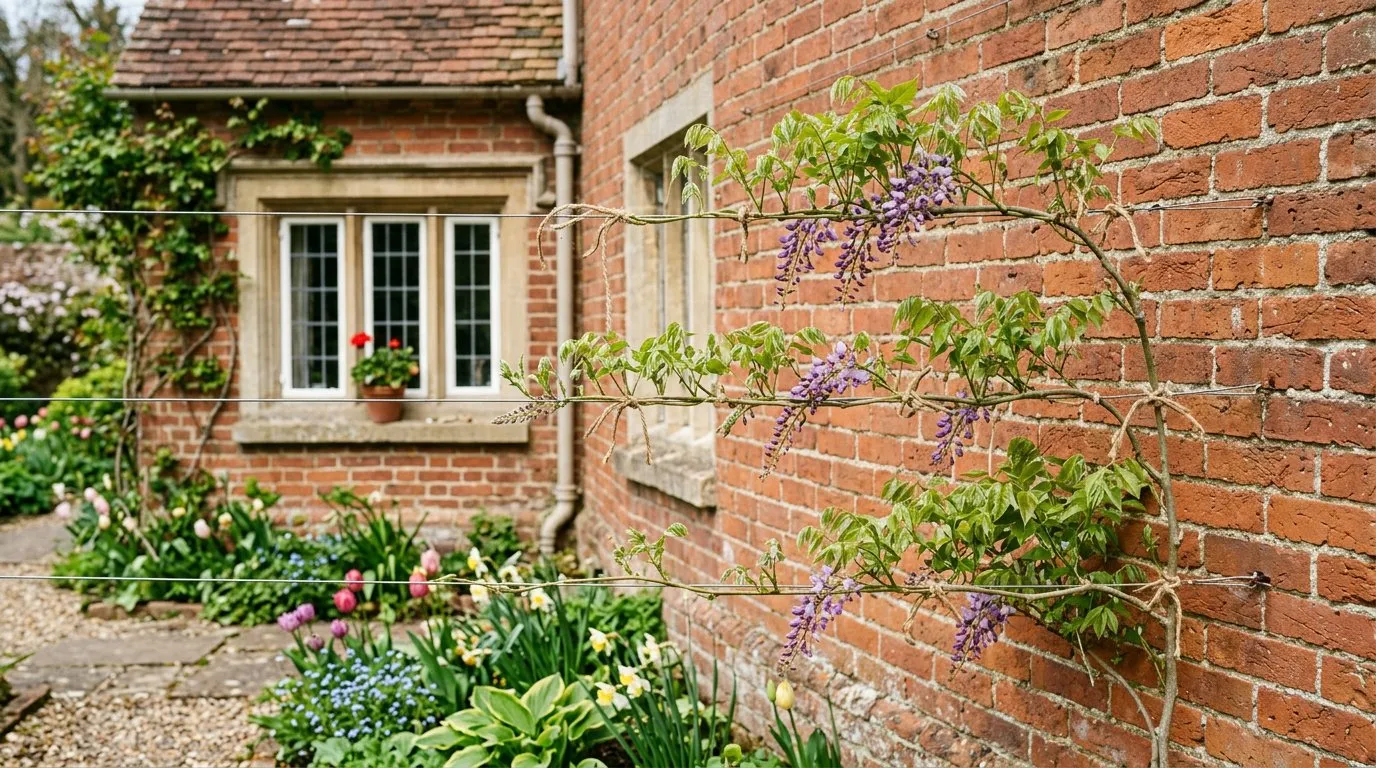
Train wisteria along horizontal wires fixed 45cm apart with vine eyes — the framework takes 3-5 years to establish
How do I support wisteria?
A mature wisteria is an immensely heavy plant. The support structure must be strong enough to hold several hundred kilograms of woody stems, foliage, and flowers, plus wind loading.
Wall support with wires
Fix heavy-gauge galvanised wire (3mm or thicker) to the wall using vine eyes driven into the mortar joints (not the bricks). Space wires 45cm apart horizontally, starting 30cm above ground level. Tension the wires firmly. The main framework stems are tied to these wires and trained horizontally, like an espalier fruit tree.
Pergola or arch
A pergola must be built from substantial timber (minimum 100mm x 100mm posts) or metal. Lightweight garden arches buckle under the weight of a mature wisteria. Set posts at least 60cm deep in concrete. Train the main stem up and over the structure, then allow side branches to hang down through the top.
Freestanding standard
Wisteria can be trained as a freestanding standard tree, supported by a stout stake. This works well in smaller gardens, on patios, or as a focal point. Keep the main stem tied to a strong 2.5m stake and prune all side growth to create a rounded head on top of the trunk. It takes 5-7 years to form but the result is striking.
How do I prune wisteria?
The two-prune system is the key to abundant flowers. It sounds complicated but takes just 20-30 minutes twice a year once you understand the principle.
Summer pruning (July to August)
In late July or August, after flowering has finished, the plant produces masses of long, whippy side shoots (often 1-2 metres long). Cut every one of these back to 5-6 buds from the main framework branch. This redirects energy from leaf production into forming flower buds at the base of these shoots.
Winter pruning (January to February)
In January or February, when the plant is bare, revisit those same summer-pruned shoots and cut them back further to 2-3 buds from the framework. These short stubs carry the flower buds that open in May. Without this winter follow-up, the spurs remain too long and produce leaves instead of flowers.
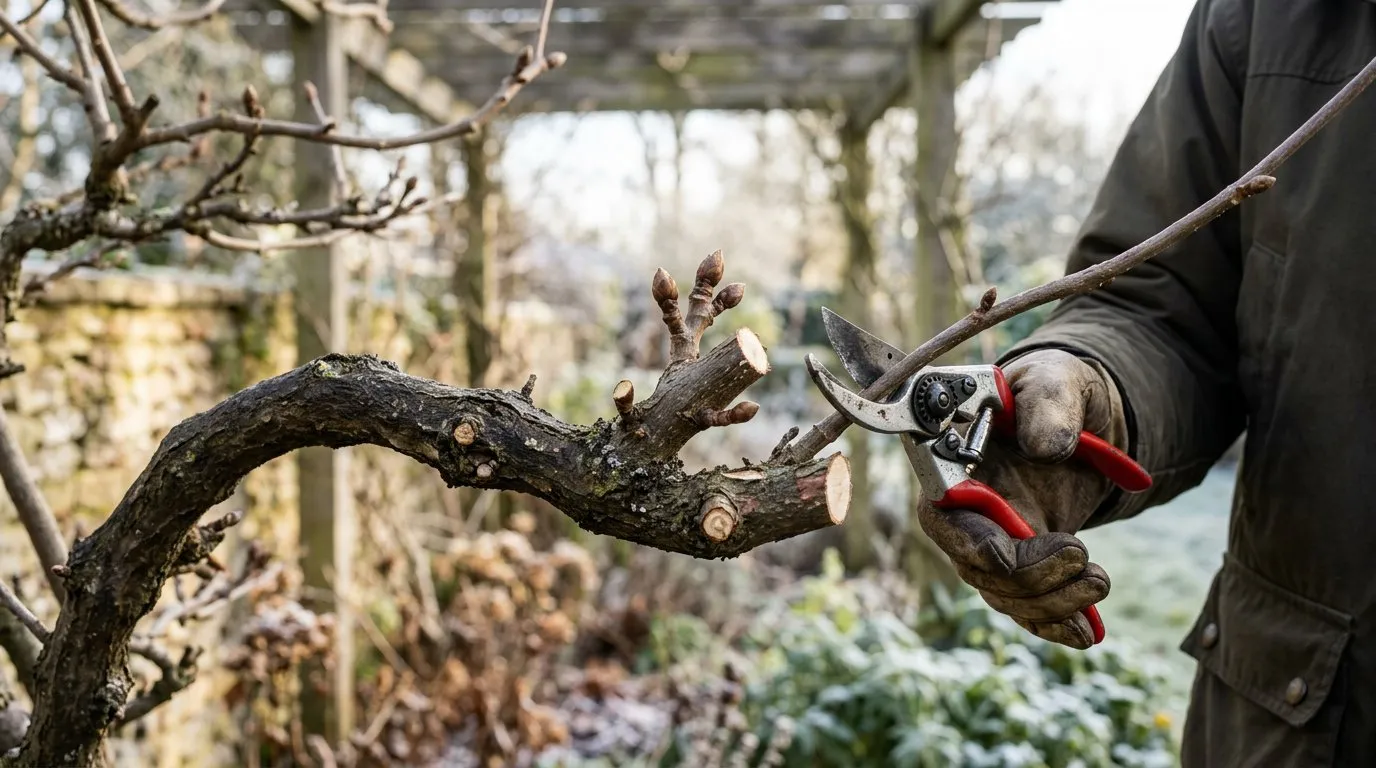
Winter-prune wisteria in January to February, cutting summer-pruned shoots back to 2-3 buds
Training new framework branches
During the first 3-5 years, select strong shoots to extend the main framework. Tie these in horizontally along the wires, spacing them 45cm apart. Let them grow unpruned until they reach the desired length, then treat them as permanent framework branches and prune all side growth as described above.
Common wisteria problems in the UK
Failure to flower
The number one problem. Usually caused by growing from seed, wrong pruning, heavy shade, or too much nitrogen. Buy grafted plants, prune twice yearly, grow in full sun, and use a high-potash feed (not a high-nitrogen lawn feed) in spring.
Frost damage to buds
Late frosts in April can destroy opening flower buds, especially in exposed or northern gardens. A south-facing wall provides the best frost protection. If a hard frost is forecast during bud swell, drape fleece over the plant overnight.
Vigorous growth, no flowers
Over-feeding with nitrogen-rich fertiliser or manure promotes leafy growth at the expense of flowers. Switch to a high-potash feed such as sulphate of potash or tomato fertiliser, applied in March. Root pruning by pushing a spade vertically into the soil 60cm from the trunk on two sides can also shock the plant into flowering.
Structural damage
Wisteria stems grow incredibly strong and can lift roof tiles, block gutters, and force themselves behind drainpipes. Twice-yearly pruning and regular checking keeps growth under control. Never let stems grow under tiles or behind pipes. Wisteria does not cause structural damage to sound brickwork and mortar.
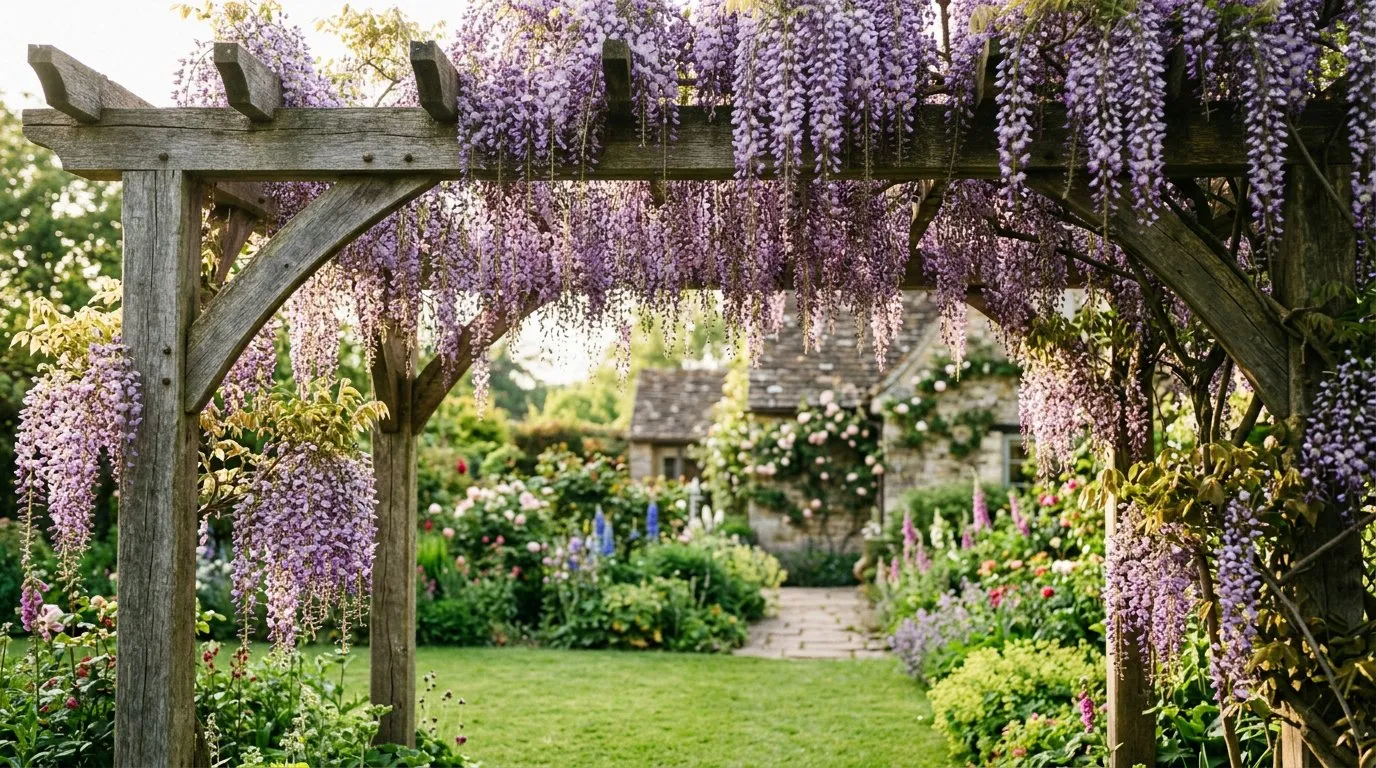
A well-maintained wisteria trained over a sturdy oak pergola rewards with decades of cascading spring blooms
Wisteria month by month
| Month | Task |
|---|---|
| January-February | Winter prune — cut side shoots to 2-3 buds from framework |
| March | Apply high-potash feed around the base |
| April-May | Enjoy the flowers. Protect buds from late frost with fleece if needed |
| June | Tie in any new framework shoots needed to extend coverage |
| July-August | Summer prune — cut whippy side shoots to 5-6 buds from framework |
| September-October | Plant new wisteria. This is the best time for planting |
| November-December | Check ties and wires. Repair any support structure before winter storms |
Wisteria turns any front garden or south-facing wall into something special. With the right variety, proper support, and a simple twice-yearly prune, it rewards you with decades of breathtaking spring displays. For summer fragrance on a warm wall alongside wisteria, jasmine flowers from June to September and is one of the most scented climbing plants available. For more on pruning techniques for garden plants, see our dedicated guides.
Why we recommend Wisteria sinensis ‘Prolific’ for UK walls: After 30 years of growing and advising on wisteria, ‘Prolific’ consistently flowers earlier and more reliably than any other cultivar we have grown on British walls. A grafted ‘Prolific’ planted against a south-west facing wall in the Midlands produced its first full flowering display in just two years — three to four years ahead of a seed-grown plant from the same nursery.
Now you’ve mastered wisteria, read our guide on best climbing plants for UK gardens to discover what to plant alongside your wisteria for a full season of colour and fragrance on walls and pergolas.
Frequently asked questions
The RHS wisteria guide covers additional varieties and advanced training techniques for UK conditions.
Lawrie has been gardening in the West Midlands for over 30 years. He grows his own veg using no-dig methods, keeps a wildlife-friendly garden, and writes practical advice based on real UK growing conditions.