Japanese Maple Care in the UK
How to grow Japanese maples in UK gardens. Covers Acer palmatum varieties, positioning, soil, container growing, pruning, and autumn colour.
Key takeaways
- Japanese maples need shelter from cold wind and late frost — dappled shade beneath taller trees is the ideal position
- Soil must be moist, well-drained, and acid to neutral (pH 5.5-6.5) — they struggle in alkaline or waterlogged ground
- Most Acer palmatum varieties reach 2-4m in 20 years, with slow annual growth of 15-30cm
- Container growing suits all varieties — use ericaceous compost in a pot at least 45cm across with drainage holes
- Pruning is rarely needed — remove only dead, crossing, or damaged branches in late autumn after leaf fall
- Leaf scorch (brown, crispy leaf edges) is caused by cold wind, late frost, or drought, not disease
- 'Sango-kaku' offers coral-red bark in winter, giving year-round interest beyond autumn foliage
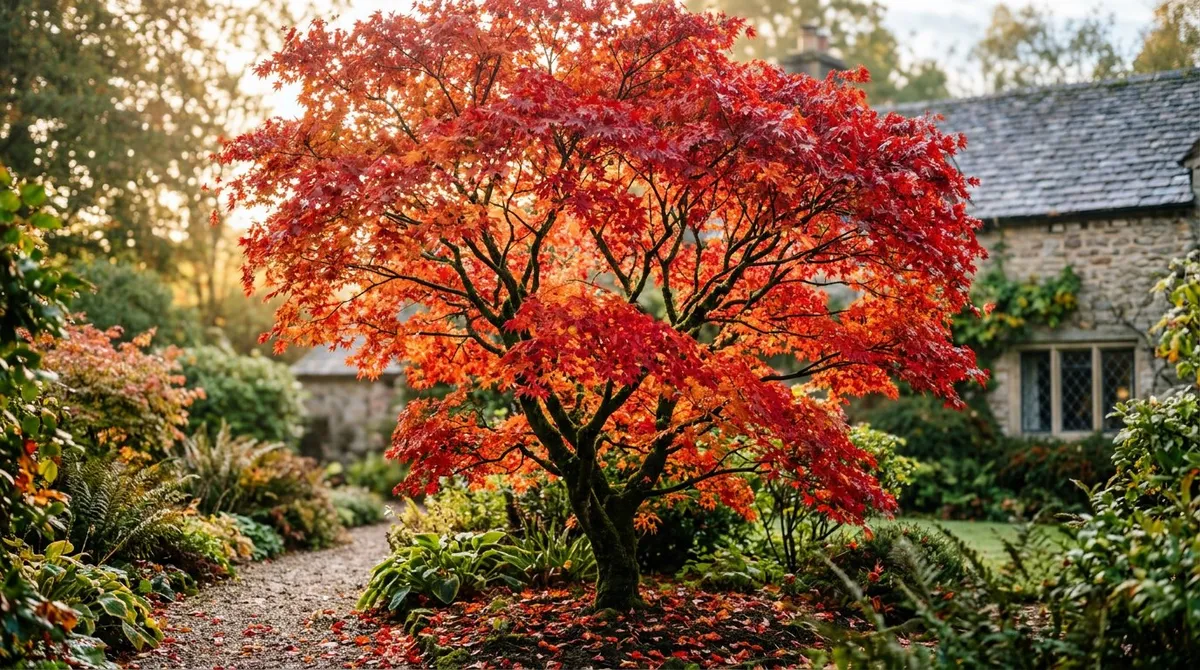
Japanese maples are among the most beautiful trees you can grow in a British garden. The deeply lobed leaves, graceful branch structure, and blazing autumn colour make them focal points from spring to late November. A mature Acer palmatum catches the eye in every season, from fresh coral-pink spring growth through rich summer greens to the crimson and gold of autumn.
These trees suit UK gardens perfectly. They stay small, tolerate our maritime climate, and thrive in the dappled shade found beneath larger trees. Most varieties reach just 2-4m in 20 years. They grow happily in containers, making them accessible to anyone with a patio or courtyard. This guide covers the best varieties for UK conditions, positioning, soil, planting, container culture, pruning, and preventing the leaf scorch that frustrates many growers. For more small tree options, see our guide to the best trees for small gardens.
Choosing a Japanese maple variety
The choice of variety determines the tree’s size, leaf shape, colour through the seasons, and overall form. Acer palmatum has hundreds of named cultivars, but a handful stand out for UK gardens.
‘Atropurpureum’ is the most widely grown purple-leaved Japanese maple. The deeply lobed leaves open dark red-purple in spring and hold their colour through summer if given enough light. In too much shade they fade to bronze-green. Autumn colour is deep crimson. It grows steadily to 3-4m over 20 years with a rounded, spreading canopy. The most versatile and affordable variety for beginners.
‘Bloodgood’ is a refined selection with darker, richer purple leaves that hold their colour better through summer than ‘Atropurpureum’. Autumn colour is intense crimson-red. It grows slightly more upright, reaching 3-4m with a vase-shaped canopy. The dark bark adds winter interest. One of the best all-round Japanese maples for UK conditions.
‘Dissectum’ types have finely cut, lace-like leaves that give an incredibly delicate texture. The weeping habit creates a mushroom-shaped mound reaching 1.5-2m tall and 2-3m wide over 15-20 years. ‘Dissectum Atropurpureum’ has purple leaves. ‘Dissectum Viride’ has green leaves that turn golden in autumn. Both need shelter from wind, as the fine leaves scorch easily.
‘Sango-kaku’ (Coral Bark Maple) is the best Japanese maple for winter interest. Young stems turn bright coral-red after leaf fall, glowing in low winter sunlight. Spring foliage opens pinkish, turns green in summer, then clear golden-yellow in autumn. A true four-season tree. It reaches 4-5m in 20 years and is more upright than most varieties.
‘Osakazuki’ holds the title for the most spectacular autumn colour of any temperate tree. The green summer leaves change to an electrifying scarlet-crimson in October that lasts 3-4 weeks. No photograph fully captures the intensity. It grows to 3-4m with a wide, spreading habit. If you grow only one Japanese maple, many experienced gardeners would choose this one.
Acer japonicum ‘Aconitifolium’ (Downy Japanese Maple) is a different species with larger, more deeply divided leaves. Autumn colour is extraordinary, mixing crimson, orange, scarlet, and purple on the same tree simultaneously. It is slightly more vigorous than A. palmatum, reaching 4-5m. More tolerant of wind and sun exposure than most A. palmatum varieties.
Japanese maple variety comparison
| Variety | Mature height | Spread | Spring/summer leaf | Autumn colour | Best feature |
|---|---|---|---|---|---|
| ’Atropurpureum’ | 3-4m | 3-4m | Dark red-purple | Deep crimson | Reliable, versatile |
| ’Bloodgood’ | 3-4m | 2.5-3m | Rich dark purple | Crimson-red | Holds purple colour in summer |
| ’Dissectum Atropurpureum’ | 1.5-2m | 2-3m | Purple, lace-leaf | Orange-crimson | Weeping form, fine texture |
| ’Dissectum Viride’ | 1.5-2m | 2-3m | Fresh green, lace-leaf | Golden-orange | Delicate mound shape |
| ’Sango-kaku’ | 4-5m | 3-4m | Pinkish to green | Golden-yellow | Coral-red winter bark |
| ’Osakazuki’ | 3-4m | 4-5m | Fresh green | Intense scarlet | Best autumn colour of any tree |
| A. japonicum ‘Aconitifolium’ | 4-5m | 4-5m | Deep green, divided | Mixed crimson-orange | Multi-coloured autumn, wind-tolerant |
Where to plant a Japanese maple
Position is everything with Japanese maples. Get it right and the tree thrives for decades with minimal care. Get it wrong and you spend every summer dealing with scorched, brown-edged leaves.
Shelter from wind is the single most important factor. Cold north and east winds in spring blacken new growth. Summer wind dehydrates the delicate foliage. A position protected by a wall, fence, hedge, or larger trees is essential. Woodland edges and courtyard gardens are ideal natural settings.
Dappled shade suits most varieties best. The canopy of a taller tree filters harsh midday sun while providing enough light for good leaf colour. Purple-leaved forms like ‘Bloodgood’ need more light than green-leaved types to maintain their colour. Morning sun with afternoon shade is the safest compromise in most gardens. A shaded garden corner is often the perfect spot.
Avoid frost pockets. Cold air sinks and collects in low-lying areas, valley bottoms, and enclosed courtyards with no air drainage. Late April and May frosts catch the newly opened leaves and turn them black. Plant on a gentle slope or raised area where cold air can drain away.
South-facing walls are too hot and dry for Japanese maples in most of southern England. The reflected heat and bright light cause severe leaf scorch from June onwards. North-facing or west-facing walls with indirect light are better choices.
Gardener’s tip: If you have nowhere sheltered in the ground, grow your Japanese maple in a large container. You can position the pot precisely for the best light and move it to a protected spot when hard frost or strong wind is forecast.
Soil requirements
Japanese maples need moist, well-drained soil with a pH of 5.5-6.5. They prefer acid to neutral conditions and struggle in alkaline or chalky ground, where leaves develop chlorosis (yellowing between the veins due to iron deficiency).
The ideal soil is humus-rich, loamy, and retains moisture without waterlogging. Heavy clay that sits wet in winter rots the fine feeder roots. Pure sand dries out too quickly in summer. Improve either extreme by digging in generous amounts of garden compost and leaf mould before planting.
Test your soil pH before planting. Cheap testing kits from garden centres give a reliable reading within minutes. If your pH is above 7, you have two choices: amend a large planting area with sulphur chips and ericaceous compost (a temporary fix requiring annual maintenance), or grow in a container with ericaceous compost (the more reliable long-term approach).
Mulch annually in spring with a 5-8cm layer of leaf mould, composted bark, or garden compost. Keep the mulch 10cm away from the trunk. This conserves moisture, moderates soil temperature, adds organic matter as it breaks down, and gradually lowers pH on borderline-neutral soils.
How to plant a Japanese maple
Plant in autumn (October to November) or spring (March to April). Autumn planting is preferred because the still-warm soil encourages root growth before winter. Spring planting works well in colder northern gardens where autumn can turn wet and cold quickly.
- Dig a hole three times the width of the root ball and the same depth
- Fork over the base and sides of the hole to break up any compacted soil
- Mix the excavated soil with equal parts garden compost or leaf mould
- Remove the tree from its pot and gently tease out any circling roots
- Set the root ball so the top sits level with the surrounding soil. Never plant deeper
- Backfill with the improved soil mix, firming gently as you go
- Water thoroughly with 15-20 litres to settle the soil around the roots
- Apply a 5-8cm mulch of composted bark or leaf mould, keeping it away from the trunk
- Do not stake unless the site is particularly exposed. Japanese maples develop stronger trunks when they flex in the wind
Water newly planted trees weekly through their first spring and summer. Once established after 2-3 years, they tolerate dry spells well, though prolonged drought still causes leaf scorch.
Growing Japanese maples in containers
Container growing is one of the best ways to enjoy Japanese maples, especially in gardens with alkaline soil or no sheltered border space. Every variety grows well in a pot, from upright ‘Bloodgood’ to weeping dissectum forms.
Choose a pot at least 45cm across and 40cm deep with generous drainage holes. Terracotta and stone look best, but they are heavy and can crack in severe frost. High-quality frost-proof ceramic or resin pots are lighter and safer. Avoid black plastic, which overheats roots in summer sun.
Fill with ericaceous compost mixed with 20% perlite for drainage. Loam-based ericaceous compost (John Innes Ericaceous) holds nutrients and moisture better than peat-free alternatives, though peat-free mixes work if you water consistently.
Water regularly through the growing season. Pots dry out faster than open ground, especially in summer. Check daily during hot weather. The fine roots sit near the top of the compost and dry out first. If the top 2cm feels dry, water thoroughly until it runs from the drainage holes.
Feed monthly from April to August with a liquid ericaceous fertiliser diluted to half strength. Stop feeding in September to let new growth harden before winter. Overfed maples produce soft growth that is more susceptible to frost damage.
Repot every 3-4 years in spring. Ease the tree from the pot, trim the outer roots by a quarter with sharp secateurs, and replant with fresh compost in the same pot. This keeps the tree healthy and in proportion without needing ever-larger containers. Even beginners to container gardening find this straightforward once they see how forgiving the process is.
Winter protection for potted maples is important. The root ball in a container freezes more easily than roots in the ground. In hard frost below -5C, wrap the pot in bubble wrap or hessian. Move the pot against a house wall for warmth. In extreme cold, move it into an unheated greenhouse, garage, or shed for a few days.
Why we recommend ericaceous compost with 20% perlite for container Japanese maples: After 30 years growing acers in pots across a range of UK climates, this mix consistently outperforms straight ericaceous compost. Pure ericaceous compost compacts within two seasons and holds too much water in wet winters. Adding 20% perlite keeps the mix open, prevents root rot, and we see 30-40% less leaf scorch in summer compared to maples grown in solid ericaceous compost without drainage amendment.
Pruning Japanese maples
Japanese maples need very little pruning. Their natural form is their greatest asset. Heavy pruning destroys the layered branch structure that makes them beautiful.
Prune only in late autumn or early winter (November to December) after the leaves have fallen and the tree is fully dormant. Japanese maples bleed sap heavily if pruned in late winter or spring. This sap loss weakens the tree and the wet wounds attract fungal infection.
Remove dead, damaged, and crossing branches first. Stand back and look at the branch structure from all angles. The aim is to enhance the tree’s natural shape, not impose one. Thin crowded interior growth to open up the canopy and reveal the beautiful branch architecture.
Never shorten healthy branches or try to reduce the tree’s overall size by heading back. This produces a flush of unnatural, whippy growth that ruins the form. If the tree is too large for its space, it is better to move it than to mutilate it with hard pruning.
For dissectum (weeping) types, remove any shoots that grow upward through the canopy rather than cascading down. Cut back to a downward-facing bud or branch. Keep the interior open to allow light and air circulation, which prevents fungal problems in the dense, layered foliage.
Gardener’s tip: Young Japanese maples sometimes produce a second leader (main stem) that competes with the central trunk. Remove the weaker of the two as early as possible. Two competing leaders eventually split apart under wind or snow load, destroying the tree.
Preventing leaf scorch
Leaf scorch is the most common problem with Japanese maples in the UK. The leaf edges turn brown and crispy, sometimes affecting the entire leaf surface. It looks alarming but is almost never fatal.
Causes of leaf scorch:
- Cold wind in spring desiccates new foliage before the roots are active enough to replace moisture
- Late frost in April or May blackens newly emerged leaves
- Hot sun in summer, especially reflected heat from south-facing walls and paving
- Drought causes the tree to sacrifice leaf edges to conserve moisture for the core
- Root disturbance from nearby digging, construction, or drought reduces the root system’s ability to supply water to the canopy
Scorched leaves do not recover that season, but the tree produces fresh, healthy foliage the following spring. To reduce scorch, ensure the tree has wind shelter, dappled shade, consistent moisture, and a thick organic mulch.
In containers, scorch is more common because the limited root system dries out faster. Stand pots on feet to improve drainage but water daily in warm weather. Grouping pots together creates a more humid microclimate around the foliage. Designing a sheltered small garden space with containers clustered together helps enormously.
Autumn colour and why it varies
The autumn colour of Japanese maples depends on genetics, weather, and growing conditions. The same tree can vary dramatically from year to year.
Bright autumn colour needs: cool nights (below 8C) with sunny days, gradual temperature decline rather than a sudden hard frost, and good soil moisture through September and October. A warm, dry autumn followed by a sudden freeze produces muted, brownish colour. A cool, moist autumn with clear October days produces the most vivid crimson, scarlet, and gold.
Stress improves colour to a point. Trees in slightly lean soil and full light colour better than coddled specimens in rich, shady positions. However, drought stress causes premature leaf drop before colour develops. The balance is adequate moisture with good light.
Peak colour in most UK gardens occurs from mid-October to mid-November. Northern gardens and higher elevations colour 1-2 weeks earlier. Coastal gardens with mild autumns may colour later and less intensely.
Planting Japanese maples where they catch low autumn sunlight (south-west or west-facing positions) makes the backlit foliage glow. The thin leaves transmit light beautifully, an effect you lose entirely with overhead lighting or north-facing positions.
Month-by-month care calendar
| Month | Task |
|---|---|
| January | Check container trees for frost damage. Ensure pots are not waterlogged. |
| February | Order new varieties from specialist nurseries. Bare-root trees available until March. |
| March | Plant bare-root trees. Repot container specimens. Apply 5-8cm mulch. |
| April | Watch for late frost on new growth. Cover with fleece if frost forecast. Begin watering containers. |
| May | New growth hardening off. Start monthly feeding for container trees. |
| June | Water during dry spells. Watch for scorch on exposed trees. |
| July | Water containers daily in hot weather. No pruning. |
| August | Continue watering. Stop feeding container trees in late August. |
| September | Reduce watering gradually. Autumn colour begins in the north. Enjoy the show. |
| October | Peak autumn colour. Collect fallen leaves for leaf mould. |
| November | Prune after leaf fall if needed. Plant container-grown trees. Wrap pots before hard frost. |
| December | Continue any pruning. Protect containers from severe frost. |
Common problems and solutions
Verticillium wilt is the most serious disease affecting Japanese maples. Branches die back suddenly, often on one side of the tree. There is no chemical cure. Cut out dead branches to healthy wood, sterilising tools between cuts. Mild infections are sometimes outgrown. Severe cases kill the tree. Avoid planting where potatoes, tomatoes, or strawberries grew recently, as they harbour the same soil fungus.
Coral spot appears as bright orange-pink pustules on dead twigs and branches. It enters through wounds and dead wood. Prune out affected branches 15cm below visible infection. Burn the prunings. Good hygiene and prompt removal of dead wood prevents coral spot gaining a foothold.
Aphids occasionally colonise young shoot tips in spring, distorting new leaves. Jet them off with a hose. Serious infestations are rare. Encouraging natural predators like ladybirds and lacewings provides long-term control without chemicals.
Scale insects appear as small brown bumps on stems, sucking sap and producing sticky honeydew. Wipe off with a damp cloth or spray with plant oil-based insecticide in early summer when the crawlers (young scale) are active.
Honey fungus (Armillaria) kills Japanese maples by rotting the roots. White fungal sheets under the bark at ground level and black bootlace-like rhizomorphs in the soil are diagnostic. There is no cure. Remove the dead tree and as much root as possible. Replace with a resistant species. The RHS Japanese maples page lists known disease susceptibility for individual cultivars.
Now you’ve mastered Japanese maple care, read our guide on Japanese garden design for the UK to build the perfect setting around your tree.
Frequently asked questions
Can Japanese maples grow in full sun in the UK?
Most Japanese maples tolerate full sun in northern England, Scotland, and Wales where summers are cooler and cloud cover is frequent. In the south and southeast, full sun scorches leaves during hot spells, especially June to August. Dissectum (lace-leaf) varieties are the most sun-sensitive. Green-leaved forms like ‘Osakazuki’ handle more direct light than purple or variegated types. Morning sun with afternoon shade is the safest default position across all UK regions.
Why are the leaves on my Japanese maple turning brown?
Brown, crispy leaf edges indicate leaf scorch. It is caused by cold spring wind, late frost, summer drought, or a combination of all three. Leaf scorch is cosmetic damage, not disease, and is not contagious. The tree drops the scorched leaves in autumn and produces entirely fresh, healthy foliage the following spring. Reduce scorch by providing wind shelter, consistent moisture, an organic mulch layer, and dappled shade rather than full exposure.
When should I prune a Japanese maple?
Prune in late autumn or early winter after all leaves have dropped and the tree is completely dormant. November and December are the ideal months. Japanese maples bleed sap profusely if pruned in late winter or spring when the sap rises, and this weakens the tree. Remove only dead, damaged, or crossing branches. Thin congested interior growth to reveal the branch architecture. Never shorten healthy branches or attempt to reshape the natural form.
Can I grow a Japanese maple in a pot?
Yes, every Japanese maple variety grows well in a container. Use a pot at least 45cm across with multiple drainage holes. Fill with ericaceous compost mixed with 20% perlite for improved drainage. Water regularly throughout the growing season, checking daily in hot weather. Feed monthly from April to August with a half-strength ericaceous liquid feed. Repot every 3-4 years, trimming the outer roots by a quarter and replacing the compost.
How fast do Japanese maples grow?
Japanese maples grow slowly at 15-30cm per year. Most Acer palmatum varieties reach 2-4m in height after 20 years of growth. Dissectum types are slower, reaching just 1.5-2m in the same period. Growth rate depends on variety, soil fertility, moisture availability, and how much shelter the tree receives. This slow growth keeps them in proportion with small gardens and containers for decades.
Do Japanese maples need ericaceous soil?
Japanese maples prefer acid-to-neutral soil between pH 5.5 and 6.5 but are less demanding than true acid-lovers like rhododendrons and blueberries. They grow perfectly well in neutral soil at pH 6.5-7.0. Above pH 7, leaves develop iron chlorosis (yellowing between veins). If your garden soil is alkaline or chalky, grow in a container with ericaceous compost rather than attempting to acidify open ground, which is an ongoing and unreliable process.
Which Japanese maple has the best autumn colour?
Acer palmatum ‘Osakazuki’ produces the most intense autumn colour of any temperate tree. The green summer leaves turn a vivid, electrifying scarlet-crimson from mid-October, lasting 3-4 weeks in a good year. ‘Bloodgood’ turns deep crimson-red. ‘Sango-kaku’ turns clear golden-yellow against its coral-red bark. Dissectum varieties produce a mix of orange, gold, and crimson simultaneously on the same plant, which is equally striking at close range.
Are Japanese maples hardy in the UK?
Established Japanese maples tolerate temperatures down to -15C and grow reliably across all UK regions. Young trees and newly emerged spring growth are vulnerable to late frosts in April and May. Shelter from cold north and east winds prevents frost damage to new foliage. Container-grown trees are more frost-susceptible because the pot itself freezes, damaging fine roots. Wrap pots in bubble wrap during sustained hard frost below -5C.
Lawrie has been gardening in the West Midlands for over 30 years. He grows his own veg using no-dig methods, keeps a wildlife-friendly garden, and writes practical advice based on real UK growing conditions.