Self-Seeding Plants for UK Gardens
Which plants self-seed reliably in UK gardens and how to manage them. Named varieties, timing, and techniques for naturalistic borders.
Key takeaways
- 30+ garden plants self-seed reliably in UK zones H4-H7 without intervention
- Foxgloves produce 10,000-20,000 seeds per stem, making them the most prolific self-seeder
- Leave 20-30% of border soil unmulched in spring to give seedlings space to germinate
- Most self-sown seedlings appear within 150mm of the parent plant
- Thin seedlings in April-May to 150-200mm spacing for strong plants
- A 3m x 1.5m border can sustain itself with 8-10 self-seeding species
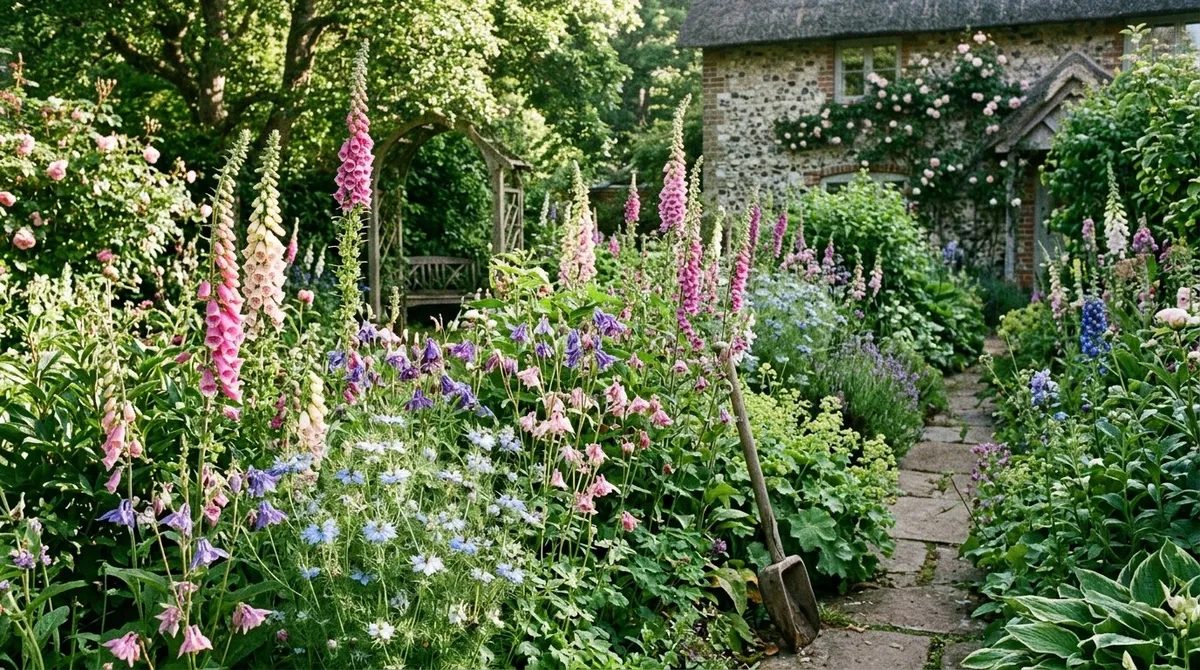
Self-seeding plants do the replanting work for you. A single foxglove drops 10,000-20,000 seeds from one flowering stem. Cottage garden borders have relied on this natural cycle for centuries. You end up with a garden that fills itself in, shifts subtly each year, and costs almost nothing to maintain.
What follows is a practical look at which plants self-seed reliably in UK conditions, how to manage them, and how to use self-seeding as a deliberate design strategy. If you’re building a naturalistic border from scratch or just want more movement in an established planting, self-seeders bring a life that planned borders often lack.
Which plants self-seed reliably in the UK?
Not every plant that produces seed will self-sow successfully. Reliable self-seeders need to produce viable seed in UK summers, survive British winters as seed, and then compete with established plants as seedlings. The RHS self-sowing plants guide covers the basic principles well.
Here are the most dependable species, grouped by type.
Biennials
Biennials are natural self-seeders. They flower in year two, set seed, and die. The cycle repeats without intervention.
- Foxglove (Digitalis purpurea) — 60-150cm. Flowers June-July. Thrives in shade and sun. The wild purple form self-seeds most reliably. ‘Camelot’ and ‘Excelsior’ hybrids also self-sow but revert to purple over 3-4 generations.
- Honesty (Lunaria annua) — 60-90cm. Flowers April-May. The purple-flowered form is strongest. Variegated leaf forms (‘Variegata’) come partly true from seed. Tolerates deep shade.
- Verbascum (Verbascum bombyciferum) — 120-180cm. Flowers June-August. Silver felted rosettes appear in autumn. Space seedlings 400mm apart for strong flowering stems.
- Wallflower (Erysimum cheiri) — 30-60cm. Flowers March-May. Short-lived perennial treated as biennial. Self-sows freely in alkaline soil and old walls.
Hardy annuals
Hardy annuals complete their life cycle in one season and produce seed prolifically.
- Nigella (Nigella damascena) — 40-50cm. Flowers June-July. ‘Miss Jekyll’ is the classic sky-blue form. Sows itself in autumn, overwinters as rosettes, flowers the following May. One of the most reliable self-seeders in any UK garden.
- Pot marigold (Calendula officinalis) — 30-60cm. Flowers May-October. Seeds are large and easy to spot. Seedlings appear in March. Remove excess to 200mm spacing.
- Opium poppy (Papaver somniferum) — 60-100cm. Flowers June-July. Each seed pod holds 1,000-2,000 seeds. Leave pods on the plant until they rattle when shaken.
- Poached egg plant (Limnanthes douglasii) — 15-20cm. Flowers May-July. Brilliant front-of-border edging. Self-sows so freely it can become a nuisance. Pull excess seedlings in April.
Perennials that self-seed
These plants persist year after year, dropping seedlings around themselves each season.
- Aquilegia (Aquilegia vulgaris) — 60-80cm. Flowers May-June. Cross-pollinates freely, producing seedlings in every colour from deep purple to white. Named cultivars will not come true. Ideal for cottage-style borders.
- Verbena bonariensis — 120-180cm. Flowers July-October. Tall, airy stems with purple flower clusters. Hardy to minus 10C. Self-sows into gravel, paths, and cracks. Seedlings appear in April.
- Erigeron karvinskianus — 15-30cm. Flowers May-October. Mexican daisy. Tiny white-to-pink flowers on spreading stems. Self-sows into walls, paving joints, and gravel. One plant can colonise 2 square metres in 3 years.
- Welsh poppy (Papaver cambricum) — 30-45cm. Flowers April-August. Yellow or orange. Native to Britain. Self-sows with determination in shady, damp spots. Can be invasive in small gardens.
- Astrantia (Astrantia major) — 60-80cm. Flowers June-August. Self-seeds gently in moist, part-shaded borders. ‘Roma’ and ‘Hadspen Blood’ produce variable offspring.
Self-seeding plants comparison table
| Plant | Height | Flowers | Seed type | Spread rate | Light | Soil |
|---|---|---|---|---|---|---|
| Foxglove | 60-150cm | Jun-Jul | Fine dust | Fast | Sun/shade | Any |
| Aquilegia | 60-80cm | May-Jun | Black, round | Moderate | Sun/part shade | Well-drained |
| Nigella | 40-50cm | Jun-Jul | In pods | Fast | Full sun | Light, free-draining |
| Verbena bonariensis | 120-180cm | Jul-Oct | Fine | Moderate | Full sun | Any well-drained |
| Honesty | 60-90cm | Apr-May | Flat discs | Moderate | Shade/sun | Any |
| Erigeron | 15-30cm | May-Oct | Tiny, wind-borne | Fast | Sun | Poor, gritty |
| Welsh poppy | 30-45cm | Apr-Aug | Fine, black | Very fast | Shade/part shade | Moist |
| Opium poppy | 60-100cm | Jun-Jul | Fine, in pods | Fast | Full sun | Any |
| Verbascum | 120-180cm | Jun-Aug | Fine dust | Slow | Full sun | Poor, dry |
| Pot marigold | 30-60cm | May-Oct | Curved, hooked | Moderate | Sun | Any |
How to encourage self-seeding in your borders
Self-seeding fails most often because gardeners are too tidy. Seeds need bare soil, light, and moisture to germinate. A thick layer of bark mulch blocks all three.
Leave bare soil in spring
Pull mulch back from the base of self-seeding plants in March. Aim for 20-30% of the border surface to be exposed soil. Seedlings need that open ground to establish without fighting through mulch. Scratch the soil surface lightly with a hand fork to create a rough texture that traps seeds.
Stop deadheading at the right time
Keep deadheading repeat-flowering plants like perennials through summer to extend the display. But stop deadheading self-seeders by late July. Seed pods need 4-6 weeks to ripen after flowering finishes. Foxglove pods turn brown and split from the top down. Nigella pods rattle when ready. Aquilegia pods open like tiny star shapes.
Timing the seed drop
Different plants release seed at different times, and knowing when helps with tidying and thinning.
- May-June: Honesty, wallflower
- July-August: Foxglove, aquilegia, nigella, Welsh poppy
- August-September: Verbena bonariensis, verbascum, opium poppy
- September-October: Erigeron, pot marigold, astrantia
Leave stems standing until seeds have dropped. Cut spent stems in October or November once they look fully brown and dry.
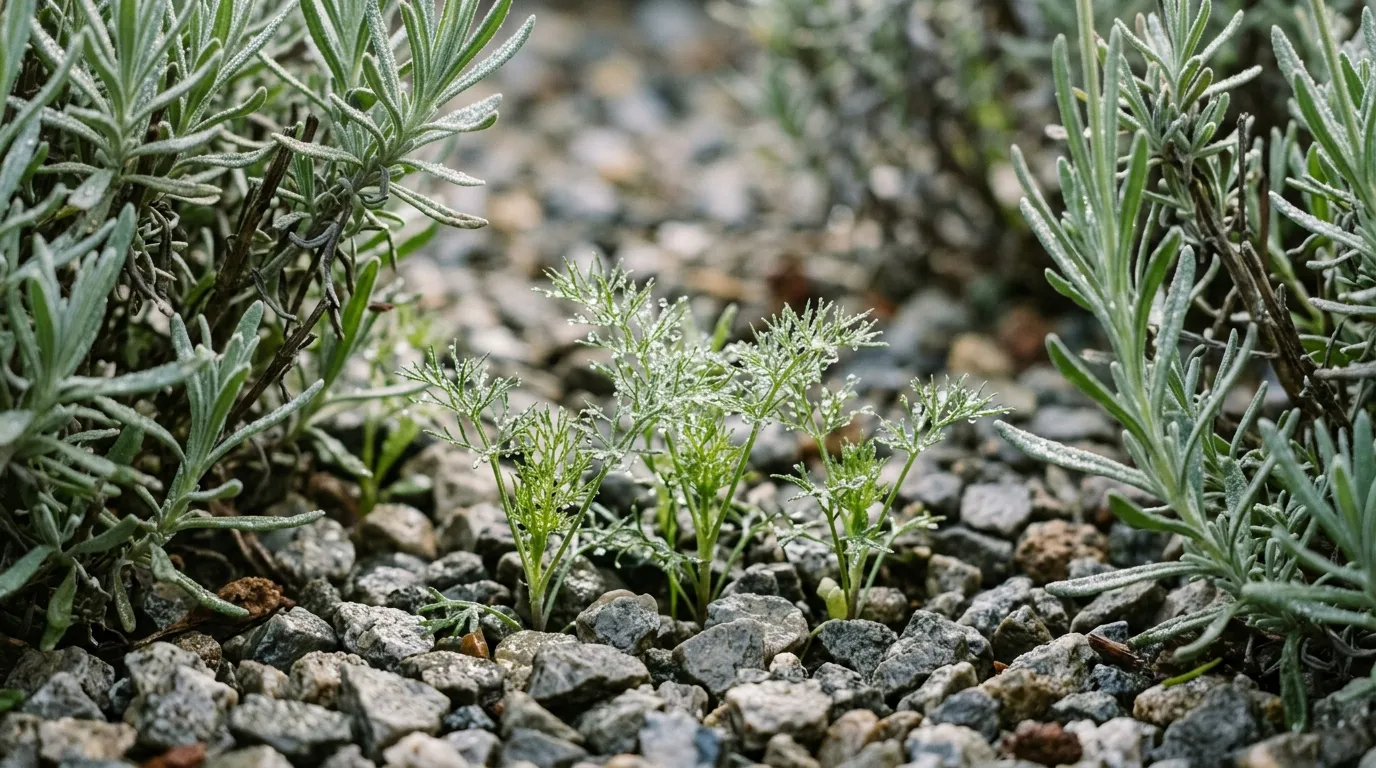 A self-sown nigella seedling pushes through gravel mulch between lavender plants. Gravel is the ideal surface for self-seeding.
Use gravel mulch instead of bark
Gravel at 10-15mm depth is the best surface for self-seeding. It holds moisture around seeds, provides the light seeds need to germinate, and keeps slugs away from tiny seedlings. Horticultural grit or pea gravel both work well, and the approach suits low-maintenance garden designs particularly well.
How to manage self-sown seedlings
What separates a self-seeded border from a weedy mess is editing. Thin, move, and remove seedlings with purpose.
Identify seedlings early
Learn to recognise your self-sown seedlings at the cotyledon (seed leaf) stage. Foxglove seedlings form flat rosettes of oval, slightly fuzzy leaves. Nigella produces feathery, thread-like leaves. Aquilegia has distinctive scalloped leaves in groups of three. If you’re unsure, leave a seedling until it’s 80-100mm tall and identifiable.
Thin in April and May
When seedlings reach 50-80mm tall, thin them to 150-200mm spacing. Remove the weakest and keep the strongest. Transplant extras to gaps in the border or pot them up for friends. Water transplanted seedlings immediately and again daily for a week.
Move seedlings while small
Self-sown seedlings transplant best when they have 4-6 true leaves and are under 100mm tall. Lift with a hand fork, keeping as much root as possible. Move them on an overcast day or in the evening. Firm in well and water. Foxgloves and verbascum develop a taproot quickly, so move these before they reach 80mm.
Remove unwanted seedlings ruthlessly
Not every seedling earns its spot. Hoe off excess seedlings in paths and gravel in April. Pull out any that appear in spots where they will crowd established plants. One foxglove can produce thousands of seedlings. Keep 3-5 per parent plant at most.
Designing with self-seeding plants
Self-seeding isn’t just a low-maintenance trick. It works as a genuine design tool. Used deliberately, it creates the naturalistic, slightly wild look that formal planting can’t achieve. Ornamental grasses paired with self-seeders create the kind of movement and texture seen in the best modern planting schemes.
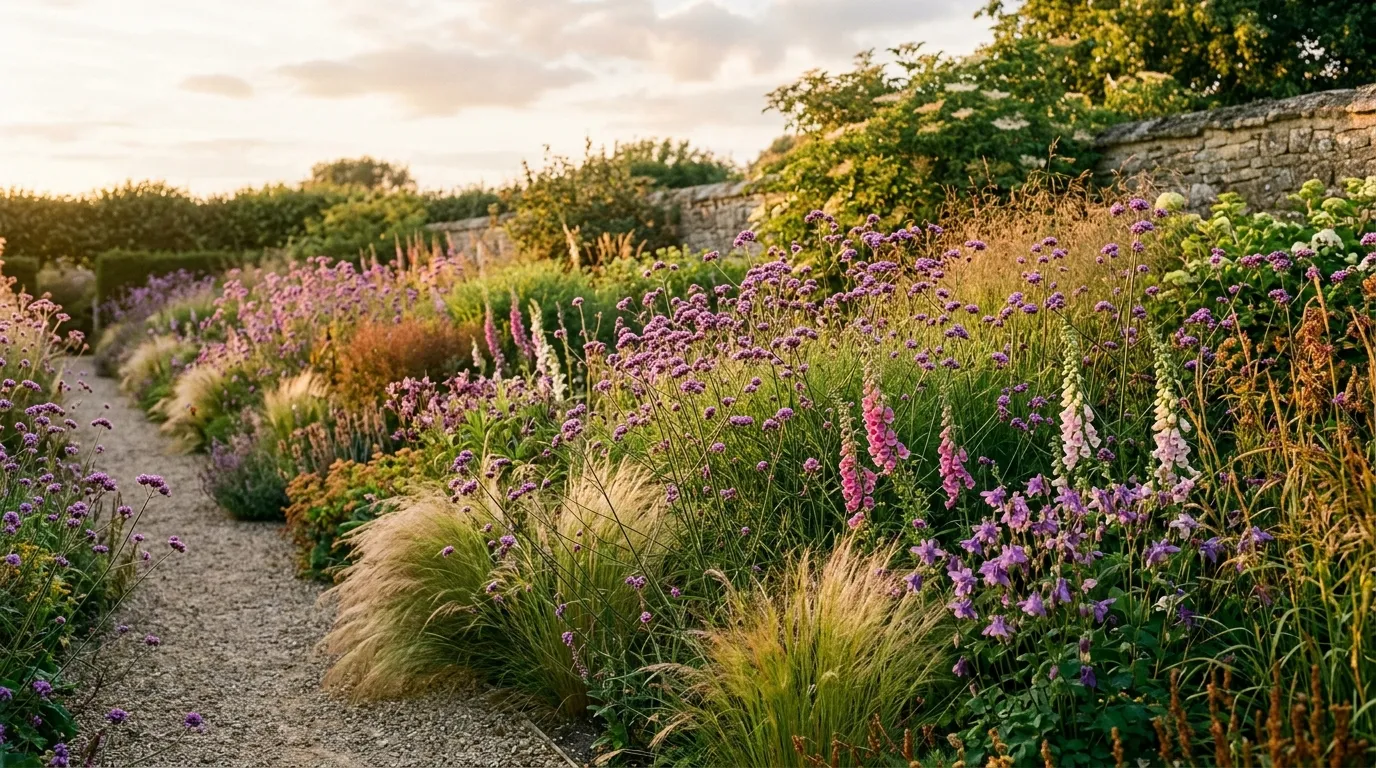 Matrix planting in action. Self-seeded verbena bonariensis and foxgloves weave through permanent perennials and grasses.
The matrix planting approach
Plant a base layer of reliable perennials at regular spacing. Then add 3-4 self-seeding species that will weave through the gaps. The self-seeders create a shifting, unpredictable layer over the permanent structure. Piet Oudolf’s New Perennial Movement works on exactly this principle.
For a 3m x 1.5m border, try this combination:
- Permanent layer: 5 x Salvia nemorosa ‘Caradonna’ at 400mm spacing, 3 x Nepeta ‘Walker’s Low’ at the front
- Self-seeding layer: Verbena bonariensis (3 plants to start), Nigella ‘Miss Jekyll’ (scatter seed), Foxglove (2-3 plants)
- Ground layer: Erigeron karvinskianus along the front edge (1 plant, it will spread)
By year three, the self-seeders will have filled every gap. The border will look different each summer, and no two years will be alike.
Colour management
Aquilegia cross-pollinates freely and produces every colour from cream to near-black. After 4-5 generations, most seedlings trend towards muddy purple. To keep specific colours, remove off-colour plants before they flower. Or embrace the mix. Both approaches look good.
Foxgloves revert to wild purple from hybrid seed within 3-4 generations. If you want white foxgloves, buy Digitalis purpurea f. albiflora and remove all purple seedlings before they flower.
Self-seeding for wildlife
Self-seeding borders happen to be outstanding for pollinators. The RHS Plants for Pollinators list confirms that many of the best self-seeders are also top pollinator plants. Standing seedheads through autumn and winter feed finches and other seed-eating birds. Hollow stems provide overwintering sites for solitary bees. You get the same benefits as a bee-friendly garden but with less effort.
A border with 8-10 self-seeding species provides continuous flowering from April to October. That’s 7 months of nectar and pollen from plants that replant themselves. A wildflower lawn alongside a self-seeded border creates a garden that practically runs itself for wildlife.
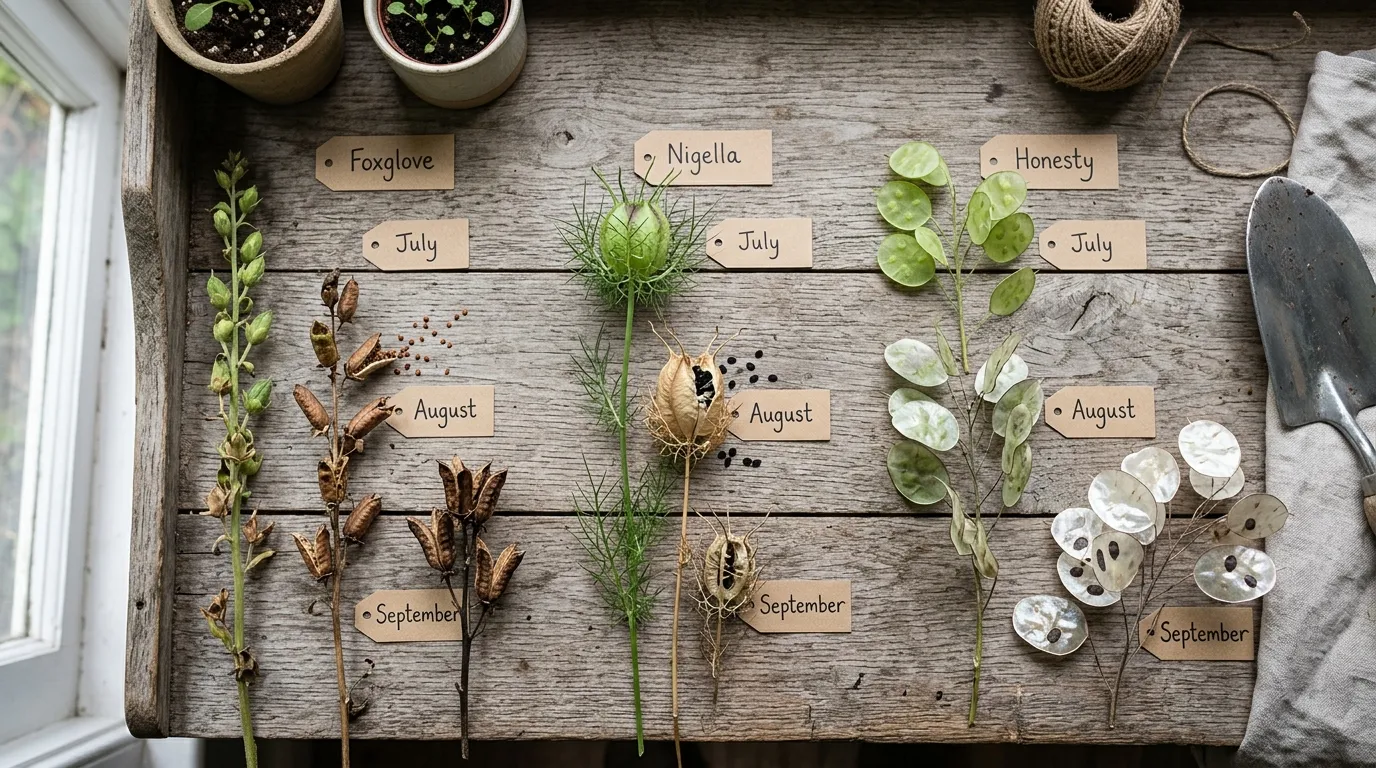 Seed pods at different stages. Foxglove pods split from the top, nigella pods rattle when ready, honesty discs turn papery silver.
Month-by-month self-seeding calendar
| Month | Task |
|---|---|
| January-February | Leave borders undisturbed. Seedlings overwinter as small rosettes. |
| March | Pull mulch back from self-seeding areas. Scratch bare soil lightly. First seedlings appear as soil warms above 8C. |
| April | Identify and thin seedlings to 150-200mm spacing. Transplant extras. Hoe off unwanted seedlings in paths. |
| May | Final thinning. Stake tall self-seeders like verbascum if exposed. Water transplanted seedlings in dry spells. |
| June | Enjoy the display. Stop deadheading biennials. Let seed pods form on foxgloves and honesty. |
| July | First seed pods ripen. Honesty discs turn papery. Foxglove pods brown from the bottom up. |
| August | Main seed drop month. Leave stems standing. Nigella pods rattle when ready. |
| September | Late seed drop from verbena bonariensis and erigeron. Cut back any plants that have finished seeding. |
| October-November | Clear spent stems once seeds have dropped. Leave some hollow stems standing for overwintering insects. |
| December | Plan next year. Note which self-seeders worked well and where gaps need filling. |
Common mistakes with self-seeding plants
Mulching too thickly. Bark mulch at 75mm or deeper kills all self-sown seedlings. Use 10-15mm of gravel instead, or leave sections bare.
Cutting back too early. Clearing borders in July or August removes seed pods before they ripen. Wait until October at the earliest.
Keeping every seedling. A foxglove produces thousands of seedlings. Keep 3-5 per plant. Overcrowded seedlings produce weak, spindly plants that flower poorly.
Ignoring aggressive self-seeders. Welsh poppies, green alkanet, and herb Robert can overwhelm a border in 2-3 years. Deadhead these ruthlessly or remove them entirely if they start to dominate.
Relying only on self-seeders. A border needs permanent structure from shrubs, grasses, and long-lived perennials. Self-seeders fill the gaps between structural plants. They shouldn’t be the entire planting.
Lawrie has been gardening in the West Midlands for over 30 years. He grows his own veg using no-dig methods, keeps a wildlife-friendly garden, and writes practical advice based on real UK growing conditions.