UK Native Plants for Gardens
UK native plants support 10x more wildlife than exotics. Expert guide: 40+ trees, shrubs, and wildflowers with wildlife value, soil types, and UK sourcing.
Key takeaways
- The UK has around 1,400 native vascular plant species, but most gardens use fewer than 10 of them
- Native plants support 10x more insect species than exotic ornamentals of equivalent size
- A native wildflower meadow costs 2-6 pounds per square metre to establish and needs no fertiliser once established
- Hawthorn, blackthorn, and guelder rose are the top three native shrubs by combined bird and insect value
- Always source native plants from UK-propagated stock — imported plants risk introducing Xylella fastidiosa and ash dieback
Native plants evolved in British soils, with British rainfall, alongside British insects and birds. UK native plants support an average of ten times more insect species than non-native ornamentals of the same size. This guide covers 40+ native trees, shrubs, wildflowers, and grasses with documented wildlife values, soil preferences, flowering periods, and sourcing advice for gardens of all sizes.
Why native plants matter for UK gardens
The case for native plants comes down to evolutionary specialisation. Most British insects are host-plant specialists: they can only feed, breed, or complete their life cycle on specific plant genera. The speckled wood butterfly larva feeds only on grasses, particularly false brome (Brachypodium sylvaticum) and cock’s-foot (Dactylis glomerata). The brimstone butterfly larva feeds only on buckthorn and alder buckthorn. A garden filled entirely with exotic ornamentals, however beautiful, is ecologically near-empty.
Published research from the University of Sussex comparing paired native and non-native gardens found native plant gardens supported three times more bumblebee species, five times more hoverfly species, and significantly higher butterfly diversity. The research was led by Professor Dave Goulson, who documented that 85% of plant-feeding insects in Britain require native plants to complete their life cycles.
The Woodland Trust states that a native oak supports over 280 insect species; a native hawthorn supports 149. A horse chestnut — introduced to Britain from Greece in the 1600s — supports around 50. An ornamental cherry from Japan supports fewer than 10.
This matters directly for garden birds. Blue tit chicks need 10,000-14,000 caterpillars during a single three-week fledgling period. Gardens without native trees and shrubs cannot support this reliably. The knock-on effect runs up every level of the food chain.
Which native plants support the most wildlife?
Not all natives are equal. Some species carry a disproportionate ecological load. The table below ranks 18 key native plants by documented insect species supported.
| Plant | Type | Insect species supported | Top wildlife beneficiaries | Flowering period |
|---|---|---|---|---|
| Silver birch | Tree | 334 | Siskin, redpoll, treecreeper | March (catkins) |
| English oak | Tree | 280+ | Blue tit, pied flycatcher, moth larvae | April (catkins) |
| Scots pine | Tree | 172 | Crossbill, coal tit, goldcrest | March-April (pollen) |
| Hawthorn | Tree/shrub | 149 | Fieldfare, redwing, whitethroat | April-May |
| Blackthorn | Shrub | 109 | Bullfinch, dunnock, brown hairstreak | March-April |
| Crab apple | Tree | 93 | Waxwing, blackbird, hedgehog | April-May |
| Alder | Tree | 90 | Siskin, redpoll, common alder moth | March (catkins) |
| Common hazel | Shrub/tree | 106 | Dormouse, nuthatch, great tit | Feb-March (catkins) |
| Dog rose | Shrub | 65 | Bullfinch, small tortoiseshell, marble gall wasp | June-July |
| Elder | Shrub/tree | 70 | Blackcap, song thrush, brimstone moth | May-June |
| Guelder rose | Shrub | 31 | Bullfinch, blackbird, viburnum beetle | May-June |
| Wild cherry | Tree | 67 | Cherry fruit moth, mistle thrush, redstart | April-May |
| Common dog violet | Wildflower | 22 | Fritillary butterfly larvae, queen bumblebees | March-May |
| Wild marjoram | Wildflower | 40+ | Marbled white, common blue, 30+ bee spp | July-September |
| Oxeye daisy | Wildflower | 30+ | 17 bee species, drone fly, hoverflies | May-September |
| Yellow rattle | Wildflower | 18 | Meadow brown, small heath, marsh fritillary | May-July |
| Teasel | Biennial | 12+ | Goldfinch (seeds), bumblebees (flowers) | July-August |
| Harebell | Wildflower | 15 | Large and small skippers, mining bees | July-September |
Native trees for gardens
For a full deep-dive on the 15 best native trees for UK gardens, see our dedicated guide. Here is a summary of the top five for domestic plots.
English oak (Quercus robur): 280+ insect species, 20-25m at maturity. For gardens of 500sqm+. Best planted as a bare-root whip (60-90cm) in November. Tolerates clay and loam, pH 4.5-7.0.
Silver birch (Betula pendula): 334 insect species, 15-20m at maturity. Fastest-establishing native tree on free-draining acidic soil. Bare-root whips cost £1.50-£3.50 each from UK specialist nurseries. Best on pH 4.5-6.5.
Hawthorn (Crataegus monogyna): 149 insect species, 5-12m. The most adaptable native species: grows on chalk, clay, loam, and sand across pH 5.0-8.0. Starts flowering and berrying within 3-5 years of bare-root planting. Essential for mixed native hedging at 33cm spacing. Our hedge planting guide covers spacing, cutting schedules, and formative pruning.
Field maple (Acer campestre): 51 insect species, 4-8m in gardens. The best native tree for small gardens. Vivid gold autumn colour, tolerates clay and chalk equally. Keeps well at 4-5m with light late-winter pruning.
Common hazel (Corylus avellana): 106 insect species, 3-6m. Multi-stem habit with vivid yellow catkins in February. Produces hazelnuts from year 4-5. Ideal as a coppiced specimen that stays compact. Loved by dormice, nuthatches, and tits. Tolerates chalk, clay, and loam.
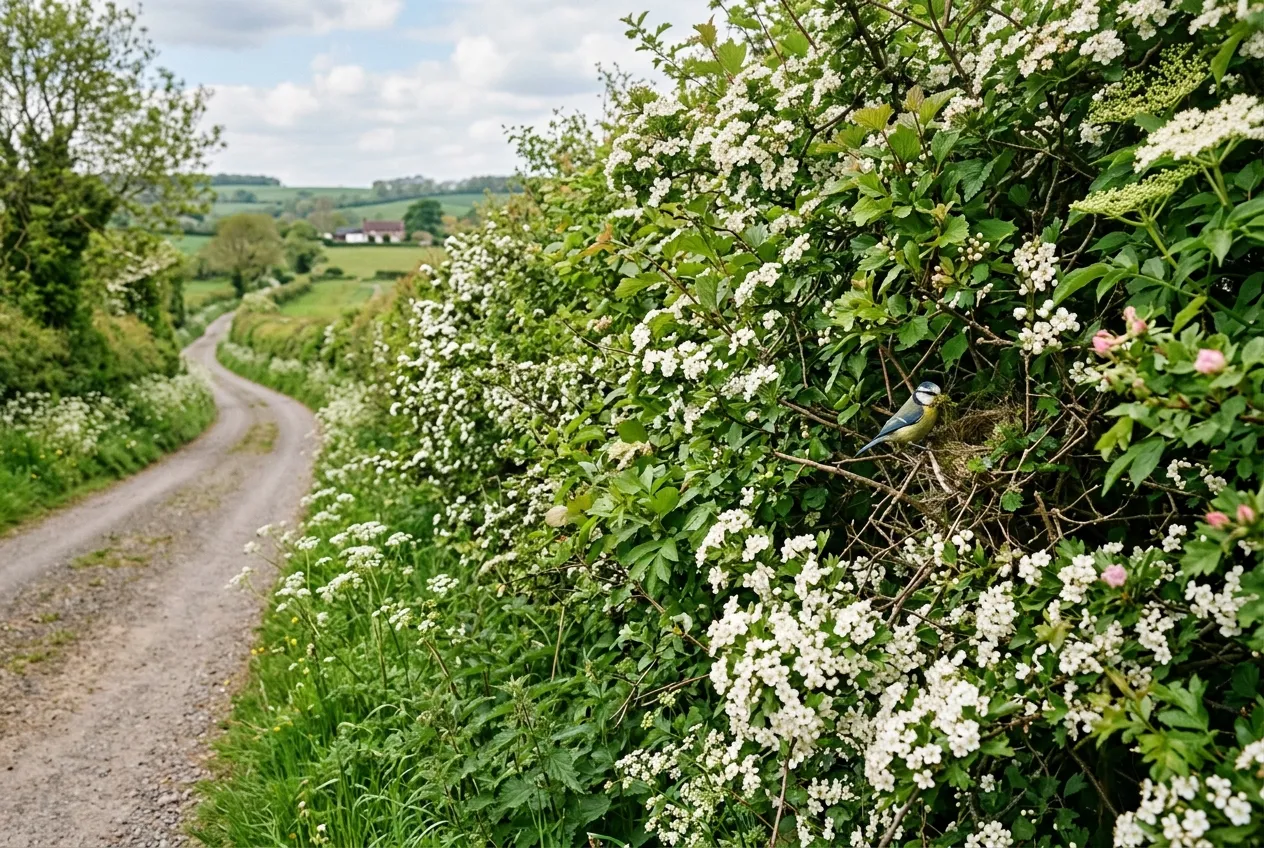 Hawthorn (Crataegus monogyna) and blackthorn (Prunus spinosa) in a mixed native hedge in Staffordshire, late April. Hawthorn supports 149 insect species and begins berrying within 3-5 years of bare-root planting.
Native shrubs: the backbone of a wildlife garden
Native shrubs fill the 1-5m gap between ground-level plants and trees. They provide nesting structure, berries, and flowers at eye-level — the most accessible part of the garden for birds. The best native shrubs combine insect value, berry production, and structural cover.
Blackthorn (Prunus spinosa): Flowers in March, before its leaves emerge, making it the earliest native pollen source. Supports 109 insect species. Sloe berries ripen in October and provide food for mistle thrush and fieldfare into winter. Spreads by suckers — contains this with a mown grass margin. Good on chalk, clay, and loam, pH 5.5-7.5.
Guelder rose (Viburnum opulus): Red berries in clusters from August to January. Flowers in flat white corymbs in May-June. Supports 31 insect species including the viburnum beetle and several hoverfly species. Best on moisture-retentive clay or loam. Reaches 2-4m. Superb autumn colour (scarlet). This is the native equivalent of the ornamental Viburnum opulus cultivars — same species, more wildlife value.
Dog rose (Rosa canina): Scrambling shrub to 3m. Pink flowers June-July, bright red hips through winter. The hips feed blackbirds, thrushes, and waxwings from October through to March. Supports 65 insect species. Tolerates poor soils including thin chalk. Can be grown through a hedge or as a freestanding specimen. One of the most important shrubs for the brown hairstreak butterfly, whose eggs overwinter on the previous year’s blackthorn growth immediately beside dog rose.
Elder (Sambucus nigra): Grows 3-7m, tolerates almost any soil, fast-establishing. Flat-topped creamy flower heads in May-June attract 70+ insect species. Berries in September-October feed blackcap, garden warbler, and blackbird. Useful in difficult damp spots or as a fast-fill shrub in a new hedge. Will regenerate vigorously if cut back hard. Easy to grow from hardwood cuttings.
Common hazel (Corylus avellana): Already listed under trees — hazel functions as a large multi-stem shrub when coppiced every 7-10 years. This traditional management keeps it at 2-4m and dramatically increases catkin and nut production. Coppicing cycle suits gardens where height must be managed.
For gardens where space is limited, the best strategy is a mixed native hedge combining at least three of the above species. A mixed native hedge planted at 33cm spacing will deliver year-round bird foraging, nesting, and insect habitat in a 50cm-wide strip. It outperforms any ornamental hedge of equivalent dimensions for biodiversity.
Native wildflowers and how to use them
Native wildflowers split into two planting contexts: meadow/grassland species that only perform in low-fertility soil without competing grasses, and border/woodland edge species that integrate into conventional garden beds.
Meadow wildflowers
Meadow wildflowers need low-fertility soil. On typical garden soil enriched by years of composting or feeding, aggressive grasses crowd them out within two seasons. The solution is either to start with genuinely poor soil (sandy, thin over chalk, or recently stripped topsoil) or to remove the top 10cm of soil from a designated area before sowing.
The key to a stable wildflower meadow is yellow rattle (Rhinanthus minor). Yellow rattle is a hemiparasite — it partially parasitises the roots of vigorous grasses, reducing their growth by 50-60% and creating gaps for fine-leaved wildflowers to establish. Sow yellow rattle fresh in September at 1-2g per square metre. It will not germinate from spring-sown seed. Results take 2-3 seasons to fully establish.
Our guide to creating a wildflower lawn covers the full establishment process. For smaller spaces, the mini-meadow method describes how to convert a 2sqm bed.
Top meadow species:
| Species | Height | Flowering | Key wildlife | Soil | Seed rate/m² |
|---|---|---|---|---|---|
| Yellow rattle | 20-50cm | May-July | Meadow brown, bees | Low fertility only | 1-2g |
| Oxeye daisy | 30-90cm | May-Sept | 17 bee spp, hoverflies | Any low-fertility | 0.5-1g |
| Meadow buttercup | 30-90cm | Apr-July | 30+ bee spp, hoverflies | Clay to loam | 1-2g |
| Field scabious | 30-90cm | June-Oct | 30+ bee/wasp spp | Chalk, loam | 0.5-1g |
| Harebell | 15-40cm | July-Sept | Mining bees, skippers | Sandy, chalk | 0.3-0.5g |
| Tufted vetch | 30-150cm | June-Aug | 30+ bee spp, moths | Any low-fertility | 2-3g |
| Common knapweed | 30-90cm | June-Sept | Marbled white, gatekeepers | Clay, loam | 0.5-1g |
| Bird’s-foot trefoil | 10-40cm | May-Sept | Common blue (larvae) | Sandy, chalk | 1-2g |
| Wild carrot | 30-80cm | June-Aug | Hoverflies, parasitic wasps | Chalk, free-draining | 0.5-1g |
Border wildflowers
Border wildflowers tolerate normal garden soil and integrate alongside conventional perennials. They are a more practical entry point than a full meadow for most gardeners.
Foxglove (Digitalis purpurea): Biennial, 1-2m, flowers June-July. Deep tubular flowers are almost exclusively visited by buff-tailed and garden bumblebees. Self-seeds freely on disturbed soil. Toxic to pets and livestock — keep away from areas used by dogs and cats. Our full guide to growing foxgloves in the UK covers position, self-seeding management, and shade tolerance.
Primrose (Primula vulgaris): Perennial, 10-20cm, flowers February-May. One of the first nectar sources for queen bumblebees emerging from hibernation in February. Supports hawthorn sawfly and several mining bee species. Grows best in partial shade under deciduous trees or shrubs. Read our detailed primrose growing guide for planting depth and division timing.
Red campion (Silene dioica): Perennial, 30-90cm, flowers April-November. One of the longest-flowering native plants. Supports 40+ insect species including the red campion moth (Hadena rivularis), whose larvae are entirely dependent on it. Tolerates partial shade, clay, and loam.
Wild garlic (Allium ursinum): Perennial bulb, 20-40cm, flowers April-June. Spreads by seed into large colonies under deciduous canopy. Strongly scented when the leaves are crushed. Attracts 20+ hoverfly species in spring. Excellent ground cover for moist, shaded woodland gardens. Edible.
Teasel (Dipsacus fullonum): Biennial, 100-200cm. Architectural seedheads from August onwards are the primary winter food source for goldfinches — a single teasel plant can feed 4-6 goldfinches simultaneously. Flowers July-August attract bumblebees and honey bees.
Common dog violet (Viola riviniana): Perennial, 5-20cm, flowers March-May. The larval food plant for all six UK fritillary butterflies, including pearl-bordered, small pearl-bordered, and high brown fritillary. Available from specialist nurseries only — not widely sold in garden centres.
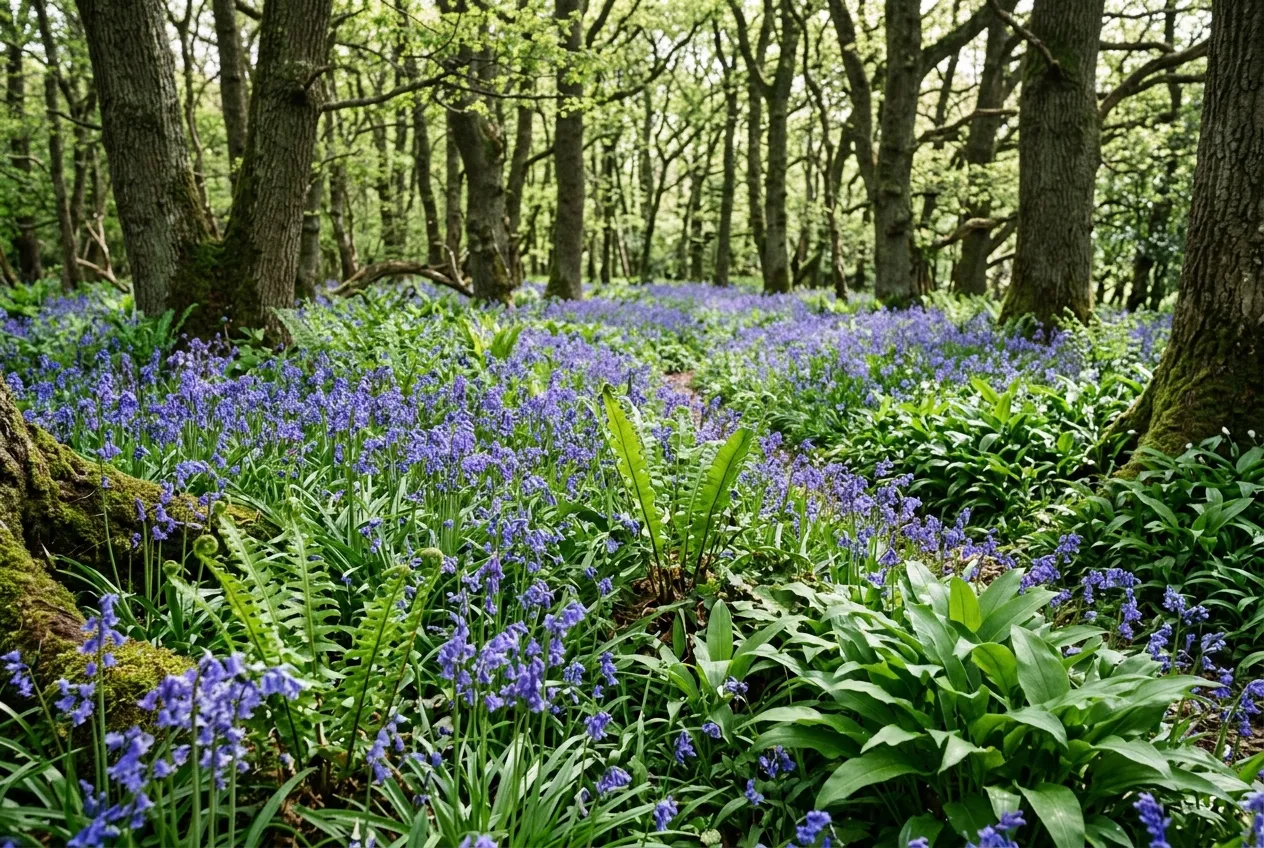 Wild bluebells (Hyacinthoides non-scripta) and wood anemone in a Derbyshire woodland garden. Bluebells are protected under the Wildlife and Countryside Act 1981 — buy only from nursery-propagated stock.
Native bulbs for shade and woodland gardens
Native bulbs fill the critical February-May window when most gardens offer little for emerging pollinators. They are largely independent once established and require no annual lifting or storage.
Bluebell (Hyacinthoides non-scripta): The most iconic native bulb. Flowers April-May under deciduous canopy. Supports queen bumblebees and hairy-footed flower bees in spring. Protected under the Wildlife and Countryside Act 1981 — it is an offence to collect bulbs or seeds from the wild. Buy only nursery-propagated stock, clearly labelled Hyacinthoides non-scripta (not the Spanish hybrid H. hispanica or the cross H. × massartiana). Naturalise in moist, well-drained soil in partial shade. Plant bulbs in September at 8-10cm depth, 10cm spacing.
Wood anemone (Anemone nemorosa): Flowers March-April. Delicate white flowers open only in sunshine. Spreads slowly from rhizomes at 5-10cm per year — it is a reliable indicator of ancient woodland in the wild. Buy rhizomes in early autumn. Does not establish well from dried rhizomes sold out of season. Suits moist soil in partial to full shade.
Wild daffodil (Narcissus pseudonarcissus): The native species, smaller and paler than cultivated varieties. Flowers March-April. Naturalises in rough grass under orchards, on banks, and in light woodland. Much better for wildlife than large Dutch daffodils, whose dense double flowers bees cannot access.
Ramsons (Allium ursinum) — see wild garlic entry above.
Native grasses
Native grasses are underused in UK gardens but critical for moths, butterflies, and invertebrates. Most grass-feeding Lepidoptera larvae will only use native grasses.
Yorkshire fog (Holcus lanatus): Soft, downy leaves. Supports 20+ moth and butterfly larvae. Tolerates poor, damp conditions. Good on clay. Flowers June-August.
Meadow fescue (Festuca pratensis): Fine, upright growth. Hosts the Essex skipper and small skipper butterfly larvae. Tolerates clay and loam. Flowers June-July.
False brome (Brachypodium sylvaticum): Shade-tolerant grass for woodland gardens. Larval food plant for the speckled wood butterfly. 30-60cm, tolerates full shade under canopy.
Tufted hair-grass (Deschampsia cespitosa): Large tussock-forming grass. Hosts 6 moth species. Tolerates waterlogged clay. Excellent structural plant for damp corners 60-120cm tall.
Common bent (Agrostis capillaris): Fine, wispy grass. Tolerates thin, acidic soils. Hosts the wall brown butterfly larva. Used in low-fertility wildflower meadow mixes.
Mix native grasses into wildflower areas at a grass:flower seed ratio of 60:40 by weight. Avoid perennial rye grass (Lolium perenne) in wildflower areas — it is a native species but aggressively competitive and will dominate at the expense of wildflowers.
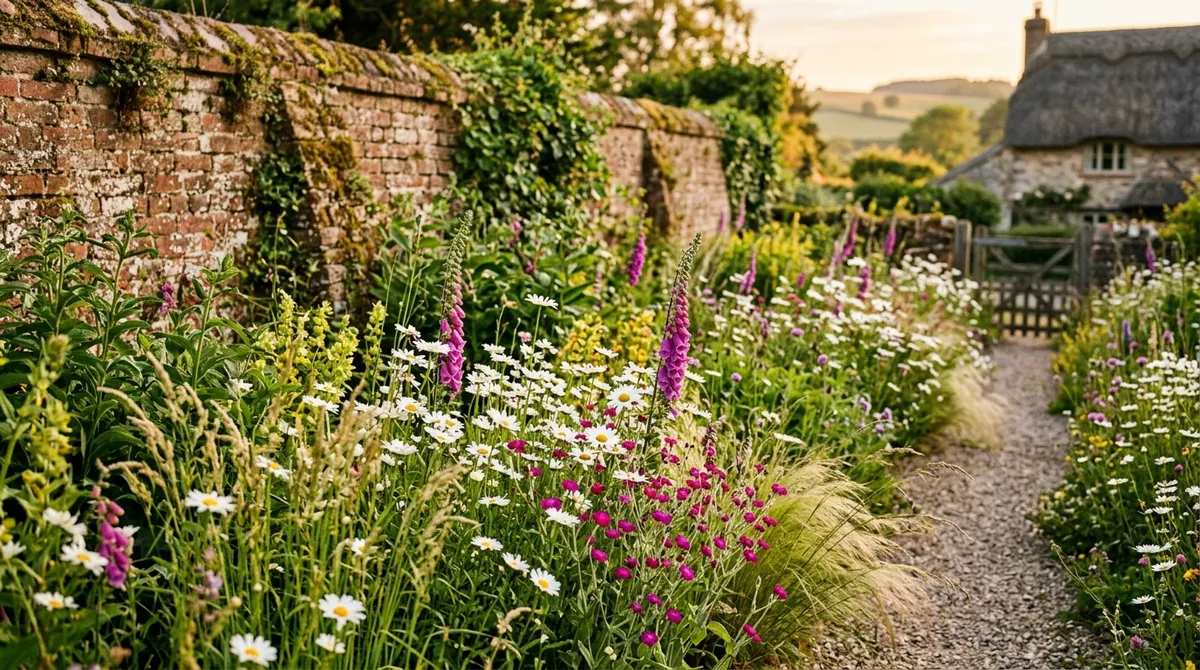
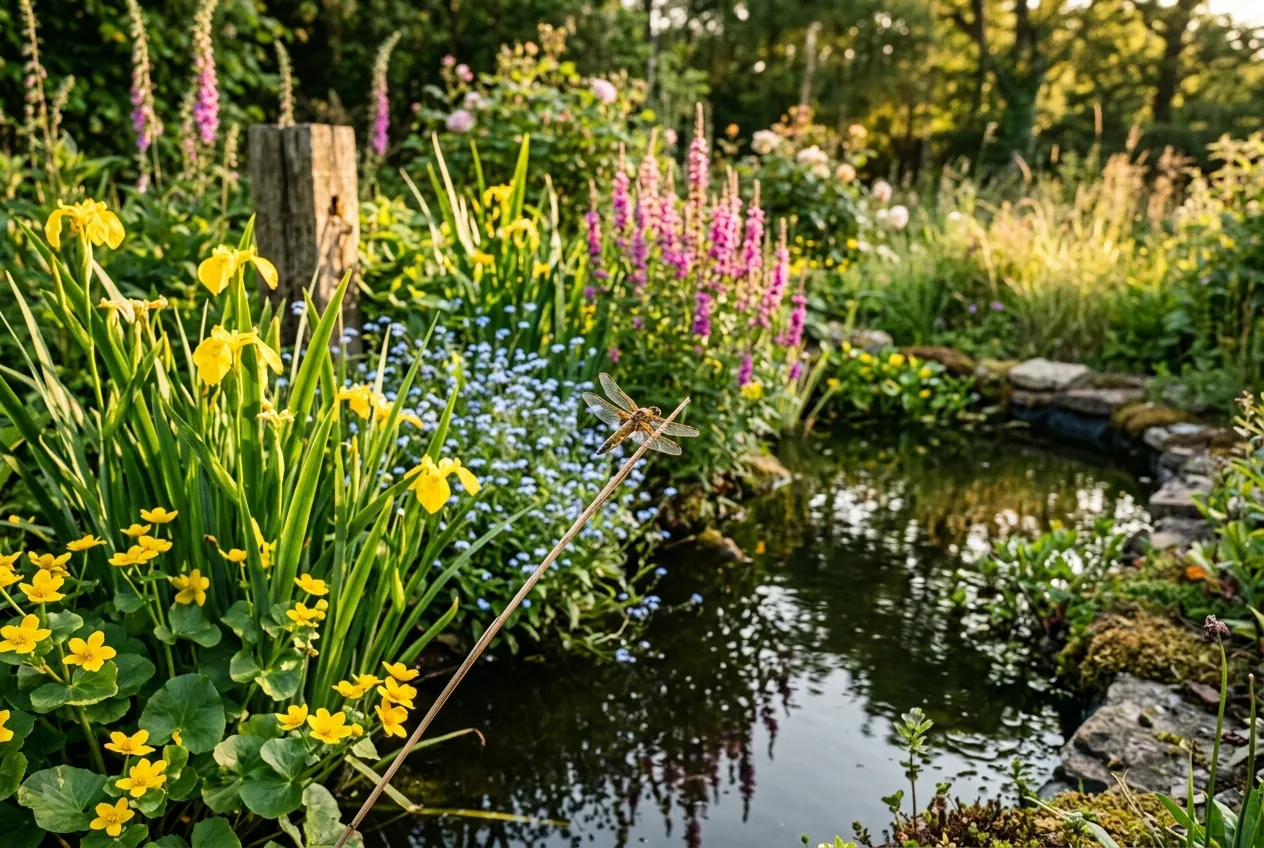 Native wildflower border in a south Staffordshire garden in July. Species visible: oxeye daisy (Leucanthemum vulgare), field scabious (Knautia arvensis), common knapweed (Centaurea nigra). Established in year 2 on stripped topsoil at 3g seed per square metre.
Native plants by garden situation
Use this table to match native species to specific garden conditions.
| Situation | Best native trees | Best native shrubs | Best wildflowers | Notes |
|---|---|---|---|---|
| Full sun, dry soil | Field maple, crab apple | Blackthorn, dog rose, gorse | Wild marjoram, harebell, viper’s bugloss | Thin chalky soil suits 30+ specialist species |
| Full sun, moist soil | Alder, crack willow | Guelder rose, elder, dogwood | Meadowsweet, ragged robin, purple loosestrife | Damp meadow mix available from specialist suppliers |
| Partial shade | Hazel, wild cherry | Hawthorn, spindle, buckthorn | Bluebell, wood anemone, primrose, red campion | Most productive wildlife zone in a mixed garden |
| Full shade | — | Elder, holly | Wild garlic, hart’s tongue fern, false brome, dog’s mercury | Restrict trees to woodland edge; no wildflowers in deep shade |
| Heavy clay | Hawthorn, alder, field maple | Blackthorn, elder, buckthorn | Meadow buttercup, ragged robin, marsh marigold | Avoid planting in winter waterlogging — wait for spring |
| Exposed / coastal | Hawthorn, blackthorn | Gorse, dog rose, elder | Sea campion, thrift, bird’s-foot trefoil | Native hedgerows act as windbreaks — see planting guide |
| Small garden (under 50sqm) | Field maple (kept pruned), hazel | Guelder rose, dog rose | Wildflower border using border species only; no meadow | Avoid oak, birch, alder — too large for small plots |
Where to source UK native plants
Sourcing matters. Imported native plants carry significant biosanitary risk. Xylella fastidiosa, ash dieback (Hymenoscyphus fraxineus), and Phytophthora species have all entered the UK via imported nursery stock. The RHS guidance on buying plants recommends always buying UK-propagated stock and inspecting plants for pest and disease signs before purchase.
Reputable UK native plant suppliers:
- Emorsgate Seeds (Norfolk): specialist native wildflower and grass seed, all UK-provenance, available in small and bulk quantities
- Wildflower Turf Ltd: ready-to-lay wildflower turf and plug plants, sourced from UK seed
- British Wildflowers (Devon): potted native plants propagated from UK-collected seed
- Habitat Aid: trees, shrubs, bulbs, and wildflower seeds, all UK provenance, strong provenance documentation
- Woodland Trust Tree Shop: subsidised native trees and hedging, bare-root, available October-April
- Local Wildlife Trusts: several county Wildlife Trusts run annual native plant sales, usually in May
What to look for on the label:
- Species name in full (genus and species): Crataegus monogyna, not just “hawthorn”
- Statement of provenance: “grown from UK-collected seed” or “UK nursery propagated”
- Avoid stock labelled “ornamental”, “selected form”, or any cultivar name (e.g. ‘Plena’) — cultivar forms typically support far fewer insects than the straight species
RHS Plant Finder allows search by species and lists nurseries stocking each plant with provenance information. Free to use at rhs.org.uk/plants/search-form.
Creating a wildlife garden with native plants
If you want to go further than individual species choices, our guide to creating a wildlife garden in the UK covers the full habitat design approach — combining native planting with water features, log piles, and management practices that support a full range of native wildlife from insects up to mammals.
For pollinators specifically, our bee-friendly garden plants guide lists the 30 best plants for bumblebees and solitary bees, ranked by pollen and nectar value. And for butterflies, the best plants for butterflies in the UK covers host plants as well as nectar sources — the distinction that most butterfly garden guides ignore.
If you are creating habitat for hedgehogs, dense native hedgerows and rough grass margins are the most important structural features. Our hedgehog-friendly garden guide explains how to integrate these with planting choices.
Related reading
- Native Trees for UK Gardens — 15 species with soil type, growth rate, and wildlife value
- How to Create a Wildflower Lawn — preparation, species selection, and first-year management
- Mini Meadow Wildflower Area — how to create a 2sqm wildflower patch from scratch
- Create a Wildlife Garden in the UK — habitat design beyond planting
- Hedge Planting Guide UK — native hedgerow species, spacing, and cutting schedules
Lawrie has been gardening in the West Midlands for over 30 years. He grows his own veg using no-dig methods, keeps a wildlife-friendly garden, and writes practical advice based on real UK growing conditions.