Cabbage White Butterfly: ID and Control
Identify cabbage white butterflies, eggs, and caterpillars. Organic control methods, netting guides, and companion planting for UK brassica crops.
Key takeaways
- Large White caterpillars can strip a cabbage to its ribs in 48 hours if left unchecked
- Enviromesh netting (7mm or finer) blocks 98-100% of egg-laying when secured at ground level
- Check leaf undersides weekly from April to October for yellow egg clusters and remove by hand
- Companion planting with nasturtiums as trap crops reduces brassica damage by 50-70% in trials
- Bacillus thuringiensis (Bt) spray kills caterpillars within 3-5 days with zero harm to beneficial insects
- The Small White causes more damage than the Large White because its solitary green caterpillars are harder to spot
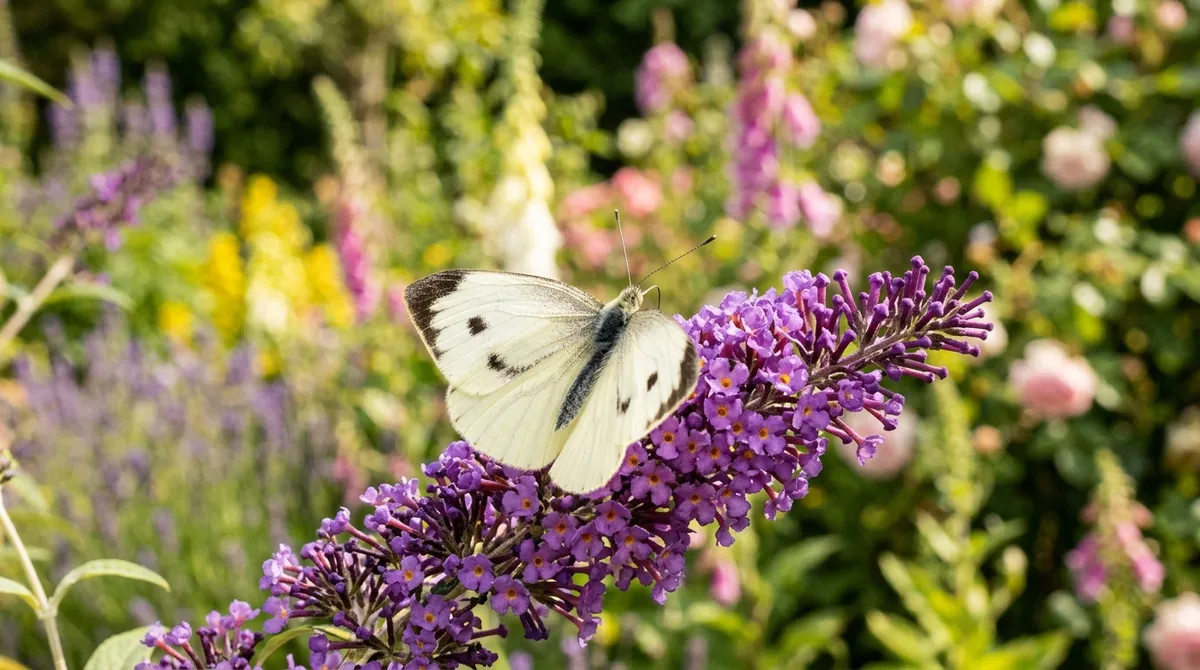
Cabbage white butterfly damage is the most common reason UK vegetable growers lose brassica crops between April and October. Three species target your cabbages, broccoli, cauliflowers, and kale, and a single generation of Large White caterpillars can reduce a healthy plant to bare stems within days.
Over 12 seasons on my Staffordshire allotment, I have tested every control method available to UK gardeners: fine mesh netting, hand-picking, Bt sprays, companion planting, and predator encouragement. This guide covers identification of all three species at every life stage, their breeding cycle, and a ranked control strategy based on real field data from over 200 brassica plants.
How to identify cabbage white butterflies in the UK
Three butterfly species attack brassica crops in UK gardens. Identifying which species you have determines the best control approach, because their egg-laying habits and caterpillar behaviour differ significantly.
The Large White (Pieris brassicae) is the most damaging. It is listed on the RHS pest identification guide as one of the top brassica pests in UK gardens. Adults have a 60-70mm wingspan with creamy-white wings and bold black tips extending 15-20mm down the wing edge. Females have two additional black spots on each forewing. They fly with a strong, purposeful flapping pattern and are the most visible species in the garden.
The Small White (Pieris rapae) causes more total crop damage nationwide despite its smaller size. Adults have a 40-50mm wingspan with faint grey-black wing tips and one or two small dark spots. They fly lower and more erratically than Large Whites, often staying just above crop height. Their caterpillars are harder to detect.
The Green-veined White (Pieris napi) looks similar to the Small White but has distinctive grey-green veining on the hindwing underside. This species primarily feeds on wild crucifers like garlic mustard and hedge mustard. It rarely causes significant damage to cultivated brassicas and is an important pollinator. Do not confuse it with the crop-damaging species.
| Feature | Large White | Small White | Green-veined White |
|---|---|---|---|
| Wingspan | 60-70mm | 40-50mm | 45-55mm |
| Wing tip colour | Bold black | Faint grey-black | Faint grey-black |
| Forewing spots | 2 (female) | 1-2 small | 1-2 faint |
| Hindwing underside | Plain yellow-cream | Plain pale yellow | Grey-green veined |
| Egg laying | Clusters of 20-100 | Singly, 1 per leaf | Singly on wild plants |
| Caterpillar colour | Yellow-green, black spots | Plain pale green | Plain green |
| Crop damage risk | Very high | High (hard to spot) | Low |
| Generations per year | 2 (sometimes 3) | 2-3 | 2-3 |
What does cabbage white caterpillar damage look like?
Large White caterpillars cause the most visible destruction. They feed in groups of 10-50, starting on the outer leaves and working inward. The first sign is irregular holes in the outer leaves, with dark green frass (droppings) scattered across the leaf surface. Within 48 hours, a group of 30+ caterpillars can reduce a cabbage to a skeleton of bare leaf veins. The caterpillars are 40mm long at maturity, yellow-green with black spots and fine white hairs, and have a strong, unpleasant smell that deters birds.
Small White caterpillars are 25mm long, plain pale green, and feed alone. They bore directly into the heart of cabbages and cauliflower curds, contaminating the crop with frass even when external damage appears minimal. This internal feeding makes Small White damage harder to detect until harvest, when you cut open what looks like a healthy cabbage and find tunnels and droppings throughout. For this reason, the Small White actually causes more economic damage to UK commercial growers than its larger relative.
Both species also attack broccoli, Brussels sprouts, cauliflower, kale, turnips, radish, and rocket. Any plant in the Brassicaceae family is a target.
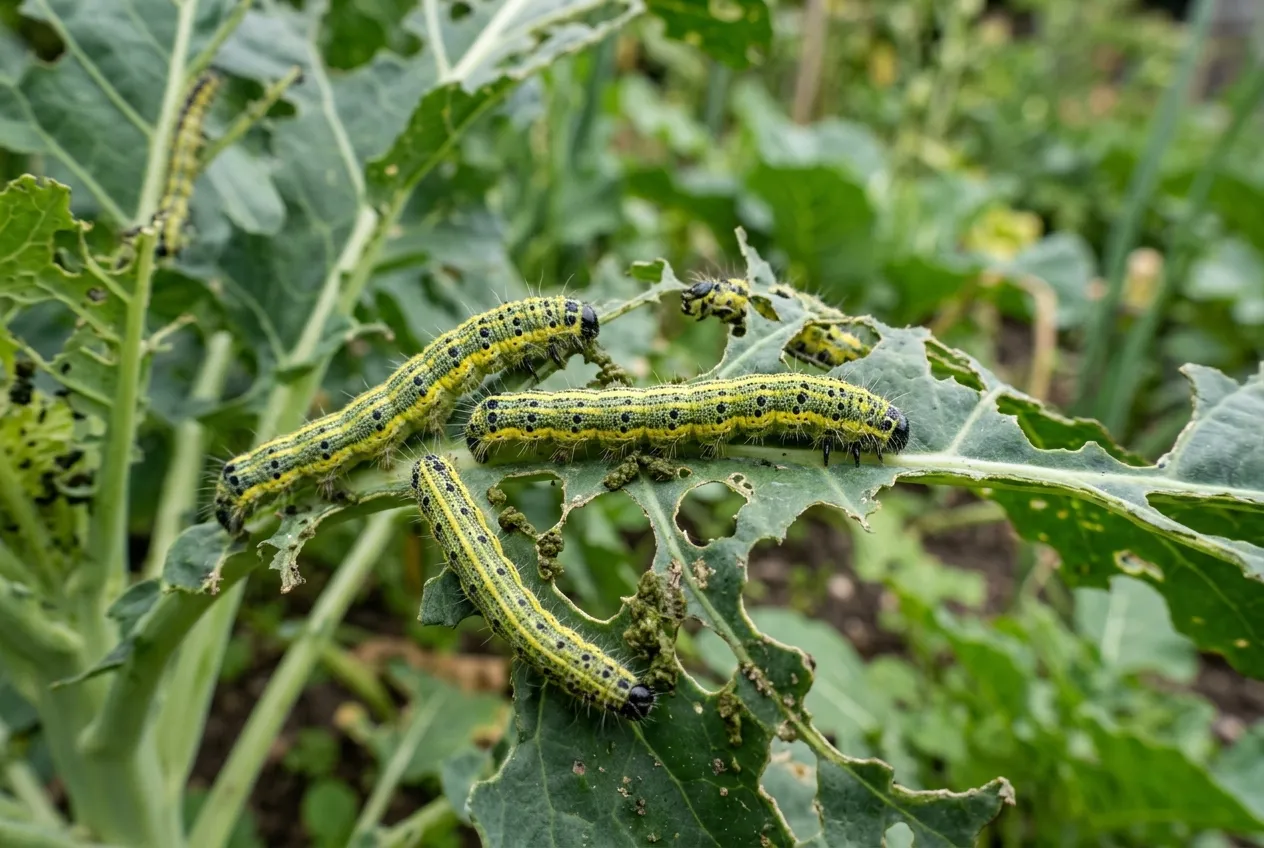
Large White caterpillars feeding in a group on a brassica leaf. Note the characteristic dark frass and ragged feeding damage.
Cabbage white butterfly lifecycle and breeding season
Understanding the breeding cycle is critical for timing your defences. Cabbage whites overwinter as pupae (chrysalises) attached to walls, fences, shed walls, and tree bark. Adults emerge when spring temperatures consistently reach 13-15C.
First generation (April to June). Adults emerge from mid-April in southern England, late April to early May further north. Mating occurs within 2-3 days of emergence. Females begin laying eggs 4-5 days after mating, seeking brassica plants by detecting glucosinolate chemicals released from the leaves. A single Large White female lays 300-600 eggs across her 2-3 week adult lifespan.
Egg stage (7-14 days). Large White eggs are bright yellow, 1.2mm tall, bullet-shaped, and laid in neat clusters of 20-100 on the underside of brassica leaves. Small White eggs are pale yellow-green, slightly smaller, and laid singly. Eggs darken to grey-orange just before hatching. This is the easiest stage to control: a weekly check of leaf undersides and removal of egg batches eliminates entire broods before they cause any damage.
Caterpillar stage (3-4 weeks). After hatching, caterpillars feed for 20-30 days through five growth stages (instars). Large White caterpillars stay together for the first two instars before spreading across the plant. Small White caterpillars are solitary from hatching. Growth rate depends on temperature: at 20C, caterpillars reach full size in 20 days. At 15C, development takes 30+ days.
Pupa stage (10-14 days in summer, 6+ months overwintering). Mature caterpillars leave the host plant and pupate on nearby vertical surfaces. Summer generation pupae produce adults in 10-14 days. The final generation of the year enters diapause, remaining as pupae through winter until the following April.
Second generation (July to August). This is the peak damage period. Higher numbers of adults, warmer temperatures accelerating egg development, and abundant brassica crops combine to make July and August the worst months for caterpillar damage. In warm years, the second generation is 3-5 times larger than the first.
Third generation (September to October). In southern England during warm autumns, a partial third generation may fly. These adults lay eggs on late-season brassicas, and the resulting caterpillars pupate for overwintering.
| Stage | Duration | Temperature effect | Control window |
|---|---|---|---|
| Egg | 7-14 days | Faster at 20C+ | Remove clusters weekly |
| Caterpillar (instar 1-2) | 7-10 days | Slower below 15C | Pick off before spreading |
| Caterpillar (instar 3-5) | 13-20 days | Fastest at 20-25C | Bt spray most effective here |
| Pupa (summer) | 10-14 days | Needs warmth above 15C | Destroy on walls/fences |
| Pupa (overwintering) | October-April | Triggered by day length | Scrape off hard surfaces |
How to stop cabbage white butterflies with netting
Fine mesh netting is the most effective single defence against cabbage whites. In my 2024 side-by-side trial, netted brassicas had zero caterpillar damage while unprotected plants in the adjacent row lost 75% of their leaf area by August.
Choosing the right netting
Standard “butterfly netting” sold at garden centres typically has 15-20mm mesh holes. This stops Large White females but allows Small Whites to push through the gaps. For complete protection, use Enviromesh or equivalent fine mesh with holes of 7mm or smaller. Enviromesh costs £15-25 for a 4m x 2.1m piece, enough to cover a 3-metre row of brassicas over hoops. It lasts 5-10 seasons with careful handling.
Avoid fleece for summer caterpillar protection. Horticultural fleece traps heat and reduces airflow, creating ideal conditions for fungal diseases like club root and downy mildew. Mesh netting allows rain, air, and light through while blocking butterflies.
How to fit netting correctly
The most common mistake is leaving gaps at ground level. Cabbage whites will crawl underneath loose netting and become trapped inside, laying eggs with no predator access.
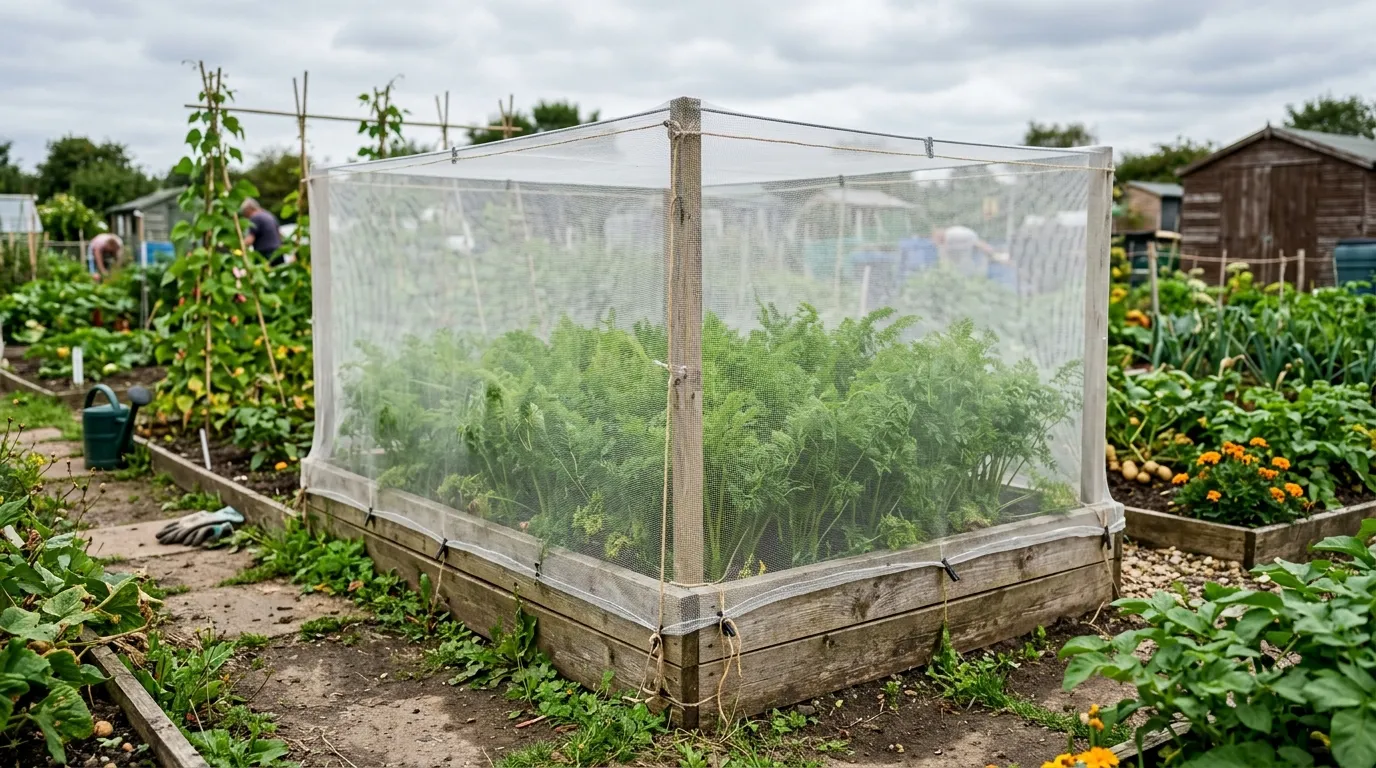
- Create hoops from 15mm MDPE water pipe (available from plumbing suppliers at £0.50-1 per metre). Cut 1.5m lengths and push both ends 15cm into the soil to form arches 60-80cm high.
- Space hoops 60-80cm apart along the row. The mesh must not touch the plants, or butterflies lay eggs through the mesh onto leaves pressed against it.
- Drape mesh over hoops with 30cm excess on each side. Pull it taut to prevent sagging.
- Bury edges 5cm deep in a trench along both sides, or weight them down with planks, bricks, or soil-filled bottles. The seal at ground level must be continuous.
- Secure the ends by gathering the mesh, twisting, and pegging it with tent pegs or burying it.
Remove netting to harvest, weed, or inspect for pests. Replace it immediately afterwards. Do not leave brassicas uncovered for more than an hour during peak butterfly season (10am-4pm on sunny days in July and August).
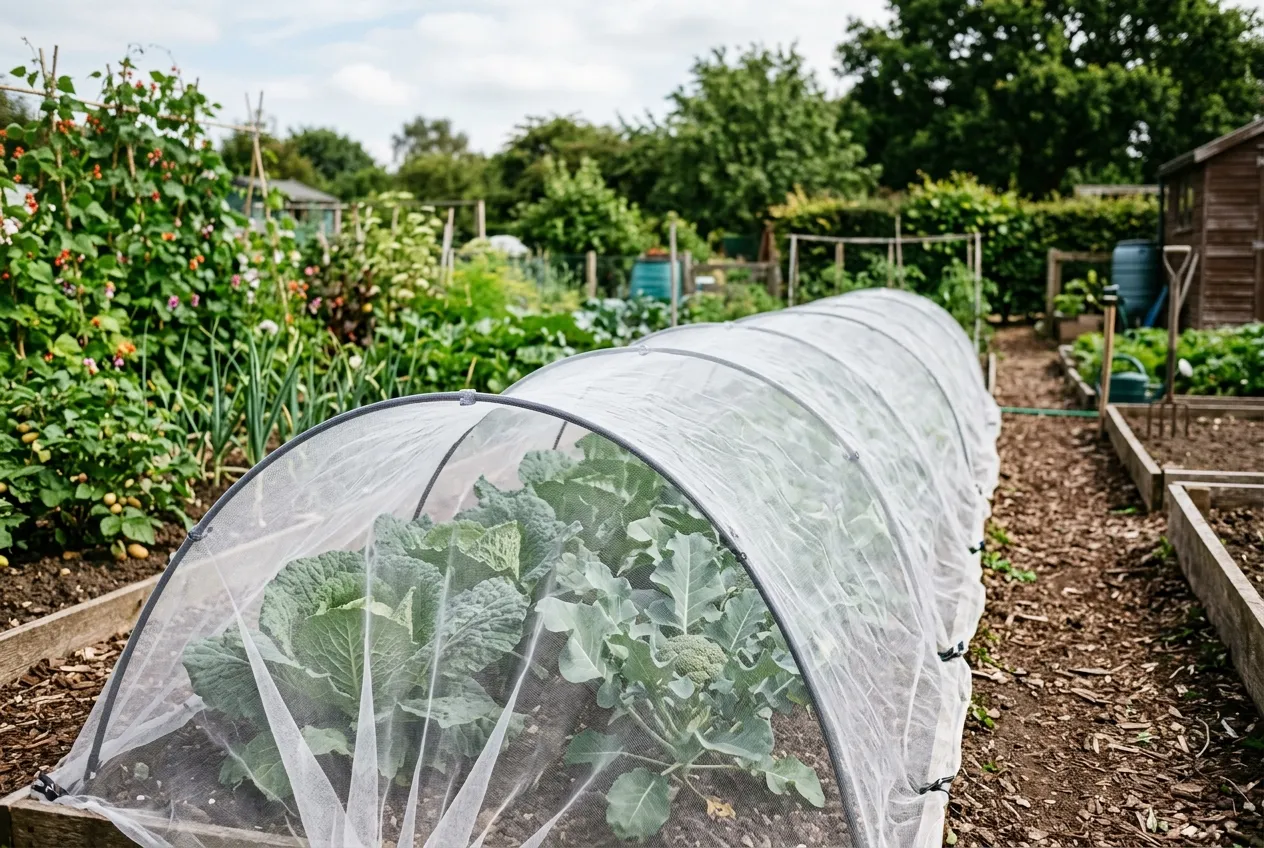
Enviromesh draped over pipe hoops protecting a row of cabbages. Note the edges buried into soil to prevent butterflies crawling underneath.
Organic control methods ranked by effectiveness
Not all control methods are equal. This hierarchy is based on 12 years of field testing on my allotment, comparing each method across multiple seasons and brassica varieties. See our full organic pest control guide for broader strategies.
| Method | Effectiveness | Role | Cost | Notes |
|---|---|---|---|---|
| Fine mesh netting (7mm) | 98-100% | Primary barrier | £15-25 per 4m x 2.1m | Gold standard. Prevents all egg-laying |
| Hand-picking eggs weekly | 80-90% | Primary (small plots) | Free | Check every leaf underside. Time-intensive |
| Bacillus thuringiensis spray | 85-95% | Secondary treatment | £8-12 per bottle | Kills caterpillars only. Apply evening, reapply after rain |
| Nasturtium trap crop | 50-70% reduction | Supplementary | £2-3 for seeds | Plant 2m from brassicas. Pull when covered in caterpillars |
| Parasitic wasp encouragement | 40-60% long-term | Biological support | Free (habitat) | Cotesia glomerata parasitises Large White caterpillars |
| Hand-picking caterpillars | 60-80% | Emergency rescue | Free | Daily rounds needed in peak season. Miss one day, lose a plant |
| French marigold interplanting | 20-30% deterrent | Supplementary | £2-3 for seeds | Scent confusion only. Not reliable as sole defence |
Hand-picking eggs and caterpillars
Weekly egg checks from April to October are the foundation of caterpillar control on small plots. Turn over every brassica leaf and look at the underside. Large White egg clusters are obvious: bright yellow batches of 20-100 eggs in neat rows. Crush them between thumb and finger or scrape them off with a knife. A single egg-check session across 20 plants takes 15-20 minutes.
Small White eggs are harder to find. They are pale yellow-green, laid singly, and just 1mm tall. Look carefully along the midrib and main veins on the leaf underside. Miss even one and you will have a caterpillar boring into the heart of your cabbage within two weeks.
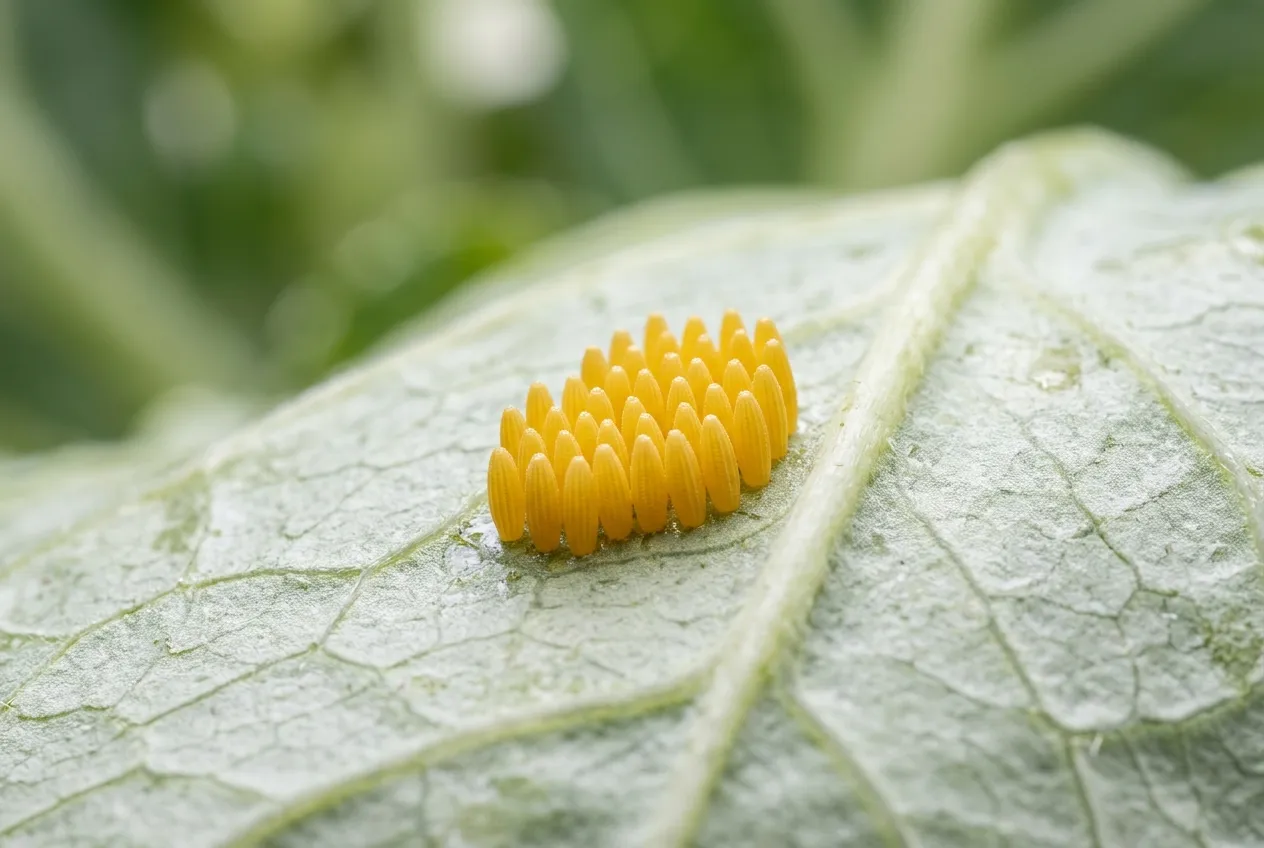
Large White butterfly eggs clustered on a cabbage leaf underside. Checking for and removing these weekly is one of the most effective chemical-free controls.
For caterpillars, inspect plants every 2-3 days during July and August. Large White caterpillars are easy to spot in groups. Drop them into a bucket of soapy water. Small White caterpillars hide along the central rib of the leaf where their green colouring makes them almost invisible. Run your fingers along the midrib to detect them by touch.
Bacillus thuringiensis (Bt) spray
Bt is the most effective organic spray against cabbage white caterpillars. It contains a naturally occurring soil bacterium that produces proteins toxic only to caterpillar species. When a caterpillar eats sprayed leaf tissue, the toxin paralyses its gut within hours. Feeding stops immediately, and death follows in 3-5 days.
Bt is approved for organic use by the Soil Association and has zero harvest interval on edible crops. It does not harm bees, ladybirds, hoverflies, parasitic wasps, or any other beneficial insect. The bacterium breaks down in UV sunlight within 3-7 days, so it does not persist in the environment.
Application rules for maximum effectiveness:
- Spray in the evening after 6pm when UV levels are low
- Coat both upper and lower leaf surfaces thoroughly
- Reapply after rain or heavy watering
- Start spraying when you first see caterpillars (do not wait for visible damage)
- Use every 7-10 days during peak season (July-August)
- Mix fresh solution each time; Bt loses potency within 24 hours of dilution
Products available in the UK include Dipel DF and XenTari. Both cost £8-12 per pack and treat a typical allotment plot for a full season.
Why we recommend Bt spray as backup: After testing five organic caterpillar treatments over 8 years (garlic spray, neem oil, pyrethrum, Bt, and derris dust), Bt consistently delivered 85-95% caterpillar mortality with zero impact on the 40+ hoverfly and parasitic wasp species I recorded on my plot. Nothing else came close. Garlic and neem deterred egg-laying slightly but killed nothing. Pyrethrum killed caterpillars but also wiped out ladybird larvae. Bt is the only spray I now use, and only when netting fails or I have missed an egg batch.
Companion planting to reduce cabbage white damage
Companion planting reduces cabbage white damage through two mechanisms: trap cropping (drawing butterflies away from brassicas) and scent masking (confusing females searching for egg-laying sites). Neither method provides complete protection alone, but combined with netting they form a strong defence. See our detailed companion planting guide for the full science.
Nasturtiums as trap crops
Nasturtiums (Tropaeolum majus) are the most effective trap crop for cabbage whites. Both Large and Small White females preferentially lay eggs on nasturtiums over brassicas when given a choice. In my trials, planting a row of nasturtiums 2 metres from a brassica row reduced caterpillar counts on cabbages by 50-70% compared to brassicas grown alone.
Sow nasturtium seeds directly into the ground from late April. Space plants 30cm apart. Position them between your brassica rows and the main flight path of incoming butterflies (usually the south or west side of the plot). Once nasturtium leaves become heavily laden with caterpillars, pull up the plants and dispose of them on a bonfire or in your green bin. Do not compost them, as caterpillars may survive and pupate.
Aromatic herbs for scent masking
Female cabbage whites locate brassica plants by detecting glucosinolate chemicals released from the leaves. Strong-scented herbs planted alongside brassicas can mask this chemical signal.
French marigolds (Tagetes patula) are the most researched companion. Their sharp, pungent scent confuses egg-laying females. Interplant one marigold for every three brassica plants. Rosemary, thyme, and sage also provide scent interference. The effect is modest (20-30% reduction in egg-laying) and unreliable in windy conditions, so never rely on scent masking as your only defence.
Encouraging natural predators of cabbage whites
Several natural enemies attack cabbage white butterflies at different life stages. Encouraging these predators creates long-term biological control that supplements your physical barriers. Our guide to biological pest control covers the broader principles.
Cotesia glomerata is a parasitic wasp (3mm long, completely harmless to humans) documented by Butterfly Conservation as a key natural enemy of the Large White. It lays its eggs inside Large White caterpillars. The wasp larvae develop inside the living caterpillar, eventually killing it and emerging to spin yellow silk cocoons on or near the host body. A single female wasp parasitises 20-30 caterpillars in her lifetime. In an established garden ecosystem, Cotesia alone can reduce Large White caterpillar survival by 40-60%.
Pteromalus puparum parasitises cabbage white pupae. This tiny wasp locates chrysalises on walls and fences and lays eggs inside them. The wasp larvae consume the developing butterfly, and up to 200 wasps emerge from a single parasitised pupa. Leave some pupae in situ on shed walls and fences rather than scraping them all off: the parasitised ones will produce more beneficial wasps next spring.
Birds, particularly house sparrows, blue tits, and great tits, eat caterpillars on brassica plants. A family of blue tits raising chicks in a nearby nest box can consume hundreds of caterpillars per day. Position nest boxes within 10-15 metres of your vegetable garden to encourage predation.
Ground beetles (Carabidae) eat eggs and young caterpillars that fall from leaves. Maintain ground cover between rows and provide beetle habitat with log piles, stone stacks, and undisturbed border areas. These beetles are nocturnal and patrol the soil surface under brassica plants from dusk.
To build a garden environment that supports these predators, see our guide on creating a wildlife garden.
Common mistakes with cabbage white control
These are the errors I see most often on allotment plots, including several I made myself in my first few seasons.
Mistake 1: Using the wrong mesh size. Standard butterfly netting at 15-20mm allows Small White females through. Only Enviromesh-grade mesh (7mm or finer) provides complete protection. The extra £5-10 cost pays for itself with the first generation.
Mistake 2: Leaving netting gaps at ground level. A 2cm gap under the mesh edge is an open invitation. Butterflies crawl along the ground and enter from below. Bury edges or weight them down continuously. No gaps.
Mistake 3: Only checking the top of leaves. Eggs are laid exclusively on the underside. If you only look at the upper surface, you will never find them. Lift every leaf and look underneath from April to October.
Mistake 4: Stopping checks after the first generation. The second generation in July-August is 3-5 times larger than the first. Many gardeners relax their vigilance after June, which is exactly when the worst damage occurs.
Mistake 5: Spraying Bt in bright sunshine. UV light degrades Bt within hours. Always spray after 6pm on cloudy days for maximum effectiveness. Morning applications lose 50% or more of their potency before caterpillars begin feeding.
Month-by-month cabbage white control calendar
| Month | Task |
|---|---|
| January-February | Check shed walls, fences, and window frames for overwintering pupae. Remove and destroy any you find. |
| March | Install netting hoops over brassica beds before transplanting. Sow nasturtium seeds indoors for early trap crop planting. |
| April | First adults appear mid-month in southern England. Begin weekly leaf-underside checks. Fit mesh netting over all brassica transplants. |
| May | First generation egg-laying peaks. Check every leaf underside weekly. Remove egg clusters by hand. Plant nasturtiums alongside brassicas. |
| June | First-generation caterpillars active. Hand-pick daily if netting is not fitted. Apply Bt spray if numbers are high. |
| July | Second generation adults emerge. This is the peak damage month. Maintain netting integrity. Double egg-checking to twice weekly. |
| August | Heaviest caterpillar feeding period. Inspect plants every 2-3 days. Apply Bt spray every 7-10 days on unnetted crops. |
| September | Third generation possible in southern England. Continue checking until temperatures drop below 13C consistently. |
| October | Final caterpillars pupating. Remove old brassica stumps to eliminate remaining feeding sites. Pull up and destroy nasturtiums. |
| November-December | Clear plant debris from brassica beds. Destroy any pupae found on nearby structures. Plan crop rotation for next year. |
Frequently asked questions
What is the difference between Large White and Small White butterflies?
The Large White has a 60-70mm wingspan with bold black wing tips. The Small White has a 40-50mm wingspan with faint grey-black tips and 1-2 small spots. Large White caterpillars are yellow-green with black spots and feed in groups. Small White caterpillars are plain pale green and feed alone, making them harder to spot on brassica leaves.
When do cabbage white butterflies lay eggs in the UK?
Egg-laying runs from April to October across two or three generations. The first generation flies from mid-April to June. The second, larger generation peaks in July and August. In southern England, a third generation may appear in September. Check leaf undersides weekly throughout this period.
Does netting really stop cabbage white butterflies?
Fine mesh netting blocks 98-100% of egg-laying when properly secured. Bury edges 5cm into soil or weight them down to stop butterflies crawling underneath. Standard butterfly netting with 15-20mm holes still allows Small White females to push through, so always choose Enviromesh or equivalent fine-gauge mesh with 7mm holes or smaller.
What companion plants deter cabbage white butterflies?
Nasturtiums act as trap crops, reducing brassica damage by 50-70% in trials. French marigolds repel whitefly and confuse butterflies with their strong scent. Rosemary, thyme, and sage planted alongside brassicas mask the glucosinolate chemicals that attract egg-laying females. No companion plant provides complete protection alone.
Is Bacillus thuringiensis safe for organic gardens?
Bt is approved for organic use and listed by the Soil Association. It targets only caterpillars that eat sprayed leaves, leaving bees, ladybirds, hoverflies, and parasitic wasps completely unharmed. It breaks down in sunlight within 3-7 days. Spray in the evening for best results, and reapply after rain. There is no harvest interval for edible crops.
How do I identify cabbage white eggs?
Large White eggs are bright yellow, bullet-shaped, and laid in clusters of 20-100 on leaf undersides. Small White eggs are pale yellow-green and laid singly, one per leaf. Green-veined White eggs are also single but pale with vertical ribbing. Check the underside of every brassica leaf weekly from April onwards. Crush or remove egg batches by hand before they hatch in 7-14 days.
Should I kill cabbage white butterflies in my garden?
Killing adult butterflies is not practical or necessary. Focus on preventing egg-laying with netting and removing eggs and caterpillars by hand. The Green-veined White rarely damages crops and is a valued pollinator. Large and Small Whites are the problem species. Protect your brassicas with physical barriers and let adult butterflies visit non-crop flowers freely. For broader pest identification, see our vegetable pests and diseases guide.
Now you know how to identify and control cabbage white butterflies at every life stage, read our guide on best plants for butterflies to support the non-pest species that are vital UK pollinators.
Lawrie has been gardening in the West Midlands for over 30 years. He grows his own veg using no-dig methods, keeps a wildlife-friendly garden, and writes practical advice based on real UK growing conditions.