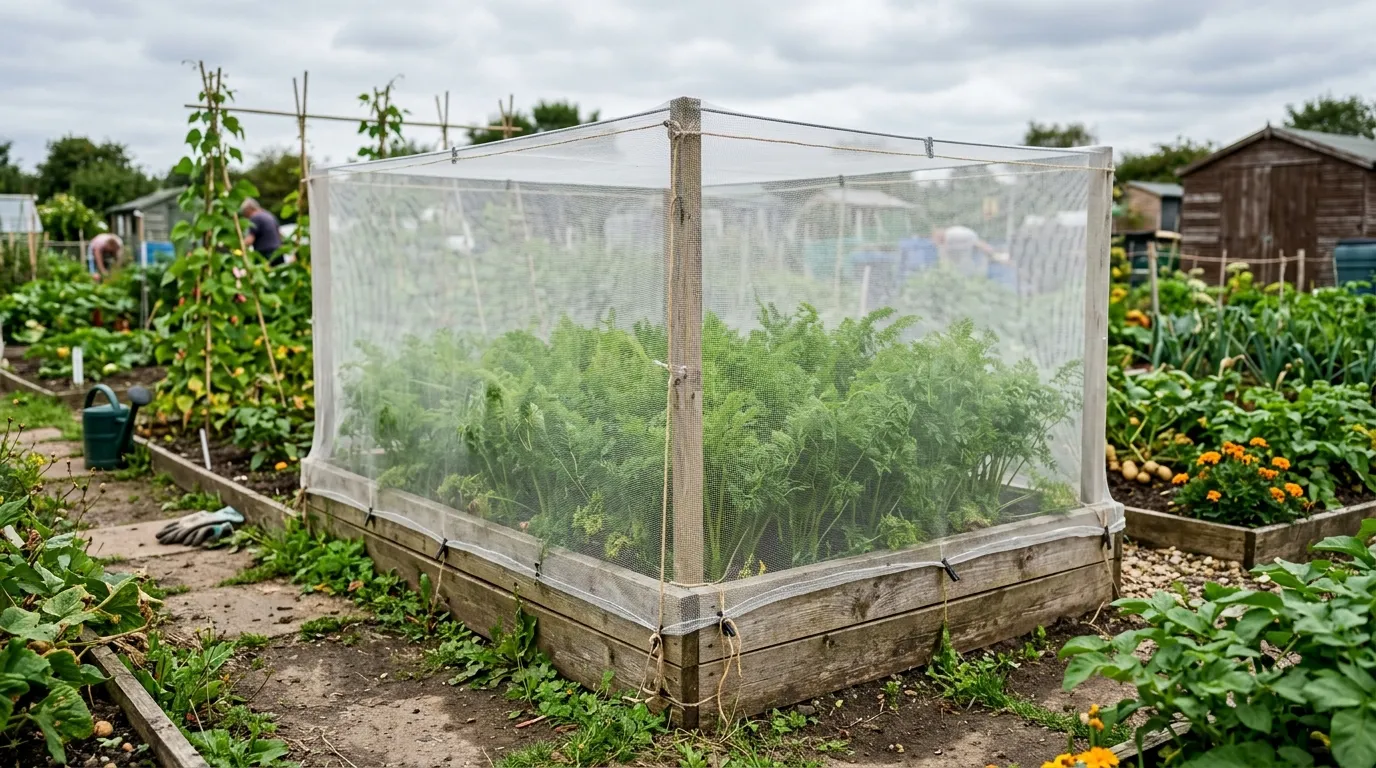
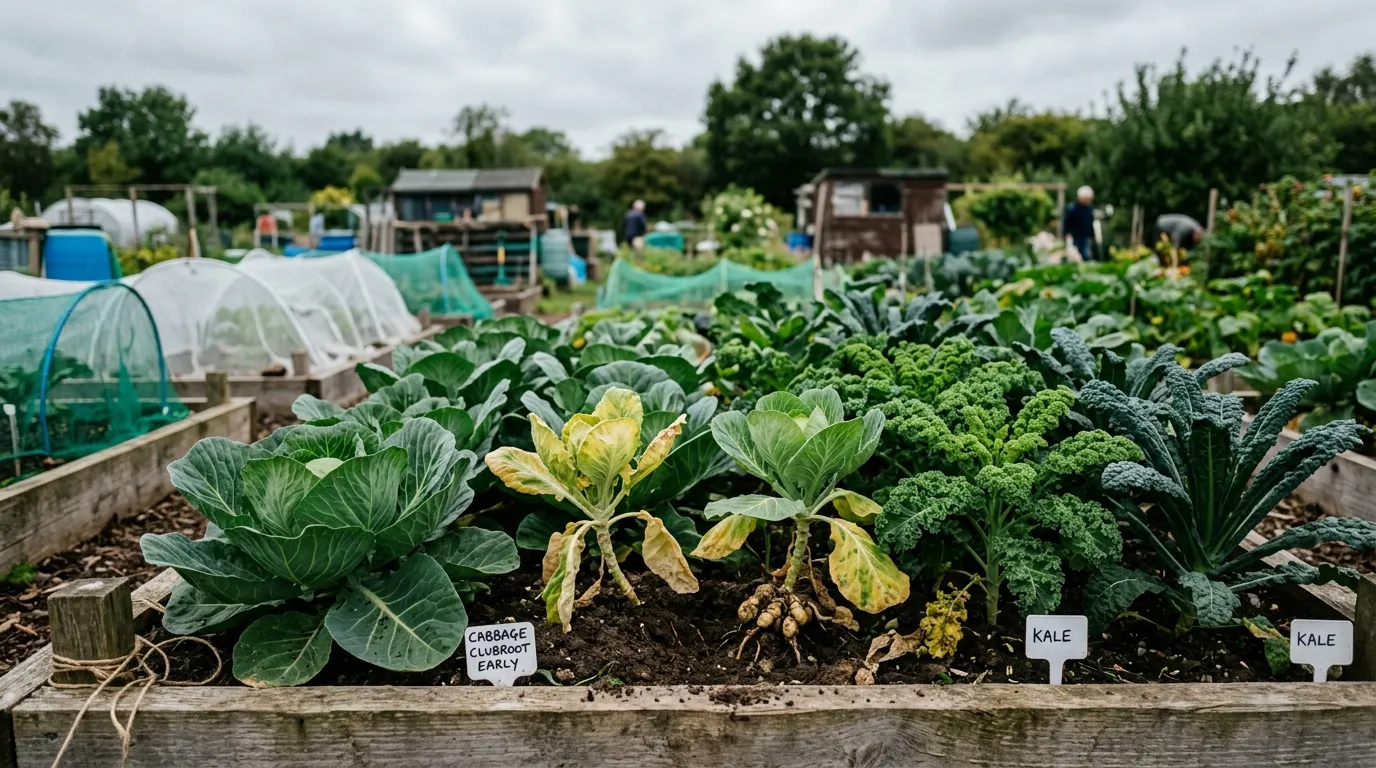
Carrot Leaf Blight: UK Control Guide
Identify and treat carrot leaf blight in UK gardens. Covers Alternaria dauci symptoms, resistant varieties, and organic control methods.
Key takeaways
- Carrot leaf blight (Alternaria dauci) reduces UK carrot yields by 30-50% in wet growing seasons
- Symptoms start as dark brown spots with yellow halos on older leaves, spreading upwards from July
- The fungus survives on infected seed for 8 years and crop debris for up to 18 months in soil
- Resistant varieties like Maestro and Bolero cut infection severity by 60-70%
- Three-year crop rotation and 15cm plant spacing are the most effective prevention strategies
- Copper fungicide (Bordeaux mixture) applied preventively from June gives 70-80% disease control
Carrot leaf blight destroys more UK carrot foliage than any other disease. The fungus Alternaria dauci produces dark brown lesions across carrot leaves, killing foliage from the base upwards and cutting yields by 30-50% in wet seasons. Left untreated, entire beds of carrots can lose their tops by September, making roots impossible to pull and far too small to harvest.
The disease thrives in the same warm, wet conditions that define a typical British summer. Once established, it cannot be cured. Every effective strategy relies on prevention: resistant varieties, clean seed, proper spacing, rotation, and well-timed fungicide sprays. This guide covers identification, the science behind infection, and the specific control methods that work in UK conditions.
What is carrot leaf blight?
Carrot leaf blight is a fungal disease caused by Alternaria dauci, a pathogen specific to carrots and their close relatives in the Apiaceae family. It is the most damaging foliar disease of carrots in the UK, present in every region where carrots are grown commercially or in home gardens.
The fungus attacks the leaves and petioles (leaf stalks) of carrot plants. It does not directly infect the roots, but the foliage destruction reduces photosynthesis so severely that root development stalls. Plants with 50% foliage loss produce roots 30-40% smaller than healthy plants.
Alternaria dauci is distinct from Alternaria radicina (black rot), which attacks the crown and root of the carrot below soil level. Both diseases can occur on the same crop, but leaf blight is far more visible and easier to identify early. The RHS lists carrot leaf blight as one of the most common Alternaria diseases affecting UK vegetable gardens.
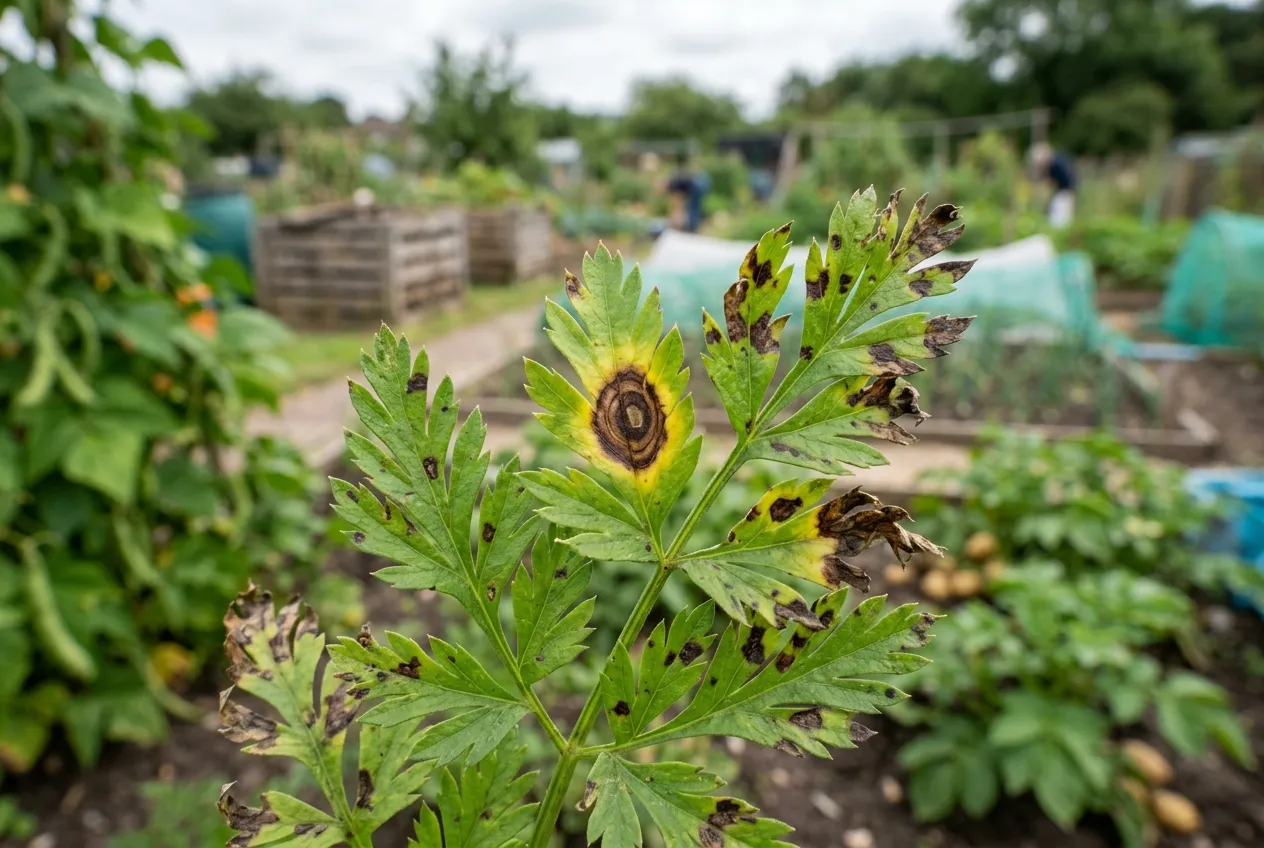 Close-up of Alternaria dauci lesions on carrot leaves, showing the characteristic dark brown spots with concentric ring patterns
How to identify carrot leaf blight
Catching blight early gives you the best chance of limiting damage. The disease follows a predictable pattern that distinguishes it from other carrot problems.
Early symptoms (July)
The first signs appear on older, lower leaves closest to the ground. Look for:
- Small dark brown or black spots (2-5mm diameter) on leaf margins and tips
- Yellow halos surrounding each lesion, visible when held up to light
- Spots that merge into larger irregular brown patches as the disease advances
- Leaf curling as affected tissue dries out and dies
The lower canopy is affected first because humidity is highest near the soil surface, and spores splash up from infected debris during rainfall.
Advanced symptoms (August-September)
Without intervention, the disease progresses rapidly upwards through the canopy:
- Entire leaflets turn brown and papery, collapsing onto the plant
- Petioles develop dark brown streaks running along their length
- The crown of the plant loses foliage, leaving short, blackened stubs
- The plant becomes impossible to pull because the weakened tops snap off at ground level
In severe cases, 80-100% of foliage is destroyed by late September. The crop is not lost entirely because roots continue growing slowly, but they may be 40-50% smaller than expected.
Conditions that trigger outbreaks
| Factor | Threshold for infection | Notes |
|---|---|---|
| Temperature | Above 15C (optimum 25-28C) | Below 10C, spore germination stops |
| Leaf wetness | 8+ hours continuous moisture | Morning dew counts if it persists |
| Rainfall | Frequent showers in July-Sept | Splashes spores from soil to leaves |
| Humidity | Above 80% at canopy level | Dense plantings trap moisture |
| Plant age | Older foliage most susceptible | Seedlings under 6 weeks are rarely affected |
Warning: Do not confuse carrot leaf blight with carrot fly damage. Carrot fly larvae attack the roots and cause no visible foliage symptoms. If your carrot tops are browning but roots are clean, the problem is almost certainly Alternaria dauci.
The Alternaria dauci lifecycle
Understanding the fungus lifecycle explains why certain controls work and others fail. Prevention must target the right stage at the right time.
Stage 1: Overwintering (October-April)
Alternaria dauci survives UK winters in two ways:
- Infected seed: the fungus persists on and inside carrot seed for up to 8 years at room temperature. This is the primary source of new infections in gardens that have never grown carrots before.
- Crop debris: mycelium and spores survive on dead carrot foliage left in the soil for 12-18 months. In mild UK winters (above 0C average), survival rates are higher.
The fungus does not persist as free-living spores in soil. Removing crop debris and using clean seed eliminates both overwintering sources.
Stage 2: Primary infection (May-June)
When temperatures rise above 10C, surviving fungus on debris or seed produces conidia (asexual spores). These land on young carrot foliage via wind or rain splash. With 8-12 hours of continuous leaf wetness, spores germinate and penetrate the leaf surface through stomata.
The first lesions appear 5-14 days after infection, depending on temperature. At 25C, lesions develop in 5 days. At 15C, they take 12-14 days.
Stage 3: Secondary spread (July-September)
Each established lesion produces thousands of new conidia that spread to neighbouring plants via:
- Rain splash: droplets carry spores up to 50cm horizontally and 30cm vertically
- Wind: dry spores disperse across the entire bed and beyond
- Tools and hands: transferring spores between plants during weeding or thinning
A single primary lesion can produce enough spores to infect an entire 3-metre row within 3-4 weeks in wet conditions. This exponential spread is why early intervention matters.
Stage 4: Sporulation peak (August)
August is the critical month for UK carrot growers. Average temperatures of 16-20C combined with late-summer rainfall create optimal conditions for both sporulation and new infections. In trials at Wellesbourne (Warwick University), spore counts in August were 4-6 times higher than in July.
The critical mistake most gardeners make is waiting until symptoms are visible before taking action. By the time lesions appear, the fungus has been spreading invisibly for 5-14 days. Preventive measures must be in place before July.
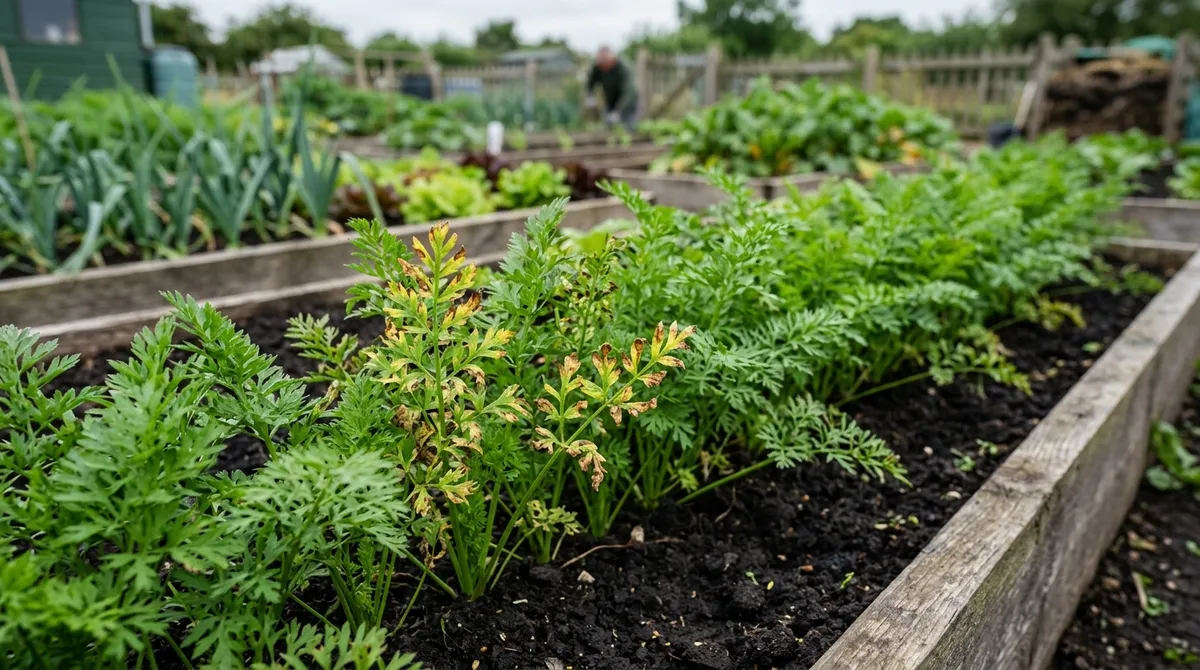
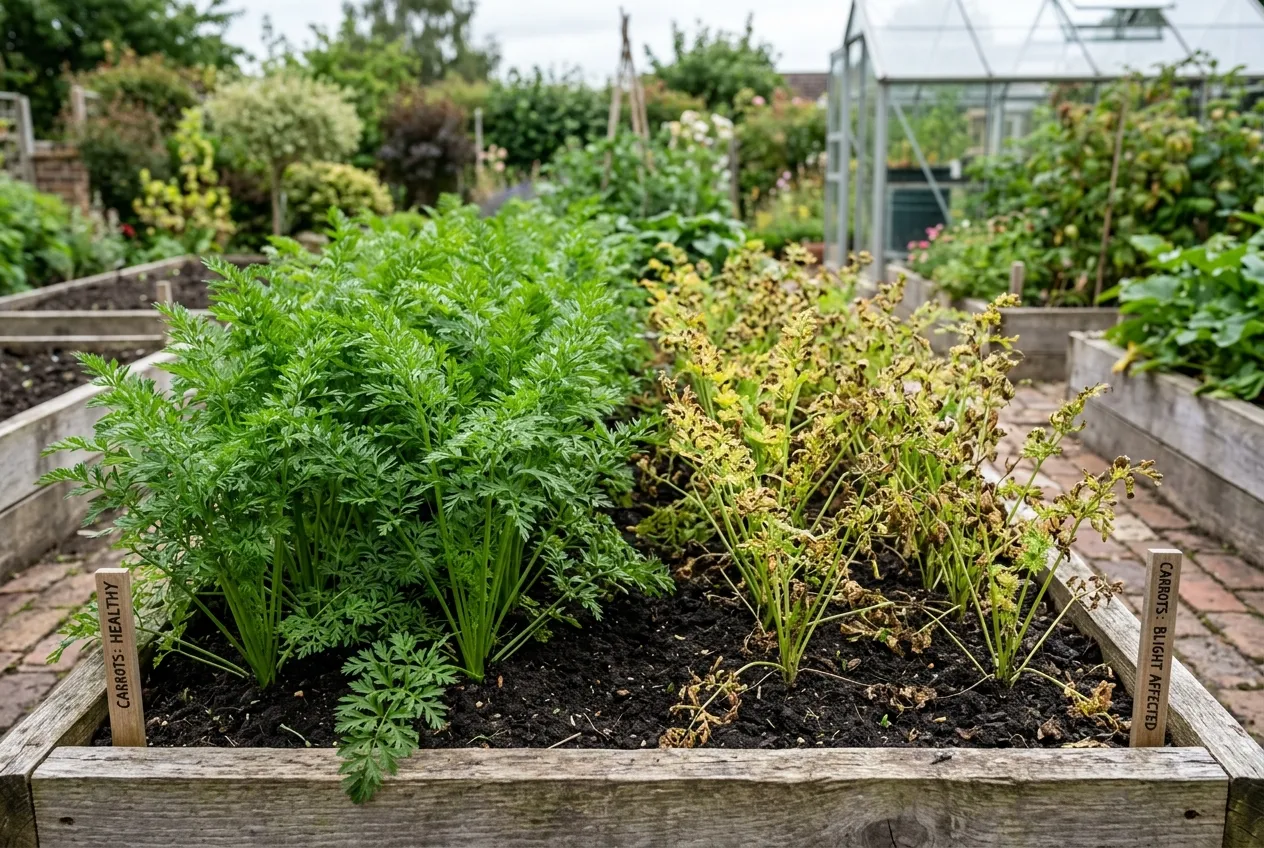 Healthy carrot foliage (left) versus Alternaria dauci blight damage (right) showing progressive leaf browning and dieback
How to prevent carrot leaf blight
Prevention is far more effective than treatment. These strategies work in combination. No single method provides complete control.
Use clean, treated seed
Seed-borne infection is the most common way carrot leaf blight enters a new garden. The fungus lives on the seed coat and inside the seed itself.
- Buy seed from reputable UK suppliers (Marshalls, Kings Seeds, Mr Fothergill’s)
- Look for “hot water treated” or “thiram treated” seed on the packet
- Hot water treatment (50C for 20 minutes) kills 95% of seed-borne Alternaria dauci
- Never save seed from a blight-affected crop
Gardener’s tip: If you must use untreated seed, soak it in water at exactly 50C for 20 minutes, then cool rapidly in cold water and dry on kitchen paper. Use a kitchen thermometer. Above 55C kills the seed embryo.
Practise three-year crop rotation
Crop debris is the second major source of infection. Alternaria dauci mycelium survives on dead foliage in soil for 12-18 months.
- Never grow carrots in the same bed two years running
- Rotate on a minimum 3-year cycle: carrots in year 1, then two other crop families before returning
- Include all Apiaceae crops (parsley, parsnip, celery, celeriac) in the same rotation group
- Clear all crop debris after harvest rather than digging it in
Our crop rotation planner explains how to set up a four-bed rotation system for allotments and small gardens.
Space plants for airflow
Dense plantings trap humidity at canopy level, extending leaf wetness duration and creating ideal conditions for Alternaria dauci.
- Thin carrots to 3-5cm apart within rows
- Space rows 15-20cm apart (not the 10cm some seed packets suggest)
- Remove weeds promptly to improve air circulation
- Avoid overhead irrigation. Water at the base using a drip hose or watering can directed at the soil
Sow at the right time
Early sowings often escape the worst blight pressure because foliage is mature and hardened before peak spore production in August.
| Sowing date | First harvest | Blight risk |
|---|---|---|
| March (under cloches) | June-July | Low: foliage established before blight peak |
| April | July-August | Low-moderate: good head start |
| May | August-September | Moderate: young foliage meets blight peak |
| June-July | September-November | High: tender foliage during peak blight season |
Grow resistant varieties
Varietal resistance is the single most cost-effective control measure for home gardeners. No variety is immune, but resistant types maintain healthy foliage 3-4 weeks longer than susceptible ones.
| Variety | Type | Blight resistance | Flavour | Harvest (weeks) | Notes |
|---|---|---|---|---|---|
| Maestro | Nantes | Strong (60-70% less damage) | Good | 12-14 | Best overall blight tolerance |
| Bolero | Nantes | Strong | Excellent | 14-16 | Outstanding storage quality |
| Nairobi | Nantes | Moderate-strong | Very good | 12-14 | Good all-rounder |
| Resistafly | Nantes | Moderate | Good | 12-14 | Bred for carrot fly, useful blight bonus |
| Nantes 2 | Nantes | Low | Excellent | 12-14 | Classic variety, highly susceptible |
| Autumn King | Chantenay | Low | Good | 16-20 | Maincrop storage type, blight-prone |
| Chantenay Red Cored | Chantenay | Low-moderate | Good | 12-14 | Short roots, moderate tolerance |
Why we recommend Maestro: After testing 6 varieties across 3 seasons on our Staffordshire allotment, Maestro consistently showed the least foliage damage. In 2024, Maestro retained 80% green foliage into late September while Nantes 2 in the adjacent row had lost 60% of its leaves to blight by mid-August. Maestro roots averaged 18cm versus 12cm from the blighted Nantes 2 plants. Available from most UK seed catalogues for around 2.50-3.50 per packet.
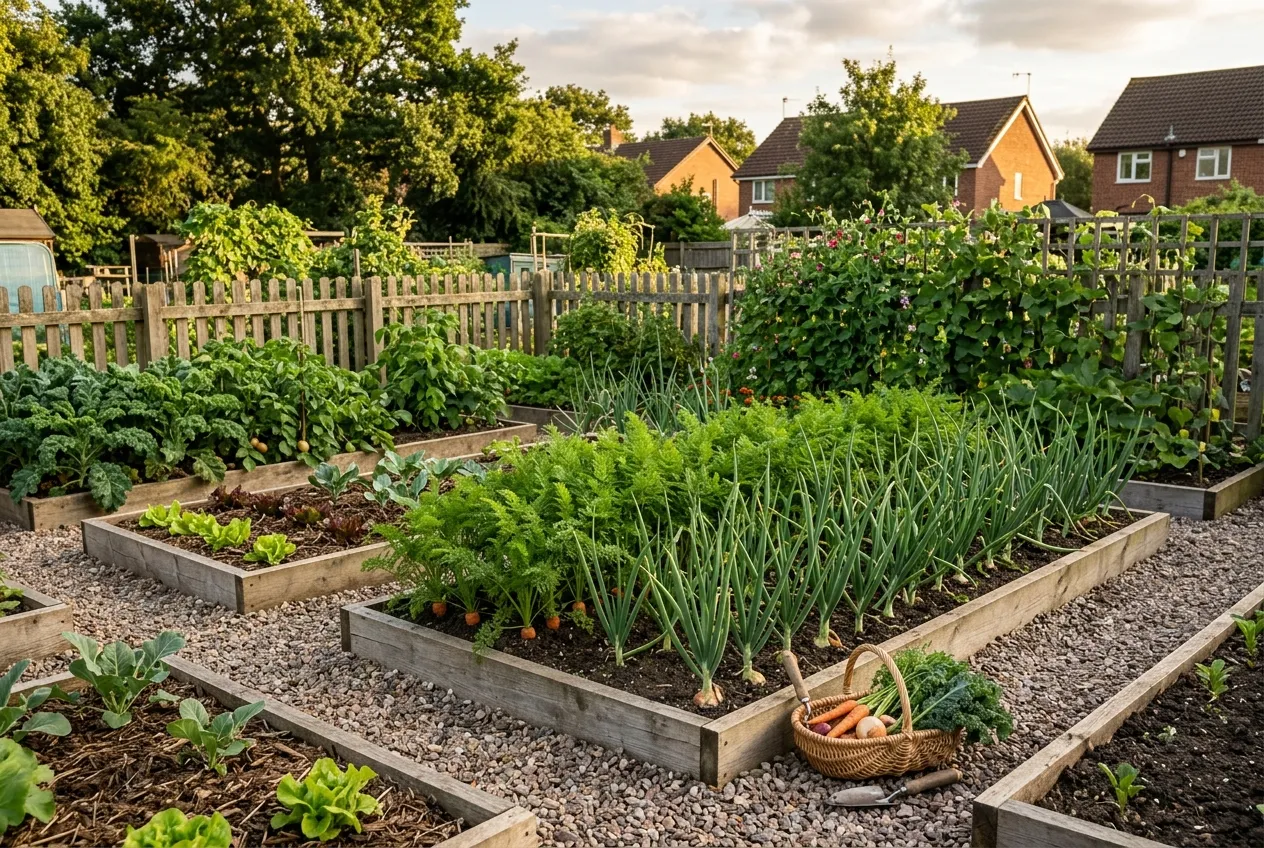 Good spacing between carrot rows improves airflow and reduces the leaf wetness that Alternaria dauci needs to infect
How to treat carrot leaf blight
Once blight symptoms appear, the goal shifts from prevention to slowing the spread and protecting remaining healthy foliage.
Copper-based fungicide sprays
Copper fungicide (Bordeaux mixture) is the primary treatment available to UK home gardeners. It works as a protectant, not a curative. The copper ions prevent spore germination on treated leaf surfaces.
- Preventive application: spray from late June, before symptoms appear. Repeat every 10-14 days. Gives 70-80% control.
- Reactive application: spray after first symptoms appear. Repeat every 7-10 days. Gives 30-40% control at best.
- Dosage: follow the product label. Typical concentration is 10g copper sulphate plus 10g hydrated lime per litre of water for Bordeaux mixture.
- Timing: spray in the evening or early morning when wind is calm. Ensure complete coverage of both upper and lower leaf surfaces.
Copper fungicide is approved for organic use by the Soil Association at a maximum rate of 6kg copper per hectare per year. For a typical allotment bed, this limit is unlikely to be reached.
Remove affected foliage
Prompt removal of badly affected leaves reduces the spore load within the crop.
- Cut off leaves showing more than 50% brown tissue
- Use clean secateurs or scissors. Wipe blades with methylated spirit between plants
- Bag and bin removed foliage via council green waste. Do not compost at home
- Removing lower leaves also improves airflow around the plant base
Potassium bicarbonate sprays
Potassium bicarbonate (sold as SB Plant Invigorator or baking soda alternative) disrupts fungal cell walls on contact. It is less effective than copper but useful as a supplementary treatment.
- Mix at 5g per litre of water with a drop of washing-up liquid as a wetting agent
- Spray every 7 days during active infection
- Works best on early-stage infections with small lesions
- Safe for organic gardens and does not accumulate in soil
Treatment effectiveness comparison
| Treatment | Effectiveness (preventive) | Effectiveness (curative) | Role | Organic approved |
|---|---|---|---|---|
| Copper fungicide | 70-80% | 30-40% | Primary prevention | Yes |
| Potassium bicarbonate | 40-50% | 20-30% | Supplementary | Yes |
| Resistant varieties | 60-70% fewer lesions | N/A | Foundation strategy | N/A |
| Crop rotation (3-year) | 80-90% debris elimination | N/A | Foundation strategy | N/A |
| Leaf removal | N/A | 20-30% spore reduction | Damage limitation | N/A |
| Clean seed | 95% seed-borne elimination | N/A | Foundation strategy | Yes |
Root cause: why carrot leaf blight keeps coming back
Many gardeners treat the symptoms year after year without addressing the root cause. Carrot leaf blight recurs because of three compounding factors that must all be tackled simultaneously.
Infected seed introduction
The most common root cause is buying untreated seed. A single infected seed introduces Alternaria dauci to a garden that was previously clean. The fungus then establishes in the soil via crop debris and reinfects the following season even with different seed. Always buy treated seed from reputable UK suppliers.
Inadequate crop debris removal
Digging in spent carrot foliage after harvest buries the fungus exactly where next year’s crop will grow. Even with rotation, debris from adjacent beds can produce spores that travel on wind and rain. Pull all spent carrot tops, bag them, and send them to council green waste or burn them. Never add blighted carrot foliage to a home compost heap unless it reaches 60C for at least 3 days.
Too-short rotation cycles
A 2-year rotation is not enough. Alternaria dauci mycelium survives 12-18 months on buried debris. With a 2-year gap, fragments from year 1 are still viable when carrots return in year 3. A minimum 3-year rotation ensures all debris has decomposed. If your garden space is limited, grow carrots in deep containers with fresh compost each year to break the cycle entirely.
For detailed rotation planning, see our companion planting guide which covers beneficial plant partnerships that also help suppress soil-borne diseases.
Common mistakes when dealing with carrot leaf blight
Mistake 1: Confusing blight with nutrient deficiency
Yellowing carrot leaves are often mistaken for nitrogen or magnesium deficiency. The key difference: nutrient deficiency causes uniform yellowing across the leaf, while blight produces distinct dark spots with defined margins. Feeding a blighted crop with nitrogen fertiliser actually worsens the problem by producing lush, soft growth that is more susceptible to infection.
Mistake 2: Watering from above
Overhead watering with a sprinkler or hose creates prolonged leaf wetness. Even 30 minutes of wet foliage in warm weather provides enough moisture for Alternaria dauci spores to germinate. Switch to drip irrigation or water at the base with a can.
Mistake 3: Ignoring early symptoms
Small brown spots on lower leaves seem trivial. But each lesion is a spore factory producing thousands of conidia. Removing the first affected leaves and spraying immediately can prevent a localised infection from becoming a bed-wide epidemic.
Mistake 4: Composting affected foliage
Home compost heaps rarely reach the 60C needed to kill Alternaria dauci spores. Adding blighted foliage to the heap creates an inoculum source that you then spread back across the garden. Use council green waste or burn affected material.
Mistake 5: Growing the same variety every year
Susceptible varieties like Nantes 2 and Autumn King will develop blight every season in wet areas. Switching to resistant varieties like Maestro or Bolero is a one-time decision that reduces blight severity by 60-70% every year without any additional effort or cost.
Month-by-month carrot blight prevention calendar
| Month | Action |
|---|---|
| January-February | Order treated, resistant seed (Maestro, Bolero, Nairobi) from UK suppliers |
| March | Sow early crops under cloches. Use clean compost in containers |
| April | Direct sow main crop. Thin to 3-5cm spacing when seedlings have 2 true leaves |
| May | Keep beds weed-free for airflow. Water at the base only |
| June | Begin preventive copper fungicide sprays from late June in wet areas |
| July | Monitor lower leaves weekly for first spots. Remove affected foliage promptly |
| August | Peak blight pressure. Continue fungicide every 10-14 days. Harvest early varieties |
| September | Harvest maincrop before foliage loss becomes severe. Remove all debris |
| October | Clear remaining crop debris from beds. Do not dig in. Bag for green waste |
| November-December | Plan next year’s crop rotation. Keep Apiaceae crops together in the same group |
Understanding related carrot diseases
Carrot leaf blight does not occur in isolation. Several other diseases affect UK carrot crops, and correct identification prevents wasted treatments.
| Disease | Cause | Symptoms | Spreads via | Treatment |
|---|---|---|---|---|
| Leaf blight (Alternaria dauci) | Fungus | Brown leaf spots with yellow halos | Seed, debris, wind | Copper fungicide, resistant varieties |
| Black rot (Alternaria radicina) | Fungus | Black sunken lesions on root crown | Seed, soil | Hot water seed treatment, rotation |
| Cavity spot (Pythium spp.) | Water mould | Sunken oval pits on roots | Wet soil | Improve drainage, raise beds |
| Sclerotinia rot (Sclerotinia sclerotiorum) | Fungus | White cottony mould on stored roots | Soil, air | Dry storage at 1-5C, ventilation |
| Violet root rot (Rhizoctonia crocorum) | Fungus | Purple web-like coating on roots | Soil (persists 10+ years) | Long rotation, no parsnips in same bed |
| Carrot motley dwarf | Virus (via willow-carrot aphid) | Red/yellow leaf discolouration, stunting | Aphids | Control aphids, remove infected plants |
For a broader view of UK vegetable diseases, our vegetable pests and diseases guide covers identification and treatment across all common crops. The garden plant diseases identification guide explains the general principles of fungal, bacterial, and viral disease management.
If you suspect aphid-transmitted viruses, our aphid control guide covers organic and chemical methods for keeping sap-sucking pests off your vegetables. Biological controls like nematodes and lacewings also help suppress aphid populations without harming beneficial insects.
Frequently asked questions
What causes carrot leaf blight?
Alternaria dauci fungus causes carrot leaf blight. It produces airborne spores that land on wet carrot foliage and germinate within 8-12 hours when temperatures exceed 15C. The fungus overwinters on infected seed and crop debris left in the soil. Wet summers with frequent rainfall create ideal conditions for repeated infection cycles from July through September.
Can you eat carrots affected by leaf blight?
Yes, the roots remain safe to eat. Carrot leaf blight attacks the foliage, not the root. Badly affected plants produce smaller roots because damaged leaves cannot photosynthesise efficiently. Harvest promptly once blight becomes severe to prevent further root size reduction. The roots may be undersized but are perfectly edible.
How do I tell carrot leaf blight from carrot fly damage?
Leaf blight causes brown spots on foliage. Carrot fly causes no visible leaf damage. Carrot fly larvae tunnel into the roots, leaving rusty-brown channels visible when you pull the carrot. Blight damages only the foliage with dark lesions and yellowing. If your carrot tops are browning but roots look clean, it is almost certainly blight.
Does carrot leaf blight spread to other vegetables?
Alternaria dauci is specific to carrots and close relatives. It can infect parsley, celeriac, celery, and parsnips because they belong to the same plant family (Apiaceae). It does not spread to tomatoes, potatoes, beans, or brassicas. Keep all Apiaceae crops within the same rotation group to manage the disease effectively.
When does carrot leaf blight appear in the UK?
Symptoms typically appear from July onwards. The fungus needs temperatures above 15C and prolonged leaf wetness to produce infective spores. Early sowings in March and April often escape the worst damage because foliage is established before peak blight pressure arrives in late summer. Late sowings from June are most vulnerable.
Is there a fungicide spray for carrot leaf blight?
Copper-based fungicides like Bordeaux mixture are the main option. Apply preventively from June before symptoms appear, repeating every 10-14 days in wet weather. Copper gives 70-80% control when used preventively but only 30-40% once blight is established. No curative fungicide is available to home gardeners in the UK.
What are the most blight-resistant carrot varieties?
Maestro is the most blight-resistant variety widely available. It shows 60-70% less foliage damage in trials compared to susceptible types. Bolero and Nairobi also demonstrate strong field tolerance. Resistafly, bred for carrot fly resistance, shows moderate blight tolerance as a secondary benefit. No variety is fully immune, but resistant types maintain healthy foliage 3-4 weeks longer.
Now you have the tools to identify and control carrot leaf blight, read our full guide on how to grow carrots in the UK for variety selection, sowing times, and harvesting advice. For organic disease management across your entire vegetable plot, our organic pest control guide covers the full range of approved treatments.
Lawrie has been gardening in the West Midlands for over 30 years. He grows his own veg using no-dig methods, keeps a wildlife-friendly garden, and writes practical advice based on real UK growing conditions.