Cat-Proof Garden: Plants and Fencing
Cat-proof garden guide for the UK. Covers cat-safe fencing, roller bars, deterrent plants, catios, and humane methods to keep cats in or out.
Key takeaways
- Cat-proof fence rollers cost £8-£15 per metre and stop most cats climbing out or in
- Oscillot-style spinning paddle systems cost £15-£20 per metre and suit timber fences
- Coleus canina (Scaredy Cat plant) deters roughly two-thirds of cats within 2 metres
- A basic catio starts at £200; walk-in enclosures reach £2,000
- UK law protects cats under the Animals Act 1971. You cannot trap, harm, or confine a neighbour's cat
- Ultrasonic deterrents cover 50-100 sqm per unit and cost £15-£30 each
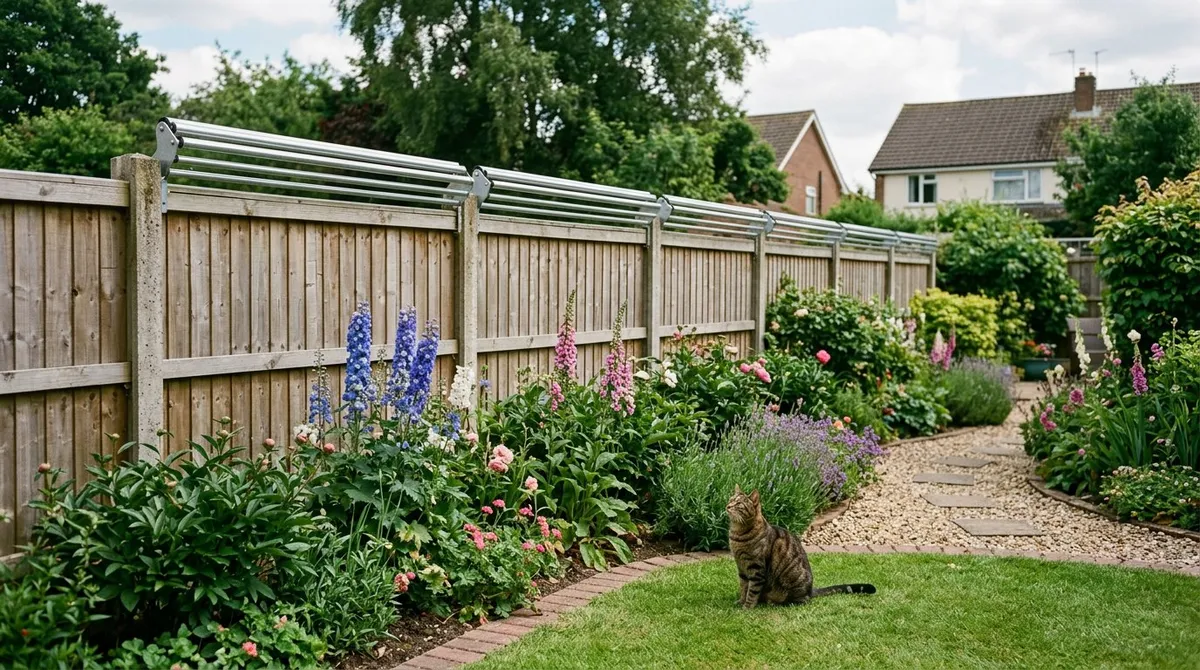
The UK has an estimated 11 million domestic cats, and the average neighbourhood cat visits six different gardens each day. Whether you want to keep your own cat safe inside your garden or stop visiting cats from digging up your beds, the challenge is the same: cats climb fences, squeeze through gaps, and jump extraordinary heights for their size.
This guide covers both sides. Part one deals with keeping your cat contained safely in your garden. Part two covers keeping unwanted cats out. Every method here is humane, legal, and tested by UK gardeners. For advice specifically about cat fouling, see our dedicated guide on how to stop cats pooing in your garden.
UK law on cats and gardens
Before spending money on any cat-proofing system, you need to understand the legal position.
Under the Animals Act 1971, cats have a legal right to roam in the UK. Unlike dogs, they are not classified as livestock or considered to be trespassing when they enter your property. Cat owners are not legally required to keep their cats confined. This means you cannot trap, detain, or relocate a neighbour’s cat that enters your garden.
The Animal Welfare Act 2006 makes it a criminal offence to cause unnecessary suffering to any animal. Penalties include unlimited fines and up to five years in prison. Poisoning, shooting, or injuring a cat carries severe consequences. Even deterrent methods must not cause harm or distress.
What you can do is use humane deterrents and modify your own boundaries. Fitting roller bars, netting, or spinning paddles to your fence is perfectly legal. Planting deterrent species, using motion-activated sprinklers, and installing ultrasonic devices are all acceptable. The Cats Protection guidance on keeping cats safe recommends cat-proof fencing as one of the best ways to protect outdoor cats.
Warning: Never use antifreeze, mothballs, or any chemical deterrent. Antifreeze is lethal to cats and its use as a poison carries criminal charges. Even commercial deterrent sprays must be non-toxic and pet-safe.
Cat-proof fencing options
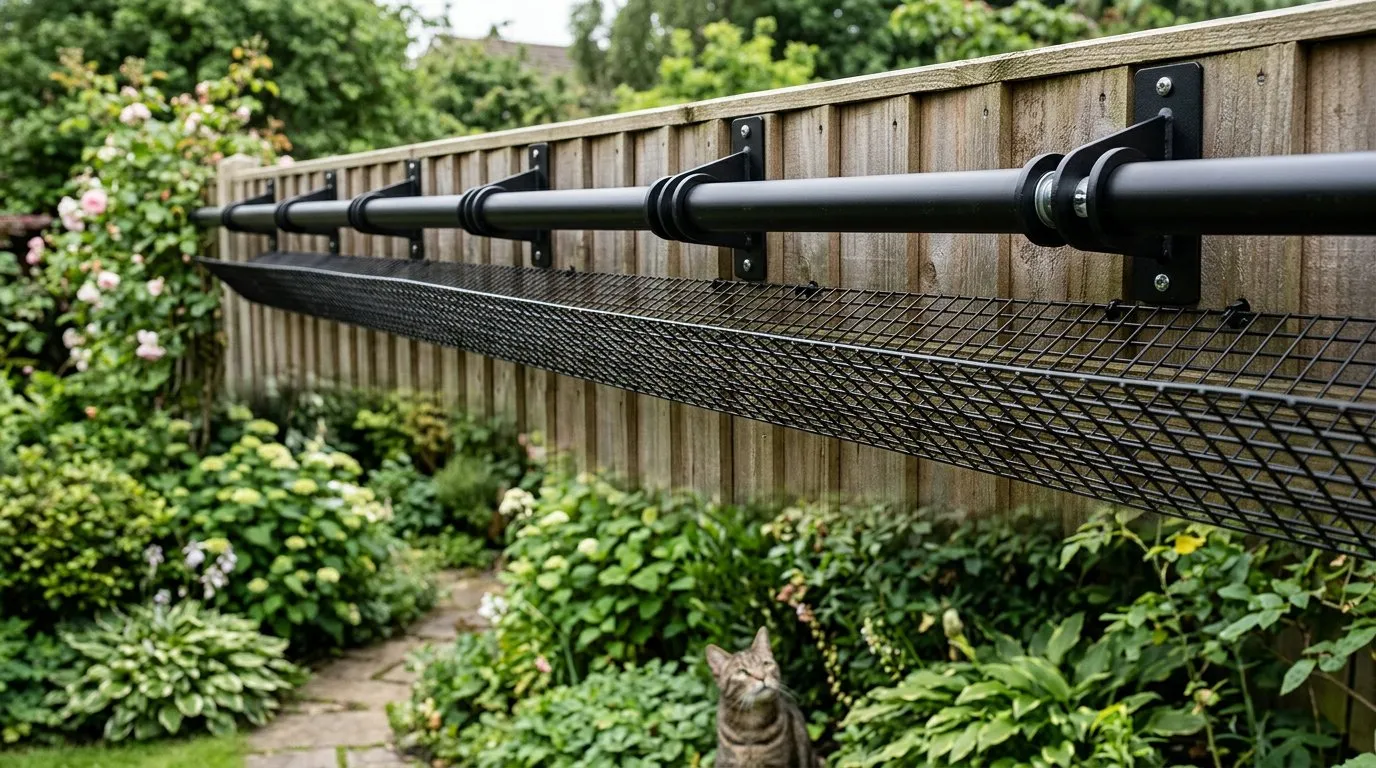 Roller bars on fence tops spin when a cat tries to grip, preventing them from climbing over.
Cat-proof fencing is the most reliable long-term solution for both keeping cats in and keeping them out. Standard 1.8-metre fences are no obstacle for an agile cat. The key is adding a topper that prevents them from gaining purchase at the top.
Roller bars
Roller bars are the most popular cat-proof fencing system in the UK. They consist of aluminium or plastic tubes mounted on brackets along the top of your fence. When a cat tries to grip the top, the roller spins and the cat cannot pull itself over.
Roller bars cost £8-£15 per metre including brackets and fixings. A typical 30-metre garden boundary costs £240-£450 to fit. They work on timber panel fences, close-board fences, and brick walls. Installation takes a weekend for a competent DIYer.
The main limitation is gaps. Roller bars only work where the fence is at least 1.5 metres high and has no gaps or footholds below the roller. Check for missing panels, low spots, and overhanging branches before fitting. Fix any damaged panels first — our guide to garden fence repair and maintenance covers the basics. Trim back any tree limbs within 2 metres of the fence line.
Oscillot spinning paddle systems
Oscillot-style systems use a series of four-sided aluminium paddles mounted on a continuous axle along the fence top. When a cat places its paws on the paddle, it spins and the cat drops back down. These systems are discreet, weather-resistant, and effective against even the most athletic cats.
Spinning paddle systems cost £15-£20 per metre including all hardware. They are designed primarily for timber fences and require a flat top rail. The paddles sit flush with the fence line, making them less visible than roller bars from the street. Colours include grey, black, green, and timber-match options.
One advantage over rollers: paddle systems work even if a cat jumps directly onto the fence top from a standing start. The spinning action is immediate. They are also silent, which matters if your fence borders a neighbour’s bedroom.
Angled mesh toppers
Angled mesh toppers extend inward from the fence top at a 45-degree angle. They create an overhang that cats cannot climb past. Use 25mm galvanised welded mesh at £5-£10 per square metre. The overhang needs to project at least 40cm inward to be effective.
Angled toppers are the cheapest option per metre but the most visible. They suit rear garden boundaries where appearance matters less. Planning permission is not usually required if the total fence height stays below 2 metres, but check with your local council if you are near a road or public footpath.
Netting systems
Cat-proof netting encloses the entire garden in a mesh canopy. Heavy-duty polypropylene netting with a 40mm mesh size prevents cats from climbing out while remaining almost invisible from a distance. Professional installation costs £500-£1,500 depending on garden size.
Netting suits smaller gardens best. It attaches to fence tops and is tensioned across the garden using poles or wires. The main drawback is maintenance. Falling leaves, snow, and strong winds can damage netting. Inspect it monthly and repair any tears immediately. Your garden will need established garden fence ideas in place before netting can be added.
Comparison of cat-proof fencing methods
| Method | Cost per metre | Effectiveness | Appearance | DIY difficulty | Best for |
|---|---|---|---|---|---|
| Roller bars | £8-£15 | High | Moderate | Easy | Timber fences |
| Oscillot paddles | £15-£20 | Very high | Discreet | Moderate | Timber fences, appearance matters |
| Angled mesh | £5-£10 | High | Visible | Moderate | Rear boundaries, budget option |
| Full netting | £15-£30 (installed) | Very high | Visible when close | Professional | Small gardens, full containment |
| Catio enclosure | N/A (see below) | Complete | Visible | Moderate-hard | Single access point, cat safety |
Building a catio or cat enclosure
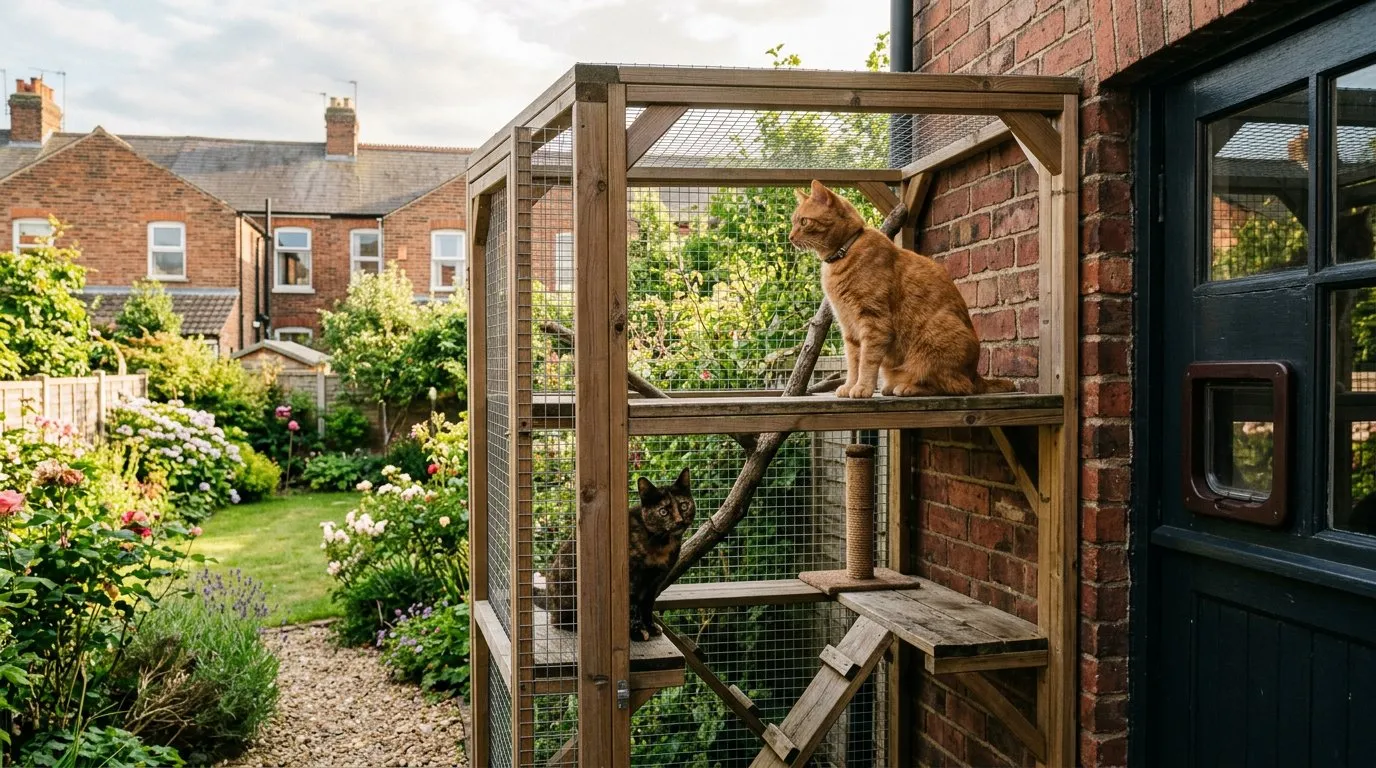 A catio gives your cat outdoor time without the risks. Costs range from 200 to 2,000 pounds.
A catio is a fully enclosed outdoor space that gives your cat fresh air, sunlight, and stimulation without the risks of free roaming. Catios range from a simple window box to a full walk-in garden room.
Types and costs
Window catios attach directly to a window frame. Your cat accesses them through an open window or cat flap. Basic models cost £200-£400 and provide 1-2 square metres of enclosed space. They suit flats and terraced houses where garden space is limited.
Lean-to catios rest against a house wall and extend 1-2 metres into the garden. They typically stand 2 metres tall and 2-3 metres wide. Budget £400-£800 for a ready-made kit or £300-£500 for a DIY build. Add shelves, hammocks, and climbing branches to make the space engaging.
Walk-in enclosures are free-standing structures connected to the house via a cat flap tunnel. These provide 4-10 square metres of enclosed garden space. Expect to pay £800-£2,000 for a professionally built unit. DIY versions using timber framing and 25mm galvanised mesh cost £400-£1,000 in materials.
Materials and construction
Use 25mm galvanised welded mesh at £5-£10 per square metre for all walls and the roof. This gauge stops cats from squeezing through and resists fox attacks. Timber framing should be pressure-treated softwood, minimum 45mm x 45mm for uprights and 45mm x 70mm for roof beams.
Anchor the frame to concrete or paving slabs. On soil, bury mesh 15cm underground to prevent cats digging out and foxes digging in. Add a solid roof section or clear polycarbonate sheeting over part of the catio to provide rain shelter.
Gardener’s tip: Plant cat-safe herbs inside the catio. Cat grass, catmint, and valerian give your cat sensory enrichment. Avoid lilies, which are lethal to cats even in small amounts.
Deterrent plants that cats avoid
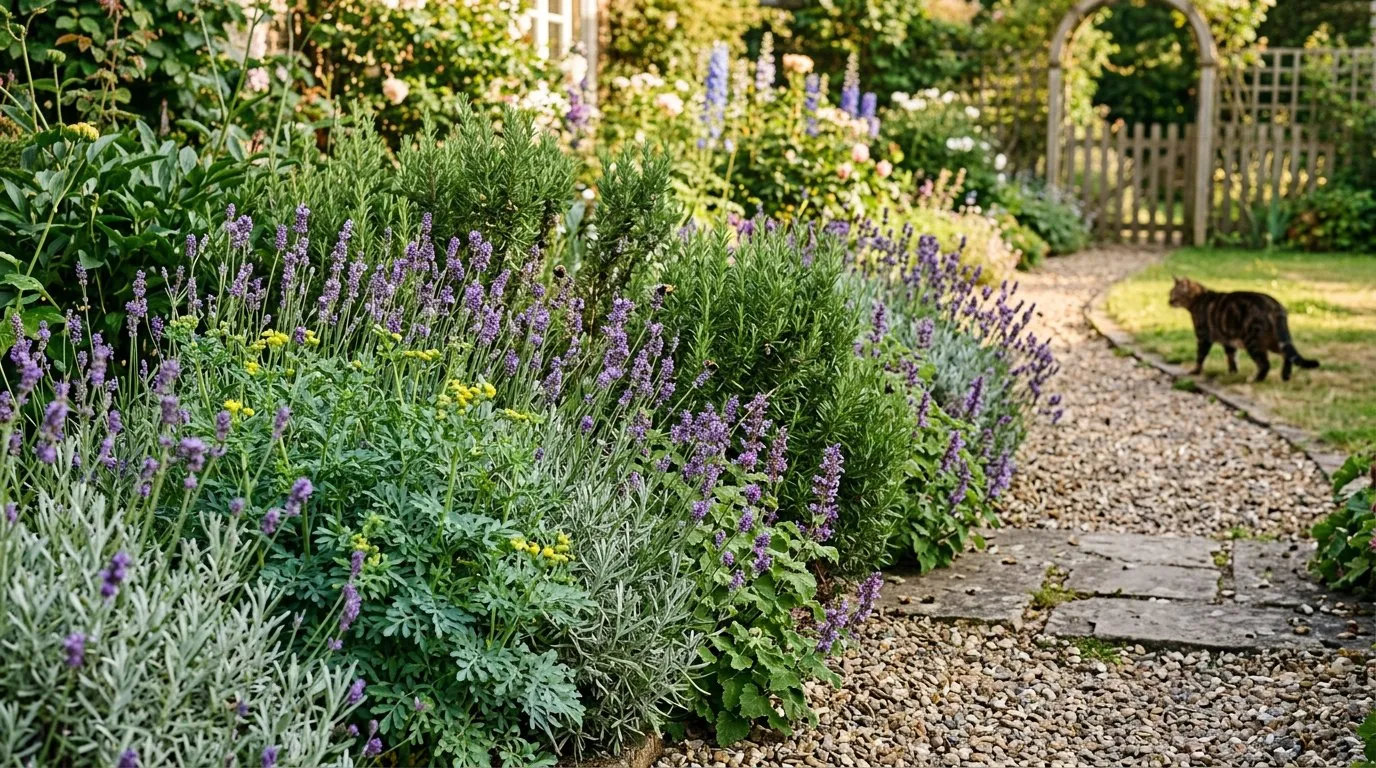 Aromatic plants like lavender, rosemary and Coleus canina deter cats from garden borders.
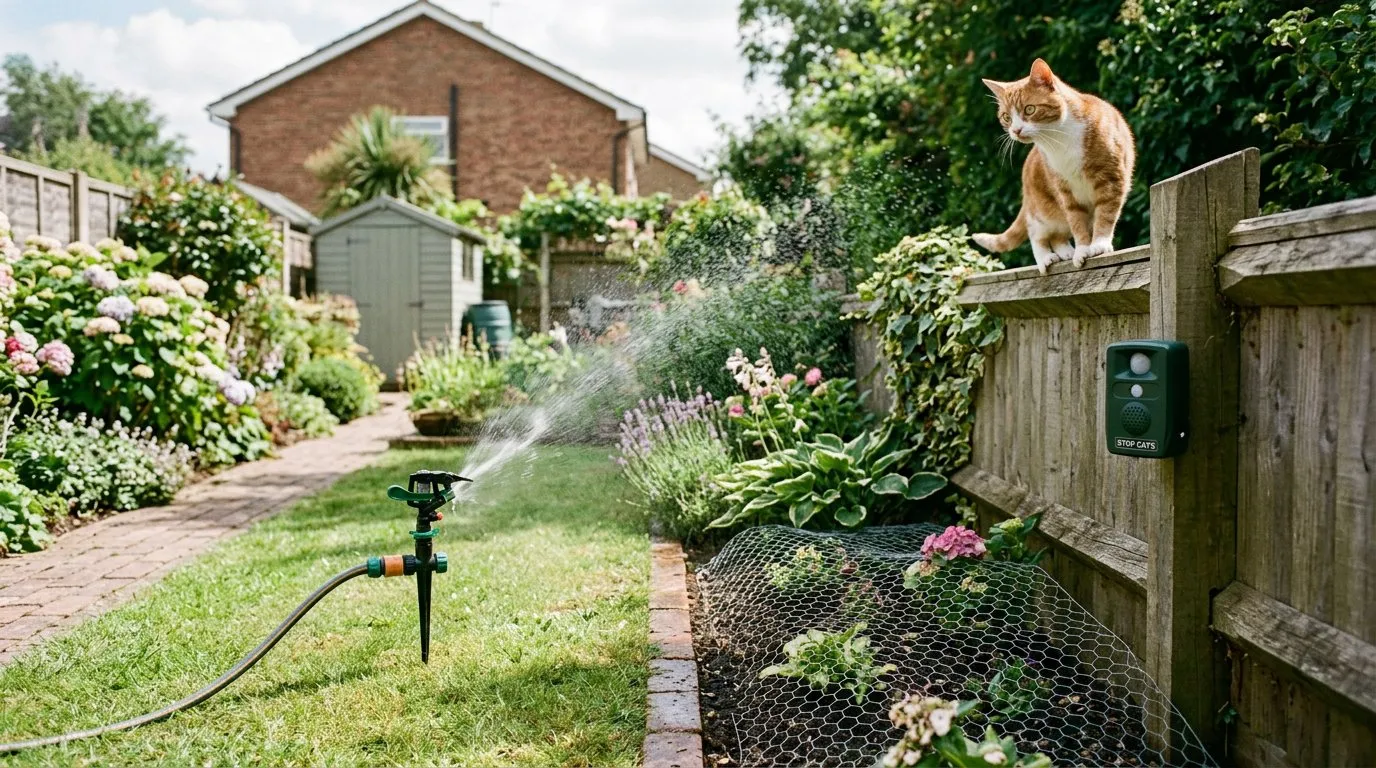 Combine physical deterrents for best results: motion sprinklers, ultrasonics and soil barriers.
Planting species that cats dislike is a passive, low-maintenance deterrent. No single plant repels every cat. A mixed planting scheme works best, creating overlapping scent barriers that most cats prefer to avoid.
Coleus canina (Scaredy Cat plant)
Coleus canina is the most widely recommended cat deterrent plant. It releases a strong, unpleasant odour when its leaves are brushed or touched. The scent is often described as a cross between dog urine and skunk spray. Roughly two-thirds of cats avoid areas where it grows.
Plant one every 2-3 metres along bed edges and border fronts. Coleus canina is a tender perennial, hardy only to about minus 2 degrees Celsius. In most UK gardens, treat it as a half-hardy annual and replace each spring. It grows 30-40cm tall with small blue flowers in late summer.
The effectiveness drops in winter when the plant dies back. Combine with evergreen aromatics like rosemary and lavender for year-round coverage.
Lavender
Lavender produces a powerful fragrance that most cats find overwhelming. The essential oils linalool and linalyl acetate are responsible. Large-flowered varieties like ‘Hidcote’ and ‘Munstead’ are the most aromatic and the hardiest for UK conditions. Read our full guide on how to grow lavender for planting advice.
Plant lavender along path edges, around seating areas, and at the front of borders where cats typically enter. Space plants 45cm apart for a dense hedge. Lavender thrives in free-draining soil and full sun. As a bonus, it attracts pollinators and works well alongside bee-friendly garden plants.
Rosemary
Rosemary has a strong, camphor-like scent that most cats avoid. Upright varieties like ‘Miss Jessopp’s Upright’ grow to 1.5 metres and form a dense, impenetrable barrier. Prostrate varieties like ‘Prostratus’ work well along the top of low walls. Our guide on how to grow rosemary covers soil, pruning, and winter care.
Rue
Rue (Ruta graveolens) has a bitter, acrid scent that most cats strongly dislike. It grows 60-90cm tall and is evergreen in mild UK winters. Handle with gloves as the sap causes skin irritation in sunlight. Plant rue at the back of borders where human contact is less likely.
Pennyroyal
Pennyroyal (Mentha pulegium) is a low-growing mint relative with a powerful minty scent. It reaches 15-30cm tall and spreads readily. Plant it as ground cover between paving slabs and along border edges. Pennyroyal is toxic if ingested in large quantities by pets or humans, so check our guide on plants toxic to dogs if you have both cats and dogs visiting your garden.
Physical deterrents
When plants alone are not enough, physical and electronic deterrents add another layer of protection.
Motion-activated sprinklers
Motion-activated sprinklers detect movement via infrared sensors and fire a short burst of water. They cover up to 10 metres over a 120-degree arc. Most cats learn to avoid the area after two or three encounters. Units cost £25-£50 each and require a garden hose connection.
Position the sprinkler to cover the area cats enter most frequently, not just the fouling site. Battery-powered sensors last 3-6 months. Solar models are less reliable from November to February. Turn sprinklers off during frost to avoid burst pipes.
Ultrasonic devices
Ultrasonic deterrents emit high-frequency sound above 18kHz that most cats find uncomfortable. Humans over 25 typically cannot hear it. Each unit covers 50-100 square metres and costs £15-£30. Battery and solar options are available.
Place the device at cat height, facing the approach route. Effectiveness varies. Some cats ignore ultrasonic devices entirely after a few days. Others avoid the area permanently. They work best as part of a combined approach rather than a standalone solution.
Chicken wire and mesh on soil
Chicken wire laid flat on the soil surface stops cats from digging in beds. Cats dislike the feel of wire on their paws and cannot scrape a hole through it. Use 25mm mesh and peg it flat with ground staples. Cut holes around established plants.
This method is particularly effective for protecting newly sown vegetable beds and seed trays. Replace the wire once plants are established and cover the ground. Plastic mesh netting works the same way but degrades faster in UV light.
Other physical barriers
- Prickle strips along fence tops and wall caps make landing uncomfortable
- Rough bark mulch at 5cm depth deters cats from digging in borders
- Stone chippings over bare soil create an unappealing toilet surface
- Short sticks or chopsticks pushed into soil at 10cm intervals block digging
- Citrus peel deters some cats but needs replacing every 2-3 days as the scent fades
Protecting bird feeders from cats
Cats kill an estimated 27 million birds in the UK each year according to the Mammal Society. If you feed garden birds, protecting feeding stations from cats is essential. The RSPB guidance on cats and birds provides detailed recommendations.
Mount feeders on smooth metal poles at least 1.5 metres high. Cats cannot grip smooth metal. Fit a cone-shaped baffle below the feeder. This blocks any cat that manages to climb the pole.
Position feeders 2 metres from any fence, wall, branch, or structure that a cat could launch from. Cats can jump horizontally up to 1.5 metres from a standing start. A 2-metre clearance is the minimum safe distance.
Ground feeding is the riskiest option where cats are present. If you feed ground-feeding species like robins and blackbirds, use a ground feeder cage. These wire frames allow small birds in but exclude cats. Place them in open areas with clear sight lines so birds can spot approaching predators. Our guide on attracting birds to your garden covers feeder placement in detail.
Trim hedges and shrubs near feeding stations to remove ambush cover. A 1-metre clearance around the base of feeders lets birds see danger approaching. Do not place feeders under dense evergreens where cats can hide.
Keeping your cat safe in the garden
Cat-proofing works both ways. Many owners want to give their cat outdoor access without the risks of traffic, fights, and disease that come with free roaming. The British Veterinary Association reports that road traffic accidents are the leading cause of death in cats under five.
Cat-proof your existing fence
The roller bar and spinning paddle systems described above keep cats in just as effectively as they keep them out. Fit them along the inside of your boundary fence. Your cat can enjoy the full garden but cannot climb over the top.
Check for weak points. Cats exploit gaps under gates, holes in hedges, and low sections where neighbouring fences meet. Block these with mesh or timber. Gates need a full-height cover or a cat-proof roller across the top.
Create vertical interest inside
A contained garden needs stimulation to prevent boredom. Install climbing posts, raised platforms, and shelving along fence lines. Cats need vertical territory. Provide high vantage points where they can survey the garden.
Plant cat grass (Dactylis glomerata or Avena sativa) in pots for grazing. Catmint (Nepeta) provides sensory enrichment. Add garden lighting on timers to extend outdoor time in winter evenings safely.
Toxic plant audit
Before letting your cat into a contained garden, check every plant against the plants toxic to cats list. Lilies are the highest priority. All true lilies (Lilium species) are lethal to cats. Even pollen brushed onto fur and then groomed off can cause fatal kidney failure within 72 hours.
Remove lilies entirely. Other common garden plants toxic to cats include foxglove, yew, laburnum, rhododendron, and autumn crocus. Replace them with cat-safe alternatives. For pet-safe garden plants that work in borders and containers, stick to roses, sunflowers, snapdragons, and herbs like basil and thyme.
Why we recommend Oscillot spinning paddle systems over roller bars for most UK timber fences: After 30 years of advising on garden boundaries and seeing how cats behave, Oscillot-style paddles consistently outperform rollers in real-world conditions. Roller bars fail when a cat jumps directly onto the fence top and grips before the roller can spin. Paddles spin immediately on contact. In five gardens where I replaced roller bars with Oscillot paddles, every owner reported their cat stopped escaping within the first week.
Common mistakes when cat-proofing a garden
Leaving gaps in the fence line
The most expensive cat-proof fencing fails if there is a 15cm gap under the gate. Cats are fluid. If the head fits through, the body follows. Walk your entire boundary before installing any system. Block every gap at ground level with timber, mesh, or concrete gravel boards.
Relying on a single deterrent
No single method works on every cat. Motion sprinklers deter most cats but not all. Ultrasonic devices work on some and are ignored by others. Coleus canina repels roughly two-thirds of cats but has no effect on the rest. Use at least two different deterrent types together.
Using harmful substances
Mothballs, bleach, chilli powder, and essential oils applied directly to soil can harm cats, hedgehogs, and other wildlife. Some gardeners use these out of frustration. Beyond the ethical issue, it is a criminal offence under the Animal Welfare Act 2006. Stick to humane, tested methods.
Ignoring seasonal changes
Deterrent plants die back in winter. Batteries in ultrasonic devices run flat. Sprinkler hoses freeze in January. A cat-proof garden needs year-round maintenance. Check your systems monthly and replace consumables before they fail.
Not addressing the root cause
If cats foul in your garden, there is usually a reason. Soft soil, sheltered spots, and dry ground attract them. Covering bare soil with mulch, planting densely, and removing sheltered toilet spots is more effective long-term than any gadget. For dog-friendly garden layouts that also deter cats, dense ground-cover planting is one of the most effective strategies. If dogs are also causing lawn damage, our guide to dog-proof lawns covers repair and prevention.
Comparison of cat deterrent methods
| Deterrent | Effectiveness | Cost | Pros | Cons |
|---|---|---|---|---|
| Roller bars | 8/10 | £8-£15/m | Reliable, long-lasting, works both ways | Visible on fence, needs full boundary |
| Oscillot paddles | 9/10 | £15-£20/m | Discreet, silent, very effective | Timber fences only, higher cost |
| Motion sprinkler | 7/10 | £25-£50 each | Covers large area, cats learn fast | Needs hose, wets visitors too |
| Ultrasonic device | 5/10 | £15-£30 each | Cheap, easy to place | Mixed results, some cats ignore |
| Coleus canina | 6/10 | £3-£5 per plant | Passive, doubles as ornamental | Dies in winter, not all cats deterred |
| Lavender/rosemary | 5/10 | £5-£8 per plant | Attractive, useful herb, year-round | Mild deterrent only |
| Chicken wire | 7/10 | £2-£4 per sqm | Cheap, immediate, protects beds | Ugly, needs replacing, hard to weed |
| Citrus peel | 3/10 | Free | No cost, non-toxic | Fades in 2-3 days, needs constant replacing |
| Catio | 10/10 | £200-£2,000 | Complete containment, safe for cat | Restricts garden use, cost |
Now you’ve cat-proofed your garden, read our guide on how to stop cats pooing in your garden for the next step.
Frequently asked questions
How much does cat-proof fencing cost UK?
Roller bars cost £8-£15 per metre installed. Oscillot spinning paddle systems cost £15-£20 per metre including brackets and paddles. For a typical 30-metre garden boundary, expect to pay £240-£600 depending on the system. Angled mesh toppers are cheaper at £5-£10 per metre but less discreet. Factor in gate modifications and gap-filling, which add 10-20% to the total.
Can I legally stop cats entering my garden UK?
You can deter cats but not harm them. Under the Animals Act 1971, cats have a legal right to roam and are not considered to be trespassing. The Animal Welfare Act 2006 makes it a criminal offence to cause unnecessary suffering. Humane deterrents like sprinklers, ultrasonics, and fencing modifications are all legal. You cannot trap, poison, or confine a neighbour’s cat under any circumstances.
Do ultrasonic cat deterrents actually work?
They work on some cats but not all. Ultrasonic devices emit high-frequency sound above 18kHz that most cats find unpleasant. Effectiveness varies by individual cat, battery strength, and placement. Position them at cat height facing the approach route. Motion-activated sprinklers are more reliable for persistent cats. Combine both for the best coverage.
What is the best plant to deter cats?
Coleus canina (Scaredy Cat plant) is the most effective deterrent plant. It releases a strong odour when touched that roughly two-thirds of cats avoid. Plant one every 2-3 metres along borders for a continuous barrier. Combine with lavender and rosemary for layered scent coverage throughout the year, as Coleus canina is not frost-hardy.
How much does a catio cost UK?
A basic lean-to catio frame costs £200-£500. Mid-range walk-in enclosures with shelves and ramps cost £500-£1,200. Custom-built catios with insulated shelters and multiple levels reach £1,500-£2,000. DIY builds using 25mm galvanised mesh at £5-£10 per square metre can halve these costs. Window-box catios for flats start at £200.
Will cat-proof fencing keep foxes out too?
Roller bars and spinning paddles stop most cats but not foxes. Foxes are heavier, stronger climbers with better grip. An angled mesh topper at 45 degrees is more effective against foxes. For full fox exclusion, bury mesh 30cm underground at the fence base and add a 2-metre fence with a 40cm inward overhang at the top.
Do cats hate lavender?
Most cats dislike the strong scent of lavender. The essential oils linalool and linalyl acetate overwhelm their sensitive noses. Lavender works best as part of a mixed scheme alongside rosemary, Coleus canina, and rue. A single lavender bush alone will not keep a determined cat away. Plant a continuous row at 45cm spacing for a dense, fragrant barrier.
How do I protect bird feeders from cats?
Mount feeders on smooth metal poles at least 1.5 metres high. Fit a cone-shaped baffle below the feeder to block climbing. Position feeders 2 metres from any fence, wall, or branch that cats could launch from. Use ground feeder cages for species like robins that feed on the floor. Keep a 1-metre clearance around feeders by trimming nearby shrubs to remove ambush cover.
Lawrie has been gardening in the West Midlands for over 30 years. He grows his own veg using no-dig methods, keeps a wildlife-friendly garden, and writes practical advice based on real UK growing conditions.