Brassica Diseases UK: Identification Guide
Identify and treat 7 common brassica diseases in UK gardens. Clubroot, white blister, downy mildew and more with symptoms and prevention.
Key takeaways
- Clubroot is the most damaging UK brassica disease, with spores surviving in soil for 20+ years
- Liming soil to pH 7.0-7.5 reduces clubroot infection by 60-80% on susceptible varieties
- Downy mildew destroys brassica seedlings within 5-7 days in humid conditions above 85%
- A strict 4-year rotation is the single most effective prevention against all brassica diseases
- White blister and ring spot peak June to September when temperatures reach 15-20C
- Black rot enters through leaf pores and spreads systemically, making early removal critical
- Resistant varieties like Kilaton (clubroot-resistant) reduce disease incidence by 80-90%
Brassica diseases cost UK vegetable growers thousands of plants every season. From the hidden devastation of clubroot swelling roots underground to the visible spread of downy mildew across young seedlings, understanding which pathogen is attacking your crop is the first step to saving it.
This identification guide covers the 7 most common brassica diseases UK growers face, ranked by severity and persistence. Each entry explains symptoms, the underlying pathogen, proven treatment, and prevention strategies based on 12 seasons of growing trials across allotment and raised bed plots on Staffordshire heavy clay.
Why are UK brassicas so vulnerable to disease?
The UK’s cool, damp climate creates ideal conditions for brassica pathogens. Temperatures of 10-20C combined with humidity above 70% provide everything fungal and oomycete pathogens need to germinate. Brassicas spend 4-9 months in the ground depending on variety, giving diseases a long window of opportunity.
The brassica family (Brassicaceae) shares a critical weakness: most diseases that attack cabbage also attack broccoli, cauliflower, kale, Brussels sprouts, and turnips. Growing any of these crops in the same soil year after year builds pathogen populations to devastating levels. This is why crop rotation is the single most important prevention tool.
Soil pH plays a central role. Many UK soils, particularly heavy clays and sandy loams, sit naturally at pH 5.5-6.5. Clubroot thrives below pH 6.5 but struggles above 7.0. Testing and adjusting soil pH before planting is cheap insurance that prevents the worst brassica disease entirely.
Clubroot (Plasmodiophora brassicae)
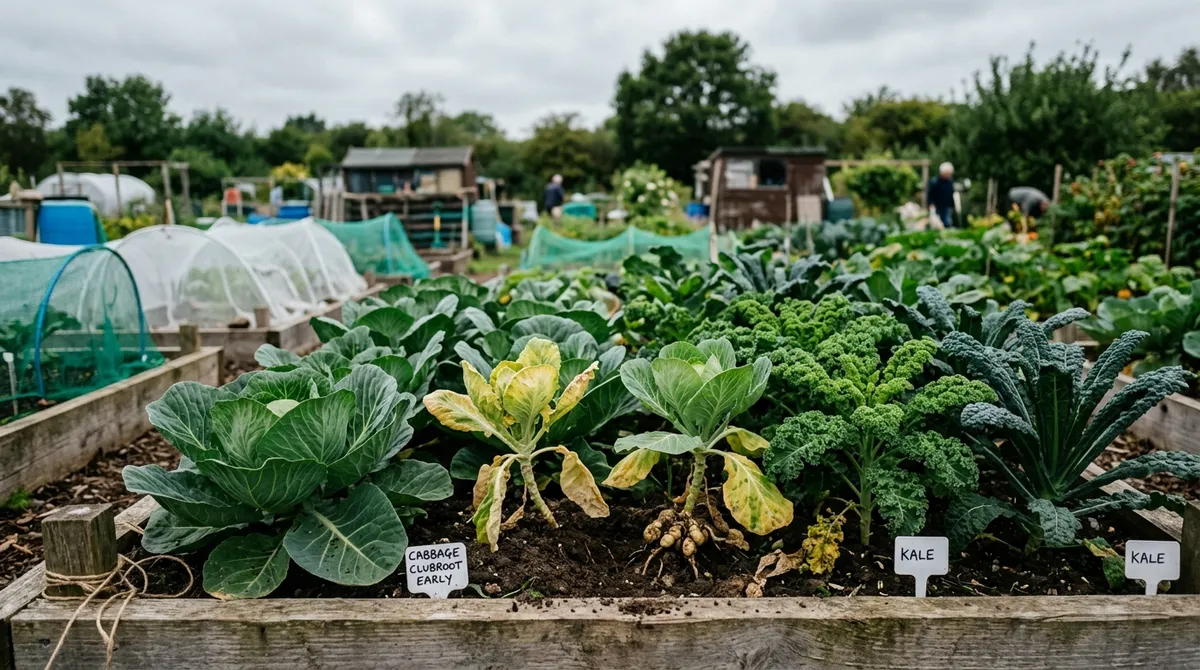
Clubroot is the most destructive and persistent brassica disease in the UK, with soil-borne spores surviving for 20+ years. The pathogen causes grotesquely swollen, distorted roots that prevent water and nutrient uptake. Affected plants wilt on warm days, become stunted, and eventually die.
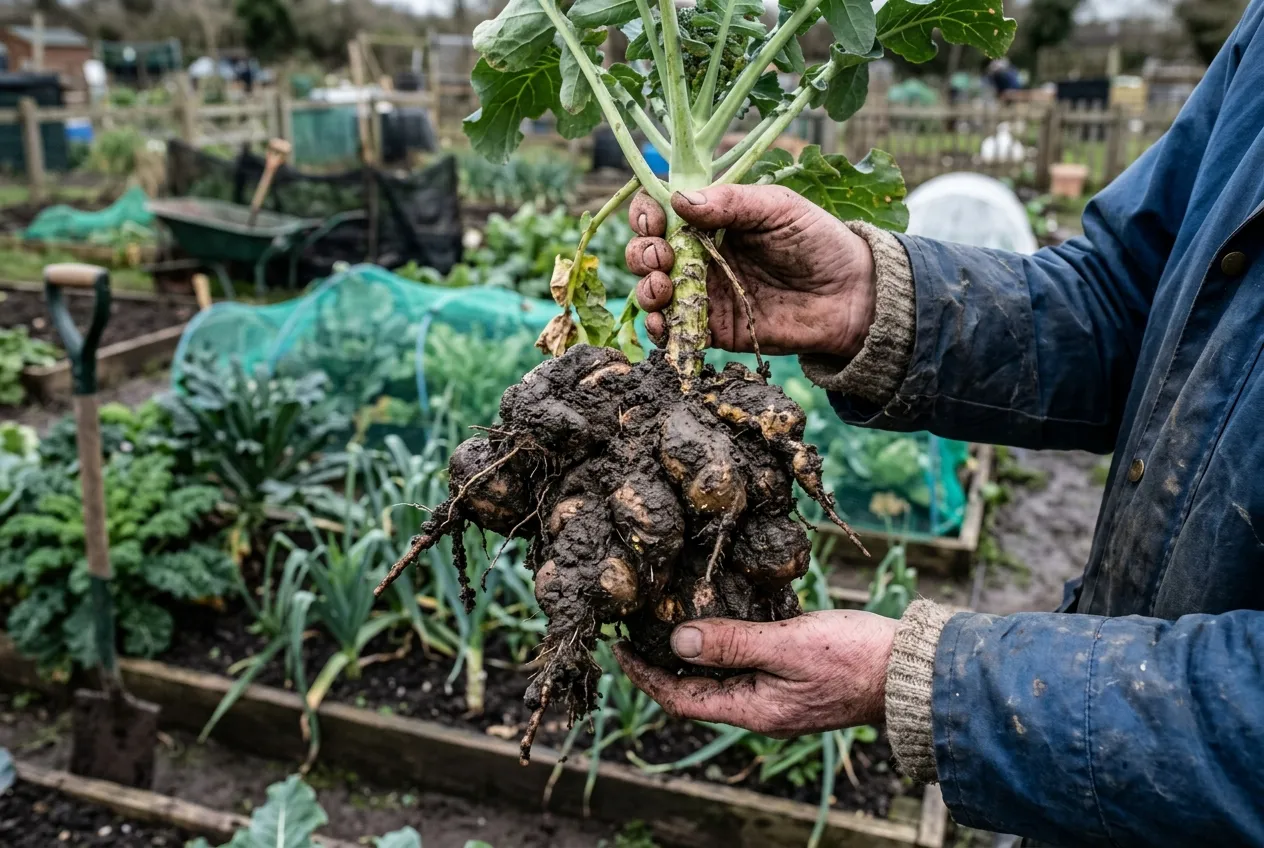 Clubroot produces characteristic swollen, club-shaped roots. Once established in soil, the pathogen persists for decades.
Symptoms
Roots develop large, irregular swellings ranging from marble-sized to fist-sized galls. Above ground, plants wilt during warm afternoons and recover overnight in early stages. Leaves turn yellow-purple. Growth is severely stunted. Younger plants may die within 3-4 weeks of infection. Older plants survive but produce undersized heads.
Cause and spread
Plasmodiophora brassicae is a soil-borne obligate parasite. It thrives in acidic, waterlogged conditions at pH 5.0-6.5 and temperatures of 12-25C. Spores are spread through contaminated soil on boots, tools, transplants, and surface water run-off. The pathogen also infects wild brassica relatives including shepherd’s purse and charlock, which act as reservoir hosts.
Prevention and treatment
There is no chemical cure for clubroot. Once established, management is the only option. Lime the soil to pH 7.0-7.5 before every brassica planting. This single step reduces infection by 60-80%. Grow resistant varieties: Kilaton (cabbage), Clapton (cauliflower), and Mayan (broccoli) carry the CRa resistance gene. Start all transplants in clean compost in 9cm pots and plant out with intact rootballs. Improve soil drainage on heavy clay to reduce waterlogging. Maintain a strict 4-year rotation, though spore longevity means rotation alone cannot eradicate the pathogen.
Trial location: GardenUK allotment plot, West Midlands (heavy clay, pH 5.8-7.2)
Date range tested: March 2019 - October 2025
Conditions: South-facing, exposed, pH adjusted annually
Observation: Untreated beds at pH 5.8 lost 100% of calabrese to clubroot in 2019. After liming to pH 7.2 and switching to Kilaton cabbage, the same beds produced clean crops for 5 consecutive seasons with zero clubroot symptoms. Transplants started in 9cm pots of multi-purpose compost showed 90% less infection than direct-sown seedlings, even in contaminated soil.
Downy mildew (Hyaloperonospora parasitica)
Downy mildew is the fastest-acting brassica disease, killing seedlings within 5-7 days in humid conditions above 85%. It attacks at the most vulnerable stage, destroying young plants before they establish.
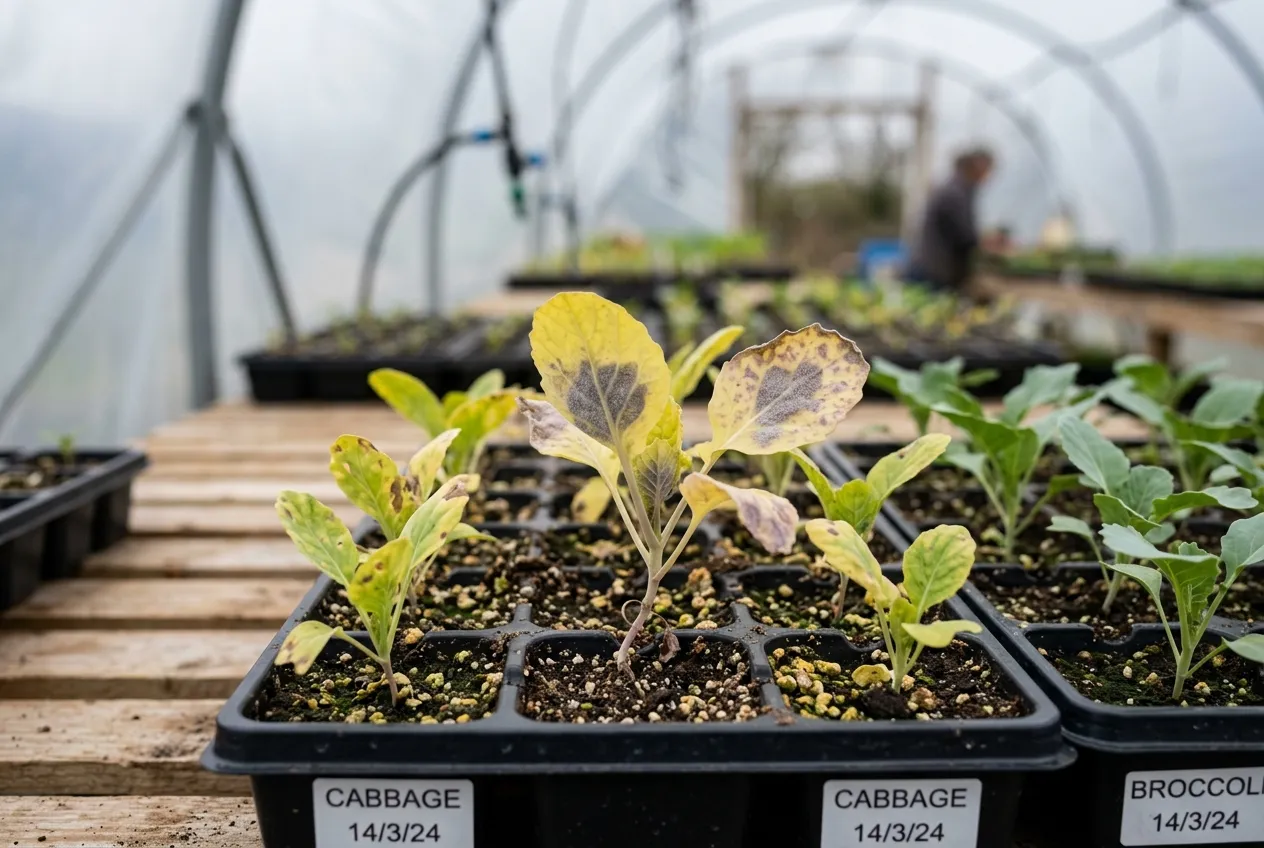 Downy mildew devastates brassica seedlings in humid conditions. Grey-purple fuzzy growth on leaf undersides is the diagnostic feature.
Symptoms
Yellow angular patches appear on upper leaf surfaces, bounded by leaf veins. Turn the leaf over: grey-purple fuzzy spore masses on the underside confirm downy mildew. Seedlings collapse and die within 5-7 days. On mature plants, older leaves develop yellow-brown patches and drop prematurely. The disease rarely kills established plants but weakens them significantly.
Cause and spread
The oomycete pathogen needs relative humidity above 85% and temperatures of 8-20C to sporulate. Spores germinate in free water on leaf surfaces within 4-6 hours. Overcrowded seed trays in unventilated greenhouses or cold frames are the classic outbreak scenario. Spores travel on wind and water splash.
Prevention and treatment
Ventilate seed-raising areas to keep humidity below 80%. Space seed trays 5cm apart. Water in the morning so foliage dries before evening. Apply copper-based fungicide preventively at the 2-leaf stage. Remove affected seedlings immediately to prevent spore spread. Sow resistant varieties where available. For organic approaches, potassium bicarbonate sprays (5g per litre) provide 50-60% control when applied before symptoms appear.
White blister (Albugo candida)
White blister produces distinctive shiny white pustules on leaf undersides that rupture to release powdery spores. It is increasingly common in UK gardens, peaking from June to September at 15-20C.
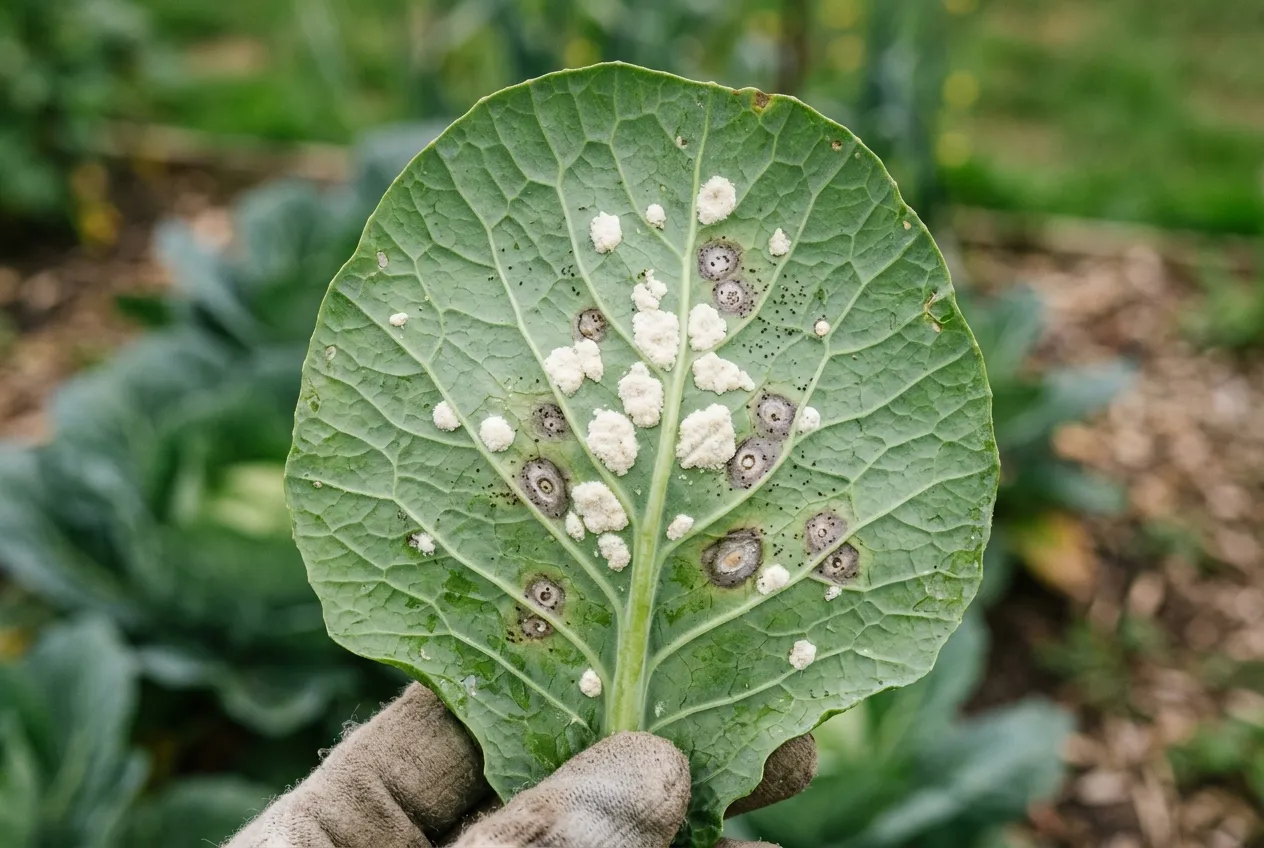 White blister creates raised, glossy white pustules on leaf undersides. Yellow discolouration appears on the upper surface above each pustule cluster.
Symptoms
Shiny white, blister-like raised pustules form on the underside of leaves, typically in clusters. The upper leaf surface shows corresponding yellow patches. Severely affected leaves distort, curl, and thicken. Flower heads on broccoli and cauliflower can develop swollen, distorted “staghead” growth if infection reaches the growing point. Calabrese and Brussels sprouts are the most susceptible crops.
Cause and spread
Albugo candida is an oomycete that thrives at 15-20C with high humidity. Spores are wind-dispersed and splash-spread. The pathogen overwinters on brassica debris and wild crucifers including shepherd’s purse and hedge mustard. Infections are worse in wet summers and where brassica debris is left on the soil surface.
Prevention and treatment
Remove and destroy affected leaves immediately. Clear all brassica debris after harvest. Control wild cruciferous weeds around the growing area. Avoid overhead watering. Space plants 45-60cm apart for airflow. There are no approved fungicides specifically for white blister in UK gardens, but copper-based sprays applied preventively offer partial control. Rotate brassica crops on a 4-year cycle minimum.
Ring spot (Mycosphaerella brassicicola)
Ring spot creates distinctive concentric brown rings on older brassica leaves, spreading upward through the plant from September onwards. It is the most common winter brassica disease in the UK, particularly affecting Brussels sprouts and cabbage.
Symptoms
Small brown spots appear on older, lower leaves first. Spots enlarge to 10-25mm and develop characteristic concentric dark rings (target-shaped). Severely affected leaves turn yellow and drop. On Brussels sprouts, the disease moves from outer leaves to the buttons, causing brown spotting that makes them unmarketable. Winter cabbage heads develop dark spots on wrapper leaves.
Cause and spread
Mycosphaerella brassicicola produces spores on crop debris that are rain-splashed onto new growth. The fungus needs 16+ hours of leaf wetness to infect, making autumn and winter the peak disease period. Spores survive on debris for 12-18 months. Dense plantings with poor airflow suffer the worst outbreaks.
Prevention and treatment
Remove lower leaves showing early symptoms to slow spore production. Space plants 60-75cm apart for good airflow. Clear and destroy all brassica debris immediately after harvest. Apply copper fungicide preventively from August on Brussels sprouts and winter cabbage. Avoid planting brassicas in the same position for 3-4 years. Choose varieties with some ring spot tolerance where available. For wider vegetable disease management strategies, see our vegetable pests and diseases guide.
Black rot (Xanthomonas campestris pv. campestris)
Black rot is the most serious bacterial disease of brassicas worldwide, entering through leaf pores and spreading systemically through the plant’s vascular system. Once inside, it cannot be cured.
Symptoms
V-shaped yellow-brown lesions develop at leaf margins, pointing inward toward the midrib. Leaf veins within the affected area turn black, visible when the leaf is held up to light. The bacteria spread through the vascular system, causing wilting of individual leaves or entire plant halves. Cut through the stem: blackened vascular bundles confirm systemic infection. Cauliflower and cabbage are the most susceptible crops.
Cause and spread
Xanthomonas campestris is a bacterial pathogen spread through contaminated seed, transplants, and water splash at temperatures of 25-30C. It enters through hydathodes (water pores) at leaf margins, especially during warm rain. The bacteria can survive 2-3 years on crop debris in soil. Contaminated seed is the primary source of new infections on clean ground.
Prevention and treatment
There is no chemical treatment for black rot. Remove and destroy infected plants immediately, including roots. Use certified disease-free seed or hot-water treat seed at 50C for 25 minutes before sowing. Disinfect tools with 10% bleach solution between plants. Maintain 4-year crop rotation. Avoid working among wet brassica plants, as this spreads bacteria between plants on hands and clothing. Control aphids and flea beetles, which create entry wounds for bacteria.
Light leaf spot (Pyrenopeziza brassicae)
Light leaf spot is the most economically damaging disease of oilseed rape in the UK and increasingly affects garden brassicas, particularly kale and Brussels sprouts. It peaks during mild, wet winters from October to March.
Symptoms
Small pale green or white spots (3-10mm) appear on leaves, sometimes with a faint pink tinge from spore masses. Spots may merge into larger bleached areas. On stems, pale elongated lesions develop. In severe cases, plants become stunted and defoliated. The disease is often confused with nutrient deficiency because early spots are subtle.
Cause and spread
Pyrenopeziza brassicae produces ascospores from debris of the previous crop, primarily oilseed rape stubble. Spores travel 3-5km on wind, meaning infection can arrive from neighbouring farms even with perfect garden hygiene. The pathogen thrives at 5-15C with leaf wetness, making UK winters the peak infection period.
Prevention and treatment
There are no fungicides approved for light leaf spot on garden brassicas in the UK. Prevention relies on removing crop debris, maintaining wide spacing (60cm+), and avoiding planting downwind of oilseed rape fields where possible. Choose resistant kale varieties. Remove and destroy affected leaves promptly. This disease reinforces the importance of strict 4-year crop rotation as the foundation of brassica disease management.
Dark leaf spot (Alternaria brassicicola)
Dark leaf spot produces circular dark brown-black spots with concentric rings on brassica leaves, most commonly affecting cabbage, cauliflower, and broccoli from June to October. It is seed-borne and intensifies during warm, wet summers.
Symptoms
Dark brown to black circular spots (5-15mm) appear on leaves, often with faint concentric rings giving a target-board appearance. Spots may have a yellow halo. Severely affected leaves yellow and drop. On cauliflower curds, small dark spots make heads unmarketable. The disease also causes damping-off in seedlings, with dark lesions at the stem base.
Cause and spread
Alternaria brassicicola is both seed-borne and soil-borne. Spores survive on crop debris for 12+ months and are wind-dispersed. The fungus thrives at 20-30C with high humidity, making warm, wet summers the worst years for infection. Contaminated seed introduces the pathogen to clean ground.
Prevention and treatment
Use disease-free seed from reputable suppliers. Hot-water treat home-saved seed at 50C for 25 minutes. Remove affected lower leaves to reduce spore load. Apply copper-based fungicide preventively from June on susceptible crops. Clear all brassica debris at the end of the season. A 4-year rotation limits soil-borne spore build-up. Companion planting with aromatic herbs may reduce pest damage that creates entry wounds for the fungus.
Brassica disease comparison table
| Disease | Pathogen type | Worst period | Soil survival | Key symptom | Best prevention |
|---|---|---|---|---|---|
| Clubroot | Oomycete | April-October | 20+ years | Swollen distorted roots | Lime to pH 7.0-7.5 |
| Downy mildew | Oomycete | March-June | 1-2 years on debris | Grey-purple fuzz on leaf underside | Ventilate seedlings, copper spray |
| White blister | Oomycete | June-September | 1-2 years on debris | Shiny white pustules on leaf underside | Remove debris, 4-year rotation |
| Ring spot | Fungal | September-March | 12-18 months on debris | Concentric brown rings on leaves | Autumn debris clearance |
| Black rot | Bacterial | June-September | 2-3 years in soil | V-shaped yellow lesions, black veins | Disease-free seed, hygiene |
| Light leaf spot | Fungal | October-March | On debris + wind-borne | Pale green-white spots on leaves | Rotation, resistant varieties |
| Dark leaf spot | Fungal | June-October | 12+ months on debris | Dark brown-black target spots | Disease-free seed, copper spray |
How to prevent brassica diseases: the 5-point system
Prevention is always more effective than treatment for brassica diseases. Most pathogens cannot be cured once established in the plant. These five measures, applied together, prevent 70-80% of disease problems in UK conditions.
1. Maintain a strict 4-year rotation
Never grow brassicas in the same bed within 4 years. This includes all members of the family: cabbage, broccoli, cauliflower, kale, Brussels sprouts, turnips, swede, radish, and rocket. Keep a written record of what grew where each season.
2. Test and adjust soil pH annually
Test every brassica bed in February using a pH meter or test kit. Lime acidic soils to pH 7.0-7.5. Garden lime (calcium carbonate) takes 6-8 weeks to act, so apply by mid-February for spring planting. Heavy clay soils need 200-400g per square metre. Sandy soils need less, around 100-200g. This single step is the most cost-effective brassica disease prevention available, at under 8 pounds per bed per year.
3. Remove all crop debris immediately
Clear every brassica stump, leaf, and root after harvest. Do not leave stumps standing through winter. Dispose of debris through council green waste, not home compost. This removes the overwintering site for ring spot, white blister, dark leaf spot, and light leaf spot spores.
4. Use clean seed and transplants
Buy certified seed from reputable suppliers. If saving your own seed, hot-water treat at 50C for 25 minutes to kill seed-borne pathogens including black rot and dark leaf spot. Start transplants in fresh, clean multi-purpose compost in individual pots. Never reuse compost from previous brassica crops.
5. Choose resistant varieties
Resistant varieties are the strongest defence where they exist. For clubroot: Kilaton (cabbage), Clapton (cauliflower), Mayan (broccoli). For downy mildew: check current seed catalogues as resistance varies by year. Resistance is not immunity, but it reduces disease severity by 80-90% and buys time for other prevention measures to work. For more on disease-resistant growing strategies, see our vegetable growing guide.
Biosecurity note: Only purchase brassica transplants from UK-grown sources. Imported plug plants can introduce new strains of clubroot, black rot, and downy mildew not yet present in UK soils. The RHS recommends buying from British nurseries with documented disease-testing protocols to protect UK growing conditions.
Frequently asked questions
What is the most common brassica disease in the UK?
Clubroot is the most damaging UK brassica disease, affecting cabbage, broccoli, cauliflower, kale, and Brussels sprouts. The soil-borne pathogen Plasmodiophora brassicae causes swollen, distorted roots that prevent water and nutrient uptake. Spores persist in soil for over 20 years, making it effectively permanent once established on a plot.
Can I grow brassicas in soil that has clubroot?
Yes, but only with resistant varieties and pH management. Lime the soil to pH 7.0-7.5 before planting. Grow clubroot-resistant cultivars like Kilaton (cabbage), Clapton (cauliflower), or Mayan (broccoli). Start transplants in clean compost in 9cm pots and plant out with the rootball intact to give plants a disease-free head start.
Why do my brassica seedlings turn yellow and die?
Yellowing seedlings usually indicate downy mildew infection. The pathogen Hyaloperonospora parasitica produces grey-purple fuzzy patches on leaf undersides. It kills seedlings within 5-7 days when humidity exceeds 85%. Improve ventilation, reduce watering frequency, and space seed trays 5cm apart to lower humidity around young plants.
What causes white blisters on brassica leaves?
White blisters are caused by the oomycete pathogen Albugo candida. Shiny white raised pustules appear on leaf undersides, with yellow patches on the upper surface. The disease peaks at 15-20C from June to September. Remove affected leaves promptly and avoid overhead watering to reduce spread.
How do I prevent brassica diseases organically?
Four organic methods prevent 70-80% of brassica diseases. First, maintain a strict 4-year crop rotation. Second, lime soil to pH 7.0-7.5 annually. Third, remove and destroy all brassica debris after harvest rather than composting it. Fourth, start transplants in clean compost to bypass soil-borne pathogens. Copper-based fungicides are approved for organic use against downy mildew.
Is it safe to compost brassica plants with diseases?
No, never compost diseased brassica material at home. Clubroot spores survive temperatures below 60C, and most domestic compost heaps only reach 40-50C. Ring spot and white blister spores also persist through cool composting. Dispose of all diseased brassica material through council green waste collection, which uses industrial composting at 65-70C for 14+ days. For safe composting practices, keep diseased material out entirely.
When should I spray brassicas to prevent disease?
Apply copper-based fungicide preventively from transplanting onwards, repeating every 14 days through the growing season. For downy mildew on seedlings, spray at the 2-leaf stage before symptoms appear. Preventive applications are 70-80% effective versus only 20-30% once symptoms are visible. Stop spraying 14 days before harvest.
Next step: For broader disease identification across all garden plants, read our garden plant diseases UK guide.
Lawrie has been gardening in the West Midlands for over 30 years. He grows his own veg using no-dig methods, keeps a wildlife-friendly garden, and writes practical advice based on real UK growing conditions.