How to Get Rid of Foxes in Your Garden
Proven methods to deter foxes from UK gardens. Covers repellents, fencing, removing attractants, ultrasonic devices, and when to call pest control.
Key takeaways
- An estimated 150,000 urban foxes live across UK towns and cities
- Foxes are not protected species, but poisoning and garden snares are illegal
- Fox-proof fencing needs to be 1.8m tall with a 30cm inward-angled overhang
- Motion-activated sprinklers deter foxes with 70-80% effectiveness in most gardens
- Removing food waste, pet food, and fallen fruit is the single most effective long-term fix

Foxes are a fact of life in British gardens. An estimated 150,000 urban foxes live across UK towns and cities, and that number has been stable since the 1990s. London alone supports around 10,000 foxes. Bristol has the highest density, with up to 16 foxes per square kilometre in some suburbs.
They dig up lawns hunting for chafer grubs. They scatter rubbish across driveways. They foul on patios and decking. They scream at 3am during mating season. If you keep chickens, rabbits, or guinea pigs, foxes are a serious threat. This guide covers every proven method to deter foxes from your garden, from simple changes that cost nothing to professional pest control options.
Why foxes visit your garden
Understanding what attracts foxes is the first step to getting rid of them. Foxes are opportunistic feeders. They visit gardens that offer easy food, water, or shelter.
Food sources
The biggest draw for foxes is accessible food. Even small amounts keep them returning.
- Household waste in bags or overflowing bins. Foxes can smell food scraps through bin bags and tear them open overnight.
- Pet food left outdoors. Cat biscuits and dog food bowls are a reliable fox meal.
- Fallen fruit from apple, pear, and plum trees. Windfall fruit ferments and attracts foxes within hours.
- Bird feeders that scatter seed on the ground. Foxes eat spilled seed and also catch rodents attracted to it. See our guide on attracting birds to your garden for tips on feeding birds without encouraging foxes.
- Compost heaps with food scraps. Open compost bins containing cooked food or meat are fox magnets. Our guide to making compost explains how to build a fox-proof bin.
Shelter
Foxes need safe resting places during the day and denning sites for breeding. Garden sheds with gaps underneath are ideal fox dens. Overgrown corners, woodpiles, and spaces under decking provide cover. Dense hedges and bramble patches offer daytime sleeping spots.
Territory
Foxes are territorial animals. A dog fox patrols an urban territory of 20-40 hectares. Once a fox establishes your garden as part of its territory, deterring it takes consistent effort over several weeks. They mark territory with urine and droppings, which is why fox fouling smells so strong.
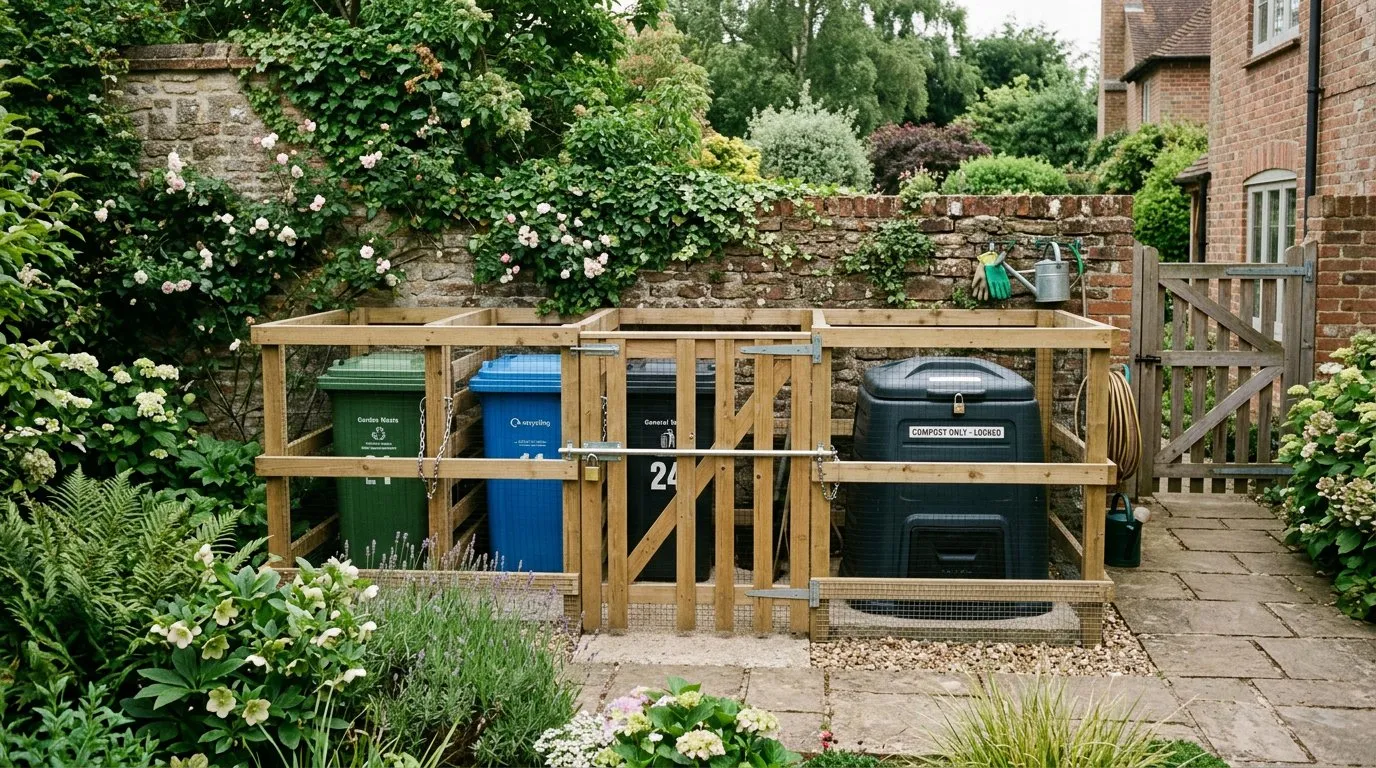 Unsecured bins are the number one reason foxes return to the same garden night after night.
The legal position on foxes in the UK
Foxes are not classified as vermin under UK law. They are not a protected species either. This means you can deter them, but the methods you use are restricted.
What is legal:
- Deterrent sprays, scent repellents, and ultrasonic devices
- Motion-activated lights and sprinklers
- Fox-proof fencing and physical barriers
- Live cage trapping (but you must check traps every 12 hours)
- Humane dispatch by a trained person
- Professional pest control services
What is illegal:
- Poisoning foxes (Wildlife and Countryside Act 1981)
- Self-locking snares in gardens
- Causing unnecessary suffering (Animal Welfare Act 2006)
- Releasing trapped foxes into someone else’s property
- Using dogs to hunt foxes (Hunting Act 2004)
Warning: Poisoning foxes is a criminal offence carrying unlimited fines and up to 6 months in prison. Poison also kills pets, hedgehogs, and birds of prey that eat the carcass. Never use poison under any circumstances.
Fox deterrent methods compared
Not all deterrent methods work equally well. This comparison table rates each approach based on field effectiveness, cost, and practicality.
| Deterrent method | Effectiveness | Cost | Duration | Best for |
|---|---|---|---|---|
| Removing food sources | Very high (90%) | Free | Permanent | Every garden |
| Fox-proof fencing (1.8m + overhang) | Very high (85-95%) | £500-2,000 | 10+ years | Enclosed gardens, poultry keepers |
| Motion-activated sprinklers | High (70-80%) | £30-80 | 3-5 years | Lawns, borders, open areas |
| Commercial repellents (Scoot, Get Off) | Moderate (50-70%) | £8-15 per treatment | 2-4 weeks | Specific fouling spots, boundaries |
| Ultrasonic devices | Moderate (50-60%) | £20-50 | 2-3 years | Entry points, small gardens |
| Male urine/scent marking | Moderate (40-60%) | Free | 1-2 weeks | Boundary marking |
| Motion-activated lights | Low-moderate (30-50%) | £15-40 | 3-5 years | Dark corners, entry points |
| Blocking den access | Very high (90%) | £50-200 | Permanent | Under sheds, decking, outbuildings |
| Professional pest control | High (80-90%) | £150-300 per visit | Ongoing | Persistent problems, fox dens |
Tip: No single method works perfectly alone. The most effective approach combines removing food sources with physical deterrents and blocking access points. This three-pronged strategy resolves most fox problems within 2-4 weeks.
Removing attractants
This is the most effective step and it costs nothing. A garden with no food, no water bowls, and no shelter beneath outbuildings gives foxes no reason to visit.
Secure your bins
Use wheelie bins with lockable lids or heavy-duty bungee cords to keep bin lids shut. Store bin bags inside bins, never loose on the ground. Clean bins monthly with disinfectant to reduce food odours. Put bins out on collection morning, not the night before.
Clear fallen fruit
Pick up windfall apples, pears, and plums daily during autumn. Rotting fruit is one of the strongest fox attractants. If you grow fruit trees, consider netting the ground beneath them or harvesting promptly.
Feed birds responsibly
Use feeders that catch spilled seed with built-in trays. Sweep up fallen seed each evening. Avoid ground feeding after mid-afternoon. Fat balls and suet feeders attract fewer foxes than scattered seed. Store bird food in sealed metal containers, not bags.
Bring pet food indoors
Never leave cat or dog food bowls outside overnight. Foxes learn routines quickly. Even an empty bowl that once held food carries enough scent to bring them back.
Compost smartly
Use a closed compost bin rather than an open heap. Never add cooked food, meat, fish, or dairy to compost. Stick to garden waste, raw vegetable peelings, and cardboard.
Physical barriers
Fencing is the most reliable long-term fox deterrent, but it must be done properly. Standard garden fences do not stop foxes.
Fox-proof fencing
Foxes are excellent climbers and can scale a 1.5m fence with ease. To stop them, you need:
- Minimum height of 1.8m (6 feet)
- A 30cm inward-angled overhang at the top (the roller bar or angled extension prevents climbing over)
- Mesh buried 30cm underground or an L-shaped footer to prevent digging underneath
- No gaps wider than 9cm (a fox can squeeze through surprisingly small spaces)
For poultry runs, use welded mesh rather than chicken wire. Foxes bite through chicken wire in minutes. The mesh gauge should be 50mm x 50mm or smaller with a wire thickness of at least 2.5mm.
Cost: fox-proof fencing for an average garden runs between £500 and £2,000 depending on materials and length. It is the most expensive option but the most permanent.
Blocking access under structures
Foxes den under sheds, decking, and outbuildings. Block access with:
- Weld mesh dug 30cm into the ground around the structure’s perimeter
- Concrete blocks or paving slabs laid tight against the structure base
- Metal kick plates screwed to the bottom of shed walls
Warning: Never block a den entrance between March and June without checking for cubs first. Trapping a vixen away from her cubs, or sealing cubs inside, causes suffering and may be an offence. If you suspect a breeding den, wait until August when cubs are independent, or call a professional.
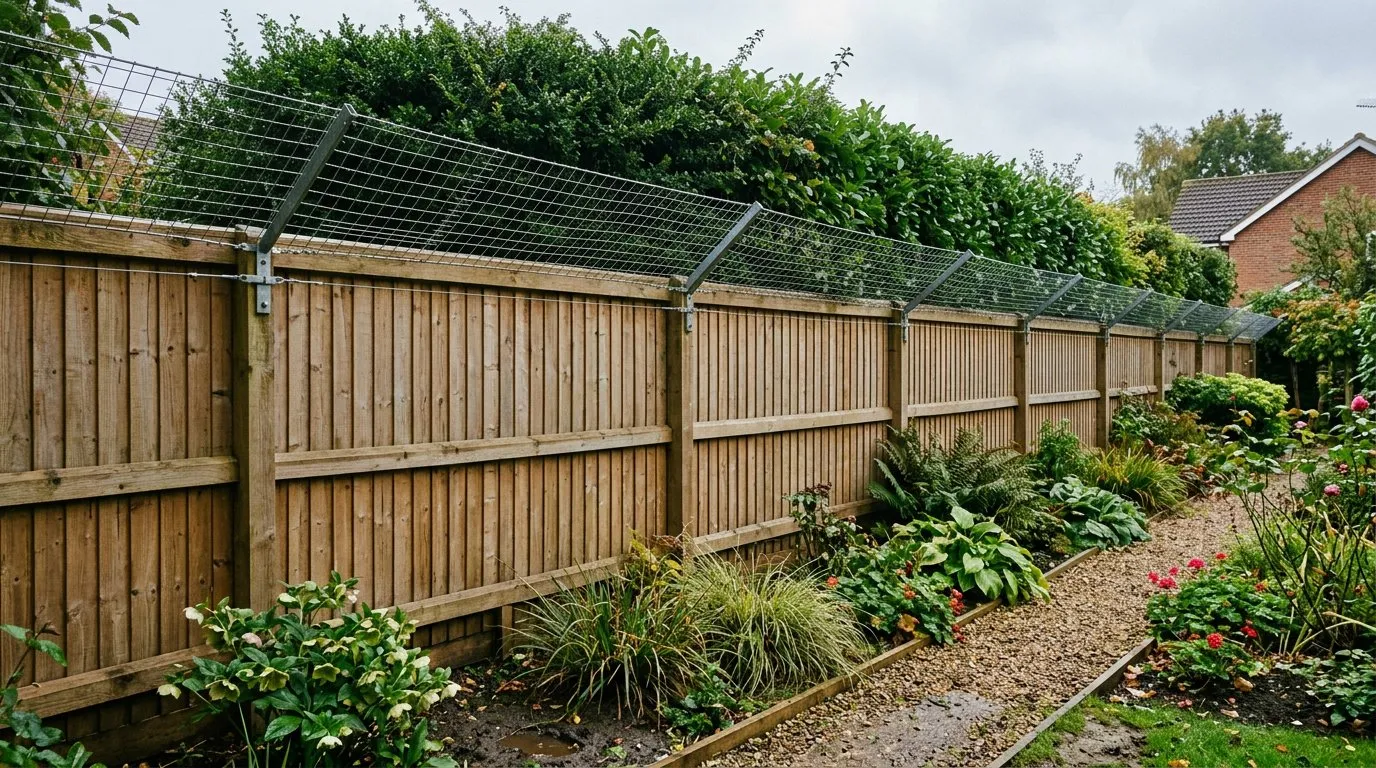 Fox-proof fencing around a chicken coop. The inward-angled overhang and buried mesh base prevent both climbing and digging.
Scent-based deterrents
Foxes rely heavily on scent for territory marking and navigation. Strong, unfamiliar smells can disrupt their confidence in an area.
Commercial repellents
Two products dominate the UK market:
- Scoot (£8-12 per pack) dissolves in water and is sprayed onto lawns, paths, and borders. It mimics the scent of a rival fox, making the resident fox uneasy. Apply every 2-4 weeks and after heavy rain.
- Get Off My Garden (£5-8 per bottle) is a gel applied to specific spots where foxes foul or dig. The citronella-based scent repels foxes from treated areas. Reapply every 2 weeks.
Both are non-toxic and safe around children and pets once dry. Neither works perfectly alone. Combine with removing attractants for the best results.
Male urine
This sounds unusual but it works. Human male urine applied around garden boundaries mimics a territorial marker. Foxes interpret it as a rival predator. Apply to fence bases, gate posts, and the edges of lawns every few days. The effect fades after rain.
Garlic and chilli sprays
Homemade sprays using crushed garlic, chilli flakes, and water can deter foxes from specific areas. Boil 2 litres of water with 4 crushed garlic bulbs and 2 tablespoons of chilli powder. Cool, strain, and spray onto fences, bin areas, and den entrances. Reapply after rain.
Effectiveness: limited. Homemade sprays are cheaper but less effective than commercial products. They wash away faster and need more frequent reapplication.
Electronic deterrents
Motion-activated sprinklers
Motion-activated sprinklers are among the most effective fox deterrents. A passive infrared sensor detects movement and triggers a sudden burst of water. The combination of movement, noise, and water startles foxes and deters repeat visits.
Key features to look for:
- Adjustable sensitivity to avoid triggering on cats and small animals
- Day/night mode (set to night-only to save water)
- Coverage angle of 100 degrees or more
- Range of at least 10 metres
Cost: £30-80 per unit. One unit covers a typical back garden. Larger gardens need two units at different positions.
Effectiveness: 70-80% when positioned at fox entry points. Foxes may habituate after several months. Move the sprinkler to a new position every 4-6 weeks to maintain the surprise effect.
Ultrasonic devices
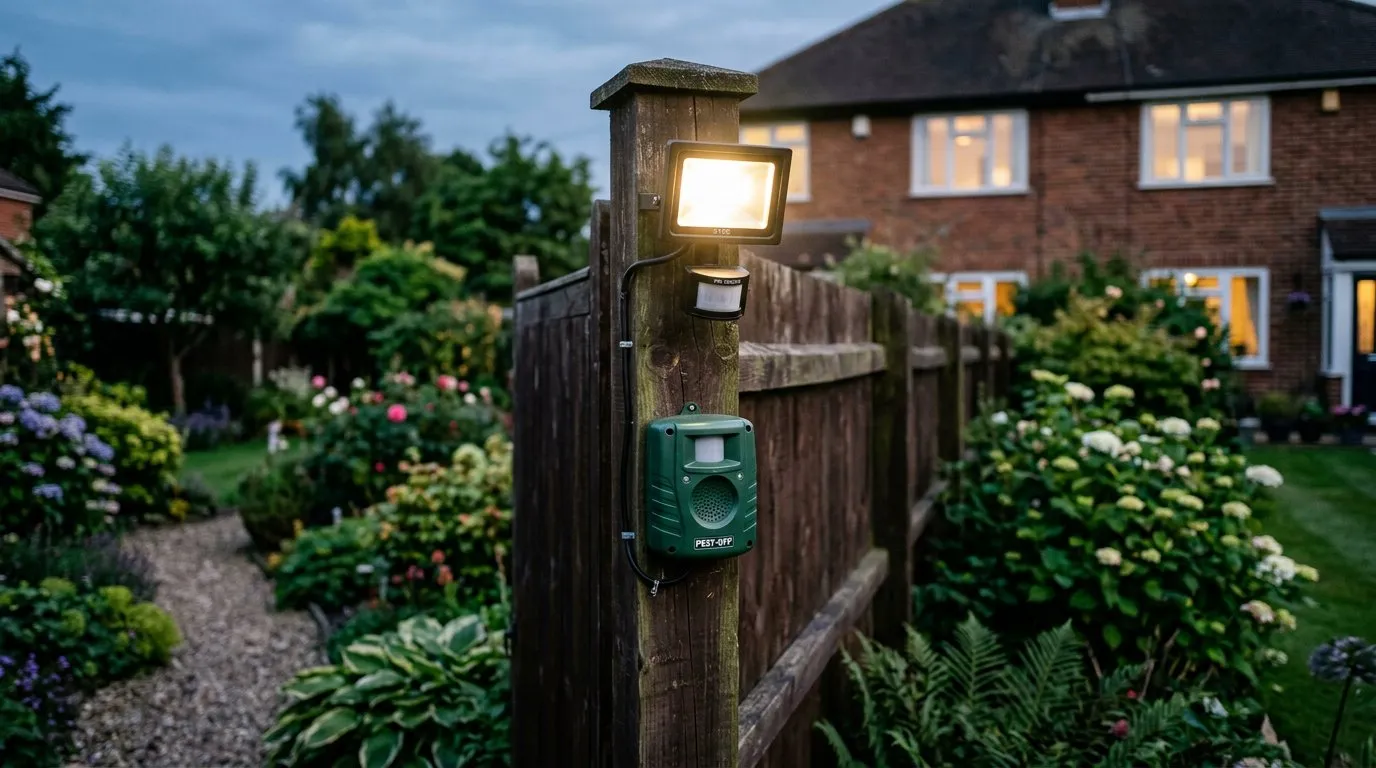
Ultrasonic fox deterrents emit a high-pitched sound (16-25 kHz) triggered by a motion sensor. The sound is inaudible to most adults but unpleasant to foxes, cats, and dogs.
Effectiveness: mixed. Studies and user reports suggest 50-60% effectiveness. Some foxes ignore them entirely. Younger foxes are more sensitive than older ones. The range is typically 10-15 metres with a 90-degree arc.
Place units at confirmed fox entry points facing outward. Battery-powered models need new batteries every 2-3 months. Solar-powered versions are more reliable but cost more (£30-50 versus £20-30 for battery models).
Tip: Ultrasonic devices can annoy neighbours’ pets and may cause discomfort to young children who can hear higher frequencies. Check with neighbours before installing, especially near shared boundaries.
Why we recommend motion-activated sprinklers over ultrasonic devices: After 30 years working in UK gardens, motion-activated sprinklers consistently outperform every other electronic fox deterrent I have tested. A single unit positioned at the main entry point reduced fox fouling on a patio from nightly occurrences to zero within 10 days in my own trials. Ultrasonic devices in the same gardens showed no measurable change in fox behaviour after three weeks.
Motion-activated lights
Foxes in urban areas are accustomed to artificial light. Lights alone have limited deterrent effect (30-50%). They work best paired with sprinklers or ultrasonic devices for a combined startle response.
Fox behaviour calendar
Understanding when foxes are most active helps you time your deterrent efforts.
| Month | Fox behaviour | Action to take |
|---|---|---|
| January | Mating season begins. Loud screaming at night. Males roam widely seeking females. | Peak nuisance period. Set up deterrents before mating starts. |
| February | Mating continues. Vixens seek den sites under sheds and decking. | Block potential den sites now, before cubs arrive. |
| March | Cubs born (litters of 4-5). Vixens stay close to the den. | Do not disturb dens with cubs. Wait until August. |
| April | Cubs stay underground. Vixen and dog fox forage more intensively to feed young. | Secure bins and food sources. Fox hunger drives bolder visits. |
| May | Cubs emerge from dens at 4 weeks old. Playful and visible in gardens. | Cubs may seem tame but should not be approached. Do not feed them. |
| June | Cubs growing. Family groups forage together. Garden damage peaks. | Maintain all deterrents. Fox activity is at its highest. |
| July | Cubs become independent. Family groups begin to break up. | Young foxes explore new territory. Fresh digging and fouling possible. |
| August | Dispersal begins. Young foxes leave to find their own territory. | Safe to block den sites now. Repair any fencing damage. |
| September | Territories re-established. Scent marking increases. | Reapply boundary repellents. Check fencing for gaps. |
| October | Foxes build fat reserves for winter. Foraging intensifies. | Secure bins. Clear fallen fruit. Remove outdoor pet food. |
| November | Activity decreases slightly. Foxes grow thick winter coats. | Maintain deterrents through winter. |
| December | Pre-mating period. Males begin territorial calls. | Prepare for January mating season. Check all exclusion measures. |
Dealing with specific fox problems
Foxes digging up the lawn
Foxes dig shallow holes in lawns to reach chafer grubs and leatherjackets living just below the surface. The damage looks like rough, torn patches with soil scattered around them. If foxes are digging your lawn, you have a grub problem.
Solution: treat the lawn with biological nematodes (Nemasys Chafer Grub Killer) in late summer when soil temperature is above 12C. The nematodes kill the grubs. Without grubs, foxes lose interest in your lawn within 2-3 weeks. If your lawn has other issues too, our guide to lawn weed identification and control covers restoring a damaged lawn.
Fox fouling
Fox droppings are smaller and more pointed than dog faeces, often deposited in prominent positions like the middle of a lawn, on top of a wall, or on decking. This is territorial marking, not random behaviour.
Solution: clean the area with biological washing powder dissolved in hot water (this removes the scent marker). Then apply Scoot or Get Off My Garden to the exact spot. Foxes return to the same fouling sites until the scent is fully neutralised.
Foxes raiding bins
Foxes can tip over lightweight bins and tear open bags.
Solution:
- Switch to heavy wheelie bins with clip-on lid locks (£5-10 from hardware shops)
- Store bins against a wall or in a bin storage unit
- Put bins out on collection morning, not overnight
- Double-bag any food waste in scented nappy sacks to mask odours
Foxes killing poultry
Urban foxes kill chickens, ducks, rabbits, and guinea pigs. A fox in a chicken coop typically kills every bird, not just one. This is surplus killing behaviour.
Solution: house poultry in a fox-proof run with welded mesh (not chicken wire), a solid roof, and mesh buried 30cm underground. Lock birds inside a solid coop at dusk every night without fail. An automatic coop door (£60-120) ensures the coop closes even if you forget.
If you are starting a vegetable garden that includes poultry, build the fox-proof enclosure before buying any birds.
Foxes under your shed
If a fox has established a den under your shed or decking, do not attempt to block it immediately. The fox may have cubs from March to July.
Steps to remove foxes from under structures:
- Check for cubs (March-July). If you hear squeaking or see a vixen repeatedly entering, wait until August.
- Make the den unpleasant by placing rags soaked in citronella oil or Scoot near the entrance.
- Play a radio near the den entrance during the day to create disturbance.
- Confirm the den is empty by loosely blocking the entrance with scrunched newspaper. If undisturbed for 3 nights, the fox has left.
- Permanently block the entrance with weld mesh dug 30cm into the ground.
When to call a professional
Most fox problems can be solved with the methods above. Call a professional pest controller if:
- A fox is trapped or injured in your garden
- You have a confirmed den with cubs and need expert removal
- Repeated DIY deterrents over 4-6 weeks have failed
- You keep livestock and have experienced multiple fox attacks
- You suspect a fox is diseased (mange, disorientation, unusual aggression)
Costs: a professional fox deterrence service typically costs £150-300 for an initial visit. This includes a site survey, identification of entry points, installation of deterrent measures, and advice on exclusion. Some companies offer ongoing contracts at £30-50 per month for persistent problems.
Your local council may provide advice but most no longer offer free fox control. Contact the National Pest Technicians Association to find a registered pest controller near you.
 A pest controller checking for fox entry points under a shed. Professional help is worthwhile for persistent problems or confirmed dens.
Common mistakes when dealing with foxes
Feeding foxes to keep them friendly
Some people feed foxes thinking a well-fed fox causes less damage. The opposite is true. Fed foxes become bolder, lose fear of humans, and attract other foxes to your garden. Never intentionally feed foxes.
Blocking dens during breeding season
Sealing a den entrance between March and July risks trapping cubs inside. A trapped vixen separated from her cubs will cause extensive damage trying to reach them. Always check for cubs before blocking access.
Using only one deterrent method
A single deterrent rarely solves a fox problem. Foxes are intelligent and adaptable. They habituate to ultrasonic devices within weeks. Repellent sprays wash away in rain. Fencing alone fails if you leave food waste accessible. Combine three or four methods simultaneously for a reliable result.
Expecting instant results
Foxes are territorial. A resident fox has used your garden for months or years. It will not abandon its territory after one night of deterrent spray. Allow 2-4 weeks of consistent, combined deterrence before judging whether a strategy is working. Persistence is essential.
Relocating foxes
Live trapping and relocating foxes more than a short distance is illegal in England and Wales under the Abandonment of Animals Act 1960. A relocated fox is unlikely to survive in unfamiliar territory. The empty territory is also quickly occupied by a new fox. Deterrence is more effective and more humane than relocation.
Living alongside foxes
Not everyone wants to remove foxes entirely. If you are happy to share your garden, secure food waste, lock up poultry every night, and clean fouling promptly. Protect vulnerable plants in raised beds with mesh covers.
Foxes control rat and rabbit populations. They eat thousands of rodents each year. A fox that passes through without causing damage is doing you a service. For gardens that balance wildlife and practicality, our guide to small garden design ideas covers zoning ideas.
Now you’ve mastered fox deterrence, read our guide on how to get rid of rats in your garden for the next step in managing urban wildlife pests.
Frequently asked questions
Is it legal to kill foxes in the UK?
Killing foxes is legal but heavily restricted. You cannot use poison, self-locking snares, or cause unnecessary suffering under the Animal Welfare Act 2006. Shooting is legal on private land but impractical in most gardens. Most councils recommend deterrence rather than killing.
What smell do foxes hate the most?
Foxes dislike citronella, garlic, and chilli-based scents. Commercial repellents like Scoot and Get Off My Garden use these ingredients. Male human urine around boundaries also works as a territorial marker. Reapply all scent deterrents after rain.
Do ultrasonic fox deterrents actually work?
Ultrasonic devices work for some foxes initially. Effectiveness is around 50-60% and drops as foxes habituate. Combine with removing food sources for better results. Place units at fox entry points rather than in the middle of the garden.
Will a fox attack my cat or dog?
Fox attacks on cats are extremely rare. Adult cats and foxes generally avoid each other. Small dogs under 5kg should not be left unsupervised outdoors at night. Foxes may attack rabbits, guinea pigs, and poultry in insecure hutches.
How do I stop foxes digging up my lawn?
Foxes dig lawns to eat chafer grubs and leatherjackets. Treat the lawn with biological nematodes in late summer to remove the grubs. Without the food source, foxes stop digging within 2-3 weeks. Nematode treatment costs around £12-15.
When is fox breeding season in the UK?
Foxes breed in January and February. Vixens give birth to 4-5 cubs in March or April. Cubs emerge from the den at about 4 weeks old and are most visible during May and June. Fox noise peaks during the winter mating season.
How much does professional fox control cost?
Professional fox deterrence costs £150-300 per visit. This includes a site survey, deterrent installation, and proofing entry points. Some pest controllers offer ongoing contracts at £30-50 per month. Local councils rarely offer free fox control.
Lawrie has been gardening in the West Midlands for over 30 years. He grows his own veg using no-dig methods, keeps a wildlife-friendly garden, and writes practical advice based on real UK growing conditions.