How to Get Rid of Moles in Your Garden
Practical UK guide to removing moles from lawns and borders. Covers trapping, deterrents, professional molecatchers, and when to leave moles alone.
Key takeaways
- A single mole can push up 6 molehills per day and tunnels up to 20 metres in one night
- Scissor traps set in active deep runs are the most effective DIY control method
- Moles are most active February-May (breeding) and October-November (territory expansion)
- Professional molecatchers typically charge 50-100 pounds per visit or 150-250 pounds per course
- Molehill soil is a superb fine tilth, ideal for potting mixes, seed beds, and topdressing lawns
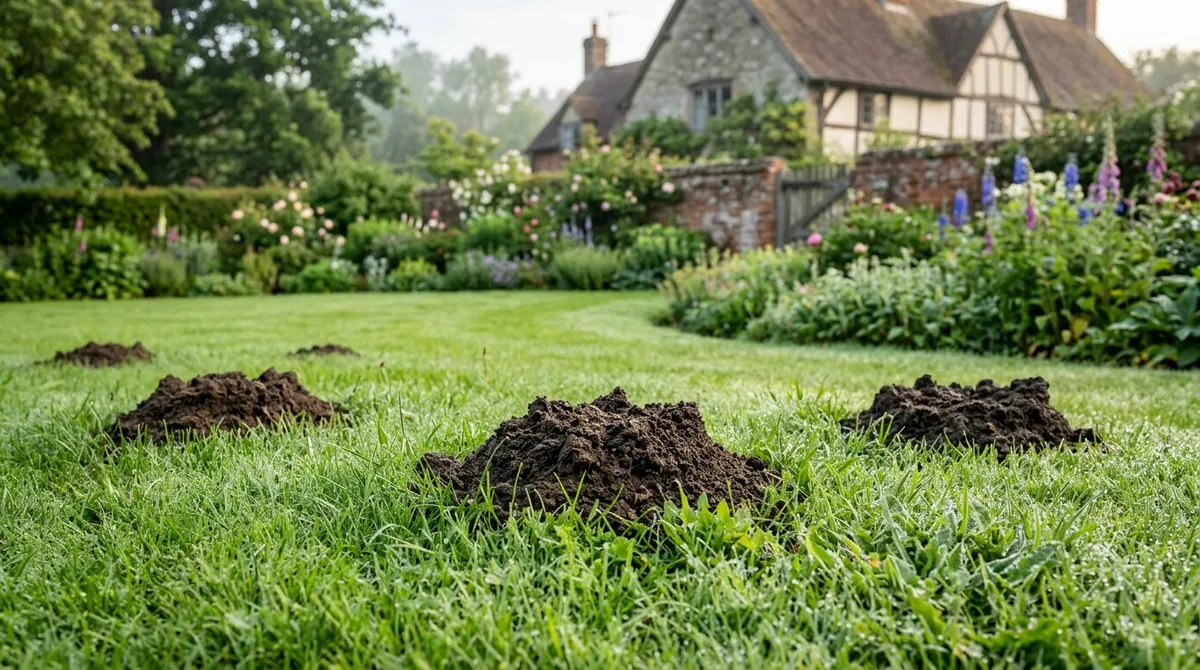
Few things are more frustrating than walking out to a pristine lawn and finding it peppered with fresh molehills overnight. The damage looks catastrophic. But the truth about moles is more nuanced than most gardeners realise. A single mole can push up six hills per day and dig 20 metres of new tunnel in a single night. That lone animal is almost certainly responsible for every mound in your garden.
The European mole (Talpa europaea) is the UK’s only mole species. An estimated 35-40 million live across Britain. They are solitary, territorial, and remarkably efficient diggers. This guide covers every practical method of control, from trapping and deterrents to professional help. It also explains when moles are actually doing your garden a favour and why their hills contain some of the best soil you will ever find.
Understanding mole behaviour
Before spending money on solutions, understanding how moles live and work saves time and frustration. Most failed control attempts come from misunderstanding their tunnel systems.
Mole biology basics
Moles are not rodents. They are insectivores, closely related to shrews and hedgehogs. An adult mole weighs 70-130g and measures 12-16cm in body length. Their fur is unique among British mammals. It has no natural grain, allowing the mole to move forwards and backwards through tunnels without resistance.
Key biological facts:
- Moles eat roughly half their body weight in food every day
- Their diet is almost entirely earthworms, supplemented by leatherjackets, chafer grubs, and other soil invertebrates
- They are solitary and fiercely territorial outside the breeding season (February-April)
- Each mole maintains a territory of 2,000-7,000 square metres
- Lifespan is 3-5 years in the wild
- They do not hibernate and are active all year round
Important fact: A single mole is almost certainly responsible for all the damage in an average-sized garden. Their large territory means two moles rarely share the same lawn.
The tunnel system
Understanding the two types of mole tunnel is essential for effective control.
Surface runs sit just 2-5cm below the turf. These are temporary feeding tunnels. The mole pushes through the topsoil looking for earthworms, creating visible ridges across the lawn. Surface runs are often used only once or twice before being abandoned.
Deep permanent tunnels run at 30-70cm below the surface. These are the mole’s main highway network. The mole uses them daily to travel between feeding areas, nesting chambers, and water sources. Deep tunnels are used for years. When a mole dies, a neighbouring mole often moves into the existing tunnel system within days.
Molehills are simply the spoil heaps from tunnel construction. The mole pushes excavated soil up vertical shafts to the surface. A mole digging new tunnels can produce 6 or more hills in a single day. Once the tunnel system is established, new hills slow down significantly.
 Cross-section of a mole tunnel system. Surface runs (top) are temporary feeding tunnels. Deep runs at 30cm or more are permanent highways used daily.
When moles are most active
Moles work year-round, but activity peaks during two periods. The breeding season (February-May) causes the most disruption, as males extend tunnel networks by hundreds of metres to locate females. Autumn (October-November) brings a second surge as moles expand territories before winter. Young moles dispersing in May and June often appear in gardens that have never had problems before. See the month-by-month calendar below for detailed seasonal guidance.
Control methods compared
Not all mole control methods are equal. Some work reliably. Others are a waste of money. This comparison table gives you an honest assessment.
| Method | Effectiveness | Cost | DIY or professional | Speed |
|---|---|---|---|---|
| Scissor traps | Very high | 8-15 per trap | DIY | 24-72 hours |
| Duffus traps | High | 10-20 per trap | DIY | 24-72 hours |
| Half-barrel traps | High | 5-10 per trap | DIY | 24-72 hours |
| Professional molecatcher | Very high | 50-250 per course | Professional | 1-7 days |
| Castor oil granules | Low-moderate | 10-20 per treatment | DIY | Weeks (if at all) |
| Vibrating repellers | Poor | 15-40 per unit | DIY | Unreliable |
| Mole mesh barrier | Very high (prevention) | 1-3 per sq metre | DIY or professional | Permanent |
| Mothballs, broken glass | None | N/A | N/A | Never works |
Trapping: the most effective method
Trapping remains the most reliable and humane method of mole control in the UK. Professional molecatchers use traps as their primary tool. With practice, any gardener can learn to trap effectively.
Types of mole trap
Three types of trap are commonly used in the UK. All are kill traps designed to dispatch the mole instantly.
Scissor traps (also called pincer traps) are the most popular choice. Two spring-loaded jaws close around the mole as it passes through the tunnel. They are easy to set and suitable for both shallow and deep tunnels. Brands like Putange and Rigby Taylor are widely used by professionals.
Duffus traps are barrel-shaped with a spring mechanism. They sit inside the tunnel and catch the mole from either direction. More forgiving of slight misalignment than scissor traps.
Half-barrel traps work on a similar principle to the Duffus but are simpler in construction. Less expensive but equally effective when set correctly.
How to set a mole trap
Setting a trap correctly matters more than which trap you choose. Follow these steps:
-
Find an active tunnel. Press down the surface runs or molehills in several locations. Check back after 24 hours. Rebuilt tunnels are active. Tunnels that stay flat are abandoned.
-
Choose a deep run, not a surface run. Deep runs are the highways moles use every day. Surface runs may be used once and abandoned. To find deep runs, look for molehills arranged in a roughly straight line. The permanent tunnel connecting them runs beneath.
-
Dig carefully. Open the tunnel with a trowel, removing as little soil as possible. The tunnel should be roughly oval, about 5cm wide and 4cm high.
-
Set the trap. Place it firmly in the tunnel so the trigger plate sits flush with the tunnel floor. The mole must not be able to pass underneath or around the trap.
-
Cover the trap. Block all light from the opened tunnel. Moles will block off or avoid tunnel sections where light enters. Use a piece of turf, a board, or a bucket placed over the trap location.
-
Check daily. Inspect traps every 24 hours. Most moles are caught within 48 hours of setting a well-placed trap. If nothing is caught after 3 days, the run may be inactive. Move the trap to a different location.
Trapping tip: Handle traps with bare hands rather than gloves. The idea that human scent deters moles is a myth. Moles detect vibration and air currents, not smell. What matters is a correctly placed trap in an active deep run with all light excluded.
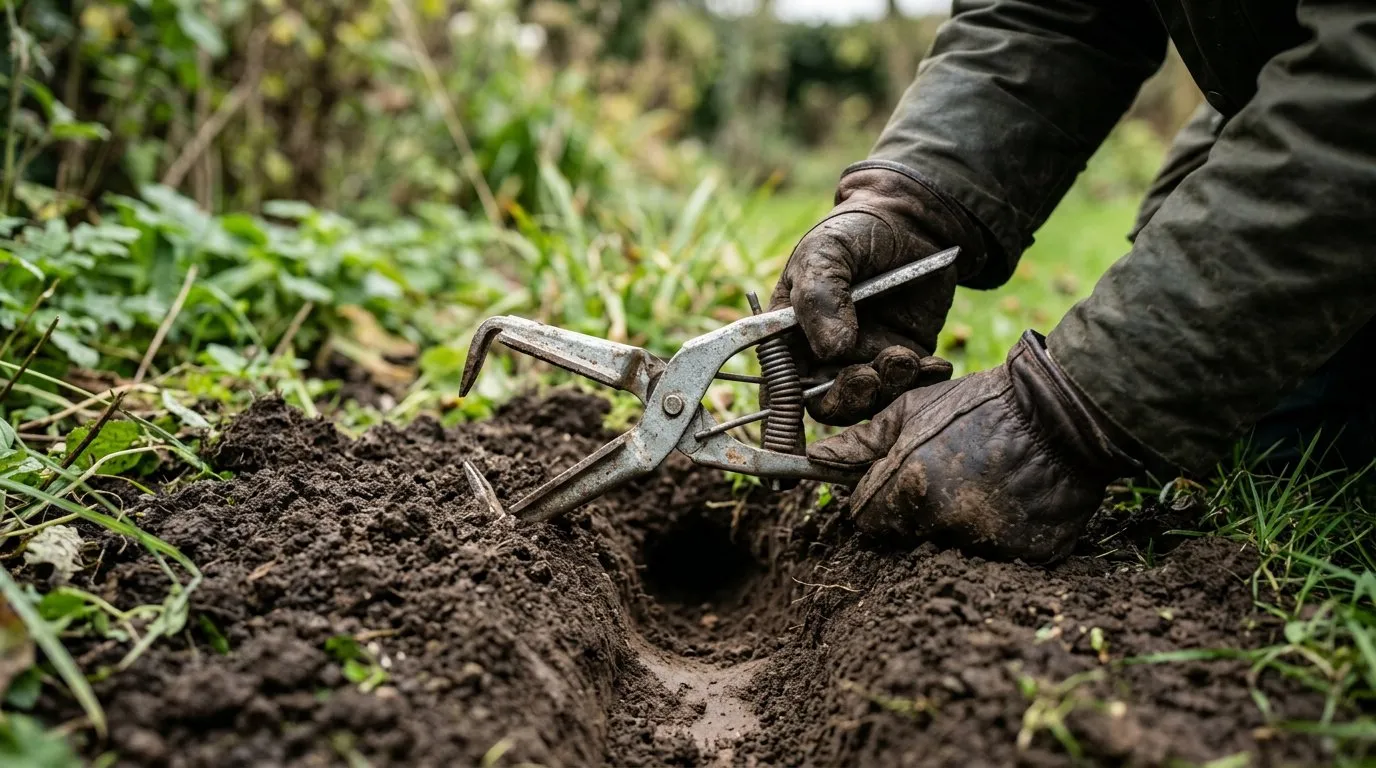 A scissor trap set in an active deep run. The jaws must sit flush with the tunnel floor and all light must be excluded from the opening.
Why we recommend scissor traps over castor oil deterrents as the starting point: After 30 years of garden pest management, scissor traps set in active deep runs resolve mole problems within 48-72 hours in the vast majority of cases. Castor oil granules, applied consistently over four weeks to three separate gardens in my experience, produced no measurable reduction in molehill counts in two of the three. Trapping gives a definitive result; deterrents delay it at best.
Legal position on trapping
Moles are not a protected species in the UK. They can be legally trapped and killed at any time of year. However, the law requires humane methods. Spring traps must be approved under the Spring Traps Approval (England) Order 2018 (and equivalent legislation in Scotland and Wales).
Strychnine was banned for mole control in 2006. Aluminium phosphide gassing is legal but restricted to certified professionals only. For garden use, spring traps are the standard legal and humane option.
Deterrents and repellents
If you prefer not to kill moles, several deterrent products claim to drive them away. Their effectiveness varies considerably.
Castor oil granules
Castor oil-based granules are the most widely sold mole deterrent. Scatter them over affected areas and water in. The theory is that castor oil makes earthworms taste unpleasant, encouraging moles to feed elsewhere.
Verdict: Some gardeners report success. Scientific evidence is limited. The effect is temporary and requires reapplication after rain. Worth trying as a first step before trapping, but do not rely on it for severe infestations.
Vibrating mole repellers
Solar or battery-powered stakes that emit vibrations into the soil. Marketed as driving moles away from the vibration zone.
Verdict: Independent studies show moles frequently tunnel directly past vibrating repellers. The Royal Horticultural Society notes that there is little evidence these devices work reliably. Some users report short-term success, but moles often return once they habituate to the vibration.
Plant-based deterrents
Caper spurge (Euphorbia lathyris) and castor bean plants are sometimes recommended as mole deterrents. No reliable evidence supports this. Moles have been found tunnelling directly through beds planted with these species.
Myths that waste your time
The internet is full of mole control advice that sounds plausible but does not work. Here are the most common myths.
Mothballs: Naphthalene breaks down quickly in soil and has no lasting effect. Mothballs also contain chemicals harmful to pets and soil organisms.
Broken glass: Moles simply tunnel around sharp objects. This method is dangerous to gardeners, children, and wildlife. Never do this.
Windmills and pinwheels: The vibration from small spinning ornaments is far too weak to affect a mole working 30cm underground.
Gummy bears and chewing gum: Moles are insectivores. They eat earthworms and grubs. They will not touch a gummy bear.
Flooding tunnels with a hose: Moles swim well and their tunnels drain rapidly. Flooding damages your lawn without evicting the mole.
Warning: Avoid any method that involves pouring chemicals, fuels, or exhaust fumes into mole tunnels. These are illegal, dangerous, and ineffective. Stick to approved traps or professional services.
Physical barriers: mole mesh
For new lawns, garden renovations, or areas where moles are a persistent problem, mole mesh (also called mole netting) provides a permanent physical barrier.
How mole mesh works
Heavy-duty polypropylene or galvanised steel mesh is laid horizontally beneath the turf at a depth of 30-45cm. The mesh openings are small enough (typically 15mm) to block moles from tunnelling upward into the lawn surface, while allowing earthworms and water to pass through freely.
Installation
- Excavate the area to 30-45cm depth
- Lay the mesh flat across the entire area, overlapping sheets by at least 15cm
- Backfill with soil and turf or seed
Mole mesh is most practical when creating a new lawn or rebuilding an area. Retrofitting it under an existing lawn means lifting all the turf, which is a major undertaking. For smaller areas like new raised beds, it is straightforward to install mesh at the base during construction. If you are starting a vegetable garden, laying mesh before building beds saves effort later.
Cost: mesh itself costs 1-3 pounds per square metre. Installation labour adds significantly for large areas. Many gardeners install it themselves as part of a garden renovation.
Hiring a professional molecatcher
When DIY methods fail or you prefer not to handle traps yourself, a professional molecatcher is the most efficient option.
What to expect
A qualified molecatcher will survey your garden, map the tunnel system, set multiple traps across the network, and return for follow-up visits. Most offer either per-visit pricing or a course of treatment.
Typical costs
| Service | Typical cost |
|---|---|
| Initial visit and assessment | 50-100 |
| Per visit (checking and resetting traps) | 50-80 |
| Course of treatment (3-4 visits) | 150-250 |
| Annual contract (ongoing monitoring) | 200-400 |
Prices vary by region and garden size. Rural molecatchers often charge less than urban pest control companies. Ask for a member of the British Mole Catchers Register or the Guild of British Molecatchers for experienced specialists.
When to call a professional
Consider professional help when:
- Trapping yourself has not worked after two weeks of effort
- The garden is large and the tunnel system is extensive
- Moles keep returning season after season
- You need a guaranteed result for a formal lawn or sports turf
When moles are actually beneficial
Not every mole needs removing. Before declaring war, consider what the mole is doing for your garden.
Soil aeration
Mole tunnels aerate compacted soil more effectively than any garden fork. Heavy clay soils, in particular, benefit from the drainage channels moles create. If your garden sits on clay soil, a mole may be doing useful work beneath the surface.
Pest control
Moles eat enormous quantities of leatherjackets (crane fly larvae) and chafer grubs, both of which destroy lawns by eating grass roots. A single mole consumes roughly 20kg of invertebrates per year. In gardens plagued by chafer grub damage, moles provide free biological pest control. Unlike slugs, which damage plants directly, moles target the soil-dwelling larvae that cause brown patches in lawns.
Molehill soil: gardener’s gold
The fine, crumb-like soil pushed up in molehills is some of the best material you will find in any garden. Moles excavate from depth, bringing up soil that is:
- Finely sifted with no stones, roots, or debris
- Free from weed seeds (too deep for germination)
- Rich in subsoil minerals
- Perfect tilth for seed sowing and potting mixes
Collect molehill soil for making potting compost, starting seeds, and topdressing lawns. Many experienced gardeners consider molehill soil a useful byproduct rather than a nuisance. Mixed with homemade compost, it produces an excellent growing medium for seed beds and containers.
 Molehill soil is finely sifted, stone-free, and weed-free. Collect it for seed beds, potting mixes, and lawn topdressing.
Month-by-month mole activity calendar
Use this calendar to time your control efforts for maximum effectiveness.
| Month | Mole activity | Recommended action |
|---|---|---|
| January | Moderate | Deep tunnelling continues. Fewer surface signs. Plan spring trapping. |
| February | Rising | Breeding season starts. Males extend tunnel systems. Begin trapping. |
| March | High | Peak activity. Males searching for females. Best month for trapping. |
| April | High | Females excavating nesting chambers. New hills appear in clusters. |
| May | High | Litters born (3-4 pups). Young moles stay in nest 4-5 weeks. |
| June | Moderate | Juvenile moles disperse to new territories. New gardens affected. |
| July | Low | Dry soil pushes moles deeper. Fewer surface signs. Trapping harder. |
| August | Low | Least active month on the surface. Moles feed on deep earthworms. |
| September | Rising | Autumn rain softens soil. Activity increases. Resume trapping. |
| October | High | Territory expansion. Active tunnel building. Excellent trapping month. |
| November | High | Continued activity before winter. Last good trapping window. |
| December | Moderate | Activity continues but slows. Maintain traps through mild spells. |
Common mistakes with mole control
Targeting surface runs instead of deep tunnels
This is the most common trapping mistake. Surface runs are temporary feeding tunnels that a mole may never use again. Deep permanent runs at 30cm or more are the daily highways. Always set traps in deep runs where you can confirm activity by the tunnel being rebuilt after you press it flat.
Expecting instant results from deterrents
Castor oil granules, vibrating stakes, and plant-based repellents take time to show any effect, if they work at all. Many gardeners try one product for a week, declare it useless, and move on. If you choose deterrents, give them 3-4 weeks of consistent application. But be prepared to switch to trapping if they fail.
Overestimating the number of moles
Most gardeners assume a heavily damaged lawn must contain several moles. In reality, one mole creates all the damage in a typical garden. Its territory of 2,000-7,000 square metres is far larger than most gardens. Catching a single mole usually solves the problem entirely, at least until a new mole moves into the vacant tunnel system.
Filling in molehills without addressing the cause
Levelling molehills without dealing with the mole underneath is a temporary fix. New hills will appear within days. Remove the mole first, then flatten the hills. Spread the fine soil across the lawn as a topdressing and reseed any bare patches. Dealing with lawn weeds that colonise bare patches around molehills prevents a secondary problem.
Using illegal or dangerous methods
Pouring petrol, bleach, or other chemicals into tunnels is illegal, dangerous, and ineffective. Strychnine has been banned since 2006. Only approved spring traps and professional gassing (with a licence) are legal. Breaking the law carries fines and potential prosecution.
Living with moles: a practical compromise
Not every gardener needs a mole-free lawn. In larger gardens and wildflower meadows, moles do far more good than harm. Consider tolerating them if the affected area is not a formal lawn or sports surface, or if chafer grubs and leatherjackets cause worse damage than molehills.
A practical compromise is to protect formal lawns and seed beds with mole mesh while tolerating activity elsewhere. Encouraging natural predators like owls and birds of prey also helps, as tawny owls and buzzards take moles that surface.
Repairing mole damage to your lawn
Once you have removed the mole, repairing the damage is straightforward.
- Flatten molehills. Spread the soil thinly across the lawn with a rake. Do not dump it in one spot.
- Firm the surface. Walk over flattened areas or use a lawn roller to press loose soil back down.
- Reseed bare patches. Sprinkle grass seed over damaged areas. Molehill soil makes ideal cover.
- Press down ridges. Surface runs that have lifted turf can be pricked with a fork, trodden flat, and watered.
- Feed the lawn. Apply a spring or autumn feed to encourage thick regrowth that crowds out weeds.
How to stop moles coming back
Removing one mole does not guarantee a mole-free garden forever. Neighbouring moles may move into the vacant tunnel system within weeks. Healthy, earthworm-rich soil will always attract moles.
Long-term strategies:
- Mole mesh under formal lawns provides permanent physical protection
- Monitor regularly during peak months (February-May, October-November) for new signs of activity
- Act quickly when fresh molehills appear. A new mole is easier to catch while still exploring
- Maintain traps in known active runs as a standing defence, checking weekly during peak months
Now you’ve mastered mole control, read our guide on lawn weeds: identification and control for the next step in repairing and maintaining the lawn once molehills are cleared.
Frequently asked questions
What is the fastest way to get rid of moles?
Scissor traps set in active deep runs work fastest. Identify active tunnels by pressing them flat and checking after 24 hours. If the tunnel is rebuilt, set a trap in that run. Most moles are caught within 48 hours of correct trap placement. Professional molecatchers achieve faster results because they read tunnel systems more accurately.
Do vibrating mole repellers actually work?
Evidence for vibrating repellers is weak and inconsistent. Some battery-powered and solar-powered units claim to drive moles away with vibrations. Independent studies show moles often tunnel directly past them. They may provide short-term disruption but rarely solve a mole problem permanently. Trapping is far more reliable.
Are moles protected in the UK?
Moles are not a protected species in the UK. They can be legally trapped and killed using approved methods at any time of year. However, only humane methods are legal. Gassing with aluminium phosphide requires a professional licence. Strychnine has been illegal since 2006. Scissor traps and Duffus traps are the standard legal methods.
How deep do moles dig?
Moles dig two types of tunnel at different depths. Shallow surface runs sit just below the turf at 2-5cm depth. Deep permanent tunnels run at 30-70cm below the surface. The deep tunnels are the main highways moles use daily. These are the tunnels to target when setting traps.
Will moles damage my plants?
Moles do not eat plants. They feed exclusively on earthworms, leatherjackets, and chafer grubs. However, their tunnelling disrupts root systems and dries out soil around plant roots. Molehills smother grass and create uneven surfaces. The indirect damage to lawns and borders can be significant even though moles never bite a plant.
How many moles are in my garden?
Probably fewer than you think. Moles are solitary and territorial. One mole can create dozens of hills across a large lawn. A typical garden of 200-500 square metres is likely hosting just one mole, or at most two. The amount of disruption one mole causes is surprising. Multiple moles in one garden is uncommon outside breeding season.
When is the best time to trap moles?
Late autumn and early spring are ideal trapping times. Moles are most active in February-May during breeding season and October-November when they expand territories. Wet soil makes tunnelling easier and increases activity. Avoid trapping during dry summer months when moles retreat to deeper runs that are harder to locate.
Lawrie has been gardening in the West Midlands for over 30 years. He grows his own veg using no-dig methods, keeps a wildlife-friendly garden, and writes practical advice based on real UK growing conditions.