How to Get Rid of Pigeons in a Garden
Proven methods to deter pigeons from UK gardens. Covers netting, spikes, decoys, ultrasonic devices, and the law on pigeon control.
Key takeaways
- The UK has an estimated 18 million feral pigeons, with populations growing 5-10% annually
- Bird netting is 95% effective and costs £2-5 per square metre for a standard vegetable patch
- Pigeon spikes prevent roosting on fences and walls at a cost of £3-8 per 30cm strip
- Pigeons are protected under the Wildlife and Countryside Act 1981 and cannot be killed without a licence
- Motion-activated sprinklers deter pigeons with 70-80% effectiveness from open garden areas
- Pigeons eat brassica seedlings, peas, lettuce, and soft fruit, causing up to 90% crop loss if unprotected
Pigeons are the most destructive bird in British gardens. They strip brassicas to bare stalks, demolish pea shoots overnight, and foul every surface they roost on. The UK’s feral pigeon population stands at an estimated 18 million birds, concentrated in towns and cities but increasingly a problem in suburban and rural gardens. Unlike most garden birds, pigeons feed in flocks. A single visit from 10-15 pigeons can destroy a row of cabbages in an afternoon.
The challenge with pigeon control is legal as well as practical. Pigeons are protected under the Wildlife and Countryside Act 1981, meaning you cannot simply trap or kill them without meeting specific conditions. This guide covers every legal and effective method to deter pigeons from your garden, protect your crops, and stop them roosting on buildings and fences.
Why pigeons target gardens
Feral pigeons (Columba livia domestica) are descended from rock doves. They are grain and seed eaters by preference but have adapted to eat a wide range of garden plants. Wood pigeons (Columba palumbus), larger and more common in rural areas, cause even more crop damage.
What pigeons eat in gardens
Pigeons target soft, accessible plant material. Their feeding causes distinctive damage that is easy to recognise.
| Crop | Type of damage | Severity | Season |
|---|---|---|---|
| Brassicas (cabbage, broccoli, kale) | Stripped leaves, bare midribs only | Very high | Year-round |
| Peas and beans | Shoots and leaves eaten, flowers pecked | High | April-August |
| Lettuce and salad leaves | Seedlings eaten whole, older leaves shredded | High | March-October |
| Soft fruit (cherries, blueberries) | Fruit pecked and eaten | Moderate-high | June-September |
| Newly sown seed | Seeds eaten from the soil surface | Moderate | Spring and autumn |
| Beet and chard | Young leaves eaten | Moderate | April-October |
A single pigeon consumes 30-50g of plant material per day. In winter, when wild food is scarce, they rely more heavily on gardens. An unprotected brassica bed can suffer 90% crop loss within a week once a flock discovers it. Protect your runner beans and peas with netting from the moment seedlings emerge.
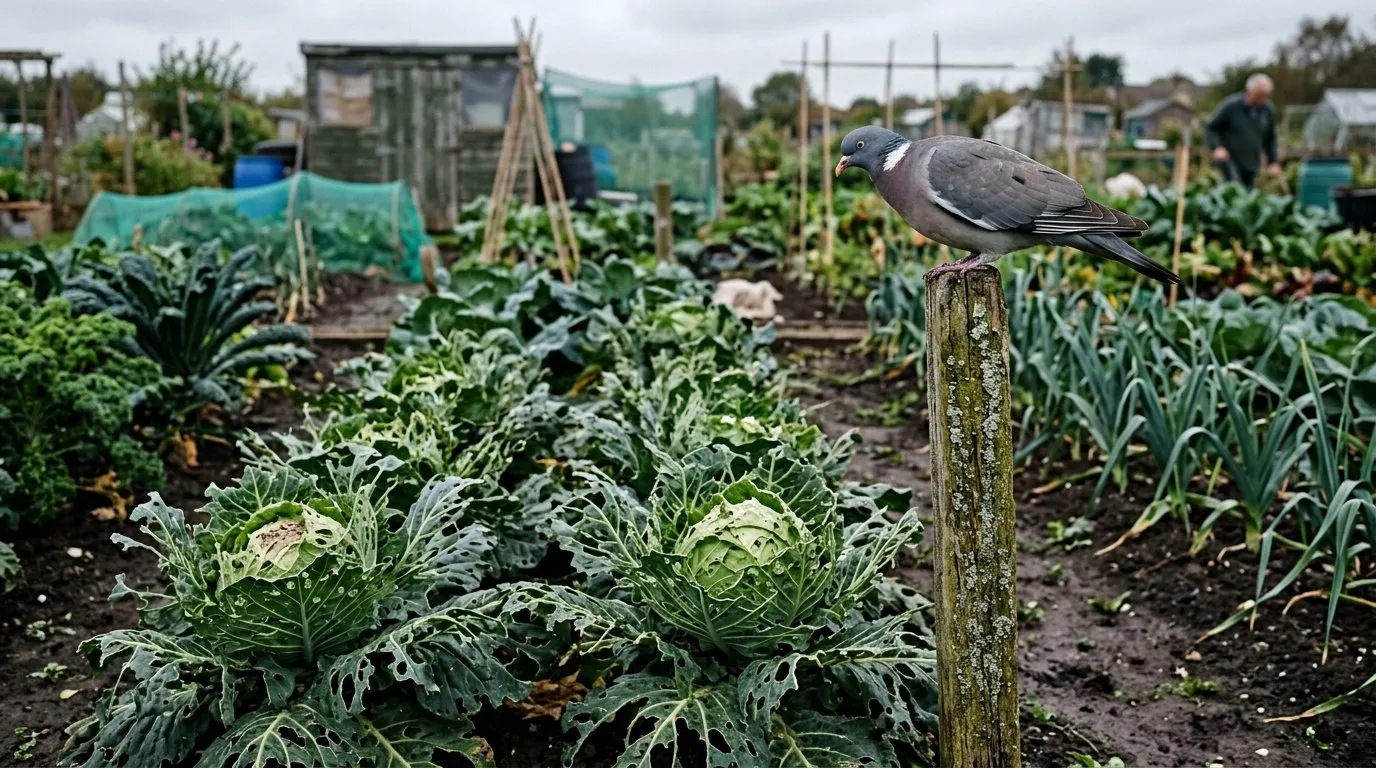
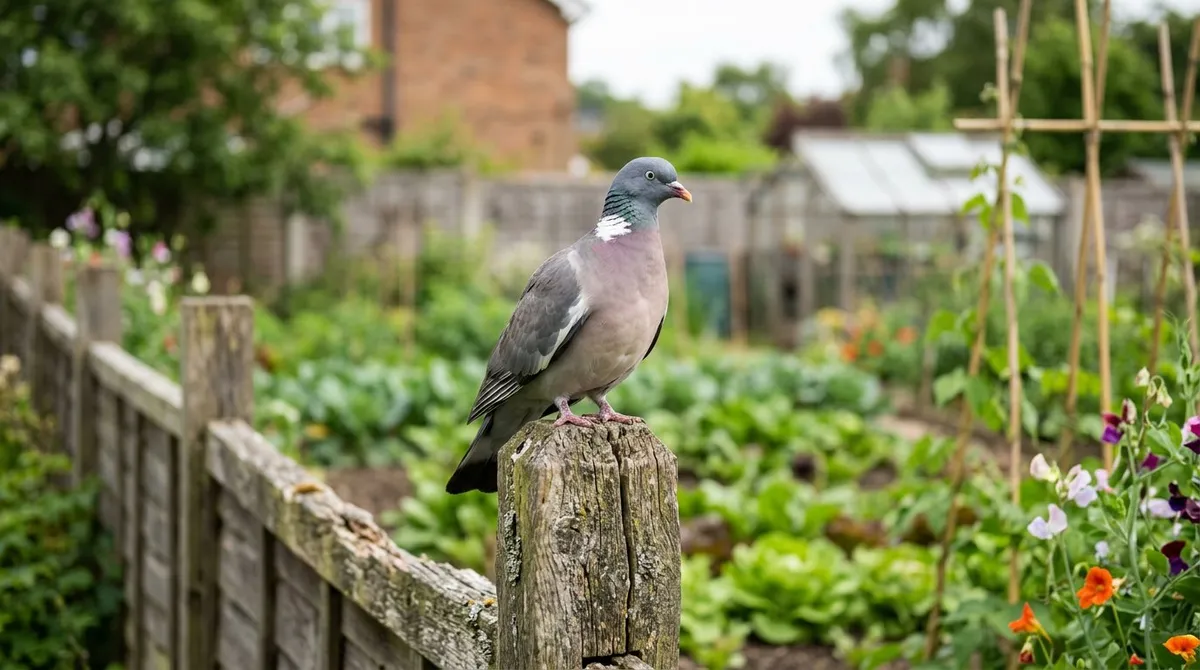
A wood pigeon surveys brassica crops at a UK allotment — unprotected cabbages are an easy target for hungry flocks.
Roosting and fouling
Pigeons roost on fences, walls, shed roofs, pergolas, and any flat elevated surface. Their droppings are highly acidic (pH 3-4.5) and cause real damage over time.
Pigeon droppings stain and etch natural stone, concrete, and painted surfaces. They corrode metal guttering and fixings. Accumulated droppings block gutters and downpipes. The droppings also create a slip hazard on paths and patios when wet.
Warning: Pigeon droppings carry diseases including psittacosis, salmonella, and cryptococcosis. Always wear disposable gloves and a dust mask when cleaning pigeon fouling. Never sweep dry droppings as this creates airborne dust containing fungal spores. Wet the area first, then scrub with a disinfectant solution.
The law on pigeon control in the UK
This is the area where most gardeners get confused. All wild birds in the UK are protected under the Wildlife and Countryside Act 1981. This includes feral pigeons and wood pigeons.
What the law says
It is illegal to intentionally kill, injure, or take any wild bird, or destroy or take its eggs or nest while in use, except under licence. The General Licences issued by the relevant authority in each country permit lethal control in specific circumstances.
| Country | Licensing authority | Relevant licence | Conditions |
|---|---|---|---|
| England | Natural England | GL42 (conservation), GL43 (public health) | Must show non-lethal methods tried first |
| Scotland | NatureScot | GL01, GL02, GL03 | Specific conditions per licence type |
| Wales | Natural Resources Wales | GL004 | Preventing serious damage to crops |
| Northern Ireland | NIEA | General Licence | Preventing damage to crops and livestock feed |
What you can do legally
Without a licence: Install netting, spikes, deterrent gel, tensioned wire, decoys, motion-activated devices, reflective tape, and any physical barrier. Remove food sources. Block access to roosting and nesting sites (but not while a nest is in active use with eggs or chicks).
Under General Licence: In England, you may kill feral pigeons and wood pigeons using permitted methods (shooting with an air rifle or shotgun) if you can demonstrate that non-lethal methods have been tried and failed, and the action is necessary to prevent serious damage to crops or for public health. You must comply with all licence conditions.
Gardener’s tip: For most garden situations, physical barriers are cheaper, more effective, and legally straightforward. Lethal control is rarely necessary or practical in a residential garden. The RSPB provides clear guidance on the law regarding bird control.
Bird netting for crop protection
Bird netting is the single most effective pigeon deterrent for vegetable gardens. It creates a physical barrier that pigeons cannot penetrate.
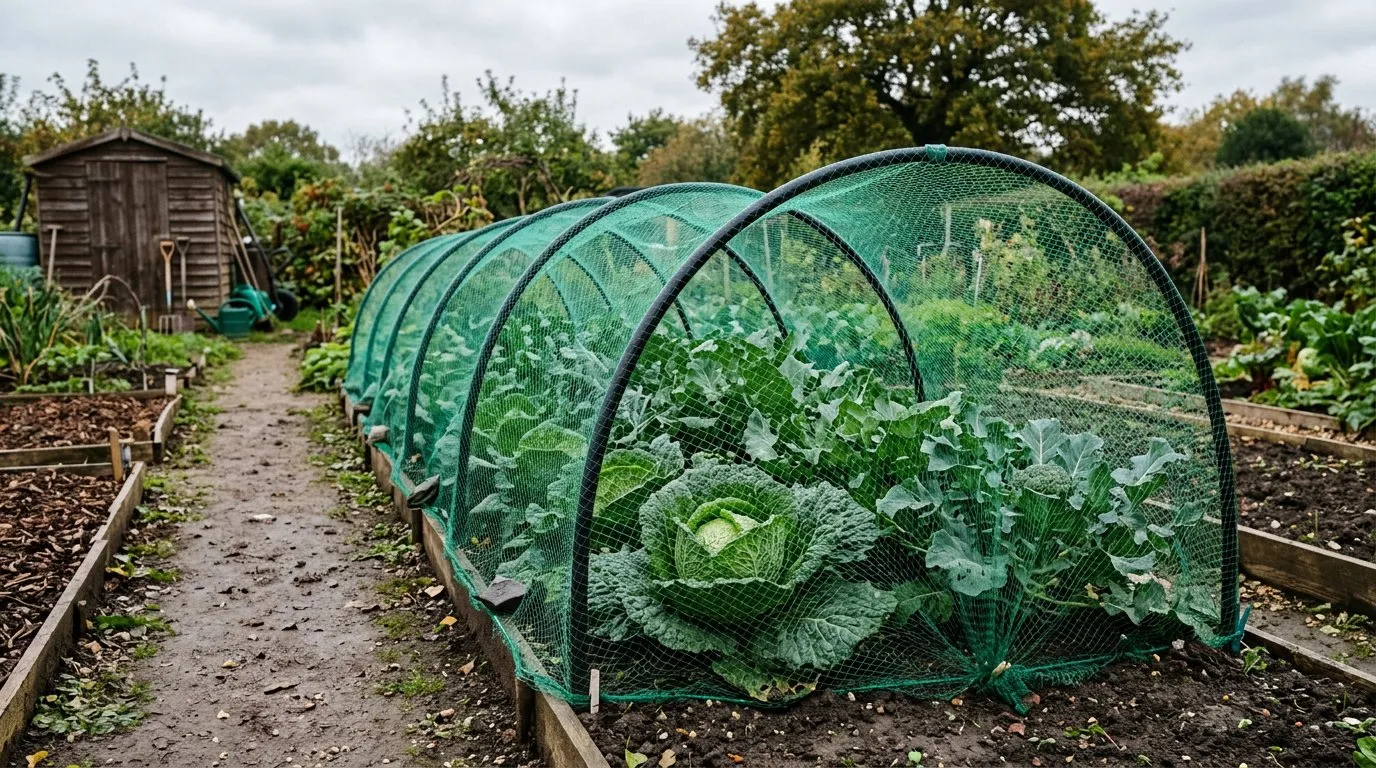
Green netting supported on hoops protects brassicas from pigeon damage in a UK vegetable garden.
Why we recommend knotted nylon netting over woven polyethylene for permanent beds: After 30 years of protecting brassica crops and soft fruit in UK gardens, knotted nylon netting consistently outperforms cheaper polyethylene alternatives in longevity. UV degradation destroys woven polyethylene netting within 2-3 seasons, while knotted nylon over the same beds remains effective for 7-10 years. Over a decade the cost-per-year works out at roughly a third of replacing budget netting every other season.
Choosing the right netting
Use 50mm mesh netting for pigeons. Smaller mesh (such as 20mm butterfly netting) also works but reduces airflow and light. Larger mesh allows pigeons to push their heads through and peck at leaves.
Knotted nylon netting lasts 5-10 years and costs £2-5 per square metre. Woven polyethylene netting is cheaper but degrades in UV light after 2-3 seasons. For permanent structures, invest in UV-stabilised netting.
Building a netting frame
Draping netting directly over crops is a mistake. Pigeons sit on top and peck through. The netting must be held at least 30cm above the crop canopy.
For temporary beds: Push 2m bamboo canes into the soil every 1.5m along the bed. Connect them with horizontal canes or string at the top. Drape netting over the frame and secure at ground level with U-shaped wire pegs or bricks.
For permanent beds: Build a timber or metal frame. A 1.2m tall cage suits most brassicas and allows easy access through a hinged panel. Use metal brackets and screws for durability. Staple the netting to the frame rather than tying it.
Critical: Secure netting at ground level with no gaps larger than 50mm. Pigeons will walk under loose netting. Bury the base edge in a shallow trench or weight it with timber battens.
Netting over fruit
Fruit cages are essential for blueberries, cherries, and currants. Standard fruit cage dimensions are 1.8m tall with a top net that can be rolled back when access is needed. Use side netting year-round and top netting from May to September during the fruiting season.
Anti-roosting spikes and deterrents
Pigeon spikes prevent birds from landing on flat surfaces. They are the standard commercial solution for buildings and work equally well on garden walls, fences, and shed ridges.
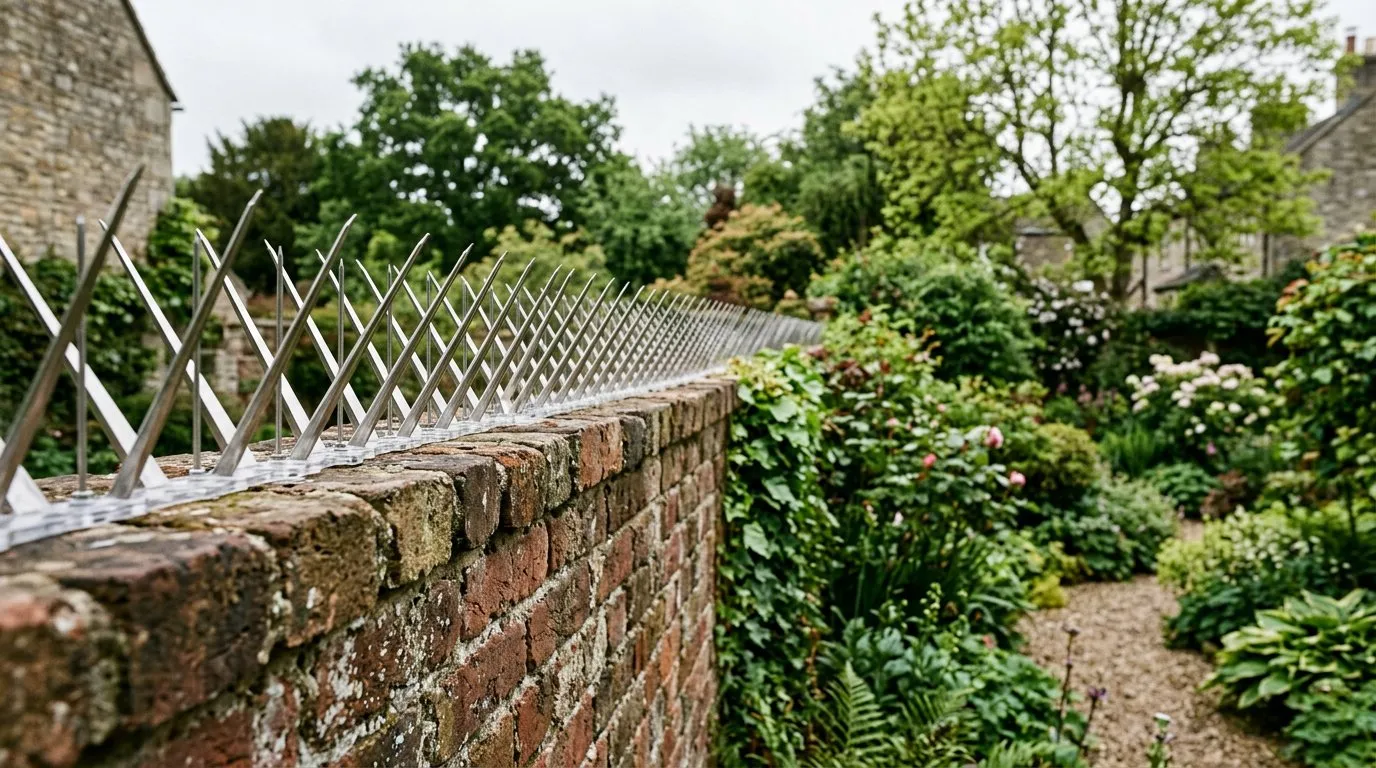
Metal anti-pigeon spikes along a brick garden wall — an effective, long-lasting roosting deterrent.
Pigeon spikes
Stainless steel spikes are the most durable option. They last 10+ years and withstand all weather. Each 30cm strip costs £3-8 depending on quality. Polycarbonate spikes are cheaper (£2-4 per strip) but become brittle after 3-5 years in UV light.
Install spikes using silicone adhesive or screws. Cover the full width of the surface. Pigeons will land on any unprotected section, even a gap of 10cm.
Bird deterrent gel
Optical gel discs create a visual and tactile deterrent. Pigeons perceive the gel as fire due to its UV reflective properties. Each disc covers approximately 20cm and costs £1-3. Apply to clean, dry surfaces. Effective for 2-3 years before replacement.
Tensioned wire systems
A single stainless steel wire mounted on spring-loaded posts, 5cm above a flat surface, prevents pigeons from landing. The wire is nearly invisible from ground level. This is the preferred solution for listed buildings and situations where spikes look unsightly. Professional installation costs £20-40 per metre. DIY kits are available for £10-15 per 5m run.
Motion-activated deterrents
Electronic and mechanical devices work by startling pigeons. They are most effective in open garden areas where netting is impractical.
Motion-activated sprinklers
Infrared sensors detect pigeon movement and trigger a burst of water. The combination of sudden movement, noise, and water startles pigeons effectively. Set to day-only mode for pigeon problems (unlike fox deterrents, which need night mode).
Effectiveness: 70-80% initially. Pigeons may habituate after 4-6 weeks. Move the unit to a new position regularly. Cost: £30-80 per unit.
Reflective deterrents
Old CDs, reflective tape, and holographic bird scare strips create flashing light patterns that disorientate pigeons. Hang them on strings where they can spin freely. Effectiveness is moderate (40-60%) and drops as pigeons habituate. Use as a supplement to physical barriers, not as the sole deterrent.
Reflective pinwheel spinners combine movement and light reflection. Mount on canes throughout the vegetable garden. Cost: £5-15 for a pack of 10.
Decoy predators
Fake owls and hawk kites exploit pigeons’ fear of raptors. A static plastic owl deters pigeons for 3-7 days before they realise it is harmless. Decoys with moving heads or wings extend this to 2-3 weeks.
Hawk kites on telescopic poles are more effective because they move with the wind. They mimic a hovering bird of prey. Position 3-5m above the area you want to protect. Move the kite to a new position every 2-3 days.
Gardener’s tip: Combine a hawk kite with reflective spinners and netting for a three-layer approach. The kite deters pigeons from the area, the spinners disorientate any that approach, and the netting stops those that land. No single deterrent works perfectly alone.
Removing food and water sources
Reducing what attracts pigeons is as important as deterring them. A garden with no accessible food holds little interest.
Secure bird feeders. Pigeons dominate ground feeders and large platform feeders. Switch to caged feeders or tube feeders that exclude birds larger than a blue tit. Clean up spilled seed daily. Our lawn weed guide explains how scattered birdseed contributes to weed problems too.
Cover compost. Open compost bins with food scraps attract pigeons. Use a closed bin with a tight-fitting lid.
Harvest promptly. Ripe fruit left on trees and fallen windfall attract pigeons. Pick strawberries and cherries daily during the season. Clear windfalls within 24 hours.
Remove standing water. Bird baths provide drinking water for pigeon flocks. If pigeons are using your bird bath, bring it in for 2-3 weeks until the flock moves on, then reintroduce it.
Protecting specific crops from pigeons
Different crops need different protection strategies.
Brassicas
Brassicas are the top target. Pigeons eat the leaves of cabbage, broccoli, Brussels sprouts, kale, cauliflower, and sprouting broccoli. Winter brassicas are especially vulnerable because pigeons switch to them when other food sources dwindle.
Build a permanent netted cage over the brassica bed. Use 50mm mesh netting on a frame at least 1.2m tall. Secure at ground level. Leave the cage in place from planting to harvest. This is non-negotiable for reliable brassica growing in areas with pigeon pressure.
Peas and beans
Pigeons eat both the shoots and the flowers. Net rows of peas and beans from the moment they emerge. Use twiggy sticks pushed into the soil between plants as additional deterrents. Pigeons dislike landing among dense, unstable structures.
Newly sown seeds
Pigeons eat freshly sown pea, bean, and sweetcorn seeds directly from the soil surface. Cover newly sown rows with fleece or netting until seedlings are well established. Remove once plants are 10-15cm tall and less vulnerable.
Seasonal pigeon activity calendar
Pigeon behaviour changes through the year. Adjust your deterrent strategy accordingly.
| Month | Pigeon activity | Recommended action |
|---|---|---|
| January-February | Breeding begins, food scarce, heavy garden feeding | Net winter brassicas, secure all food sources |
| March-April | Nesting, eating newly sown seeds and seedlings | Cover seed beds with fleece, install netting on brassica beds |
| May-June | Feeding young, heavy demand for soft plant material | Maintain netting, check for gaps, protect soft fruit |
| July-August | Fledglings join flocks, peak numbers | Harvest promptly, check netting integrity, add decoys |
| September-October | Post-breeding moult, feeding on seeds and grain | Protect autumn-sown crops, maintain deterrents |
| November-December | Food scarce, pigeon flocks concentrate on gardens | Heaviest pressure on winter brassicas, full netting essential |
Common mistakes with pigeon deterrence
1. Relying on decoys alone. A plastic owl without any other deterrent stops working within a week. Pigeons are intelligent birds with excellent learning ability. They quickly identify static objects as harmless. Always combine decoys with physical barriers.
2. Leaving gaps in netting. A 50mm gap is enough for a pigeon to squeeze through. Secure netting at every point where it meets the ground, the frame, or another surface. Check for holes and tears monthly.
3. Feeding other birds at ground level. Ground feeders attract pigeons. Switch to caged hanging feeders that physically exclude pigeons while allowing smaller birds to feed.
4. Using ultrasonic devices as the sole deterrent. Pigeons hear in a similar range to humans. Most ultrasonic devices operate above their hearing threshold. The scientific evidence for ultrasonic bird deterrence is poor. Spend the money on netting instead.
5. Ignoring the problem until crops are damaged. Install protection before you plant, not after pigeons have found the food. Prevention is always more effective than trying to drive an established flock away from a known food source.
Now you’ve mastered pigeon deterrence, read our guide on how to get rid of foxes in your garden for the next step in protecting your crops and livestock from garden predators.
Frequently asked questions
Is it legal to kill pigeons in the UK?
You cannot kill pigeons without a General Licence. Feral pigeons are protected under the Wildlife and Countryside Act 1981. In England, Natural England issues General Licences (GL42 and GL43) that permit lethal control to prevent serious damage to crops or for public health. You must demonstrate that non-lethal methods have been tried first. Licences vary by country within the UK.
What is the best pigeon deterrent for a vegetable garden?
Bird netting over a frame is the most effective option. Use 50mm mesh netting draped over hoops or a cage frame at least 30cm above the crop. This stops pigeons landing on and eating plants while allowing rain, light, and pollinating insects through. Netting achieves 95% protection and costs £2-5 per square metre.
Do ultrasonic pigeon deterrents work?
Ultrasonic devices have limited effectiveness against pigeons. Pigeons hear in a similar frequency range to humans (20Hz-10kHz), so most ultrasonic devices operating above 15kHz are outside their hearing range. Some audible alarm-type devices work initially but pigeons habituate within 2-4 weeks. Physical barriers like netting are far more reliable.
Will a fake owl scare pigeons away?
A static fake owl works for 3-7 days before pigeons realise it is not real. Moving decoys with bobbing heads or rotating wings last slightly longer, up to 2-3 weeks. Move the decoy every 2-3 days and combine with other deterrents. Used alone, decoys are not a reliable long-term solution.
How do I stop pigeons sitting on my fence?
Install anti-roosting pigeon spikes along the top of the fence. Stainless steel spikes in 30cm strips cost £3-8 each and last 10+ years. For a more discreet option, use bird deterrent gel strips or tensioned wire 5cm above the fence top. Spring-loaded bird wire is nearly invisible and highly effective on flat surfaces.
What damage do pigeons cause in gardens?
Pigeons strip brassica leaves to bare stalks, eat pea and bean shoots, destroy lettuce seedlings, and peck soft fruit. A single pigeon eats 30-50g of plant material daily. A flock of 10 visiting your garden eats 300-500g per day. They also foul paths, patios, and garden furniture with acidic droppings that stain stone and corrode metal.
How do I protect my brassicas from pigeons?
Build a cage frame over the bed using 2m bamboo canes or metal hoops and cover with 50mm bird netting. Secure netting at ground level with pegs or buried edges. The cage must be tall enough that pigeons cannot peck through the netting onto leaves. For raised beds, a permanent frame with hinged access panels is the most practical option.
Do pigeons carry diseases?
Pigeons carry several diseases transmissible to humans. Psittacosis (chlamydia psittaci) causes flu-like symptoms and pneumonia. Salmonella and E. coli are present in pigeon droppings. Cryptococcosis, a fungal infection, grows in dried pigeon droppings. Always wear gloves and a dust mask when cleaning pigeon fouling. Wash hands thoroughly afterwards.
Lawrie has been gardening in the West Midlands for over 30 years. He grows his own veg using no-dig methods, keeps a wildlife-friendly garden, and writes practical advice based on real UK growing conditions.