How to Get Rid of Rats in Your Garden
A practical UK guide to getting rid of rats in your garden. Covers signs, traps, poison safety, rat-proofing compost bins, and when to call pest control.
Key takeaways
- The UK has an estimated 10.5 million brown rats, and numbers are rising in suburban gardens
- Rats produce 40-50 droppings per night, each 12-17mm long, dark, and tapered at the ends
- Snap traps placed along walls and runs are the safest DIY control method for gardens
- Rat poison must legally be placed in tamper-resistant bait stations to protect children and pets
- Professional pest control costs 100-250 pounds privately, but many UK councils offer free treatment
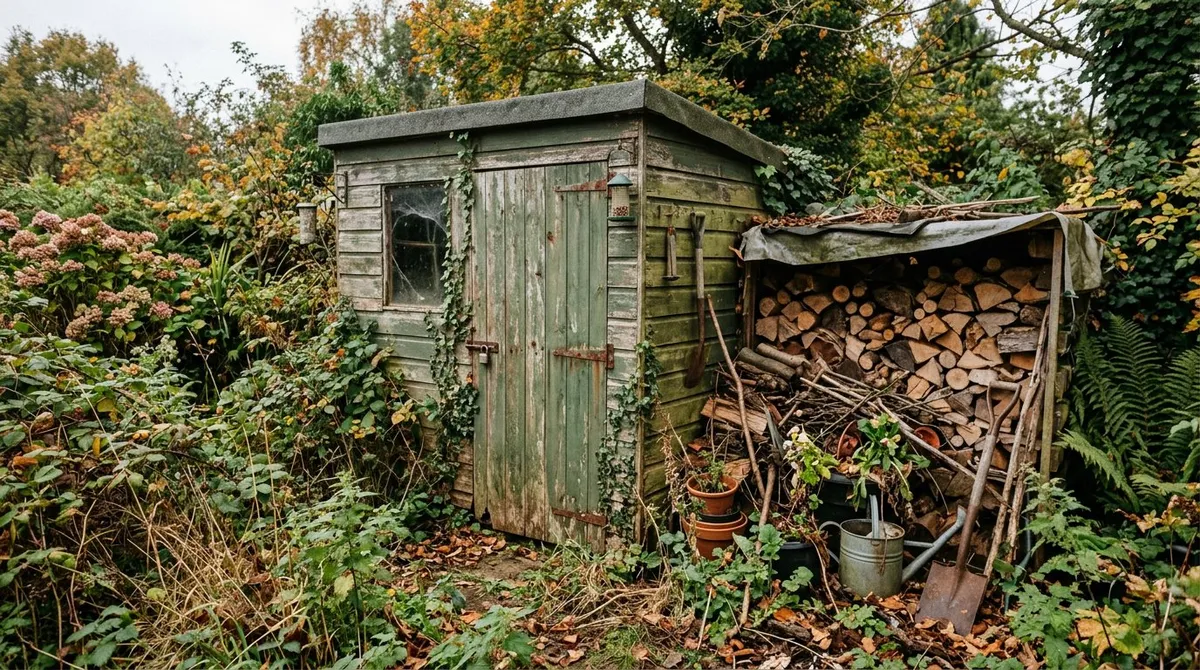
Finding rats in your garden is unsettling. Unlike the odd mouse, rats signal a persistent problem that will not resolve itself. The UK is home to an estimated 10.5 million brown rats (Rattus norvegicus), and populations have risen steadily in suburban gardens over the past decade. Milder winters, more bird feeding, and increased food waste have all contributed.
Rats are not just a nuisance. They carry Weil’s disease (leptospirosis), salmonella, and rat bite fever. They gnaw through cables, undermine foundations with their burrows, and contaminate stored food. Under the Prevention of Damage by Pests Act 1949, UK occupiers have a legal duty to report and control infestations. The BPCA rat control guide covers the legal framework in detail.
This guide explains how to identify a rat problem, choose the right control method, and prevent rats from returning. Browse our problems section for solutions to other garden pests and issues, including our guide to getting rid of ants.
Signs of rats in your garden
Rats are nocturnal. You will rarely see them unless the population is large. Instead, look for these telltale signs.
Droppings
Rat droppings are the most reliable evidence. Fresh droppings are dark, moist, and soft. Old ones are grey, dry, and crumbly. Brown rat droppings measure 12-17mm long, roughly the size of a large olive stone. They are tapered at both ends, unlike the blunt, rounded droppings of mice (3-6mm).
A single rat produces 40-50 droppings per night. Finding a cluster of droppings in one area indicates a regular feeding spot or run. Check along the base of fences, beside sheds, near compost bins, and under bird feeders.
Burrows
Brown rats dig burrow systems with entrances 6-9cm in diameter. Look for them along the base of walls, under sheds, beneath decking, and in compost heaps. Active burrows have smooth, compacted entrances with fresh soil scattered around the opening. Cobwebs or leaves across the entrance mean the burrow is disused.
Runs and smear marks
Rats follow the same routes repeatedly, creating worn paths (runs) through grass and along the base of walls and fences. These runs are easier to spot in lawns that are otherwise well maintained. Patches of flattened, discoloured grass that do not match typical lawn weed patterns may indicate a rat run. Along solid surfaces, look for dark grease marks where the rat’s oily fur rubs against wood or stone. These marks build up over weeks and are a clear sign of an established route.
Gnaw marks
Rats gnaw constantly to keep their teeth short. Look for gnaw marks on wooden shed bases, plastic bins, compost bin lids, and rubber hosepipes. Fresh gnaw marks are light in colour. Old marks darken over time. Rats can gnaw through soft metals, plastic, and wood with ease.
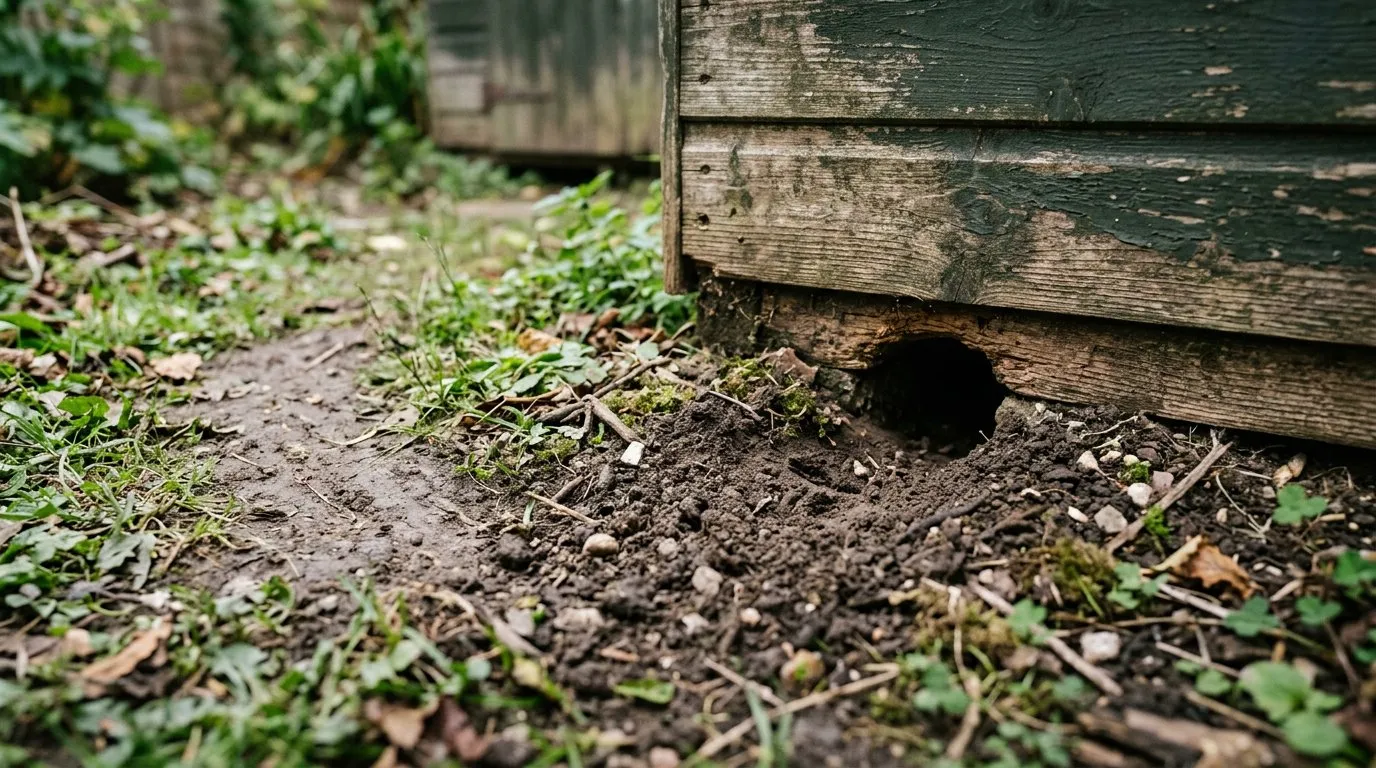 A rat burrow entrance at the base of a shed. The smooth, compacted soil and worn path leading away are classic signs of an active burrow.
Why rats come to gardens
Understanding what attracts rats to your garden is the foundation of any control plan. Rats need three things: food, water, and shelter.
Food sources
- Bird feeders are the number one attractant. Spilled seed on the ground beneath feeders is an open invitation. Rats can also climb poles and access hanging feeders.
- Compost bins containing kitchen scraps, especially cooked food, meat, or dairy. Open compost heaps are more vulnerable than enclosed bins.
- Pet food left outdoors, particularly overnight.
- Chicken coops with accessible feed stores.
- Unsecured bins and food waste left in bags rather than solid containers.
- Fallen fruit from apple, pear, and plum trees left to rot on the ground.
Shelter
Rats nest under decking, in sheds, beneath dense vegetation, and inside log piles. Overgrown corners of the garden with ivy, brambles, or dense shrubs provide perfect cover. Keeping your garden well maintained removes these harbourage points.
Water
Rats need water daily. Dripping taps, garden ponds, pet water bowls, and even persistently damp areas of soil provide what they need. Leaky outdoor taps are an easy fix that removes one attraction.
Warning: If you see a rat during daylight hours, it usually indicates a large population. Rats are nocturnal by nature. Daytime activity suggests the colony is overcrowded and subordinate rats are being forced to forage when dominant rats are resting. Contact pest control promptly.
Control methods compared
There is no single best approach to rat control. The right method depends on the scale of your problem and whether you have pets or children.
| Method | Effectiveness | Cost | Safety | Best for |
|---|---|---|---|---|
| Snap traps | High | 3-8 pounds per trap | Moderate (set away from children/pets) | Small populations, DIY control |
| Live traps | Moderate | 10-20 pounds per trap | High | Those who prefer humane capture |
| Rodenticide (poison) | Very high | 15-30 pounds (consumer bait stations) | Low (secondary poisoning risk) | Larger infestations, used in bait stations only |
| Electronic traps | High | 25-40 pounds per trap | High | Indoor and sheltered areas |
| Professional pest control | Very high | 100-250 pounds (private) | High | Persistent or large infestations |
| Council pest control | Very high | Free to 50 pounds | High | First response, subsidised option |
| Ultrasonic repellers | Very low | 10-30 pounds | High | Not recommended (no reliable evidence) |
Using snap traps
Snap traps are the most practical DIY method for garden rats. They kill quickly and allow you to confirm each catch, unlike poison where rats die in inaccessible locations.
Choosing and baiting traps
Use rat-sized snap traps, not mouse traps. A mouse trap is too small to kill a rat cleanly and risks injuring rather than killing it. Bait with a small amount of peanut butter, chocolate spread, or hazelnut. Peanut butter is ideal because rats cannot grab it and run. They must linger on the trigger plate.
Placement
Placement matters more than bait choice. Rats travel along edges, not across open ground. Set traps perpendicular to walls, with the trigger end touching the wall or fence. Place them along identified runs, near burrow entrances, and beside gnaw marks or droppings. Rats are suspicious of new objects. Leave traps baited but unset for 2-3 nights so rats become accustomed to feeding from them. Then set the traps on the third or fourth night.
Why we recommend snap traps with peanut butter bait over rodenticide as the first line of defence: After 30 seasons of managing garden pest problems, snap traps confirm every kill above ground, cost under £8 each, and carry zero secondary poisoning risk. In gardens where I have used both methods side by side, snap traps placed perpendicular to walls along active runs caught rats within 48 hours in every case. Rodenticide killed rats in inaccessible burrows where carcasses attracted secondary pests.
Checking and safety
Check traps every morning. A dead rat left in a trap attracts flies and deters other rats from approaching. Dispose of dead rats in a sealed bag in general waste. Wear disposable gloves when handling traps and dead rats.
If you have dogs, cats, or young children, place traps inside a bait station or a length of drainpipe. The pipe allows rats to enter but prevents pets and children from reaching the trap mechanism. A 10cm diameter drainpipe cut to 30cm length works well.
Tip: Set multiple traps. Rats are intelligent and trap-shy. If you catch one rat on a trap, move it to a new location. Surviving rats will often avoid the exact spot where another rat was caught. Use at least three traps for a small garden, spaced 3-5 metres apart along identified runs.
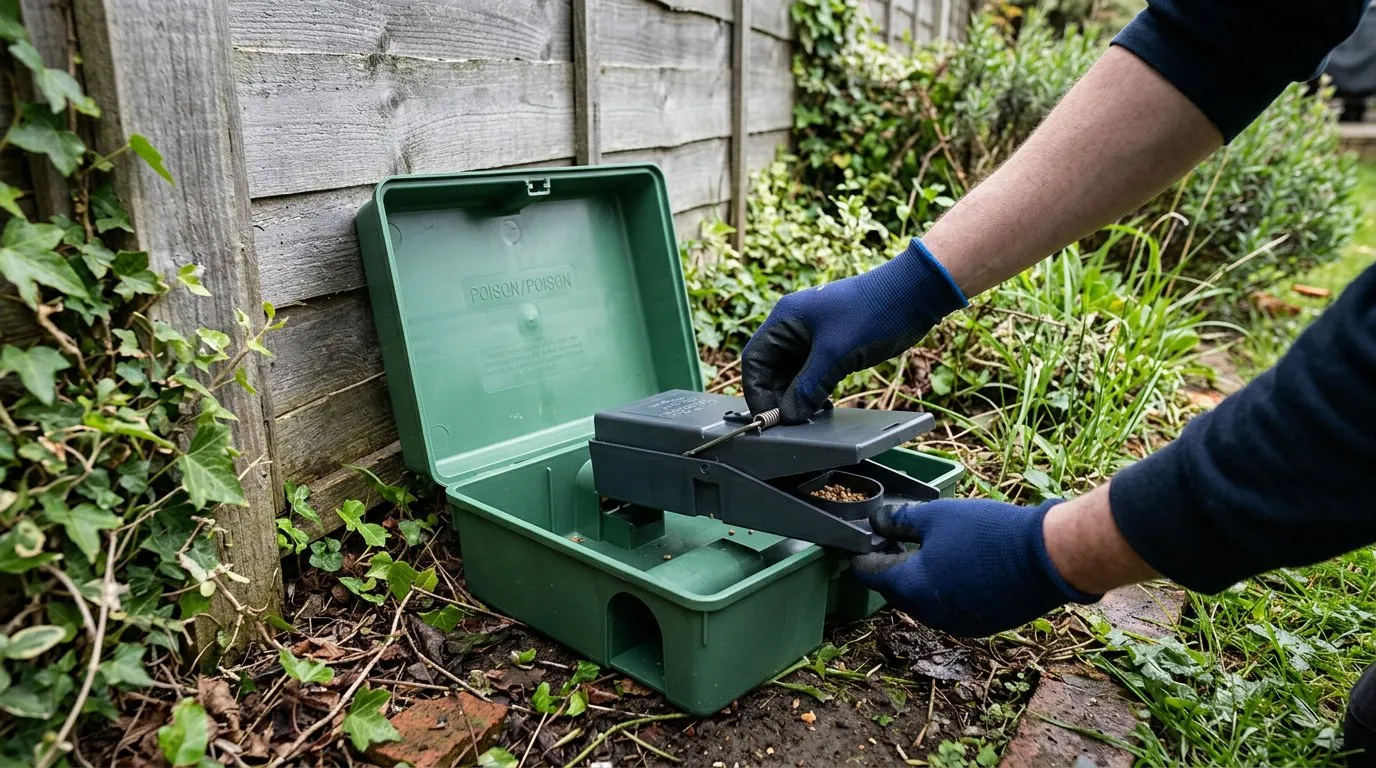 A snap trap positioned perpendicular to a fence, with the trigger plate touching the wall. This placement targets the rat’s natural route along edges.
Using rodenticide safely
Rodenticide (rat poison) is effective but carries significant risks. It should be a last resort after trapping has failed, or a first response only in severe infestations.
Legal requirements
In the UK, it is legal to use rodenticide against brown rats (Rattus norvegicus). Since 2016, professional-strength anticoagulant rodenticides (second-generation products containing brodifacoum, bromadiolone, or difethialone) require CRRU certification for professional use. Consumer-grade products are available from garden centres and hardware stores but are weaker formulations.
All rodenticide must be placed inside tamper-resistant bait stations. It is illegal and irresponsible to scatter loose poison bait. Bait stations prevent access by children, pets, and non-target animals such as hedgehogs.
Secondary poisoning risk
The greatest danger of rodenticide is secondary poisoning. A poisoned rat takes 3-7 days to die. During that time, a weakened rat becomes easy prey for cats, dogs, foxes, owls, and birds of prey. The predator then ingests the poison.
Barn owl populations have been particularly affected. Studies by the Predatory Bird Monitoring Scheme found rodenticide residues in 87% of barn owls tested in England. If you have owls, kestrels, or other raptors visiting your garden, avoid using rodenticide entirely.
Best practice with bait stations
- Use only tamper-resistant bait stations with a locking mechanism.
- Place stations along confirmed rat runs, against walls or fences.
- Check every 2-3 days and replace consumed bait.
- Remove all bait stations and remaining bait once activity stops.
- Search for and dispose of any dead rats found above ground.
- Store unused rodenticide in a locked cupboard away from children and pets.
Warning: Never use rodenticide in areas where garden birds feed regularly. The risk of secondary poisoning to birds and the predators that feed on poisoned rats is too high. Choose trapping instead if you value your garden wildlife.
Professional pest control
When trapping has not worked after 2-3 weeks, or when the infestation is large, professional help is the most effective option.
Council pest control
Many UK local authorities offer rat control services, often free or subsidised for domestic properties. Some councils charge a nominal fee of 20-50 pounds. Contact your local council’s environmental health department. Council pest controllers use professional-grade treatments and make multiple follow-up visits.
Response times vary by council. Urgent cases involving rats inside a property are typically seen within 5 working days. Garden-only infestations may take 2-3 weeks for a first visit.
Private pest control
Private pest control companies typically charge 100-250 pounds for a standard garden rat treatment. This usually includes an initial assessment, bait station placement, and 2-3 follow-up visits over 4-6 weeks. Choose a company that is a member of the BPCA (British Pest Control Association) or NPTA (National Pest Technicians Association). Membership ensures the technician holds the RSPH Level 2 Award in Pest Management.
When to call a professional
- You see rats during daylight hours (indicating a large colony).
- You find multiple burrow entrances around your garden.
- DIY trapping has caught nothing after 2-3 weeks of effort.
- Rats are entering your house, shed, or garage.
- You suspect rats are living under decking or foundations.
Rat-proofing your garden
Prevention is more effective than cure. Once you have removed an existing population, these measures stop rats from returning.
Rat-proof your compost bin
Open compost heaps are a magnet for rats. They provide food, warmth, and shelter in one convenient location. Our guide to making compost covers general composting, but here are the specific rat-proofing steps.
- Line the base of your compost bin with 6mm galvanised hardware cloth (wire mesh). Rats chew through chicken wire easily, so use the stronger hardware cloth with a maximum 6mm grid.
- Never add cooked food, meat, fish, or dairy to the compost. These attract rats faster than anything else. Stick to raw vegetable peelings, garden waste, cardboard, and plant material.
- Use an enclosed bin with a tight-fitting lid rather than an open heap.
- Turn the compost regularly. Rats avoid frequently disturbed sites. Turning the heap once a week deters nesting.
- Consider a tumbler-style compost bin raised off the ground. These are virtually rat-proof as there is no ground contact and the rotating drum is impenetrable.
Composting well and keeping rats away are not mutually exclusive. The key is what goes in and how often you disturb the heap.
Feed birds without attracting rats
You do not need to stop feeding garden birds. You just need to do it more carefully. See our guide on attracting birds to your garden for full feeding advice, but these points specifically address rat prevention.
- Use no-mess seed mixes (husked sunflower hearts, kibbled peanuts) that leave no waste on the ground beneath the feeder.
- Clean up spillage daily. Sweep or rake the ground under feeders each evening before rats emerge.
- Use a seed tray beneath hanging feeders to catch dropped food.
- Mount feeders on metal poles with baffles that rats cannot climb. Avoid wooden posts and fence-mounted feeders that rats scale easily.
- Bring feeders in at dusk if rats are active. Rats learn feeding times quickly.
- Avoid scattering food on the ground, especially near hedges, walls, or dense vegetation where rats shelter.
Secure food and waste
- Store pet food, chicken feed, and wild bird seed in sealed metal bins. Rats gnaw through plastic containers.
- Keep wheelie bin lids closed at all times. Place food waste in the bin, not beside it in bags.
- Clear fallen fruit from beneath trees promptly. Fermenting windfall apples and plums attract rats from a wide area.
Remove shelter and harbourage
- Keep vegetation trimmed around shed bases, fences, and walls. Dense ground-level cover provides rat runs and nesting sites. Overgrown borders also harbour slugs and other pests.
- Seal gaps beneath decking. Fit fine mesh across the gap between the decking edge and the ground.
- Block holes in shed walls and bases with cement or metal plates. Rats enter gaps as small as 25mm (roughly the diameter of a one pound coin).
- Store firewood and materials off the ground on a raised platform, away from fences and buildings.
Our small garden design ideas include storage and layout tips that naturally discourage pests.
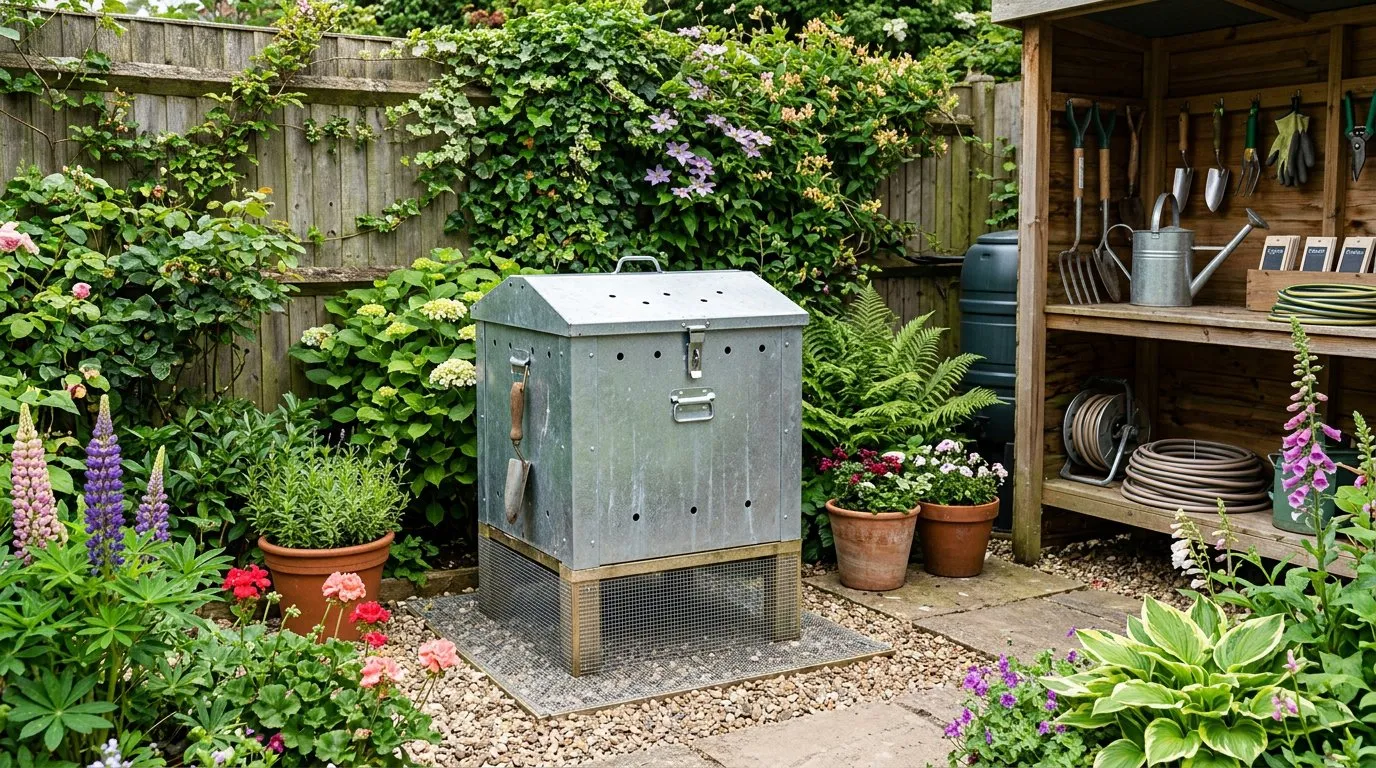 A well-maintained garden with rat prevention in mind. Enclosed compost, tidy borders, and a pole-mounted bird feeder all reduce rat risk.
Month-by-month rat activity calendar
Rat behaviour changes through the year. Knowing when they are most active helps you time your control efforts.
| Month | Rat activity | What to do |
|---|---|---|
| January | Moderate, seeking warmth and stored food | Check sheds and outbuildings for signs of entry |
| February | Breeding begins if weather is mild | Set traps along known runs before populations grow |
| March | Activity increases, spring litters born | Deploy snap traps, check compost bins for burrows |
| April | Populations growing, young rats dispersing | Maintain traps, clean up beneath bird feeders daily |
| May | High activity, abundant food from gardens | Check for new burrow entrances, maintain rat-proofing |
| June | Peak breeding season, litters every 6-8 weeks | Professional control advisable for persistent problems |
| July | High, feeding on garden produce and fallen fruit | Clear windfall fruit promptly, secure vegetable patches |
| August | Peak numbers, warm weather encourages foraging | Maintain all control measures, block new burrow entrances |
| September | Activity remains high, autumn food sources | Clear fallen fruit, secure compost bins before autumn |
| October | Rats seek shelter as temperatures drop | Block entry points to sheds, garages, and under decking |
| November | Move towards buildings for warmth | Check all structures for entry points, set traps near buildings |
| December | Less visible but still active, sheltering indoors | Inspect loft spaces and cavity walls for signs of entry |
Tip: Brown rats breed year-round in the UK but peak in spring and autumn. A single pair can produce up to five litters per year with 6-12 young per litter. Early intervention in February and March prevents exponential population growth through the summer.
Common mistakes with rat control
Ignoring the food source
The most common mistake is trying to kill rats without removing what attracts them. Setting traps beside an overflowing bird feeder or open compost bin is futile. The food supply replaces caught rats within days. Remove the food source first, then trap or poison the remaining population.
Using mouse traps instead of rat traps
Mouse traps are too small to kill a brown rat cleanly. An injured rat becomes trap-shy and teaches others to avoid traps. Always use full-sized rat snap traps. The increased spring strength delivers a quick, humane kill.
Placing traps in the open
Rats avoid open ground. A trap placed in the middle of a lawn will catch nothing. Position traps along walls, fences, and identified runs where rats feel secure. The trigger plate should touch the wall surface. Rats run with one side brushing against the wall and will step directly onto a correctly placed trap.
Scattering poison without bait stations
Loose poison bait is dangerous and illegal in practice. Hedgehogs, cats, dogs, and garden birds can all access scattered bait. Even a pet that does not eat the bait directly may consume a poisoned rat. Always use tamper-resistant bait stations with a locking key mechanism.
Blocking burrows without trapping first
Filling in burrow entrances before eliminating the rats simply forces them to dig new exits. They often emerge inside sheds, garages, or under decking. Trap first, block burrows after. Once trapping catches no further rats over 5-7 days, fill the burrows with a mix of soil and broken glass or crushed stone that discourages re-excavation.
Working with your neighbours
Rats do not respect property boundaries. If your neighbour has an overgrown garden, open bins, or chicken coops, rats will move freely between your properties. A polite conversation about shared rat-proofing is often more effective than anything you do on your own land.
Under the Prevention of Damage by Pests Act 1949, local authorities have the power to require landowners to control rat infestations. If a neighbouring property is the source and the owner will not act, contact your council’s environmental health department. They can issue a notice requiring action.
If you keep chickens alongside a vegetable patch, our guide to starting a vegetable garden covers food storage that avoids feeding rats.
What does not work
Several commonly recommended rat deterrents have little or no scientific support.
- Ultrasonic repellers produce high-frequency sound that supposedly drives rats away. Multiple studies, including research published by the University of Nebraska, found no reliable repellent effect. Rats habituate to the sound within days. Save your money.
- Peppermint oil is widely recommended online. While rats dislike the smell initially, the effect fades within 24-48 hours as the oil evaporates. It does not deter established populations.
- Mothballs contain naphthalene or paradichlorobenzene. They are mildly irritating to rats but not enough to repel them. They are also toxic to children and pets and should not be used outdoors.
- Cat presence deters some rats but is unreliable. Many domestic cats will not tackle a full-grown brown rat, which can weigh 300-500g and fights back aggressively. Farms with cats still have rats.
Dealing with rats in raised beds
Raised beds can attract burrowing rats, especially when filled with compost and growing root vegetables. If you are building raised beds, line the base with 6mm galvanised hardware cloth before filling with soil. This prevents rats from tunnelling up from below.
For existing raised beds, look for burrow entrances along the outer edges where the bed frame meets the soil. Set snap traps along these routes and block the entrances once trapping is complete.
Now you’ve mastered rat control, read our guide on how to get rid of slugs naturally for the next step in tackling the other persistent pest that thrives in overgrown garden borders.
Frequently asked questions
What attracts rats to my garden?
Food sources attract rats more than anything else. Bird feeders with spilled seed, open compost bins containing kitchen scraps, pet food left outdoors, and unsecured bin bags are the most common attractants. Rats also seek shelter under decking, in sheds, and in dense overgrown vegetation. Remove food sources and harbourage to make your garden less inviting.
Are rats in the garden dangerous?
Rats carry several diseases harmful to humans. Weil’s disease (leptospirosis) spreads through rat urine in water or soil and causes flu-like symptoms that can become life-threatening. Rats also carry salmonella, E. coli, and rat bite fever. Wear gloves when handling traps or cleaning areas contaminated with droppings.
How do I know if I have rats or mice?
Rat droppings are 12-17mm long, dark, and tapered. Mouse droppings are only 3-6mm, smaller than a grain of rice. Rat burrow entrances measure 6-9cm across. Rats leave greasy smear marks along walls and fences where their oily fur rubs repeatedly. Rats are also noisier, and you may hear scratching and gnawing at night.
Is it legal to poison rats in the UK?
Yes, rodenticide is legal against brown rats in the UK. However, poison must be placed inside tamper-resistant bait stations to prevent access by children, pets, and non-target wildlife. Since 2016, professional-strength rodenticides require certification. Consumer-grade products are available but must still be used responsibly in bait stations.
Will rats leave my garden on their own?
Rats will not leave while food and shelter remain available. They are territorial and establish runs, burrows, and feeding routes. Removing all food sources forces rats to move on, but this process takes 2-4 weeks. Active control with traps speeds up the process significantly.
How do I rat-proof my compost bin?
Use an enclosed bin with a solid base or hardware cloth lining. Line the bottom with 6mm galvanised hardware cloth. Never add cooked food, meat, dairy, or fish to open compost heaps. Turn the heap regularly to disturb nesting. Rats avoid frequently disturbed compost. A tumbler-style bin raised off the ground is the most rat-resistant design.
Should I call pest control for rats in my garden?
Call pest control if you see rats during daylight hours. Daytime sightings indicate a large population that has outgrown its territory. Also call if you find multiple burrow entrances or if trapping has not worked within 2-3 weeks. Many UK councils offer free or subsidised rat control. Private pest controllers typically charge 100-250 pounds for a standard garden treatment with follow-up visits.
Lawrie has been gardening in the West Midlands for over 30 years. He grows his own veg using no-dig methods, keeps a wildlife-friendly garden, and writes practical advice based on real UK growing conditions.