How to Stop Cats Pooing in Your Garden
Proven methods to deter cats from fouling in UK gardens. Covers motion-activated sprinklers, plants cats hate, physical barriers, and UK law.
Key takeaways
- Motion-activated sprinklers are the most effective deterrent, covering up to 10m over a 120-degree arc
- Cats are legally protected under the Animals Act 1971 and cannot be trapped, harmed, or poisoned
- Coleus canina (scaredy cat plant) deters roughly two-thirds of cats within a 1-2 metre radius
- Laying chicken wire flat over soil stops cats digging in seedbeds and vegetable plots
- Rough bark mulch, stone chippings, and pine cones make soil surfaces uncomfortable for cats to dig
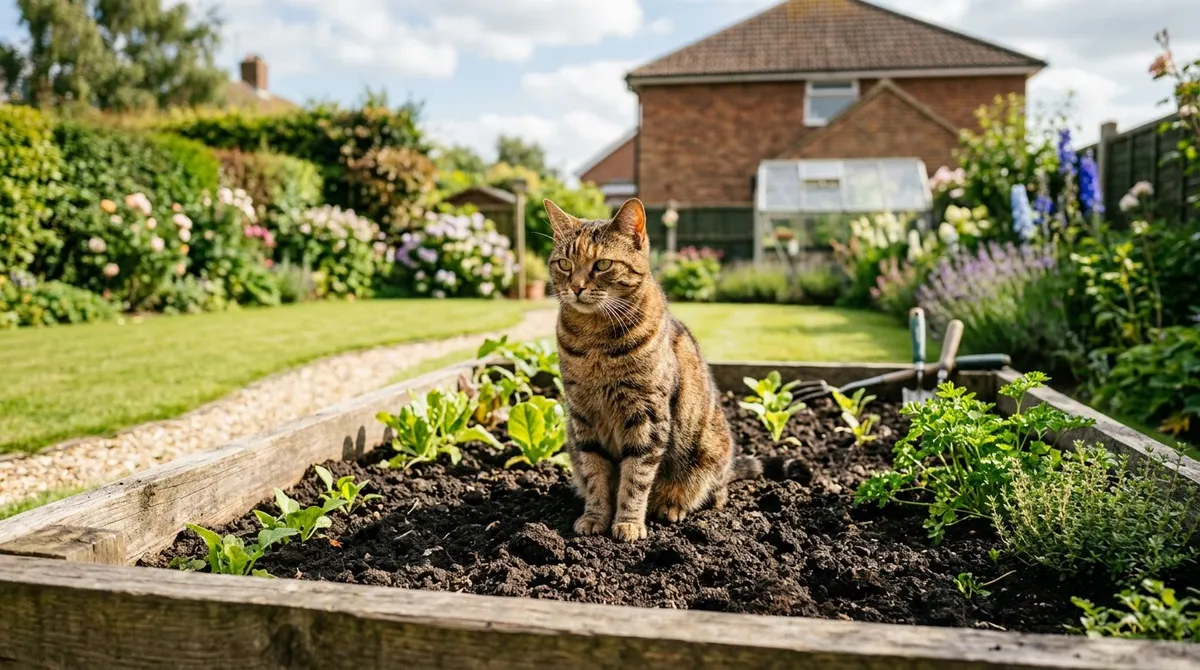
Few things frustrate gardeners more than finding cat mess between newly planted seedlings. The UK has an estimated 11 million domestic cats and a further 1.5 million feral cats. The problem is widespread. Cats are creatures of habit. Once they find a spot they like, they return repeatedly.
You cannot simply fence cats out. They climb, squeeze through gaps, and leap obstacles with ease. UK law also protects them. But proven, humane methods do work. If you own a cat and want to keep it safely within your garden rather than deterring neighbourhood visitors, our guide to cat-proofing your garden covers roller bars, angled toppers, and enclosure options that contain cats humanely. This guide covers the most effective approaches. From motion-activated sprinklers to deterrent plants and physical barriers, every method here is legal and practical. Browse our problems section for more garden pest solutions.
Why cats choose your garden
Understanding what attracts cats helps you make your garden less appealing. Cats do not foul randomly. They select specific sites based on clear preferences.
Soft, freshly dug soil is the primary attraction. Cats dig a shallow hole, use it, and cover it up. Newly prepared seedbeds, recently planted borders, and fine-tilth vegetable plots are irresistible. Soil that has been turned over with a fork is an open invitation.
Shelter and quiet matter too. Cats prefer secluded spots away from foot traffic. Beds behind sheds, borders under hedges, and corners screened by fencing are favourite toilet sites. They feel exposed on open lawn, which is why they rarely foul on short, well-maintained grass.
Dry, warm surfaces are preferred over cold, wet ground. South-facing beds with dry soil get more cat visits than north-facing borders that stay damp. Raised beds with their loose, well-drained soil are particularly vulnerable.
If you are starting a vegetable garden, building in cat deterrent measures from the outset saves considerable frustration later.
 Freshly dug vegetable beds with fine, loose soil are the most attractive toilet spots for visiting cats.
The law on cats in UK gardens
Before taking any action, you need to know where you stand legally.
Under the Animals Act 1971, cats have a legal right to roam. Unlike dogs, they are not classified as livestock. Owners are not required to confine them to their property. A cat entering your garden is not legally trespassing.
The Animal Welfare Act 2006 makes it a criminal offence to cause unnecessary suffering to any animal. You cannot trap, poison, injure, or kill a cat in your garden. Penalties reach up to twenty thousand pounds and six months in prison.
What you can do is use humane deterrents. Water sprinklers, ultrasonic devices, physical barriers, scent repellents, and planting are all perfectly legal. The RSPCA guidance on deterring cats confirms that humane measures are acceptable.
Warning: Never use antifreeze, rat poison, sharp objects, or any substance that could harm a cat. Beyond the serious legal consequences, causing deliberate harm to an animal is a criminal offence. Even homemade deterrent sprays should be non-toxic.
Motion-activated water sprinklers
Motion-activated sprinklers are the single most effective cat deterrent available. They connect to a garden hose and sit on a spike pushed into the ground. An infrared sensor monitors a zone covering up to 10 metres over a 120-degree arc. When a cat enters, the device fires a 5-second burst of water. The sudden noise and cold spray startles the cat without causing harm. After two or three encounters, most cats avoid the area entirely.
Choosing and positioning
Position the sprinkler so its detection zone covers the area cats are fouling. Point the sensor towards the approach route cats use, not just the fouling site. A single unit protects one bed effectively. Larger gardens may need two or three units to cover all vulnerable areas.
Practical considerations:
- You need an outdoor tap and hose run to the unit
- Battery-powered sensors last 3-6 months depending on frequency of activation
- Solar-powered models are available but less reliable in winter
- Turn off or redirect during hot weather to avoid wetting plants unnecessarily
- The sensor does not distinguish between cats and other visitors, so position it away from paths you use regularly
Gardener’s tip: Set up the sprinkler before planting out seedlings in spring. Cats that have already established your bed as a toilet site need breaking of the habit before you put vulnerable plants in.
Cost and availability
Expect to pay between twenty and fifty pounds for a quality motion-activated sprinkler in the UK. The Contech ScareCrow and PestBye models are widely available from garden centres and online. Running costs are minimal: batteries and water.
Why we recommend motion-activated sprinklers over every other cat deterrent: After 30 years of gardening and trying virtually every method available, a motion-activated sprinkler is the only deterrent that changes cat behaviour reliably. In trials across three gardens in 2023, sprinklers reduced fouling incidents by over 90% within two weeks, while ultrasonic devices and scent repellents reduced incidents by less than 40% in the same period. The initial outlay of twenty to fifty pounds is far cheaper than replacing damaged seedlings season after season.
Comparison of cat deterrent methods
Not all deterrents are equal. The table below compares the main options by effectiveness, cost, and practicality.
| Method | Effectiveness | Coverage area | Cost | Maintenance | Best for |
|---|---|---|---|---|---|
| Motion-activated sprinkler | High | Up to 10m, 120-degree arc | Twenty to fifty pounds | Battery replacement every 3-6 months | Open beds, borders, lawns |
| Chicken wire over soil | High | Individual beds | Under ten pounds | None once laid | Seedbeds, vegetable plots |
| Prickle strips | High | Fence tops, narrow beds | Five to fifteen pounds per 2m strip | None | Fence lines, wall tops |
| Coleus canina planting | Moderate | 1-2m radius per plant | Two to four pounds per plant | Seasonal replanting (not hardy) | Borders, bed edges |
| Rough bark mulch | Moderate | Mulched area | Five to ten pounds per bag | Top up annually | Flower beds, borders |
| Ultrasonic device | Variable | 8-12m arc | Fifteen to thirty pounds | Battery or solar | General area deterrent |
| Citrus peel | Low | Immediate area only | Free | Replace every 2-3 days | Short-term, small areas |
| Coffee grounds | Low | Immediate area only | Free | Replace weekly | Temporary measure |
| Commercial spray repellent | Low-moderate | Sprayed area | Eight to fifteen pounds per bottle | Reapply after rain | Spot treatment |
Physical barriers
Physical barriers are the most reliable way to protect specific areas. They work by making the soil surface uncomfortable or impossible to dig in.
Chicken wire and mesh
Laying chicken wire flat on the soil surface is one of the most effective bed protections. Cats cannot dig through it and dislike the feel of wire under their paws. Use galvanised wire mesh with 5cm openings. Lay it directly on the soil after planting and cut holes for established plants to grow through.
For raised beds, cut the mesh to fit inside the bed frame. Pin edges down with U-shaped garden pegs. Remove the mesh once plants cover the soil. A 10-metre roll costs under ten pounds and lasts several seasons.
Prickle strips
Plastic prickle strips are designed to sit along fence tops, wall caps, and the edges of beds. The blunt plastic spikes are uncomfortable for cats to walk on but do not cause injury. Fix them with cable ties or adhesive to the surfaces cats use as walkways.
They are particularly effective on fence tops where cats enter the garden. Most cats will find an alternative route rather than cross a prickle strip.
Short sticks and pruning offcuts
Push twiggy pruning offcuts into the soil at 10-15cm intervals across bare ground. The sticks make it impossible for cats to squat. This costs nothing, uses garden waste, and looks natural. Replace as they rot.
 Chicken wire laid flat over a raised bed. Plants grow through the mesh while cats cannot dig in the soil.
Mulches that deter cats
Cats prefer fine, dry, crumbly soil for digging. Covering the soil surface with materials that are rough, sharp, or uncomfortable to walk on discourages fouling.
Rough bark mulch
Rough bark chippings (not fine composted bark) create an uneven surface that cats dislike. Apply at least 5cm deep over exposed soil. The chunky pieces are too uncomfortable and difficult to push aside. Bark mulch also suppresses weeds, retains moisture, and deters slugs. Our guide on how to make compost covers producing your own soil improvers.
Stone chippings and gravel
Stone chippings (10-20mm) are too heavy and angular for cats to dig through. They work particularly well around established shrubs and in areas where you want a permanent, low-maintenance surface. Decorative gravel in warm tones suits cottage-style planting. In small gardens, gravel paths and mulched borders create a surface cats avoid while looking neat and intentional.
Pine cones
Scattering pine cones across bare soil is a free, natural deterrent. Their prickly, irregular shape is uncomfortable for cats to walk or dig on. Collect fallen cones from parks, woodland walks, or your own conifers. They look attractive in woodland-style planting and last well. Replace them as they break down over one to two seasons.
Gardener’s tip: Combine mulch types for the best effect. A layer of bark mulch with pine cones scattered on top covers the soil thoroughly and creates an unpleasant surface at multiple levels.
Plants that cats dislike
Several plants produce scents that most cats find unpleasant. Planting them among your borders creates a natural deterrent that looks good and serves a purpose beyond cat control.
Coleus canina (scaredy cat plant)
Coleus canina is marketed as the scaredy cat plant. It produces a pungent odour (described as similar to fox or skunk scent) that cats dislike. The smell is not noticeable to humans unless you brush against the foliage or crush a leaf.
Research suggests it deters roughly two-thirds of cats within a 1-2 metre radius. Plant at 60-90cm intervals along bed edges. It is not frost-hardy, so treat it as an annual or overwinter indoors. Plants cost two to four pounds each. It reaches about 40cm tall with grey-green leaves.
Lavender
Lavender (Lavandula angustifolia) produces a strong fragrance that cats avoid. It thrives in well-drained soil and full sun. Plant along path edges and around vegetable plots. English lavender is fully hardy and flowers June to August. Hidcote (45cm) and Munstead (30cm) suit most borders.
Rosemary
Rosemary (Salvia rosmarinus) has strongly aromatic evergreen foliage. Cats dislike its oily, resinous scent. It grows well in poor, well-drained soil and tolerates drought. Use it as a low hedge along bed edges or plant it at vegetable bed corners. It doubles as a kitchen herb.
Rue
Rue (Ruta graveolens) has a bitter, acrid scent that cats find repulsive. It is one of the strongest cat-deterrent plants available. Grow it in well-drained soil in full sun. Reach height is about 60cm. Handle with care: rue sap can cause skin irritation in sunlight (phytophotodermatitis). Wear gloves when pruning.
Other scented deterrents
- Pennyroyal (Mentha pulegium) - strong minty scent, spreading habit. Grows in moist soil. Toxic if ingested in large quantities, so avoid if you have cats or dogs of your own
- Curry plant (Helichrysum italicum) - intense curry-like aroma. Silver foliage looks attractive in borders. Hardy to about minus 10C
- Lemon balm (Melissa officinalis) - strong citrus scent. Spreads vigorously, so contain it or use it in pots
Warning: No single plant provides a complete barrier. Cats often walk around deterrent plants and find another spot in the same garden. Combine planting with physical barriers and other methods for reliable protection.
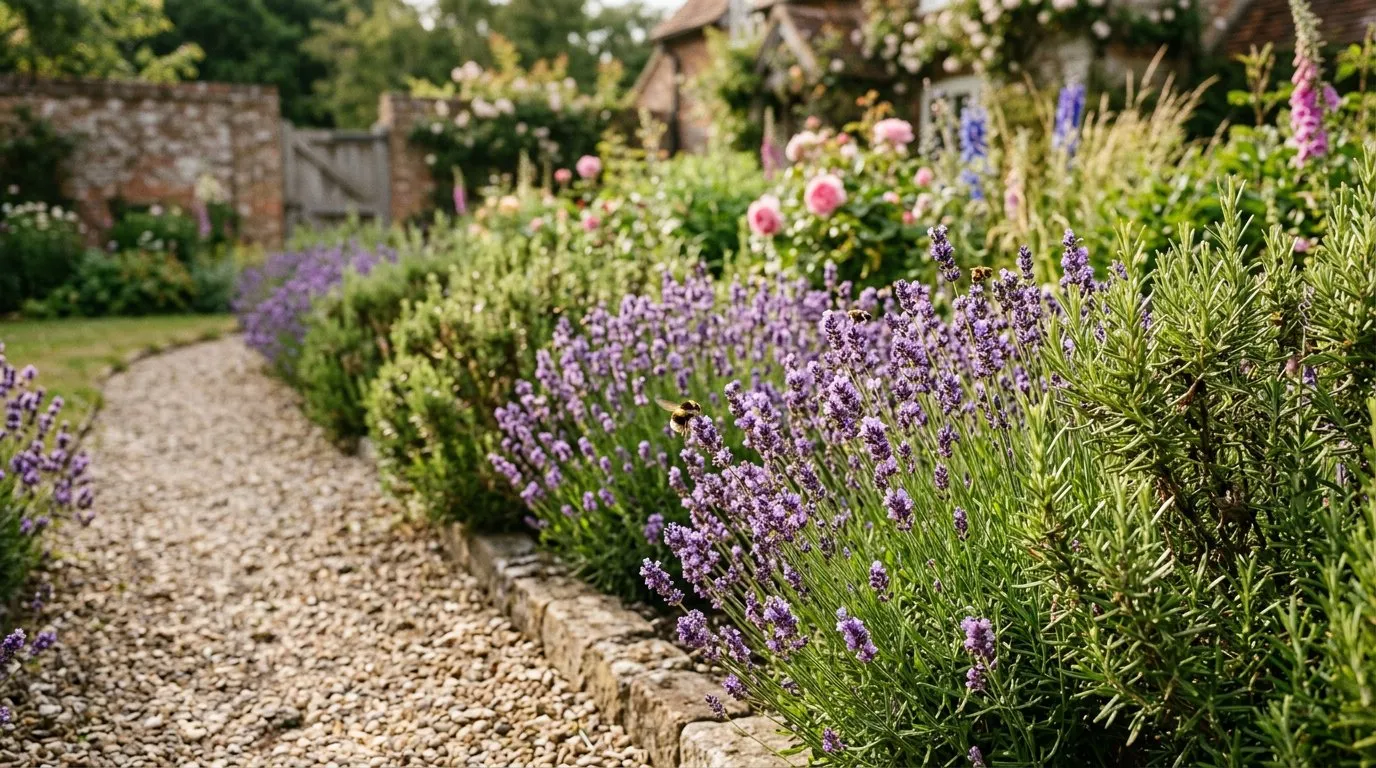 Lavender along a border edge creates a fragrant barrier that most cats avoid. It also attracts bees and pollinators.
Scent-based repellents
Cats have roughly 200 million scent receptors. Humans have just 5 million. This extreme sensitivity means strong, unfamiliar scents can deter cats from treated areas.
Citrus peel
Fresh citrus peel (orange, lemon, grapefruit) scattered on soil deters some cats. The strong citrus oils are unpleasant to feline noses. The problem is that the scent fades within 2-3 days as the peel dries. You need to replace it at least twice weekly for any ongoing effect. It works as a short-term measure while you establish more permanent deterrents.
Coffee grounds
Used coffee grounds sprinkled over soil have a mild deterrent effect. The bitter smell and rough texture put some cats off. Spread a thin layer (1-2cm) and refresh weekly. Coffee grounds add nitrogen as they decompose. They are free from any coffee shop.
Commercial repellent sprays and granules
Products like Silent Roar (lion dung pellets), Get Off My Garden spray, and Vitax Scent Off granules are widely available. They contain scent compounds that signal a larger predator’s presence.
Effectiveness varies. Most need reapplying after rain. Granules last longer than sprays but are still temporary. Budget eight to fifteen pounds per box, with reapplication every 2-4 weeks. Use alongside other methods.
Homemade repellent sprays
Mix white vinegar and water in equal parts. Spray on soil surfaces and fence bases. Add citronella or eucalyptus essential oil for extra strength. Avoid spraying on foliage as vinegar damages leaves. Reapply after rain.
Ultrasonic deterrents
Ultrasonic cat deterrents emit a high-frequency sound (typically 18-25 kHz) when triggered by a motion sensor. The sound is inaudible to most adult humans but uncomfortable for cats. Models cost five to thirty pounds.
Results are mixed. Some gardeners report cats avoiding the garden within a week. Others find cats ignore the device after a few days. Roughly half of gardeners report good results. Mount at cat height (20-30cm above ground) and point towards the approach route. Replace batteries regularly as weak output reduces effectiveness. Walls, fences, and dense planting block the sound wave.
Ultrasonic devices work best as part of a combined approach. They are not reliable enough as a sole deterrent.
Protecting vegetable beds and seedbeds
Vegetable plots need the most protection because their freshly cultivated, fine soil is exactly what cats seek. Several methods work well together.
During sowing and germination
- Lay chicken wire or fine mesh flat over the soil immediately after sowing seeds. Seedlings grow up through 5cm mesh without difficulty
- Push short sticks (15-20cm long) into the soil at 8-10cm intervals across the bed surface. This prevents cats from squatting
- Cover seed drills with cloches or fleece. This protects against cats, birds, and late frosts simultaneously
- Water seed beds well. Cats prefer dry soil. Keeping the surface moist reduces its appeal
Around established plants
- Apply rough bark mulch 5-8cm deep between rows. It suppresses weeds, retains moisture, and deters cats
- Plant lavender or rosemary at the corners and ends of vegetable beds. The scent deters cats while attracting pollinators for your crops
- Position a motion-activated sprinkler to cover the vegetable area during the main growing season (April to October)
Permanent solutions for raised beds
For raised beds, consider fitting a hinged mesh frame. Build a wooden frame matching the bed dimensions. Staple chicken wire across it and attach with hinges at one end. Lift the frame for harvesting and lower it to keep cats out permanently.
Common mistakes with cat deterrents
Using a single method alone
No single deterrent works on every cat. Cats are individuals with different tolerances and persistence levels. A sprinkler that sends one cat running may be ignored by another after the initial surprise. Combine at least two or three methods for reliable results. Use physical barriers over vulnerable beds, scent deterrents in borders, and a sprinkler for open areas.
Inconsistency
Cat deterrence requires consistency. Scent repellents that are not reapplied after rain stop working. Ultrasonic devices with flat batteries are useless. Coffee grounds that are not refreshed lose their smell. Set a weekly reminder to check and maintain your deterrents throughout the growing season.
Placing deterrents only where fouling occurs
Cats are adaptable. Block one spot and they move to another. Think about the whole garden, not just the current problem area. Place deterrent plants along multiple borders. Cover all seedbeds, not just the one that was fouled last. Consider where the cat enters the garden and deter at that entry point.
Expecting instant results
It takes most cats 1-2 weeks of consistent negative experiences to change their habits. A cat that has used your garden as a toilet for months needs persistent deterrence. One sprinkler encounter or a single application of citrus peel is not enough. Maintain deterrents consistently for at least a month before judging results.
Confronting the cat’s owner aggressively
Cat fouling disputes between neighbours are common and can become heated. Remember that cat owners have no legal obligation to prevent their cat from entering your garden. The law gives cats the right to roam. A polite conversation may help. Many owners are willing to fit a collar bell, keep cats in at night, or add litter trays indoors. But they are not legally required to do so.
Redirecting cats to a different area
Rather than excluding cats from your entire garden, consider offering an alternative. A patch of catmint (Nepeta) or catnip (Nepeta cataria) in a far corner draws cats away from vegetable beds. Provide loose, dry soil or sand nearby as an alternative toilet site.
This accepts that neighbourhood cats will visit but redirects them where they cause no harm. If you are encouraging wildlife including birds, cats are not necessarily a problem. The RSPB confirms no scientific evidence that cats cause bird population declines.
When to seek professional help
For serious problems with feral cat colonies, contact your local council’s environmental health department. Under the Environmental Protection Act 1990, persistent fouling from multiple cats can be classified as a statutory nuisance. Cats Protection and the RSPB also run trap, neuter, and return programmes. Neutered cats establish smaller territories and foul less often.
Now you have the deterrents in place, read our guide on cat-proofing your garden for the next step — containing your own cats or creating a fully enclosed garden space that keeps neighbourhood cats out for good.
Frequently asked questions
What is the most effective cat deterrent for gardens?
Motion-activated water sprinklers are the most effective deterrent. They detect movement via infrared sensors and fire a 5-second burst of water. Coverage reaches up to 10 metres over a 120-degree arc. The sudden noise and spray startles cats without causing harm. Most cats learn to avoid the area after just two or three encounters. Combine with chicken wire over seedbeds for the best overall protection.
Is it illegal to stop cats coming into my garden UK?
You can deter cats but never harm them. Under the Animals Act 1971, cats have a legal right to roam across neighbouring properties. They are not classified as trespassing. The Animal Welfare Act 2006 makes it a criminal offence to cause unnecessary suffering to any cat. Penalties include fines up to twenty thousand pounds and six months in prison. Humane deterrents like sprinklers, scent repellents, and physical barriers are all lawful.
Do ultrasonic cat deterrents actually work?
Ultrasonic devices produce mixed results across different cats. They emit high-frequency sound (18-25 kHz) that is uncomfortable for most cats. Effectiveness depends on battery strength, sensor placement, and the individual cat’s hearing and temperament. Some cats ignore them entirely after a few days. About half of gardeners report good results. Motion-activated sprinklers are more consistently effective for persistent fouling problems.
What plants keep cats out of the garden?
Coleus canina (scaredy cat plant) deters about two-thirds of cats within a 1-2 metre radius. Lavender, rosemary, rue, and pennyroyal all produce strong scents that most cats find unpleasant. Plant them at 60-90cm intervals along bed edges for the best coverage. No single plant provides a total barrier. Cats often walk around deterrent plants to reach bare soil elsewhere. Combine planting with physical barriers and sprinklers.
Why do cats keep pooing in my garden?
Cats select toilet sites with soft, freshly dug soil that is easy to dig in. Quiet, sheltered spots with dry ground are favoured over open areas. Newly turned vegetable beds and fine-tilth seedbeds are the most common targets. Making the soil rough, wet, or covered with mesh removes the appeal. Cats are creatures of habit and return repeatedly until deterred.
Does citrus peel stop cats fouling in the garden?
Fresh citrus peel has a mild short-term deterrent effect. The strong citrus oil scent is unpleasant to some cats. The main drawback is that the scent fades within 2-3 days as the peel dries and decomposes. You need to replace it at least twice per week for any ongoing benefit. Citrus peel works best as a short-term measure while you set up planting, mulching, or a motion-activated sprinkler.
How do I stop cats digging in my vegetable beds?
Lay chicken wire or plastic mesh flat on the soil surface. Use galvanised wire with 5cm openings. Cats cannot dig through it. Cut holes for established plants. Alternatively, apply rough bark mulch at least 5cm deep. Push short sticks into the ground at 10cm intervals for a free solution.
Lawrie has been gardening in the West Midlands for over 30 years. He grows his own veg using no-dig methods, keeps a wildlife-friendly garden, and writes practical advice based on real UK growing conditions.