Japanese Knotweed Identification Guide
How to identify Japanese knotweed in every season. Covers UK legal obligations, mortgage implications, professional treatment costs, and disposal rules.
Key takeaways
- Japanese knotweed grows up to 20cm per day in spring, reaching 3 metres by midsummer
- Causing knotweed to spread is a criminal offence under the Wildlife and Countryside Act 1981
- Major mortgage lenders refuse loans on properties with untreated knotweed within 7 metres
- Professional herbicide treatment costs £2,000-5,000 and takes 3-5 years to complete
- Knotweed rhizomes extend up to 7 metres from visible growth and 3 metres deep
- All knotweed waste is classified as controlled waste requiring licensed disposal
Japanese knotweed is the most destructive invasive plant in Britain. Fallopia japonica was introduced as an ornamental in the 1850s by the Victorian plant hunter Philipp von Siebold. Within decades it had escaped gardens and colonised riverbanks, railway embankments, and waste ground across the country. Today it affects an estimated 4-5% of UK properties and costs the British economy around £166 million per year in treatment and property damage.
What makes knotweed uniquely problematic is not just its aggressive growth. It is one of only a handful of plants in the UK that carries legal obligations for landowners, affects mortgage applications, and requires licensed waste disposal. Identifying it correctly is the essential first step. Several common garden plants look similar, and misidentification causes both unnecessary panic and missed infestations. This guide covers identification in every season, explains your legal responsibilities, and sets out what treatment actually involves.
How to identify Japanese knotweed in spring
Spring identification is critical because early treatment is more effective. Knotweed shoots first appear in late March or early April as reddish-purple asparagus-like spears pushing through the soil from crown buds.
These shoots are fleshy, with tightly rolled leaves. They grow at an extraordinary rate, up to 20cm per day in ideal conditions. By mid-May the shoots have unfurled into recognisable stems with distinctive features:
- Stems are hollow, bamboo-like, with a green surface speckled with purple-red spots
- Nodes (joints) appear every 5-10cm along the stem, creating a zig-zag growth pattern
- Leaves are shield-shaped (like a flattened heart), 10-15cm long, with a flat base and pointed tip
- Leaf arrangement is alternate, with leaves growing in a staggered pattern along the stem
By late spring the plant reaches 1-1.5 metres. The stems thicken to 2-3cm diameter and the characteristic zig-zag pattern between nodes becomes obvious.
Gardener’s tip: The flat leaf base is the single most reliable identification feature in spring and summer. Most look-alike plants have rounded, notched, or lobed leaf bases. Japanese knotweed leaves have a perfectly straight, truncated base where the leaf meets the stalk.
How to identify Japanese knotweed in summer
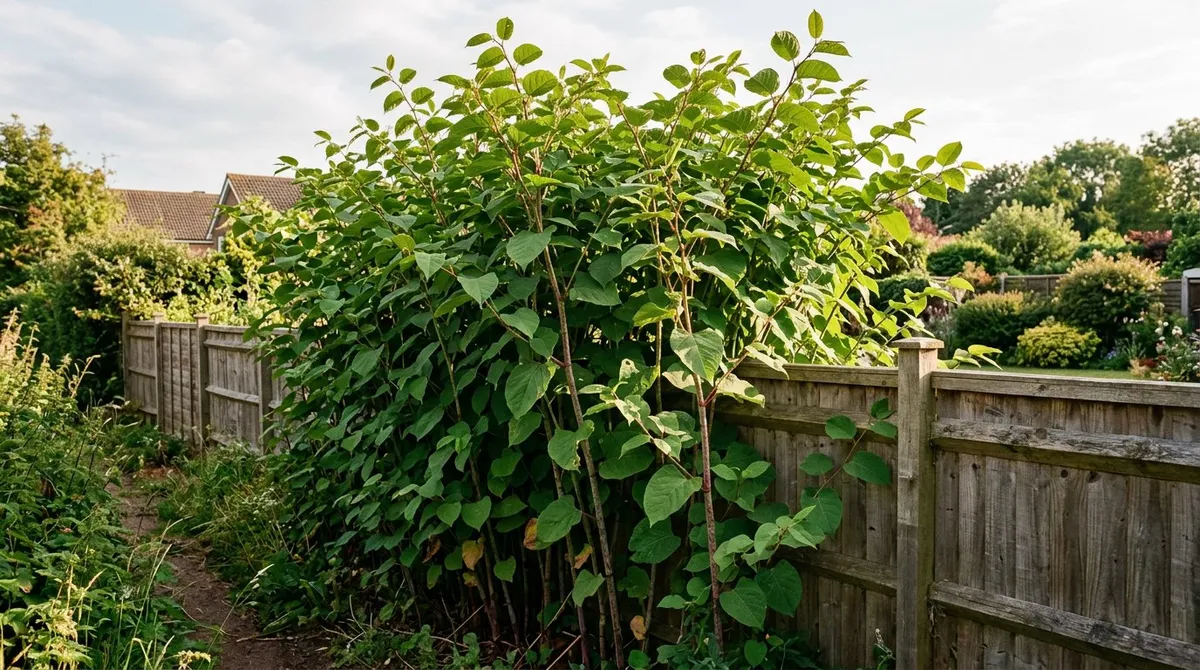
By July, Japanese knotweed is at full height, forming dense stands 2-3 metres tall. The plant is unmistakable at this stage.
Key summer features
- Height: 2-3 metres, occasionally taller in sheltered sites
- Stems: thick, hollow, green with purple speckles, resembling bamboo
- Leaves: large shield-shapes up to 20cm long, arranged alternately
- Leaf colour: bright green on top, paler beneath
- Canopy: dense enough to shade out all other vegetation beneath it
- Growth pattern: dense clumps with stems growing very close together
Flowers
Creamy-white flower clusters appear in late August and September. The flowers are small, individually about 3mm across, arranged in drooping sprays (panicles) 8-15cm long that grow from the leaf joints near the top of the stem. Flowering is more prolific in warmer southern counties. In colder northern areas, some stands rarely flower.
Japanese knotweed in the UK is almost exclusively female. It does not produce viable seed here. All spread occurs through rhizome fragments, pieces of underground root system that break off and establish new plants.
How to identify Japanese knotweed in autumn and winter
Autumn (October-November)
The leaves turn yellow, then brown, and fall from the stems. This happens later than most native plants, typically from mid-October. The stems change from green to dark brown and become increasingly brittle. Dead flower clusters persist as dry, papery tassels.
Winter (December-March)
In winter, Japanese knotweed is identifiable by its dead canes. These stand through the winter as tall, pale brown, hollow stems in dense clusters. They are distinctively bamboo-like with clear nodes every 5-10cm. The canes snap cleanly when bent, unlike most other dead stems that bend or tear.
At ground level, look for crown buds: reddish-purple, knobby growths sitting on or just below the soil surface. These are the growing points for next season’s shoots. Crown buds are one of the most reliable winter identification features.
| Season | Key features | Confidence of identification |
|---|---|---|
| Spring (March-May) | Red-purple asparagus-like shoots. Zig-zag stems. Shield-shaped leaves with flat base. | High from late April |
| Summer (June-September) | 2-3m tall bamboo-like stems. Dense stands. Cream flower sprays in late summer. | Very high |
| Autumn (October-November) | Yellow-brown dying leaves. Persistent cream flower tassels. Stems turning brown. | High |
| Winter (December-February) | Pale brown hollow canes with clear nodes. Reddish-purple crown buds at ground level. | Moderate. Best confirmed by specialist. |
Plants commonly confused with Japanese knotweed
Several common garden and wild plants are regularly mistaken for knotweed. This causes unnecessary alarm and sometimes expensive professional surveys that find nothing.
| Plant | How to tell it apart |
|---|---|
| Russian vine (Fallopia baldschuanica) | A climber, not free-standing. Twining stems. Smaller leaves. White/pink flowers in large clusters. |
| Himalayan honeysuckle (Leycesteria formosa) | Hollow stems but arching, not upright. Leaves are opposite (in pairs), not alternate. Purple berries. |
| Broad-leaved dock (Rumex obtusifolius) | Leaves are much longer and narrower. No bamboo-like stems. Grows as a rosette, not a tall cane. |
| Lilac (Syringa vulgaris) | Heart-shaped leaves but with a pointed, not flat, base. Woody branches, not hollow stems. Purple flowers. |
| Bindweed (Calystegia sepium) | A twining climber with arrow-shaped leaves and white trumpet flowers. No hollow canes. |
| Houttuynia (Houttuynia cordata) | Heart-shaped leaves but much smaller (5-8cm). Ground cover, not tall. Orange peel scent when crushed. |
| Bamboo (various species) | Evergreen. Leaves narrow and grass-like. Stems woody and persistent, not dying back in winter. |
If you are uncertain, take clear photographs showing the stem, a full leaf (including the base), and the overall growth habit. Send these to a PCA-qualified surveyor for free preliminary assessment. Many firms offer this service via their website or email. The RHS Japanese knotweed page has detailed photographs for comparison.
For bindweed specifically, our guide to getting rid of bindweed covers identification and removal of that particular weed.
Legal obligations for UK landowners
Japanese knotweed carries more legal weight than any other plant in the UK. Understanding your obligations prevents criminal prosecution, civil liability, and problems selling your property.
Wildlife and Countryside Act 1981
It is an offence to cause Japanese knotweed to grow in the wild. This covers actions such as dumping garden waste containing knotweed rhizomes, fly-tipping contaminated soil, or mowing knotweed and spreading fragments. The maximum penalty is a £5,000 fine (magistrates’ court) or an unlimited fine and up to 2 years’ imprisonment (Crown Court).
Anti-social Behaviour, Crime and Policing Act 2014
Local authorities can issue Community Protection Notices requiring landowners to control knotweed that is causing a nuisance to neighbours or the community. Failure to comply is a criminal offence with fines up to £2,500 for individuals.
Environmental Protection Act 1990
Japanese knotweed waste, including soil containing rhizome fragments, is classified as controlled waste. It must be disposed of at a licensed landfill site with an environmental permit for invasive plant waste. Disposing of knotweed in household bins, at ordinary tips, or by fly-tipping is illegal. Waste carriers must hold appropriate licences.
Property sales (TA6 form)
When selling a property in England and Wales, you must complete the TA6 Property Information Form. This asks directly whether the property is affected by Japanese knotweed. Failure to disclose known knotweed is actionable misrepresentation. Buyers who discover undisclosed knotweed after purchase can and do sue for damages.
Warning: Even if knotweed has been treated and appears dead, you must disclose its history on the TA6 form. Many sellers have faced legal action for declaring “no knotweed” after treatment, when residual rhizomes remained in the ground.
Civil liability
If your knotweed encroaches onto neighbouring land and causes damage, you can be sued for private nuisance. The 2018 case of Williams & Sherwood v Network Rail confirmed that allowing knotweed to spread onto a neighbour’s land constitutes an actionable nuisance. Network Rail was ordered to pay damages and treat the knotweed.
Japanese knotweed and mortgages
Knotweed is one of the few plants that directly affects your ability to buy, sell, or remortgage a property.
The 7-metre rule
Most UK mortgage lenders use the 7-metre rule as their decision threshold. If Japanese knotweed, or evidence of it, is found within 7 metres of a habitable structure, the lender will typically:
- Refuse the mortgage unless a professional management plan is in place
- Require an insurance-backed guarantee (IBG) from a PCA-registered treatment firm
- Request a specialist survey confirming the extent of the infestation
- Reduce the loan-to-value ratio offered
RICS risk categories
The Royal Institution of Chartered Surveyors (RICS) classifies knotweed risk in four categories:
| Category | Description | Typical lender response |
|---|---|---|
| 4 (low) | Knotweed within 7m but not causing damage. Rhizome more than 7m from building. | Lending usually possible with management plan. |
| 3 (medium) | Knotweed within 7m of habitable space. Rhizome within 7m of building boundary. | Management plan and IBG required. Reduced LTV possible. |
| 2 (high) | Knotweed causing visible damage to hard surfaces within 7m. | Some lenders decline. Others require excavation plan. |
| 1 (very high) | Knotweed causing structural damage to building or growing within building footprint. | Most lenders decline until full remediation is complete and certified. |
Warning: If you discover knotweed during a property purchase, do not proceed without a specialist survey. The survey typically costs £300-500 and provides the evidence lenders require. Proceeding without one risks buying a property you cannot remortgage or resell.
Professional treatment: methods and costs
DIY treatment of Japanese knotweed is legal but rarely advisable. The legal risks of inadequate treatment, including spread onto neighbouring land, are significant. Professional treatment provides documentation that satisfies mortgage lenders and buyers.
Herbicide treatment (standard approach)
The standard method is glyphosate-based herbicide applied by stem injection or foliar spray over 3-5 growing seasons.
Stem injection involves drilling into each cane and injecting glyphosate solution directly into the hollow stem. This delivers herbicide straight to the rhizome network. Treatment begins in July when the plant is in full growth and continues through October.
Foliar spraying applies glyphosate to the leaves at a concentration of 5g/L (trade-strength, stronger than retail products). Like treating brambles, autumn application is most effective because the plant translocates herbicide to its roots.
| Treatment year | Action | Expected result |
|---|---|---|
| Year 1 | Initial stem injection or foliar spray (July-October) | 60-80% reduction in above-ground growth |
| Year 2 | Second treatment on regrowth | Further 70-90% reduction |
| Year 3 | Third treatment. Most stands show minimal regrowth. | 90-95% of rhizome network dead |
| Years 4-5 | Monitoring and spot treatment of any survivors | Full eradication confirmed |
| Years 6-10 | Annual monitoring visits under guarantee | Insurance-backed guarantee covers regrowth |
Cost: £2,000-5,000 for a typical residential site, including the 10-year insurance-backed guarantee.
Excavation and removal
For situations requiring faster results, such as a property sale or building project, excavation removes all contaminated soil.
- A mini digger excavates soil to a depth of 3 metres and a radius of 7 metres from the visible knotweed
- All excavated soil is classified as controlled waste and transported to a licensed landfill by registered waste carriers
- The void is backfilled with clean soil
Cost: £10,000-50,000 depending on the volume of soil removed and disposal costs. Landfill charges for knotweed-contaminated soil run £50-150 per tonne.
On-site burial
A cheaper alternative to off-site disposal is on-site encapsulation. Contaminated soil is buried in a membrane-lined cell at least 5 metres deep on the same property. This avoids disposal costs but limits future use of that area.
Cost: £5,000-15,000 depending on volume.
Choosing a treatment provider
Use a firm that is a member of the Property Care Association (PCA) Invasive Weed Control Group. PCA members must follow an industry code of practice and can provide insurance-backed guarantees recognised by mortgage lenders. The Property Care Association website has a searchable directory of registered firms.
Why we recommend PCA-registered herbicide treatment over DIY removal: After 30 years working with problem plants, the cases we have seen go worst are invariably those where a homeowner dug out knotweed without professional guidance. Fragmenting the rhizome manually turns a contained stand into a scattered problem across a 7-metre radius. PCA-registered stem injection programmes achieve 90-95% rhizome kill by year three and produce the insurance-backed guarantee documentation that mortgage lenders and property solicitors specifically require.
Disposal rules for knotweed waste
Knotweed is not the only invasive plant that causes problems for UK gardeners. Spider mites in greenhouses can devastate crops just as quickly, though with very different control methods.
Japanese knotweed waste cannot be treated like normal garden waste. The rules are strict and enforced.
- All knotweed plant material (stems, leaves, roots, rhizome fragments) is controlled waste
- Soil containing any rhizome material is also controlled waste
- Waste must be transported by a registered waste carrier and disposed of at a licensed landfill with the correct environmental permit
- A waste transfer note must accompany every load. Keep records for 2 years minimum
- Burning knotweed on site is permitted if done responsibly, but any remaining rhizome fragments in the soil are still controlled waste
- Composting knotweed at home is not viable. Rhizome fragments survive composting temperatures
Full guidance is available from the Environment Agency invasive plant page.
Warning: Fly-tipping knotweed waste carries unlimited fines and up to 5 years’ imprisonment. Even small amounts of contaminated soil dumped in a green waste bin or a skip can result in prosecution. The fragments root wherever they land, potentially creating new infestations miles from the original site.
Common mistakes with Japanese knotweed
Digging it up without professional guidance
Digging knotweed fragments the rhizome network and scatters viable pieces through the soil. Each fragment weighing as little as 0.7 grams can produce a new plant. Amateur excavation often turns a contained infestation into a much larger problem. It also creates controlled waste that requires licensed disposal.
Putting knotweed in garden waste bins
Council green waste collections process material at composting facilities. The temperatures and conditions in most municipal composting systems do not reliably kill knotweed rhizomes. Contaminated compost then gets spread across gardens and allotments, creating new infestations. Knotweed must go to licensed landfill only.
Ignoring it and hoping it goes away
Knotweed rhizomes extend 1-2 metres per year underground. An infestation left for 5 years will have a rhizome network 7-10 metres beyond the visible growth. The longer you wait, the more expensive treatment becomes. Early action when the stand is small saves thousands of pounds. Persistent weeds like knotweed often appear alongside other difficult plants. Our guide to lawn weeds covers the less severe but equally common weeds that colonise neglected ground once the main invasive is removed.
Treating it once and assuming it is dead
A single herbicide application kills above-ground growth but rarely eliminates the rhizome network. Rhizomes store enough energy to produce new shoots for several years. The standard treatment requires 3-5 consecutive years of application. Stopping after one year because no growth is visible in spring often leads to regrowth the following year.
Not disclosing on the TA6 form
Sellers sometimes believe that treated knotweed no longer needs declaring. This is incorrect. The TA6 question asks about current and past knotweed on the property. Failing to disclose treated knotweed exposes you to misrepresentation claims. Courts have awarded damages exceeding £100,000 in knotweed non-disclosure cases.
Now you’ve identified knotweed and understand your obligations, read our guide on how to get rid of bindweed for the next most persistent invasive weed in UK gardens.
Frequently asked questions
How do I identify Japanese knotweed in winter?
Look for tall, pale brown, hollow canes in dense clusters. Winter canes stand 2-3 metres tall with visible nodes every 5-10cm, resembling bamboo. Dead leaf sheaths cling to the lower nodes. The canes are brittle and snap cleanly when bent. Cane clusters grow from distinctive reddish-purple crown buds at ground level.
Will Japanese knotweed devalue my property?
Yes, knotweed typically reduces property value by 5-15%. Some buyers withdraw entirely. Mortgage lenders require a professional management plan and insurance-backed guarantee before lending. Properties with professionally treated and certified knotweed may sell close to full value, provided the guarantee covers the remaining risk period.
Can I remove Japanese knotweed myself?
You can treat knotweed yourself, but professional treatment is strongly recommended. DIY glyphosate treatment is legal, but you remain legally responsible for preventing spread. Any soil containing rhizomes is controlled waste requiring licensed landfill disposal. Incorrect treatment often makes the problem worse by fragmenting rhizomes.
How quickly does Japanese knotweed spread?
Knotweed shoots grow up to 20cm per day in late spring. The rhizome network extends 1-2 metres per year horizontally. A single fragment weighing 0.7g can produce a new plant. Knotweed spreads almost entirely through rhizome fragments in the UK, not by seed. Moving contaminated soil is the main way humans spread it.
Do I have to tell my neighbour about Japanese knotweed?
There is no legal duty to notify neighbours. However, if your knotweed spreads onto their land, you could face civil action for property damage and nuisance. Under the Anti-social Behaviour Act 2014, your local council can issue a Community Protection Notice requiring you to manage it. Informing neighbours early avoids costly disputes.
How long does it take to get rid of Japanese knotweed?
Professional herbicide treatment takes 3-5 years of repeated applications. Excavation is faster at 1-2 weeks of groundwork but costs £10,000-50,000. Most treatment guarantees run for 10 years. Even after treatment, monitoring continues for a minimum of 2 years. The PCA standard requires no regrowth for 2 consecutive growing seasons.
What is the legal position on Japanese knotweed in the UK?
Causing knotweed to spread in the wild is an offence under the Wildlife and Countryside Act 1981. Disposing of waste illegally breaches the Environmental Protection Act 1990. Local authorities can serve Community Protection Notices under the Anti-social Behaviour Act 2014. You must declare known knotweed on the TA6 form when selling.
Can Japanese knotweed damage buildings and foundations?
Knotweed exploits existing cracks and weaknesses in hard surfaces. It pushes through tarmac, concrete paths, cavity walls, and drainage systems. It does not typically cause structural damage to sound foundations but worsens existing defects. Rhizomes growing through drainage pipes cause blockages. The main concern for lenders is remediation cost.
Lawrie has been gardening in the West Midlands for over 30 years. He grows his own veg using no-dig methods, keeps a wildlife-friendly garden, and writes practical advice based on real UK growing conditions.