Lily Beetle: Identification and Control
How to identify and control red lily beetle in UK gardens. Covers lifecycle, hand-picking, organic treatments, and biological controls.
Key takeaways
- Red lily beetles are 6-8mm long, bright scarlet, and active in UK gardens from late March to October
- Hand-picking adults 3 times weekly from April onwards achieves 80-90% population control
- Larvae disguise themselves under a coating of their own black excrement on leaf undersides
- Lily beetles attack all Lilium species and Fritillaria, but not daylilies (Hemerocallis)
- The parasitoid wasp Tetrastichus setifer has been released at 50+ UK sites by CABI since 2010
- Neem oil spray applied to leaf undersides every 7-10 days deters egg-laying and kills young larvae
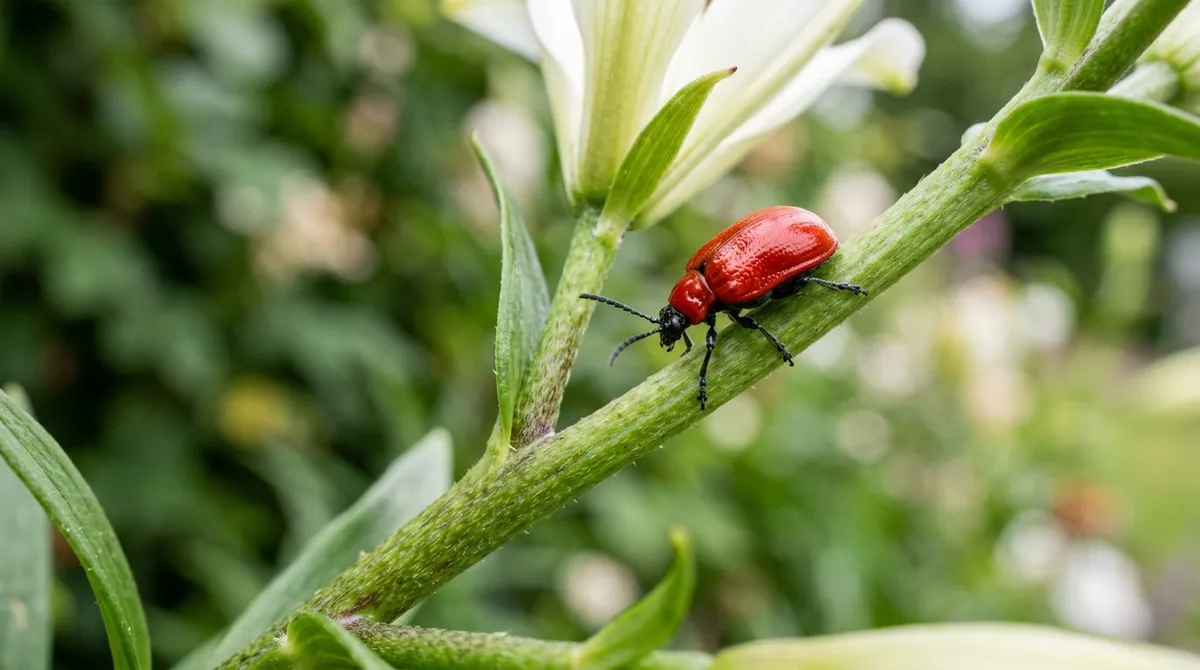
The red lily beetle is the most damaging pest of garden lilies in the UK. This bright scarlet beetle, just 6-8mm long, strips leaves, devours buds, and defoliates entire plants if left unchecked. A single pair of beetles and their larvae can destroy 10-15 lily stems in a season. First recorded as an established UK population in Surrey in 1939, it has now spread to every county in England, most of Wales and Scotland, and parts of Northern Ireland.
The good news is that lily beetle is one of the easier garden pests to control without chemicals. The adults are large, conspicuous, and slow-moving. Hand-picking alone, done consistently, keeps damage to tolerable levels. This guide covers identification of every life stage, the beetle’s annual cycle, and every control method from hand-picking to biological control.
How to identify red lily beetle
Lilioceris lilii is unmistakable once you know what to look for. No other common UK garden beetle looks quite like it.
Adult beetles
Adults are 6-8mm long with a bright scarlet red body, black head, black legs, and black antennae. The wing cases (elytra) are smooth and glossy. Viewed from above, the body is an elongated oval.
They are often found sitting on lily leaves in sunshine, especially in the morning. When disturbed, they drop to the ground and land on their backs, showing their black underside. This makes them almost invisible against dark soil. They also produce a high-pitched squeak (stridulation) when handled.
Do not confuse lily beetle with:
| Beetle | Colour | Size | Difference |
|---|---|---|---|
| Red lily beetle | Bright scarlet, black head/legs | 6-8mm | Smooth, glossy wing cases |
| Cardinal beetle | Red-orange, flattened | 15-20mm | Much larger, fan-shaped antennae |
| Soldier beetle | Orange-red with black tips | 10-14mm | Softer body, found on flower heads |
| Rosemary beetle | Metallic green-purple stripes | 6-8mm | Striped, found on herbs |
| Scarlet malachite beetle | Scarlet with green tips | 6-8mm | Green-tipped wing cases, found on flowers |
Eggs
Female beetles lay eggs in irregular rows on the underside of lily leaves from April to mid-July. Each egg is 1mm long, cylindrical, and bright orange-red when fresh, darkening to deep red before hatching. A single female lays 200-300 eggs per season in batches of 3-12.
Eggs hatch in 6-10 days depending on temperature. Warmer springs (above 15C) accelerate hatching. Check the underside of every lily leaf from mid-April onwards.
Larvae
Larvae are the most damaging stage but the hardest to spot. They are soft-bodied, orange-brown grubs up to 9mm long with a black head. They cover themselves with their own wet, black excrement (frass), creating a slimy blob that disguises them and deters predators.
Look for shiny black blobs on the undersides of leaves. Beneath each blob is a larva actively feeding. They skeletonise leaves by eating the tissue between the veins, leaving a lace-like skeleton. Larvae feed for 16-24 days before dropping to the soil to pupate.
Pupae
Larvae pupate in the soil at a depth of 5-10cm, enclosed in a cocoon of soil particles. The pupal stage lasts 16-22 days. New adults emerge from the soil in August and September, feed briefly, then burrow back into the soil to overwinter.
Gardener’s tip: Familiarise yourself with the excrement-covered larvae. Most gardeners spot the bright red adults but walk past the larvae because they look like bird droppings or dirt. The larvae cause more damage than the adults. Removing one larval blob can save an entire leaf.
Lily beetle lifecycle in the UK
Understanding the annual cycle helps you target control efforts at the most effective times.
| Period | Life stage | Activity | Control opportunity |
|---|---|---|---|
| Late March-April | Adults emerge | Leave soil, fly to lily shoots, begin feeding | Hand-pick as soon as first adults appear |
| April-July | Egg-laying | Females lay 200-300 eggs on leaf undersides | Inspect leaves, crush eggs weekly |
| May-August | Larvae feeding | Larvae skeletonise leaves under frass covering | Remove larvae 3x weekly, spray neem oil |
| June-August | Pupation | Mature larvae drop to soil and pupate at 5-10cm depth | Disturb soil lightly around lily bases |
| August-September | New adults emerge | Feed briefly on remaining lily foliage | Hand-pick new generation before they burrow |
| October-March | Overwintering | Adults dormant 5-10cm deep in soil | Winter soil disturbance, mulch removal |
The critical window is April to July. This is when adults are mating, eggs are being laid, and larvae are feeding. Consistent action during this period prevents the population from building.
Which plants do lily beetles attack?
Red lily beetle feeds on a narrow range of host plants, all in the family Liliaceae and related groups.
Primary hosts (severe damage)
All species and cultivars of Lilium (true lilies) are attacked. This includes Asiatic hybrids, Oriental hybrids, Trumpet lilies, Martagon lilies, L. regale, L. longiflorum, and all other Lilium species. No true lily is immune.
Fritillaria species are also attacked, including Fritillaria imperialis (crown imperial), F. meleagris (snake’s head fritillary), and F. persica. Damage is typically less severe than on lilies because fritillaries grow earlier in the season, before beetle populations peak.
Secondary hosts (occasional feeding)
Lily beetle has been recorded feeding on Nomocharis, Cardiocrinum (giant Himalayan lily), and occasionally Convallaria (lily of the valley) and Polygonatum (Solomon’s seal). Damage to these is usually minor.
Plants NOT attacked
Daylilies (Hemerocallis) are not true lilies and are never attacked by lily beetle despite the similar common name. Other lily-like plants such as Agapanthus, Crocosmia, Nerine, and Amaryllis are also unaffected. If lily beetle makes growing true lilies too frustrating, these alternatives provide a similar garden effect without the pest problem.
Hand-picking: the primary control method
Hand-picking is the most effective control for lily beetle in home gardens. It requires no equipment, costs nothing, and achieves 80-90% population reduction when done consistently.
Technique
Approach plants slowly. Lily beetles are alert to vibration and will drop from the leaf when they sense you coming. Hold one hand or a piece of white card beneath the beetle before reaching for it with the other hand. When it drops, it lands in your hand rather than disappearing into the soil.
Crush beetles between finger and thumb (they have a hard exoskeleton but are not difficult to kill). Alternatively, drop them into a pot of soapy water.
Frequency
Inspect all lily plants three times per week from early April to late August. This sounds like a lot, but each inspection takes only 5-10 minutes for a typical collection of 20-30 lily stems. Focus on:
- Upper leaf surfaces for adult beetles
- Leaf undersides for eggs (orange-red rows) and frass-covered larvae
- Growing tips and flower buds where adults feed
- The soil surface beneath plants where dropped beetles land
Warning: Lily beetles are strong fliers and will recolonise from neighbouring gardens. Even perfect hand-picking on your own plants does not guarantee zero beetles. Nearby gardens with unmanaged lilies act as a reservoir population. This is why consistent, repeated removal is essential rather than a one-off effort.
Egg removal
Run your finger along the underside of each leaf to crush eggs. They are small and fragile. A weekly check during April-July catches most eggs before they hatch. Each batch of eggs you destroy prevents 3-12 larvae from feeding.
Larval removal
Pick off the black frass-covered blobs with your fingers or use a soft paintbrush to dislodge them into soapy water. Larvae beneath the frass are soft and easy to crush. Check every leaf on every plant. A single missed larva can defoliate an entire stem.
Organic sprays for lily beetle
When hand-picking alone cannot keep up with a heavy infestation, organic sprays provide additional control.
Neem oil
Neem oil is the most effective organic spray against lily beetle. It contains azadirachtin, which disrupts insect feeding, growth, and reproduction. Neem deters egg-laying, inhibits larval development, and reduces adult feeding.
Dilute 5ml of cold-pressed neem oil in 1 litre of warm water with 2-3 drops of washing-up liquid as an emulsifier. Spray thoroughly onto both upper and lower leaf surfaces every 7-10 days from April to August. Spray in the evening to avoid harming pollinators. Neem breaks down in sunlight within 3-5 days, so regular reapplication is necessary. For broader organic pest control methods, see our full guide.
Why we recommend neem oil as the primary spray for lily beetle: After 30 years of growing lilies in UK gardens, cold-pressed neem oil applied every 7-10 days from April onwards consistently reduces beetle damage by 70-80% when combined with hand-picking. Unlike pyrethrum, it does not kill bees and hoverflies visiting lily flowers. A single 250ml bottle at around £8 makes 50 litres of spray solution, enough for a season’s treatment of 20-30 lily stems. The azadirachtin in neem also disrupts larval development even when larvae are hidden under their frass coating.
Pyrethrum
Pyrethrum sprays (derived from chrysanthemum flowers) kill lily beetle adults and young larvae on contact. They break down within hours in sunlight. Spray directly onto beetles for best results. Pyrethrum is non-selective and kills beneficial insects too, so use as a targeted spot treatment rather than a blanket spray.
Garlic spray
A homemade garlic spray deters adult beetles from feeding and laying eggs. Crush 4 garlic bulbs in 1 litre of boiling water, steep overnight, strain, and dilute 1:10. Spray onto lily foliage weekly. It does not kill beetles but makes the plants less attractive. Reapply after rain.
Chemical controls
For gardeners who find hand-picking and organic sprays insufficient, synthetic insecticides offer faster knockdown. Use these as a last resort and be aware of the impact on beneficial insects.
Available products
| Active ingredient | Product examples | Effectiveness | Persistence | Impact on beneficials |
|---|---|---|---|---|
| Deltamethrin | Bayer Provado, various | High (kills on contact) | 2-4 weeks on foliage | High: kills bees, ladybirds, hoverflies |
| Lambda-cyhalothrin | Westland Resolva | High | 2-3 weeks | High |
| Acetamiprid | Bug Clear Ultra | High (systemic) | 3-4 weeks | Moderate-high |
| Fatty acids (organic) | Various brands | Moderate (contact only) | Hours | Low |
| Neem oil (organic) | Various brands | Moderate | 3-5 days | Low |
Systemic products like acetamiprid are absorbed into the plant and kill beetles that feed on treated foliage for several weeks. They are more effective against hidden larvae than contact sprays. However, systemic insecticides also enter pollen and nectar, posing a risk to pollinators visiting nearby flowers.
Warning: Never spray insecticides on open lily flowers. Lilies produce abundant pollen and are visited by bees, hoverflies, and butterflies. Spray before buds open or after flowers fade. Target leaf undersides where larvae feed rather than flowers. Check the product label for bee-safety information.
Biological control: Tetrastichus setifer
The most promising long-term solution for lily beetle is a tiny parasitoid wasp called Tetrastichus setifer. This wasp, just 1-2mm long, lays eggs inside lily beetle larvae. The wasp larvae develop inside the host, killing it before it can pupate.
CABI research programme
The Centre for Agriculture and Bioscience International (CABI), based in Surrey, has been researching T. setifer since the early 2000s. After extensive safety testing to ensure the wasp would not attack non-target species, they began field releases in 2010.
Over 50 release sites across England have received T. setifer. Early results are encouraging. At several sites, lily beetle parasitism rates have reached 70-90%, significantly reducing beetle populations. The wasp appears to be establishing and spreading naturally from release points.
Current availability
T. setifer is not yet available for gardeners to purchase. It remains a research programme, not a commercial product. If it establishes widely across the UK, it could provide passive, permanent control without any gardener intervention. This is how the biological control of Japanese knotweed psyllid works in principle, though that programme targets a plant rather than an insect.
Other natural predators
Few UK predators eat lily beetles because the bright red colour signals toxicity (the beetles sequester bitter compounds from lily plants). However, some natural mortality occurs:
- Parasitic flies (Tachinidae) occasionally parasitise larvae
- Ground beetles eat eggs and small larvae that fall to soil level
- Birds (especially starlings) sometimes learn to eat the adults
- Frogs and toads eat larvae that drop to ground level during rain
Cultural controls and prevention
Reducing the beetle population without sprays or picking is possible through garden management techniques.
Winter soil disturbance
Adults overwinter 5-10cm deep in soil near the base of lilies. In November or December, lightly fork over the soil around lily clumps to a depth of 10-15cm. This exposes dormant beetles to frost, rain, and predators (particularly robins and blackbirds, which will pick them out of turned soil).
Do not dig deeply enough to damage lily bulbs. Most lilies are planted 15-20cm deep, so light surface cultivation is safe.
Container growing
Growing lilies in pots and moving them away from infested ground reduces beetle access. Beetles still fly to potted lilies, but container-grown plants are easier to inspect thoroughly. Bring pots close to a seating area where you pass them daily. You will spot and remove beetles as a matter of routine.
Resistant varieties
No lily variety is immune to lily beetle, but some tolerate damage better than others due to vigorous growth or abundant foliage.
| Variety/group | Vigour | Foliage density | Recovery from damage |
|---|---|---|---|
| Lilium regale | Very strong | Dense | Excellent: regrows strongly after defoliation |
| Asiatic hybrids | Strong | Moderate | Good |
| Oriental-Trumpet (OT) hybrids | Very strong | Dense | Excellent |
| Martagon lilies | Moderate | Moderate | Fair: slow to recover if defoliated |
| L. longiflorum | Moderate | Sparse | Poor: limited foliage reserves |
Lilium regale is the toughest choice for beetle-prone gardens. It grows vigorously, sets seed freely, and recovers quickly from larval feeding. The fragrant white trumpets open in July. Plant it alongside sweet peas for a classic cottage garden pairing.
Common mistakes with lily beetle control
1. Starting too late. The first adults emerge in late March. If you wait until May when damage is visible, you have already lost 6-8 weeks of egg-laying. Begin inspecting lilies as soon as shoots appear above ground.
2. Checking only the top of leaves. Adults sit on upper surfaces, but eggs and larvae are on the underside. Lift every leaf and check beneath it. The most damaging stage (larvae) is the one hidden from view.
3. Assuming one clearing is enough. Lily beetles fly. New adults arrive from neighbouring gardens throughout the season. A single hand-picking session removes today’s beetles, but more appear within days. Consistency is everything. Three checks per week from April to August is the minimum.
4. Ignoring fritillaries. If you grow crown imperials, snake’s head fritillaries, or other Fritillaria species, beetles feed on these first (they emerge earlier than lilies). Clearing beetles from fritillaries in April reduces the population before your lilies start growing.
5. Throwing beetles on the ground. Dropped beetles land on their black undersides and are instantly camouflaged against soil. Always catch them in your hand or over a container. Crush or drown them immediately. Any beetle that reaches the ground is effectively lost.
Now you’ve mastered lily beetle identification and control, read our guide on organic pest control for UK gardens for the full range of chemical-free methods to protect your plants.
Frequently asked questions
What does lily beetle damage look like?
Leaves are stripped to bare stalks or have ragged holes. Adults eat clean-edged holes in leaves and petals. Larvae skeletonise leaves from the underside, leaving only the veins. Flower buds are eaten before they open. Look for black, slimy excrement blobs on leaf undersides. These contain the larvae feeding underneath.
When is lily beetle most active in the UK?
Adults emerge from soil in late March or early April. They mate and lay eggs from April to mid-July. Larvae feed from May to August. New adults appear in August and feed until October before burrowing into soil to overwinter. Peak damage occurs between May and July when both adults and larvae are feeding simultaneously.
Do lily beetles attack daylilies?
No. Red lily beetles attack true lilies (Lilium species) and fritillaries (Fritillaria) only. Daylilies (Hemerocallis) are not affected despite the similar common name. If you want lily-like flowers without beetle problems, plant daylilies, Agapanthus, or Crocosmia instead.
Can I use biological control against lily beetle?
The parasitoid wasp Tetrastichus setifer is being researched by CABI and has been released at over 50 UK sites since 2010. It lays eggs inside lily beetle larvae, killing them. However, it is not yet available for gardeners to buy. Research is ongoing, with establishment confirmed at several release sites. Nematodes effective against other beetles do not work on lily beetle.
What is the best spray for lily beetle?
Neem oil is the most effective organic spray. Dilute 5ml per litre with a drop of washing-up liquid and spray leaf undersides every 7-10 days from April to August. It disrupts feeding and egg-laying. For severe infestations, synthetic pyrethroids containing deltamethrin or lambda-cyhalothrin give faster knockdown but also kill beneficial insects.
How do lily beetles overwinter?
Adults burrow 5-10cm into the soil in October, usually near the base of host plants or in nearby borders. They stay dormant through winter and emerge when soil temperatures reach 10-12C in late March or April. Disturbing soil around lilies in winter exposes beetles to frost, predators, and birds.
Should I remove lilies from my garden because of lily beetle?
No. Lily beetles are manageable with regular hand-picking. Three inspections per week from April to August keeps damage below acceptable levels. Many gardeners grow outstanding lilies despite beetle pressure. Choose tough varieties like Lilium regale, the Asiatic hybrids, and Oriental-Trumpet crosses that produce enough foliage to tolerate some feeding damage.
Lawrie has been gardening in the West Midlands for over 30 years. He grows his own veg using no-dig methods, keeps a wildlife-friendly garden, and writes practical advice based on real UK growing conditions.