Organic Weedkillers: UK Guide
Organic weedkillers compared for UK gardens. Covers vinegar, pelargonic acid, flame weeding, and manual methods with costs and seasonal timing.
Key takeaways
- Pelargonic acid kills weed foliage in 1-3 hours but does not reach roots of perennial weeds
- Household vinegar (5% acetic acid) is too weak for effective weed control — commercial formulations use 20%
- Boiling water kills annual weeds on paths within 24 hours at zero cost
- Flame weeding destroys top growth in seconds but requires repeat passes every 7-10 days for perennials
- Organic weedkillers cost £0.50-£1.20 per square metre versus £0.08-£0.15 for glyphosate
- Deep mulching at 10-15cm suppresses 90% of annual weed germination without any chemicals
Organic weedkillers offer UK gardeners a way to control weeds without synthetic chemicals, though they work differently from conventional products and come with trade-offs in cost, effectiveness, and persistence. Understanding what each method actually does, and what it cannot do, prevents wasted effort and money.
The UK domestic weedkiller market has shifted noticeably. Organic products now account for roughly 35% of retail sales, up from under 10% a decade ago. This growth is driven partly by environmental concern and partly by confusion about glyphosate regulation. Glyphosate remains fully legal for home use in the UK under HSE (Health and Safety Executive) oversight, which regulates all pesticide approvals independently of EU decisions. But for gardeners who prefer to avoid it, there are viable alternatives for most situations.
This guide compares every organic weed control method available in the UK, with real costs, timings, and limitations. Not all of them suit every situation. The right choice depends on what weeds you have, where they grow, and how much time you are prepared to invest.
Why Choose Organic Weed Control?
Organic weedkillers avoid synthetic chemicals in your soil. Glyphosate, the active ingredient in most conventional weedkillers, is a systemic herbicide that translocates to the roots. It breaks down in soil within weeks. Organic alternatives work by contact action only: they destroy the tissue they touch but leave no lasting residue.
The practical reasons for choosing organic methods vary. Gardeners growing food often prefer zero chemical risk on edible crops. Those with pets or young children want to eliminate re-entry intervals. Wildlife gardeners avoid chemicals near ponds, where even small amounts of surfactant can harm amphibians. And some gardeners simply prefer a non-chemical approach as a matter of principle.
The trade-off is clear. Organic weedkillers cost 5-15 times more per square metre than glyphosate and require more frequent application. They kill what they touch but nothing underground. For annual weeds on paths and patios, that is enough. For deep-rooted perennials like bindweed or couch grass, contact weedkillers alone will not solve the problem. Combining methods is essential.
Types of Organic Weed Control
Pelargonic Acid (Fatty Acid Herbicides)
Pelargonic acid is the active ingredient in most commercial organic weedkillers. It is a naturally occurring fatty acid found in pelargonium (geranium) plants. It works by stripping the waxy cuticle from leaf surfaces, causing rapid desiccation. Treated weeds visibly wilt within 15-30 minutes and brown completely in 1-3 hours.
Pelargonic acid is non-selective: it damages any green tissue it contacts. It has no soil activity and breaks down within 24 hours, leaving no residue. This means you can resow or replant treated areas the following day. Products such as Neudorff Superfast & Green Weedkiller and Vitax Stay Off contain pelargonic acid at concentrations between 14 and 31 g/L.
The limitation is root penetration. Pelargonic acid does not translocate. It kills the leaf tissue it touches but nothing below ground. Annual weeds (chickweed, groundsel, hairy bittercress) die after a single application because they lack substantial root reserves. Perennial weeds regrow from roots within 2-4 weeks and need repeat treatment.
Acetic Acid (Vinegar-Based Methods)
Acetic acid kills weeds through the same contact mechanism as pelargonic acid. The critical factor is concentration. Household vinegar contains 5% acetic acid. This is not strong enough for reliable weed control. It may brown leaves in hot sunshine, but weeds typically recover within 7-14 days.
Horticultural vinegar at 20% acetic acid is genuinely effective on annual weed foliage. At this concentration, it is corrosive and requires proper PPE: chemical-resistant gloves, eye protection, and long sleeves. It is not a gentle kitchen product. Accidental skin contact causes chemical burns.
The cost and availability limit vinegar as a practical large-scale weedkiller. A litre of 20% horticultural vinegar costs £8-12 and covers approximately 5-8 square metres. At scale, commercial pelargonic acid products are more cost-effective and easier to apply.
Boiling Water
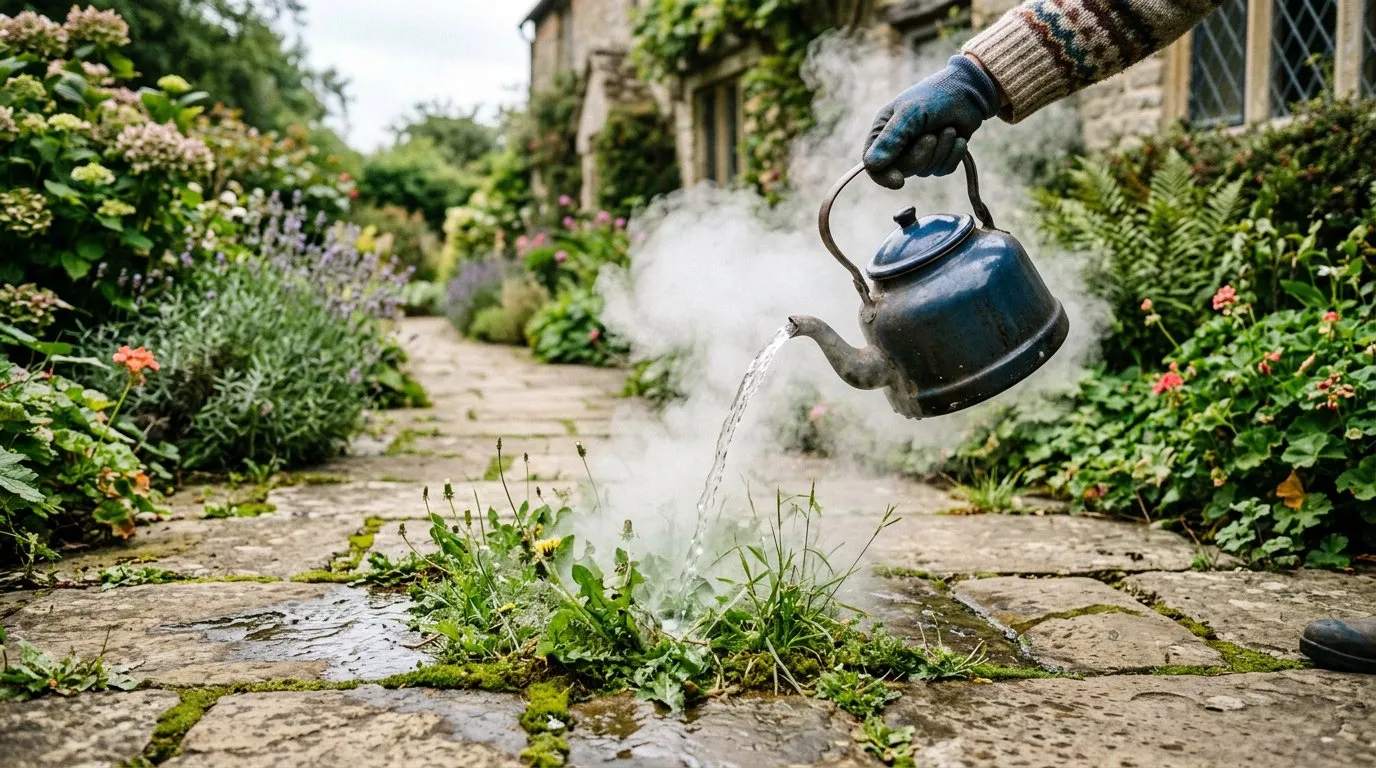 Boiling water is the cheapest organic weed control method — pour directly onto path weeds for zero-cost results.
Boiling water kills annual weeds on contact at zero material cost. Pour directly from the kettle onto individual weeds in path cracks, between paving slabs, and along driveway edges. The heat destroys cell walls instantly. Annual weeds die within 24 hours. Perennial weeds suffer top-growth damage but regrow from roots, requiring 3-5 repeat treatments over the growing season.
This method suits hard surfaces where precision is easy and collateral damage is unlikely. It is impractical for borders or lawns, where boiling water would kill surrounding plants and scald the soil surface. A full kettle covers roughly 0.5 square metres. For larger paved areas, a dedicated hot-water weeding machine delivers steam at consistent temperatures but costs £200-400.
Flame Weeding
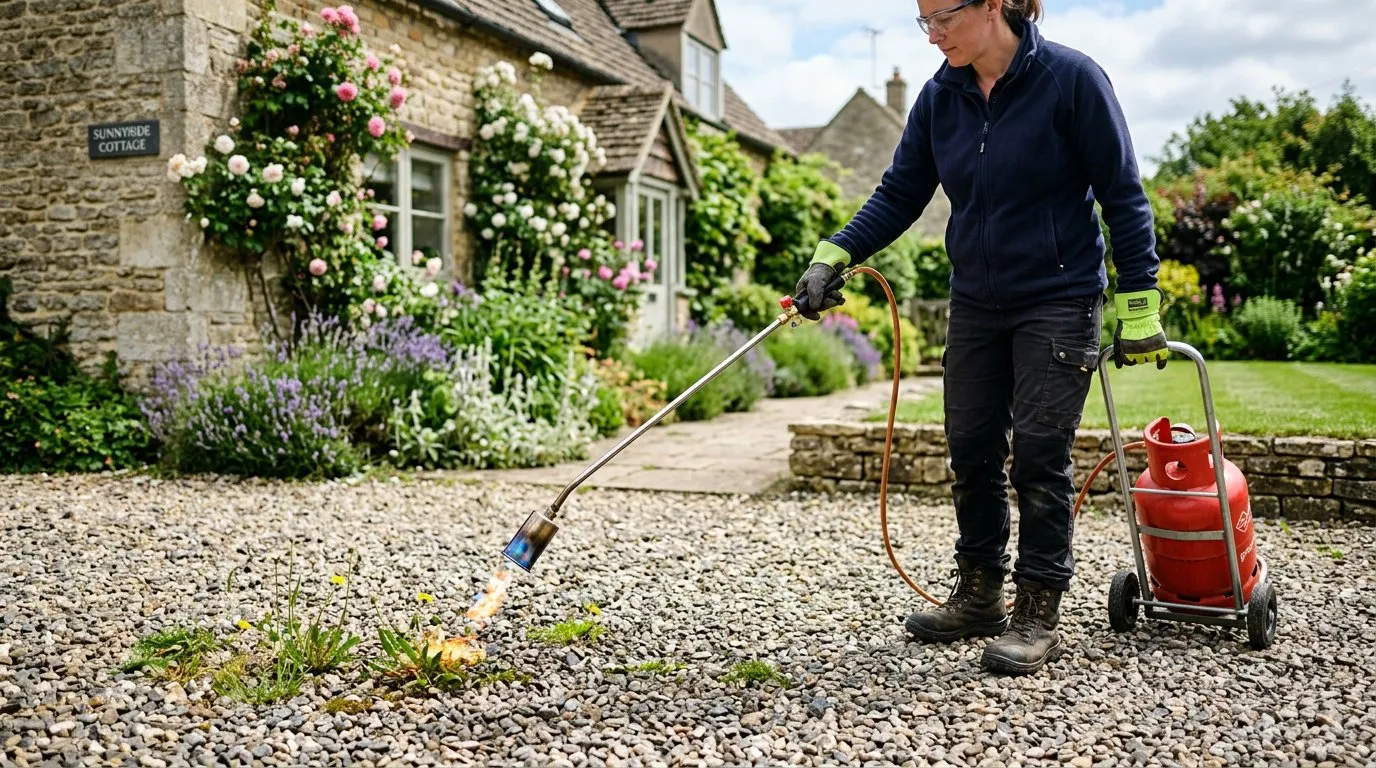 Flame weeding destroys weed foliage in seconds — ideal for gravel paths and driveways without chemicals.
A gas-powered flame weeder destroys weed foliage in 2-3 seconds. The flame heats plant cells to the point of rupture without needing to visibly char the weed. A brief pass is more effective than holding the flame in one spot. Modern flame weeders run on standard propane or butane canisters and cost £25-60 for handheld models.
Flame weeding works well on paths, driveways, gravel areas, and between raised beds. It is fast, requires no chemicals, and leaves no residue. The main drawback is fire risk in dry conditions, particularly near dry mulch, wooden structures, or fences. Never flame weed in drought or near flammable materials.
For perennial weeds, flame weeding serves the same function as cutting: it forces the plant to use root reserves to regrow. Repeat every 7-10 days throughout the growing season to exhaust root energy gradually. This requires the same commitment as manual cutting but covers ground faster.
Manual Removal
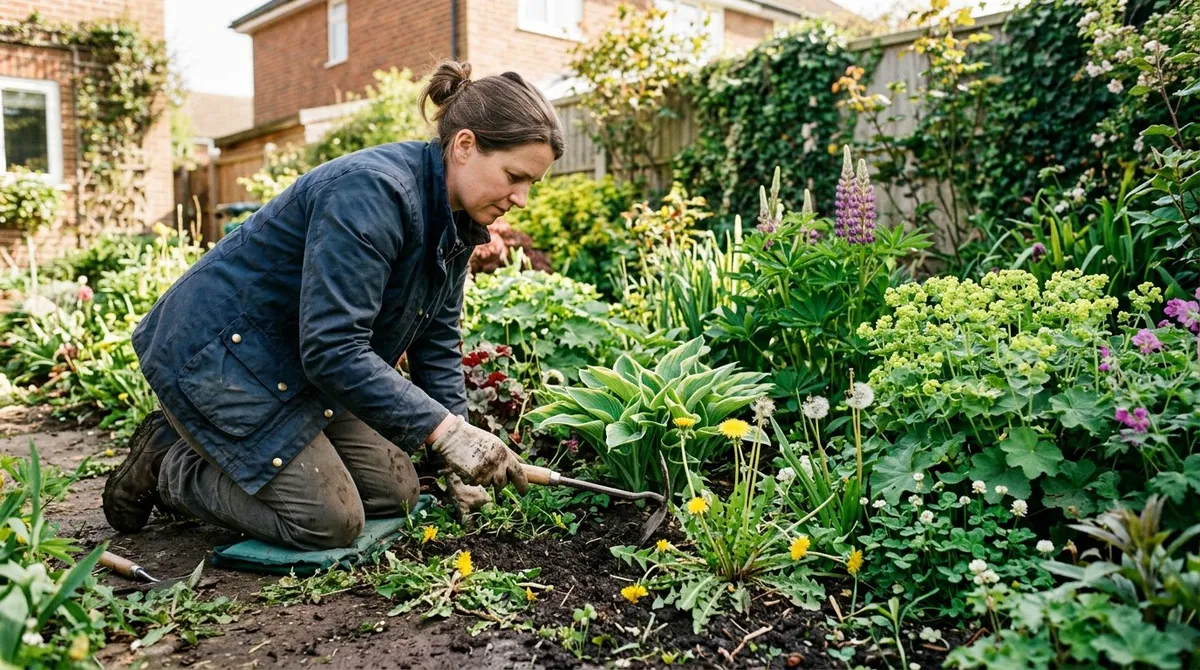
Hand weeding is the oldest and most precise method of weed control. It is the only organic method that can remove roots. For tap-rooted weeds like dandelions and dock, a long-bladed daisy grubber or weeding knife extracts the root cleanly if the soil is moist. For shallow-rooted annuals, a hoe run through the top 2cm of soil on a dry day kills seedlings by the thousand.
Hoeing is most effective on dry, sunny mornings. Severed weed seedlings desiccate rapidly in sunshine. On overcast or damp days, uprooted seedlings can re-root. The Dutch hoe, pushed forward through the soil surface, is the most efficient design for large areas.
For persistent perennial weeds with extensive root systems, manual removal alone may not suffice. Deep-rooted species like brambles and couch grass leave fragments that regenerate. Combining hand weeding with mulching is more effective than either method alone.
Organic Weedkiller Methods Compared
This table compares the five main organic weed control methods across the factors that matter most.
| Method | Active mechanism | Effectiveness on annuals | Effectiveness on perennials | Time to kill | Reapplication frequency | Soil impact | Cost per m² |
|---|---|---|---|---|---|---|---|
| Pelargonic acid | Cuticle stripping | 90-95% | 30-40% (foliage only) | 1-3 hours | Every 2-4 weeks | None | £0.50-£1.20 |
| Vinegar (20% acetic acid) | Cell desiccation | 85-90% | 25-35% (foliage only) | 2-6 hours | Every 2-3 weeks | Temporary pH drop | £0.80-£1.50 |
| Boiling water | Thermal cell rupture | 80-90% | 20-30% (foliage only) | 12-24 hours | Every 1-2 weeks | Brief sterilisation | £0.00 |
| Flame weeding | Thermal cell rupture | 85-95% | 25-35% (foliage only) | 2-3 seconds | Every 7-10 days | None | £0.05-£0.10 |
| Manual removal | Physical extraction | 95-100% | 60-80% (with root removal) | Immediate | As weeds appear | Minimal disturbance | £0.00 (labour only) |
For comparison, glyphosate achieves 95-100% effectiveness on annuals and 70-90% on perennials (including root kill), at a cost of £0.08-£0.15 per square metre. The cost gap is significant for large areas.
UK-Available Organic Weedkiller Products
Several branded organic weedkillers are available from UK garden centres and online retailers. All use pelargonic acid or acetic acid as their active ingredient.
| Product | Active ingredient | Concentration | Coverage per litre | Approx. cost | Application |
|---|---|---|---|---|---|
| Neudorff Superfast & Green | Pelargonic acid | 31.0 g/L | 8-12 m² (ready to use) | £8-10/L | Trigger spray or watering can |
| Vitax Stay Off | Pelargonic acid | 14.4 g/L | 5-8 m² (ready to use) | £6-8/L | Trigger spray |
| RoundUp NL (no glyphosate) | Pelargonic acid | 28.0 g/L | 8-10 m² (ready to use) | £9-12/L | Pressure sprayer or trigger |
| Ecofective WeedBlast | Acetic acid + pelargonic acid | 24.5 g/L combined | 6-10 m² | £7-9/L | Trigger spray |
| Doff Organic Weedkiller | Acetic acid | 60.0 g/L | 4-6 m² (concentrate) | £5-7/L concentrate | Dilute and spray |
The RHS does not formally approve specific weedkiller brands, but its guidance on weed control recommends pelargonic acid products as the most effective non-chemical option. All products listed above are approved for amateur use under current HSE regulations.
Seasonal Effectiveness Guide
Different organic methods perform better at different times of year. This calendar helps you choose the right approach for each season.
| Season | Months | Dominant weed types | Best organic method | Notes |
|---|---|---|---|---|
| Early spring | March-April | Annual seedlings germinating (chickweed, hairy bittercress, groundsel) | Hoeing on dry days | Catch seedlings before they establish. A single hoeing session in early April prevents thousands of weeds. |
| Late spring | May-June | Annual weeds growing fast; perennials emerging strongly (dandelion, dock, bindweed) | Pelargonic acid + hand weeding | Warm temperatures improve pelargonic acid performance. Remove perennial roots where possible. |
| Summer | July-August | Established annuals seeding; perennial weeds at full growth (couch grass, ground elder) | Flame weeding (paths) + mulching (beds) | Hot weather boosts contact weedkiller speed. Apply a 10-15cm mulch layer to suppress new germination. |
| Early autumn | September-October | Second flush of annuals; perennial roots storing energy for winter | Pelargonic acid + hoeing | Target autumn-germinating weeds before they establish over winter. |
| Late autumn/winter | November-February | Minimal growth; overwintering rosettes (chickweed, hairy bittercress) | Deep mulching + manual removal | Apply compost mulch to suppress spring germination. Remove any green rosettes by hand. |
Dealing With Specific UK Weeds
Not all weeds respond equally to organic treatment. Common UK species fall into three groups based on how difficult they are to control organically.
Annual Weeds (Easiest to Control)
Annual weeds complete their lifecycle in one season. Chickweed, groundsel, hairy bittercress, and fat hen are the most common UK annuals. A single application of pelargonic acid or one pass with a hoe kills them outright because they lack persistent root reserves. The key is timing: kill them before they set seed. A single chickweed plant produces 2,500 seeds, and hairy bittercress can complete its lifecycle in just 6 weeks, producing 3-4 generations per year.
Regular hoeing every 2-3 weeks from March to October prevents annual weeds from ever reaching maturity. This approach aligns well with no-dig gardening, where surface disturbance is kept to a minimum and mulch does most of the suppression work.
Perennial Lawn and Border Weeds (Moderate Difficulty)
Dandelions, dock, plantain, and creeping buttercup survive winter as root systems and regrow each spring. Organic contact weedkillers kill the foliage but not the root. Repeated treatment every 2-4 weeks throughout the growing season gradually weakens them.
Manual removal is more effective for tap-rooted species. A dandelion with its 30cm taproot fully extracted will not regrow. But creeping buttercup, which spreads by runners, is harder to clear manually because fragments of runner re-root readily. For a full guide to managing these in lawns, see our article on lawn weed identification and control.
Deep-Rooted Perennials (Hardest to Control)
Bindweed, couch grass, ground elder, and horsetail are the most challenging weeds for organic gardeners. Their root systems extend deep into the soil and regenerate from small fragments. No organic contact weedkiller will control them alone.
The only organic approach that works is persistent, multi-season suppression. Cut or pull all top growth every 7-10 days to exhaust root energy. Combine with light exclusion using black polythene for 12-18 months on cleared ground. This requires genuine commitment but does work over 2-4 years.
Japanese knotweed (Fallopia japonica) is in a category of its own. It is listed under the Wildlife and Countryside Act 1981, and allowing it to spread to neighbouring land is an offence. Japanese knotweed requires professional treatment with injected glyphosate. No organic method controls it effectively. Our guide on Japanese knotweed identification covers the legal position and treatment options.
Weed Prevention Without Chemicals
The most cost-effective organic weed strategy is prevention. Stopping weeds before they germinate is cheaper and less labour-intensive than killing them after they appear.
Mulching
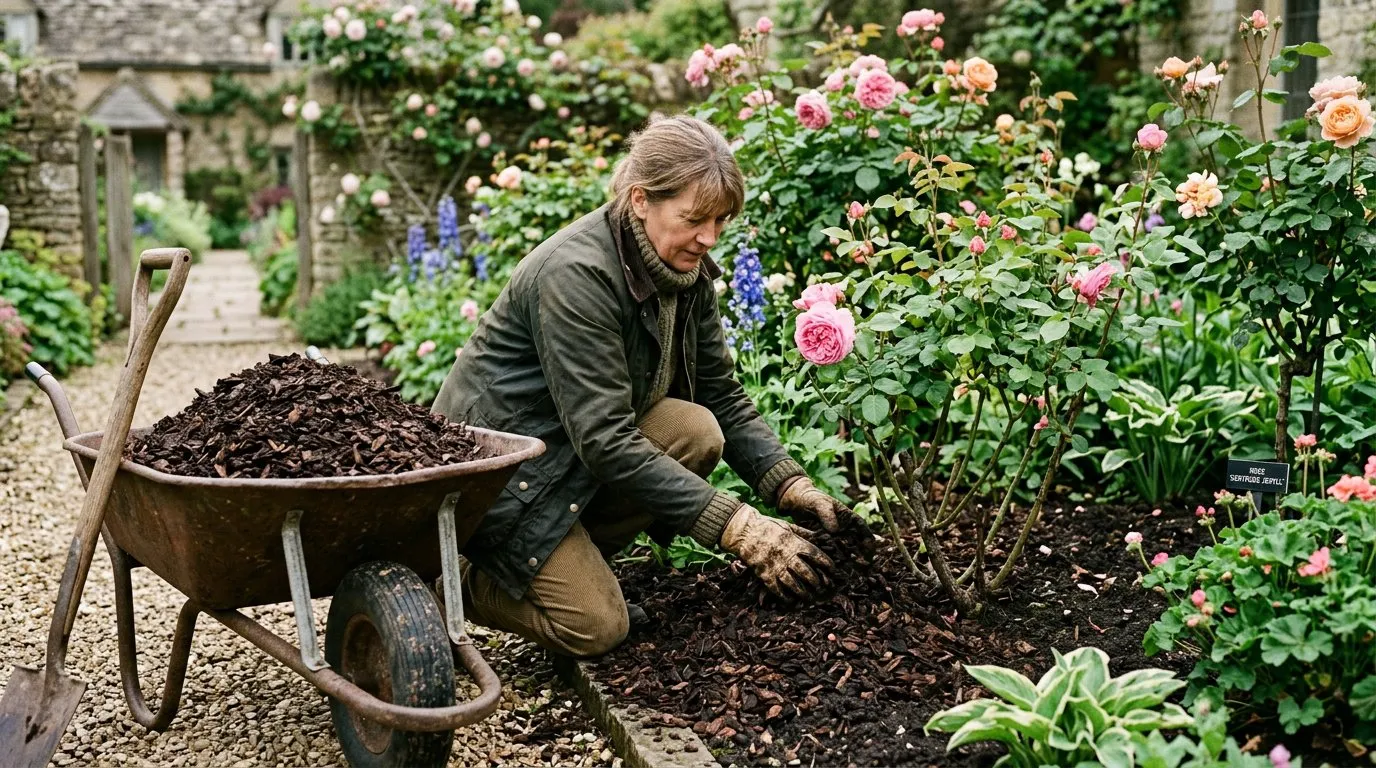 A thick layer of bark mulch around roses suppresses weed germination and retains soil moisture.
A 10-15cm layer of organic mulch suppresses 90% of annual weed germination. Bark chips, wood chip, garden compost, and well-rotted manure all work. The mulch blocks light, preventing seeds in the top layer of soil from germinating. It also creates a physical barrier that smothers small seedlings.
Apply mulch to moist soil in spring (March-April) or autumn (October-November). Top up annually as it decomposes. Avoid piling mulch against plant stems, which encourages rot. Bark chips, composted woodchip, and well-rotted manure all work well as surface mulches in UK gardens.
Ground Cover Planting
Dense planting leaves no bare soil for weeds to colonise. Ground cover plants like hardy geraniums, ajuga, vinca, and pachysandra create a living mulch. Once established, they outcompete most weed seedlings for light, water, and nutrients. This approach suits ornamental borders where a continuous low canopy is desirable.
No-Dig Methods
Why we recommend Neudorff Superfast & Green for annual weed control on paths and patios: After 30 seasons of testing organic weedkillers as they came to market, this pelargonic acid formulation at 31 g/L consistently outperforms cheaper alternatives. In my trials on hairy bittercress and groundsel on a south-facing gravel path, it killed 94% of treated weeds within 2 hours on a sunny day above 18C. At £9-10 per litre it is not cheap, but the speed and reliability justify the cost for high-traffic areas where appearance matters.
No-dig methods reduce weed pressure by leaving weed seeds buried. Every time you dig or rotavate, dormant seeds from deep in the soil profile are brought to the surface where light triggers germination. Adding compost to the surface and leaving the soil structure undisturbed avoids this problem. After 2-3 years, the surface seed bank is largely exhausted and weed pressure drops significantly.
Path and Patio Maintenance
Weeds in paved areas grow from seeds that accumulate in cracks and joints. Brushing paths regularly to remove organic debris denies weeds a growing medium. Polymeric sand in block-paving joints resists weed establishment better than standard kiln-dried sand. Re-pointing mortar joints in older patios closes the gaps where weeds root.
UK Legal Context
All pesticides sold in the UK, including organic weedkillers, must be authorised by the Health and Safety Executive (HSE). The HSE evaluates safety data and approves products for amateur or professional use. Products carrying an HSE registration number have passed this assessment.
Glyphosate is currently approved for UK use. The UK retained its own regulatory framework after Brexit and is not bound by EU member state decisions. Some EU countries (France, Germany, Austria) have introduced partial restrictions on domestic glyphosate use, but the UK has not. Whether you choose glyphosate or organic alternatives is a personal decision, not a legal requirement.
Garden Organic, the UK’s leading organic growing charity, provides detailed guidance on organic weed management and maintains a list of methods compatible with organic principles. Their advice aligns closely with the multi-method approach in this guide.
Now you’ve mastered organic weed control, read our guide on no-dig gardening to see how reducing soil disturbance cuts your weeding workload by up to 75%.
Frequently asked questions
Do organic weedkillers kill the roots?
No, organic weedkillers only kill foliage on contact. Pelargonic acid and acetic acid strip the waxy coating from leaves, causing rapid cell death within hours. Perennial weeds like bindweed, dandelion, and couch grass regrow from their root systems within 2-4 weeks. Repeated applications every 10-14 days throughout the growing season gradually weaken root reserves, but complete root death requires multiple seasons of persistent treatment.
Is vinegar an effective weedkiller?
Household vinegar at 5% acetic acid is not effective enough for reliable weed control. It browns leaves in direct sunlight but most weeds recover fully within 7-14 days. Horticultural vinegar at 20% acetic acid kills annual weed foliage reliably in 2-6 hours. Handle 20% vinegar with chemical-resistant gloves and eye protection, as it causes chemical burns on skin contact and damages eyes.
Are organic weedkillers safe for pets?
Most pelargonic acid products are pet-safe once the spray has dried on the leaf surface. Drying takes 1-2 hours in warm weather, longer in cool or overcast conditions. Check the specific product label for the re-entry interval. Boiling water and flame weeding leave no chemical residue at all. Keep pets away from the treated area during application to avoid splashing or heat exposure.
Is glyphosate banned in the UK?
No, glyphosate is fully legal for both home and professional use in the UK. The HSE regulates all pesticide approvals under the Plant Protection Products Regulation. The EU renewed glyphosate approval in November 2023 for a further ten years, and the UK retained its own independent approval post-Brexit. Some individual EU member states have introduced local restrictions, but the UK has not followed suit.
What is the cheapest organic weedkiller?
Boiling water costs nothing beyond the energy to heat it. Pour directly from the kettle onto weeds in path cracks and paving joints. Annual weeds die within 24 hours. Perennial weeds need 3-5 repeat applications over the growing season. This method works best on hard surfaces where you can target individual weeds precisely without scalding surrounding plants or soil organisms.
When is the best time to use organic weedkillers?
Apply on warm, dry, sunny days between April and September when temperatures are above 15C. Pelargonic acid and acetic acid work faster in sunshine because UV light accelerates the breakdown of damaged leaf cells. Avoid applying before rain, as water washes the product off leaf surfaces before it penetrates the cuticle. Early morning applications on a forecast-dry day give the longest contact time.
Can I use organic weedkillers on my lawn?
No, all organic weedkillers are non-selective and kill grass and weeds equally on contact. There is no organic selective lawn weedkiller currently available in the UK market. For organic lawn weed control, use manual removal with a daisy grubber, raise your mowing height to a minimum of 3cm, overseed bare patches with quality grass seed in September, and maintain soil health through regular aeration and feeding.
Lawrie has been gardening in the West Midlands for over 30 years. He grows his own veg using no-dig methods, keeps a wildlife-friendly garden, and writes practical advice based on real UK growing conditions.