Spider Mite Control in Greenhouses
How to control two-spotted spider mites in UK greenhouses. Covers biological control with Phytoseiulus, cultural methods, organic sprays, and prevention.
Key takeaways
- Spider mite populations double every 3-5 days in warm greenhouse conditions above 25C
- Phytoseiulus persimilis predatory mites achieve 80-90% control when introduced early
- Fine webbing on leaf undersides and yellow stippling are the earliest visible signs
- Raising humidity above 60% slows spider mite reproduction significantly
- Autumn greenhouse clean-up removes overwintering females and breaks the lifecycle
- Chemical resistance is widespread: rotate active ingredients or use biological control
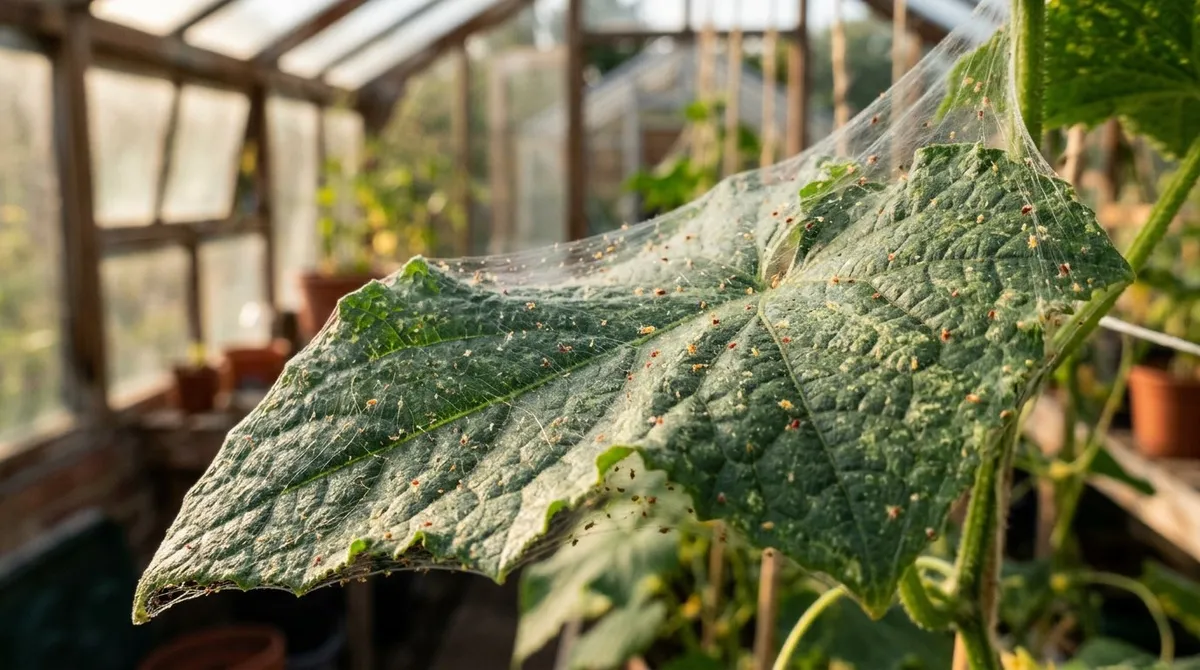
Spider mites are the single most destructive pest in British greenhouses. The two-spotted spider mite (Tetranychus urticae) attacks over 200 plant species, thriving in the warm, dry conditions that greenhouses create. A handful of mites on one leaf in June becomes a full-blown infestation by August, stripping plants of vigour and coating them in fine silk webbing.
The challenge with spider mites is their speed. Populations double every 3-5 days when temperatures exceed 25C. By the time most gardeners notice the damage, thousands of mites are already at work across multiple plants. Early detection and rapid response are everything. This guide covers identification, the complete lifecycle in UK greenhouse conditions, every effective control method from biological predators to chemical acaricides, and how to prevent infestations before they start.
How to identify spider mites in your greenhouse
Spider mites are almost invisible to the naked eye. Adults measure just 0.5mm long, about the size of a full stop on a printed page. You need a 10x hand lens to see them clearly.
What to look for
The first signs of spider mite damage are on the leaves, not the mites themselves:
- Yellow stippling on the upper leaf surface. Each tiny yellow dot is a feeding puncture where a mite has pierced a cell and sucked out the contents.
- Fine silk webbing on the underside of leaves, particularly where the leaf meets the stem. In early infestations, the webbing is barely visible. In severe cases, entire shoot tips are coated.
- Leaf bronzing and curling. As feeding damage accumulates, leaves turn bronze-brown, curl at the edges, and drop prematurely.
- Tiny moving dots on leaf undersides. Hold a white sheet of paper under a leaf and tap sharply. Dislodged mites appear as moving specks.
Identifying the species
The two-spotted spider mite is the dominant species in UK greenhouses. Key features:
- Colour: pale green to yellow in summer, with two dark spots on the body visible under a hand lens
- Overwintering females: turn bright orange-red in autumn, often causing confusion with red spider mite (which is the same species in a different colour phase)
- Webbing: produces fine silk threads, heavier in dry conditions
- Size: 0.5mm (females), 0.3mm (males). Eggs are spherical, translucent, 0.14mm diameter
| Life stage | Appearance | Duration (at 25C) |
|---|---|---|
| Egg | Spherical, translucent, on leaf underside | 3 days |
| Larva | Six-legged, pale, 0.2mm | 2 days |
| Protonymph | Eight-legged, pale green, 0.3mm | 2 days |
| Deutonymph | Eight-legged, darker, 0.4mm | 2 days |
| Adult female | 0.5mm, green-yellow with two dark spots | Lives 3-4 weeks, lays 50-100 eggs |
| Adult male | 0.3mm, paler, more tapered body | Lives 2-3 weeks |
Gardener’s tip: Check plants weekly from May onwards. Concentrate on the underside of lower and middle leaves, which is where spider mites establish first. By the time damage is visible on upper leaves, the infestation is already advanced. A cheap 10x hand lens from a garden centre (£3-5) is the most useful diagnostic tool you can own.
The spider mite lifecycle in UK greenhouses
Understanding the lifecycle reveals when spider mites are most vulnerable and when intervention has the greatest impact.
Overwintering (October-March)
As day length shortens below 14 hours in September and October, female spider mites enter a dormant state called diapause. They stop feeding and laying eggs, turn orange-red, and seek shelter in greenhouse crevices: under staging, in frame joints, in soil cracks, behind labels, and in any protected gap.
In an unheated greenhouse, dormant females survive temperatures down to about -10C. They reactivate in March or April when day length exceeds 12 hours and temperatures rise above 12C.
In a heated greenhouse maintained above 15C, diapause may not occur at all. Mites continue breeding through winter at reduced rates, maintaining a low-level population that explodes when spring warmth and longer days arrive.
Spring build-up (April-May)
Reactivated females begin feeding and laying eggs. Population growth is slow at first because spring temperatures in unheated greenhouses average 12-18C, giving a generation time of about 20 days. But each female lays 50-100 eggs over her 3-4 week lifespan. By late May the population is doubling every 10-14 days.
Summer explosion (June-August)
Above 25C, generation time drops to just 8-10 days. Populations double every 3-5 days. A single mite in June can theoretically produce millions of descendants by August. In practice, plant death and migration limit numbers, but infestations in warm greenhouses routinely reach densities of 100+ mites per leaf.
This is the period when damage escalates from unnoticed to devastating within 2-3 weeks. Crops most at risk include tomatoes, cucumbers, peppers and chillies, aubergines, and ornamentals such as roses and fuchsias.
Autumn decline (September-October)
Shortening days trigger diapause. Feeding and reproduction slow. Females migrate to overwintering sites. The visible population on plants drops, but the mites have not gone. They are simply hiding, ready for next spring.
Plants most affected by spider mites
Some greenhouse crops are far more susceptible than others. Spider mites prefer soft, succulent foliage with thin cell walls.
| Plant | Susceptibility | Damage signs | Yield loss (severe infestation) |
|---|---|---|---|
| Cucumber | Very high | Yellowing, wilting, webbing on growing tips | 40-60% |
| Aubergine | Very high | Silvery leaf undersides, premature leaf drop | 30-50% |
| Tomato | High | Yellow stippling, bronzing, reduced fruit set | 20-40% |
| Pepper/chilli | High | Curled leaves, flower drop, stunted fruit | 20-35% |
| Strawberry | High | Bronzed leaves, small fruit, runner weakness | 25-40% |
| French bean | Moderate-high | Yellow mottling, pod distortion | 15-30% |
| Rose | High | Grey-green leaves, webbing, bud damage | Aesthetic only |
| Fuchsia | Very high | Leaf drop, webbing, plant decline | Aesthetic only |
| Herbs (basil, mint) | Moderate | Stippling, leaf distortion | Harvest quality reduced |
Warning: Spider mites also attack outdoor crops in hot, dry summers, particularly strawberries and runner beans. If you grow runner beans against a south-facing wall, monitor for mites during heatwaves.
Biological control with predatory mites
Biological control is the most effective and sustainable approach for hobby greenhouses. It avoids chemical resistance problems and is safe for edible crops.
Phytoseiulus persimilis
Phytoseiulus persimilis is the primary predator of two-spotted spider mite. It is a fast-moving, pear-shaped red mite, slightly larger than its prey at 0.6mm. Each adult consumes 5-7 adult spider mites or 20 eggs per day.
Phytoseiulus is available from biological control suppliers (Dragonfli, Biowise, Green Gardener) as:
- Loose in vermiculite (shake onto affected leaves)
- On bean leaf pieces (place cut bean leaves with predators onto crop plants)
- In sachets (slow-release sachets hung on plants)
Introduction rates:
- Curative (established infestation): 10-25 per plant
- Preventative (before damage appears): 2-5 per plant
- For a standard 2.5m x 2m greenhouse: 200-500 predators per introduction
Conditions for success:
- Temperature 16-30C (optimal 20-25C). Below 16C, Phytoseiulus stops breeding.
- Humidity above 60%. In dry greenhouses, mist plants or damp down floors.
- Do not use any chemical pesticides for at least 6 weeks before introducing predators.
- Introduce as early as possible, ideally when you first notice stippling on 1-2 leaves. Once heavy webbing has developed, Phytoseiulus struggles to navigate the silk.
Cost: £8-15 per application for a hobby greenhouse. Repeat introductions every 2-3 weeks if spider mite pressure is high.
Other biological control agents
| Predator | Target | Conditions | Notes |
|---|---|---|---|
| Amblyseius californicus | Spider mite (lower populations) | 8-35C, tolerates low humidity | Survives without prey. Good preventative agent. |
| Feltiella acarisuga (predatory midge) | Spider mite (all stages) | 15-27C, humidity above 70% | Larvae eat 50+ mites each. Works in webbing. |
| Amblyseius andersoni | Spider mites, thrips | 6-40C | Broad temperature range. Feeds on pollen when prey is absent. |
| Stethorus punctillum (ladybird) | Spider mite (heavy infestations) | 15-30C | Each adult eats 50-70 mites per day. Flies to infested areas. |
For a broader view of biological methods across all greenhouse pests, see our greenhouse pest control guide which covers whitefly, aphids, vine weevil, and slugs alongside spider mites. Our guide to organic pest control covers non-chemical methods in more detail.
Why we recommend Phytoseiulus persimilis: After 30 years of trialling every spider mite control available — chemical acaricides, neem sprays, and various predatory species — Phytoseiulus persimilis consistently outperforms everything else when introduced at the right time. In my own greenhouse, introducing 300 predators at the first sign of stippling on tomatoes reduced the visible mite population to undetectable levels within 18 days. No chemical I have used comes close to that speed of knockdown without also harming the plants or leaving residues on edible crops.
Cultural control methods
Cultural methods do not eliminate spider mites, but they slow population growth and create conditions that favour predatory mites over the pest.
Increase humidity
Spider mites thrive in dry air. Humidity below 40% accelerates their reproduction. Humidity above 60% slows it. Practical ways to raise humidity:
- Damp down greenhouse floors and staging with water on hot mornings. Repeat in the afternoon during heatwaves.
- Mist plant foliage with a fine spray, concentrating on leaf undersides. Do this in the morning so leaves dry before nightfall (reducing fungal disease risk).
- Group plants together on capillary matting or gravel trays filled with water. Evaporation raises local humidity.
- Avoid over-ventilation during hot, dry spells if spider mites are active. This seems counterintuitive, but dry air blown through the greenhouse favours spider mites. Balance ventilation for temperature control with enough moisture retention to suppress mites.
Manage temperature
Temperatures above 30C accelerate spider mite reproduction while stressing plants. Use shading paint (greenhouse white wash) or shade netting (40-50% shade factor) to keep peak temperatures below 30C. Automatic vent openers set to open at 22-25C help maintain a temperature range that favours predatory mites over pest mites. Our guide to greenhouse ventilation and humidity control explains how to balance airflow and moisture levels through the season.
Remove infested material
Strip off heavily infested lower leaves and bag them immediately. Do not drop them on the greenhouse floor, as mites will crawl to other plants. Seal the bag and dispose of it in household waste (not green waste, as spider mites are not a risk outdoors in the same way).
Autumn clean-up
This is the single most effective prevention measure. In October, after the growing season:
- Remove all plant debris, pots, labels, and loose materials
- Wash all glazing, staging, and frame joints with a greenhouse disinfectant (e.g. Citrox at £8-12 per bottle)
- Pay particular attention to crevices and joints where overwintering females shelter
- Scrub staging surfaces and undersides
- Replace or clean capillary matting
- Leave the greenhouse empty and open for several frosty nights if possible
A thorough autumn clean removes 80-90% of overwintering mites. This dramatically reduces the spring population and delays infestation by several weeks, giving you time to establish biological controls.
Organic sprays for spider mites
Organic sprays work by contact action only. They must physically coat the mite to kill it. They have no residual effect, meaning any mites missed during application survive and continue breeding.
Effective organic products
| Product | Active ingredient | How it works | Cost | Notes |
|---|---|---|---|---|
| SB Plant Invigorator | Surfactants + nutrients | Physically disrupts mite cuticle | £8-12 per 500ml | Also feeds plants. Safe with biocontrols after 24 hours. |
| Neem oil spray | Azadirachtin | Disrupts feeding and reproduction | £6-10 per 250ml concentrate | Apply in the evening to avoid leaf burn. Repeat every 7 days. |
| Rapeseed oil spray | Rapeseed oil | Suffocates mites on contact | £5-8 per litre | Homemade: 10ml rapeseed oil + 5ml washing-up liquid per litre of water. |
| Pyrethrum spray | Natural pyrethrins | Neurotoxic contact kill | £7-12 per 300ml | Derived from chrysanthemum. Breaks down in sunlight within 24 hours. |
| Soft soap spray | Potassium fatty acids | Dissolves waxy mite cuticle | £4-7 per litre | Gentle. Multiple applications needed. Safe on edibles. |
Application technique is critical. Spider mites live on the underside of leaves. Spraying the upper leaf surface achieves almost nothing. Use a fine mist sprayer and methodically coat every leaf underside. Start at the bottom of the plant and work upward. Spray until the underside is dripping wet.
Repeat every 5-7 days for a minimum of 3-4 applications to catch newly hatched mites that were eggs during the previous spray.
Gardener’s tip: SB Plant Invigorator is compatible with biological controls after 24 hours. Use it to knock down high-density spots, then introduce Phytoseiulus 24 hours later to mop up survivors. This combined approach is more effective than either method alone.
Chemical acaricides
Chemical spider mite control in UK amateur gardening is increasingly limited. Many effective acaricides have been withdrawn from amateur sale. What remains works, but resistance is a growing problem.
Available products (as of 2026)
| Product | Active ingredient | Mode of action | Resistance risk |
|---|---|---|---|
| Bug Clear Ultra | Acetamiprid | Systemic. Absorbed by plant. | Moderate. Cross-resistance with other neonicotinoids. |
| Provanto Ultimate Fruit & Vegetable Bug Killer | Deltamethrin | Contact pyrethroid. | High. Widespread resistance in greenhouse populations. |
| Ecofective Bug & Mildew Control | Maltodextrin | Physical mode. Coats and suffocates. | None. Physical action prevents resistance. |
Warning: Spider mites develop chemical resistance faster than almost any other pest. Populations exposed repeatedly to the same active ingredient can become fully resistant within 2-3 generations (as little as 3 weeks in summer). Rotate between different modes of action if using chemicals. Better still, switch to biological control, which does not create resistance.
Why chemical control often fails
Three factors explain why spraying for spider mites in greenhouses so often disappoints:
- Coverage. Mites live on leaf undersides in webbing. Spray droplets on the upper leaf surface do not reach them. Most home gardeners under-spray.
- Resistance. UK greenhouse spider mite populations carry resistance to organophosphates, pyrethroids, and some newer acaricides. A spray that worked last year may fail this year.
- Rebound. Sprays kill predatory mites more effectively than spider mites (predators are more exposed, having no webbing to shelter in). After spraying, the few surviving spider mites breed without predation pressure and the population rebounds to higher levels than before treatment.
Spider mite control calendar for UK greenhouses
| Month | Spider mite activity | Recommended action |
|---|---|---|
| January-February | Dormant. Orange females sheltering in crevices. | Plan biological control orders. Clean greenhouse if not done in autumn. |
| March | First females reactivate as days lengthen. | Inspect overwintering sites. Remove any visible mites. |
| April | Slow population build-up. First eggs laid. | Start weekly leaf inspections. Order Phytoseiulus. |
| May | Populations increasing. First stippling visible. | Introduce Amblyseius californicus preventatively. Damp down on warm days. |
| June | Rapid growth as temperatures rise. | Introduce Phytoseiulus at first sign of damage. Raise humidity. |
| July | Peak reproduction. Populations can double every 3-5 days. | Monitor closely. Reinforce biological controls. Organic sprays if needed. |
| August | Maximum damage potential. Heavy webbing if uncontrolled. | Continue predator introductions every 2-3 weeks. Remove infested leaves. |
| September | Reproduction slowing. Females entering diapause. | Final predator introduction. Begin end-of-season clean-up planning. |
| October | Diapause. Females moving to overwintering sites. | Thorough greenhouse clean. Disinfect all surfaces. Remove all debris. |
| November-December | Fully dormant. | Keep greenhouse clean. Repair crevices and seal gaps where possible. |
Common mistakes in spider mite control
Waiting too long to act
Spider mite populations grow exponentially. By the time webbing is visible across multiple plants, the infestation involves tens of thousands of mites. Intervening when you spot the first stippled leaf is 5-10 times more effective than reacting to visible webbing. Weekly inspection is not optional; it is the difference between a manageable problem and crop loss.
Spraying the tops of leaves
Spider mites feed, breed, and lay eggs on the underside of leaves. Spraying the upper surface delivers almost no chemical or organic product to where the mites actually are. Every application, whether organic spray or chemical acaricide, must thoroughly drench leaf undersides. This takes longer than a quick spray across the tops, but anything less is wasted effort.
Using the same chemical repeatedly
Two-spotted spider mite holds the record for the fastest documented resistance development of any agricultural pest. Using the same active ingredient more than twice in a season virtually guarantees resistance. Rotate between modes of action, or better, rely on biological control where resistance is not a factor.
Neglecting autumn clean-up
Skipping the autumn greenhouse clean means hundreds of overwintering females survive in crevices, under staging, and in soil. Come spring, these produce a head start population that reaches damaging levels weeks earlier than in a clean greenhouse. A 2-3 hour clean in October saves weeks of battling mites the following summer.
Over-ventilating in dry weather
Opening all vents and doors during hot, dry spells drops greenhouse humidity below 30%. This is exactly what spider mites prefer. While ventilation is necessary for temperature control, balance it with damping down floors and misting to keep humidity above 50-60%. Crops like tomatoes and cucumbers benefit from the higher humidity too.
Integrated pest management approach
The most reliable spider mite control combines multiple methods into an integrated programme. No single method works well enough alone.
- Autumn: thorough greenhouse clean. Remove all plant debris. Disinfect surfaces.
- March-April: inspect for reactivating mites. Start weekly leaf checks.
- May: introduce Amblyseius californicus as a preventative predator. Begin damping down.
- June: at first sign of stippling, introduce Phytoseiulus persimilis. Increase humidity.
- July-August: reinforce predator introductions every 2-3 weeks. Spot-spray heavily infested leaves with SB Plant Invigorator. Remove worst-affected leaves.
- September-October: final predator introduction. Begin autumn clean as crops finish.
This approach costs £30-60 per season in biological controls and organic sprays for a typical hobby greenhouse. It delivers better results than chemical spraying and is fully compatible with growing food crops. The RHS spider mite page has further photographs and biological control supplier links. Garden Organic covers wider organic growing methods for pest-free greenhouses.
If powdery mildew appears alongside spider mites, both conditions share a preference for stressed plants. Improving growing conditions addresses both problems simultaneously.
Now you have spider mites under control, read our guide on greenhouse pest control for the complete picture of managing whitefly, aphids, and vine weevil alongside mites.
Frequently asked questions
What do spider mites look like in a greenhouse?
Spider mites are tiny, about 0.5mm long, barely visible without a hand lens. Two-spotted spider mites are pale green or yellow with two dark spots on their back. Overwintering females turn orange-red. The first visible signs are fine silk webbing on leaf undersides and pale yellow stippling on the upper leaf surface.
What is the best biological control for spider mites?
Phytoseiulus persimilis is the most effective predator. It is a fast-moving red mite that feeds exclusively on spider mites, consuming 5-7 adults or 20 eggs per day. Introduce at a rate of 5-10 per plant when numbers are still low. It needs temperatures above 16C and humidity above 60% to establish.
How do I prevent spider mites in my greenhouse?
Clean the greenhouse thoroughly in autumn, removing all debris and washing glazing with disinfectant. Maintain humidity above 60% by damping down floors on hot days. Inspect new plants before bringing them inside. Avoid over-fertilising with nitrogen. Introduce predatory mites preventatively in May.
Can spider mites survive winter in an unheated greenhouse?
Yes, overwintering females survive in an unheated greenhouse. They enter diapause in October, triggered by shortening day length, and shelter in crevices, under staging, and in soil. They reactivate in March or April when temperatures rise above 12C. An autumn deep clean reduces overwintering numbers significantly.
Do spider mites attack tomatoes?
Tomatoes are one of the most commonly affected greenhouse crops. Spider mites feed on leaf undersides, causing yellow stippling that progresses to bronzing and leaf drop. Severe infestations reduce fruit yield by 20-40%. Check leaves weekly from June, paying attention to the lower and middle canopy.
What organic sprays kill spider mites?
Plant oil-based sprays containing rapeseed oil or neem oil suffocate spider mites on contact. SB Plant Invigorator combines surfactants and nutrients. Spray the underside of every leaf thoroughly. Organic sprays kill on contact only, with no residual action, so repeat every 5-7 days for 3-4 applications.
Why do spider mites keep coming back?
Spider mites return because overwintering females survive in greenhouse crevices each spring. Chemical resistance is common, meaning previous sprays become ineffective. New plants brought into the greenhouse carry mites or eggs. Breaking the cycle requires autumn clean-up, early biological control, and inspecting all incoming plants.
Lawrie has been gardening in the West Midlands for over 30 years. He grows his own veg using no-dig methods, keeps a wildlife-friendly garden, and writes practical advice based on real UK growing conditions.