Tomato Blight: Prevention and Treatment
UK guide to preventing and treating tomato blight. Covers late and early blight, resistant varieties, fungicide timing, and greenhouse vs outdoor growing.
Key takeaways
- Tomato blight can destroy an entire outdoor crop in 7-10 days once symptoms appear
- Greenhouse-grown tomatoes rarely develop blight due to lower leaf wetness
- Blight-resistant varieties like Crimson Crush reduce infection risk by 70-90%
- Preventive copper fungicide spraying must start in late June, before blight arrives
- UK gardeners lose 40-60% of outdoor tomato crops to blight in wet summers
- Blight spores spread on wind from infected potato crops up to 10km away
Tomato blight is the most feared disease in the British vegetable garden. A thriving row of outdoor tomatoes can turn from lush green to brown and dead in under two weeks. The culprit is Phytophthora infestans, the same water mould that caused the Irish potato famine and still destroys potato crops today.
In a wet UK summer, blight can wipe out 40-60% of outdoor tomato plantings nationwide. The disease arrives on wind-borne spores from infected potato crops, sometimes travelling 10km or more. Once those spores land on wet tomato leaves, infection takes hold within hours. There is no cure once symptoms appear. Every effective strategy relies on prevention.
This guide covers how to identify blight, when and how to apply preventive fungicides, which resistant varieties to choose, and why growing under cover turns your chances of a successful harvest. If you are new to growing tomatoes, start with our beginner’s guide to growing tomatoes.
How to identify tomato blight
Catching blight early gives you the best chance of saving part of your crop. Learn to distinguish it from other common tomato problems.
Late blight (Phytophthora infestans)
Late blight is the devastating form. It is the one that destroys entire crops. Symptoms progress quickly:
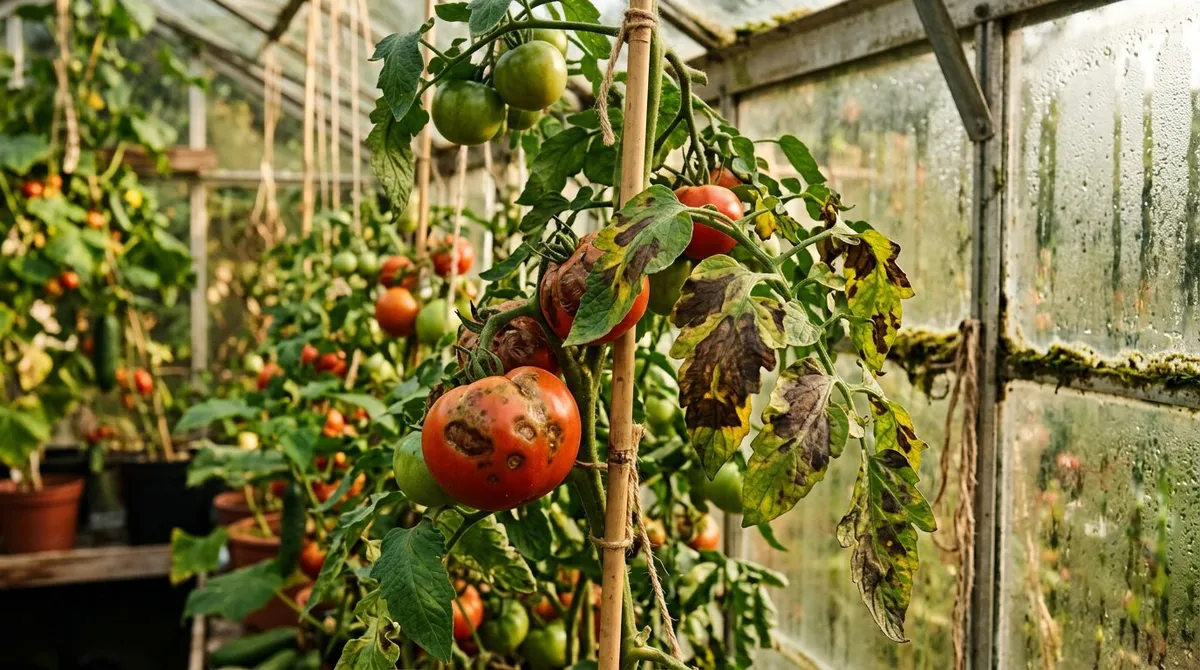
- Leaves: dark brown or black patches appear at leaf tips and edges, often with a yellow halo. In humid weather, a white mould (sporangia) appears on the underside of affected leaves. Patches spread rapidly and whole leaves collapse within 2-3 days.
- Stems: dark brown or black streaks run along stems, particularly near the top of the plant. Affected stems become brittle and snap.
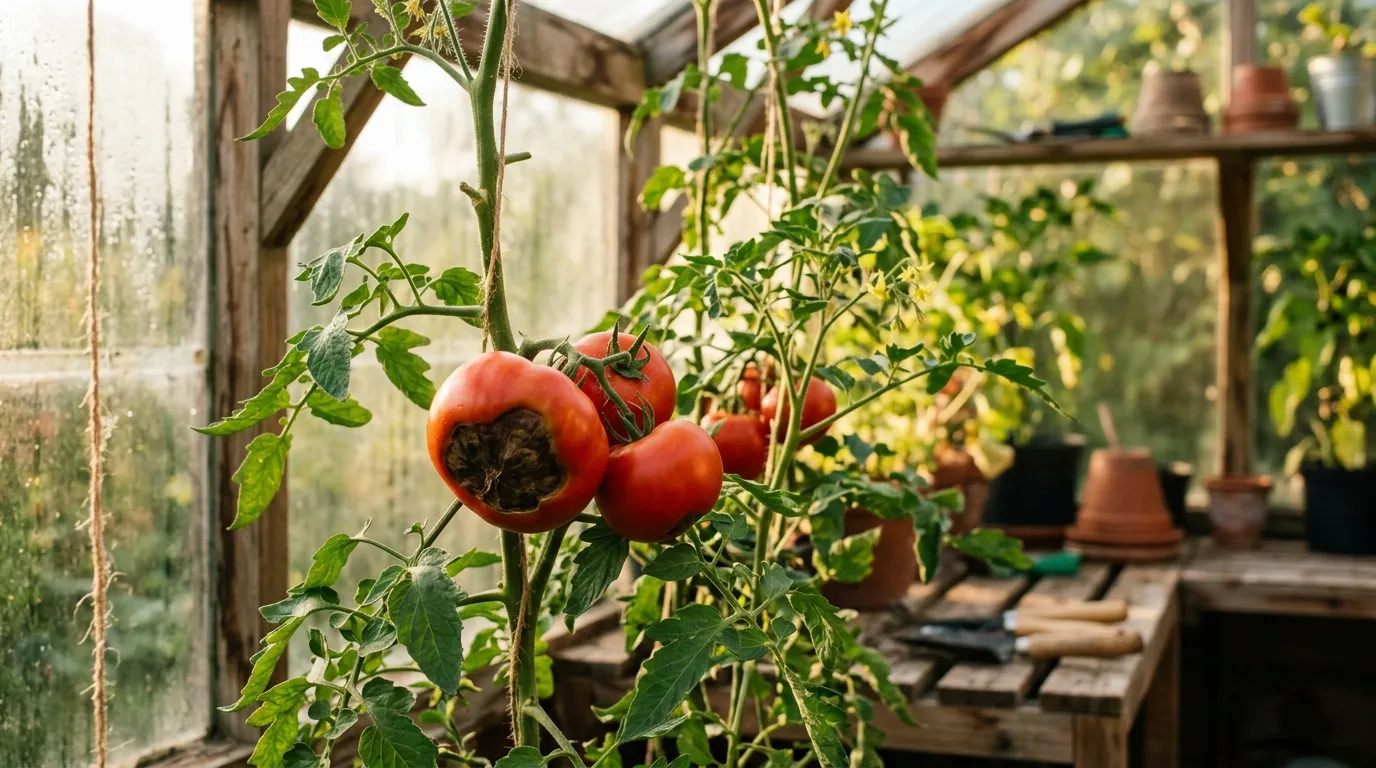
- Fruits: firm brown or purple patches develop, often starting around the calyx (where the fruit meets the stem). Affected areas do not soften immediately but become leathery. Secondary bacterial infection then causes soft rot and a foul smell.
The speed of progression is the defining feature. A plant can go from first symptoms to total collapse in 7-10 days in warm, wet conditions.
Early blight (Alternaria solani)
Early blight is a different disease caused by the fungus Alternaria solani. It is less destructive than late blight but more common in some years.
| Feature | Late blight | Early blight |
|---|---|---|
| Cause | Phytophthora infestans (water mould) | Alternaria solani (fungus) |
| Leaf symptoms | Large dark patches, white mould underneath | Concentric brown rings (“target spots”) |
| Stem symptoms | Dark streaks, rapid collapse | Dark spots, slower progression |
| Fruit symptoms | Firm brown patches, eventual rot | Sunken dark spots near stem end |
| Speed | Destroys plant in 7-10 days | Progresses over several weeks |
| Conditions | Wet, humid, 10-25C | Warm, alternating wet/dry |
| UK severity | Severe in wet years | Moderate, rarely kills plants |
Early blight weakens plants and reduces yield but rarely kills them outright. Removing affected lower leaves often contains the spread.
Other problems that look like blight
Not every brown patch is blight. Before panicking, rule out these common mimics:
- Magnesium deficiency: yellowing between leaf veins, starting on lower leaves. No dark patches or stem damage.
- Blossom end rot: dark, sunken patch on the bottom of the fruit only. Caused by calcium deficiency from irregular watering. Leaves remain healthy.
- Septoria leaf spot: small, round spots with grey centres and dark borders on lower leaves. Spreads slowly upwards.
- Sunscald: white or pale patches on fruit exposed to direct sun. No mould or rot.
What causes tomato blight in the UK
Understanding the biology of Phytophthora infestans helps you predict when blight will strike and take preventive action.
The blight lifecycle
Phytophthora infestans is not a true fungus. It is a water mould (oomycete) more closely related to brown algae. Its lifecycle depends on water at every stage:
- Spore production: infected plant tissue produces sporangia (spore cases) on the leaf surface in humid conditions
- Spore release: sporangia detach and travel on wind, potentially covering 10km or more
- Infection: sporangia land on wet leaves and release zoospores (swimming spores) that enter leaf tissue through stomata
- Colonisation: the organism grows through leaf tissue, killing cells and producing new sporangia within 4-7 days
- Cycle repeats: each new generation of sporangia can infect more plants
The entire cycle from spore landing to new spore production takes 4-7 days in ideal conditions.
The Hutton Criteria
UK plant pathologists developed the Hutton Criteria (replacing the older Smith Period) to predict when blight risk is high. Blight conditions exist when:
- Minimum temperature remains at or above 10C for two consecutive days
- Relative humidity exceeds 90% for at least 6 hours on each of those two days
When the Hutton Criteria are met, blight spores can germinate and infect within 48 hours. The AHDB BlightWatch service tracks these conditions across the UK and sends alerts to registered users.
Why outdoor tomatoes are so vulnerable
Outdoor tomatoes suffer worst because their leaves get wet from rain, dew, and overhead watering. Every droplet of water on a leaf surface is a potential infection site. UK summers deliver exactly the combination of warmth and moisture that blight thrives on. July and August bring average relative humidity above 80% across most of England and Wales.
Potatoes growing in fields, allotments, and gardens are the main reservoir of blight spores. Wind carries these spores to nearby tomato plants. This is why outdoor tomatoes often develop blight 1-2 weeks after the first reports of potato blight in your area.
Prevention methods
Since blight cannot be cured, every effort must go into prevention. The three pillars are: grow under cover, choose resistant varieties, and apply protective fungicide sprays.
Growing tomatoes under cover
Growing tomatoes in a greenhouse or polytunnel is the single most effective way to prevent blight. The disease needs prolonged leaf wetness to infect. Under cover, leaves stay dry. Even a simple rain shelter (a sheet of clear polythene over a frame) dramatically reduces blight risk.
Key practices for growing under cover:
- Water at the base only, never overhead. Use drip irrigation or a watering can directed at the compost.
- Ventilate well to keep humidity below 80%. Open vents and doors on warm days. Close them in the evening to trap warmth.
- Space plants 45-60cm apart to allow air circulation around foliage.
- Remove lower leaves up to the first truss once fruits begin to swell. This improves airflow and removes the leaves closest to the damp soil surface.
Choosing blight-resistant varieties
Plant breeding has produced several tomato varieties with strong resistance to late blight. These are not immune, but they significantly delay or reduce infection.
| Variety | Type | Resistance level | Flavour | Best for |
|---|---|---|---|---|
| Crimson Crush (F1) | Large, beefsteak | Very high | Good, slightly acidic | Outdoor growing |
| Mountain Magic (F1) | Medium, cocktail | High | Excellent, sweet | Outdoor or under cover |
| Losetto | Cherry, tumbling | Good tolerance | Sweet, prolific | Hanging baskets, containers |
| Lizzano (F1) | Cherry, tumbling | Good tolerance | Good | Hanging baskets, containers |
| Cocktail Crush (F1) | Cherry | High | Very sweet | Outdoor or under cover |
| Ferline (F1) | Medium, round | Moderate | Good | Outdoor beds |
| Legend | Large, round | Moderate | Good | Outdoor beds |
Crimson Crush was bred by the John Innes Centre specifically for UK outdoor growing. In field trials, it showed 70-90% less infection than susceptible varieties like Gardener’s Delight or Moneymaker. It is the best choice if you must grow outdoors without fungicide protection.
Gardener’s tip: Grow a blight-resistant variety outdoors as your insurance crop, and your favourite flavoured varieties (Sungold, Gardener’s Delight, Black Cherry) under glass where blight cannot reach them. This way you get both reliability and flavour.
Why we recommend Crimson Crush for outdoor tomato growing in the UK: After 30 years of trialling tomato varieties outdoors in the Midlands — including the notoriously wet summers of 2012, 2021, and 2024 — Crimson Crush is the only variety I grow outdoors without copper fungicide backup. In a side-by-side trial with Gardener’s Delight, Moneymaker, and Crimson Crush grown without any fungicide protection, both susceptible varieties were destroyed by blight within 10 days of first symptoms in August; Crimson Crush showed only two infected leaves on the whole plant and continued cropping for another five weeks, producing 4.2kg per plant.
Preventive fungicide spraying
Copper-based fungicides create a protective barrier on leaf surfaces that kills blight spores before they can penetrate. They must be applied before symptoms appear. Once blight is inside the plant, no fungicide can stop it.
Bordeaux mixture (copper sulphate + hydrated lime) is the traditional preventive spray. It is approved for organic use. Apply from late June as a preventive, or as soon as the Hutton Criteria are first met in your area.
Application schedule:
| Timing | Action |
|---|---|
| Late June | First application if Hutton Criteria met, or as routine prevention |
| Every 10-14 days | Repeat throughout July and August |
| After heavy rain | Reapply within 48 hours as rain washes off the copper coating |
| September | Final spray if warm, wet weather continues |
Apply to all leaf surfaces, including undersides. Cover stems as well. Spray in dry weather so the copper dries onto the leaf surface before rain.
Warning: Copper accumulates in soil over time and is toxic to earthworms at high concentrations. Do not exceed the recommended application rate. Limit copper fungicide use to 6kg of metallic copper per hectare per year (the organic farming maximum). In practice, this means not spraying more than 8-10 times per season on the same ground.
Cultural prevention practices
These simple practices reduce blight risk significantly:
- Never grow tomatoes next to potatoes. Potato blight spores travel to tomato plants first. Separate them by at least 10 metres if possible.
- Avoid overhead watering. Water at the base of plants early in the morning so any splashes dry quickly. Never water in the evening, as wet foliage overnight is an open invitation to blight.
- Remove lower leaves. Strip leaves from the bottom 30cm of each plant by mid-July. This improves airflow and removes the leaves most likely to catch soil-splashed spores.
- Stake and support. Keep plants upright and open. Sprawling, congested growth traps humidity. Use sturdy canes or string supports.
- Mulch around the base. A 5cm layer of straw or bark mulch prevents soil (and any spores it contains) splashing onto lower leaves during rain. See our guide to using mulch for more detail.
- Rotate crops. Do not grow tomatoes in the same spot year after year. Rotate with unrelated crops. Follow our vegetable planting calendar for rotation planning.
Seasonal blight management calendar
| Month | Blight risk | Recommended action |
|---|---|---|
| January-March | None | Order blight-resistant seed varieties |
| April | None | Sow tomato seeds indoors; plan growing locations |
| May | Very low | Harden off plants; plant out after last frost (late May in most of the UK) |
| June | Low-moderate | First fungicide spray in late June if Hutton Criteria met; remove lower leaves |
| July | High | Monitor BlightWatch; spray every 10-14 days; check leaves daily |
| August | Very high | Peak blight month; continue spraying; harvest ripe fruit promptly |
| September | Moderate-high | Harvest remaining fruits; remove and destroy any blighted plants |
| October | Low | Clear all tomato debris; clean greenhouse; do not compost blighted material |
| November-December | None | Plan next year’s layout; order seed for resistant varieties |
What to do when blight strikes
Despite your best efforts, blight may still arrive. Acting fast limits the damage.
Immediate response
- Confirm the diagnosis. Check for dark patches on leaves with white mould underneath. Stems with brown streaks. Firm brown patches on fruit. If in doubt, photograph the symptoms and compare with the RHS blight identification guide.
- Harvest all unaffected fruit immediately. Pick every fruit that shows no brown patches, including green ones. Green tomatoes ripen indoors on a sunny windowsill over 1-2 weeks. You can also make green tomato chutney.
- Remove blighted plants. Cut stems at soil level. Bag all foliage, stems, and affected fruit in black bin bags. Send to council green waste or burn. Never compost blighted material. Spores can survive in home compost heaps.
- Clean up thoroughly. Remove all fallen leaves and fruit from the soil. Blight spores on debris can infect other plants.
Can you save green tomatoes from blighted plants?
Yes, if the fruit itself shows no brown patches. Harvest them, wash in clean water, and bring indoors. Place them in a single layer in a warm room (18-21C) out of direct sunlight. Most will ripen within 7-14 days. Discard any that develop brown patches during ripening.
Store unripe tomatoes with a ripe banana in a paper bag. The banana releases ethylene gas, which accelerates ripening.
Greenhouse vs outdoor growing: a comparison
Growing location determines blight risk more than any other single factor.
| Factor | Outdoor growing | Greenhouse growing |
|---|---|---|
| Blight risk | High in wet years (40-60% crop loss) | Very low (less than 2% crop loss) |
| Leaf wetness | Frequent from rain and dew | Rare if watered at base |
| Humidity control | Impossible | Ventilation manages humidity |
| Season length | June-September (4 months) | April-October (7 months) |
| Variety choice | Blight-resistant essential | Any variety including heritage |
| Fungicide needed | Yes, preventive spraying | Rarely |
| Yield per plant | 2-4kg average | 4-8kg average |
The difference in yield alone justifies growing under cover if you have the space. A single greenhouse tomato plant producing 6kg of fruit is worth more than three outdoor plants that blight destroys in August.
Common mistakes with tomato blight
Waiting until you see symptoms before spraying
Copper fungicide is preventive only. It creates a barrier on leaf surfaces that kills spores on contact. Once blight is inside the leaf tissue, no spray can reach it. Start spraying in late June or when the Hutton Criteria are first met. Waiting until you see brown patches means the infection is already 4-7 days old and spreading.
Growing susceptible varieties outdoors without protection
Heritage and heirloom varieties like Gardener’s Delight, Moneymaker, and Sungold have zero blight resistance. Growing them outdoors in the UK without fungicide protection or rain cover is a gamble you will lose in most years. Save these varieties for the greenhouse. Grow Crimson Crush or Mountain Magic outdoors.
Composting blighted material
Phytophthora infestans spores survive in home compost heaps that do not reach high enough temperatures to kill them. Council green waste processing reaches 60-70C, which destroys spores. Always send blighted material to council waste or burn it. Never add it to your home compost bin.
Overwatering from above
Overhead watering mimics rainfall and creates the leaf wetness blight needs. Even a brief spell of wet foliage in warm weather gives spores enough time to germinate. Always water at the base. If you use a hosepipe, direct it at the soil, not the plants. Drip irrigation is ideal.
Planting tomatoes next to potatoes
Potatoes and tomatoes are both hosts for Phytophthora infestans. Growing them side by side guarantees that blight on one crop immediately spreads to the other. Separate them by the greatest distance your garden allows. Ideally, position them at opposite ends of the plot with other crops between them.
Related growing guides
Blight is not the only challenge facing tomato growers. Aphids commonly infest tomato plants, particularly under glass, and can transmit viruses that weaken plants further. Spider mites thrive in hot, dry greenhouse conditions and damage foliage. For overall pest management in the vegetable garden, see our organic pest control guide.
Healthy, well-fed tomato plants resist disease better than stressed ones. Our tomato growing guide covers feeding, watering, and training for maximum plant health.
Now you have blight prevention covered, read our beginner’s guide to growing tomatoes for the full method on feeding, watering, and training for the best possible harvest.
Frequently asked questions
Can you eat tomatoes with blight?
Unaffected green or ripe fruits from blighted plants are safe to eat. Remove any fruit showing brown patches or firm discoloured areas and discard them. Harvest all remaining healthy fruits immediately when you spot blight on the foliage. Green tomatoes can be ripened indoors on a sunny windowsill or made into chutney.
What does tomato blight look like?
Tomato blight first appears as dark brown or black patches on leaves, usually starting at the leaf tips and edges. Stems develop dark brown streaks. Fruits show firm brown patches that spread and rot. A white mould may appear on leaf undersides in humid conditions. Symptoms spread rapidly from lower leaves upwards.
Is tomato blight the same as potato blight?
Yes, both are caused by the same organism, Phytophthora infestans. Blight spores travel on wind from infected potato fields to nearby tomato plants. This is why outdoor tomatoes often develop blight 1-2 weeks after local potatoes show symptoms. Never grow tomatoes next to potatoes.
Can I save a blighted tomato plant?
Once blight symptoms are visible, the infection cannot be cured. No fungicide reverses existing damage. Remove and destroy affected plants immediately to protect nearby healthy plants. Harvest any unaffected fruits and ripen them indoors. Prevention with resistant varieties and fungicide sprays is the only reliable strategy.
Do greenhouse tomatoes get blight?
Greenhouse tomatoes very rarely develop blight. The disease needs prolonged leaf wetness to infect, and greenhouse conditions keep foliage dry. Good ventilation prevents the humidity buildup that blight requires. If you grow tomatoes in a greenhouse with open doors and windows during heavy rain, spores can enter but infection remains unlikely if leaves stay dry.
When does tomato blight season start in the UK?
Blight season in the UK typically starts in late June or early July. The exact timing depends on weather conditions. Blight needs temperatures between 10-25C and humidity above 90% for 48 hours to produce infective spores. The Hutton Criteria forecast on BlightWatch helps predict when conditions become favourable in your area.
What are the most blight-resistant tomato varieties?
Crimson Crush (F1) is the most blight-resistant variety available in the UK, bred specifically for outdoor growing. Mountain Magic (F1) offers strong resistance with excellent flavour. Losetto is a blight-tolerant tumbling cherry variety ideal for hanging baskets. Lizzano and Cocktail Crush also show good field tolerance.
Should I remove tomato plants with blight?
Remove blighted plants immediately. Cut stems at ground level and bag them for council green waste collection or burn them. Do not compost blighted material as spores can survive in compost heaps. Clear all fallen leaves and fruit from the soil surface. Blight spores do not survive in UK soil over winter.
Lawrie has been gardening in the West Midlands for over 30 years. He grows his own veg using no-dig methods, keeps a wildlife-friendly garden, and writes practical advice based on real UK growing conditions.