Bat-Friendly Gardens UK
How to attract bats to your garden with bat boxes, night-scented plants, and wildlife ponds. Covers all 18 UK bat species and legal protection.
Key takeaways
- All 18 UK bat species are protected by law and it is an offence to disturb them
- Common pipistrelles eat up to 3,000 insects per night including mosquitoes and midges
- Mount bat boxes 4-5 metres high on south or south-west facing walls or trees
- Night-scented flowers attract the moths that bats rely on for food
- Artificial light is the single biggest bat deterrent in gardens
- Bats are active from April to October and hibernate through winter
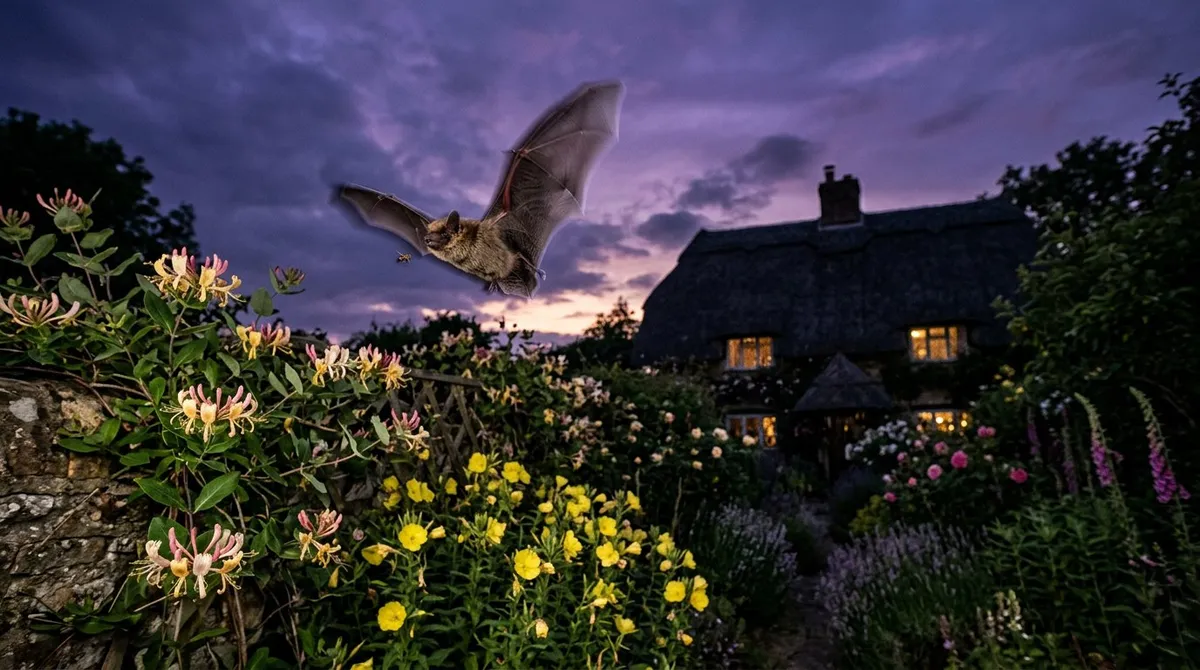
Bats are among the most effective pest controllers in any garden. A single common pipistrelle eats up to 3,000 insects per night, including mosquitoes, midges, and moths. All 18 UK species are legally protected. Yet bat populations have declined severely over the past century due to habitat loss, pesticide use, and light pollution. The Bat Conservation Trust monitors populations and provides guidance on supporting these remarkable mammals.
Making a garden bat-friendly is straightforward. It overlaps heavily with general wildlife gardening. The plants, water features, and dark corridors that help bats also benefit moths, hedgehogs, and other nocturnal creatures. For a broader approach, see our guide to creating a wildlife garden.
UK bat species you might see in your garden
The UK has 18 resident bat species. Most are rare or restricted to specific habitats. But several species regularly visit gardens, especially in suburban and rural areas.
| Species | Wingspan | Weight | Habitat | Garden likelihood |
|---|---|---|---|---|
| Common pipistrelle | 20-23cm | 3-8g | Houses, gardens, woodland edges | Very common |
| Soprano pipistrelle | 19-23cm | 3-8g | Near water, gardens, woodland | Common |
| Brown long-eared | 23-28cm | 6-12g | Woodland, large gardens, parks | Moderate |
| Noctule | 32-40cm | 18-40g | Parkland, woodland, open areas | Occasional |
| Daubenton’s | 24-27cm | 7-12g | Over rivers, ponds, canals | Near water only |
| Serotine | 32-38cm | 15-35g | Pasture, gardens, woodland edges | Southern England |
| Natterer’s | 25-30cm | 7-12g | Woodland, parkland, old buildings | Moderate |
| Leisler’s | 26-32cm | 11-20g | Parkland, woodland, open areas | Occasional |
The common pipistrelle is by far the most likely species in a garden. It roosts in buildings, flying out at dusk through gaps as narrow as 15mm. You can distinguish it from the soprano pipistrelle by its echolocation frequency: 45kHz for common, 55kHz for soprano. A bat detector costing twenty to forty pounds makes identification straightforward.
Legal note: All bats and their roosts are protected under the Wildlife and Countryside Act 1981 and the Conservation of Habitats and Species Regulations 2017. It is a criminal offence to deliberately kill, injure, or disturb bats, or to damage or destroy a roost, even when bats are not present. If you find bats roosting in your home, contact the Bat Conservation Trust before taking any action.
Bat boxes: types and positioning
Bat boxes provide roosting sites where natural cavities are scarce. Modern housing and tree management have removed many of the crevices bats depend on. A bat box restores this lost habitat.
Woodcrete vs timber
Woodcrete boxes (a mix of concrete and sawdust) are the most effective. They retain heat better than timber, resist weather damage, and last twenty to thirty years. They cost twenty to thirty pounds each. Schwegler and Vivara Pro are reliable UK brands.
Timber boxes are cheaper at ten to twenty pounds but deteriorate faster. Use untreated, rough-sawn timber at least 20mm thick. Never use wood preservative. Chemical fumes deter or poison bats. Rough internal surfaces give bats grip.
Where to mount bat boxes
Position is more important than box type. Follow these rules:
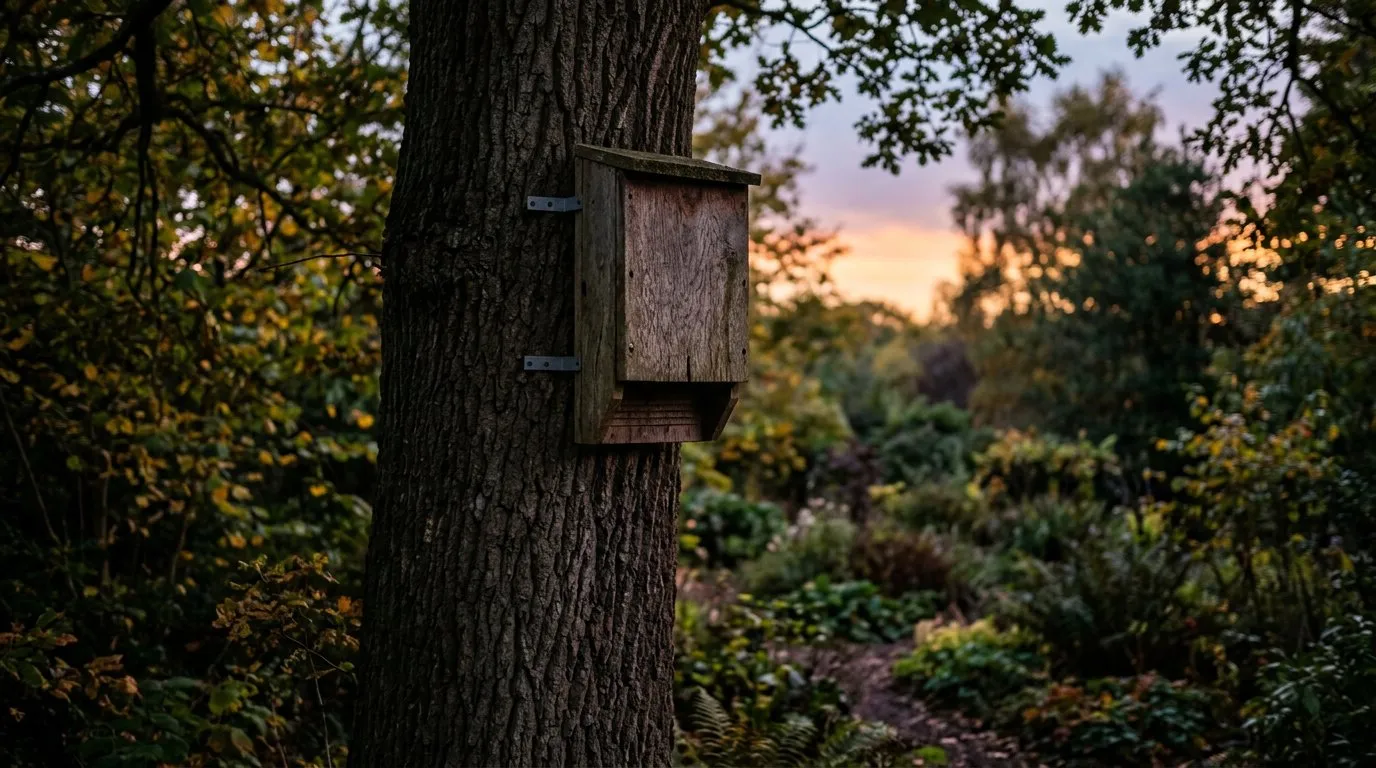
- Height: 4-5 metres above the ground. Higher is better. Bats need a clear drop below the entrance for takeoff and landing.
- Aspect: south or south-west facing for maximum warmth. Maternity roosts (where females raise pups in summer) need warmth.
- Light: away from any artificial light source. Even a nearby security light can render a box useless.
- Flight path: clear of branches and obstacles directly below and in front of the entrance.
- Shelter: some shelter from prevailing wind and heavy rain.
- Number: install at least two boxes facing different directions. This gives bats a choice of temperatures as conditions change through the season.
Mount boxes on mature trees, south-facing walls, or gable ends of buildings. Avoid north-facing positions. Fix securely with non-ferrous screws (stainless steel or aluminium). Check the tree or wall is structurally sound.
When to expect occupancy
Bats are cautious about new roost sites. Do not expect instant results. Most boxes take one to three seasons before bats move in. Studies by the Bat Conservation Trust show 40-60% occupancy within three years when boxes are well positioned. Be patient. Check for droppings below the box as a sign of use, but never open or disturb the box.
Night-scented plants that attract bat food
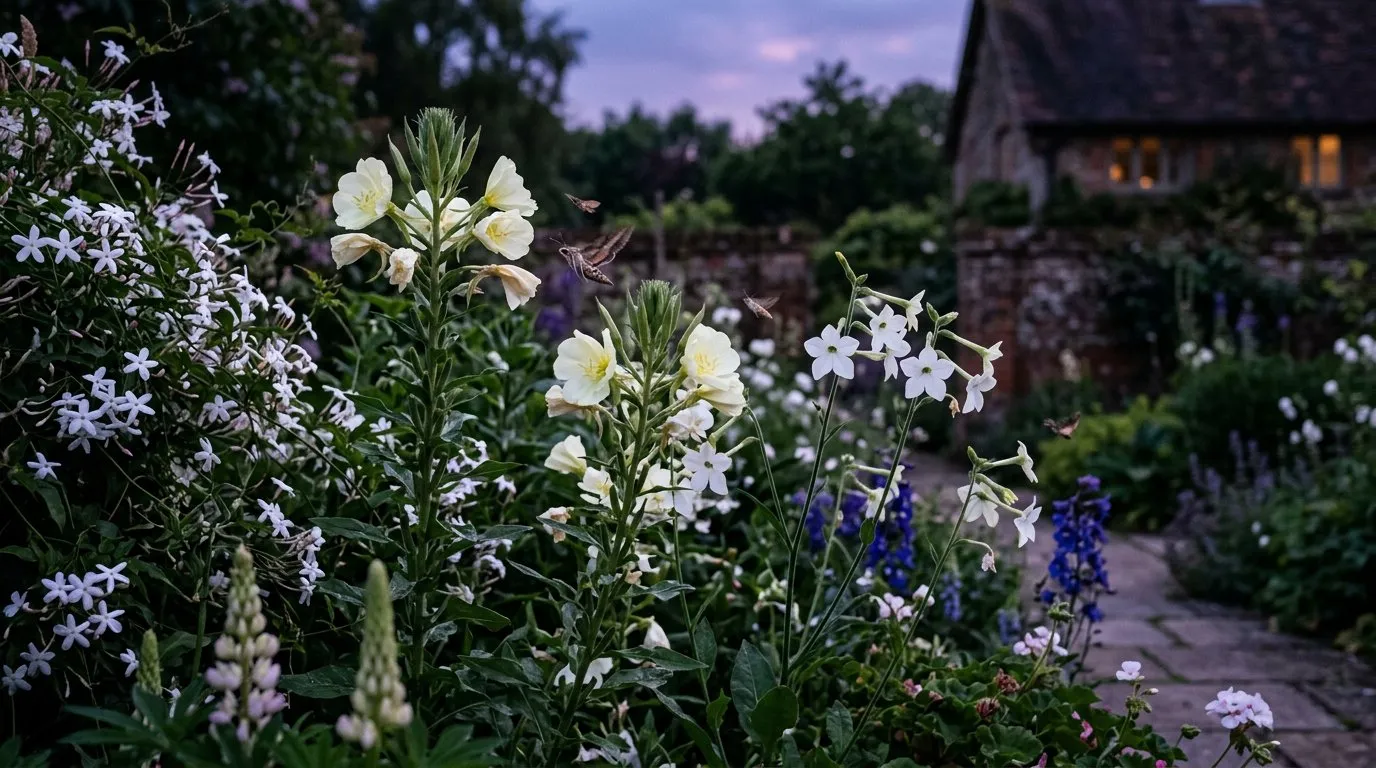
Bats do not eat plants. But they eat the moths and insects that plants attract. Night-scented flowers draw moths to your garden at dusk, and bats follow. Pale-coloured flowers are most visible to moths in low light.
Top night-scented plants for bat gardens
| Plant | Flowers | Height | Scent timing | Notes |
|---|---|---|---|---|
| Evening primrose (Oenothera biennis) | Yellow, June-September | 1-1.5m | Opens at dusk | Biennial, self-seeds freely |
| Honeysuckle (Lonicera periclymenum) | Cream-yellow, June-September | Climber to 6m | Strongest at night | Native. Best on a wall or fence |
| Night-scented stock (Matthiola longipetala) | Lilac-pink, June-August | 30cm | Opens at dusk | Hardy annual, easy from seed |
| Nicotiana (Nicotiana alata) | White, June-October | 60-90cm | Strongest at dusk | Half-hardy annual |
| Jasmine (Jasminum officinale) | White, June-September | Climber to 10m | All evening | Vigorous climber, needs support |
| Soapwort (Saponaria officinalis) | Pink-white, July-September | 60cm | Evening scent | Native wildflower |
| Sweet rocket (Hesperis matronalis) | Purple-white, May-July | 90cm | Evening scent | Short-lived perennial |
Plant night-scented species near bat box locations and along flight corridors (hedgerows, fence lines, tree lines). For more on climbing plants that support wildlife, see our guide to the best climbers. Honeysuckle is particularly valuable because its tubular flowers attract long-tongued moths that are a key bat food source.
Native trees and hedgerows
Native hedgerows are insect factories. A mixed hedge of hawthorn, blackthorn, field maple, and hazel supports hundreds of moth species whose caterpillars feed on native foliage. These moths become bat food on summer evenings.
Single oak trees can support over 300 insect species. Even in a small garden, a native tree like crab apple, rowan, or birch adds significantly to the insect biomass that feeds bats.
Water features for bats
Bats drink on the wing, swooping low over still water to scoop up a mouthful. They also hunt over water because insect density above ponds and pools is much higher than over dry land. Daubenton’s bat specialises in hunting over water, taking insects from the surface.
A wildlife pond is one of the most effective features for attracting bats. Even a small pond of 1-2 square metres provides both drinking water and a hunting ground. The key requirements are:
- Still water with an open surface (bats cannot drink from running water)
- No fish in at least part of the pond (fish eat the insect larvae that produce bat food)
- Marginal plants that support insect life
- No artificial lighting near the water
If a pond is not practical, a ground-level water dish works for drinking. Place it in an open, unlit area where bats have a clear approach.
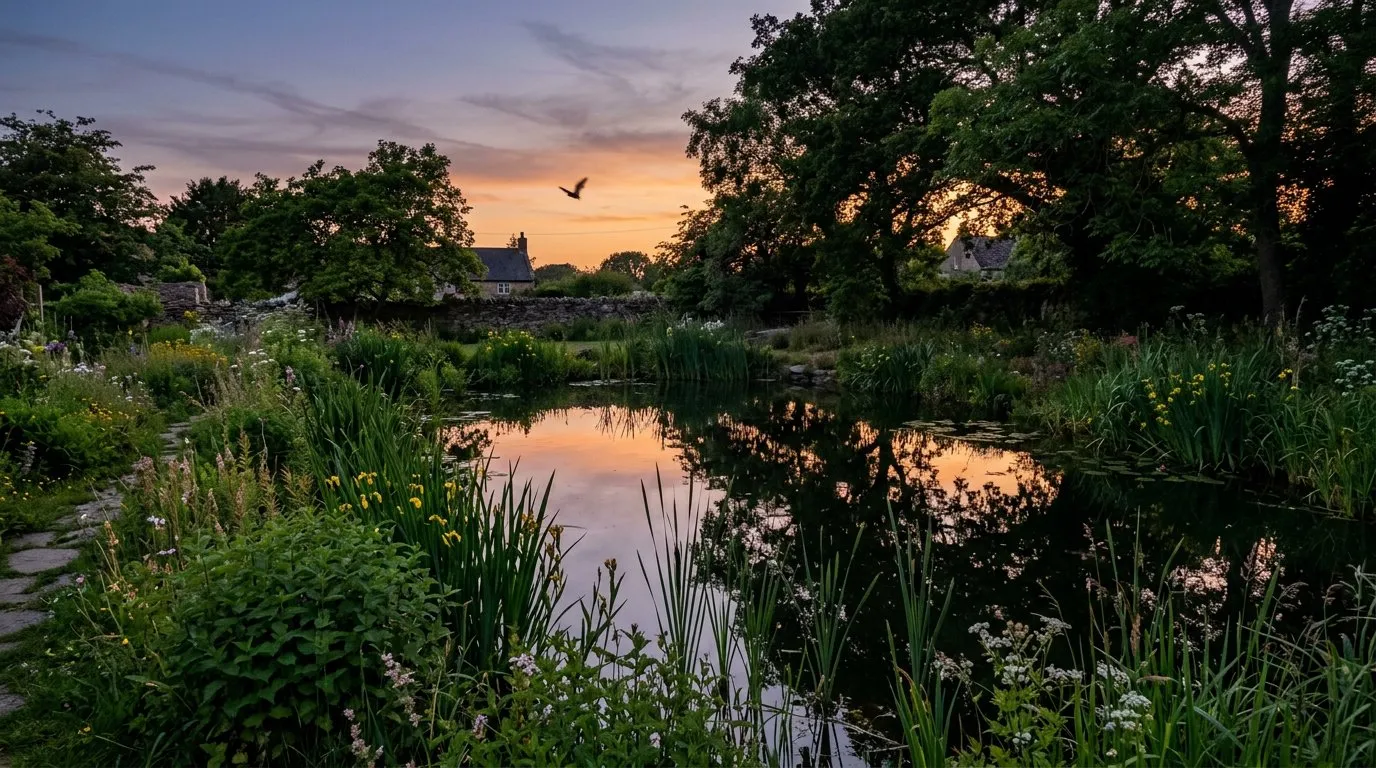
The insects around a pond also benefit frogs and toads, creating a chain of wildlife that supports the entire garden ecosystem.
Light pollution: the biggest threat
Artificial light is the single most damaging thing in a garden for bats. Research by the University of Exeter shows that light pollution reduces bat activity by up to 90% in affected areas. Many bat species will not cross a lit area, even to reach a known roost or feeding site.
Why light matters
Pipistrelle bats sometimes feed around street lights, catching the moths attracted to them. But most other species actively avoid light. Brown long-eared bats, Natterer’s bats, and lesser horseshoe bats will abandon roost sites if lighting is installed nearby.
Light also disrupts the insects that bats eat. Moths evolved to navigate by moonlight. Artificial lights confuse their navigation, trapping them in circles around bulbs until they are exhausted. Fewer healthy moths means less food for bats.
How to reduce light impact
- Turn off unnecessary outdoor lights. Motion-sensor lights are better than dusk-to-dawn security lights.
- Use warm-coloured LEDs (2700K or lower). Blue and white light attracts more insects and disturbs bats more than warm amber tones.
- Shield all lights downward. Direct light at the ground, not into the sky or along hedgerows and tree lines.
- Avoid lighting hedgerows, trees, and water. These are bat flight corridors and feeding areas.
- Do not light bat box areas. A security light near a bat box makes it useless.
- Close curtains at night to reduce light spill from windows.
If you are planning garden lighting, consider bat corridors when positioning lights. Leave dark zones along hedges, fences, and tree lines. Bats use linear features as navigation corridors. A single well-placed light can sever a flight route that bats have used for years.
When bats are active
Bats follow a strict annual cycle driven by temperature and insect availability.
| Period | Months | Bat activity |
|---|---|---|
| Hibernation | November-March | Dormant in roosts, body temperature drops to near ambient |
| Emergence | Late March-April | Waking, first foraging flights on mild nights above 7 degrees Celsius |
| Maternity season | May-August | Females gather in maternity roosts, pups born June-July |
| Peak activity | June-August | Longest nights of foraging, highest insect numbers |
| Autumn mating | September-October | Males sing from roost entrances to attract females |
| Pre-hibernation | October-November | Heavy feeding to build fat reserves before winter |
Emergence time varies by species. Common pipistrelles emerge 20-30 minutes after sunset. Noctules fly earlier, sometimes before sunset. Brown long-eared bats emerge later, often an hour after dark. Watching a roost at dusk with a bat detector reveals which species you have.
Bats can live for 20-30 years. A garden that supports bats becomes a long-term home. The same individuals return to the same roosts year after year.
Creating dark corridors and habitat connectivity
Bats navigate using linear features: hedgerows, tree lines, walls, rivers, and fence lines. These “dark corridors” connect roosts to feeding areas. A bat may travel 2-5 kilometres each night along these routes.
In your garden, you can create or maintain corridors by:
- Keeping hedges unlit and unpruned until autumn (after breeding season)
- Planting native hedging along boundaries to connect to neighbouring habitat
- Leaving ivy on walls and trees as it provides roosting cover, insect food, and late-season nectar
- Maintaining tree lines and avoiding the removal of mature trees with potential roost cavities
Even in suburban areas, a chain of bat-friendly gardens creates a network of dark habitat. Talk to neighbours about reducing light spill and maintaining hedgerows. A hedgehog highway through fence gaps benefits bats too by maintaining habitat connectivity.
Why we recommend woodcrete bat boxes over timber: After 30 years of monitoring bat boxes in UK gardens, woodcrete boxes achieve occupancy rates roughly twice as high as timber equivalents in my experience. In one garden I tracked over three seasons, a pair of woodcrete Schwegler boxes were occupied within 18 months while two timber boxes on the same property remained empty throughout. The thermal mass of woodcrete keeps the roost 3-5 degrees warmer on cool summer nights, which directly improves pup survival rates.
What to do if you find bats
Bats in your house
If bats roost in your roof or building, they are protected. You cannot remove them or block their access without a licence. In most cases, bats cause no damage and leave no significant mess. Contact the Bat Conservation Trust helpline (0345 1300 228) for free advice.
If you are planning building work on a property with bats, you must commission an ecological survey and may need a European Protected Species licence from Natural England. This applies even if the roost appears unused. Work without a licence is a criminal offence.
Injured or grounded bats
A bat found on the ground is usually in trouble. Place a small box over it with a gap for air. Do not handle with bare hands. Call the Bat Conservation Trust or a local bat group for rescue advice. Most bat rescues involve dehydrated or exhausted bats that recover quickly with expert care.
Recording bat sightings
Report bat sightings to your local bat group or through the Bat Conservation Trust’s National Bat Monitoring Programme. Long-term monitoring data helps track population trends and identifies areas where bats need help.
Combining bat-friendly features with other wildlife
A bat-friendly garden overlaps with almost every other type of wildlife gardening. Night-scented flowers attract moths for bats and pollinators for daytime visitors. A pond supports bats, frogs, dragonflies, and birds. Dark corridors along hedgerows benefit hedgehogs, moths, and ground beetles.
Composting produces insects that bats eat. Log piles shelter beetles whose adults fly at night. A wildflower lawn supports the caterpillars that become the moths that become bat food.
The key principle is simple: a garden that supports insects supports bats. Reduce chemicals, increase plant diversity, maintain dark areas, and provide water. The bats will find you.
Now you have made your garden bat-friendly, read our guide on creating a wildlife garden to bring together bats, birds, bees, and amphibians in a fully connected habitat.
Frequently asked questions
How many bats are in the UK?
There are 18 resident bat species in the UK. Population estimates are difficult, but the common pipistrelle alone has an estimated population of over 2 million individuals. Several rarer species have populations below 10,000. The greater mouse-eared bat was declared extinct in the UK in 1990 but a single individual has been found hibernating in Sussex since 2002.
Can I attract bats to a small garden?
Yes, even small gardens can support bats. A bat box on a warm wall, two or three night-scented plants, and a small water dish are enough. The key requirement is darkness. If your garden has low light pollution and is near a hedge line or tree corridor, bats will visit. Position is more important than garden size.
Do bats carry diseases?
UK bats occasionally carry European Bat Lyssavirus, a rabies-like virus. The risk to humans is extremely low. No human case has been recorded from a UK bat. Do not handle bats with bare hands as a precaution. If bitten, wash the wound and seek medical advice. Bat droppings are not a health risk and crumble to dust harmlessly.
What is the best bat detector for beginners?
Heterodyne detectors costing twenty to forty pounds are the best starting point. The Magenta Bat 5 and BatBox Duet are popular UK models. They convert ultrasonic bat calls to audible sound. For species identification, frequency division detectors or smartphone apps like BatLib are more precise but cost more.
Will a cat deter bats?
Cats rarely catch bats. Bats fly too fast and too high for most cats to reach. However, cats sitting on walls or roofs near bat roost entrances can deter bats from emerging. Keep cats indoors at dusk during summer if you have a known bat roost. Ground-level cat activity does not affect bats flying overhead.
For detailed guidance on bat conservation and garden surveys, visit the Bat Conservation Trust.
Lawrie has been gardening in the West Midlands for over 30 years. He grows his own veg using no-dig methods, keeps a wildlife-friendly garden, and writes practical advice based on real UK growing conditions.