How to Build a Wildlife Pond UK Guide
Step-by-step guide to building a wildlife pond in the UK. Covers liner choice, planting, depth, wildlife access, maintenance, and costs from fifty pounds.
Key takeaways
- A wildlife pond is the single best habitat addition for any UK garden
- Basic pond costs fifty to one hundred pounds with a butyl liner and native plants
- Minimum 60cm deep at the centre to prevent freezing solid in winter
- Sloped edges are essential — wildlife must be able to walk in and climb out
- Never add fish — they eat tadpoles, newt larvae, and dragonfly nymphs
- Expect frogs, newts, and dragonflies within the first season without stocking
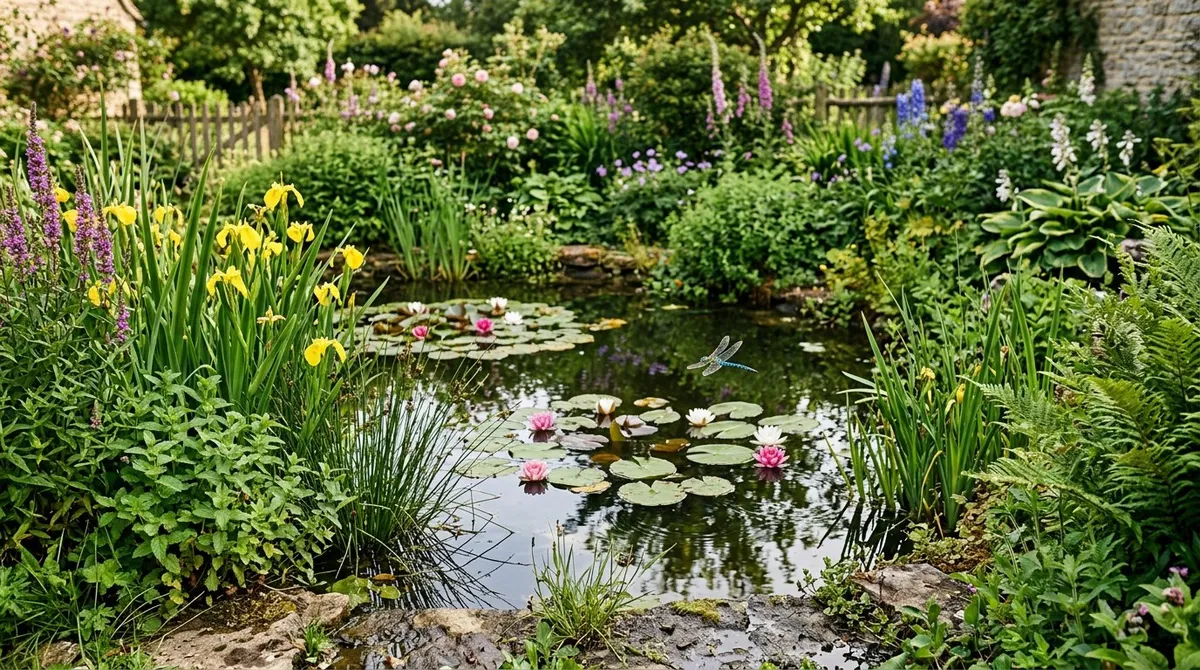
A wildlife pond is the single most effective thing you can do for biodiversity in your garden. Nothing else attracts as many species as quickly. Frogs, newts, dragonflies, damselflies, water beetles, and birds will find even a small pond within weeks. The Freshwater Habitats Trust estimates the UK has lost 50% of its ponds since 1900. Every new garden pond helps reverse that decline.
You do not need a large garden or a large budget. A pond 1m across and 60cm deep costs fifty to one hundred pounds and takes a weekend to build. This guide covers everything from digging the hole to planting and long-term maintenance. If you are already creating a wildlife garden, a pond should be your first project.
Choosing a location
The right spot makes the difference between a thriving pond and a murky, leaf-choked problem.
Sunlight
Place the pond where it gets at least 6 hours of direct sunlight per day. Sunlight drives plant growth, which oxygenates the water and feeds the ecosystem. A pond in full shade will have fewer plants, less oxygen, and fewer species.
Away from trees
Avoid placing the pond directly under trees. Falling leaves decompose in the water, releasing nutrients that fuel algae growth and reduce oxygen. Autumn leaf fall can smother a small pond in days. If you cannot avoid nearby trees, plan to net the pond in October and November.
Level ground
The site must be level, or water will be deeper on one side and the liner will show on the other. Check with a spirit level on a long straight edge across the excavation before laying the liner. Even a 5cm difference across a 2m pond is visible and looks wrong.
Access for wildlife
Position the pond near existing wildlife corridors: hedgerows, fences with gaps, long grass, or log piles. Hedgehogs fall into ponds and drown without a sloped edge or ramp. Frogs and toads need cover nearby to shelter during the day. Place rocks, logs, or dense planting within 1m of the pond edge.
Safety
If young children use the garden, consider a raised pond, a pond with a rigid mesh cover below the water surface, or delay building until children are older. Drowning risk is real — even 10cm of water is dangerous for toddlers. A bog garden (permanently damp but not flooded) is a safer alternative that still attracts wildlife.
Planning the shape and depth
Wildlife ponds work best with an irregular, natural shape. Avoid perfect circles or rectangles. Curves and inlets create varied habitats and look more natural.
Depth zones
A good wildlife pond has three depth zones:
-
Shallow margins (0-15cm) — the most important zone. Frogs spawn here. Birds bathe and drink. Marginal plants root in the shallows. This zone warms up fastest in spring, triggering breeding activity.
-
Mid-depth shelf (15-40cm) — a planting shelf for taller marginal plants and emergent species. Water lilies can root at this depth in small ponds.
-
Deep zone (40-60cm+) — the deepest part of the pond. This zone stays cool in summer and does not freeze solid in winter. Overwintering frogs rest in the mud at the bottom of the deep zone.
Minimum size
A pond as small as washing-up bowl size will attract wildlife. However, a 1m x 2m pond with 60cm depth provides stable conditions year-round and supports a much wider range of species. Larger ponds are more resilient. If you have the space, go bigger.
Edge profile
Gently sloped edges are critical. A slope of about 1 in 3 (one unit down for every three along) lets hedgehogs, frogs, and beetles walk in and climb out. Vertical edges trap and drown wildlife. At least one section of the pond edge must be a gradual beach-like slope.
| Zone | Depth | Purpose | Key plants |
|---|---|---|---|
| Shallow margin | 0-15cm | Frog spawning, bird bathing, marginal plants | Marsh marigold, water mint, brooklime |
| Mid-depth shelf | 15-40cm | Taller marginals, emergent plants | Water forget-me-not, yellow flag iris, water plantain |
| Deep zone | 40-60cm+ | Winter refuge, oxygenating plants | Hornwort, water starwort, spiked water milfoil |
| Beach edge | Slope to 0cm | Wildlife access and exit | None (pebbles and gravel) |
Choosing a liner
The liner keeps water in. There are three main options for garden wildlife ponds.
Butyl rubber (EPDM)
The best choice for most wildlife ponds. Butyl rubber is flexible, puncture-resistant, and lasts 30-50 years. It conforms to irregular shapes and varied depths. A 0.75mm thickness is sufficient for garden ponds. Butyl is more expensive than PVC but far more durable.
PVC liner
Cheaper than butyl but lasts only 10-20 years. Less flexible in cold weather and more prone to cracking over time. Acceptable for a budget pond but expect to replace it within 15 years.
Pre-formed rigid liner
Fibreglass or plastic moulded shapes. Easy to install but limited to fixed shapes and sizes, usually too steep at the edges for good wildlife access. Most pre-formed ponds are too small and too uniform in depth. Avoid them if you want a proper wildlife pond.
Calculating liner size
Measure the maximum length, width, and depth of your excavation. The liner needs to be:
- Length: pond length + (2 x depth) + 60cm overlap each side
- Width: pond width + (2 x depth) + 60cm overlap each side
For a 2m x 1.5m pond with 60cm depth: liner = 3.8m x 3.3m.
Underlay
Always lay a protective underlay beneath the liner. Old carpet, sand (5cm layer), or purpose-bought geotextile underlay prevents stones and roots puncturing the liner from below. This is not optional — a punctured liner means draining and relaying. The cost of underlay is trivial compared to the work of fixing a leak.
| Liner type | Lifespan | Cost per sq metre | Flexibility | Best for |
|---|---|---|---|---|
| Butyl rubber (EPDM) | 30-50 years | Eight to twelve pounds | Excellent | All wildlife ponds |
| PVC | 10-20 years | Four to six pounds | Good | Budget ponds |
| Pre-formed rigid | 15-25 years | Thirty to sixty pounds (per unit) | None | Not recommended for wildlife |
Step-by-step construction
What you need
- Butyl liner (calculated to size)
- Protective underlay or old carpet
- Spade and wheelbarrow
- Spirit level and long straight edge
- Hosepipe or rope (to mark the outline)
- Sand (optional, for underlay)
- Native aquatic plants
- Pebbles and cobbles for the beach edge
Digging
-
Mark the outline with a hosepipe or rope laid on the ground. Stand back and check the shape looks natural from different angles.
-
Remove turf from the marked area. Set aside good turf for use elsewhere.
-
Dig the shallow margin first, to 15cm depth, around the full perimeter.
-
Dig the mid-depth shelf within the margin, to 30-40cm. Leave a 30cm-wide shelf at this depth for planting baskets.
-
Dig the deep zone in the centre, to at least 60cm. For a small pond, 60cm is enough. For larger ponds, 80-100cm is better.
-
Create a beach slope on at least one side. Grade the soil gradually from the rim down to the shallow margin. This is the wildlife access ramp.
-
Check levels across the entire excavation using a spirit level on a plank. The rim must be level all the way around. Adjust by adding or removing soil.
-
Remove any sharp stones, roots, or debris from the excavation.
Installing the liner
-
Lay protective underlay across the entire excavation, overlapping pieces by 30cm.
-
Unfold the liner loosely over the hole. Let it drape into the shape without stretching. If possible, do this on a warm day when the liner is more flexible.
-
Begin filling with water from a hose. The weight of water pushes the liner into the contours. Smooth out large wrinkles as the water rises. Small folds are normal and will be hidden by plants and gravel.
-
Once full, trim the liner leaving 30cm excess around the edges. Tuck excess under turf, stones, or soil. The edge must be secure and hidden.
-
Place cobbles and pebbles on the beach slope. Add gravel to planting shelves. This hides the liner and provides surfaces for invertebrates and algae to colonise.
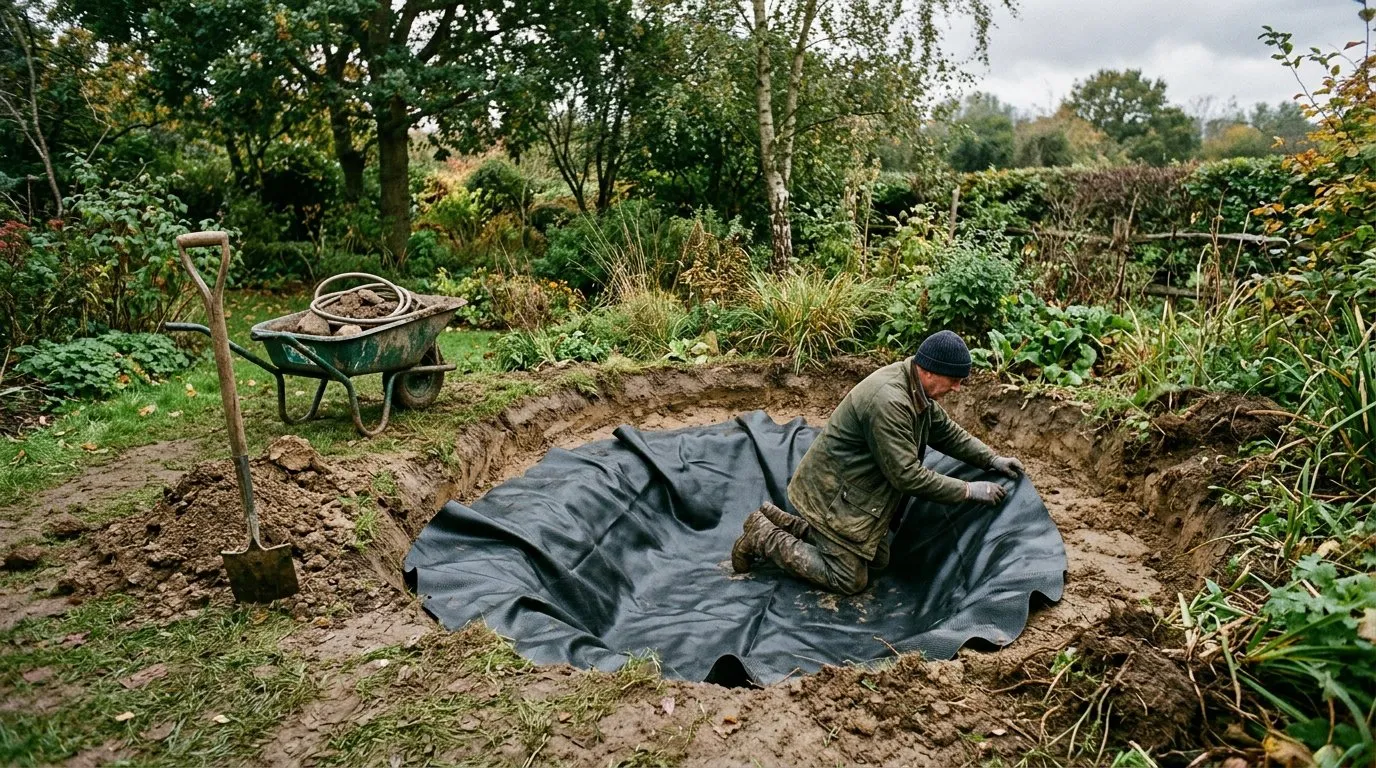
A butyl liner being laid into a freshly dug wildlife pond with gently sloping edges — the spade and wheelbarrow are never far away.
Planting a wildlife pond
The right plants are what turn a hole full of water into a thriving ecosystem. Native plants support native wildlife. Exotic ornamental plants look attractive but provide little habitat value.
Oxygenating plants (submerged)
These are essential. They produce oxygen, absorb excess nutrients, and keep the water clear. Plant them in the deep zone.
- Hornwort (Ceratophyllum demersum) — free-floating, no planting needed. Drop weighted bunches into the deep zone. The most effective oxygenator for UK ponds.
- Water starwort (Callitriche stagnalis) — native, evergreen. One of the few oxygenators that works through winter.
- Spiked water milfoil (Myriophyllum spicatum) — feathery foliage. Excellent habitat for invertebrates and newt egg-laying.
Marginal plants (shallow water)
Plant these on the shelves and in the shallow margins. They provide cover, food, and egg-laying sites.
- Marsh marigold (Caltha palustris) — bright yellow flowers in March/April. One of the first pond plants to flower. Loved by early bees and hoverflies.
- Water forget-me-not (Myosotis scorpioides) — blue flowers from May. Sprawling growth covers the pond edge naturally. Self-seeds freely.
- Water mint (Mentha aquatica) — lilac flowers in July/August. Aromatic foliage. Spreads vigorously — plant in a basket to contain it.
- Brooklime (Veronica beccabunga) — blue flowers, semi-evergreen. Native plant that provides early cover for emerging frog spawn.
- Yellow flag iris (Iris pseudacorus) — tall (1m+), dramatic yellow flowers in June. Only for ponds 1.5m+ across — it is vigorous and will dominate a small pond.
- Purple loosestrife (Lythrum salicaria) — magenta flower spikes from July. Grows in damp soil at the pond edge. Attracts butterflies and bees. See our guide to the best plants for butterflies.
Floating plants
Surface cover shades the water, reducing algae and providing shelter for pond life underneath.
- Frogbit (Hydrocharis morsus-ranae) — native floating plant. Small, round leaves and white flowers. Provides shade without the vigour of water lilies. Perfect for small ponds.
- Water lily (Nymphaea alba) — only for larger ponds (2m+ across). The native white water lily needs 40-60cm depth. Provides excellent shade and a landing platform for dragonflies. Dwarf varieties suit smaller ponds.
Bog plants (damp margins)
The area around the pond edge, kept permanently damp by capillary action from the liner, supports moisture-loving plants. Creating a wildflower lawn near the pond’s damp margins extends the habitat further.
- Ragged robin (Silene flos-cuculi) — pink flowers in May/June. A declining native wildflower. Thrives in damp soil.
- Meadowsweet (Filipendula ulmaria) — creamy white, scented flower heads in July. Grows to 1.2m.
- Bugle (Ajuga reptans) — blue flower spikes in April/May. Excellent low ground cover near the pond edge.
| Plant | Zone | Depth | Flowers | Key benefit |
|---|---|---|---|---|
| Hornwort | Submerged | 30-60cm | None | Best oxygenator |
| Water starwort | Submerged | 10-60cm | Tiny white | Winter oxygenation |
| Marsh marigold | Marginal | 0-10cm | Yellow, Mar-Apr | Early pollen for bees |
| Water forget-me-not | Marginal | 0-10cm | Blue, May-Jul | Natural edge cover |
| Frogbit | Floating | Surface | White, Jul-Aug | Shade for small ponds |
| Purple loosestrife | Bog/edge | Damp soil | Magenta, Jul-Sep | Butterfly and bee food |
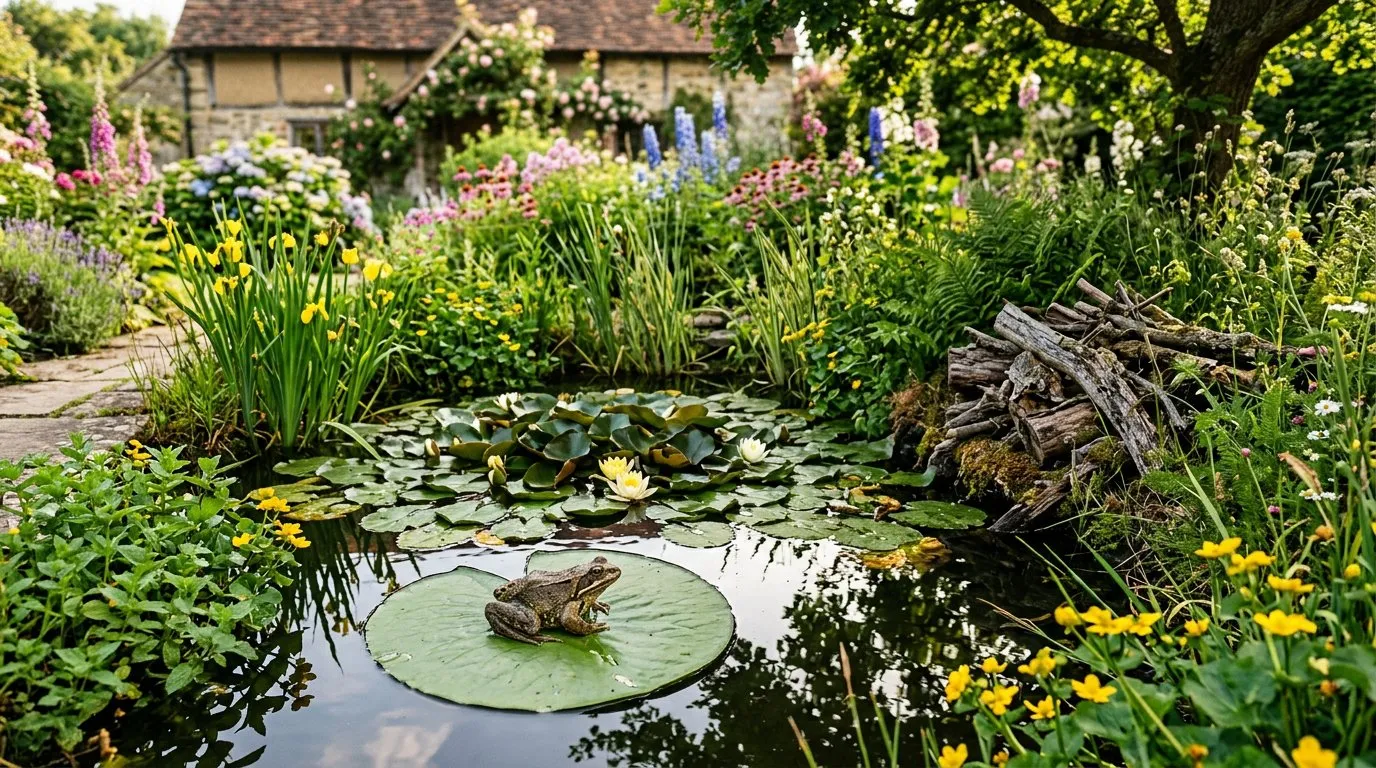
An established wildlife pond surrounded by marginal plants, water lilies, and a log pile — a frog rests on a lily pad in the warm summer light.
Gardener’s tip: Buy native pond plants from specialist aquatic nurseries, not garden centres. Garden centre “pond plants” often include non-native species like Australian swamp stonecrop (Crassula helmsii), which is invasive and illegal to plant in the wild. Always check the label for the Latin name.
What wildlife to expect
A wildlife pond attracts species remarkably quickly. You do not need to introduce anything — let wildlife find the pond naturally.
First year
- Pond skaters and water boatmen — often arrive within days
- Frogs — most new ponds have visiting frogs within the first year. Frog spawn appears the following spring.
- Dragonflies and damselflies — adults lay eggs in the first summer. Larvae develop over 1-3 years before emerging as adults.
- Water beetles — colonise new ponds within weeks by flying in
- Birds — use the shallow edges for drinking and bathing straight away. Attracting birds to your garden is much easier with a pond.
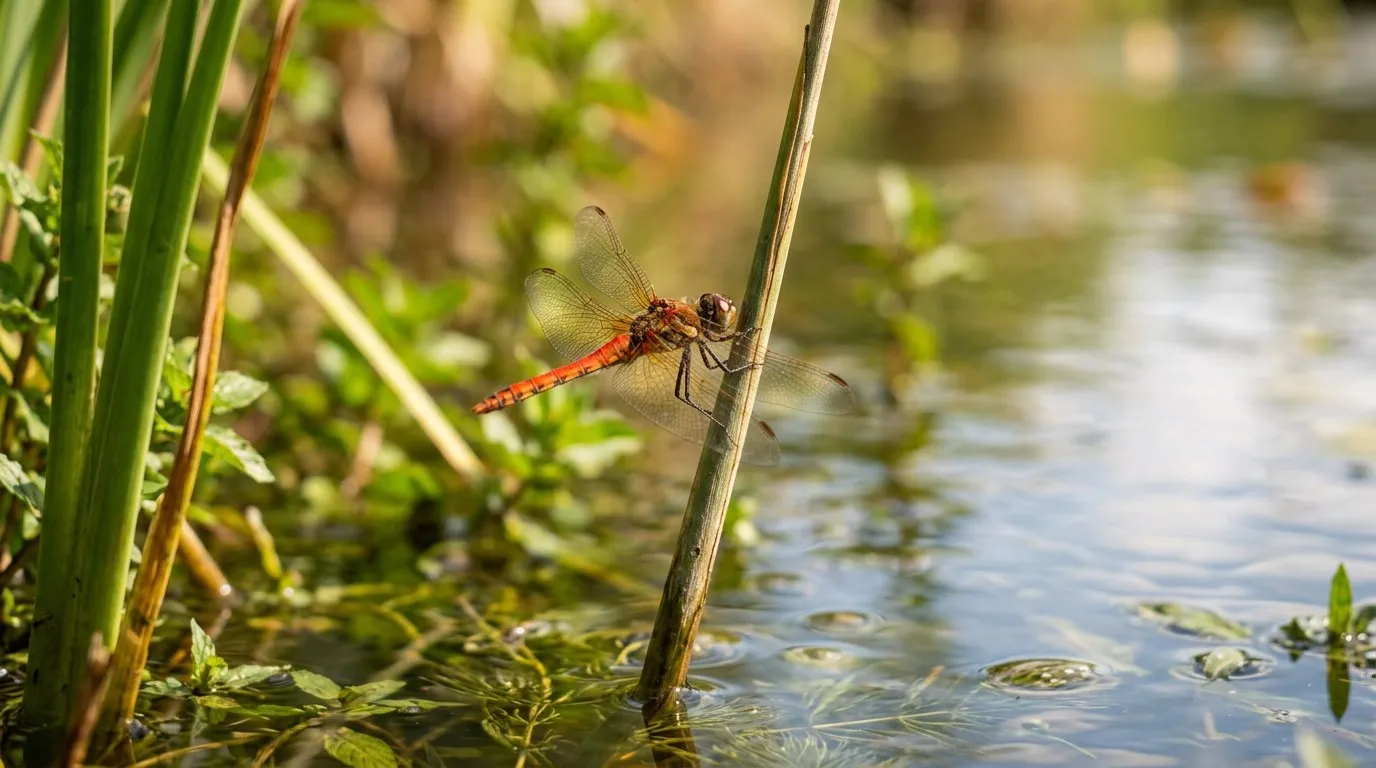
A dragonfly rests on reeds at the pond edge — expect these stunning visitors from the first summer.
Second year onwards
- Newts — smooth newts and palmate newts find ponds within 1-2 years. They need submerged plants for egg-laying. Great crested newts are protected and rarer but may colonise if populations exist locally.
- Dragonfly larvae — emerge as adults from the second or third year
- Grass snakes — visit ponds to hunt frogs. They are harmless and a sign of a healthy garden ecosystem.
- Hedgehogs — drink from the shallow edges at night. Ensure your hedgehog-friendly garden has sloped pond edges.
What not to add
Never add fish. Goldfish, koi, and other ornamental fish eat frog spawn, tadpoles, newt larvae, water beetles, and dragonfly nymphs. A pond with fish will have dramatically fewer amphibians and invertebrates. If you want fish, our guide on how to build a garden pond covers ornamental and fish pond construction.
Never transfer frog spawn or pond water from another pond. This spreads chytrid fungus and ranavirus, which kill frogs and newts. Let wildlife colonise naturally.
Maintenance calendar
A properly built wildlife pond needs very little maintenance. Over-managing is the biggest mistake people make.
Spring (March to May)
- Check for frog spawn in the shallows. Do not move or disturb it.
- Remove any blanket weed by twisting it onto a stick. Leave it on the bank overnight so pond creatures can crawl back into the water.
- Top up water levels if spring is dry. Use rainwater from a water butt if possible. Tap water contains chlorine and nutrients that feed algae. If you must use tap water, let it stand for 24 hours first.
Summer (June to August)
- Algae bloom in the first spring is normal. It clears as plants establish.
- Thin vigorous plants if they cover more than two-thirds of the surface.
- Top up water in hot weather. A water-efficient garden with a rain barrel makes this easier.
- Watch for dragonflies laying eggs and damselflies resting on stems.
Autumn (September to November)
- Net the pond if trees are nearby to catch falling leaves. Remove the net once leaf fall ends.
- Cut back dead marginal plant stems to 15cm above water level. Leave some standing for overwintering insects.
- Do not clear out pond sediment in autumn. Creatures are settling in for winter.
Winter (December to February)
- If the surface freezes, never smash the ice. The shockwave stuns and kills fish and amphibians. Melt a hole by placing a pan of hot water on the surface.
- Frogs overwinter in the mud at the bottom. Do not disturb them.
- Leave dead stems standing. Hollow stems allow gas exchange even under ice.
| Month | Task | Time needed |
|---|---|---|
| March | Check for spawn, remove early blanket weed | 15 minutes |
| May | Top up water level, check plant growth | 10 minutes |
| July | Thin vigorous plants, top up water | 30 minutes |
| September | Cut back dead stems, remove excess floating plants | 30 minutes |
| October | Net pond if near trees | 15 minutes |
| December | Melt ice hole if frozen, leave sediment undisturbed | 5 minutes |
Cost breakdown
A wildlife pond does not need to be expensive. Here is what a basic 2m x 1.5m pond costs.
| Item | Cost |
|---|---|
| Butyl liner (4m x 3.5m) | Thirty to forty pounds |
| Underlay or old carpet | Free to ten pounds |
| Native plants (6-8 species) | Fifteen to thirty pounds |
| Pebbles and cobbles | Five to ten pounds |
| Total | Fifty to ninety pounds |
You already own a spade. The most expensive component is the liner. PVC liner halves the cost but lasts half as long. Reclaimed materials (old carpet for underlay, stones from the garden) reduce costs further. A pond in a half-barrel or large container costs even less and still attracts frogs, dragonflies, and birds.
Why we recommend butyl rubber liner over all alternatives: After 30 years of building and advising on wildlife ponds, butyl rubber is the liner I specify every time. In two ponds I built using PVC liner in the 1990s, both needed relining within 14 years. The butyl ponds built in the same period are still holding water without a single repair. The higher upfront cost of butyl — typically £8-£12 per square metre versus £4-£6 for PVC — pays for itself many times over across a 30-50 year lifespan.
Common mistakes to avoid
Making edges too steep
Steep edges trap and drown wildlife. At least one edge must slope gently — a gradient of 1 in 3 or shallower. Think of a beach, not a swimming pool. Even with sloped edges, adding a rough log or stone as an exit ramp provides extra safety.
Adding tap water without treatment
Tap water contains chlorine, chloramine, and phosphates. These feed algae and can harm sensitive invertebrates. Use rainwater where possible. If using tap water, let it stand in buckets for 24 hours to off-gas chlorine.
Overplanting
A new pond looks bare. The temptation is to fill it with plants. But aquatic plants grow fast. Start with 5-6 species and let them establish over two seasons. You can always add more. Removing overgrown plants is harder than planting new ones.
Cleaning too often
Wildlife ponds should not be crystal clear. Slightly green or brown water is healthy and full of microscopic life. The sediment layer on the bottom is habitat for invertebrates and hibernating frogs. Only remove sediment every 3-5 years, and then only from half the pond at a time.
Introducing fish
This is worth repeating. Fish eat everything that makes a wildlife pond interesting. A single goldfish will eat every tadpole, water beetle larva, and dragonfly nymph in a small pond within one season.
Container ponds for small spaces
No garden is too small for a pond. A half-barrel, large pot, or old Belfast sink makes an excellent container pond. If you are working with a small garden or patio garden, a container pond fits on a balcony, patio, or courtyard.
Setting up a container pond
- Choose a container at least 40cm deep and 50cm across. Ensure it is watertight. Seal terracotta pots with pond sealant.
- Place in a spot with at least 4-6 hours of sunlight.
- Add 5cm of aquatic compost or garden soil (not commercial potting mix, which is too rich).
- Plant one oxygenator (hornwort), one marginal (marsh marigold or water forget-me-not), and one floater (frogbit).
- Fill with rainwater. Top up with rainwater in dry weather.
- Add a few stones or a small branch for wildlife access and exit.
- Wait. Insects will find it within days.
Container ponds attract dragonflies, damselflies, water beetles, hoverflies, and birds. Frogs sometimes find elevated container ponds too, but ground-level containers are more accessible. Even without frogs, the invertebrate life alone justifies the effort.
Now you’ve built your wildlife pond, read our guide on best pond plants for UK gardens for the next step.
Frequently asked questions
How deep should a wildlife pond be?
At least 60cm at the deepest point. This depth prevents the pond freezing solid in harsh UK winters, protecting overwintering frogs and invertebrates. Shallower margins of 5-15cm provide warm water for frog spawning and marginal plants. A varied depth profile with gentle slopes supports the widest range of species.
Can I put fish in a wildlife pond?
No, never add fish to a wildlife pond. Goldfish, koi, and other fish eat frog spawn, tadpoles, newt larvae, and dragonfly nymphs. A pond with fish supports far fewer species. Build a separate ornamental pond if you want fish. Keep at least 3m between the two ponds.
When is the best time to build a wildlife pond?
Autumn is the ideal time, typically September to November. The soil is moist and workable after summer. Plants establish roots over winter. The pond is ready for frog spawning in spring. Spring construction works too, but summer heat stresses newly planted aquatic plants.
Do I need a pump or filter for a wildlife pond?
No, a wildlife pond needs no equipment at all. Submerged oxygenating plants like hornwort and water starwort keep the water healthy. A balanced ecosystem with the right plants stays clear naturally. Pumps create currents that disturb still-water species. Filters remove the microscopic life that feeds the food chain.
How do I stop a wildlife pond going green?
Green algae bloom is normal in new ponds during the first spring. It clears naturally within 6-8 weeks as submerged plants grow and compete for nutrients. Cover at least a third of the surface with plants to shade the water. Use rainwater instead of tap water. Never add algaecides or chemicals.
Will frogs find my pond on their own?
Yes, frogs colonise new ponds remarkably quickly. Most UK garden ponds have frog visitors within the first twelve months. Frogs travel up to 500m overland and detect water sources through humidity. Never transfer frog spawn from another pond, as this spreads chytrid fungus and ranavirus.
Do I need planning permission for a garden pond?
No planning permission is needed in most cases. Garden ponds are classified as permitted development. The exception is if you live in a listed building or conservation area, or if the pond is very large. Check with your local planning authority if in doubt. There are no restrictions on wildlife ponds under normal circumstances.
For detailed guidance on pond creation and native aquatic plant sourcing, the Freshwater Habitats Trust provides research-backed advice on building ponds that support the widest range of UK freshwater species.
Lawrie has been gardening in the West Midlands for over 30 years. He grows his own veg using no-dig methods, keeps a wildlife-friendly garden, and writes practical advice based on real UK growing conditions.