Bumble Bee Species Guide for UK Gardens
Identify the 7 most common bumble bee species in UK gardens. Covers flight seasons, nesting habits, and the best plants for each species.
Key takeaways
- 7 bumble bee species make up over 95% of UK garden sightings
- The buff-tailed bumblebee is the most common, flying February to November
- Queens emerge from hibernation as early as late January in the south
- Three UK bumblebee species are critically endangered and need garden habitat
- Tail colour and band pattern are the two most reliable identification features
- Planting for March to October forage covers all 7 common species
The UK is home to 24 bumble bee species, but just 7 make up over 95% of garden sightings. Three species have become critically endangered since the 1950s, and two have gone extinct entirely. Gardens now play a vital role in bumblebee survival, particularly as wildflower-rich farmland has declined by 97% since the 1930s.
This guide covers the 7 bumble bee species you are most likely to see in a British garden. You will learn how to tell them apart by tail colour, band pattern, and body size. Each species has different flight seasons and flower preferences, so knowing which bees visit your garden helps you plant the right forage.
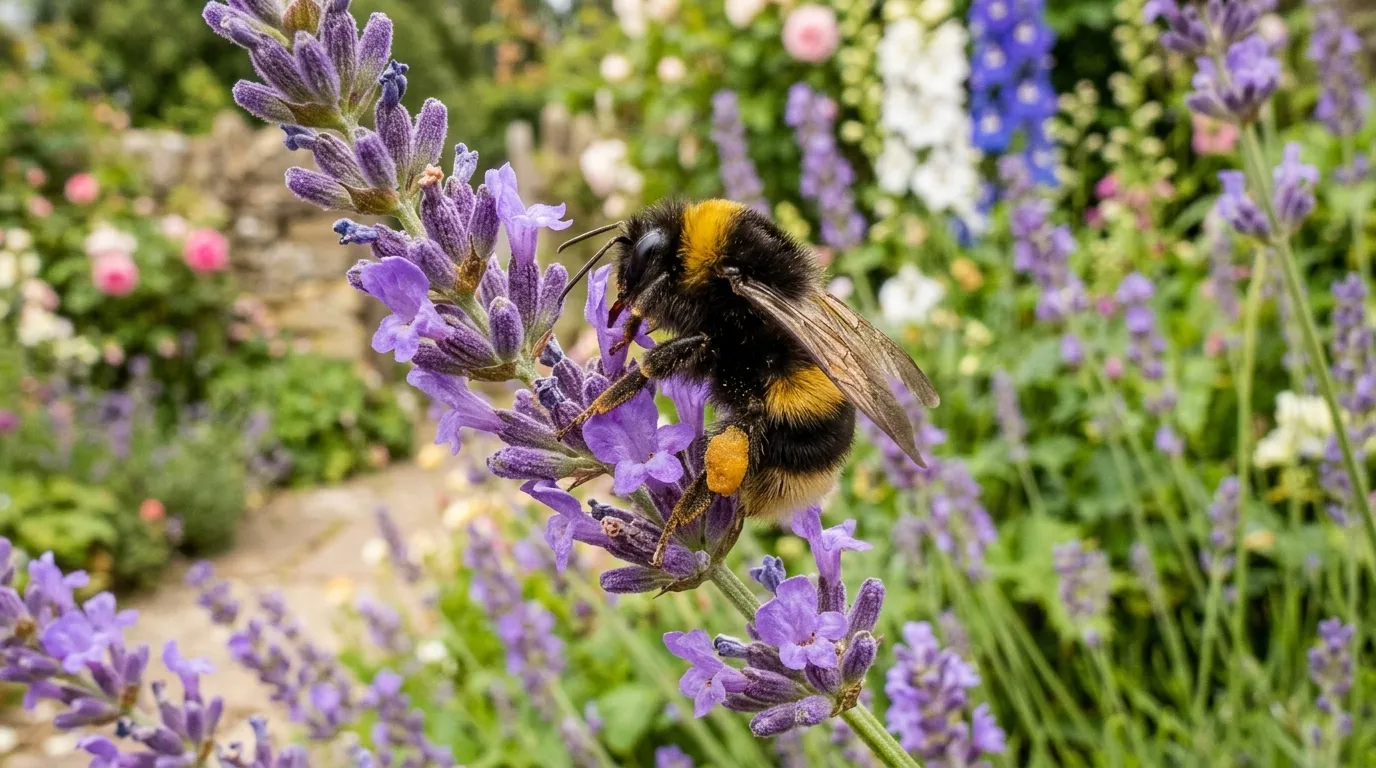
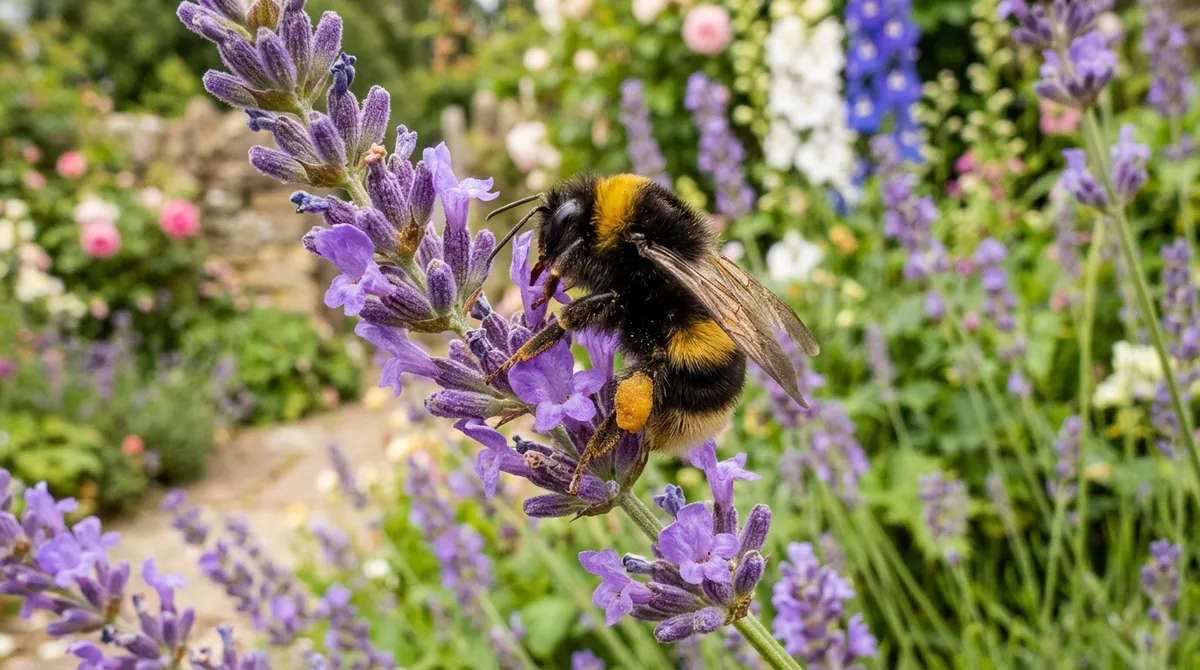
A buff-tailed bumblebee foraging on lavender, the most commonly sighted bumble bee species in UK gardens.
How to identify bumble bee species in the UK
The two most reliable identification features are tail colour and thorax band pattern. Body size helps distinguish queens from workers, but varies within the same species. Caste (queen, worker, male) also affects appearance, which is why beginners sometimes struggle.
Here is a simple three-step process:
- Check the tail colour. Red-orange, white, or buff (dirty yellow-white) narrows the field immediately.
- Look at the thorax bands. Count the yellow or orange stripes on the thorax (the area behind the head) and abdomen.
- Note the size. Queens are the largest caste, appearing in spring. Workers are smaller and appear from late spring onward.
Carry a phone with the Bumblebee Conservation Trust’s identification guide when you walk the garden. Photographing bees from above while they feed gives the clearest view of markings. For broader wildlife identification in your space, our guide to creating a wildlife garden covers observation techniques.
The Big 7: common bumble bee species in UK gardens
1. Buff-tailed bumblebee (Bombus terrestris)
The buff-tailed bumblebee is the most common species in British gardens. Queens are large, measuring 20-22mm body length, with a dirty yellow-white (buff) tail. Workers have white tails, which causes confusion with the white-tailed bumblebee.
Flight season: February to November. Queens emerge first, sometimes as early as late January in the south of England.
Nesting: Underground, often in old mouse holes or at the base of hedges. Colonies contain 200-500 workers.
Flower preference: Short tongue. Prefers open flowers: lavender, sedum, heather, daisy-family plants. Will also rob nectar from tubular flowers by biting a hole at the base.
2. White-tailed bumblebee (Bombus lucorum)
Almost identical to the buff-tailed, but queens have a pure white tail rather than buff. Workers of both species look virtually identical in the field. The white-tailed is actually a species complex of 3 cryptic species (B. lucorum, B. magnus, B. cryptarum) that can only be reliably separated by DNA analysis.
Flight season: March to September. Slightly later than the buff-tailed.
Nesting: Underground in similar locations. Colonies of 100-200 workers.
Flower preference: Short tongue. Similar tastes to the buff-tailed: lavender, thistles, bramble, and knapweed.
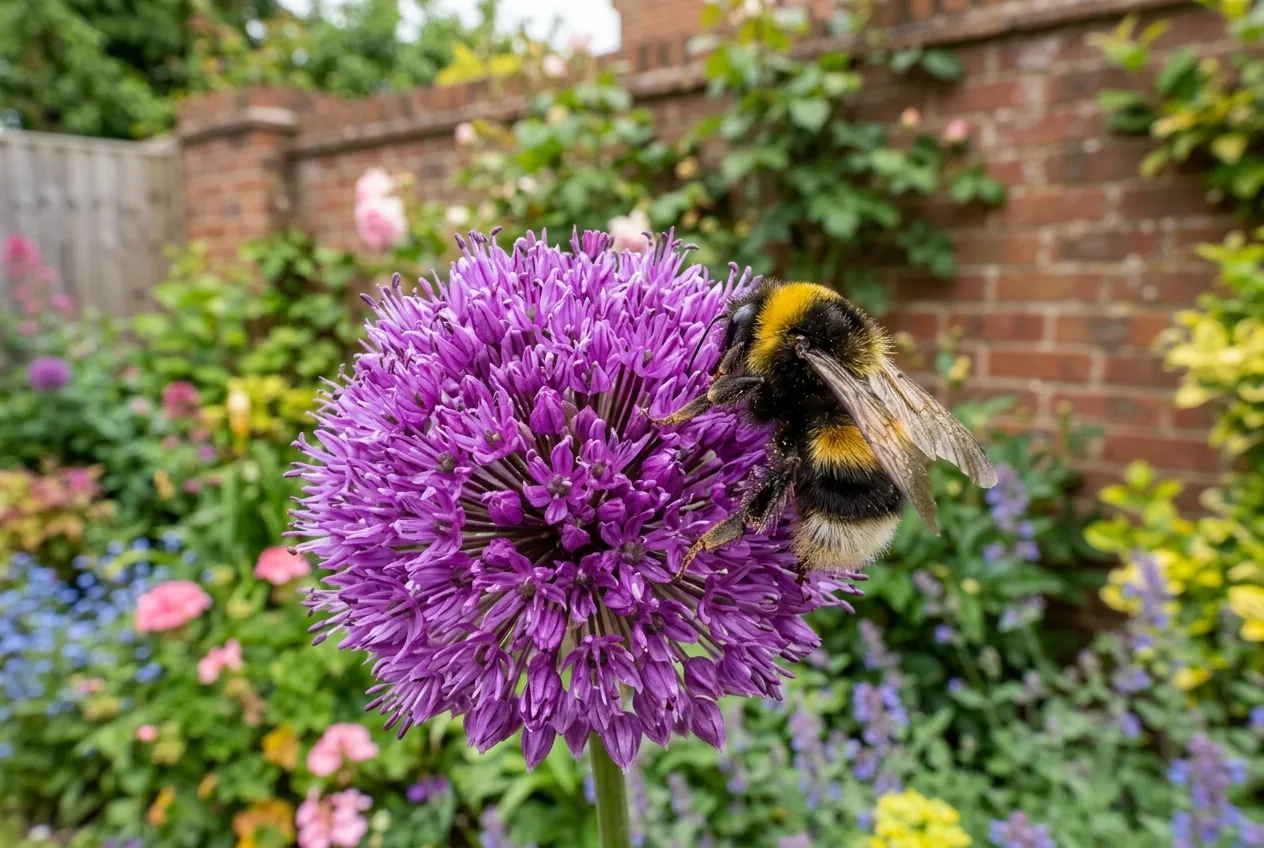
A white-tailed bumblebee visiting allium flowers. The pure white tail distinguishes queens from the buff-tailed species.
3. Red-tailed bumblebee (Bombus lapidarius)
The easiest species to identify. Queens and workers are jet black with a vivid red-orange tail. Males are different: they have yellow facial hair and yellow thorax bands, which confuses beginners who assume they are a separate species.
Flight season: March to October.
Nesting: Underground or in stone walls and rockeries. The Latin name lapidarius means “of stones.”
Flower preference: Medium tongue length. Visits thistles, knapweed, bird’s-foot trefoil, and garden dahlias. A wildflower lawn with bird’s-foot trefoil and clover is ideal habitat.
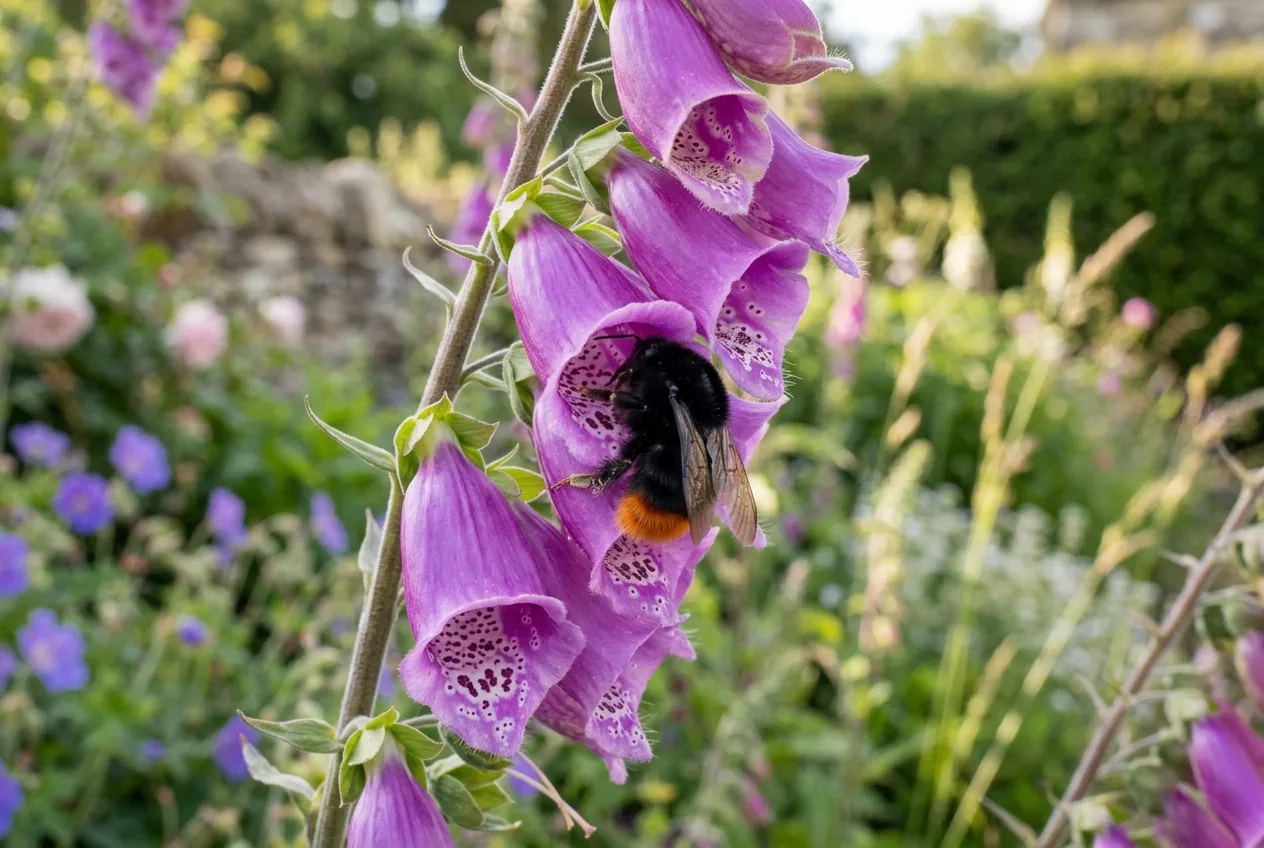
A red-tailed bumblebee on foxglove. The jet-black body with bright red-orange tail makes this the easiest bumble bee species to identify.
4. Early bumblebee (Bombus pratorum)
A small bumblebee, roughly two-thirds the size of a buff-tailed. Queens have a yellow thorax band, a yellow abdominal band, and an orange tail. Workers sometimes lack the abdominal band. This species completes its colony cycle quickly, often finishing by July.
Flight season: March to July (occasionally a second brood in late summer).
Nesting: Above ground in bird boxes, loft spaces, and dense hedgerows. One of the few bumblebees that readily nests above ground level.
Flower preference: Short to medium tongue. Cotoneaster, raspberry, white clover, and soft fruit blossom. Early bumblebees are important pollinators of apple trees and other spring fruit.
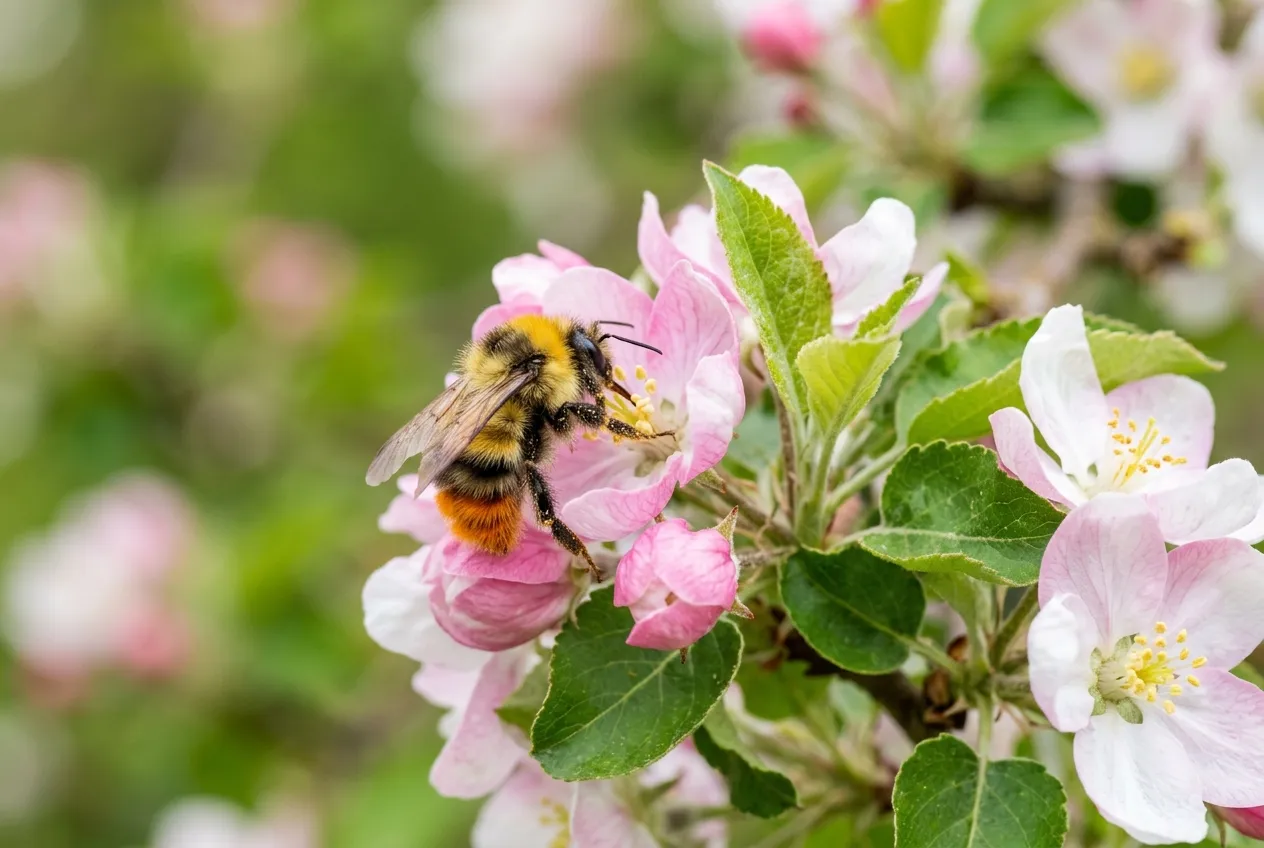
An early bumblebee pollinating apple blossom. This small species is critical for spring fruit pollination in UK gardens.
5. Common carder bee (Bombus pascuorum)
The only common bumblebee that is ginger-brown all over. No bold stripes or contrasting tail colour. The thorax fur is distinctively tawny, and the abdomen is paler brown. Carder bees get their name from their habit of “carding” (combing) moss and grass into a ball to cover their nest.
Flight season: March to November. One of the longest flight seasons of any UK bumblebee.
Nesting: Above ground in thick grass tussocks, at the base of hedges, or in compost heaps. Leaving areas of long grass in your garden directly benefits this species. A composting area for wildlife provides both nesting material and warmth.
Flower preference: Medium to long tongue. Dead-nettles, red clover, comfrey, betony, and woundwort. Also visits lavender and catmint.
6. Garden bumblebee (Bombus hortorum)
A large species with the longest tongue of any common UK bumblebee. This allows it to feed from deep tubular flowers that other species cannot reach. It has yellow-black-yellow banding with a white tail, and a characteristically elongated face.
Flight season: April to September.
Nesting: Underground or at ground level, often in garden sheds and under decking.
Flower preference: Long tongue. Foxgloves, honeysuckle, delphiniums, red clover, and comfrey. If you grow foxgloves and honeysuckle, you will attract this species. Foxgloves also benefit other long-tongued bumblebees, which is one reason why building a bug hotel near these plants creates a pollinator hotspot.
7. Tree bumblebee (Bombus hypnorum)
A relative newcomer to the UK, first recorded in Wiltshire in 2001. It has since spread across England, Wales, and into Scotland. Distinctive colouring: ginger-brown thorax, black abdomen, and white tail. The only common bumblebee that routinely nests in bird boxes, roof soffits, and tree cavities.
Flight season: March to July.
Nesting: Above ground. Bird boxes are a favourite. Colonies can alarm householders because the bees cluster around the entrance, but this is normal mating behaviour (males waiting for new queens). They are not aggressive.
Flower preference: Short tongue. Cotoneaster, bramble, raspberry, pyracantha, and garden roses. Visits a wide range of flowering shrubs.
Bumble bee species comparison table
| Species | Tail colour | Thorax bands | Tongue length | Flight season | Nest location |
|---|---|---|---|---|---|
| Buff-tailed | Buff (queens), white (workers) | 1 yellow | Short | Feb-Nov | Underground |
| White-tailed | White | 1 yellow | Short | Mar-Sep | Underground |
| Red-tailed | Red-orange | None (queens) | Medium | Mar-Oct | Underground/stone walls |
| Early | Orange | 1 yellow + 1 abdominal | Short-medium | Mar-Jul | Above ground (bird boxes) |
| Common carder | Ginger-brown (all over) | None distinct | Medium-long | Mar-Nov | Grass tussocks |
| Garden | White | 2 yellow | Long | Apr-Sep | Underground/sheds |
| Tree | White | Ginger thorax (no bands) | Short | Mar-Jul | Bird boxes/roofs |
What plants attract each bumble bee species?
Not all bumblebees visit the same flowers. Tongue length determines which blooms each species can access. Planting a mix of open and tubular flowers supports all 7 common species.
Short-tongued species (buff-tailed, white-tailed, tree)
These bees need open, accessible flowers where nectar sits near the surface:
- Lavender (Lavandula angustifolia ‘Hidcote’)
- Sedum (Hylotelephium ‘Autumn Joy’)
- Heather (Calluna vulgaris)
- Bramble (Rubus fruticosus)
- Cotoneaster
- Marjoram (Origanum vulgare)
Long-tongued species (garden, common carder)
Deep tubular flowers that only long-tongued bees can exploit:
- Foxglove (Digitalis purpurea)
- Honeysuckle (Lonicera periclymenum)
- Red clover (Trifolium pratense)
- Comfrey (Symphytum officinale)
- Delphinium
- Salvia
Medium-tongued species (red-tailed, early)
These versatile bees access a wide range:
- Knapweed (Centaurea nigra)
- Bird’s-foot trefoil (Lotus corniculatus)
- White clover (Trifolium repens)
- Catmint (Nepeta varieties)
- Dahlia (single-flowered varieties only)
A mini wildflower meadow with native knapweed, bird’s-foot trefoil, and red clover provides natural forage from June to September.
How to help nesting bumblebees in your garden
Each species nests differently, so a varied garden structure supports the most bees.
For underground nesters (buff-tailed, white-tailed, red-tailed, garden)
Leave undisturbed areas of soil, particularly south-facing banks. Old mouse holes are the most common nest entrance. Avoid rotavating or digging borders in spring when queens are searching for nest sites. A layer of leaf mulch over bare soil provides cover.
For above-ground nesters (early, common carder, tree)
- Leave grass tussocks uncut. The common carder bee needs long grass for nesting material.
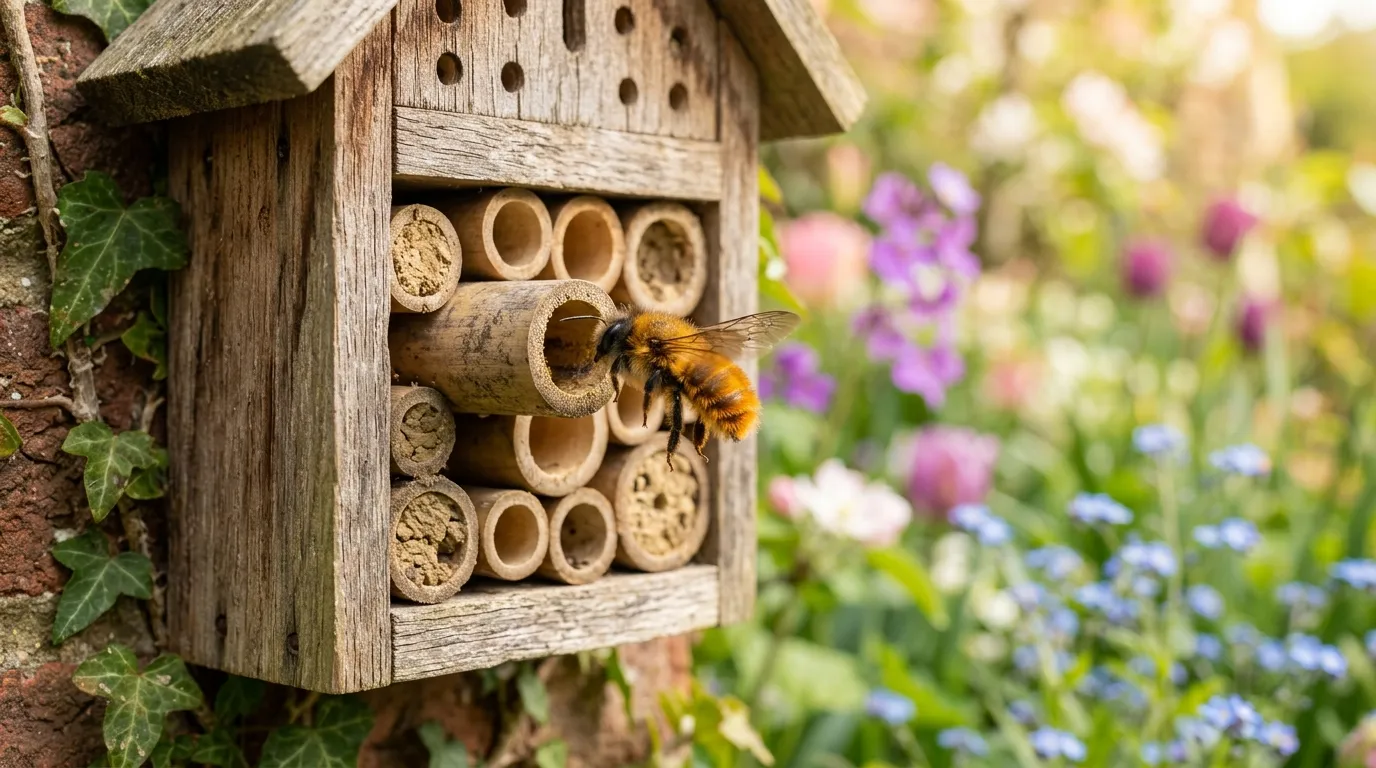
- Mount bird boxes with 25mm entrance holes on fences and walls. Tree bumblebees and early bumblebees will use them.
- Leave dead plant stems standing over winter. Queens hibernate in hollow stems and leaf litter.
- A pile of dry moss near a hedge provides nesting material for carder bees.
For a wider approach to supporting garden wildlife beyond bumblebees, our guide to solitary bees covers the 240 other bee species you might encounter in your garden.
Bumblebee conservation in the UK
Two UK bumblebee species have gone extinct since 1940: Cullem’s bumblebee (Bombus cullumanus, last recorded 1941) and the apple bumblebee (Bombus pomorum, last recorded in the 1860s). Three more are critically endangered: the great yellow bumblebee, the shrill carder bee, and the short-haired bumblebee.
The main causes are habitat loss, intensive farming, and pesticide exposure. The 97% decline in wildflower meadows since the 1930s removed the primary food source for most species. Gardens now collectively cover more land area than all UK nature reserves combined, making them a critical refuge.
What you can do:
- Avoid pesticides. Neonicotinoids are particularly harmful to bumblebees, even at sub-lethal doses that impair navigation and colony growth.
- Plant for gaps. Early spring (February-March) and late autumn (September-October) are the hardest periods for foraging bees.
- Leave messy corners. Uncut grass, dead stems, and leaf piles provide nesting and hibernation sites.
- Record sightings. Submit records to the Bumblebee Conservation Trust or iRecord. Population data drives conservation decisions.
Frequently asked questions
Lawrie has been gardening in the West Midlands for over 30 years. He grows his own veg using no-dig methods, keeps a wildlife-friendly garden, and writes practical advice based on real UK growing conditions.