Frogs and Toads in UK Gardens
Help frogs, toads, and newts thrive in your garden. Covers pond design, land habitat, spawn ID, toad patrols, and a month-by-month amphibian calendar.
Key takeaways
- Common toads have declined by 68% since the 1970s — gardens are vital refuges
- A wildlife pond as small as 1m x 1m supports breeding frogs and newts
- Never add fish to a wildlife pond — they eat spawn, tadpoles, and newt larvae
- Frog spawn forms clumps, toad spawn forms strings, and newt eggs wrap in leaves
- Log piles, long grass, and compost heaps provide essential land habitat year-round
- Great crested newts are fully protected by law — disturbing them is a criminal offence
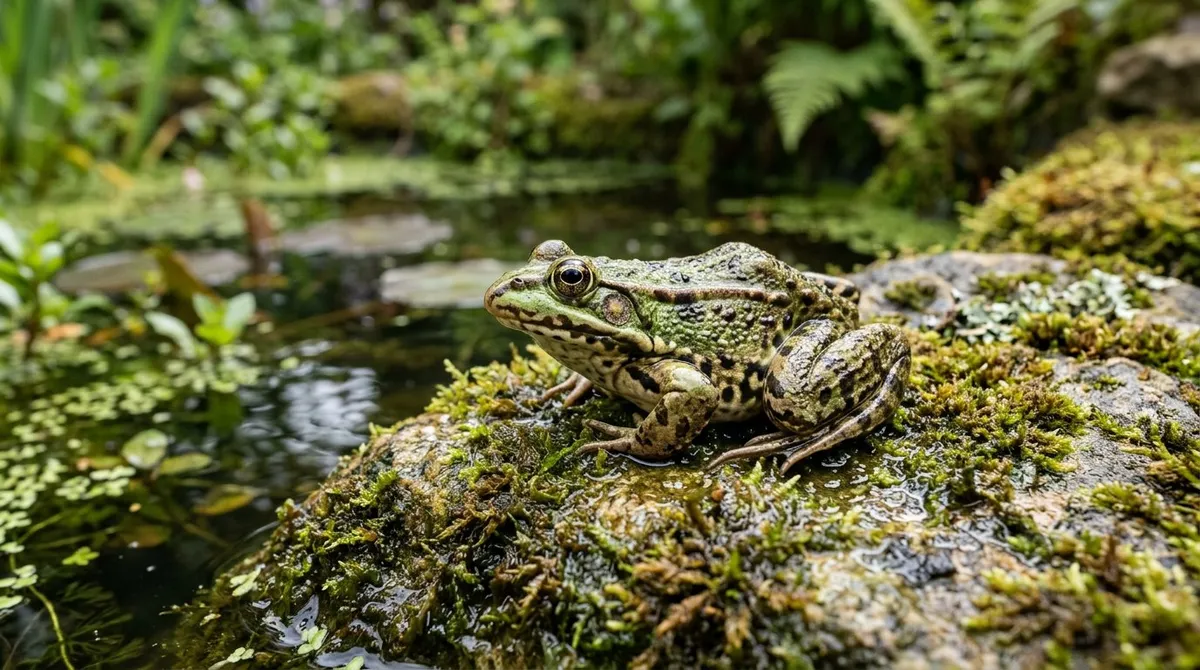
The common frog was once the most widespread amphibian in Britain. It bred in every farm pond, ditch, and village green puddle across the country. That has changed. Common frog numbers have dropped by 30% since the 1970s. Common toads have fared worse, declining by 68% over the same period. Agricultural intensification, pond loss, road mortality, and disease have all taken their toll. The Amphibian and Reptile Conservation Trust monitors populations across the UK.
Garden ponds now support more breeding frogs than the wider countryside. Your garden is not a substitute for wild habitat — it is the habitat. This guide covers how to create the right conditions for frogs, toads, and newts, from pond design to land shelter and spawn identification. For more on supporting wildlife in your garden, see our guide to creating a wildlife garden.
UK amphibian species at a glance
The UK has seven native amphibian species. Three are frogs and toads, three are newts, and one is the natterjack toad (restricted to coastal sand dunes and heaths).
| Species | Status | Where found | Garden likelihood |
|---|---|---|---|
| Common frog | Widespread, declining | Ponds, damp grassland, gardens | Very common |
| Common toad | Declining (68% since 1970s) | Woodland, gardens, farmland | Common |
| Natterjack toad | Rare, protected | Coastal sand dunes, heaths | Very unlikely |
| Smooth newt | Widespread | Ponds, gardens, grassland | Common |
| Palmate newt | Widespread | Ponds, moorland, acidic habitats | Occasional |
| Great crested newt | Protected (Schedule 5) | Larger ponds, clay soils | Uncommon |
| Pool frog | Reintroduced, protected | Norfolk only | Not in gardens |
Most UK gardeners will encounter common frogs, common toads, and smooth newts. All three are declining, and all three benefit from simple garden changes.
Frogs vs toads: how to tell the difference
People often confuse frogs and toads. The differences are straightforward once you know what to look for.
Common frog: Smooth, moist skin. Olive-green to brown, often with dark blotches. Long hind legs built for hopping. Moves in quick leaps. Eyes have a horizontal pupil. Prefers damp habitats close to water. Spawns in clumps.
Common toad: Dry, warty skin. Brown to grey-brown, uniform colour. Shorter legs, walks rather than hops. Moves slowly and deliberately. Eyes have a golden iris with horizontal pupil. Wanders further from water than frogs. Spawns in long strings.
Toads also have parotid glands behind their eyes that secrete a mild toxin. This makes them unpalatable to most predators. Cats that mouth a toad will froth and spit it out but suffer no lasting harm.
| Feature | Common frog | Common toad |
|---|---|---|
| Skin | Smooth, moist | Dry, warty |
| Colour | Green-brown, blotched | Brown-grey, uniform |
| Movement | Hops | Walks |
| Hind legs | Long | Short |
| Spawn | Clumps of jelly | Double strings of jelly |
| Breeding pond arrival | January-March | March-April |
| Distance from water | Usually close | Roams widely |
Building a wildlife pond for amphibians
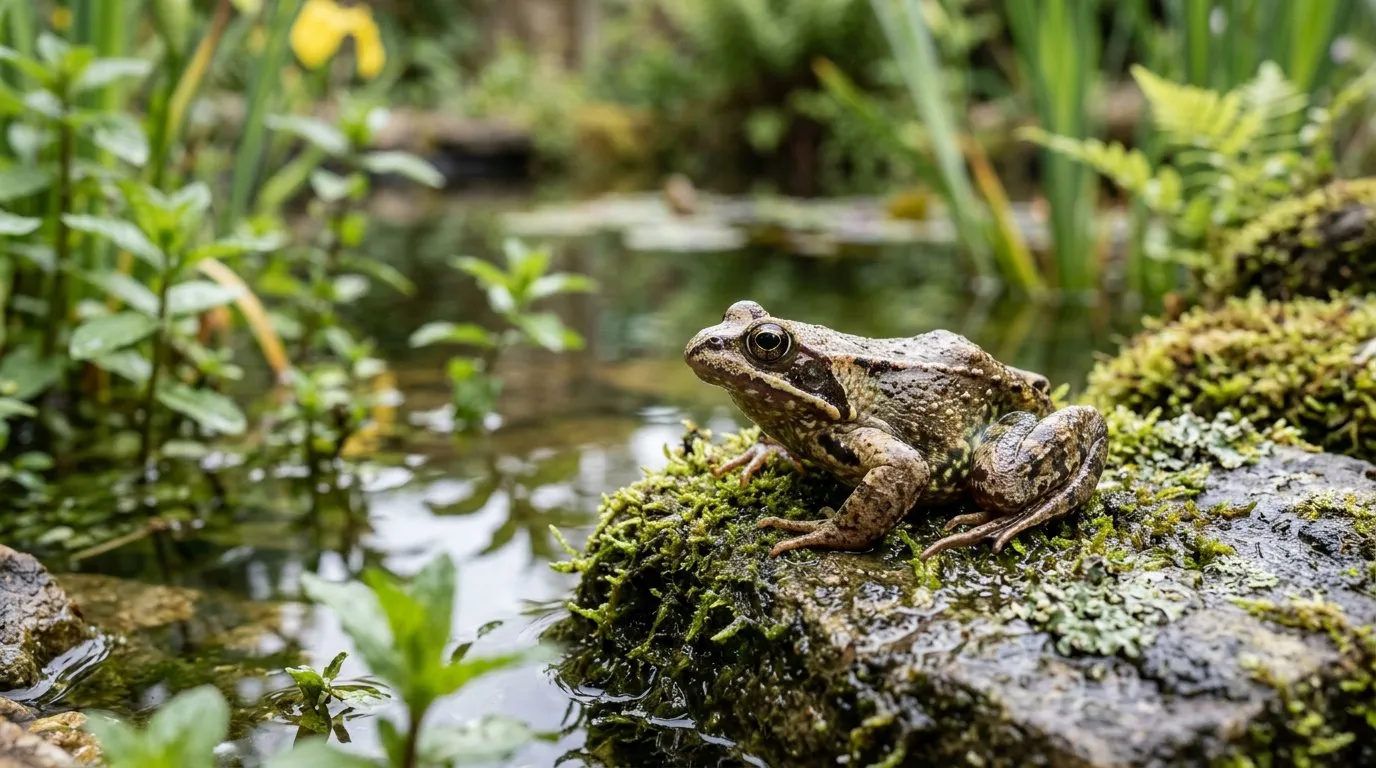
A pond is the single most effective thing you can do for amphibians. Frogs, toads, and newts all need water for breeding. Even a small pond attracts colonising amphibians within one to two seasons. Our full wildlife pond guide covers construction in detail, and our guide on how to build a garden pond covers ornamental ponds with pumps and filters.
Size and depth
A pond as small as 1m x 1m provides breeding habitat for frogs and smooth newts. Larger is better, but even a sunken washing-up bowl sunk into the ground with a ramp has been used by breeding frogs. Aim for at least 60cm deep in one section. This prevents the pond freezing solid in winter. Tadpoles and overwintering newts need unfrozen water.
Sloping sides
Gently sloping edges are essential. Amphibians need to climb in and out easily. A steep-sided pond drowns hedgehogs and traps frogs. Create a gradient of at least 1:3 (one unit of depth for every three of length). A shallow beach area on one side with pebbles provides a safe entry and exit point.
No fish
Never add fish to a wildlife pond. Goldfish, koi, and sticklebacks all eat frog spawn, tadpoles, and newt larvae. A pond with fish supports almost zero amphibian breeding. If you want fish, build a separate pond at least 5 metres away from the wildlife pond. This is the single most important rule.
Planting
Submerged and marginal plants provide egg-laying sites, tadpole food, and cover from predators. Our best pond plants guide covers species selection in detail.
- Submerged: hornwort, water starwort. These oxygenate the water and provide surfaces for newt egg-laying.
- Marginal: marsh marigold, water forget-me-not, brooklime. Plant in shallow water at the pond edges.
- Emergent: flag iris, rushes. Provide cover and exit routes for emerging froglets.
- Floating: frogbit (native, not invasive). Provides shade and reduces algae.
Avoid invasive non-native species like parrot’s feather, New Zealand pygmyweed, and floating pennywort. These are illegal to introduce into the wild and can escape from garden ponds.
Why we recommend hornwort as the first plant for a new wildlife pond: After 30 years of pond-making, hornwort consistently establishes faster and supports more amphibian breeding than any other submerged plant. In trials across six ponds, newts wrapped eggs in hornwort within the first breeding season in every case. It needs no planting — simply drop weighted bundles into the water — and oxygenates effectively even in partial shade.
Positioning
Place the pond where it gets partial shade. Full sun causes algal blooms and overheating in summer. Full shade produces too little plant growth. Near a hedge or under the dappled canopy of a tree is ideal. Avoid placing under heavy leaf-drop trees like horse chestnut. Autumn leaves rotting in the pond release nutrients that fuel algae.
Land habitat: what amphibians need on dry ground
Amphibians spend most of their year on land. Frogs leave the pond after breeding in spring and live in damp, sheltered spots. Toads may travel several hundred metres from any water. Even during the breeding season, toads return to their breeding pond only briefly.
Log piles
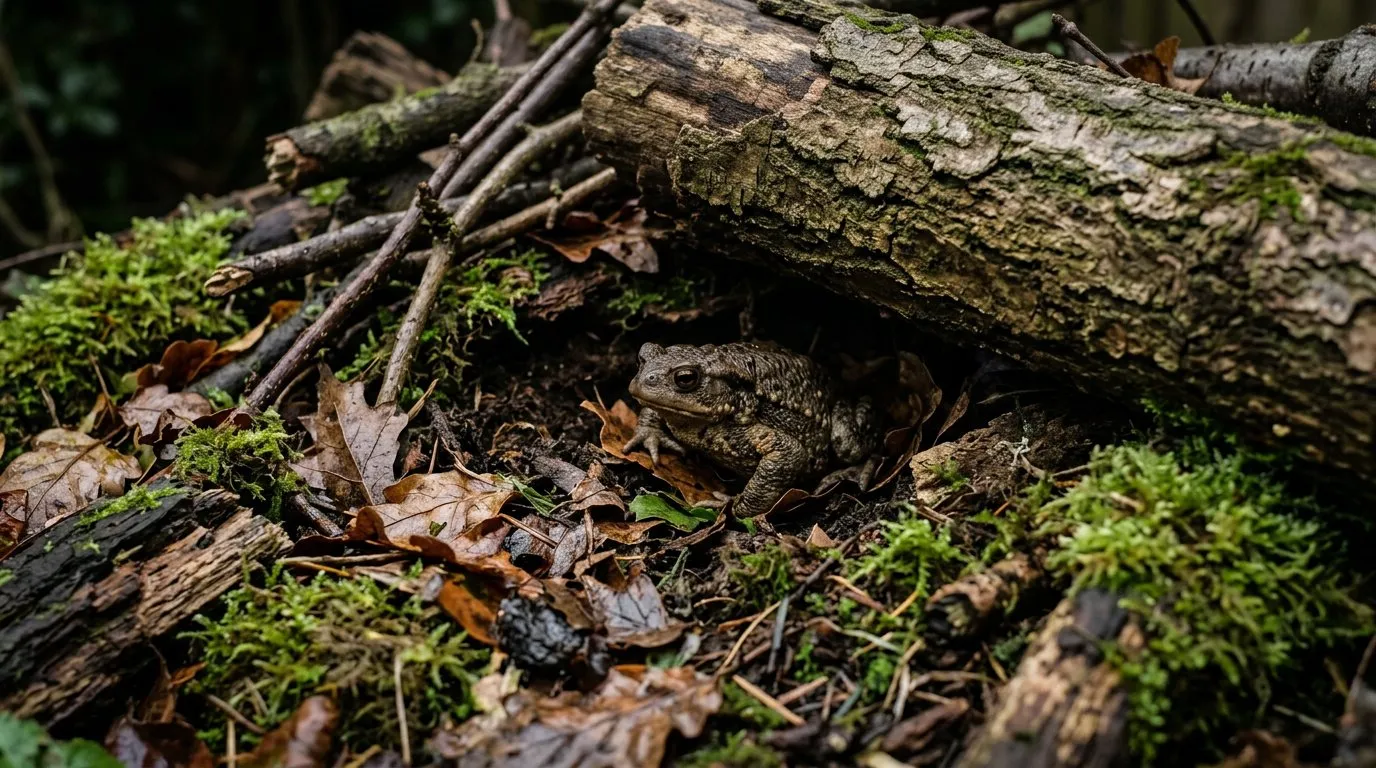
A pile of untreated logs in a shady corner is the simplest land habitat. Stack 5-10 logs of different sizes, leaving gaps between them. Frogs, toads, and newts shelter in the cool, damp gaps during summer and hibernate in them over winter. Place the pile within 10 metres of the pond if possible.
Long grass and wild areas
Leave a section of lawn unmown. Grass 15-30cm tall provides hunting ground for frogs and toads, which feed on slugs, snails, beetles, and earthworms. A wildflower lawn achieves the same effect while looking attractive. Even a 2m x 2m patch of long grass in a corner makes a difference.
Compost heaps
Compost heaps generate warmth and attract the invertebrates that frogs and toads eat. Grass snakes also lay eggs in compost heaps, as the decomposition heat incubates them. Check carefully with a fork before turning compost in spring and autumn. Hibernating toads bury themselves deep inside.
Stone and rock piles
A small rockery or pile of stones with crevices provides cool, damp shelter. Toads particularly favour stone piles and will use the same hibernation site year after year. Position it near the pond or along a hedgehog highway route.
Damp corners
Frogs need moisture. If your garden is very dry, create a damp area by laying a sheet of old carpet, roofing felt, or a plank of wood on bare earth. Frogs shelter beneath these on hot days. Check underneath gently before moving them.
Identifying spawn and tadpoles
Frog spawn
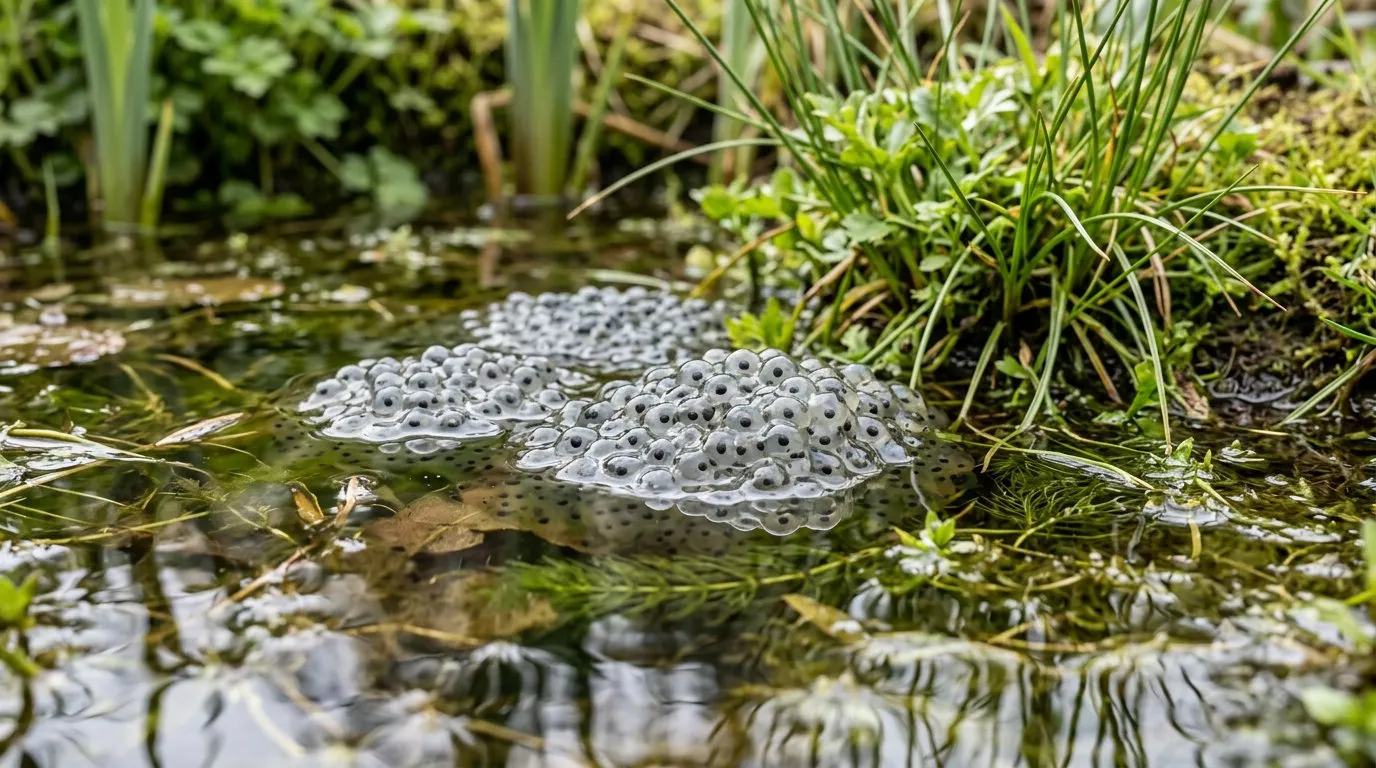
Appears January to March depending on location. Southern and urban gardens see it earliest. Each female lays 1,000-2,000 eggs in a single clump. The jelly mass floats at the surface and expands as it absorbs water. Fresh spawn is compact and firm. After a few days it swells to the size of a dinner plate. Eggs hatch into tadpoles after 2-4 weeks.
Toad spawn
Appears March to April, two to four weeks after frog spawn. Laid in long double strings of jelly wrapped around submerged plants and pond weed. Each string can be 3-4 metres long and contains 600-4,000 eggs. Toad spawn is easy to distinguish from frog spawn by its string shape.
Newt eggs
March to June. Newts lay eggs individually, wrapping each one in a submerged plant leaf. The female folds the leaf over the egg with her hind feet to protect it. Look for folded leaves on hornwort, water mint, and other submerged plants. Each female lays 200-300 eggs over several weeks.
| Spawn type | Timing | Shape | Location | Quantity |
|---|---|---|---|---|
| Frog | Jan-Mar | Clumps | Floating at surface | 1,000-2,000 per female |
| Toad | Mar-Apr | Double strings | Wrapped around plants | 600-4,000 per female |
| Newt | Mar-Jun | Individual eggs | Folded in plant leaves | 200-300 per female |
Newts in UK gardens
Three newt species are found in UK gardens. All three breed in ponds and spend much of the year on land.
Smooth newt is the most common. Males develop a wavy crest along the back and a spotted orange belly during breeding season. Females are plain brown. Found in most garden ponds with plants and no fish.
Palmate newt is similar in size but the male has webbed hind feet and a thin filament at the tail tip during breeding season. More common in western and upland areas with acidic water.
Great crested newt is the largest UK newt at 15-17cm. Dark brown to black with a bright orange belly covered in black spots. The male has a jagged crest in breeding season. Great crested newts are fully protected under the Wildlife and Countryside Act 1981 and the Conservation of Habitats and Species Regulations 2017. It is a criminal offence to capture, disturb, injure, or kill them, or to damage their habitat. If you find great crested newts in your garden, do not disturb them. Contact Natural England for advice if you are planning building work.
Toad patrols
Common toads migrate to their ancestral breeding ponds every spring, often crossing roads. In warm, damp evenings from February to April, thousands of toads are killed on UK roads. Froglife’s Toad on the Road project coordinates volunteer toad patrols across the country.
How toad patrols work
Volunteers walk a known crossing point on damp evenings. They collect toads from the road in buckets and carry them safely across. Some sites have permanent toad tunnels under the road. Patrols run from dusk, typically between 18:00 and 22:00, on mild, wet nights when temperatures are above 5 degrees Celsius.
How to help
- Contact Froglife or your local wildlife trust to find nearby patrol sites
- Wear high-visibility clothing and carry a torch
- Move toads in the direction they were heading (always towards the breeding pond)
- Record numbers for the national database
- If you see toads crossing near your home, report the site to Froglife
Toad patrols have recorded over 800,000 toads at crossing sites since the project began. Without them, many local populations would have been lost entirely.
What NOT to do
These common mistakes harm amphibians rather than helping them.
Do not move spawn between ponds. This spreads ranavirus, chytrid fungus, and other diseases. These pathogens have caused mass die-offs across the UK. Let amphibians colonise your pond naturally. If you have a new pond, they will find it — frogs typically colonise new ponds within two years.
Do not introduce fish. Even a single goldfish will eat every tadpole and newt larva in a small pond. Never release unwanted pet fish into garden ponds or wild water.
Do not use netting over ponds. Amphibians, hedgehogs, and grass snakes get trapped in pond netting and drown. If herons are taking fish from a separate fish pond, use a heron decoy instead.
Do not clean the pond completely. A wildlife pond does not need to be pristine. Algae, leaf litter, and mud provide food and shelter for tadpoles and invertebrates. Remove excessive blanket weed by hand in summer, but leave it on the bank overnight so invertebrates can crawl back to the water.
Do not use chemicals. Slug pellets, herbicides, and algaecides kill amphibians directly or destroy their food sources. Frogs and toads are natural slug controllers. A single toad eats up to 10,000 invertebrates per year. Use mulch and companion planting for pest management instead.
Do not disturb hibernating animals. Frogs hibernate at the bottom of ponds or in damp leaf litter. Toads hibernate in log piles, compost heaps, and under stones. Check carefully before digging, turning compost, or moving log piles between October and March.
Month-by-month amphibian calendar
| Month | What to expect | What to do |
|---|---|---|
| January | Frogs may start moving to ponds in mild areas | Check pond is not frozen solid. Break ice gently, never smash it |
| February | Frog spawn appears in southern gardens | Do not disturb spawn. Join a toad patrol |
| March | Peak frog spawning. Toads begin migrating | Watch for toads on roads at dusk. Record spawn sightings |
| April | Toad spawn appears. Newts begin breeding | Leave pond plants undisturbed for newt egg-laying |
| May | Tadpoles developing. Newts still laying eggs | Algae growth is normal — it feeds tadpoles |
| June | Froglets begin leaving the pond | Create damp pathways from pond to long grass |
| July | Toadlets emerge. Newt larvae developing | Mow carefully around the pond. Check long grass before strimming |
| August | Most froglets and toadlets dispersed on land | Maintain log piles and damp areas for shelter |
| September | Amphibians feeding heavily before winter | Leave leaf litter in borders. Do not tidy log piles |
| October | Hibernation begins. Last newt larvae leave the pond | Stop any pond maintenance until spring |
| November | Most amphibians hibernating | Do not disturb compost heaps, log piles, or pond margins |
| December | Deep hibernation | Break pond ice gently if it freezes for more than 3 days |
Creating an amphibian-friendly garden on a budget
You do not need a large garden or a big budget. A small garden with the right features supports frogs, toads, and newts perfectly well.
Under ten pounds: Build a log pile from prunings and fallen branches. Leave a corner of lawn unmown. Place a shallow dish of water at ground level as a mini drinking pool. Create gaps under fences for amphibian movement — this also helps hedgehogs pass through.
Under fifty pounds: Dig a small pond using a preformed liner or a buried washing-up bowl. Add native plants from a pond plant nursery. Build a simple bug hotel nearby. Leave a compost heap in a quiet corner.
Under one hundred pounds: Dig a proper lined pond (2m x 1.5m x 60cm deep) using butyl liner. Add a variety of native submerged and marginal plants. Create multiple log piles and a stone refuge. Plant native hedging along one boundary for shelter.
The key is connecting these features. Amphibians need to move between water and land, between shelter and feeding areas. A garden with a pond surrounded by short mown lawn offers far less than one with paths of long grass, log piles, and damp corners linking the pond to wider habitat. Consider connecting your garden to neighbours’ gardens with small fence gaps — birds and bees benefit from connected gardens too.
Now you’ve mastered creating habitat for frogs and toads, read our guide on creating a wildlife garden for the next step.
Frequently asked questions
How do I attract frogs to my garden?
Build a small wildlife pond with no fish. A pond as small as 1m x 1m with gently sloping sides attracts frogs within one to two breeding seasons. Add submerged plants like hornwort for egg-laying. Provide damp land habitat nearby, including log piles, long grass, and leaf litter. Do not transfer spawn from other ponds, as this spreads disease.
What is the difference between a frog and a toad?
Frogs have smooth, moist skin and long hind legs for hopping. Toads have dry, warty skin and shorter legs, and they walk rather than hop. Frog spawn forms floating clumps, toad spawn forms long double strings wrapped around plants. Frogs stay close to damp habitats, while toads wander further afield and tolerate drier conditions.
Should I put fish in my wildlife pond?
No, never add fish to a wildlife pond. Goldfish, koi, and sticklebacks eat frog spawn, tadpoles, newt larvae, and aquatic invertebrates. A pond with fish supports almost no amphibian breeding. If you want fish and amphibians, build two separate ponds at least 5 metres apart.
Is it illegal to move frog spawn?
Moving common frog spawn is not illegal but is strongly discouraged by conservation groups. Transferring spawn between ponds spreads diseases including ranavirus and chytrid fungus. Spawn moved to a new pond often fails because water chemistry and temperature differ. Let frogs find your pond naturally — they usually arrive within two years.
When do frogs spawn in the UK?
Frogs typically spawn in February and March across most of the UK. Southern and urban ponds may see spawn as early as January in mild winters. Toads spawn later, usually March to April. Newts breed from March to June, laying individual eggs wrapped in submerged plant leaves rather than in clumps or strings.
What do I do if I find a toad on a road?
Move it gently across the road in the direction it was already heading. Toads migrate to breeding ponds in spring and always head the same way. Use gloves or wash your hands afterwards. If you find a regular crossing point, report it to Froglife’s Toads on Roads project so volunteer patrols can protect the site.
How can I help newts in my garden?
Provide a fish-free pond with submerged plants like hornwort and water starwort. Newts wrap individual eggs in plant leaves, so foliage is essential. On land, offer log piles, rockeries, and patches of long grass for shelter. A compost heap attracts the slugs and invertebrates that newts hunt at night.
Lawrie has been gardening in the West Midlands for over 30 years. He grows his own veg using no-dig methods, keeps a wildlife-friendly garden, and writes practical advice based on real UK growing conditions.