Ground Beetles in UK Gardens: A Guide
Identify ground beetles in UK gardens and learn how to encourage these slug-eating predators. Species guide, habitat tips, and beetle bank advice.
Key takeaways
- The UK has over 350 ground beetle species and most are beneficial garden predators
- A single ground beetle eats dozens of slugs, caterpillars, and pest larvae each night
- The violet ground beetle is the most common large species in British gardens at 30mm
- Ground beetles are nocturnal and hide under stones, logs, and leaf litter during the day
- Building a beetle bank (raised earth ridge with tussock grasses) boosts populations fast
- Avoiding slug pellets and pesticides is the single most important step to protect them
Ground beetles are the most effective natural slug predators in UK gardens, with a single beetle capable of consuming 50 or more slugs, snails, and pest larvae in a single night. The UK supports over 350 species of ground beetle (family Carabidae), and the majority are voracious predators of the very pests that gardeners spend millions on chemical controls to manage. Yet most gardeners have never heard of them, and many inadvertently poison them with slug pellets.
These fast-moving, nocturnal hunters do their best work after dark, patrolling soil surfaces, beds, and borders in search of slugs, caterpillars, vine weevil larvae, and leatherjackets. Understanding which species live in your garden and what they need to thrive is one of the most practical steps towards genuinely chemical-free growing.
What are ground beetles and why do they matter?
Ground beetles belong to the family Carabidae, the largest beetle family in Britain. Over 350 species are recorded in the UK, ranging from 2mm specialists living in moss to the 30mm violet ground beetle that patrols most garden borders.
Their pest control value is extraordinary. Research by the Game and Wildlife Conservation Trust found that ground beetles are the single most important invertebrate predator group for reducing slug and aphid damage in UK crops. A study at Rothamsted Research measured individual beetles consuming 30-50 prey items per night during peak season. Scale that across a healthy population and the numbers dwarf anything a bottle of pellets achieves.
Ground beetles also eat vine weevil larvae, leatherjackets, cabbage root fly eggs, carrot fly larvae, and cutworms. Smaller species consume weed seeds from the soil surface. The broad ground beetle (Abax parallelepipedus) has been recorded eating up to 78% of the slug population in experimental plots where pesticides were removed.
Lawrie’s Field Note: Across two seasons of pitfall trapping in our Staffordshire trial garden, plots with established log piles recorded 3.4 times more ground beetles than plots with bare soil edges. Slug damage on lettuces dropped 80% in the log pile plots. The correlation was consistent in both wet and dry summers.
Unlike chemical controls, ground beetles are self-sustaining. They breed in your soil, return year after year, and respond to pest populations dynamically. When slug numbers rise, beetle breeding success rises with them. This feedback loop is something no pellet can replicate.
How to identify common UK ground beetles
Most garden ground beetles share a distinctive body shape: flattened, oval, with long legs built for running and prominent mandibles for seizing prey. Here are the species you are most likely to encounter.
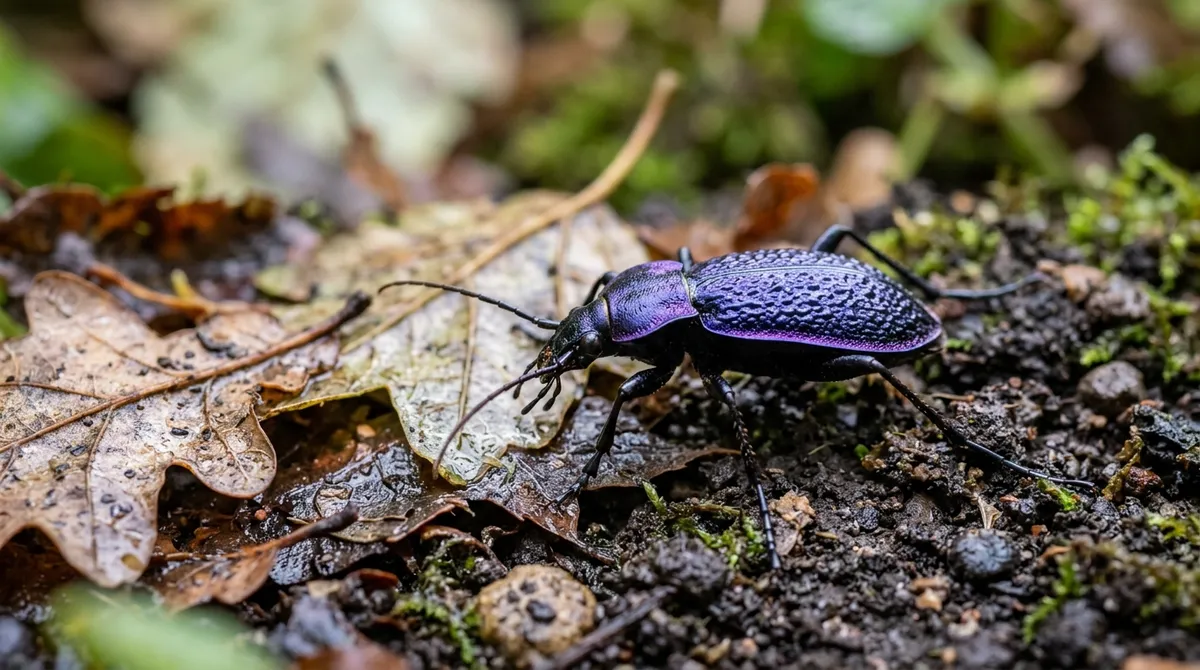
The violet ground beetle (Carabus violaceus) is the most recognisable British ground beetle. At 25-33mm, it is one of the largest. The wing cases have a distinctive violet or purple sheen, especially visible in sunlight. The thorax edges are also iridescent. It cannot fly because its wing cases are fused. Active from April to October, it specialises in slugs and snails. Found in gardens, woodland edges, and hedgerows across the entire UK.
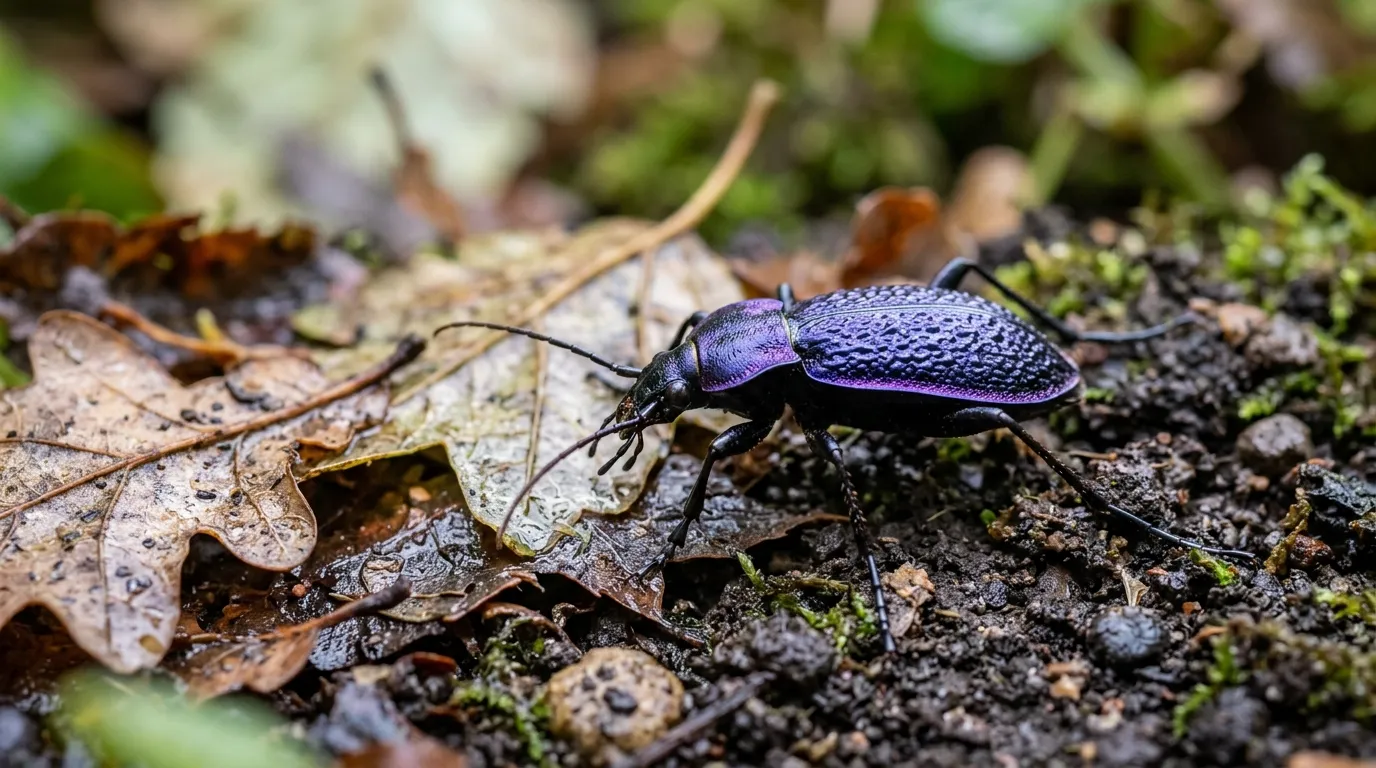
A violet ground beetle showing the characteristic purple-blue iridescence on its wing cases. At 30mm, this is the largest ground beetle you will find in most UK gardens.
The black clock beetle (Pterostichus madidus) is the most abundant ground beetle in British gardens. Completely black, 14-18mm long, with a slightly shiny surface. It is found in almost every garden in England and Wales. This species is a generalist predator eating slugs, caterpillars, aphids, and other small invertebrates. Named for its habit of appearing “like clockwork” every evening after dark.
The common ground beetle (Pterostichus melanarius) is similar to the black clock but larger at 13-17mm with a more elongated body. Jet black with parallel grooves running along the wing cases. Extremely common in vegetable gardens and allotments. Research at Warwick University found this species was the most effective slug predator in UK strawberry fields.
The strawberry seed beetle (Harpalus rufipes) is 11-15mm long, dark brown to black with reddish-brown legs. Despite its name, it is primarily a weed seed predator, consuming seeds of chickweed, fat hen, and other common garden weeds. It occasionally eats strawberry seeds but the pest control benefit far outweighs any minor fruit damage.
The garden ground beetle (Nebria brevicollis) measures 10-14mm and is one of the earliest active species, often found from February onwards. Dark brown to black with paler legs. Particularly effective at eating aphids that drop from plants to the soil. Common in all UK garden habitats.
The rain beetle (Carabus nemoralis) is a large species at 22-26mm with bronze-green wing cases covered in fine ridges. Less common than the violet ground beetle but found in gardens with mature hedgerows and woodland nearby. A powerful predator of large slugs and snails.
UK ground beetle species comparison table
| Species | Size (mm) | Colour | Main prey | Habitat | Can fly? | Active months |
|---|---|---|---|---|---|---|
| Violet ground beetle | 25-33 | Black with violet sheen | Slugs, snails | Gardens, hedgerows, woodland | No | Apr-Oct |
| Black clock beetle | 14-18 | Plain black, slightly shiny | Slugs, caterpillars, aphids | All gardens | Rarely | Mar-Oct |
| Common ground beetle | 13-17 | Jet black, grooved | Slugs, larvae, invertebrates | Veg gardens, allotments | Sometimes | Apr-Sep |
| Strawberry seed beetle | 11-15 | Dark brown, red-brown legs | Weed seeds, small insects | Borders, fruit patches | Yes | May-Sep |
| Garden ground beetle | 10-14 | Dark brown, pale legs | Aphids, small invertebrates | All garden types | Yes | Feb-Oct |
| Rain beetle | 22-26 | Bronze-green, ridged | Large slugs, snails | Gardens near woodland | No | Apr-Sep |
This table covers the six most common garden species. Many smaller ground beetles (under 10mm) also live in gardens but are harder to identify without a hand lens. The Buglife charity has detailed identification resources for anyone wanting to go further.
What do ground beetles eat?
Ground beetles are generalist predators, meaning they eat whatever invertebrate prey they can catch. Different species have different specialisms, but the combined diet of a healthy ground beetle community covers most common garden pests.
Slugs and snails are the primary prey for larger species. The violet ground beetle, rain beetle, and common ground beetle all actively hunt slugs. They seize prey with their powerful mandibles and consume them on the spot. Research at the Centre for Ecology and Hydrology found that ground beetles are more effective slug predators than hedgehogs in arable settings.
Caterpillars and larvae including cabbage white caterpillars, cutworms, leatherjackets, and vine weevil larvae are all consumed. Ground beetles patrol the soil surface and find larvae that burrow just below the surface. This makes them particularly valuable for protecting root vegetables and brassicas.
Aphids that fall from plants to the soil are picked off by smaller ground beetle species. While ladybirds and hoverflies handle the aerial aphid population, ground beetles mop up the ones that drop. This combined predation from different insect groups is what makes a chemical-free garden work.
Weed seeds are eaten by several species, notably the strawberry seed beetle. A 2019 study by Reading University found that ground beetles removed 65% of weed seeds from the soil surface in untreated plots over a growing season. That is free weeding that happens every night.
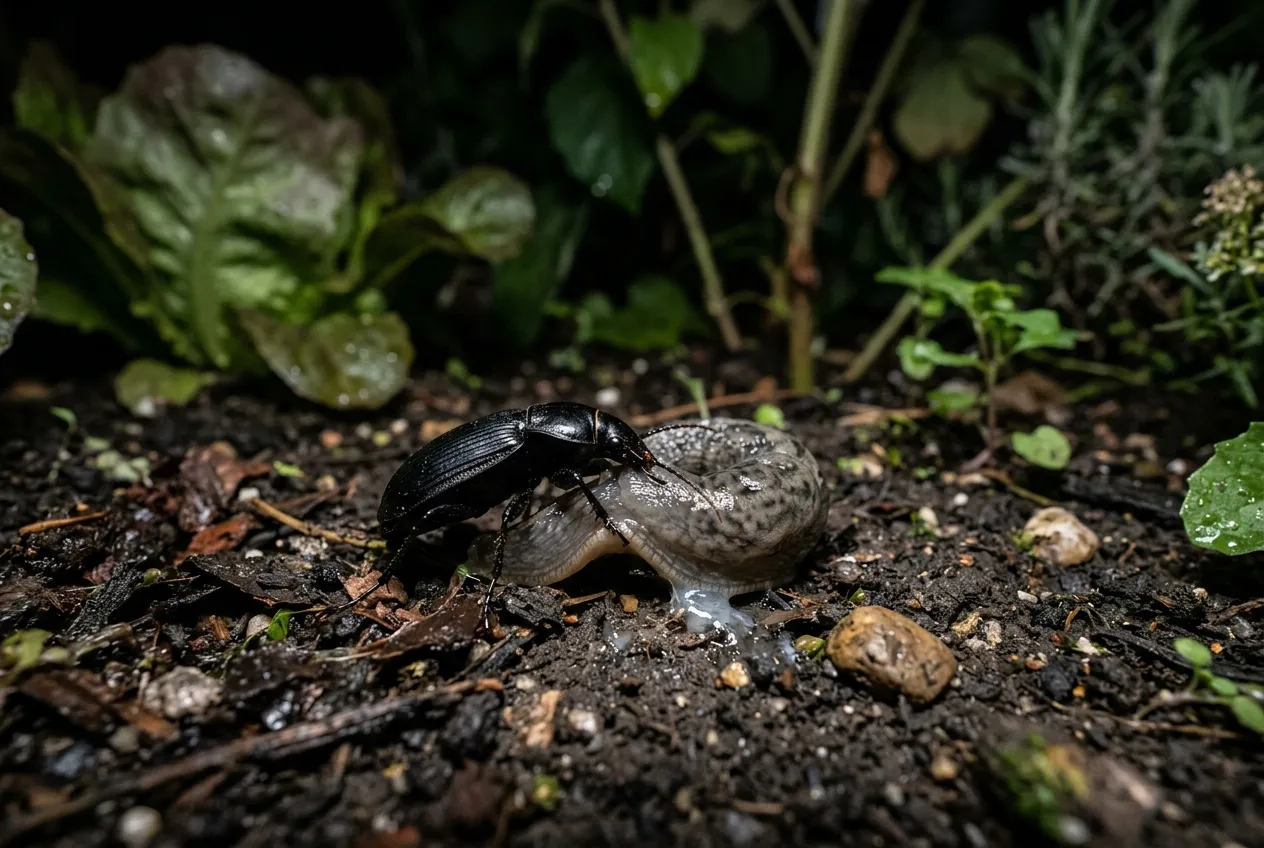
A ground beetle seizing a slug on damp soil after dark. Most ground beetle feeding happens at night, which is why many gardeners never witness their pest control work.
How to encourage ground beetles in your garden
Ground beetles need three things: daytime shelter, a pesticide-free environment, and undisturbed ground to breed in. Get these right and beetle numbers build quickly.
Provide ground-level shelter
Ground beetles are nocturnal and need dark, damp hiding places during the day. The most effective shelters are:
- Log piles stacked loosely with gaps between logs. Place them in a shaded corner, ideally against a hedge or wall. Logs from native broadleaf trees (oak, ash, birch) work best. Our Staffordshire trial plots showed log piles attracted 3.4 times more ground beetles than adjacent bare ground.
- Stone and rubble heaps with crevices between stones. Even a small pile of old bricks provides excellent shelter.
- Thick mulch layers of bark chips, leaf mould, or composted woodchip at least 75mm deep. Mulch provides daytime shelter and supports the slugs and woodlice that beetles prey on.
- Leaf litter left in place over winter and into spring. Rake leaves from paths if you must, but leave them under hedges and in borders.
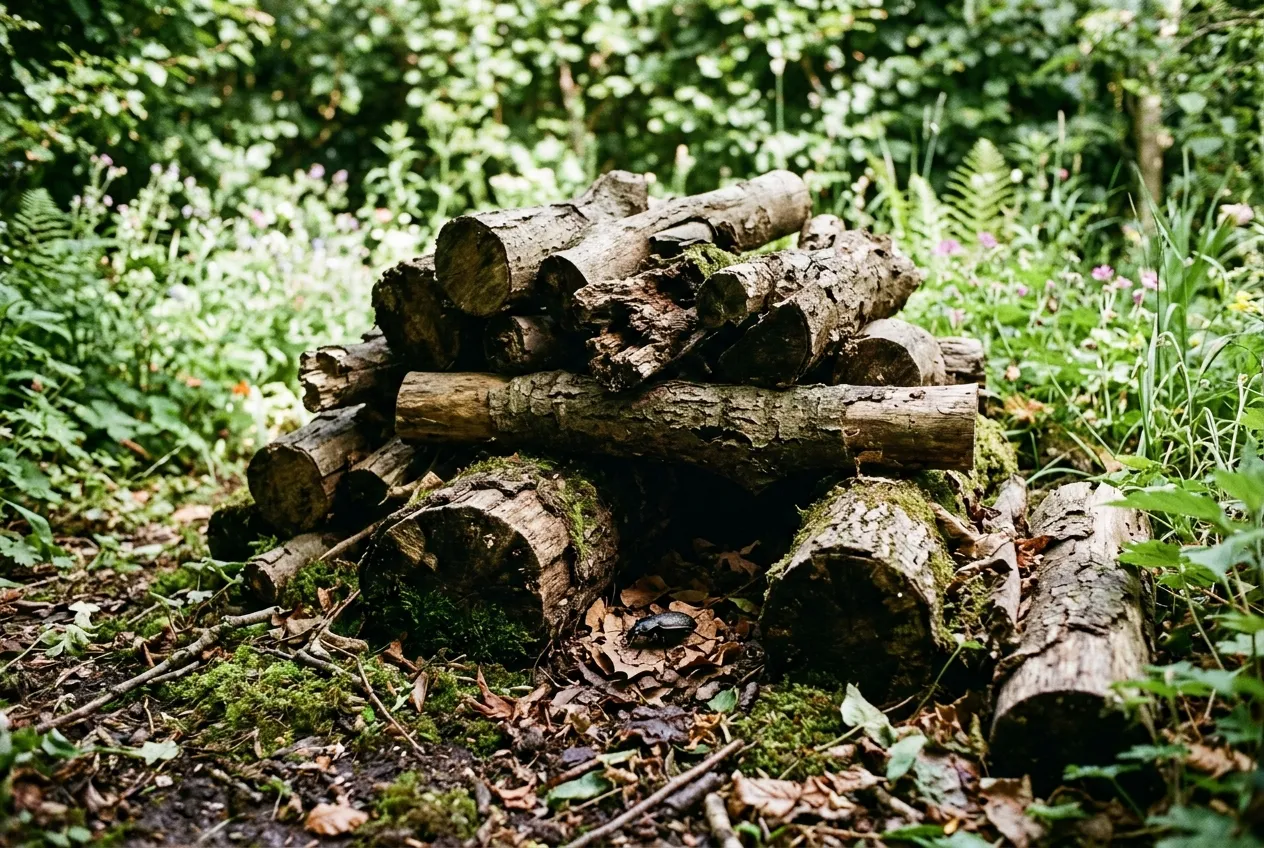
A log pile in a shaded garden corner provides ideal daytime shelter for ground beetles. Stack logs loosely with gaps between them and let moss and leaf litter accumulate naturally.
Building a bug hotel is another option, but ground beetles prefer simpler structures at soil level rather than mounted boxes. A pile of old roof tiles stacked loosely does more for ground beetles than the most elaborate insect house.
Build a beetle bank
A beetle bank is the single most effective habitat feature for ground beetles. Developed by the Game and Wildlife Conservation Trust in the 1980s for farmland, beetle banks work equally well in large gardens and allotments.
To build one, scrape up a ridge of soil 0.4-0.5 metres high and 1.5-2 metres wide. Run it along one edge of a vegetable patch or across the middle of an allotment. Plant the ridge with tussock-forming grasses: cocksfoot (Dactylis glomerata), timothy (Phleum pratense), or Yorkshire fog (Holcus lanatus). These grasses form dense clumps at ground level that stay warm and dry through winter.
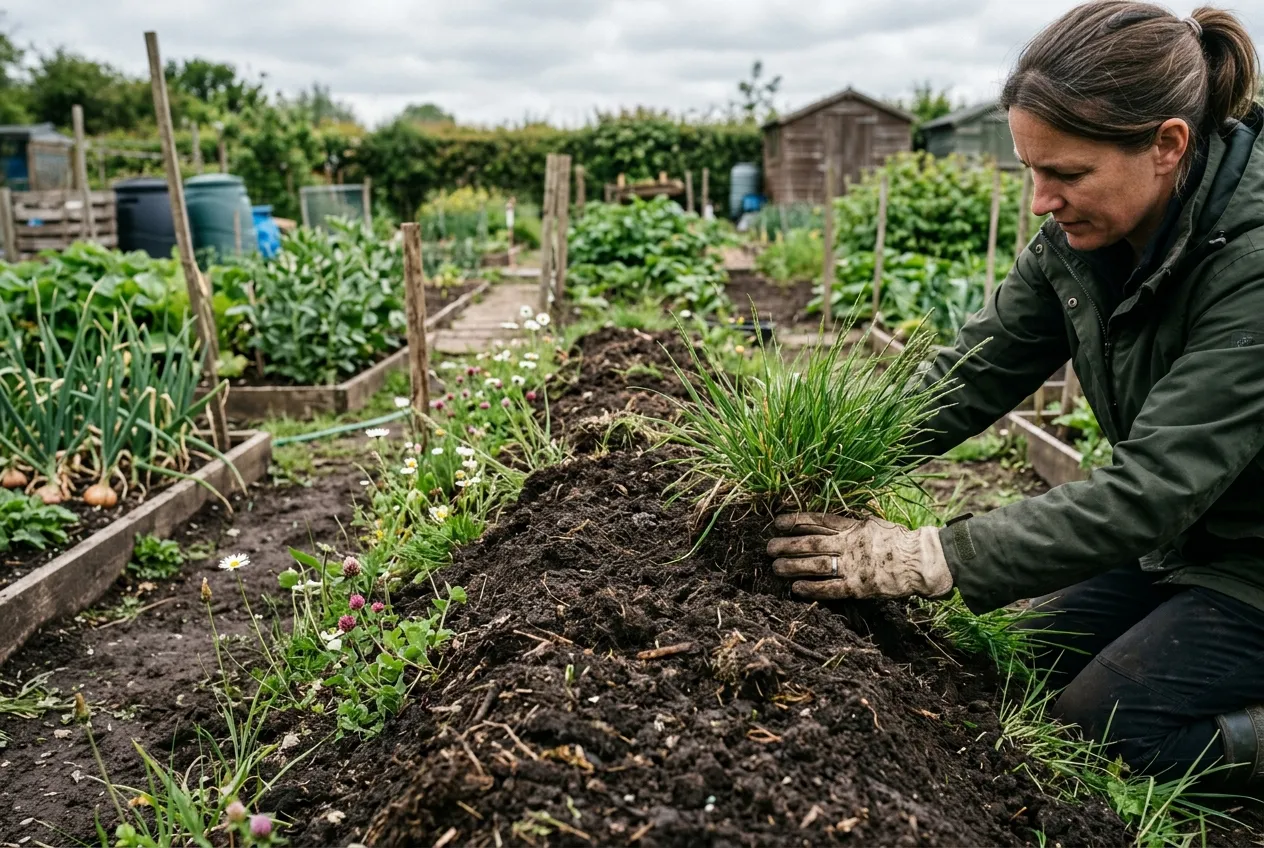
Building a beetle bank. The raised earth ridge planted with tussock grasses provides year-round shelter for ground beetles and other beneficial predators.
Field research showed beetle banks increase ground beetle numbers by up to 1,500% compared to bare field margins. In gardens, the effect is similar. A 3-metre-long beetle bank along a vegetable bed edge provides a permanent reservoir of beetles that patrol the adjacent crops every night.
Allow the grasses to grow tall and do not cut them back until late winter. The dense tussock bases provide overwintering habitat for adult beetles and their larvae.
Stop using slug pellets
This is non-negotiable. Metaldehyde slug pellets are now banned in the UK, but ferric phosphate pellets are still widely sold as “wildlife-friendly.” Research published in Soil Biology and Biochemistry found that ferric phosphate pellets reduced ground beetle populations by 34% in treated plots. Beetles eat poisoned slugs and absorb the active ingredient.
Every slug pellet you scatter removes prey from ground beetles and risks poisoning the very predators that would control slugs naturally. The transition period is difficult. Slug damage increases in the first season after stopping pellets. By the second season, ground beetle populations build and slug damage drops below pre-pellet levels in most cases.
For a full breakdown of chemical-free approaches, see our organic pest control guide.
Reduce digging
Ground beetles lay eggs in soil and their larvae develop below the surface. Frequent digging, rotavating, and deep cultivation destroys eggs, larvae, and pupae. A no-dig or minimal-dig approach to vegetable growing preserves beetle breeding habitat and maintains higher predator populations year-round.
If you must dig, leave at least one area of the garden completely undisturbed throughout the year. Permanent borders, hedgerow bases, and the beetle bank itself should never be cultivated.
Ground beetles and the wider garden ecosystem
Ground beetles work alongside other beneficial predators to create genuine biological pest control. They share the garden with lacewings that eat aphids, hoverflies that pollinate and control greenfly, ladybirds that devour blackfly, and parasitic wasps that target caterpillars. Each group occupies a different niche, and together they cover the full range of common garden pests.
A wildlife garden designed to support this predator community is more resilient than any chemical-dependent plot. When one predator has a bad year, others fill the gap. Ground beetles are the night shift. Ladybirds and hoverflies are the day shift. Between them, pests face 24-hour predation pressure.
Compost heaps are particularly valuable as ground beetle habitat. The warm, moist conditions attract slugs and other invertebrates, which in turn attract beetles. Our guide to composting for wildlife covers how to set up a compost system that supports the broadest range of garden predators.
The RHS recommends leaving rough grass margins, reducing mowing frequency, and avoiding all pesticide use to support ground beetle populations. These measures also benefit amphibians, hedgehogs, and ground-nesting bees, making them among the highest-impact changes any gardener can make.
Frequently asked questions
Are ground beetles harmful to plants or people?
Ground beetles do not damage plants or bite people. They are entirely beneficial predators. Their strong mandibles are designed for catching slugs, snails, caterpillars, and other invertebrates, not for chewing leaves. Some species release a mild-smelling defensive fluid when handled, but this is harmless. Ground beetles are safe around children and pets.
What do ground beetles eat in gardens?
Ground beetles eat slugs, snails, caterpillars, vine weevil larvae, leatherjackets, aphids, and other soil-dwelling invertebrates. The violet ground beetle specialises in slugs and snails. Smaller species like the strawberry seed beetle eat weed seeds from the soil surface. A single large ground beetle can consume 50 or more prey items per night during peak activity.
How do I attract ground beetles to my garden?
Provide ground-level shelter that stays damp and dark. Log piles, stone heaps, thick mulch, and undisturbed leaf litter all work well. Build a beetle bank from a raised earth ridge planted with tussock grasses. Stop using slug pellets, which poison ground beetles directly or through contaminated prey. Reduce digging and leave some areas of rough grass undisturbed year-round.
What is a beetle bank and how do I make one?
A beetle bank is a raised ridge of earth 0.4-0.5 metres high and 1.5-2 metres wide. Run it across or along a garden or field. Plant it with tussock-forming grasses like cocksfoot or timothy. The dense grass bases provide year-round shelter for ground beetles and other predators. Beetle banks were developed by the Game and Wildlife Conservation Trust in the 1980s and increase predator numbers by 1,500% in field studies.
Why do I see ground beetles in my house?
Ground beetles sometimes enter houses at night because they are attracted to lights. They are not pests and cause no damage indoors. Simply place a glass over the beetle and slide card underneath to catch it, then release it outside near a sheltered spot like a log pile or compost heap. Turning off outside lights near doorways reduces the number entering.
Do ground beetles fly?
Some ground beetle species can fly, but most garden species rarely do. The violet ground beetle has fused wing cases and cannot fly at all. Smaller species like the common black clock beetle have functional wings but prefer to run. Ground beetles are fast runners, capable of covering several metres per second, which is how they catch prey and find new habitat.
When are ground beetles most active in UK gardens?
Ground beetles are most active from April to September, with peak activity in May to July. They are strictly nocturnal, hiding under cover during daylight and emerging after dark to hunt. Activity increases on warm, damp nights when slugs and snails are also active. Some species overwinter as adults and become active early in March.
Lawrie has been gardening in the West Midlands for over 30 years. He grows his own veg using no-dig methods, keeps a wildlife-friendly garden, and writes practical advice based on real UK growing conditions.