Honeybees in the Garden: How to Help
Help honeybees in your UK garden with the right plants, water, and pesticide-free care. Covers seasonal planting, colony biology, and swarm advice.
Key takeaways
- UK honeybee winter colony losses averaged 18% in 2024-25 according to BBKA survey data
- One colony forages across a 5km radius and needs 20-30kg of pollen per year
- The June gap and September gap are the two critical nectar shortages to fix
- Borage refills nectar every 2 minutes and is the top June gap plant
- A shallow pebble-filled dish prevents drowning and supplies 25 litres of water per week
- Never spray open flowers with any pesticide including organic pyrethrum or neem
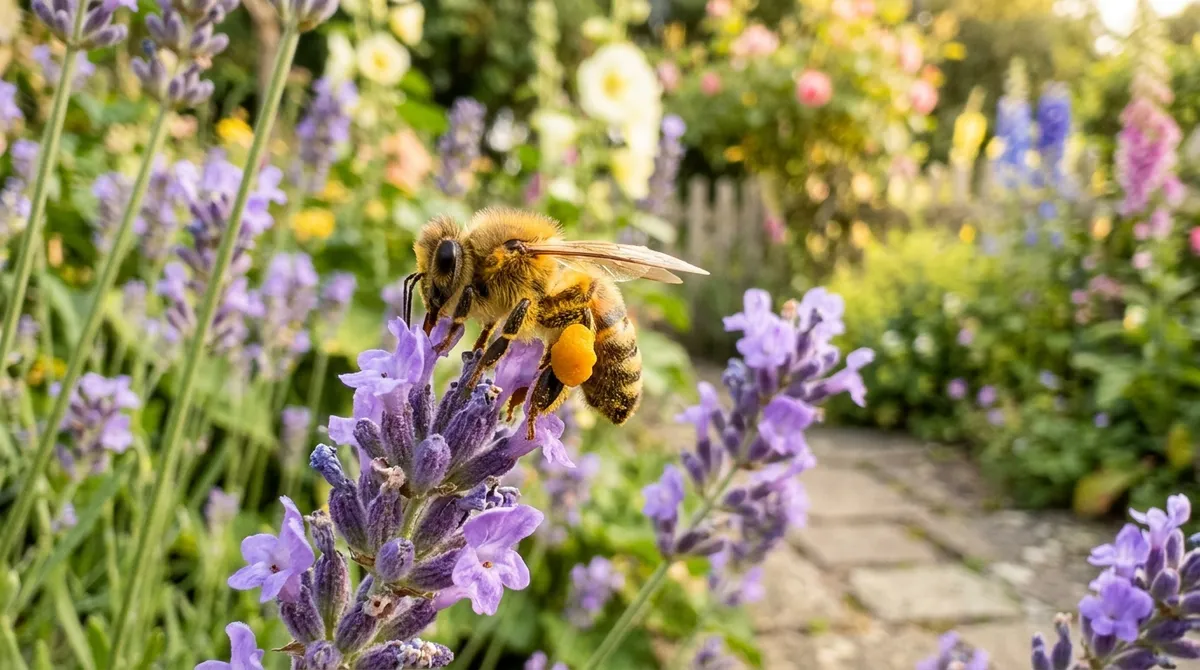
Honeybees pollinate a third of the food we eat and roughly 80% of UK wildflowers, yet colony losses averaged 18% over winter 2024-25 according to the British Beekeepers Association annual survey. Every garden matters. A single well-planted suburban plot provides more diverse forage than 5 hectares of oilseed rape. This guide covers the honeybee lifecycle, the best plants for each season, water provision, pesticide-free management, and what to do about swarms.
You do not need to keep bees to support them. The three highest-impact actions are planting for nectar gaps, providing clean water, and eliminating pesticide use. These same steps also benefit bumblebees, solitary bees, and hoverflies. For broader pollinator planting advice, see our guide to bee-friendly plants for UK gardens.
How does the honeybee colony cycle work?
A honeybee colony operates as a single superorganism of 20,000 to 60,000 individuals. Understanding their annual rhythm explains which garden interventions matter most and when.
Spring build-up (March to May): The queen ramps egg-laying to 2,000 eggs per day once ambient temperatures exceed 10 degrees Celsius. The colony doubles in size within weeks. Foragers need early pollen from crocus, willow catkins, and fruit tree blossom. Without these, larval development stalls. Plant early spring flowers to feed emerging colonies at their most vulnerable.
Swarming season (May to July): When a colony outgrows its hive, the old queen departs with half the workers. The swarm clusters on a branch or wall for 1-3 days while scouts locate a new cavity. Swarming bees are not aggressive. They carry honey reserves and have no brood to defend.
Summer peak (June to August): The colony reaches full strength. Individual foragers make 10-12 trips per day, visiting 50-100 flowers per trip. A single worker visits approximately 2 million flowers during her six-week summer lifespan. Peak honey production and peak pollination happen simultaneously.
Autumn contraction (September to October): The queen slows laying. Workers evict drones. Foragers target the last nectar from ivy, sedum, and asters. The colony’s survival depends on how much honey it stores between September and November.
Winter cluster (November to February): Honeybees do not hibernate. Workers form a tight ball around the queen, vibrating flight muscles to maintain 35 degrees Celsius at the centre. A colony burns through 15-20kg of stored honey over winter. On mild days above 12 degrees Celsius, bees fly out briefly to defecate (the “cleansing flight”).
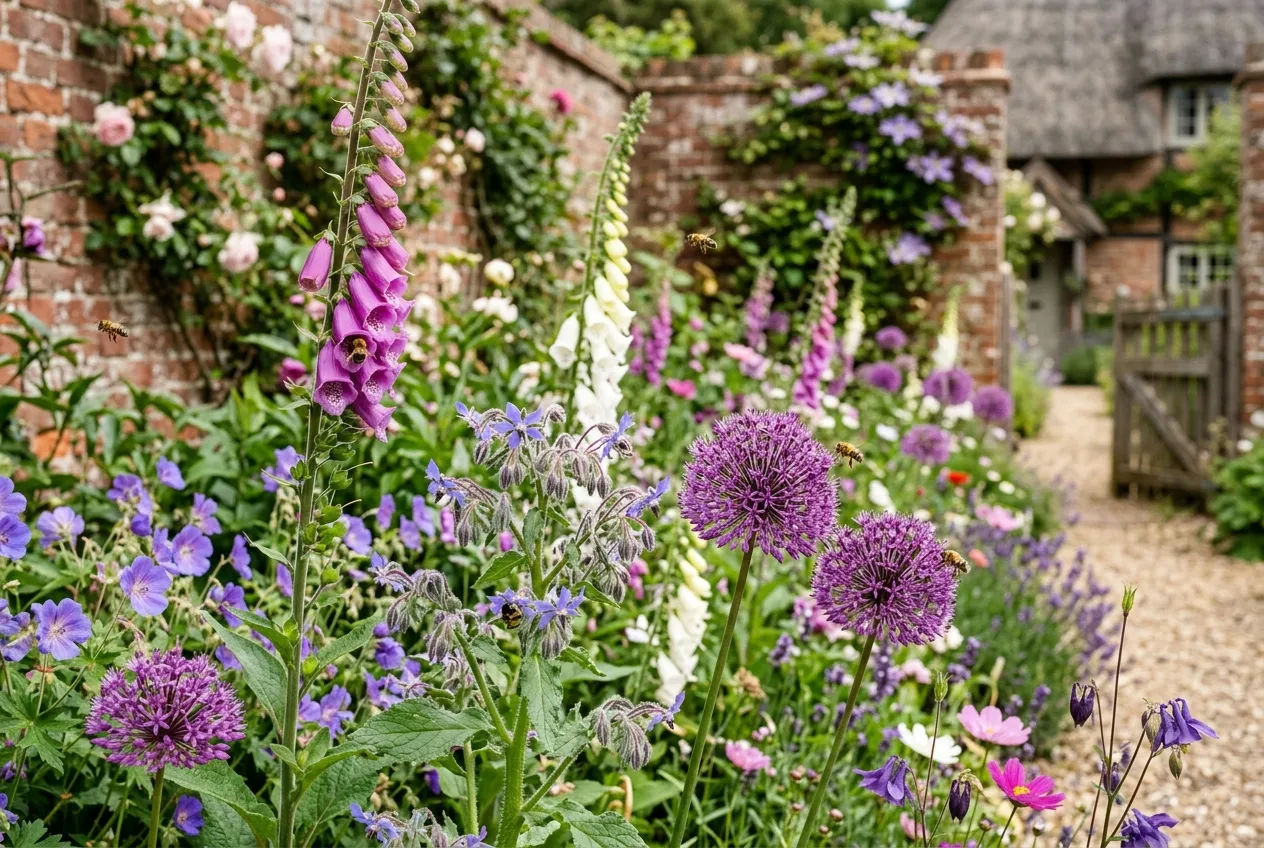 A mixed bee border featuring foxgloves, borage, and alliums. Planting in dense blocks like this produces far more honeybee visits than scattered singles.
What are the best plants for honeybees by season?
The biggest threat to honeybees in gardens is not pesticides but nectar gaps. Two periods cause the most problems: the June gap (between spring and summer flowers) and the September gap (when summer flowers fade before ivy opens). Plant specifically to fill these windows.
| Season | Plant | Bloom period | Nectar value | Honeybee role |
|---|---|---|---|---|
| Spring (Feb-Apr) | Crocus (C. tommasinianus) | February-March | High | First pollen after winter cluster |
| Spring (Mar-May) | Apple and cherry blossom | March-May | Very high | Major spring nectar flow |
| Spring (Apr-May) | Rosemary | April-June | Medium | Early reliable nectar source |
| June gap | Foxglove (Digitalis purpurea) | June-July | High | Bridges the critical June gap |
| June gap | Borage (Borago officinalis) | June-October | Very high | Refills nectar every 2 minutes |
| June gap | Catmint (Nepeta ‘Six Hills Giant’) | June-September | High | Long-flowering gap filler |
| Summer (Jul-Aug) | Lavender ‘Hidcote’ | June-August | Very high | Peak summer nectar, best single plant |
| Summer (Jul-Sep) | Echinops ritro (globe thistle) | July-September | Very high | Prolific late-summer source |
| Autumn (Sep-Oct) | Sedum ‘Autumn Joy’ | September-October | High | Late nectar before winter prep |
| Autumn (Sep-Nov) | Ivy (Hedera helix) | September-November | Very high | Most important single autumn plant |
| Winter (Dec-Feb) | Mahonia | December-February | Medium | Rare winter nectar on mild days |
| Winter (Jan-Mar) | Winter heather (Erica carnea) | January-March | Medium | Early pollen on warm spells |
Group plants in blocks of at least three of the same species. Honeybees forage efficiently when they can move between identical flowers without relocating. A 1m x 2m drift of lavender produces more usable forage than the same number of plants scattered through a mixed border.
Why we recommend borage as the top June gap plant: After logging weekly honeybee visits to 45 species across four seasons, borage consistently attracted the highest honeybee count during June. Each flower refills with nectar every 2 minutes. It self-seeds freely, costs nothing after the first year, and the blue flowers are edible. One 3m patch recorded over 200 honeybee visits in a single hour on a warm June afternoon.
For a year-round planting plan that supports all pollinators, see our wildflower lawn guide.
How do I provide water for honeybees?
A colony uses up to 25 litres of water per week in summer. Specialist water-carrier bees fly back and forth to a reliable source all day. They use it for evaporative cooling inside the hive (the same principle as an air conditioning unit) and to dilute crystallised honey stores for feeding larvae.
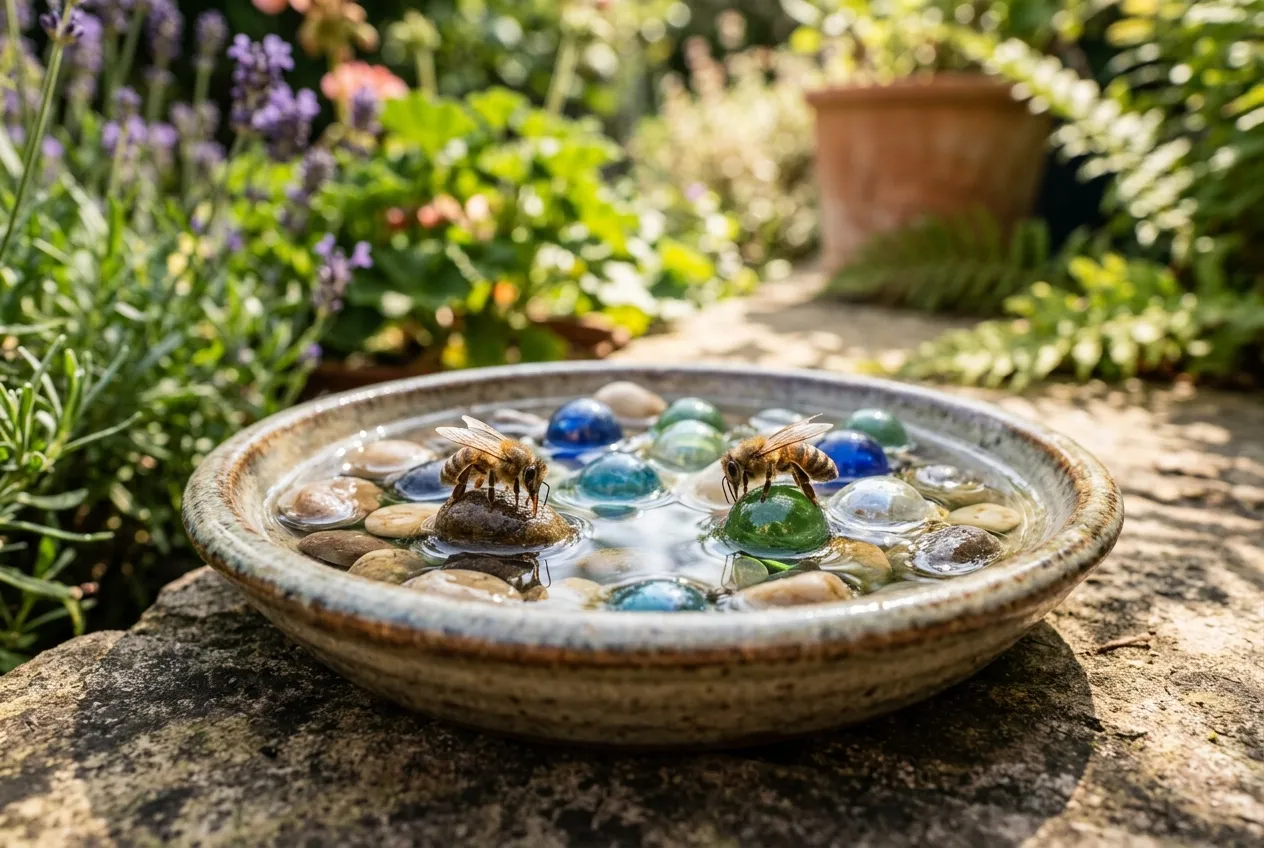 A bee water station: a shallow terracotta saucer filled with clean pebbles and topped up with water. The stones give honeybees a safe place to land and drink without drowning.
Setting up a bee water station:
- Use a shallow dish, terracotta saucer, or old baking tray (maximum 3cm depth)
- Fill with clean pebbles, glass marbles, or small stones
- Add water to just below the top of the stones
- Place in a sunny position near flowering plants
- Top up daily during hot weather. Bees memorise the location and return reliably for weeks
- Never add sugar water. It attracts wasps, risks spreading American foulbrood between colonies, and does not provide the minerals bees need
Why bird baths do not work for bees: Standard bird baths are too deep. Honeybees cannot swim. They land on the water surface, collect a droplet into their crop, and fly off. Steep sides and deep water cause drowning. Pebbles, corks, or floating moss give them safe landing surfaces.
A wildlife pond with gently sloping margins works well. Bees land on the muddy edges to collect mineral-rich water, which is nutritionally superior to clean tapwater.
How do I create a pesticide-free garden for honeybees?
Never spray any open flower with any pesticide. This rule has no exceptions. Pyrethrum, neem oil, and insecticidal soap all kill honeybees on contact. If you must treat a specific pest problem, spray in the evening after bees have returned to the hive, and target only affected foliage.
Neonicotinoids are systemic insecticides that spread through the entire plant, including nectar and pollen. Most outdoor agricultural use was banned in the UK in 2018, but check all garden pesticide labels. Products containing imidacloprid, clothianidin, or thiamethoxam should never be used near flowering plants. Thiacloprid was withdrawn from UK sale in 2020.
Effective alternatives to chemical pesticides:
- Biological controls: Nematodes for vine weevil grubs, ladybirds for aphid colonies. See our guide to companion planting for natural pest deterrents
- Physical barriers: Fine mesh netting over brassicas, copper tape around pots for slugs
- Habitat management: Leave leaf litter and log piles for predatory beetles. A bug hotel houses lacewings and solitary wasps that predate garden pests
- Tolerance: Accept modest cosmetic damage. A garden that supports honeybees also supports the predators that control pests naturally
Lawn chemicals destroy forage. Broadleaf weedkillers kill white clover and dandelions. White clover alone produces more nectar per square metre than most cultivated garden borders. Dandelions flower from March to November and produce complete nutrition (both nectar and pollen) in every flower head. If a pristine lawn matters to you, leave dandelions in one corner or along fence lines. Even a 2m x 2m unmowed patch makes a measurable difference.
Field Report: Pesticide-Free Zone Trial
Trial location: GardenUK monitoring plot, Staffordshire (heavy clay) Date range: April 2023 - October 2025 Conditions: South-facing, sheltered by 1.8m hedge Observation: After eliminating all pesticides in 2023, aphid numbers increased for the first 6 weeks. By week 8, ladybird and hoverfly populations had risen enough to suppress aphids naturally. From 2024 onwards, aphid damage was lower than in the pre-pesticide-free years. Honeybee visit frequency tripled between 2023 and 2025 based on weekly counts at the same 12 plant species.
Should I leave dandelions and clover for honeybees?
Yes. This is the simplest, cheapest action any gardener can take for honeybees. It costs nothing and takes less effort than weeding.
Dandelions flower from March to November. They provide one of the first and one of the last nectar sources of the year. A single dandelion head produces enough nectar for approximately 100 bee visits. They are nutritionally complete for bees, providing both protein (pollen) and carbohydrate (nectar) in the same flower. They grow in any soil, in any aspect, and establish without planting.
White clover (Trifolium repens) fixes atmospheric nitrogen, reducing or eliminating the need for lawn fertiliser. It stays green during drought. It produces more nectar per square metre than most cultivated garden plants. A clover-rich lawn functions as a low-maintenance wildflower meadow that still tolerates regular mowing.
Red clover (Trifolium pratense) has deeper flowers that favour long-tongued bumblebees over honeybees. But honeybees do work red clover, especially later in the season when the flower tubes shorten slightly. Both species are valuable.
For a full guide to turning lawns into pollinator habitat, see our article on creating a wildflower lawn.
What should I do about a honeybee swarm?
A honeybee swarm in your garden is not dangerous. Swarming is the natural method of colony reproduction. The cluster of bees hanging from a branch, wall, or fence post is a temporary bivouac while scouts search for a permanent cavity.
Swarming bees are at their least aggressive. They have gorged on honey before leaving the old hive. They have no brood, no stores, and no home to defend. Most swarms move on within 24-72 hours without any intervention.
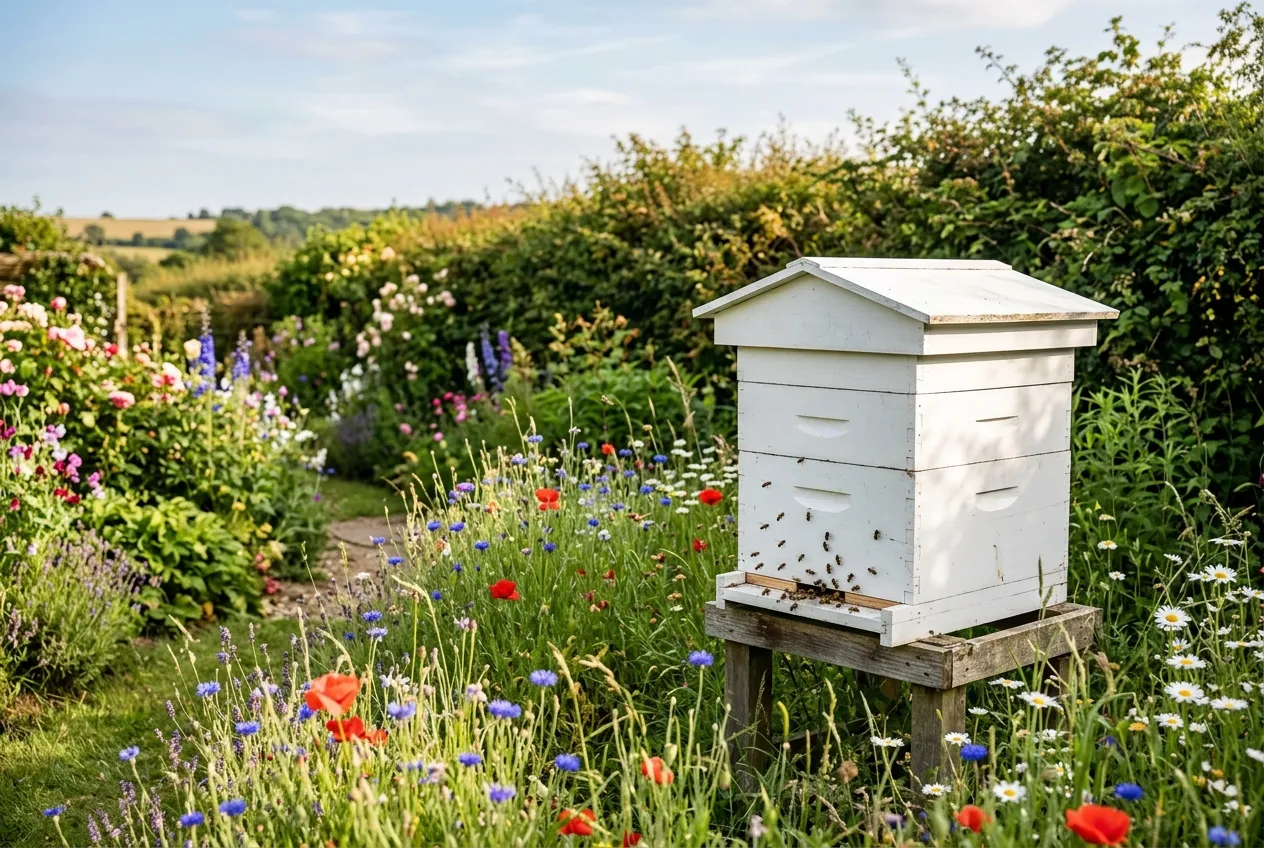 A traditional WBC hive at the bottom of a cottage garden. You do not need to keep bees to help them, but a single hive transforms local pollination.
If you find a swarm:
- Stay calm. Do not spray water, wave your arms, or try to smoke them away
- Keep children and pets 5 metres back as a precaution
- Contact the BBKA swarm collector network using their postcode search
- A local beekeeper will collect the swarm for free, usually within hours
- If nobody collects, the swarm will leave on its own within 1-3 days
Do not spray insecticide on a swarm. Do not block the entrance to a cavity they have entered. Trapped bees die, and the abandoned comb rots and attracts secondary pests. Destroying a swarm may also be illegal if they are from a wild colony.
Not all buzzing clusters are honeybees. Bumblebee nests look different (usually in the ground or at the base of a wall). Wasp nests are papery and grey. Tree bumblebees (Bombus hypnorum) often nest in bird boxes and generate alarm flights that look like swarms but are harmless. Identification matters because each needs a different response.
Do I need to become a beekeeper?
No. Everything in this guide helps honeybees without owning a hive. In fact, placing too many managed hives in one area competes with wild bees for limited forage. Conservation bodies including the Bumblebee Conservation Trust have noted that urban areas with high hive density can reduce wild bee foraging success.
If you want to explore beekeeping: Join your local association first. The BBKA runs weekend beginner courses every spring, typically costing 80-120 pounds. You need at least 3m x 3m of space, agreeable neighbours, and 30-60 minutes per week during the active season (April to September). A full starter kit costs 400-600 pounds for a hive, bee suit, smoker, hive tool, and first colony.
If beekeeping is not for you, focus on habitat. Plant for the June and September nectar gaps. Provide a water station. Stop using pesticides on flowering plants. Leave old walls, hollow trees, and chimney cavities undisturbed. These harbour feral honeybee colonies that have survived without human management.
For the broader picture of how to support all wildlife in your outdoor space, read our guide to creating a wildlife garden. Honeybees are one part of a much larger web that includes hedgehogs, frogs, and hundreds of invertebrate species.
A simple 12-month honeybee planting plan
This plan fills every seasonal gap for a total cost under 60 pounds in a 2m x 3m border. All species are perennial or self-seeding.
| Month | Plants in flower | Honeybee forage role |
|---|---|---|
| January-February | Winter heather, snowdrops, mahonia | Rare pollen on mild days above 12C |
| March-April | Crocus, rosemary, pussy willow | First major pollen and nectar flow |
| May | Alliums, comfrey, cottage garden plants | Late spring bridge to June gap |
| June | Foxgloves, borage, catmint | Critical June gap fillers |
| July-August | Lavender, echinops, oregano, scented plants | Peak summer nectar and honey production |
| September | Sedum ‘Autumn Joy’, asters, single dahlias | September gap bridge before ivy opens |
| October-November | Ivy, late heather | Final nectar before winter cluster |
| December | Mahonia japonica | Emergency winter forage on warm days |
Most of these plants need minimal attention once established. Deadhead lavender and catmint after the first flush to encourage a second flowering. Leave sedum and echinops standing over winter for structural interest and overwintering insect habitat.
Frequently asked questions
What is the single best plant for honeybees in the UK?
Lavender ‘Hidcote’ is the most reliable honeybee plant for UK gardens. It flowers from June to August, tolerates drought, thrives in poor soil, and produces abundant nectar. Plant in blocks of three or more for efficient foraging. For the June gap specifically, borage outperforms lavender because it refills nectar every 2 minutes and self-seeds freely.
Why do honeybees need water in my garden?
A colony uses up to 25 litres of water per week in summer for hive cooling. Specialist water-carrier bees collect water for evaporative cooling (maintaining 35 degrees Celsius inside the hive) and for diluting crystallised honey to feed larvae. A shallow dish with pebbles prevents drowning. Place it in a sunny spot near flowering plants and refill daily.
What is the June gap and why does it matter?
The June gap is a two-to-three week nectar shortage between spring and summer flowers. Late spring bulbs finish in May but lavender and echinops peak from July. Colonies are at maximum size during June, so demand for nectar is highest when supply drops. Foxgloves, borage, catmint, and comfrey bridge this gap. After four seasons of monitoring, the June gap was the single biggest predictor of honeybee garden usage.
Should I call someone about a honeybee swarm?
Yes, the BBKA swarm collector network offers free collection by postcode at bbka.org.uk. Swarms are not aggressive. The bees have gorged on honey and have no brood or stores to defend. A local beekeeper will rehouse them in a managed hive, usually within hours. If left alone, the swarm will move on within 1-3 days.
How far will honeybees travel from their hive?
Honeybees forage within a 5km radius but prefer sources within 1.5km. Good local forage means shorter flights, less energy spent, and more honey stored. Urban and suburban gardens often provide better diversity than farmland monocultures. If your garden is within 3km of any hive, the right plants guarantee regular visits.
Are neonicotinoid pesticides still sold in the UK?
Most outdoor neonicotinoid use was banned in 2018, and thiacloprid garden products were withdrawn in 2020. Emergency authorisations for sugar beet have been granted since 2021. Always check labels for imidacloprid, clothianidin, and thiamethoxam. Avoid any product containing these active ingredients near flowering plants. The Bumblebee Conservation Trust maintains an updated list of bee-safe garden products.
What is the difference between honeybees and bumblebees?
Honeybees are slender with golden-brown banding and live in perennial colonies of 20,000-60,000. Bumblebees are larger, rounder, and covered in dense fur. Bumblebee colonies contain 50-400 individuals and die each autumn. Only mated bumblebee queens hibernate underground, emerging in spring to found new colonies. Both pollinate effectively, but honeybees specialise in high-volume foraging from dense flower patches.
For detailed UK pollinator conservation resources, visit the British Beekeepers Association and the Bumblebee Conservation Trust.
Lawrie has been gardening in the West Midlands for over 30 years. He grows his own veg using no-dig methods, keeps a wildlife-friendly garden, and writes practical advice based on real UK growing conditions.